Integrated Link Level
and
Circuit Level Simulation
of
Mobile Communication Systems
J
eyhan Karaoguz
Center for Communication and Signal Processing
Department of Electrical and Computer Engineering
North Carolina State University
Raleigh, North Carolina
.
November 1989
KARAOGUZ, JEYHAN. Integrated Link level and Circuit Level Simulation of
Mobile Communication Systems. (Under the direction of Michael B. Steer and
Sasan H. Ardalan)
This thesis discusses the development of a simulation environment for the
anal-ysis and design of RF communication systems from the link level down to the
nonlinear RF circuit level. The integrated simulation environment supports block
diagram representations, multirate sampling, and an interactive graphical user
in-terface. It enables the incorporation of sophisticated user models of individual
blocks, in a mixed time-domain and frequency-domain environment.
The simulation of a multi-channel mobile communication system is presented.
The integrated link level and circuit level simulation environment is used to
de-termine the large-signal nonlinear distortion effects such as harmonic distortion,
intermodulation distortion and spurious noise which are due to the RF receiver
front-end. Also presented are the results of large-signal distortion effects on the
adjacent channel interference and signal to noise ratio.
Finally, the simulation results are compared to measured receiver front-end
Table of Contents
1 Introduction
1.1
1.2
Motivation For This St udy
Thesis Overview .
...
...
1
1
2
2 Review of Computer-aided Techniques for Communication
System Analysis and Design 5
2.1 Discussion of Terms: Modeling, Simulation, and Simulation Model 5
2.1.1 The Aid of Simulation Modeling in Communication Systems
Analysis and Design
2.2 Review of Previous Work .
Discussion and Conclusion . . . . 2.3
2.2.1
2.2.2
2.2.3
Computer-aided Analysis and Design Techniques.
Simulation Based Methods . . . .
Communication System Modeling
6 7 8
10
14 193 Integrated Simulation Environment Design
3.1 Introduction .
21
21
3.2 General Structure and Functions of the Integrated Simulation
Environment . . . 22
3.2.1
3.2.2
Link level Simulation: CAPSIM . .
Circuit Level Simulation: FREDA
23
3.3 Summary · . · · · ·
4 The Simulation System: Mobile Communications
33
34
4.1
4.2
4.3
Introduction. . . · · · ·
Technical Problems in Mobile Communication Systems ·
4.2.1 Link level Impairments . . . .
4.2.2 Circuit Level Impairments.
Description of Mobile Communication System.
34 35 35 36
38
4.3.14.3.2
Description of Link Level .
Description of Circuit Level
38
41
5 Methodology and Implementation of Mobile Communication
System Simulation
5.1 Introduction . . .
43
43
5.2
5.3
Simulation Procedure
Functional Description of the Simulation Example
43
46
5.3.1
5.3.2
5.3.3
Transmitter Galaxies. . . .
Transmission Medium Galaxy.
Receiver Galaxy .
46
48
50
6 Simulation Results and Discussion 53
6.4 Noise Distortion .
6.5 Adjacent Channel Interference
6.2
6.3
6.6
Harmonic Distortion . . . .
Intermodulation Distortion
IF Spectrum for 29 Incommensurable Input Frequencies
54
58
65
72
80
RF Power vs. IF Power Measurements
7 90 kHz Experiment
7.1 Introduction . . .
7.2
7.3
7.4
7.5
Experimental Setup
Noise Measurements . . . ·
Conclusion and Discussion ·
...
82
82
82 8789
93 8 Conclusion Discussion .Suggestions for Further Study
8.1
8.2
8.3
Summary
. .
.
. . .
. .
.
.
.
.
.
.
.
.
.
. .
.
.
.
.
.
.
.
.
.
.
.
.
.
...
9696
97 99 References 101 Appendices 106A Detailed Software Structure of Integrated Simulation Environment 106
A.I
A.2
Introduction . . .
CAPSIM Software
...
...
106
A.4 Interface.
109
B User's Guide
.
.
...
113
B.1
Introduction113
B.2 CAPSIM Environment .
...
113
B.3 FREDA Topology
120
B.4 Terminal Session
...
124
Introduction
1.1
Motivation For This Study
Digital communications and computers are having a tremendous impact on the
world today. The number of technologies available for providing a given service is
growing daily, covering transmission media (microwave and coaxial cable
transmis-sion, optical communication via fibers and space satellite transmission), devices
(GaAS and silicon devices and VLSI circuits), and software (protocols, system
ad-ministration, diagnostics, and maintenance). The resulting design, analysis, and
optimization of performance can be very demanding and difficult.
Many computer-aidedtechniqueshave been introduced in recent years to assist in the modeling., analysis, design and testing of communication and signal
process-ing systems. Although there have been significant developments in computer-aided
modeling, analysis, and design of communication systems, there are still some
es-sential issues which ·have not been addressed strongly or not at all. One of the
important issues is the amalgamation
[1]
of several levels of a system into a singleaffect the performance of others, and sometimes it is extremely difficult to isolate
a part of the system from the others except in some oversimplified cases.
The problem of estimating the performance of the circuit level in the presence
of all link level sources of impairments such as inter- and co-channel interferences,
up- and down-link noise
[2]
necessitated the design of an integrated simulationenvironment. The objective of this study is the development of such an integrated
simulation environment concept. In particular, the study presents a multi-channel
mobile communication system simulation to verify the operation of the proposed
integrated simulation environment.
The following section provides an overview of the organization of this thesis.
1.2
Thesis Overview
Chapter 2 presents a thorough literature review of the computer-aided techniques
for communication system analysis and design. Different level simulation tools are
described and their performances are evaluated. Another purpose of this review
section is to familiarize the reader with the large amount of terminology used in
this area, and place the proposed simulation environment into the proper category.
Chapter 3 is devoted to the development of the integrated simulation
environ-ment. The different level simulators, CAPSIM and FREDA, which were used to
concepts and procedure in interfacing FREDA into CAPSIM are given. The
fea-tures of the integrated simulation tool are summarized briefly at the end of that
chapter.
Chapter 4 explains the reasons for choosing mobile communication systems as
the simulation example. The technical problems which make the mobile
communi-cation systems challenging for design and analysis purposes are presented. Finally,
the chapter ends with the detailed description of the general mobile
communica-tion system at the link and circuit level.
Chapter 5 focuses on the implementation of the simulation example. After
the introduction of the simulation procedure, the functional descriptions of the
individual blocks which build up the system are given. The incorporation of the
link level and circuit level impairments into the operation of functional blocks is
presented.
Chapter 6 presents the results of the simulation example implemented in
Chap-ter 5. The results include the harmonic and spurious response of the nonlinear RF
mixer circuit, intermodulation distortion, adjacent channel interference and noise
distortion. Along with the .results, the large signal nonlinear distortion effects of
the link level impairments on the RF circuit level are discussed.
Chapter 7 presents the 90 kHz receiver front-end experiments. First the
exper-imental setup is introduced. Then the results for conversion loss (RF powerVB. IF
Chapter 8 contains the summary, conclusion and suggestions for future study.
Appendix A presents the detailed software structure of the integrated
simula-tion environment. The user's guide for the simulasimula-tion tool is given in Appendix
B. The C-programming codes for the stars (building blocks) are provided in
Chapter
2
Review of Computer-aided Techniques for
Communication System Analysis and Design
2.1
Discussion of Terms: Modeling, Simulation, and
Simulation Model
Before starting the review section, we would like to clarify and discuss the meanings
of the terms modeling, simulation, and simulation model since these terms are
frequently used throughout the thesis.
Modeling and simulation have been practiced ever since there were difficult
problems to solve and complezobjects to describe. Modeling can be simply defined as creating any abstract representation of something or some activity short of the
real thing or the thing-to-be. For example, a model can be a mental picture or
concept, a sketch, a description, a set of plans, a set of mathematical equations,
a computer program, a pattern, etc. It is a means by which something which
is modeled can be explained, expressed, presented, or studied. Simulation, as
defined by Webster's, is "the act or process of giving the appearance or effect of".
Thus, in general, the two terms modeling and simulation are quite synonymous.
sense one may say that simulation is a process by which model( s) of something or
an activity is exercised or stimulated to produce the effects (on certain objects)
similar to or relatable to that of the real object or activity. It is also in this rather
limited sense that the term simulation model is used - a model specifically built
for simulation.
2.1.1
The Aid of Simulation Modeling in Communication
Systems Analysis and Design
The complexity of communication and signal processing systems has grown
con-siderably during the past years. As the growth in the subtleness of the system
has increased, the analysis and design have become demanding and difficult. Also
the rapid emergence of the new technologies has made many existing products
obsolete and therefore has created a competitive market for new products. This
aspect of technology requires engineers to design new products in a timely, cost
effective, and error free manner. These demands can be met only through the use
of powerful computer-aided analysis and design (CAAD) tools [3].
A large body of computer-aided techniques have been developed during recent
years to assist in the process of modeling, analyzing, designing and testing
com-munication and signal processing systems. Each of them has its own approach
both analytical and simulation, to guide the analysis and design throughout the
life cycle of a system [4]. Performance evaluations and tradeoff analysis are the
central issues in the design of communication networks, links and circuits.
Dig-ital simulation provides a useful and effective means to direct analytical
evalu-ation of communicevalu-ation system performance. Indeed there are many situevalu-ations
where explicit performance evaluation defies analysis and meaningful results can
be obtained. only through either actual prototype hardware evaluation or digital
computer simulations [4].
The interactive nature of different levels - network, link, circuit and signal
processing level - make the design and analysis of communication systems a
chal-lenging task for engineers. Therefore in the communications industry, designers
are looking into means to analyze the whole communication system interactively.
The top-down analysis of communication systems is essential because the
perfor-mance and response of the circuit level strongly depend on the network or link
level, and vice versa. Except for some idealized and often oversimplified cases, it is
extremely difficult and time consuming to find analytical or closed form solutions
to this aspect of the system.
2.2
Review of Previous Work
In this section, computer-aided modeling, analysis, design and simulation tools
performances of these CAAD tools are evaluated.
2.2.1
Computer-aided Analysis and Design Techniques
Computer-aided techniques for system analysis and design can be divided into two
categories
[5] :
• Formula Based Approach - In this approach, computer is used to solve sets of equations in finding closed-form solutions .
• Simulation Based Approach - In this case, computer simulates voltage and current waveforms or signals that flow through the system.
The basic distinction between the two is that formula-based models are
im-plemented as mathematical expressions that are usually oriented towards some
measures of merit (e.g., performance), whereas simulation models are designed to
emulate functions and are oriented towards stimulus and response (e.g.,
input-output signals). Both of these approaches have unique sets of advantages and
disadvantages. These are further discussed as follows.
The formula-based model [6] requires only a suitable mathematical model to
represent, for instance, the performance of a receiver subsystem such as the
demod-ulator/detector. The advantages [5] of -the formula-based or so called analytical
i)
numerous previous results can easily be utilized.ii) computer implementationis usually quite straight forward and efficient
with-out requiring a great amount of computer storage.
iii) computation time is generally short and, hence easily accommodated.
The major disadvantages of the analytical modeling approach are the lack of
flex-ibility in representing different implementation methods, and the limited depth or
accuracy of the system which depends on the adequacy of the analytical
descrip-tion. Also, the formula-based mathematical techniques require that the system
models be simple, thus serving to broadly explore the design space.
II: .he simulation modeling approach, the same demodulator/detector as
men-tioned above would have to be numerically represented and implemented. In effect,
the numerical implementation would be closely equivalent to actual hardware
im-plementation. Given the required numerical model, a simulated numerical input
signal(s) could be applied to the simulated demodulator/detector. The
advan-tage of this approach is that the simulated demodulator/detector could be used
again and again to generate and evaluate the responses to different input signal
characteristics. Additionally, the simulation approach does not require a priori
information about the received signal vector. With simulation-based techniques,
systems can be modeled to any arbitrary level of detail, and hence the design
space can be explored more finely. The major disadvantage, however, is that a
ongo-disadvantages of the simulation modeling approach.
Based on the above observations, the best approach would be to structure
the simulation software primarily to support the simulation modeling approach
with enough flexibility to support the incorporation of analytical models. As
an example,
CLASS [7,8]
uses a combination of waveform level simulation andformula-based analysis for evaluating the performance of satellite communication
systems. Although, these two different techniques are complementary in that many
simulation based techniques now incorporate formula based results to reduce the
computational burden, the simulation based approach has become the primary
tool for modeling and analyzing complex communication systems, and therefore
is the subject of this thesis.
2.2.2
Simulat'ion Based Methods
The simulation based methods have gone through different phases throughout their
existence. The aspects that have changed are their approaches to communication system simulation, the languages of simulation packages, and the host computers
used.
First, an examination of the different approaches to communication system
simulation shows that in the early days, users wrote individual programs to
design [3]. These programs were typically executed on a main-frame computer in a
batch mode, and the simulation output consisted primarily of numbers and tables.
A considerable portion of the engineer's time was spent in writing and debugging
the programs rather than on modeling and analysis [3]. Block-oriented approaches
to modeling and simulation such as MIDAS, SCADS, and CSMP [9,10,11] were
developed in the early 1960's for digital simulation of analog systems. This
ap-proach eliminates the need for the user to write simulation code. Block-oriented
simulations draw their motivation from the analog block diagram as a simple and
convenient way of describing continuous systems [12]. Advances in discrete-time
systems and signal processing have led to new approaches for digital
communi-cation system simulation. Software packages for simulations based upon
trans-form domain techniques (FFT for frequency domain and biliniar-Z transtrans-form for
time domain techniques] began to emerge in the late 1960's and early 1970's.
S}TSTID [13,14], CMSP, CHAMP [15,16], LINK [17] and others [18,19] were
developed in this time frame. The state of the art block-oriented simulators, such
as BLOSIM IC AP51M [20,21] and BOSS [22], provide an interactive framework
for simulation-based analysis and design of communication systems with
capabili-ties to 1) develop simulation models in a hierarchical fashion using graphical block
diagram representations,
2)
configure and execute waveform level simulations, 3)review the results of simulations, and 4). perform design iterations.
level languages such as FORTRAN etc. Unfortunately, those higher level languages
lack the opportunity
[4]
to allow input via block diagrams which is an essential partof the block-oriented approach. Therefore today's software simulation packages
tend to have a pre-processor to a lower level language. This approach lends itself
to portability and frees the user from having to know the details of the underlying
operating system and the hardware configuration of the simulation facility. The
pre-processor STARGAZE
[23]
of CAPSI11 is an example of the state of the art.Finally, the host computer environment has changed as the computer
hard-ware advanced. In the early days, circuit and control analysis softhard-ware tools (e.g.,
ECAP, SCEPTRE, AIIMIC
[14])
or analog computers were used to simulatecer-tain systems in the time domain. However, both methods had serious drawbacks,
including excessive computer run time and step-up complexity. This was
particu-larly true when addressing complicated problems involving performance analysis
measurements, such as noise power ratio, and when simulating systems with low
bit error rates. In the past ten years, computer hardware and software have
un-dergone significant changes. Powerful workstations such as the
SUN, APOLLO,
VAX
workstations arid personal computers like theIBAfSy~tem! and Macintosh. ~offer friendly computing environments with highly visual and graphical user
inter-faces. Considerable effort is currently directed towards developing intelligent and
workstations as well as PC technologies
[12].
Two examples of simulation packagesthat take full advantage of the hardware/software environments offered by
work-stations are CAPSIM
[21]
and BOSS[22].
These provide an interactive frameworkfor simulation-based analysis and design of communication systems with the
ca-pability for developing simulation models in a hierarchical fashion using graphical
block diagram representations. For many applications, PC's are preferred because
they not only provide sufficient power for simulation- based analysis and design of
communication systems, but they are also low cost and provide complete control
over the simulation environment since they are rarely a shared resource. Some
examples of PC-based software packages are the PC version of lCS
[24]
denotedas ll'eS, and
uooeu
[25].
Numerous simulation packages have been introduced, serving different levels of
the communication systems. Desirable features of a simulation package are defined
as follows
[12] :
• Modular Structure - In order to provide maximum flexibility, simulation
packages used to aid communication system analysis and design should have
a modular structure.
• Simulation Programming Language - Fortran, Pascal, or C do not allow
input via block diagrams. Therefore a pre-processor simulation language is
needed, or object oriented languages such as C++ and objective C may be
age should permit the design engineer to connect the functional blocks in
any desired topological interconnection, providing maximum flexibility.
• Model Library - The usefulness of a simulation package depends heavily on the availability of a model library containing many models of various
functional blocks that make up transmission systems and networks.
• Time and Event Driven Simulation - For maximum flexibility, provisions should be made for both time driven and event driven modes of processing
so that event driven blocks can be used interchangeable with time driven
blocks.
• User Interface - Finally, the whole simulation package should be made user friendly.
2.2.3
Cornmunication System Modeling
For the simulation of communication systems, it is convenient to model the system
using three lavels as in Fig. 2.2.1.
The network level [26] is made up of switches (nodes), mtiltiplexers, and
con-centrators connected by means of transmission systems. The transmission link is
composed of communication media (transmission channel and noise), modulators,
NETWORK LEVEL
LINK LEVEL
CIRCUIT
AND
SIG. PROC. LEVEL
Figure 2.2.1: Hierarchy of CAAD Tools
mixers and other circuits.
Network Level CAAD Tools
Network level CAAD tools are based on computer aided analytic techniques,
sim-ulation, or emulation. In the first two techniques, which are sometimes combined,
the network performance is evaluated using abstracted functional models [27]. In
the third technique, the user specifies the network protocols in great detail [28],
often supplying an actual program implementing the protocol, and these protocols
are then simulated. Tools in this category are called emulators or iestbeds [3].
proto-techniques or tables are used to specify the nodes and interconnecting links. The
modeling of the protocols involves specifying the data structures and the rules that
govern the flow and modifications to the data structures. Three broad approaches
are currently being used for this. The first approach consists of graph based
mod-els such as finite state machines, and petri-nets. These modeling approaches are
typically used for protocol specification and validation. The second modeling
ap-proach uses an extended queuing paradigm. This model is suitable for analytic
solution of network performance obtained via queuing theory. In the third class
of models, the protocol functions are specified as a collection of interacting
proce-dures. This approach is based on the fact that network protocols are algorithmic
in nature, and a signal flow type block diagram can express the algorithmic nature
of protocol functions clearly.
In network level CAAD tools, event driven simulation is used, since network
functions process packages of data such as arrival and departure of messages,
occurrences of transmission errors, etc
[12].
Several simulation based CAAD toolsfor communication networks are available. BONeS [29] is an example in this
category.
Link Level CAAD Tools
Whereas network level CAAD tools use event driven simulations, link level CAAD
a signal flow block diagram form where each block performs a functional operation
like modulation, coding, filtering, etc. The simulation approach consists of
gener-ating sampled versions of all the input signals, processing them through functional
blocks in the model, generating sampled values of the output signals and analyzing
them to extract performance measures. At the link level, the end-to-end
perfor-mance [26] is measured in terms of waveform distortions, output signal-to-noise
ratios, and error probabilities as a function of link level parameters such as filter
bandwidths, power levels of input signals and noise, operating point of amplifiers
and nonlinear circuits, and so forth.
Systems and signals are represented in the discrete time domain using sampling,
and bandpass signals are usually represented by their complex lowpass equivalents
[30]. Monte-Carlo techniques [31,32,33] are used to handle random variations in
signals and systems and simulation is run long enough to accumulate enough
sam-ples to obtain statistically valid estimators of performance measures. However the
computational burden of Monte Carlo simulations is considerable. For example,
if Monte Carlo simulations are used to estimate the unknown error probability in
a digital communication link, several million symbols will have to be processed
during the simulation in order to obtain statistically accurate estimators of low
probability (on the order of 10-6
) [26]. The processing time for this may approach
the order of several hours to days. A number of techniques are currently being
Circuit and Signal Processing Level CAAD Tools
One of the primary areas in which engineers are most involved is circuits. Until
now, many software packages have been introduced such as SPICE [35,36] and
FREDA [37]. The basic difference between link level and circuit level simulation
packages is that link level CAAD tools are generally simulation environments for
time driven waveform simulations whereas circuit level CAAD tools are based on
solving a set of linear or nonlinear differential equations resulting from application
of Kirchoff's voltage law and Kirchoff's current law using constitutive relations
(i.e., the element characteristics). The methods for circuit level simulation may
be characterized into three groups by the way in which the circuit elements are
treated: Time Domain Methods, Hybrid Methods, and Frequency Domain Method»
[37].
In time domain methods both linear and nonlinear elements are analyzed in
the time domain. The numerical integration of the circuit parameters is used. The
time domain methods are useful if the transient response is desired but inefficient
when the circuit has widely varying time constants or the signal is widely separated
in frequency. A widely used time domain circuit simulator is
SPICE
[35,36]. Thehybrid methods use time domain analysis for the nonlinear elements, and frequency
domain analysis for the linear elements [38,39]. These methods directly calculate
the entire circuit is analyzed in the frequency domain without transformations
between the time and frequency domains. FREDA is an example of a frequency
domain circuit simulator [37].
The availability of low cost/high speed signal processing hardware has allowed
the increasing use of digital signal processing in many areas. With the drive
towards all digital communication networks, significant portions of the
communi-cation systems use complex signal processing techniques, and an increasing need
exists for CAAD tools which can aid in the design of these systems. Many of the
currently available signal processing simulation tools perform analysis and design
of only specific DSP algorithms and functions, such as FIRand IIR filtering. One
of the few examples in this category is SPW(Signal Processing Worksystem)
[3].
2.3
Discussion and Conclusion
In this chapter, computer-aided design, analysis, and simulation tools for
commu-nication networks, links and circuits were surveyed.
There is no doubt that the complexity of modern communication systems
whether they are at the link, network or circuit level, require an extensive use
of
CAAD
tools. While simulation is a very powerful tool for the analysis anddesign of communication systems, it imposes some problems to be addressed as
well.
coded communication systems operating at low error rates may take several
hours of cpu time .
• The development of an expert ~Y3temfor simulation based de3ign - At the present time simulation is primarily used as an analysis tool, with the
engi-neer making heuristic choices for design iterations on a trial and error basis
which is time consuming and inefficient.
• The integration ofsimulation tools - There is a lack of integration between simulation tools within and between the various levels of the hierarchy shown
in Fig. 2.2.1. There is a considerable amount of "hand transfer" of data
be-tween various CAAD tools which is the cause of numerous design errors and
delays. An integrated environment for CAAD tools is essential for improving
productivity and minimizing costly errors.
In this thesis, we are going to deal with the latter problem and present a
simulation environment which integrates different level CAAD tools, namely, the
link and circuit level. The practical use of this integrated simulation environment
Chapter
3
Integrated Simulation Environment Design
3.1
Introduction
Conceptually, the need for amalgamating the link level simulation with that of
the nonlinear RF circuit level led to the design of an integrated communication
system simulation environment. The main goal for this integrated environment
is the development of an hierarchical approach to simulation which permits the
use of multiple tools within the environment and a hierarchy within each level
of the system as well. A simulation tool at an intermediate level accepts data
from the lower level modules and provides data to the models used in the next
higher level. By loosely integrating the simulation tools at successive levels in
the hierarchy through a flexible interface, an integrated environment has been
achieved for the simulation and design of communication and signal processing
systems. Also considered were the provisions for merging different circuit level
Simulation Errvir-onrnent
The integrated simulation environment is a mixed time domain and frequency
domain simulator. Mostly frequency domain processing has been employed in the
simulation environment. Frequency domain processing is more advantageous for
linear functional blocks such as filters. It permits the use of measured values of
filter characteristics such as amplitude and phase response [4].
The sampling rate is an important issue in communication system simulation.
Especially for RF communication systems, the baseband signal can be many
or-ders of magnitude lower than the frequency of the RF signal. This has led to the
complex envelope representation of signals and baseband equivalents of
subsys-tems to reduce the sampling rate [30,40,41]. However, when we are dealing with
nonlinear systems, this technique is inappropriate since nonlinear characteristics
involved in the frequency translation from RF to baseband are not captured. By
the same token, any functional operation such as filtering or passing the signal
through a nonlinear transmission medium has different effects on the baseband
signal than it would have for the RF signal. This characteristic of the system
precludes using the complex envelope and baseband equivalent representations of
the bandpass signals. In time domain analysis, a remedy seems to be to increase
the sampling rate, but this is very inefficient. For the proposed integrated
for bandpass signal processing. What is meant by representing the bandpass
sig-nals in frequency domain is that only the RF frequency part of the spectrum is
retained since the spectrum elsewhere is redundant. Accordingly, all functional
blocks process the RF signal spectrum at this RF carrier related frequency.
The designed CAAD tool can be divided into two parts, i.e., CAPSIM (link
level simulator) and FREDA (nonlinear RF circuit level simulator). CAPSIM and
FREDA have different approaches to simulation since they are dealing with
differ-ent levels of the system. The integrated simulation environmdiffer-ent is the appropriate
interface of FREDA to CAPSIM. Before proceeding with the interface procedures,
next two sections describe CAPSIM and FREDA.
3.2.1
Link level Simulation
CAPSIM
CAPSIM
[21]
is a complete interactive simulation environment for the design andanalysis of communication systems. The integrated environment includes the
ca-pability to design models, subsystems, and systems in a hierarchical fashion using
block diagrams. CAPSIM is a refinement and extension of the time-driven block
diagram simulator BLOSIM [20]. The BLOSIM simulator was chosen because of
its hierarchical block orientation and many other desirable features; however it has
the drawback of being text oriented. CAPSIM was designed to allow BLOSIM to
be used much more easily and efficiently.
op-to specify the design in a hierarchical manner using block diagrams which are
fa-miliar to system designers. CAPSIM provides a complete interactive environment
for communication system design and engineering. The integrated environment
includes the capability of defining blocks and models in a hierarchical fashion,
configuring and executing a simulation, reviewing the results of simulation, and
performing design iterations. Each of these capabilities is controlled through a
user interface using interactive graphical techniques.
CAPSIM is essentially a time-driven simulator and each block is polled at each
sampling instance. Multirate sampling techniques enable the simulation of many
systems whose blocks have different bandwidths.
CAPSIM Approach
Philosophically, CAPSIM is closest in approach to writing a special-purpose
sim-ulation program, and offers similar advantages of efficiency and generality. At the
same time it overcomes the deficiencies of many special-purpose simulation efforts
by providing a structured environment for programming simulations. This
struc-tured environment encourages the programmer to use highly strucstruc-tured
program-ming techniques, but without requiring any prior familiarity with these techniques.
This means that CAPSIM frees the user from having to contend with simulation
house-keeping duties. Instead, the u~er may concentrate on the functions of the
divi-dends. First it encourages the writing of simulation code for small pieces of the
system being simulated, and this code is written to a single carefully defined
in-terface. As a result libraries of routines, re-usable in future simulations, can be
developed. Second, multiprogrammer simulation efforts become relatively painless
since routines written by different programmers readily interface to one another
[20].
The terminology that is used in CAPSIM in describing the different types of
blocks is, as in BLOSIM, modeled after cosmology: A block which is elementary
or atomic in the sense that it is implemented directly by a user-provided routine is
called a star. A block which is defined as a connection of other blocks, on the other
hand, is called a gala:vy. Finally, a special galaxy is defined which encompasses
the entire systems, and which therefore has no inputs or outputs. Such a galaxy
is known as the universe. By definition, unlike all other blocks, the universe
can only have a single instance. The cosmology of blocks differs from ordinary
cosmology in that a galaxy need not contain exclusively stars, but rather can
contain other galaxies. There is no limit on the nesting of galaxies
[20].
The Pre-processor
A star consists of code written in pseudo C-code. The statements themselves are
legal C operations, but the star is not an executable C-program. Before the star
can be used, it must be passed through the stargaze pre-processor which produces
pre-pseudo C-code into an ordinary C-program. The user can easily define new stars
to perform almost any function of interest. To facilitate the introduction of a new
star into CAPSIM, a pre-processor called pre-capsim has been designed. This
pre-processor creates the object code for the star, and after leaving a COPJTof this code in an individual user library, links this code with the remainder of the object
modules related to CAPSIM. The result is the creation of a customized version of
CAPSIM which contains only the stars needed by that specific user. This allows
different users to have their own customized version of CAPSIM, containing the
stars necessary for their individual simulations.
Simulation Configuration
CAPSIM supports a hierarchical definition of blocks. That is, it is simple to define
new blocks which are made up of specified interconnections of other blocks. In
subsequent simulations, these higher level blocks are indistinguishable from blocks
implemented directly by a user program. In addition, multiple instances of blocks
are supported. That is, the same block can appear as many times as desired in
a given simulation (usually its functionality is specified by setting different values
for its parameters). This is particularly convenient for simulation systems which
have a replication of similar or identical functions (for example a systolic array of
or a system with multiple filters). CA,PSIM also makes many consistency checks
user programming errors. The scheduling of the order of execution of the blocks
in the universe is done without regard to whether the blocks are stars orgalaxies.
All the blocks are examined to find any which have no inputs. These blocks are
scheduled to execute in arbitrary order. At step k, all the blocks which have not
been scheduled in steps 1throughk-l are examined to find any which have inputs connected exclusively to blocks which have been scheduled in steps 1 through k-l.
Blocks satisfying these criteria are scheduled next in arbitrary order. These steps
are repeated until all blocks within a universe have been scheduled.
A user defined topology is constructed by selecting blocks from the menu
and placing them on the work space. As each block is selected, the user will
be prompted for parameters if needed.
The Post Processor
The results of simulation are displayed using signal plotting and processing
tech-niques. The outputs of the simulation may be sent to a text file for manipulation
by another program or can be used as inputs to subsequent CAPSIM simulation.
The post processor uses the same interactive graphic interface to allow the user
to select signals from the block diagram for display and manipulate the plotting
FREDA is a nonlinear RF circuit simulator described in [37] and [42]. Although
the methods for analyzing nonlinear RF circuits are varied, they are all based
on solving a set of nonlinear differential equations resulting from application of
Kirchhoff's voltage law and Kirchhoff's current law using the constitutive relations
(i.e., the element characteristics). The methods fall into three groups according to
the way in which the nonlinear elements are treated: time domain methods,
hy-brid (harmonic balance) methods, and frequency domain methods. Time domain
methods analyze the nonlinear circuit by solving the nonlinear differential
equa-tions governing the circuit in the time domain using a method related to numerical
integration
[43].
They are generally regarded as unsuitable for RF and microwavecircuit analysis. Microwave and RF circuits typically have widely separated time
constants resulting in a set of stiff state equations. The consequence is that a small
time step must be chosen and simulation must proceed for a large number of time
steps leading to excessive computation time. Furthermore, it may be difficult to
identify the steady-state solution when closely spaced frequencies are present.
The hybrid methods avoid the numerical integration of the state equations as
required in the time domain. These methods directly calculate the steady-state
response of the nonlinear circuit, and are generally referred to as harmonic balance
methods. The modern version of the harmonic balance method was presented in
partitioning the network into smaller sub-networks that are composed of either
linear circuit elements or nonlinear elements. The linear sub-networks are solved in
the frequency domain while nonlinear sub-networks are solved in the time domain.
Several variations of the harmonic balance method in [38] have been proposed to
handle nonharmonically related signals. The modified harmonic balance methods
are presented in [39,44,45,46,47].
The frequency domain methods avoid explicit time domain calculations. This
is accomplished through the use expansion of the input-output characteristics of
the nonlinear elements in a set of basis functions. There are three types of basis
function expansions: Volterra series, algebraic functional expansion, and power
series. Volterra series techniques can only be used to analyze weakly nonlinear
systems [37]. The algebraic functional expansion method is related to Volterra
series, but the analysis procedure is quite different
[48].
With frequency domainspectral balance analysis, power series based techniques are proving to be the most
general methods for the analysis of nonlinear circuits with multi-frequency large
signal excitations and are easily integrated into existing computer-aided design
tools [37].
FREDA implements the harmonic balance and frequency 'domain methods of
nonlinear RF circuit analysis [37,42]. Both methods implement the spectral
bal-ance procedure as follows. A nonlinear analog circuit is partitioned into linear and
Of
t t·
-+---
---..
"
-.l
LINEAR
I I
ViNONLINEAR
SUBCIRCUIT v ELEMENT
T
"--
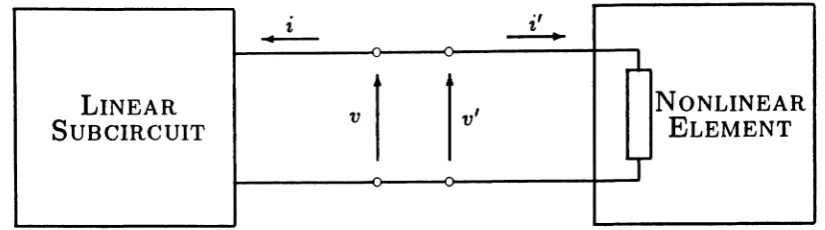
...Figure 3.2.1: Partitioning of a microwave circuit into linear and nonlinear subcir-cuits for harmonic balance analysis
In this example the frequency domain form of the voltage v
==
v' (i.e. a set of phasors) across both the linear and nonlinear elements is assumed, and the currenti (as a set of phasors) into the linear subcircuit is calculated using standard linear
circuit techniques [43]. Then the current i ' (again as a set of phasors) flowing
into the nonlinear circuit is calculated using the almost periodic Fourier transform
technique [46,47], the multidimensional fast Fourier transform technique (NFFT)
[49], or the arithmetic operator method (AOM) [37]. (Of these the NFFT method
is preferred for the simplicity in nonlinear device modeling and the AOM technique
for speed and memory usage when there are two or more incommensurable signals.)
Whichever method i~ used in determining the nonlinear curre~ti', a balance of i
and i ' is achieved using a Newton iteration scheme to update the estimated voltage
3.2.3
Interface of FREDA into CAPSIM
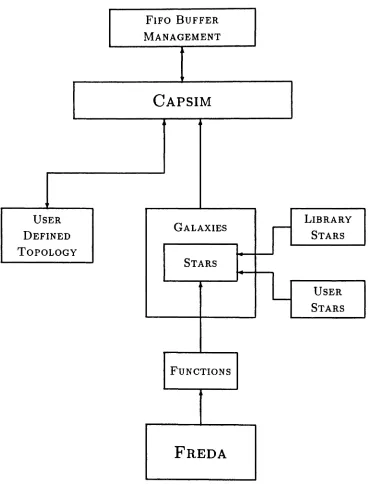
Fig. 3.2.2 illustrates the structure of the integrated simulation environment,
partic-ularly as it relates to the user interface. The user provides three types of routines:
a system topology, star routines (could be system-provided as well), and a
net-list for FREDA. These routines interface to CAPSIM (rather than directly to one
another) which handles FIFO buffer management. The user-supplied "topology
definition" program specifies the names of stars, the routine which implements
each star, and how the stars are interconnected. The topology definition
rou-tine is also able to pass parameters to the stars to specialize their function. The
stars get their input samples from input FIFO's, and put their generated output
samples into output FIFO's.
The functions, in Fig. 3.2.2, are particular routines to be called by a star when
they are needed. Those functions could be an FFT (Fast Fourier Transform),
dig-ital filters, or any other user defined mathematical functions. The convenience
introduced by the functions is that the user can easily implement frequently
needed routines in stars simply by calling functions. FREDA was interfaced into
CAPSIM as one of these functions. More information as to the software details
in the interface procedure is provided in Appendix A. Once the simulation is
exe-cuted according to the user defined topology, FREDA takes over as the nonlinear
RF circuit simulator at the appropriate point in the simulation. By
FIFO BUFFER
MANAGEMENT
CAPSIM
USER LIBRARY
GALAXIES
I
STARSDEFINED
TOPOLOGY ~
STARS
...
L
USERSTARS
FUNCTIONS
FREDA
FREDA is a complete frequency domain simulator, all CAPSIM stars connected
to the FRED A star are forced to process in the frequency domain in order to be
consistent with FREDA through the interface. This transformation is managed
by FFT stars in the CAPSIM system topology.
3.3
Summary
In summary, the incorporation of the link and the nonlinear RF circuit level
simula-tion of the communicasimula-tions systems has resulted in a flexible integrated simulasimula-tion
environment which enables us to see the effects of link level perturbations on the
nonlinear RF circuit level such as the effect of transmission media change on the
received signal at physical level and vice versa. In addition, a great deal of
effi-ciency is achieved in representing the filters and bandpass signals in the frequency
The Simulation System : Mobile
Communications
4.1
Introduction
In choosing an example, we tried to cover a broad range of applications and be
fairly general. The simulation of a mobile communication system was suited to
this objective because of its complexity and the way that the different levels of
the system affect each other. Another motivation in choosing the mobile
commu-nication system as an example is the practical need for an integrated simulation
environment for the design and analysis of mobile communication systems. This
is because, in industry, engineers carry out some field experiments which change
the circuit designs or the modulation schemes accordingly. However, this is a very
costly approach both financially and in terms of the time spent by the engineers to
construct the experiment and take the data. Therefore, an integrated simulation
environment is essential in the design and development of communication circuits
4.2
Technical Problems in Mobile Communication
Systems
The complexity of communication systems has been greatly increased by the
pres-ence of mobile radio technology, although some technical and regulatory issues
still remained unsolved [50]. The allocation of new transmission channels at 900
MHz added many more problems to circuit complexity and analysis as well [51].
Various technical problems make the mobile communication systems difficult for
designers to deal with. These technical problems can be divided into two groups:
link level impairments, and circuit level impairments.
4.2.1
Link Ievel Jmpairmerrts
In the first place, there is a great deal of rnultipath transmission. Because of
reflection from buildings, lamp posts, utility wires, and other obstructions, the
signal may travel from the transmitter to the receiver by many different paths
with different lengths. When one end of the channel is moving, as is usually
the case in mobile communications, the predominant feature of the multipath is
fading. The fading results because, in some relative positions, phases of the signals
arriving from the various paths interfere constructively. Thus as a vehicle moves,
the received signal strength varies erratically and unpredictably over a range of
20 to 30 decibels. Another set of problems that arise in the mobile channel is also
Doppler spreading of approximately
+
100 Hz [50]. This motion-related problemleads to other problems such as co-channel and adjacent channel interference. In
a narrow band system the channels can be separated in frequency by 25, 30,
or 50 kHz. Because of vehicle motion, a receiver and a transmitter operating
on adjacent or nearly adjacent channels may be physically close together. The
receiver selectivity must be extremely good to prevent substantial interference
from the strong transmitter signal. Finally, some other problems like intersymbol
interference which results from the arrival of signals at the receiver at different
times are also due to the motion in mobile radio.
4.2.2
Circuit Level Impairments
The problems at the circuit level in mobile communication systems are mostly the
large signal nonlinear distortion effects due to the RF receiver front-end. These
distortions can be localized in the nonlinear RF mixer where the RF signal is
converted down to the IF signal.
As suggested in [52] nonlinear distortion and interference effects in mixers are
those effects which represent departure from the ideal performance when the input
signal in the passband is large. The nonlinear distortion and interference effects
i) gain compression or enhancement - which is a variation of the mixer
con-version gain, or loss, due to the amplitude of the desired input signal.
ii) intermodulation - refers to generation of spurious frequency components at
the sum and difference frequencies of the desired and undesired input signals.
iii) desensitization - modulation of the desired signal by an undesired signal.
iv) detuning - generation of de charge or dc current, due to a large input signal
resulting in a change of the diode bias condition.
In addition to the large signal distortion effects, there is yet another distortion
effect proportional to local oscillator power as well, which had been studied
thor-oughly in
[53].
In[53],
it was concluded that intermodulation will first increase,then reach a maximum, and finally decrease as local oscillator power increases.
However, the conversion loss is inversely proportional to the local oscillator power,
i.e., the conversion loss decreases as the local oscillator power increases. This fact
suggests a compromise between the nonlinear distortion effects and the conversion
loss.
Another problem related to the circuit level is the inadequate bandpass filtering
at the RF front-end which gives rise to the adjacent channel interference and the
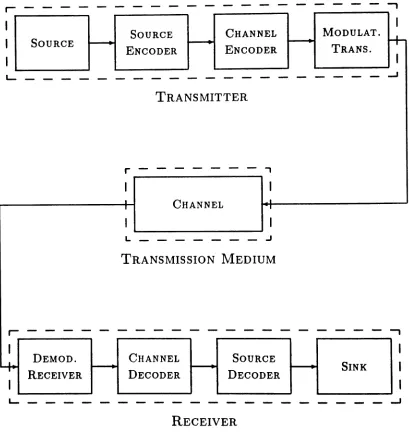
A block diagram is illustrated in Fig. 4.3.1 of a generic communication system
which provides a model for the simulation example. The objective in designing
the simulation example is to include the link and circuit level impairments, i.e.,
to define the individual blocks of the communication system incorporating the
impairments mentioned in Section 4.2. The blocks into which these impairments
are built, are the transmission medium block, i.e., the channel and additive noise,
and the RF front-end block, i.e., the nonlinear RF mixer circuit and bandpass
filter. In the following sections the functional blocks in each level are described.
4.3.1
Description of Link Level
The link level consists of transmitters and the transmission medium. T,,'Po
mitter units are used in order to simulate a multi-channel system. Each
trans-mitter generates a two-tone signal. It is advantageous to use two-tone signals in
the characterization of the channel and in measuring intermodulation distortion
[54]. The purpose of the modulator/translator block in Fig. 4.3.1 is to map the
two-tone signal into a waveform suitable for transmission over the transmission
medium.
The most important block in the link level is the transmission medium block
which is composed of a channel and additive white Gaussian noise. In choosing
I
I
SOURCE CHANNEL MODULAT.+-I
SOURCE----..
~ ~ENCODER ENCODER TRANS.
I
I
L...
-
-
-
- -
-
- - -
-
- - - -
-
- -
-
-
-
-JTRANSMITTER
r
-
-
- - - - -
,
I
I
I
CHANNEL I
I I
I
I
L
- -
-
- - -
-
JTRANSMISSION MEDIUM
r
-
-
-
- - -
-
- -
-
- -
-
-
-
-
-
-
-
-
-,I
I
Y.
DEMOD.----..
CHANNEL ~ SOURCE ~ SINKI
RECEIVER DECODER DECODERI
I
. - - - .
L... _
---_-.1
RECEIVER
n(t)
FIXED
DELAY
DIRECT PATH
SPECULAR
~MULTIPATH
X
-2:
~ej¢
~---"'fX...--.. DIFFUSE MULTIPATH
To
Differential Delay
Figure 4.3.2: Multipath Path Fading Channel Model
general capability which can support the impairments mentioned in the previous
sections. A physical and practical channel model [40] which satisfies these
re-quirements is a three component fading multipath channel plus additive noise. In
particular, the fading multipath channel is assumed to consist of a single direct
path, a specular multipath component, and a diffuse multipath component as
il-lustrated in Fig. 4.3.2. The quantities
eel
ande.
in Fig. 4.3.2 represent the specularand diffuse multi-path signal energies, respectively, each normalized to the energy
fo are also associated with rnultipath components. The noise component,
n(t)
in Fig. 4.3.2, is an additive white Gaussian noise (AWGN). The noise source is
detailed in the implementation section, Chapter 5. This channel model includes
all link level impairments mentioned in Section 4.2.1.
4.3.2
Description of Circuit Level
At the receiver front-end are the nonlinear RF mixer circuit, bandpass filter, and
the other necessary demodulation blocks.
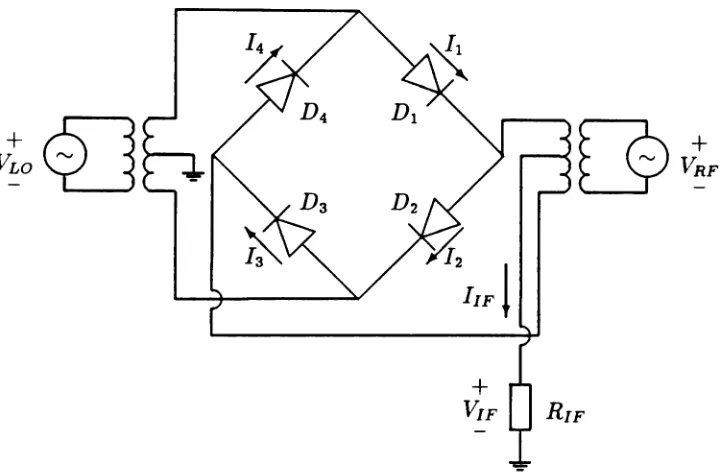
The nonlinear RF mixer circuit is a double-balanced ring diode mixer, as
il-lustrated in Fig. 4.3.3, which is a widely used communication mixer circuit. The
double-balanced ring diode mixer was chosen because of its practical use and its
better performance on harmonic and intermodulation distortion and RF /IF
iso-lation due to its balanced characteristic [55]. The ring diode mixers can also be
used as modulators, phase detectors, and even voltage-controlled attenuators [55].
Therefore, they are very versatile components.
The bandpass filter block is represented in the frequency domain like the other
blocks in the system. It uses measured or independently calculated values for
amplitude and phase response
[4].
This block has an essential role in simulatingthe adjacent channel interference because it determines the leakage power from
Chapter
5
Methodology and Implementation of Mobile
Communication System Simulation
5.1
Introduction
This chapter illustrates by way of example the approach that a programmer
us-ing the proposed integrated simulation environment uses to develop a simulation,
particularly the simulation of a multi-channel mobile communication system. The
functional descriptions of blocks (stars) that build up the mobile communication
system are elaborated. The C-programming codes for the stars are provided in
Appendix B.
Next section presents an outline of the simulation procedure as it relates to
the implementation of the simulation example.
5.2
Simulation Procedure
The CAPSIM user can configure a wide variety of digital communication systems
from basic functional blocks, i.e., stars. In the mobile communication system
sim-ulation example, the CAPSIM stars include: signal sources, FFT blocks,
effectively interfaces FREDA into CAPSIM.
The mobile communication system being simulated is illustrated in Fig. 5.2.1
in terms of its implementation in CAPSIM terminology. The detailed descriptions
of the functional blocks follow in Section 4.3. For the purposes of simulation, as
well as actual implementation, the system, i.e., the universe is partitioned into a
number of galaxies. Those galaxies are further subdivided into stars. Each star
is simulated by a user-defined C-program, and the integrated simulation
environ-ment combines these individual simulations into a simulation of entire system.
Before proceeding with the descriptions of the stars, we would like to restate and review the communication between CAPSIM and FREDA, and the
commu-nication within each simulator as well. As mentioned in Chapter 3, there are two
different means to communicate with CAPSIM simulation environment. The first
way is through an interactive graphical interface. The second way, which is less
user-friendly, is to provide CAPSIM with a user-defined system topology. This
approach is rather text-oriented. The graphical interface has the disadvantage
that it requires the user to run the simulation on a workstation. Although the
text-oriented approach is less friendly and less visual, it is possible to run the
simulation on a computer terminal. In this simulation example, the latter way of
communication with CAPSIM was employed.
r
,
GALAXY I GALAXY II
I
,
,
I I,
I,
I -"r--- ..
I I,
ITRANSMITTER
,
,
I I,
,
TRANSMITTERI
,
,
III I I I I I
---
---"
~------STAR
i---i
I,
I I I COMBINER,
- - - , +
+r---I
,
,
I I,
L _______---J
r---
..
I I I I I,,
I I ~-GALAXY IIIr - - -
-1- ---
~
I
I
II I
I I
: TRANSMISSION :
I MEDIUM I
I I
I I
I I
..
_---"
GALAXY IV
r - - -
-1- ---
~
I I
RECEIVER
~---"
L _
_---J
tioned in Chapter 3, FREDA uses a circuit net-list to communicate with the user.
The net-list specifies the topology, definitions, element values and node numbers
of the particular circuit.
Finally the communication between CAPSIM and FREDA is achieved through
the FREDA mixer star.
5.3
Functional Description of the Simulation Example
The mobile communication systemuniverse, as illustrated in Fig. 5.2.1, consists of two transmitter galaxies (since adjacent channel interference is of concern there are two transmitters which modulate the information signals up to two
differ-ent carrier frequencies in the adjacdiffer-ent channels), a combiner star, a transmission medium galaxy and a receiver galaxy.
The rest of this chapter is devoted to the functional descriptions of stars which build up the galaxies and finally the universe.
5.3.1
Transmitter Galaxies
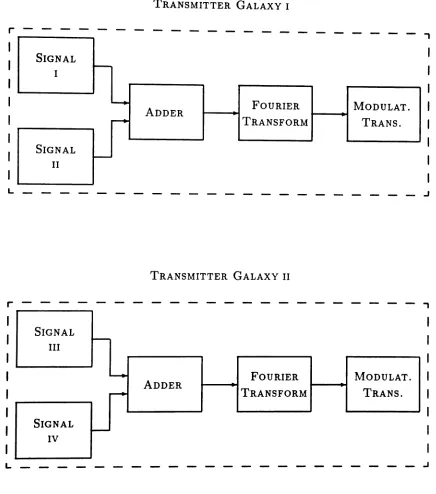
In transmitter galaxy I, there are two signal stars as shown in Fig. 5.3.1. Each of the signal stars generates a sinusoidal signal which is the discrete sequence of the sampled analog waveform. The frequency and corresponding sampling rate
TRANSMITTER GALAXY I
- - - ,
-SIGNAL
~ I
...
FOURIER MODULAT.ADDER
---+ TRANSFORM TRANS.
SIGNAL
-II
r
-L____________________
JTRANSMITTER GALAXY II
r - - - -
- - - ,
SIGNAL
-III
~ FOURIER MODULAT.
ADDER
TRANSFORM TRANS.
--..
SIGNAL
-IV
L ~
addition of the two input sample streams. Therefore, each signal star must have
the same sampling rate while generating the sinusoidal waveform. After the adder
star, a two-tone sinusoidal signal is obtained. The two-tone signal was chosen for
its convenience in measuring the intermodulation distortion [54]. Following the
adder star, the time domain two-tone signal is passed through the F FT (Fast
Fourier Transform) star by which the information is transformed into the
fre-quency domain. The next step is to modulate the baseband signal to a higher
frequency suitable for transmission through the channel. This is achieved by the
modulator /translation star which performs double-sideband suppressed carrier
(DSBSC) modulation on the baseband signal [30]. The suppressed carrier
fre-quency and the other parameters are specified in the user-defined CAPSIM
topol-ogy. The description of the transmitter galaxy I I is similar since it consists of
identical blocks as the transmitter galaxy I.
In Fig. 5.2.1, the two transmitter galazy8 are connected to the combiner star.
As its name implies, the combiner star combines the two different spectrums and
sends the resulting RF spectrum through the iransmis sion medium galaxy.
5.3.2
Transmission Medium Galaxy
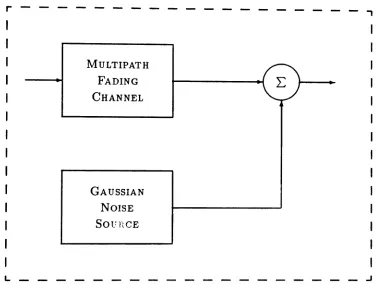
As mentioned in Chapter 4, the transmission medium gala:cy in Fig. 5.3.2 is a
r - - - _ ,
MULTIPATH
FADING
CHANNEL
GAUSSIAN
NOISE
SOlrnCE
L J
- normalized to the energy in the direct path) are under direct user control.
In addition, the user is allowed to adjust the relative phase
t/J
of the specularmultipath component relative to the direct path component. Other parameter
choices include the nominal differential delay To and the differential Doppler
/0
associated with the two multipath components. All of these parameters can be
modified through the parameters list in the user-defined CAPSIM topology.
The noise star in the transmission medium galazy is simply a white Gaussian
noise generator operating in the frequency domain. The additive noise components
are the sampled values of white Gaussian noise spectrum. The variance of the
Gaussian noise is a parameter under user control.
5.3.3
Receiver Galaxy
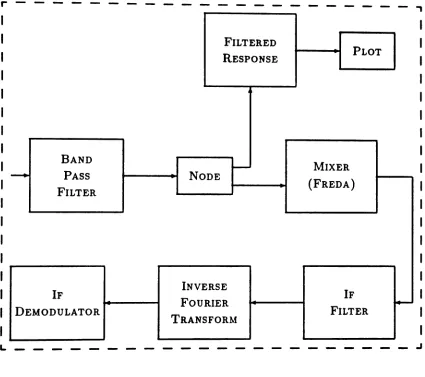
The receiver galazy, illustrated in Fig. 5.3.3, is composed of a bandpass filter
star, a mizer (FREDA) star, an IF filter siar , a IFFT (Inverse Fast Fourier
Transfonn) star, and an IF demodulator star, The ba,ndpo,~.! filter .ttlr is a
bandpass filter represented in the frequency domain. It has lower and upper
cut-off frequencies and roll-cut-off factor in the transition band which' are specified in the
user-defined CAPSIM topology. Those parameters are effective in the adjacent
channel interference measurements as explained in Section 4.3.2. The RF signal
r - - - - - - - -
---,
FILTERED
RESPONSE PLOT
BAND
~ MIXER
- - + PASS NODE
(FREDA)
FILTER
--IF
INVERSEIF
FOURIER ~
DEMODULATOR
TRANSFORM FILTER
L ---~
from the inadequate filtering. The mixer star takes the RF spectrum and invokes
FREDA to analyze the nonlinear RF mixer circuit illustrated in Fig. 4.3.3. The
local oscillator power and the other circuit parameters are specified in the
user-defined FREDA net-list. The output of the mieer sia» is taken by the
IFFT
star which carries out an inverse Fourier transform on the IF frequency spectrum.
Hence, the time domain IF waveform is obtained after the
IFFT
star, As example,several IF waveforms and spectrums are presented in Chapter 6.
Finally, the IF demodulator star demodulates the IF signal using time domain
techniques. The demodulation techniques are beyond the scope of this work. Thus,