University of Windsor University of Windsor
Scholarship at UWindsor
Scholarship at UWindsor
Electronic Theses and Dissertations Theses, Dissertations, and Major Papers
2008
A cross-layer implementation of Ad hoc On-demand Distance
A cross-layer implementation of Ad hoc On-demand Distance
Vector routing (AODV) protocol
Vector routing (AODV) protocol
Olakunle Michael Aruleba University of Windsor
Follow this and additional works at: https://scholar.uwindsor.ca/etd
Recommended Citation Recommended Citation
Aruleba, Olakunle Michael, "A cross-layer implementation of Ad hoc On-demand Distance Vector routing (AODV) protocol" (2008). Electronic Theses and Dissertations. 8132.
https://scholar.uwindsor.ca/etd/8132
A Cross-Layer Implementation of Ad Hoc
On-Demand Distance Vector Routing
(AODV) Protocol
By
Olakunle Michael Aruleba
A Thesis
Submitted to the Faculty of Graduate Studies
through the Department of Electrical and Computer Engineering
in Partial Fulfillment of the Requirements for
the Degree of Master of Applied Science at the
University of Windsor
Windsor, Ontario, Canada
2008
1*1
Library and Archives CanadaPublished Heritage Branch
395 Wellington Street Ottawa ON K1A0N4 Canada
Bibliotheque et Archives Canada
Direction du
Patrimoine de I'edition
395, rue Wellington Ottawa ON K1A0N4 Canada
Your file Votre reference ISBN: 978-0-494-47011-4 Our file Notre reference ISBN: 978-0-494-47011-4
NOTICE:
The author has granted a non-exclusive license allowing Library and Archives Canada to reproduce, publish, archive, preserve, conserve, communicate to the public by
telecommunication or on the Internet, loan, distribute and sell theses
worldwide, for commercial or non-commercial purposes, in microform, paper, electronic and/or any other formats.
AVIS:
L'auteur a accorde une licence non exclusive permettant a la Bibliotheque et Archives Canada de reproduire, publier, archiver,
sauvegarder, conserver, transmettre au public par telecommunication ou par Plntemet, prefer, distribuer et vendre des theses partout dans le monde, a des fins commerciales ou autres, sur support microforme, papier, electronique et/ou autres formats.
The author retains copyright ownership and moral rights in this thesis. Neither the thesis nor substantial extracts from it may be printed or otherwise reproduced without the author's permission.
L'auteur conserve la propriete du droit d'auteur et des droits moraux qui protege cette these. Ni la these ni des extraits substantiels de celle-ci ne doivent etre imprimes ou autrement reproduits sans son autorisation.
In compliance with the Canadian Privacy Act some supporting forms may have been removed from this thesis.
Conformement a la loi canadienne sur la protection de la vie privee, quelques formulaires secondaires ont ete enleves de cette these.
While these forms may be included in the document page count,
their removal does not represent any loss of content from the thesis.
Canada
Bien que ces formulaires
Author's Declaration of Originality
I hereby certify that I am the sole author of this thesis and that no part of this thesis
has been published or submitted for publication.
I certify that, to the best of my knowledge, my thesis does not infringe upon
anyone's copyright nor violate any proprietary rights and that any ideas, techniques,
quotations, or any other material from the work of other people included in my thesis,
published or otherwise, are fully acknowledged in accordance with the standard
referencing practices. Furthermore, to the extent that I have included copyrighted material
that surpasses the bounds of fair dealing within the meaning of the Canada Copyright Act,
I certify that I have obtained a written permission from the copyright owner(s) to include
such material(s) in my thesis and have included copies of such copyright clearances to my
appendix.
I declare that this is a true copy of my thesis, including any final revisions, as
approved by my thesis committee and the Graduate Studies office, and that this thesis has
Abstract
Mobile Ad hoc Networks (MANETs) are networks which will form the basis for the
ubiquitous data access because of their ease of deployment. Due to the dynamic nature of
a MANET, routing is one of the most critical elements of MANET. Routing protocols for
MANET can be broadly classified as a proactive routing protocol or a reactive routing
protocol. In the proactive routing protocols, mobile nodes periodically exchange routing
information among themselves. Hence proactive routing protocols generate high
overhead messages in the network. On the other hand, reactive routing protocols work
on-demand. Thereby generating less number of overhead messages in the network
compared to proactive routing protocols. But reactive routing protocols use a global
search mechanism called 'flooding' during the route discovery process. 'Flooding'
generates a huge number of overhead messages in the network. Those overhead messages
affect the performance of reactive routing protocols in term of network throughput. That
kind of performance problem is called 'scaling' problem. Ad hoc On-demand Distance
Vector Routing with Cross-Layer Design (AODV-CL) protocol has been proposed to
solve this scaling problem. The AODV routing protocol has been modified to implement
AODV-CL protocol. AODV-CL protocol reduces 'flooding' problem of reactive routing
protocols by limiting the number of nodes that should participate in route discovery
process based on their status in the network and also avoiding congested area of the
network. It is shown that AODV-CL protocol reduces overhead messages by 73% and
A cknowledgements
I would like to express my sincere appreciation to my supervisor, Dr Kemal Tepe for
giving me the opportunity to work with him. It's indeed a great privilege. I'm also grateful
to him for his patience, invaluable support and guidance during my research work
presented in this thesis. Working with him has been fun and enjoyable. I would also like to
thank my thesis committee members, Dr. Arunita Jaekel and Dr. Huapeng Wu, for their
priceless contributions and support.
I'm grateful to my loving parents, Mr. and Mrs. Simon Aruleba, for their encouragement,
prayers and moral support. I'll forever by indebted to them for my upbringing. Many
thanks to my siblings: Bukky, Kayode, Seun and Tayo, for their unwavering support and
affection. I would like to express my sincere gratitude to Mary Oyakhire, for her friendship
and kindness. I count myself blessed to have a passionate and caring friend like her. I'm
very grateful to Andria Turner who put in a lot of effort in ensuring that I become a
graduate student at the University of Windsor. I would like to thank John Renauds for his
fatherly advice and kindness. I would also like to thank my colleagues and friends who had
Table of Contents
AUTHOR'S DECLARATION OF ORIGINALITY iii
ABSTRACT iv
DEDICATION v
ACKNOWLEDGEMENTS vi
LIST OF FIGURES ix
ABBREVIATIONS xi
1. INTRODUCTION 1 1.1 Motivation 1 1.2 Contribution and applicability 5
1.3 Thesis Organization 7
2. BACKGROUND 9 2.1 Introduction to Mobile Ad Hoc Network 9
2.2 Routing protocols of MANET 11 2.3 Review of routing protocol for MANET 13
2.4 Proactive routing protocols 13 2.5 Reactive routing protocol 15 2.6 Ad Hoc On-Demand Distance Vector (AODV) Routing Protocol 17
2.6.1 Route Discovery 18 2.6.2 Route Maintenance 21 2.7 Flooding problems in AODV 22
2.7.1 Analysis of Contention 22 2.7.2 Analysis of Collision 23 2.7.3 Analysis of Redundant Broadcast 23
2.8 Network simulator 26 2.9 Wireless Network Model 28 2.10 Cross Layer Design for MANET 30
3. AD HOC ON-DEMAND DISTANCE VECTOR ROUTING PROTOCOL
WITH CROSS-LAYER DESIGN (AODVCL) 36
3.1 Introduction 36 3.2 AODV-CL Protocol 39
3.2.1 FN selection algorithm 39 3.2.2 FN de-selection 42 3.3 Overhead and delay analysis 43 3.4 Cross-layer design in FN selection 46 3.5 Simulation results: delays and overhead analysis 51
3.6 Performance analysis with varying rates 52 3.7 Verification of Cross-layer design 55 3.8 Comparison with a pure probabilistic protocol 56
3.9 Conclusions 58
4. CONCLUSIONS AND FUTURE WORK 60
4.1 Summary of Contributions 60
4.2 Future work 61
List of Figures
Number Page
Figure 1.1 A mobile Ad hoc network 2
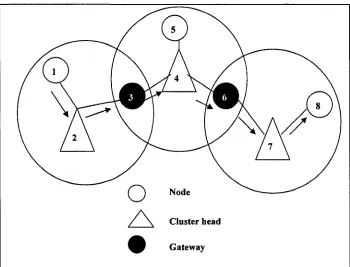
Figure 2.1 CGSR: routing from node 1 to 8 15
Figure 2.2 Route discovery in DSR 17
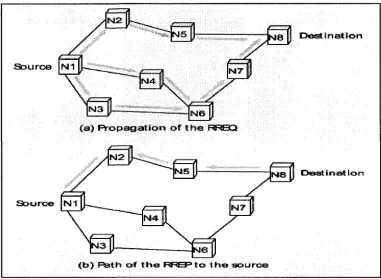
Figure 2.3 AODV route discovery 19
Figure 2.4 Reverse path formation 20
Figure 2.5 Forward path formation 21
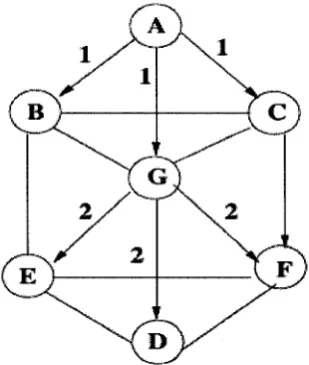
Figure 2.6 Redundant broadcast scenario 1 24
Figure 2.7 Redundant broadcast scenario 2 24
Figure 2.8 Additional area covered by a rebroadcast 25
Figure 2.9 NS-2 model 27
Figure 2.10 Logical view of mobile node connection 28
Figure 2.11 Portrait of mobile node 30
Figure 2.12 OSI model for protocol stack 31
Figure 2.13 Cross-layer architecture 31
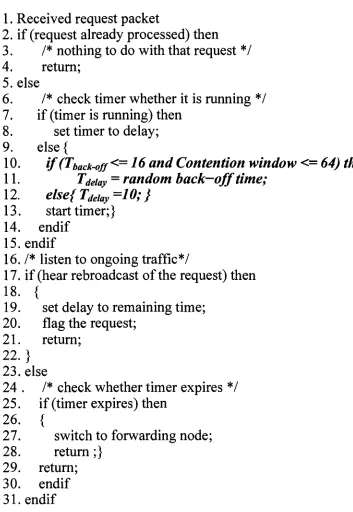
Figure 3.1 The pseudo-codes of FN selection algorithm 40
Figure 3.2 Transition from MN to FN 42
Figure 3.3 Transition from FN to MN 43
Figure 3.4 Broadcast reduction with varying values of K 45
Figure 3.5 Broadcast reduction with 20 connections 45
Figure 3.6 Delay reduction with FN selection algorithm 47
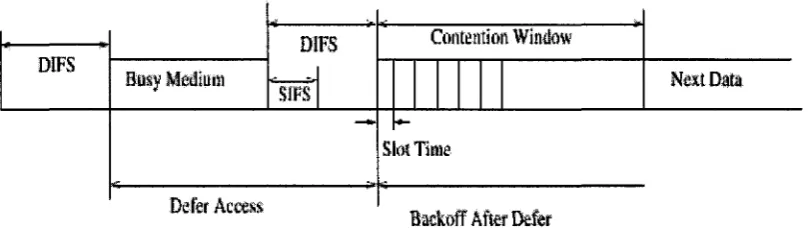
Figure 3.7 Basic access mechanism in IEEE 802.11 48
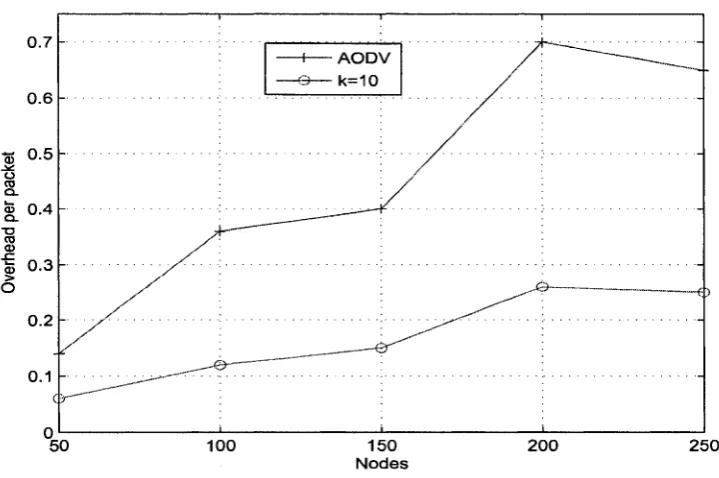
Figure 3.9 Overhead reduction with AODV-CL 52
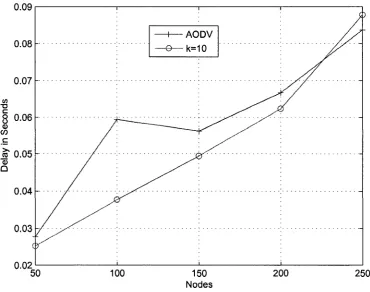
Figure 3.10 Delay improvement with AODV-CL 53
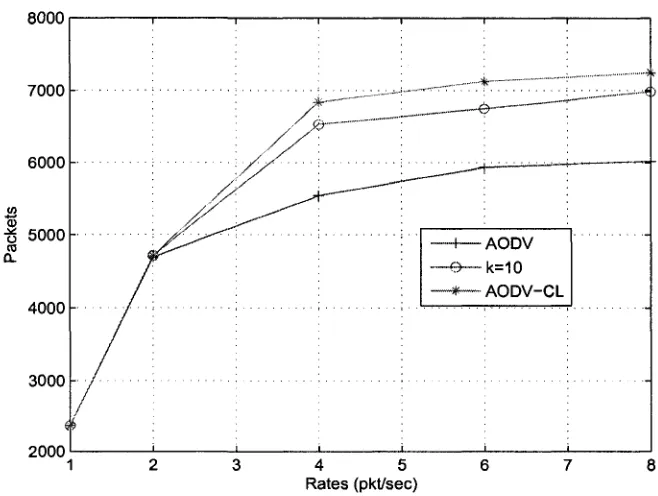
Figure 3.11 Data packet delivered with varying loads 53
Figure 3.12 Delay comparison with varying loads 54
Figure 3.13 Throughput comparison with varying loads 55
Figure 3.14 Average contention window size along routes 56
Figure 3.15 Overhead comparison with probability scheme 57
Abbreviations
ACK AODV ARP BER CTS CSMA CA CGSR CH CBR CRP CPU DSR DSDV DARPA DHCP DCF DIFS AcknowledgeAd hoc On-demand Distance Vector
Address Resolution Protocol
Bit Error Rate
Clear To Send
Carrier Sense Multiple Access
Collision Avoidance
Clusterhead Gateway Switch Routing
Cluster Head
Constant Bit Rate
Congestion adaptive Routing Protocol
Central Processing Unit
Dynamic Source Routing
Destination Sequence Distance Vector
Defense Advance Research Project Agency
Dynamic Host Configuration Protocol
Distributed Coordination Function
DCA FN FTP GPS GIS HDSR IEEE IETF IP LCC LAN LCA MAC MANET MN NS NAM OSI OTcI PDA RTS RR SIFS TCP UDP VINT
Distributed Clustering Algorithm
Forwarding Node
File Transfer Protocol
Global Positioning System
Geographical Information System
Hierarchical Dynamic Source Routing
Institute of Electrical and Electronic Engineers
Internet Engineering Task Force
Internet Protocol
Least Cluster Change
Local Area Network
Linked Cluster Architecture
Medium Access Control
Mobile Ad Hoc Network
Mobile Node
Network Simulator
Network Animator
Open System Interface
Object Oriented Tel
Personal Digital Assistant
Request To Send
Route Request
Short Inter Frame Space
Transport Control Protocol
Unigram Data Protocol
Chapter 1
Introduction
1.1 Motivation
Wireless networking over the past years is becoming more popular in the field of
telecommunications. This increasing popularity can be traced back to the early days of
packet radio network introduced by Defense Advanced Research Project Agency
(DARPA) [33] and the popularity that it has attracted in the research and academic
environment. The current breakthroughs in the development of portable mobile devices
such as personal digital assistance (PDAs), mobile phones and laptops have increased the
drive towards ubiquitous computing. Information can be accessed anytime and anywhere.
The era of ubiquitous computing can only be achieved by a mobile network which extends
to large areas. Such mobile network can not be realized by infrastructure networks only
because there are places and situations where it will be difficult to build a new
infrastructure. An example is a battle field, where it is impossible and infeasible to have a
fixed infrastructure because soldiers, war plane and war ships need to communicate and
they are constantly on the move. Another example is the case of natural disasters where
existing networks could have been destroyed by cyclone, tsunami and tornado. In such a
case, a temporary network needs to be set up to carry out rescue missions. The above
examples show the need for a temporary network in order to have a true ubiquitous
(MANETs). MANETs consist of mobile devices with limited power and processing
capabilities who comes together to form a temporary network without a central
administrator. They are self-organizing and self-configuring. A MANET can find an
application in military, distributed and collaborative computing and wireless sensor
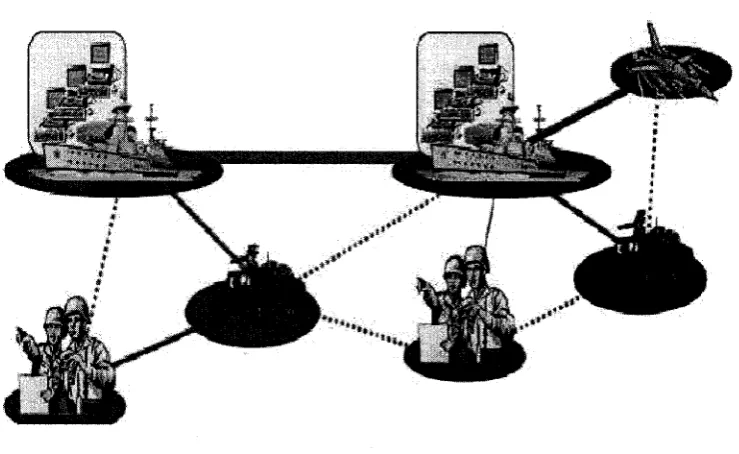
networks [39]. A typical MANET network is shown in Figure 1.1.
Figure 1.1: A mobile ad hoc network
MANETs have some characteristics which are not present in wired networks. It has a
dynamic topology. Mobile nodes are free to move randomly which leads to frequent path
breaks. Because the transmission medium used is wireless, MANETs also inherit some of
the features of wireless communications such as higher error rate than the wired medium,
There are various challenges still facing the MANETs such as routing, multicasting,
energy management and scalability [39]. Routing is the most important issue in the
MANET. Routing in MANETs can be categorized into two major categories; proactive
and reactive. In proactive routing protocols such as Destination Sequence Distance Vector
(DSDV) [21] and Wireless Routing Protocol (WRP) [25], every node maintains a global
view of the topology through periodical routing table exchanges flooded throughout the
network. The periodical exchanges generate large number of overhead packets in the
network which makes proactive routing protocol unsuitable for MANET's. Reactive
routing protocols such as Ad hoc On-demand Distance Vector (AODV) [4] and Dynamic
Source Routing (DSR) work on-demand [7], they do not maintain a global view of the
network topology. These protocols obtain paths when they are needed. This approach has
far less overhead than proactive approach. But reactive protocols use a global search
procedure called "flooding" during a route search. In the route search a mobile node
generates a special packet called Route Request (RR) packet which is broadcasted to all its
neighbors. When a neighbor receives RR packet, it replies if it is the destination or if it has
a route to the destination in its routing table, else it re-broadcasts the RR packet to its
neighbors. This procedure continues until the destination node receives the RR packet.
Thus the whole network is flooded with RR packets. The flooding significantly affects the
performance of a large network. Some of the problems associated with "flooding" are (1)
collision, (2) contention, and (3) redundancy [23]. A simultaneous retransmission of RR
packets by two neighboring nodes causes a collision. There is a high probability that a
node will receive multiple copies of the same RR packet which are redundant. Researchers
have proposed various schemes to reduce "flooding" problem in the MANETs. The
schemes are broadly classified into three major categories (1) location based schemes [3,
10] and [12], (2) clustering schemes [26] and [27] and (3) probability based schemes [12]
and [13]. There are also other schemes which do not directly fall into any of the above
performed based on the location of a node in the network. For example location based
routing schemes can select routing nodes based on their proximity to the destination node.
In clustering schemes, the network consists of various clusters with one "cluster head" and
a group of "ordinary nodes". The "cluster head" forwards RR packets on behalf of the
"ordinary nodes" through a node, called "gateway nodes" which connects two clusters. In
probabilistic schemes, nodes broadcast a packet with a probability which is less than 1.0.
The probability of each node is calculated using various parameters. One of the important
requirements for an efficient operation of the schemes mentioned above is that the
network topology must be known by each node. In the location schemes the global view is
achieved by the use of Global Positioning System (GPS) by each node in the network.
This introduces additional cost in terms of hardware and software requirements. In cluster
based schemes, nodes are required to transmit "HELLO" messages among themselves in
order to get a global view of the network and, in some cases, to determine or to elect a
"cluster head". This definitely generates extra overheard in the network.
Another problem that occurs in the MANETs is congestion. Congestion in MANET leads
to longer delay, higher overhead and high packet loss [30]. Reactive routing protocols
such as AODV and DSR use the shortest path during routing, which is the path with the
minimum number of hops out of all the paths discovered during the route discovery.
According to [28], the shortest path routing might not be the best for the MANETs.
Analysis in [28] showed that the center of a network using the shortest path routing
decisions tends to be more congested than the other parts of the network. That is the nodes
at the center of the network carry more traffic than the nodes at the edges. This is also
collaborated by [29]. Protocols such as [29] and [30] have been proposed to mitigate the
effect of congestion in the MANETs. These protocols obtain congestion information of a
node through the interface queue and this information is used in routing.
The goal of a routing protocol is to find route to a destination efficiently. This requires
routing protocols hardly meet these requirements. There are usually trade offs in meeting
these objectives. Different applications have their own unique requirements. For example,
security plays an important role in military applications. In sensor networks, energy
conservation is important. Reliability takes priority in collaborative and distributed
systems. These applications also require different information to achieve their own unique
requirements. For example information about node mobility is useful for routing and
network management. Energy statuses of nodes are needed in the routing decision of
energy sensitive applications. The need for MANET to meet diverse application
requirements has led researchers to suggest that the present Open System Interconnect
(OSI) fixed protocol stack is not suitable for MANET [30]. The OSI model was designed
primarily for wired networks and therefore cannot meet the requirements of a dynamic
network like MANET. They have proposed interactions among protocol stack which is
called "Cross Layer" design [38]. Some examples of cross layer design are [2, 29, 31] and
[32]. A design that uses MAC layer feedback to notify TCP about congestion was
proposed in [31]. Using congestion information obtained from the MAC layer for routing
decisions has been investigated in [2, 29] and [32]. In [32] the ratio of packet being
currently buffered to the link layer buffer size is used to categorize a node as "green",
"yellow" and "red". Routes are chosen to forward packets based on the above indicators.
In [2], contention window size from the MAC layer is used in routing decision.
1.2 Contribution and applicability
This thesis addresses the problem of efficient reactive routing protocol for MANET that
reduced the problem of "flooding" and congestion effect by having only few nodes
involved in route selection and also avoiding congested area of the network. The proposed
routing protocol is called Ad hoc On-demand Distance Vector routing protocol with Cross
(AODV) protocol has been modified and optimized to implement AODV-CL. In the
AODV-CL, nodes are classified either as Mobile Nodes (MN) or Forwarding Nodes (FN).
The MNs are source and destination nodes while FNs act as packet forwarding nodes and
are selected based on some criteria. Since only FNs participate in route discovery process,
less overhead packet are generated in the network. Reduction in overhead lowers
collisions and contentions in the network usually caused by overhead packets. Since less
number of nodes are contending for the medium in a given area of the network, network
resources such as bandwidth are used more efficiently in AODV-CL than AODV. This
implies that there will be more bandwidth in transmitting actual data packets instead of
overhead packets. In AODV-CL, nodes after receiving route request packet, only a few
number of them, re-broadcast this packet to their neighbors. This effectively reduces the
collision probability in the medium. When nodes receive route request packet, they
execute an algorithm similar to that used in HDSR [2] to determine if they'll become an
FN. This FN selection algorithm can be used by any on-demand routing protocol [2]. In
AODV-CL this FN selection algorithm is further modified by using a cross-layer design to
select FN in less congested area of the network in order to improve delay performance.
MAC layer congestion information is used in FN selection. It is shown in this thesis that
using congestion information in FN selection algorithm further improves network
performance in terms of delay, throughput and overhead reduction. In the modified FN
selection algorithm, MNs located in less congested area of the network have higher
probability of becoming FN than nodes located in the congested area. Hence the FN
selection algorithm can be implemented on any MAC layer where congestion information
is available such as the IEEE 802.11 protocol [33].
Energy efficiency is a major concern in MANET which is usually achieved by controlling
the transmit power levels of nodes. Though energy efficiency is not address in this thesis,
the goal of AODC-CL is to reduce flooding. That reduction in packet overhead is useful in
The AODV-CL has the following advantages:
• No additional hardware (i.e., GPS) is required.
• No additional control message like 'Hello' message is needed. Existing control
messages such as RR packets has been used. Hence AODV-CL protocol is a
passive routing protocol
• It works on-demand. That means nodes exercise FN algorithm when there is need
to discover a route
• The global information about network is not required. FN selection algorithm uses
only information that is already available at the node locally at different layers of
protocol stacks.
• Cross layer interactions are used to implement AODV-CL protocol
The AODV-CL protocol uses node energy efficiently. Hence network life is
maximized
1.3 Thesis Organization
This thesis consists of 4 chapters. Each chapter will contain an introductory section to give
an overview of the chapter and a conclusion section to summarize the chapter. In this
chapter motivation for this thesis was presented.
A brief overview of Mobile Ad hoc Network (MANET) is provided in Chapter 2. The
operations of proactive and reactive routing protocols are explained. A detailed operation
of Ad hoc on-demand distance vector (AODV) routing protocol and the effects of
'flooding' in MANET is explained in details. A brief review of related studies on solving
"flooding" is presented. Cross-layer design for MANET is introduced in Chapter 2 with
examples. Network Simulator (NS-2) has been used in this thesis to simulate the protocols
and to measure performances of these protocols. Chapter 2 also contains background of
In Chapter 3, Ad hoc On-demand Distance Vector Routing with Cross-layer design
(AODV-CL) is introduced. FN selection algorithm is introduced in this chapter. A
comparative performance analysis of AODV protocol and AODV-CL protocol is
presented in this chapter.
Chapter 2
Background
2.1 Introduction to Mobile Ad Hoc Network
Mobile ad hoc network (MANET) is a distributed system comprising of mobile nodes to
form a temporary network. MANET is dynamic, self-organizing and has no central
administration. These attributes make MANET a viable candidate for the ubiquitous
computing age. The drive for the ubiquitous computing has been on the rise due to
proliferation of mobile computing and communication devices. Wireless network is
certainly the easiest solution to provide connectivity to ubiquitous computing services.
MANET comes as an option for a flexible and low cost deployment of a network where
wireless devices need to interconnect with each other in the absence of a fixed
infrastructure. A MANET is highly dynamic and therefore its topology is highly
unpredictable. This constantly changing topology makes link breakages a regular
occurrence and routing in such dynamic networks is very difficult. Previously MANET
was developed to provide communication network for the military communication systems
especially in the battle field. Some of the other applications of MANET are in crisis
management, telemedicine, tele-geoprocessing, process control, personal communication,
virtual navigation, education and security.
cyclone and tornado makes us have an infrastructure-less communication network
which can be deployed quickly. With such networks rescue workers can
communicate with each other despite the destruction of the fixed communication
infrastructure. Also these infrastructureless networks can serve to temporarily
restore the communication facilities in the disaster area.
• Telemedicine: In the event of a traffic accident in a location without fixed
communication access, MANET can be used by the paramedic to obtain medical
records of the victim such as X-ray and blood type. The paramedic can relay back
vital information about the victim to the hospital. Assistance may also be received
from experts in case of emergency intervention.
• Tele-geoprocessing: The combination of MANET, geographical information
system (GIS) and Global Position Systems (GPS) can be used in the areas of
sensor networks to monitor the environment.
• Process Control: MANET such as sensor networks can be used in industrial and
manufacturing processes to remotely monitor temperature, pressure and humidity.
• Personal Communication: The world is moving towards an era of personal
communication where devices such as laptop, personal digital assistance (PDA),
mobile phones and household appliances (Television, gas cooker, microwave
oven) will be able to from a network and communicate with each other.
• Virtual navigation: Vehicles can receive information from a remote database
containing graphical representation of streets, buildings and layout of metropolis
in order for the occupants of the vehicle to navigate the city. Also this information
may assist in an emergency rescue plan.
• Education via the Internet: In remote places around the world, educational
opportunities can be made available to the students who do not have access to a
nearby school.
around facilities such as airports and restricted areas in order to monitor and detect
intrusion.
2.2 Routing protocols of MANET
Routing is the most active research area within MANET. The complexities and
challenges in designing an efficient routing protocol for MANET are large. That is why
many routing protocols have been proposed and their performance evaluated by the
Internet Engineering Task Force (IETF)'s MANET working group [31]. A routing
protocol must find feasible paths to a destination, minimize consumption of node's
energy, maintain the discovered routes, and utilize bandwidth efficiently. Challenges in
designing a protocol for MANET are mobility, resource constraint, error prone channel,
bandwidth constraint and contention.
• Mobility: MANET topology is highly dynamic due to movements of nodes. The
node movement leads to frequent link breakages, routing loops, stale routing
information and difficulty in resource reservation. These disruptions do not occur
in wired networks. Therefore routing protocols used for wired network can hardly
be used in MANET. That is why efficient routing protocols for MANET should be
designed to address mobility related challenges.
• Bandwidth constraint: In contrast with wired networks, wireless networks have
limited bandwidth. This limited bandwidth needs to be used effectively. So a
routing protocol for MANET needs to make use of the limited bandwidth
efficiently by reducing overhead in the network.
• Error prone channel: Wireless communication channel has high bit error rate
(BER). That is why the routing protocol needs to consider channel properties while
making routing decisions.
processing are usually limited. Therefore, the routing protocol should be able to
manage these limited resources efficiently.
Because of difficulties mentioned above, MANET requires specialized type of routing
protocols. A routing protocol in MANET should have the following characteristics:
distributed, minimum route acquisition, loop-free route discovery, quick route
maintenance, minimum control overhead and scalability.
• Distributed: Routing in MANET must be distributed because centralized routing is
prone to single point of failure.
• Minimum route acquisition: the time needed for route acquisition by a source to a
destination depends on some factors such as the size of the network, collision
probability and congestion in the network. A good routing protocol should have
minimum delay in acquiring route.
• Loop-free route discovery: For a dynamic environment like MANET, transient
route is usually common. A routing protocol for this type of network should be
able to eliminate, detect and recover from routing loop as soon as possible.
• Quick route maintenance: Constant route breakage is a frequent occurrence in any
dynamic network. A good routing protocol should be able to detect link failures as
quickly as possible. It should also find alternate routes to the destination in a short
time.
• Minimum control overhead: A lot of overhead packets are usually generated when
finding a route. These overhead lead to collision in the network and inefficient use
of scare bandwidth. The routing protocol must ensure that limited overhead
packets are used during route discovery.
• Scalability: The ability of a routing protocol to work with network of any size
designing a protocol that minimizes the number of overhead packets used during
route acquisition.
2.3 Review of routing protocol for MANET
Large number of protocols has been designed for MANET. Routing protocols in MANET
can be broadly classified into three major categories: proactive, reactive and hybrid. In
proactive routing protocols [21] and [25], each node maintains the network topology
information in their routing tables. This is done by periodical exchange of routing
information through flooding. Therefore each node can find current route to other nodes in
the network. Constant flooding of routing information generates large overhead in the
network. This large overhead makes it very difficult to use proactive routing protocols in
MANET. Reactive routing protocols [4] and [7] find route to destination only when
needed this is why they are also called on-demand. Reactive routing protocols do not
maintain a global view of the network. When a route is needed a global search called
"flooding" is initiated. The "flooding" generates a large overhead during route request.
Also there is a delay in finding routes to a destination in reactive protocols because the
route to a destination might not be readily available all the time like proactive protocols.
The third type of routing protocols is the hybrid routing protocol which combines the best
features of both proactive and reactive protocols [24].
2.4 Proactive routing protocols
Proactive routing protocols maintain consistent and current routing information of the
network in the form of routing tables. That is why they are also called table-driven routing
protocols. In order to maintain an accurate view of the network and also respond to
changes in the network topology, each node is required to propagate updates throughout
vector Routing (DSDV) [21] and Clusterhead Gateway Switch Routing (CGSR) [42]. The
DSDV protocol is one of the first protocols proposed for ad hoc networks [39] and is
based on the Bellman-Ford algorithm [40] with some improvements such as faster
convergence and avoidance of routing loops. Just like any other table-driven protocols,
every mobile node in the network maintains a routing table containing route to all
destination and also the number of hops to each destination. The nodes exchange this
routing table frequently in order to maintain a consistent view of the network. The periodic
exchange of routing information leads to increased traffic in the network. In order to
reduce the volume of traffic in the network, two types of update packets are used: Full
dump and incremental. "Full dump" packets carry all available routing information and
can may need multiple network protocol data units (NPDUS).They are used when there is
a significant change in the network topology. On the other hand, "incremental" packets
contain information about changes which occurred after the last "full dump". They usually
fit into one NPDU. Each route entry on the routing table is marked by a sequence number.
Routes with the most recent sequence number are always used. In the event that two
updates have the same sequence number, the route with lower hop distance is chosen.
The CGRS routing protocol is another proactive routing protocol but differ from DSDV in
the type of addressing and network organization scheme used [34]. It uses hierarchical
network topology instead of a flat one. In the CGRS, nodes are grouped into clusters with
each cluster having a cluster head (CH) which controls the nodes in the cluster. A
distributed algorithm is used to elect the CH within the cluster. The dynamic nature of the
topology can lead to frequent CH changes which can adversely affect routing protocol
performance. A clustering algorithm called Least Cluster Change (LCC) is employed to
mitigate this problem. Every node within a cluster is within one hop of its CH and DSDV
is the underlying protocol used within the cluster. Other nodes defined by CGRS are
"cluster members" and "gateway nodes". Gateway nodes are nodes that are in the
not in its cluster, it sends the packet to its CH and the packet is routed through a gateway
node to another CH and so on until the packet gets to the CH of the destination node.
Figure 2.1 illustrates routing in the CGRS. Each node maintains two tables; cluster
member table and routing table. The cluster member table contains destination CH for
each node in the network and is propagated periodically. Routing table is used to
determine the next hop to reach a destination.
Fig 2.1: CGSR: routing from node 1 to 8
2.5 Reactive routing protocols
Reactive routing protocols are also known as source-initiated on demand routing. Unlike
the proactive routing protocol they do not maintain the network topology information.
Routes are generated on-demand. If a source has a packet to be delivered to a particular
initiates a route discovery process, which ends when a route to the destination is found.
Since frequent route breaks do occur in dynamic topology, reactive protocol performs
route maintenance procedure to maintain the routes. Some reactive routing protocols are
Ad Hoc On-demand Distance Vector routing (AODV) [4] and Dynamic Source Routing
(DSR) [7]. DSR is an on-demand protocol designed to reduce the bandwidth taken by
control packets in MANET [39]. It differs from other proactive protocols by not requiring a
periodical beacon transmission in its operations. DSR like most reactive protocols have
two major phases: route discovery and route maintenance. When a mobile node has a
packet to send, it checks its route cache to see if it has a route to the destination. If it has, it
uses that route else it initiates a route discovery by broadcasting a route request packet.
This route request packet contains (1) the address of the destination (2) source node
address and (3) a unique identification number. Each node in the network receiving this
route request packet checks whether it has a route to the destination. If it does not, it
appends its address to the packet and forwards it. This is illustrated in Figure 2.2 until the
route request packet reaches the destination or an intermediate node having a route to the
destination. To limit the amount of packet flooded in the network a node only forwards the
route request packet if it has not received the packet initially or if its address is not in the
packet already. When the destination node receive the route request packet, it generates a
route reply packet back to the source node by either using the reverse route from the route
request packet or if symmetric links are not allowed, it initiates a route request back to the
source by piggybacking the response on it. If an intermediate node with a current route to
the destination receives the route request packet, it appends the route in its cache to the
ones already in the route request packet and generates a route reply.
Route maintenance is accomplished in DSR with route error packet and acknowledgments.
When a link to a destination is broken, the node close to that point generates a route error
the erroneous route is removed from the node's route cache. Acknowledgment such as that
from the MAC layer can be used to verify the correct operation of a link.
N1-N2
Ssuroa
Q Destination
NI-NS-NWff
NWWM-NI
(i) Building of the route record during route d t o w y
N1-N2-N5-NB,
r
Saures
KI4B-N94M
ciWWion
f b) ftopapta of the route reply with the route record
Figure 2.2: Route discovery in DSR
2.6 Ad Hoc On-Demand Distance Vector (AODV) Routing
Protocol
Ad hoc on-demand distance vector is another reactive protocol which is based on DSDV.
AODV is an improvement over DSDV because it minimizes broadcast and transmission
latency. The authors classified the AODV as a pure on-demand route acquisition system
because nodes that do not lie on active path do not maintain routing information or
participate in periodic routing table exchanges [4], It differs from DSR in that it
dynamically establishes routing table entries at intermediate nodes as opposed to the
links. The protocol proposed in this thesis is based on AODV. This is the reason why the
AODV is investigated and analyzed in detail in this section. The author in [4] stated the
primary objective of the protocol to be the following;
• To broadcast discovery packets only when necessary,
• To distinguish between local connectivity management neighborhood detection
and general topology maintenance,
• To disseminate information about changes in local connectivity such as hello
messages, to those neighboring mobile nodes that are likely to need the
information.
AODV uses two major mechanisms in its operations (1) route discovery (2) route
maintenance. Route discovery allows a source to discover route to a destination. Route
maintenance allows source to discover broken links and to recover from it.
2.6.1 Route Discovery
Route discovery mechanism is used to find a route to a destination. A source node having a
packet to send to a destination node and not having a route to that destination in its route
cache initiates a route discovery process. This is done by broadcasting a route request
(RREQ) packet to its neighbors which then forward the request to their neighbors as shown
in Figure 2.3, by increasing the hop count field of the packet. The process continues until
the request reaches to the destination or to an intermediate node with a current route to the
/ /
I
N 2 ^
^ - ^
/
S o u r c e
f. J N 1
::;:„ J
N S s
s*
\ \ N 3M41
k y
' t
N T j
1
N 8 D e s t i n a t i o n
\ X
M©
( a ) P r o p a g a t i o n o f t h e R R B Q
/ /
N 2
r " s , ^ ^
/ M S
?
' >
y
S o u r c e I N 1 | L - _
I V ———
4^-—__
\s*
* M 3l _
/
N 4
i
K
\
M — ,
¥ »_
HO) i - B i n o r i n e I'^PjCJ.* N® t o
N 7
N 8 D o s t m a t i o n
?l
]
h o s o u r c e
Figure 2.3: AODV route discovery
The RREQ packet contains the following fields; source address, source sequence number,
broadcast ID, destination address and hop count. The RREQ is uniquely identified by the
sequence number and broadcast ID. Each node maintains its own sequence number and
broadcast ID. The sequence number is utilized by AODV to ensure that there are no routing
loops. The broadcast ID is incremented each time a node initiate a route request process. As
the RREQ is forwarded in the network, intermediate nodes record the neighbor through
which the packet is received. This process is used to form a reversed path as shown in
Figure 2.4. If a node receives additional copies of the same RREQ, these packets are
discarded. As soon as the RREQ reaches the destination or an intermediate node with a
fresh route to the destination, the destination/intermediate node unicasts a route reply
(RREP) packet back to the source along the reverse path already formed. As the RREP is
path were formed. Figure 2.5 shows the formation of forward paths. An intermediate node
receiving a RREP packet propagates it towards the source. If the node receive further
RREP packet towards the same source, it updates its routing information, and only
propagates the RREP only if the sequence number is greater than the previous RREP or if
the RREP and the previous RREP have the same sequence number with a smaller hop
count.
Reverse pointer towards next neighbor
Forward pointer
towards next neighbor r>
Inactive reverse pointers timeout
Figure 2.5: Forward path formation
2.6.2 Route Maintenance
Route maintenance is a mechanism used in the network topology changes such as link
breakages. The acknowledgment packet sent by the underlying MAC protocol such as
IEEE 802.11 Wireless LAN can be used to detect link failures when nodes move. If a
source node moves, it's able to re-initiate a route discovery mechanism to find a new path
to the destination. When an intermediate node moves, its upstream neighbors inform the
end node about the breakage by propagating an unsolicited route reply packet with hop
count set to infinity. This unsolicited route reply is also called route error (RERR) packet.
The upstream neighbors also subsequently relay the message to their own neighbors. This
relaying continues until all active nodes are notified. The source node can then re-initiate a
2.7 Flooding problems in AODV
The AODV, like any other on-demand routing protocol, finds route to a destination only
when needed. This route finding entails a global search of the network by broadcasting
route request packet to neighbors. If the neighbors themselves are not the destination or do
not have a valid route to the destination in their route cache, they in turn rebroadcast the
route request to their neighbors. This rebroadcast goes on until route request packet gets to
the destination or an intermediate node with a valid route. This re-broadcasting of route
request leads to "flooding" or "storming" of overhead packets in the network. Some
measures, such as limiting the rate of route discovery and imposing shorter hop count in
finding route (route search are restricted to a ring), have been proposed to reduce flooding
in AODV. Even with these measures, flooding problem still persist in AODV and is still a
major issue. The effects of flooding are contention, collision and redundant broadcast.
• Contention: when nodes within the same coverage area receive a packet, they all try
to re-broadcast at the same time. This ultimately leads to contention for the medium
among the nodes. More the number of nodes are, more the severity of the
contention is.
• Collision: if several nodes try to broadcast packets at the same time, there is a high
probability that the packets will collide.
• Redundant broadcast: nodes in the neighborhood of each other will receive
duplicated copy of a packet that have once been sent by a node in that neighborhood
when the packet is rebroadcasted by another node in the neighborhood.
2.7.1 Analysis of Contention
To really understand contention problem, consider a scenario when a host A having n host
as neighbors, transmit a broadcast message. If all the neighbors try to rebroadcast the
Researchers in [23] showed that contention will increase as the number of nodes around A
increases. It was also shown in [23] that for just two nodes around A, the probability of
having contention in the medium is 59%.
2.7.2 Analysis of Collision
The IEEE 802.11 MAC layer has been used to minimize collision in MANET because of
its medium access control mechanism called carrier sensed multiple access with collision
avoidance (CSMA/CA). The CSMA/CA requires a node to start a back-off procedure
when it senses that another node is transmitting a message, or when the medium is busy
and the previous back-off has expired. This back-off procedure limits the amount of
collision in MANET. But there are situations such as when the medium have been idle for
a long period and all the nodes have completed their back-off procedures. In such
situations, if two or more nodes have packet to broadcast, they'll all try to transmit at the
same time thereby causing collision.
In [22], the collision probability for IEEE 802.11 MAC layer is given by
y = l_g-("-')/» t (2.1)
where n is the number of neighbors in a given area, and p is the parameter of the
exponential back-off period. It can be concluded from (2.1) that as the number of nodes in
a given region increases, the probability of collision increases.
2.7.3 Analysis of Redundant Broadcast
Redundant broadcast in MANET is illustrated in Figure 2.6, where node A is the source
node while node D is the destination node. Node A initiates a route discovery process by
sending a route request packet. Other nodes in the network also rebroadcast that request.
Therefore, there are six transmissions before node D gets the request if no attempt is made
Figure 2.6: Redundant broadcast scenario 1
On the other hand if some of the nodes are selected to participate in forwarding of the route
request, the number of route request packets will be reduced. For example, if node G is
selected to be the only node to forward route request and node B, C, E and F are restricted
from forwarding. The number of transmissions required to get the request to node D is just
two. This gives a reduction of four transmissions from six. The new scenario is illustrated
in Figure 2.7. It can be seen that only one route to the destination is obtained by reducing
the number of transmissions. There is generally a trade off between the number of route
discovered and the overhead in the network.
Figure 2.8: Additional area covered by a rebroadcast
To further illustrate the problem of redundant broadcast. We look at the additional area
covered by a new broadcast. The additional area covered by a new broadcast depends on
the location of the nodes. Consider the scenario in Figure 2.8, node A sends a broadcast
massage and node B decides to rebroadcast the message. Let r be the radius of the
transmission range of A and B, and d is the distance between them. The additional area
INC(d) = 4 _[ jr2-x2dx (2.2)
The coverage area is the largest when d = r, and is given bynr2 - INC(r) - 0.61/zr2. This shows that a rebroadcast can provide 61 % additional coverage over that already covered by
the previous transmission. It is also shown in [23] that on average, a rebroadcast covers
only additional 41% area. The additional area covered by a rebroadcast depends on the
distance between the nodes.
Flooding problem is generally not prevalent in small networks because there are always a
small number of nodes present in any given area. Therefore the performance of a small
network is unaffected by flooding. But as the network gets larger, flooding problem
becomes more prevalent and performance is greatly affected because of collisions,
contentions and redundant broadcast. The aim of this thesis is to mitigate the effect of
flooding in MANET by introducing an algorithm that reduces the number of nodes that can
participate in the route request process. Detailed description of this algorithm is given in
Chapter 3 of this thesis. Simulation and performance analysis of this algorithm where
carried out using a powerful simulator called NS-2. The NS-2 simulator is described in the
next section.
2.8 Network simulator
The network simulator (NS-2) is a discrete event simulator used mainly in the networking
research. It was developed by the University of California, Berkeley. It initially started in
1989 as a variant of the REAL network simulator at Cornell University, Ithica, New York
[35]. The development of NS-2 throughout the years have been supported by the Defense
Advance Research Project Agency (DARPA) through the Virtual Inter-network Testbed
Center (PARC), University of California at Berkeley (UCB), Information Science Institute
(ISI) of the University of Southern California (USC) and Collaborative Simulation for
Education and Research (CONSER) by The National Science Foundation (NSF). There are
many other contributions to NS-2 from other researchers especially the wireless code
which was contributed by researchers working at UCB at Daedelus and Carnegie Mellon
University (CMU) Monarch projects and Sun Microsystems. NS-2 can simulate Transport
Control Protocol (TCP) and Unigram Data Protocol (UDP), traffic source behavior such
as File Transfer Protocol (FTP), telnet, web, constant bit rate (CBR), router queue
management mechanism such as drop tail, routing algorithms such as Dynamic Source
Routing (DSR), Ad hoc On-demand Distance Vector (AODV), Destination Sequence
Distance Vector (DSDV) and MAC protocol like IEEE 802.11. NS-2 is an open source
simulator and it is evolving continuously through research and development.
OTcl Script
Smuiliiiioit
Tel Interpreter
BvetH Scheduler Objects
Networts CttinpraMint Objects
Netwtirfc setup Module
A
Simulation Results
/
Nam Animator
Figure 2.9: NS-2 model
Currently, NS-2 is based on two languages; an object oriented simulator written in C++
and Object Tool Command Language (Otcl): Tel script language with Object oriented
extensions developed at Massachusetts Institute of Technology (MIT). It has a rich set of
library for network and protocol objects. NS-2 consists of two class hierarchies: the
shows a simplified model for NS-2. It has an Object oriented Tel (OTcl) script which
consists of a simulation event scheduler and network component object libraries, and
network setup libraries. Users of NS-2 program in OTcl script language setup and run a
simulation network. The packet generated by the NS-2 has unique identification and the
record of each packet is stored in the trace file. Trace file stores all the events related to a
packet such as when it was generated, its size, what was the source node of that packet and
when it reached the destination. Network Animator (NAM) can show graphically the
network activities in terms of packet drop, mobile node movement, and other network
parameters.
2.9 Wireless Network Model
The wireless network extension to NS-2 was implemented by the Monarch project of
Carnegie Mellon University. New elements were added to NS-2 at the physical, MAC and
routing layers. These elements make it possible to construct detailed and accurate
simulations of wireless subnets, LANs, and multi-hop ad hoc networks [36]. The logical
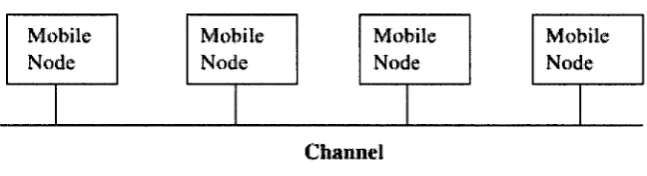
view of node connections using the CMU Monarch extensions to NS-2 is shown in Figure
2.10.
Mobile Node
Mobile Node
Mobile Node
Mobile Node
Channel
Each mobile node acts as an independent entity which might have one or more network
interfaces attached to a channel. The channel acts as the link that carries packet between
mobile nodes. Every packet transmitted to the channel has a copy distributed to all the
network interfaces on the channel. Each interface then uses a radio propagation model to
determine if it can receive the packet. Mobile nodes are responsible for computing their
position and velocity as a function of time.
The mobile node architecture of NS is shown in Figure 2.11. Each arriving packet from the
channel is stamped by the network interface with the receiving properties and then invokes
the propagation model. Based on the propagation model and the receiving properties the
network interface determines if the node can receive the packet or not. If it can receive the
packet, the packet is handed to the MAC layer where it determines if the packet has an error
or arrives collision free. If it has no error and arrives collision free, the MAC layer hands
the packet to the mobile's node entry point. At this point if the node is the final destination
of the packet, the address demux will hand the packet to the port demux, and then to the
proper sink agent. If the node is not the packet's final destination, it will be handed to the
default target of the address demux, and the routing agent will assign the packet a next hop
address and pass the packet back to the link layer. If the next hop address is an IP address,
the Link Layer (LL) object queries the ARP object to translate the IP address to a hardware
address. On getting the hardware address, the packet is inserted into the interface queue
(IFq). The MAC layer takes packets from the head of the interface queue and sends them to
Some/siik
ARP
MobileNode
PtGpagatiofi
models
d
o
PrtjVart
Classifier: Forwarding
Agent: protocol Entity
Node Bitty
IJL: Link layer object
IFQ: Interface queue
MAC: Mac object
PHY: Net interface
Radio propagation/ antenna models
CHANNEL
Figure 2.11: Portrait of mobile node
2.10 Cross Layer Design for MANET
Recently, there has been an increase in the design of routing protocols for MANET which
are based on cross-layer design. MANET needs to meet different type of Quality of Service
(QoS) for the different applications. Some of the applications of MANET are sensor
networks, personal networks, home networks. These applications are different from one
another and thus require unique service level requirements. A sensor network consist of
various sensor nodes which work together to gather specific information such as
temperature, pressure, humidity. The sensors used in this network usually have limited
power and processing capabilities. Thus reliability of data is crucial in sensor networks.
Personal networks consist of cell phone, laptop, and personal digital assistance (PDA). The
support different requirements such as reliability, data rate, and delay. Home networks are
made of house hold appliances, entertainment centers, home phones, computers, security
devices. Rate of connectivity between devices in home networks are diverse; they connect
with each other using different rates.
A p p l i c a t i o n . L a y e r
_f_
N e t w o r k L a y e rW
M A O L a y e r
I
L i n k L a y e r
Figure 2.12: OSI model for protocol stack
S p t e m Constraint
• M *
Application Layer
•
Network Layer
*
M A C Layer
*
Link Luvtr
^s=--Cross-layer Adaptivitj
Future applications will also need diversified requirements. Researchers have also argue
that the fixed layered architecture shown in Figure 2.12, which has worked well for wired
networks, is not suitable for wireless networks.
In fixed protocol stack, the overall networking tasks are divided into layers which act
independently to provide services. These layers cannot communicate directly with
nonadjacent layers and only communicate with adjacent layers through defined procedure
calls and responses. This type of system prevents a layer from adapting its performance in
response to performance from other layers. Researchers have stated that the best way to
meet the performance requirement of the various applications of MANET is to allow for
interactions among layers because changes in some layers might affect performance in
other layers. A cross-layer architecture shown in Figure 2.13 was proposed in [38]. The
figure indicates that information needs to be exchange by all layers of the protocol stack so
that protocols in each layer will be able to adapt universally to network conditions and
application requirements. There are also some system level constraints which need to be
met by joint optimization by the layers.
Numerous literatures have been published on cross-layer design. A survey and summary of
those publications can be found in [37]. Challenges and new modalities for design
protocols were pointed out in the publication. Some cross-layer designs such as those
presented in [2, 29, 32], and [37] are related to this thesis and will be briefly explained.
A cross-layer design called Hierarchical Dynamic Source Routing (DSR) is presented in
[2]. This protocol's objective was to reduce the effect of flooding in MANET by using a
novel node selection algorithm called FN selection algorithm and further improve the
selection algorithm by combining with a cross-layer design. The FN selection algorithm
classifies nodes as either mobile nodes (MN) or forwarding nodes (FN). The cross-layer
design works by using congestion information (contention window) obtained from the
congested areas of the network. Results obtained show a significant improvement over
DSR protocol in terms of overhead reduction, delays and throughput.
Cross-Layer Ad hoc On-demand Distance Vector (CLAODV) was proposed in [37].This
protocol which is based on Ad hoc On-demand Distance Vector (AODV), make use of
information interaction between MAC sub-layer and routing sub-layer to reduce the size of
the HELLO message in the network and thereby reducing overhead. Each node saves its
current sequence number in the header field of the data frame in the MAC layer. When the
MAC layer of a node receive a data frame from a neighbor it passes the new sequence
number to its routing layer where it is saved in its routing table together with MAC address
of the neighbor. This form of exchange of sequence number information between
neighbors helps to reduce the frequency of sending HELLO messages. Also the size of the
HELLO messages are reduce because the sequence numbers are saved in the headers of the
data frames instead of the body.
In [29] the authors stated that nodes can measure the degree of congestion around
themselves by monitoring the instantaneous transmission queue length and the average
MAC layer utilization at the node. The average MAC layer utilization is defined as the
fraction of time that node either (1) has one or more packets to transmit in its network
interface queue, or (2) has attempted to transmit a packet but failed. Since the
instantaneous utilization at a node is either "0" or "1", these values were average over a
period of 10 seconds. The authors in [29] suggested that the congestion level measurement
can be used by routing protocols in various ways such as: (1) not attempting local route
repairs in congested areas in protocols such as AODV, (2) reduction of periodic
advertisement when the medium is busy and (3) chosen route in less congested areas
during route discovery. Simulation results presented in [29] showed an improvement in
packet delivery and overhead reduction when routes are selected in less congested areas.
The congestion level measurement can be used in other layers such as the transport layer
a packet IP header. It can also be used in the presentation layer to compress data before
transmission if the medium around the node is very busy.
Congestion-adaptive Routing Protocol (CRP) was proposed in [32]. The authors argue that
most existing routing protocols such as AODV are congestion-unadaptive protocols. The
congestion unawareness in these protocols causes long delay, high overhead and high
packet losses. In reactive protocols, such as AODV, there is a delay between the time
congestion is detected and the time it takes to search for a new route. A lot of overhead is
generated in discovering a new route to a destination. Also before congestion is detected, a
lot of packets could have been lost already. The CRP has been proposed to mitigate the
above mentioned problems by avoiding congested route. In the CRP, each node gets
congestion information from its next node along a route to a destination. Depending on the
severity of the congestion, a node uses a "bypass" route to avoid the potentially congested
area. The authors suggested various parameters for monitoring congestion by a node such
as average packet delay, number of packets discarded due to a filled buffer, average queue
length, number of packets timed out and standard deviation of packet delay. The authors
made use of the ratio between the numbers of packets waiting for transmission in the buffer
to the buffer size. This ratio is used to classify a node as "green" (i.e., far from congested),
"red" (i.e., congested), or "yellow" (i.e., getting congested). When the next node on a route
becomes "yellow" or "red", the previous node looks for a bypass route to avoid the
congested area. Simulation results showed that the CRP performed better than AODV and
DSR in terms of packet delivery and end-to-end delay.
The various cross-layer design approaches presented here show that cross-layer design can
improve the performance of a network. This is a great advantage for MANET. But
cross-layer design also comes with some adverse effects. These adverse effects have been
investigated by [43]. Some of them are:
• It can lead to disorderly design which will make further innovation difficult.
2.11 Conclusions
In this chapter, MANET was introduced. The unique characteristic of MANET that makes
it different from wired network, the importance of an efficient routing protocol in MANET
and also the features of such routing protocols were discussed. Proactive and reactive
routing protocols were explained. "Flooding" problem in reactive routing protocols was
explained and the effect of "flooding" was analyzed. Cross-layer design was introduced in
this chapter. The importance of cross-layer design in helping to meet the performance
Chapter 3
Ad Hoc On-Demand Distance Vector Routing
Protocol with Cross-Layer Design (AODV-CL)
3.1 Introduction
Finding routes in less congested areas of the network and reducing flooding in MANET
leads to reduction in the amount of overhead packet generated in the network and hence
improves bandwidth utilization and scalability. A lot of protocols have been proposed to
reduce the amount of overheads generated in MANET. These protocols are classified as (i)
location based schemes such as [3, 8, 9, 10] and [23], (ii) probability schemes such as [12,
13] and [23] and (iii) clustering schemes such as [1] and [27].
In [3] a location based scheme using Mobile Backbone Network (MBN) was proposed.
Three types of nodes exist in this type of network, that are backbone nodes (BN), backbone
capable nodes (BCN) and regular nodes (RN). It is assumed that each node is equipped
with a Global Positioning System (GPS). The RN acquires the location of other RNs
through the BNs. Thereby eliminating the need for a central location server and reducing
the overhead incurred in updating the location server. The RN performs route discovery by
propagating route request message toward the location of the destination using the AODV
protocol. This limits the search area thereby reducing overhead. This scheme does not find
route to destination using least number of hops rather determines a route to destination with
the lowest delay. Providing GPS for every node adds extra cost. The greedy perimeter
stateless routing (GPSR) proposed in [8] broadcasts route request packet to the closest
node to the destination node. The location of each node is assumed to be known by other