University of Windsor University of Windsor
Scholarship at UWindsor
Scholarship at UWindsor
Electronic Theses and Dissertations Theses, Dissertations, and Major Papers
2009
Adaptive foreground segmentation using fuzzy approach
Adaptive foreground segmentation using fuzzy approach
Huajing Yao
University of Windsor
Follow this and additional works at: https://scholar.uwindsor.ca/etd
Recommended Citation Recommended Citation
Yao, Huajing, "Adaptive foreground segmentation using fuzzy approach" (2009). Electronic Theses and Dissertations. 7989.
https://scholar.uwindsor.ca/etd/7989
This online database contains the full-text of PhD dissertations and Masters’ theses of University of Windsor students from 1954 forward. These documents are made available for personal study and research purposes only, in accordance with the Canadian Copyright Act and the Creative Commons license—CC BY-NC-ND (Attribution, Non-Commercial, No Derivative Works). Under this license, works must always be attributed to the copyright holder (original author), cannot be used for any commercial purposes, and may not be altered. Any other use would require the permission of the copyright holder. Students may inquire about withdrawing their dissertation and/or thesis from this database. For additional inquiries, please contact the repository administrator via email
NOTE TO USERS
This reproduction is the best copy available.
ADAPTIVE FOREGROUND SEGMENTATION
USING FUZZY APPROACH
by Huajing Yao
A Thesis
Submitted to the Faculty of Graduate Studies through the School of Computer Science in Partial Fulfillment of the Requirements for
the Degree of Master of Science at the University of Windsor
Windsor, Ontario, Canada 2009
1*1
Library and Archives CanadaPublished Heritage Branch
395 Wellington Street OttawaONK1A0N4 Canada
Bibliotheque et Archives Canada
Direction du
Patrimoine de I'edition
395, rue Wellington OttawaONK1A0N4 Canada
Your file Votre reference ISBN: 978-0-494-57639-7 Our We Notre reference ISBN: 978-0-494-57639-7
NOTICE: AVIS:
The author has granted a
non-exclusive license allowing Library and Archives Canada to reproduce, publish, archive, preserve, conserve, communicate to the public by
telecommunication or on the Internet, loan, distribute and sell theses
worldwide, for commercial or non-commercial purposes, in microform, paper, electronic and/or any other formats.
L'auteur a accorde une licence non exclusive permettant a la Bibliotheque et Archives Canada de reproduire, publier, archiver, sauvegarder, conserver, transmettre au public par telecommunication ou par I'lnternet, preter, distribuer et vendre des theses partout dans le monde, a des fins commerciales ou autres, sur support microforme, papier, electronique et/ou autres formats.
The author retains copyright ownership and moral rights in this thesis. Neither the thesis nor substantial extracts from it may be printed or otherwise reproduced without the author's permission.
L'auteur conserve la propriete du droit d'auteur et des droits moraux qui protege cette these. Ni la these ni des extraits substantiels de celle-ci ne doivent etre imprimes ou autrement
reproduits sans son autorisation.
In compliance with the Canadian Privacy Act some supporting forms may have been removed from this thesis.
Conformement a la loi canadienne sur la protection de la vie privee, quelques
formulaires secondaires ont ete enleves de cette these.
While these forms may be included in the document page count, their removal does not represent any loss of content from the thesis.
Bien que ces formulaires aient inclus dans la pagination, il n'y aura aucun contenu manquant.
1*1
HI
Author's Declaration of Originality
I hereby certify that I am the sole author of this thesis and that no part of this thesis has been published or submitted for publication.
I certify that, to the best of my knowledge, my thesis does not infringe upon anyone's copyright nor violate any proprietary rights and that any ideas, techniques, quotations, or any other material from the work of other people included in my thesis, published or oth-erwise, are fully acknowledged in accordance with the standard referencing practices. Fur-thermore, to the extent that if I have included copyrighted material that surpasses the bounds
of fair dealing within the meaning of the Canada Copyright Act, I certify that I have ob-tained a written permission from the copyright owner(s) to include such material(s) in my thesis and have included copies of such copyright clearances to my appendix.
I declare that this is a true copy of my thesis, including any final revisions, as approved
iv
Abstract
Intelligent visual surveillance which attempts to detect, recognize and track certain
ob-jects from image sequences is becoming an active research topic in computer vision com-munity. Background modeling and foreground segmentation are the first two and the most important steps in any intelligent visual surveillance systems. The accuracy of these two steps highly effects performance of the following steps. In this thesis, we propose a simple and novel method which employs histogram based median method for background
V
Dedication
VI
Acknowledgements
I would like to take this opportunity to express my sincere gratitude to Dr. Imran
Ah-mad, my supervisor, for his steady encouragement, patient guidance and enlightening dis-cussions throughout my graduate studies. Without his help, the work presented here could not have been possible.
I also wish to express my appreciation to Dr. Boubakeur Boufama, School of Computer
Science and Dr. Mehdi Monfared, Department of Mathematics and Statistics for being in the committee and spending their valuable time and Dr. Ziad Kobti, School of Computer Science for serving as the chair of the defense.
Contents
Author's Declaration of Originality iii
Abstract iv
Dedication v
Acknowledgements vi
List of Tables ix
List of Figures x
1 Introduction 1
2 Intelligent Visual Surveillance 6
2.1 Overview of the Intelligent Visual Surveillance 6 2.2 Applications of Intelligent Visual Surveillance 10
2.3 Approaches for Motion Detection 11 2.3.1 Background subtraction 12 2.3.2 Temporal differencing 13 2.3.3 Optical flow 13
2.4 Summary 14
CONTENTS viii
3 Related Work 15
3.1 Color Space 16
3.2 Previous Work 18
3.3 k-Means clustering Method 22 3.4 Mixture of Gaussians 25
3.5 Summary 28
4 The Proposed Method 30
4.1 Statistical Background Modeling 30
4.2 Adaptive Foreground Segmentation 34
4.3 Summary 38
5 Experimental Results 39
5.1 Comparative Results 39 5.2 Analysis and Discussion 51
5.3 Summary 53
6 Conclusions and Future Work 54
Bibliography 56
List of Tables
5.1 The processing time corresponding to video in Figure 5.1 43
5.2 The processing time corresponding to video in Figure 5.3 44 5.3 The processing time of the proposed approach for PETS series videos . . . 50
5.4 The processing time of MoG for PETS series videos 50
5.5 The processing time of k-Means clustering method for PETS series videos . 50
List of Figures
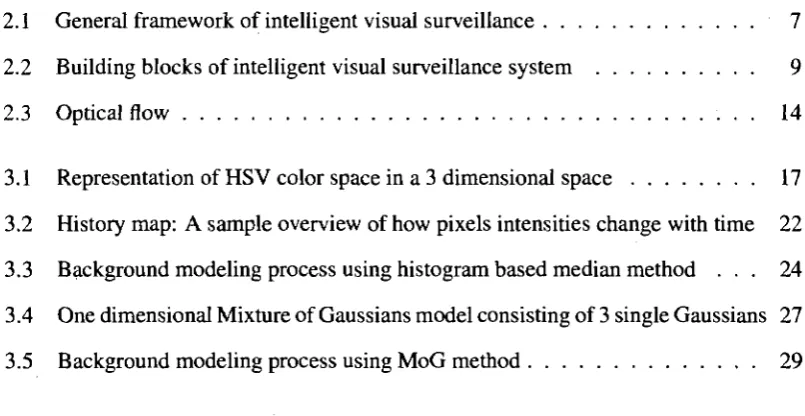
2.1 General framework of intelligent visual surveillance 7
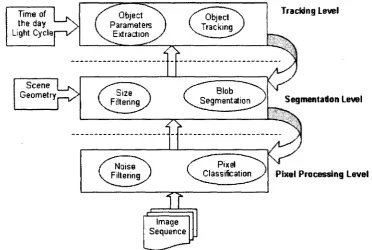
2.2 Building blocks of intelligent visual surveillance system 9
2.3 Optical flow 14
3.1 Representation of HSV color space in a 3 dimensional space 17 3.2 History map: A sample overview of how pixels intensities change with time 22
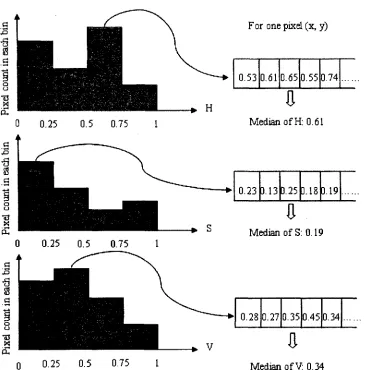
3.3 Background modeling process using histogram based median method . . . 24 3.4 One dimensional Mixture of Gaussians model consisting of 3 single Gaussians 27
3.5 Background modeling process using MoG method 29
4.1 Background modeling of a single pixel using its statistical information . . . 33
5.1 The images from an indoor video for background modeling taken in a corridor 40 5.2 The estimated background using image sequence in Figure 5.1 . 41 5.3 Another set of images from an indoor video but with a lower dimension . . 42
5.4 The estimated background using image sequence in Figure 5.3 43
5.5 Segmentation results using 3 different methods on frame 71 of video in
Figure 5.1 44 5.6 Segmentation results using 3 different methods on frame 121 of video in
Figure 5.1 45
LIST OF FIGURES XI
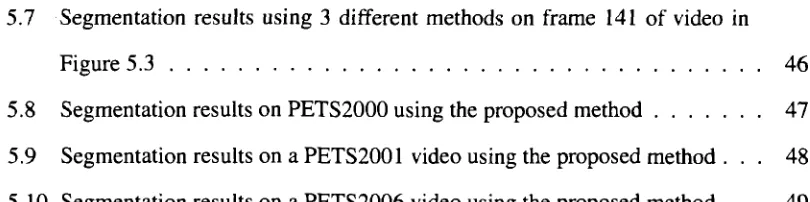
5.7 Segmentation results using 3 different methods on frame 141 of video in
Figure 5.3 46 5.8 Segmentation results on PETS2000 using the proposed method 47
5.9 Segmentation results on a PETS2001 video using the proposed method . . . 48
Chapter 1
Introduction
In recent years, intelligent visual surveillance, also called automated visual surveillance
has emerged as an important research topic in computer vision community and with good
reason. According to New Scientist magazine: "If the technology takes off it could put
an end to a longstanding problem that has dogged CCTV almost from the beginning. It
is simple: there are too many cameras and too few pairs of eyes to keep track of them.
With more than a million CCTV cameras in the UK alone, they are becoming increasingly
difficult to manage.
Surveillance cameras are cheap and ubiquitous. In conventional approach of visual
surveillance systems, Closed-Circuit Television (CCTV) cameras are installed in public
and private areas to capture indoor or outdoor scene information, which is then transmitted
and displayed in a terminal or a television where a human observer keeps monitoring and
optionally records video information in a storage medium [61].
However, the manpower required for surveillance is not only expensive but may also
involves a host of associated problems. From the real-time threat detection perspective, it
1 New Scientist, 12 July 2003, page 4.
CHAPTER I. INTRODUCTION 2
is a well known fact that over a period of time, the human visual attention drops below an acceptable level even when trained personnel are assigned to the surveillance task. Further, it is difficult for one operator to concurrently monitor several places. Currently, most of the video information from the cameras are used merely as an archive to refer back to once an
incident is known to have taken place [52].
The purpose of intelligent visual surveillance system is to obtain a description of what is happening in a monitored area and then to take appropriate action based on that interpre-tation, e.g., alert a human supervisor to reduce human involvement significantly and assist
human operators for better monitoring [24], [2].
The essential idea of developing an intelligent visual surveillance system is to detect motion and track objects of interest that generates motion, upon which higher level recog-nition capabilities can be achieved [42], [24], [25], [27].
A typical method to detect unusual motion is through background subtraction - a tech-nique which detects moving regions in an image by taking the difference between the
cur-rent frame and the background model in a pixel-by-pixel fashion [24], [25]. Background subtraction has two important components: (1) background modeling and (2) foreground segmentation. Background modeling is a representation of the empty scene (without fore-ground objects), while forefore-ground segmentation is the detection of moving forefore-ground ob-jects within the monitored scene.
In an ideal situation, the background model is known in advance and the background does not change over time. However, in realistic environments, background subtraction methods encounter several problems. Following is a brief description of some of the im-portant ones [29], [35], [43]:
CHAPTER 1. INTRODUCTION 3
empty background model, i.e., public areas such as airport terminals, shopping malls, etc.
• the appearance of objects in background model changes due to illumination changes
in the scene, e.g., changing weather conditions, time of the day, or the switching of lights can lead to entire scene being misclassified as foreground object(s).
• there may be dynamic background objects in the surveillance scene, i.e., flickering computer screen, wavering tree branches, etc.
• some or all of the static background part may convert to a dynamic background, e.g., by turning on a computer screen. A dynamic background pixel can also turn to a
static one such as a wavering tree branch when the wind stops.
• the background object turns to the foreground object, e.g., in a parking lot, a car may enter the scene and is parked. Initially, the car needs to be detected as a fore-ground object but after it has been parked there, should be considered as part of the
background, and vice versa.
Background model for general scenes should be able to represent not only the stationary objects, i.e., walls, doors and room furniture, but also the non-stationary (or "dynamic") objects such as waving tree branches, moving escalators. Moreover, background model for general environments should self-evolve to incorporate illumination changes in the scene and changes of background objects (i.e., add, remove and relocate the background objects).
Once background is computed or known, foreground segmentation and detection of
CHAPTER 1. INTRODUCTION 4
• Finding a threshold to differentiate between background and foreground is difficult. If the threshold is too low, some background pixels may be misclassified as foreground
pixels. If the threshold is too high then some foreground pixels may be
misclassi-fied as background pixels. In the latter case, the foreground region might consist of apertures inside and/ or get segmented into several isolated regions. The inaccurate
segmentation results will create problems for later tasks, i.e., tracking the foreground objects and will result in poor performance of the overall surveillance system.
• Shadow introduces several difficulties for the process of detecting foreground, i.e., object shape distortion, object merging or even object losses due to shadow over another object. Shadows are categorized into cast shadows and self shadows. The cast shadow is caused by moving objects on the side of the object while self shadow
is caused by the object on itself, i.e., shadows cast by folding of a shirt. During the process of cast shadow removal, some of the self shadow regions may also be deleted which may not be desirable.
• Another major problem in foreground segmentation is the camouflage. When a
fore-ground object has a similar color and intensity as the backfore-ground, it is difficult to distinguish between them. Part of the foreground object is misclassified as the back-ground, and that may lead to missing or split foreground object regions.
Designing an automated surveillance system has a number of issues and difficulties and some of those have been presented above. The first stage of an automated surveillance system is to build a background model from which the foreground object(s) can be properly separated. Therefore, there is a need to improve background modeling and foreground
CHAPTER I. INTRODUCTION 5
In this thesis, we use a fast and effective background modeling scheme that is based on a histogram based median method. It estimates the background model from the image se-quence itself without prior knowledge of the scene, i.e., even in the presence of foreground objects in the image sequence [28], and proposes fuzzy k-Means clustering for foreground
segmentation, which eliminates the dilemma of choosing a proper threshold.
Rest of the thesis is organized as follows: Chapter 2 is a detailed introduction of the
Chapter 2
Intelligent Visual Surveillance
This chapter gives an overview of intelligent visual surveillance. The general framework and the functional components are explained, followed by some applications of the intelli-gent visual surveillance. Finally, the conventional approaches for motion detection which is the first important step in intelligent visual surveillance are discussed.
2.1 Overview of the Intelligent Visual Surveillance
Intelligent visual surveillance attempts to detect, recognize and track certain objects from image sequences. Its general framework includes following stages:
• modeling of environments
• detection of motion
• classification of moving objects
• tracking
CHAPTER 2. INTELLIGENT VISUAL SURVEILLANCE
understanding and description of behaviors
• human identification
fusion of data from multiple cameras
Figure 2.1 is the illustration of the intelligent visual surveillance system [24].
Q C a m e r a 1 / Camera n
Motion Detection
Environment modeling
Motion segmentation
Object classification
Tracking
B ehavior understanding and description Personal identification Environment modeling Motion segmentation Object classification Tracking
B ehavior understanding and description
Personal identification
Fusion of information from multiple cameras
Figure 2.1: General framework of intelligent visual surveillance
Motion detection is the first and the most important step in nearly every visual surveil-lance system. It aims at segmenting regions corresponding to moving objects from the rest
CHAPTER 2. INTELLIGENT VISUAL SURVEILLANCE 8
dependent on it. Environment modeling, motion segmentation, and object classification
are typical processes in motion detection [24], [57]. Environment modeling is same as the background modeling, and aims to establish a background model for the surveillance scene. Motion Segmentation is carried out to detect regions corresponding to moving objects such as vehicles and humans. Detection of moving regions provides a focus of attention for later processes since only these regions need be considered. Object classification is the
determi-nation of the type of object corresponding to different moving regions, i.e., in road traffic scenes, may include humans, vehicles, flying birds and moving clouds.
After motion detection, surveillance systems generally track moving objects from one frame to another in an image sequence. The difficulty of tracking is determining the
ap-pearance and location of a particular object in the sequence of frames, i.e., two people walk towards each other, after occlusion, the tracking algorithms have to figure out "who is who?" among all the frames [21]. Understanding of behaviors is the recognition of sus-picious motion patterns: the behaviors in the testing sequence are analyzed and compared with typical labeled behaviors. In some applications, description of behaviors using natural
language is necessary for a nonspecialist operator involved in visual surveillance [41]. Personal identification deals with the issue "who is now entering the area under surveil-lance?". It can be treated as a special behavior understanding problem. In such applications, biometric features such as human face and gait are widely used [55]. Fusion of
CHAPTER 2. INTELLIGENT VISUAL SURVEILLANCE 9
results of different cameras to obtain an integrated trajectory" [24].
From the functional blocks point of view, intelligent visual surveillance system consists
of three levels: pixel processing level, object segmentation level and tracking level as shown in Figure 2.2.
Time of the day Light Cycler
Scene I ^ Geometry,_J^
^ T V
Tracking Level
Segmentation Level
Pixel Processing Level
Image Sequence
Figure 2.2: Building blocks of intelligent visual surveillance system
Pixel processing level is a basic step for any intelligent visual surveillance system. The classification of foreground and background is based on the pixel itself, i.e., intensity, color. Object segmentation level establishes clear foreground object's blob, which is a spatially coherent group of pixels clustered together. Usually 4-connectivity or 8-connectivity
CHAPTER 2. INTELLIGENT VISUAL SURVEILLANCE 10
to the pixel at (x,y). 8-connected pixels are neighbors to every pixel that touches one of their edges or corners. These pixels are connected horizontally, vertically, and diagonally.
In addition to 4-connected pixels, every pixel with coordinates (x±l,v±l)or(jc±l,y=Fl) is connected to the pixel at (x,y).
2.2 Applications of Intelligent Visual Surveillance
Intelligent visual surveillance has a wide range of applications, such as a security for com-munities and important buildings, traffic surveillance in cities and expressways, detection of military targets, etc [19]. However, the most investigated application is the surveillance
of people or vehicles. Some of the important applications are described as follows:
1. Crowd flux statistics and congestion analysis
Using techniques for human detection, visual surveillance systems can automatically com-pute the flux of people at important public areas such as shopping malls and travel sites, and then provide congestion analysis to assist in the management of people [11]. In a similar way, visual surveillance systems can monitor expressways and junctions in road networks, and further analyze the traffic flow and the status of road congestion, which are of great
importance for traffic management [24].
2. Identity checking (biometrics)
Video surveillance can be used for access control in some security-sensitive locations such as military bases and important organizations. Identity of a person can be verified by differ-ent biometric features such as height, facial appearance and walking gait in real time, and
CHAPTER 2. INTELLIGENT VISUAL SURVEILLANCE 11
3. Suspect identification
Using intelligent visual surveillance, criminals or suspects can be identified in public or
suspected places, e.g., subway stations, casinos by analyzing biometric features of that sus-pect. If the person detected is a suspect, alarms are given immediately. Such systems along
with face recognition capability have already been used at public sites, but the reliability is too low for police requirements [24].
4. Interactive surveillance using multiple cameras
For social society, cooperative surveillance using multiple cameras could be used to ensure the security of an entire community, for example by tracking suspects over a wide area by using the cooperation of multiple cameras. For traffic management, interactive
surveil-lance using multiple cameras can help the traffic police discover, track, and catch vehicles involved in traffic offences [24].
5. Anomaly detection and alarming
In some circumstances, it is necessary to analyze the behaviors of people and vehicles and determine whether these behaviors are normal or abnormal. For example, visual surveil-lance systems set up in supermarkets and parking lots can analyze abnormal behaviors indicative of a theft and robbery [14].
2.3 Approaches for Motion Detection
CHAPTER 2. INTELLIGENT VISUAL SURVEILLANCE 12
important features: high precision with two meanings of accuracy in shape detection and
reactivity to changes in time, flexibility in different scenarios (indoor, outdoor) or different light conditions, and efficiency, in order for detection to be provided in real-time [19].
There are three conventional approaches in literature for motion segmentation or foreground segmentation [24], [2].
2.3.1 Background subtraction
Background subtraction is a popular method for motion segmentation. It is especially useful in situations with a relatively static background. It can detect moving regions in an image
by taking the difference between the current image and a reference background image in a pixel-by-pixel fashion. It is a simple and computationally affordable method for real-time applications, but is extremely sensitive to changes in dynamic scenes derived from lighting and extraneous events etc. Therefore, it is highly dependent on a good background model to reduce the influence of these changes [18], [22], [45] in the background model.
The background subtraction method can be written mathematically as:
FG{x,y) = \
I 0, otherwise.
where Lxy) is the color of a pixel at a 2D location (x,y) and BG^xy^ is the color of the
CHAPTER 2. INTELLIGENT VISUAL SURVEILLANCE 13
2.3.2 Temporal differencing
Temporal differencing, also known as the Frame Differencing makes use of pixel-wise dif-ferences between two or three consecutive frames in an image sequence to extract moving
regions [3]. Temporal differencing is very adaptive to dynamic environments, but generally does a poor job of extracting all of the relevant pixels, e.g., there may be holes left inside
moving entities.
Mathematically, temporal differencing can be written as:
t
1, \i\l\ ,~l'r\\>T;
FG{x,y) = { ' ^ ^ '
0, otherwise.
where /{ -, is the intensity of a pixel at the location (x,y) in the current frame captured
at time t and I'r\ is the intensity of the same pixel in a frame captured at time t — 1. If the difference between these two exceeds the threshold T, the pixel (jr,y) in current frame is considered as the foreground, otherwise, it is considered as the background. Sometimes more than two consecutive frames are considered to increase the accuracy of detection.
2.3.3 Optical flow
Optical flow based motion segmentation methods use characteristics of flow vectors of moving objects over time to detect moving regions in an image sequence. They can be used
CHAPTER 2. INTELLIGENT VISUAL SURVEILLANCE 14
can be found in [4].
w5
Figure 2.3: Optical flow
2.4 Summary
This chapter presents a detailed view of intelligent visual surveillance in terms of its
Chapter 3
Related Work
For background modeling without specific domain knowledge, the background is usually represented by image features at each pixel. The features extracted from an image sequence
can be classified into three types [35], [38]: spectral, spatial, and temporal features. Spec-tral features could be gray-scale or color information. Spatial features could be gradient
or local structure, and temporal features could be inter-frame changes at the pixel. Most of the existing methods use spectral information, i.e., distribution of intensities or colors at each pixel for background modeling since it is straightforward and suitable for static
background pixels [15], [60], [22], [54]. To tolerate the illumination changes, some spatial features are incorporated with spectral information [37], [29]. Temporal features are inves-tigated in [58], [36], [35] to describe the dynamic background pixels such as waving trees, flicking screens. In this thesis, we use color information represented in HSV color space for background modeling and foreground segmentation.
CHAPTER 3. RELATED WORK 16
3.1 Color Space
The images extracted from video are represented in RGB color space (R: Red; G: Green; B: Blue). In this color space, spectral information is equally spread among all of the three components, and it is not perceptually similar to our eyes. Any change in illumination results in changes in values of all of the three components. Therefore, most of the
back-ground subtraction approaches convert RGB color space to some other color space such as HSV color space before further processing. HSV stands for Hue, Saturation and Value. It is a widely described color scheme in literature for surveillance [44], [1], [27], [2]. It is a nonlinear transformation of RGB color space.
Figure 3.1 is a pictorial representation of HSV color space. It provides a color decom-position close to human perception where wavelength, brightness and intensity information are separated [34]. The H (Hue) determines the basic color. A hue is referenced as an angle on a color wheel with a range of [0,360°]; the S (Saturation) determines the grey level of the color (or the amount of white light in the color) in the range [0,1]; the V (Value) represents
the global intensity of the light with a range of [0,1].
The advantage of using this color space is that the intensity (V) can be separated from the chromatic information (HS). All of the useful information is present only in the V chan-nel. HSV color space can deal with noise and shadow in the image region very effectively.
The mathematical relationship between RGB and HSV is given as follows [32]:
{
8 if B<G360° - 9 if B > G
CHAPTER 3. RELATED WORK 17
Value
Yellow
Cyan
l/ = 1 (White)
l / = 0 (Black)
ft (Hue Angle)
S (Saturation)
Figure 3.1: Representation of HSV color space in a 3 dimensional space
in which
9 = cos
V = -(R + G + B)
., ^[{R-G) + {R-B)] [(R-G)2 + {R-B)(G-B)}i
Normalized color space is another popular color space [56], [45], [15] used in intelli-gent visual surveillance. It is independent of the intensity and thus, robust to shadows and varying lighting conditions, with mathematical transformation given as:
M
\*J
' (R + G + G)/3 ^ R/{R + G + B)
y G/{R + G + B) )
CHAPTER 3. RELATED WORK 18
the RGB color pixel.
3.2 Previous Work
Up until now, a large amount of work has been proposed to address the issues of background model representation and adaption. These algorithms share the common assumption that
an initial background model can be obtained by employing a period of training sequence, in which no foreground objects are present [22], [40], [58].
In some cases it is impractical or impossible to record a separate background sequence without objects' interference, e.g., airport terminals. Further, it is expensive to clear up
the scene from foreground objects on a regular basis since this procedure must be repeated every time there is even a small change in the background.
Median filter [17] and Kalman filter [51] were proposed to address the above
limita-tions. They provide a good background model when the scene is not too crowded, i.e., at every pixel, the background should be visible more than fifty percent of the time during the training sequence. If the assumption fails, the output background model contains blending pixels or areas of error.
Long and Yang [40] presented an adaptive smoothness method based on the assumption
that the longest and most stable interval of pixel intensity is most likely to represent the background. At each pixel, a moving window along time is employed to search for the stable intervals. However, when the data include multi-modal distributions (i.e., dynamic backgrounds including swaying trees) and when the modes from foreground objects are stationary for a long period of time, a lot of pixels are incorrectly classified.
CHAPTER 3. RELATED WORK 19
compute the probability of each stable interval of intensity being the background and then selects the most probable one to represent the background. Since the result of computation of local optical flow is sensitive to the insignificant movement of other objects in the sce-nario or the interaction between objects, the algorithm is less robust to deal with complex situations.
Stauffer et al. [53] designed a mixture of Gaussian (MoG) model, currently one of the most popular methods, to effectively deal with the dynamic background and light changes.
Each pixel in MoG is modeled by three to five Gaussian distributions, which are adaptively adjusted as each new frame is coming. The main deficiency of MoG is that it is time consuming. Some researches are dedicated in improving the learning rate of MoG [33]. Another serious problem of MoG is that the slow moving objects and zooming objects are easily separated as referenced background, which makes the foreground information lost.
To overcome the problem of inaccurate background model caused by errors in
param-eter estimation methods such as MoG, Elgammal, Harwood et al. [15] proposed a non-parametric model for background modeling. The model employs a kernel estimator to determine the type of current pixel value based on recently observed values for this pixel. However, several pre-calculated lookup tables for the kernel function values are required to reduce the burden of computation in this approach. Also, this method can not resist the
influence of foreground objects in the training stage.
Pixel-based methods mentioned above assume that the time series of observations is independent on each pixel. Region- or frame-based models are recently developed in [9], [58], [46], [13]. These models consider pixel as correlated random variables, and estimate probabilities based on their neighborhood relationships.
CHAPTER 3. RELATED WORK 20
chromatic and temporal overlap with their neighbors. Such kind of similarities between pixels are served to cast votes for each other in the local region to determine pixel's
back-ground period. The disadvantage of this algorithm is that the output performance is highly related to the initial guess of each pixel's background mode.
Oliver et al. [48] proposed an approach called Eigenbackgrounds which captures spatial correlations by applying principal component analysis to a set of Ni video frames that do not contain any foreground objects. This results in a set of basis functions of which only
the first d basic functions are required to capture the primary appearance characteristics of these frames. A new frame can then be projected into the eigenspace denned by these d basis functions and then back projected into the original image space. Since the basis
functions only model the static part of the scene when no foreground objects are present, the back projected image does not contain any foreground objects. As such, it can be used as
a background model. The limitation of this approach is that computing the basis functions requires a set of video frames without foreground objects.
Li et al. [36], [37], [35], [38] proposed a generalized framework using Bayesian theory to update the background model by frame-based features. The approach is reported to be robust to illumination changes (gradual and sudden "once-off'), dynamic backgrounds (i.e., waving trees, rippling water surfaces) and changed background (add, remove and relocate
background objects). The shortcoming is that if the foreground objects remain motionless in the scene for a while, they are quickly absorbed into the background.
Due to its pervasiveness in various contexts, background subtraction has been investi-gated by many researchers with plenty of published literature (see surveys in [49], [50]). There is no unique classification of proposed methods. The following include some usually
CHAPTER 3. RELATED WORK 21
• Parametric versus nonparametric: Parametric models (e.g., [60]) are tightly coupled with underlying assumption, do not always perfectly correspond to the real data, and
the choice of parameters can be cumbersome, thus reducing automation. On the other hand, nonparametric models (e.g., [15], [30]) are more flexible but heavily data
dependent.
• Unimodal versus multimodal: Basic background models assume that the intensity values of a pixel can be modeled by a single unimodal distribution (e.g., [60], [17],
[20]). Such models usually have low complexity, but cannot handle moving back-grounds, while this is possible with multimodal models (e.g., [53], [58]), but at the price of higher complexity.
• Recursive versus nonrecursive: Nonrecursive techniques (e.g., [60], [53]) store a buffer of a certain number of previous sequence frames and estimate the background
model based on the temporal variation of each pixel within the buffer, while recursive techniques (e.g., [58], [10]) recursively update a single background model based on each input frame. In nonrecursive techniques, the background well adapts to eventual variations, but memory requirements can be significant while in recursive techniques, space complexity is lower, but input frames from distant past can have an effect on
the current background, and therefore any error in the background model is carried out for a long time period.
CHAPTER 3. RELATED WORK 22
This step obviously increases the overall complexity.
3.3 k-Means clustering Method
Background estimation using the median intensity value for each pixel was first used in a traffic monitoring system [17]. In [28], a histogram is constructed to determine the
confi-dence of median value as the estimated background pixel.
Figure 3.2 shows a history map to represent intensity characteristics of a pixel over a time period. In this figure, the observed images are the image frames obtained from the video over a period of time. The cell string represents entire intensity variation at each pixel
location over all the frames, and represents the D dataset. Each pixel has three components H, S and V which are obtained from R, G and B.
Observed images
Pixel (0.0)
R G
1 1
Hi Si V
- 1 ( - - » • - •
Hi S! V Cell String
NT
y—,— -, * ; HI si v •
D
1 2
1 I
R G B R G B R
N
G B
Pixel(m,n) , ; , j , ; s, ; ; Hi si v
t L L ; ' * 1 ' * J
Figure 3.2: History map: A sample overview of how pixels intensities change with time
CHAPTER 3. RELATED WORK 23
size. It is an effective way to represent continuous measures, such as time or intensity. In [28], histogram is used to identify a stable intensity value of each pixel in a certain time interval.
The histogram based median method for background modeling is based on a simple observation that the more often a pixel takes a particular stable color, the more likelihood it belongs to the background. To locate these pixels, the histogram is used to identify how often a particular pixel takes a specific color value.
More specifically, the pixel's HSV values among the training frames are stored, and
then the histogram of 4 bins for each pixel's color component is constructed. The median value of the largest bin from the histogram is chosen as the estimated background model's color value. As an example in Figure 3.3, the HSV values for the pixel (x,y) in the back-ground model are (0.61,0.19,0.34). The same procedure is applied on all pixels and the background model is then established.
The next step is to separate the foreground objects from the background through seg-mentation. In [28], k-Means clustering method is used. It can find a group of pixels similar in color, position or a combination of both. The value of k represents the number of clusters to be formed among the pixels of the image. The similarity measure between the feature
vectors is calculated by the Euclidean distance function. The detailed steps are as follows:
1. Convert current video frame into HSV color space;
2. Subtract the H, S and V component of background model (obtained using histogram based median method) from the H, S and V components of the video frame and store their absolute values into a difference matrix;
CHAPTER 3. RELATED WORK 24
For one pixel (x, y)
0.53 10.61 0.65 0.55 10.74
a
Median of H: 0.61
0.23b.l3p.25P.18b.l9
a
Median of S: 0 19
0.28 0.27 0.35 0.45 0.34
a
Median of V: 0.34
CHAPTER 3. RELATED WORK 25
corresponds to the seed of the background cluster, denoted by Ml whereas the
maxi-mum value corresponds to the seed of the foreground cluster, denoted by M2;
4. If DJI > Da, then assign i to foreground cluster, otherwise assign i to the background
cluster where D;\ is pixel's distance to the centroid of the background cluster whereas
D,2 is pixel's distance to the centroid of the foreground cluster;
5. Recalculate mean of the background cluster Ml and mean of the foreground cluster M2;
6. Repeat step 4 and step 5 until Ml and M2 do not change significantly (i.e., the differ-ence between the two mean is approximately zero, e.g. 0.001 or so);
7. Report pixels in foreground cluster as the foreground region and also the pixels in the background cluster as the background region.
3.4 Mixture of Gaussians
In background modeling, pixel intensity is the most commonly used feature. If we monitor the intensity values of a pixel over time in a relatively static scene, then the pixel inten-sity can be reasonably modeled with a Gaussian distribution N(fj, a2), given that the image
noise over time can be modeled by a zero mean Gaussian distribution N(0,a2). This
Gaus-sian distribution model [60] for the intensity value of a pixel is the underlying model for many background subtraction techniques. However, such single-mode models cannot han-dle dynamic backgrounds, such as waving trees, lighting changes and shadow casts.
CHAPTER 3. RELATED WORK 26
leaf of a tree in another frame, a tree branch in a third frame, and so on. In each situation, the pixel will have a different intensity or color, so a single Gaussian assumption for the probability density function of the pixel intensity will not hold. Instead, a generalization based on a mixture of Gaussians is proposed by Stauffer and Grimson [18], [53], [54]
to model such variations. In this method, the pixel intensity is modeled by a mixture of K Gaussian distributions (K is a small number from 3 to 5). They report good results
on outdoor scenes, especially in case of multi-modal backgrounds. The work of [56] is close to Stauffer and Grimson's work. It employs incremental update algorithm which is Expectation Maximization (EM) algorithm for parameters of MoG.
In [56], colors of a pixel in a background object among frames are also described by
multiple Gaussian distributions. The mode2 of the 3D RGB color histogram for one pixel
over time can be considered as the background color for that pixel.
Due to the fact that the normalized rg color space can effectively deal with shadows
and varying lightings, 3D color space in [56] is converted to normalized rg color space. That's to say in RGB color space, a pixel can be denoted by a triplet (R,G,B) in a frame and now can be denoted by a tuple (r, g). Then the mode of the 2D rg color histogram for one pixel over time could be considered as the background color for the pixel. Moreover, the channel r and the channel g are uncorrected, instead of estimating a 2D rg-histogram,
two ID histograms r and g are separately estimated.
The ID color histograms r and g then can be modeled by the mixture model [6], which is given as below:
2In statistics, the mode is the value that occurs the most frequently in a data set or a
probabil-ity distribution. In Gaussian distribution, the mean, median and mode all coincide. Available at
CHAPTER 3. RELATED WORK 27
K
where itj is the prior of the Gaussian distribution /_,- with meanly and standard deviation
Oj, and x is the color value r or g and K is the number of Gaussians or kernels. Figure 3.4
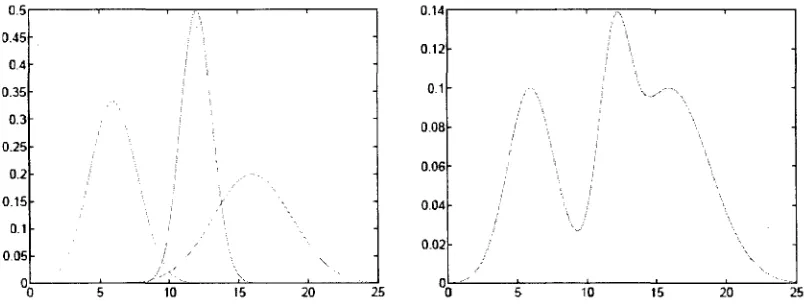
is an example of Mixture of Gaussians distribution with K = 3 used in this scheme.
0.5- 0.45- 0.4- 0.35-0.3 0.25- 0.2- 0.150.1 -
0.05-°0 5 10 15 20 25 "{> 5 10 15 20^ 25
Figure 3.4: One dimensional Mixture of Gaussians model consisting of 3 single Gaussians
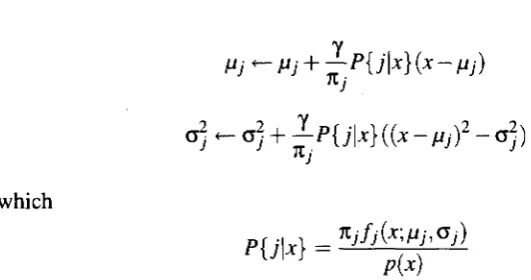
At first, the three Gaussians' parameters are set as Kj = l/K, HJ — j/(K+\) and Oy = 0.01 jK which means the K number of kernels are equally distributed over the normalized r and g channels. Then MoG method estimates and updates the parameters 7iy, JJJ and Gj for both r and g channels in the mixture model formula by Expectation Maximization
algorithm [12], which is the incremental variant of the maximum-likelihood estimation:
0.120.1 - 0.08- 0.06- 0.04-
CHAPTER 3. RELATED WORK 28
1
o)^o
2j+ ^P{j\x}{{x-^f-o])
in which
P{j\x} = njfj{jr^aj)
p{x)
is the posterior - the chance that the color value x is part of kernel j . The variable y is the learning rate and indicates to what amount the parameters are updated. For one complete update of all of the parameters, one should apply all of these formulas over the range j =
{l,...,K} for both r and g channels of each pixel in the image frame.
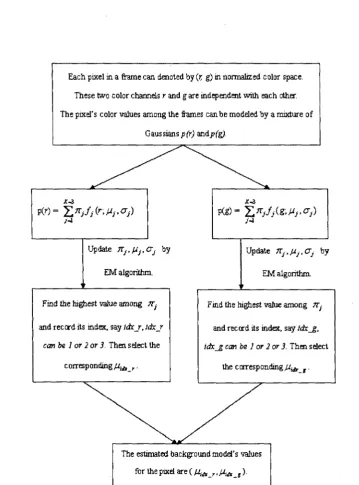
Figure 3.5 is the illustration of the background modeling process using MoG method. The mode of p{x) is assumed to be the background color whereas the estimated means of r and g corresponding to the highest priors.
After learning the mode of each background pixel, we can determine a pixel in the current frame to be part of the foreground if the differences between both the normalized
color values and the estimated means corresponding to the highest priors are larger than 2.576 a (i.e., 99% confidence).
3.5 Summary
CHAPTER 3. RELATED WORK 29
Each pixel in a frame can denoted by (r, g) in normalized color space. These two color channels r and g are independent with each other. The pixel's color values among the frames can be modeled by a mixture of
Gaussians p(r) and^fg).
peg)- 2>>/j(*-./<>.0>)
Update TTj^j.CTj by
EM algorithm.
Find the highest value among JTj
and record its index, say idx_r, idx_r can be 1 or 2 or 3. Then select the
corresponding/^jA r.
Update ni,}Ai,ai by
EM algorithm.
Find the highest value among TT;
-and record its index, say idx_g, idx_g can be 1 or 2 or 3. Then select
the corresponding fl^ g.
The estimated background model's values for the pixel are ( fxiis_r, /*iA_, )•
Chapter 4
The Proposed Method
This chapter describes details of the proposed method. The background modeling approach
using a histogram based median method is presented, which dynamically models the back-ground without prior knowledge of the scene. Then a fuzzy k-Means clustering method is presented to segment the foreground objects from the background.
4.1 Statistical Background Modeling
Let /, (x,y) is the intensity of a pixel p(x,y) in a frame t such that 1 < t < N' where N' is the total number of frames in an image sequence or video. The background model is built by the training sequence {/) (x,y),.. .,I^(x,y)} where N is the number of image frames used in the training period such that N < N'.
To make the task feasible, we make the following assumptions, similar to those in [20],
[28]:
1. Each pixel in the image reveals the background for a short interval of the sequence such that one bin out of the four reaches 50% of the total probability.
CHAPTER 4. THE PROPOSED METHOD 31
2. The background is nearly stationary with stable and constant illumination.
3. A short processing delay is allowed subsequent to acquiring the training sequence.
Figure 4.1-(a) is an illustration of N frames from a video used for background modeling. Figure 4.1-(b) shows an intensity typical plot over time for only one pixel in the image marked by the plus sign in each of these frames. The human object enters the scene around Frame 100 but occludes the marked pixel around Frame 119.
From Figure 4.1-(b), it can be seen that for the same pixel, the intensity is quite stable as a background pixel but it changes significantly when it is occluded by a pixel in the
foreground object. The histogram for the intensity values of the same pixel can better illustrate the stable value among the frames as shown in Figure 4.1-(c).
The histogram based median method for background modeling can deal with the so-called bootstrapping problem - it can model the background model even in the presence of foreground objects. The use of HSV color space gives advantage of noise removal. The
detailed steps of the scheme are as follows [28]:
1. Convert each of the N frames of the training sequence from RGB color space to HSV color space.
2. For each pixel among the frames, construct a 4-bins histogram on its intensity values, or the V component (For the purpose of displaying the background, all of the three HSV components are needed but for processing, only V component is significant and
needed).
3. Find a bin with the highest frequency of intensity values from the histogram.
4. Our objective is to locate the highest bin and pick up the intensity values among
CHAPTER 4. THE PROPOSED METHOD 32
Frame #1
Frame #N
Frame #101
(a) N frames from a sample video
CHAPTER 4. THE PROPOSED METHOD 33
£ 60
(c)The histogram of V component of the pixel denoted by the plus sign among the N frames
CHAPTER 4. THE PROPOSED METHOD 34
values first, and establish histogram to find out the index of the highest bin. Then we
have to scan the intensity values again to record the intensity values fall into the range of the highest bin. Here, we want to scan one time only to find out those intensity
values to reduce processing time. We use the idea of flags which offer a space-time tradeoff. For each pixel among frames, establish flags which record the bin numbers
the intensity values fall into. For example, in Frame 1, the intensity value falls into
the second bin in V histogram, the flag for this pixel in Frame 1 is 2.
5. Select intensity values whose flags are the same as the highest bin number and store
them in a buffer and discard it otherwise.
6. Choose the median of all the intensity values in the buffer and consider it as the
intensity value of the pixel in the background model.
7. Perform step 2-6 until all pixels are processed.
After background model is established, segmentation for foreground objects can be done through the background subtraction method as explained in subsequent sections.
4.2 Adaptive Foreground Segmentation
Foreground segmentation is the process of classifying each pixel either as the background or the foreground. By background subtraction, one can detect the motion in a given frame. If a pixel is part of the background in current frame, the difference between its intensity
CHAPTER 4. THE PROPOSED METHOD 35
the scene as isolated pixels but as a group of adjacent pixels and exhibit similarity in color or intensity.
Clustering is the process of dividing data items into classes or clusters. Clustering algo-rithms attempt to segregate a data set into distinct regions of membership with an essential
goal to minimize the disperse between data items within a cluster and maximizing it among the data items in different clusters. Generally speaking, clustering techniques can be
classi-fied into two broad categories [16]: (1) exclusive clustering and (2) overlapping clustering.
In exclusive clustering, assignment of a data item to a particular cluster is made on the basis of hard or crisp decision. Therefore, a data item can belong to one and only one
cluster. If we need to cluster a set % — {x \, X2,..., JC/V } of N data items, the goal of exclusive clustering is to partition x into k, 2 < k < N disjoint, non-empty clusters {C\ ,C2, • • • ,Q}
such that:
X = C i U C2U . . . U Q
where:
QnCj=0,iJe{l,...,k} and
C , - # 0 , i e { l , . . . , * }
In overlapping clustering, also known as the fuzzy clustering, a data item may belong to more than one cluster with different degrees of memberships. The membership values typically range between 0 and 1 and indicate the extent to which a particular data item may
belong to a certain cluster.
Bezdeck [5] proposed a family of fuzzy clustering algorithms. Such algorithms con-sider each cluster as a fuzzy set while a membership function measures the probability that
CHAPTER 4. THE PROPOSED METHOD 36
multiple clusters with some degree of certainty, as determined by the membership function. Therefore, partitioning of data is based on soft decision. Fuzzy k-Means clustering [26] facilitates identification of overlapping groups of objects by allowing the objects to belong to more than one group. The essential difference between fuzzy k-Means clustering and standard k-Means clustering is primarily the way data is partitioned among the clusters.
In order for us to be able to properly detect foreground objects, it is important to
dis-tinguish between foreground and background pixels. Since the change in intensity value can be either due to change in the characteristics of the background or due to introduction of foreground objects, we believe that the fuzzy k-Means is more appropriate to establish suitability of each pixel as background or foreground due to its varying degree of mem-bership. Further, the membership values of a pixel may change over time as the scene
progresses. Fuzzy k-Means in general improves the standard k-Means clustering by finding better centers of clusters and has better time performance for convergence [47].
The fuzzy k-Means algorithm for detection of foreground objects is as followings:
1. Set the number of clusters k — 2: a background cluster and a foreground cluster and set the blending factor, or the extent of overlapping between clusters b = 1.25 [62].
2. Initialize to compute the clusters' means. Subtract the current frame in HSV color space from the background model. It will give us a difference matrix. From the absolute values of the matrix, select the maximum and the minimum values of V
component and use them as the the means Hi, i= 1,2 of the two clusters co,-.
3. For each pixel Xj, calculate its distance J,7- from the foreground mean and the back-ground mean using absolute difference matrix where i is the cluster, j is the pixel
CHAPTER 4. THE PROPOSED METHOD 37
we use Manhattan distance as the distance function since the feature used (i.e., V component) is only 1-dimensional and hence, requires less computations.
4. Compute the memberships of each pixel Xj among the clusters co, as:
E ( i Mv) W - ' >
l=\
5. Compute new means for each of the two clusters:
Y.[K<*\*j)\bx]
I [P{<»i\xj)}h
6. If fj((new) — fii{old) < y where y is the established threshold, go to 7; otherwise re-place old mean value with the new one and go to 3.
7. If P((£>fg\xj) < P((Obg\xj), Xj belongs to the background cluster; otherwise it belongs
to the foreground cluster.
At the end of the classification process, we obtain a binary image in which all of the foreground pixels are set to 1 whereas all of the background pixels are set to 0. Since the background modeling and foreground segmentation are based on pixel-level, the output may contain noise in form of spots, holes and spurs. Therefore, there may be a need to
CHAPTER 4. THE PROPOSED METHOD 38
4.3 Summary
This chapter presents the proposed method and deals with the first two steps of intelligent visual surveillance systems. The background is modeled by statistical method and
his-togram analysis for bootstrapping in dynamic scene. The foreground segmentation is done by fuzzy k-Means clustering which automatically finds the grouping of foreground pixels
and the background pixels. The fuzzy k-Means clustering method is more robust than the approaches which set thresholds to differentiate the foreground and the background pixels
Chapter 5
Experimental Results
This chapter presents some of the experimental results of the proposed method. These experiments are conducted on a series of indoor videos and on a set of benchmark videos. We have compared results with two other similar methods discussed before.
5.1 Comparative Results
In order to validate the proposed scheme, a series of experiments are conducted using a 2.4GHz Intel quad-core PC running Microsoft Windows XP. For testing purposes, all of the implementation are in MATLAB. All of the videos we recorded have dimensions of either 640x480 or 320x240 pixels. As suggested in [28] and [31], we chose to use 40 frames to establish the initial background model with a threshold for change y = 0.001.
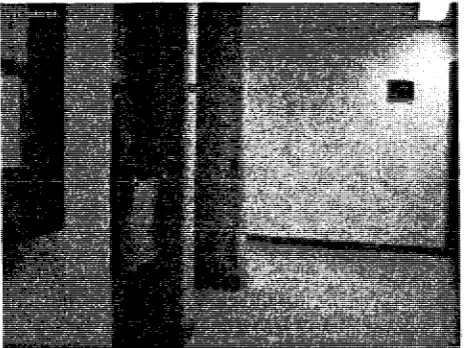
Figure 5.1 shows a set of sample frames for a video with 640x480 pixels dimensions. These frames are extracted from an indoor video taken in a corridor and represent a typical environment in video surveillance applications. The background modeling result of this set of images is given in Figure 5.2 - an almost perfect background image.
CHAPTER 5. EXPERIMENTAL RESULTS 40
CHAPTER 5. EXPERIMENTAL RESULTS 41
Figure 5.2: The estimated background using image sequence in Figure 5.1
In Figure 5.3, the image set is from a similar video but with a lower dimensions of 320x240 pixels. The established background modeling result for this image set is given in Figure 5.4.
The segmentation results using the discussed three methods can be found in Figure 5.5, Figure 5.6 and Figure 5.7. As one can observe, the proposed method can always provides better results whereas MoG fails. It is due to the underlying assumption of MoG that the color distribution of each pixel among frames can be modeled by a few number of Gaussians which do not always perfectly correspond to the real data. In Figure 5.3, the foreground
object has a wide color distribution and that may lead to misclassifications in MoG.
Table 5.1 and Table 5.2 provide the processing time for each of these three methods for both background modeling and foreground segmentation. For background modeling, k-Means clustering method and our proposed method are faster than MoG but our proposed
CHAPTER 5. EXPERIMENTAL RESULTS 42
CHAPTERS. EXPERIMENTAL RESULTS 43
Figure 5.4: The estimated background using image sequence in Figure 5.3
the other algorithms.
Table 5.1: The processing time corresponding to video in Figure 5.1
Video size 640x480 pixels k-Means Clustering Mixture of Gaussians The proposed method
modeling (sec) 354 453 354
segmentation (sec/frame) 535.0 0.6 15.0
In addition to testing our approach on some in-house videos, we also conducted exper-iments on some of the benchmark videos in PETS series3. We conducted our experiments on 1452 frames in PETS2000 video, on 2688 frames in a PETS2001 video and on 2550
frames in PETS2006 video. PETS2000 and PETS2001 videos are outdoor video scenes with human objects and vehicles moving in and out of the scene. Figure 5.8 and Figure 5.9 show the segmentation results on some of the frames. PETS2006 is a video of an indoor scene captured in a subway with group of people. Some of the segmentation results for this
CHAPTER 5. EXPERIMENTAL RESULTS 44
(a) Original frame 71 (b) Segmentation by MoG
(c) Segmentation by k-Means clustering (d) Segmentation by the proposed method
Figure 5.5: Segmentation results using 3 different methods on frame 71 of video in Figure 5.1
Table 5.2: The processing time corresponding to video in Figure 5.3
Video Size 320x240 pixels k-Means Clustering Mixture of Gaussians The proposed method
modeling (sec) 92 136 92
segmentation (sec/frame) 21.0
CHAPTER 5. EXPERIMENTAL RESULTS 45
(a) Original frame 121 (b) Segmentation by MoG
(c) Segmentation by k-Means clustering (d) Segmentation by the proposed method
CHAPTER 5. EXPERIMENTAL RESULTS 46
(a) Original frame 141 (b) Segmentation by MoG
(c) Segmentation by k-Means clustering (d) Segmentation by the proposed method
CHAPTER 5. EXPERIMENTAL RESULTS 47
(a) original frames in PETS2000 (b) Segmentation results by the proposed method
CHAPTER 5. EXPERIMENTAL RESULTS 48
* 8 ^ 3 S S B ^
(a) original frames in PETS2001 (b) Segmentation results by the proposed method
CHAPTER 5. EXPERIMENTAL RESULTS 49
CHAPTER 5. EXPERIMENTAL RESULTS 50
video are shown in Figure 5.10. The corresponding processing time for the PETS series
videos are listed in Table 5.3.
Table 5.3: The processing time of the proposed approach for PETS series videos
Video size (pixels)
PETS2000 (768x576) PETS2001 (768x576) PETS2006 (720x576)
# of frames
1452 2688 2550 modeling (sec) 452 447 422 segmentation (sec/frame) 20.2 22.4 15.8
Table 5.4: The processing time of MoG for PETS series videos
Video size (pixels) PETS2000 (768x576) PETS2001 (768x576) PETS2006 (720x576) modeling (sec) 628 631 615 segmentation (sec/frame) 0.8 0.9 0.7
Table 5.5: The processing time of k-Means clustering method for PETS series videos
CHAPTER 5. EXPERIMENTAL RESULTS 51
5.2 Analysis and Discussion
From the previous section, we can see that the performance of our proposed method is better than the two similar contemporary methods. It can detect foreground objects like vehicles, single and group of humans in a scene. When there is no foreground object in the
scene, the proposed method gives very limited isolated white pixels which are caused by image noise. Such kind of image noise can be easily removed by morphological operators, i.e., a pair of open and close [2], [56], [35].
There are some limitations of the proposed method. When the global illumination
changes in the scene, e.g., in PETS2001, the whole frame is detected as foreground. The background subtraction technique is based on an accurate background model from which foreground objects can be detected. Thus, it is necessary to include the adaptability of background model, i.e., robust to gradual illumination and sudden illumination changes. The former one is easier than the latter one to deal with. A simple way to tolerate gradual
illumination change is IIR (Infinite Impulse Response) filter. One feasible solution dealing with the latter problem is proposed by Li et al. [35].
Secondly, when the foreground object enters the scene and essentially becomes part of the background, for example, gray car (in the first original frame of Figure 5.8, the second car counting from right side in the parking lot) getting parked in Figure 5.8, green car (in
the first original frame of Figure 5.9, the third car counting from right side in the parking lot) getting parked in Figure 5.9, the cars are not absorbed into the background. Therefore, in all of the following frames, the gray car and the green car are detected as the foreground objects. However, it is not always necessary to convert the foreground to the background, for example, in Figure 5.10, the luggage was dropped on the floor and alarms should be
CHAPTER 5. EXPERIMENTAL RESULTS 52
actions surveillance systems should do.
Thirdly, there are some foreground object regions missing after detection, i.e., in Figure 5.8 and Figure 5.9. The vehicles are not totally detected. The reason for that is the intensity of the foreground object is too close to the background, this problem is also known as camouflage. More features such as spatial information can be incorporated to get rid of
such kind of problems.
Shadows as in Figure 5.10 is another big problem. Due to the color space we used, most of the human objects' shadows are removed. But in the frame with group of persons, one severe shadow (in the third original frame of Figure 5.10, the second person counting from
right side) can not be suppressed and needs additional techniques handling it.
Segmentation processing speed or convergence speed is the major problem in k-Means clustering method. The proposed scheme outperforms k-Means clustering method for seg-mentation processing time. For MoG method, when the background involves a wide
dis-tribution of color/ intensity, modeling the background with a mixture of a small number of Gaussian distribution is not efficient. Moreover, when foreground objects are included in the training frames, MoG doesn't work well and it will misclassify [59] as in Figure 5.7. For objects that present a slow motion, only the edges are highlighted. The central parts of the object are absorbed quickly, resulting in a set of sparse points of the object [23].
Finally, the background modeling time of MoG is higher than the k-Means clustering and the proposed method.
One may doubt whether our proposed method can be applied to real-time applications.
CHAPTER 5. EXPERIMENTAL RESULTS 53
as 640x480 pixels, 768x576 pixels or 720x576 pixels. These sizes are equal to or more than four times of the size of 320x240 pixels, i.e. ^ ^ t o = ^- As o n e c a n s e e m Table 5.1 and Table 5.2, when the dimension reduces, the processing time reduces significantly. The
other reason is the implementation tool. MATLAB is much slower than other lower level developing tools, such as VC++ and OpenCV. The proposed algorithm developed by other tools will have much higher speed than in MATLAB.
There is one interesting note for the experiments which is the effectiveness using dis-tance as the feature in k-Means clustering method and our proposed method. In k-Means
clustering or fuzzy k-Means clustering, calculating the means or centroids of the clusters are based on the data set itself, in our case here, it's the difference matrix of V component. After one iteration, we calculate the average of the V values falling into foreground cluster and background cluster separately. However, if we use the average of the distances falling into foreground cluster and background cluster as the new means, the segmentation results
are sometimes even better than using difference matrix. The reason behind that is probably the distance is served as weights. The smaller the distance value, the closer the pixel be-longs to the cluster. But if there is no foreground object in the scene, this distance scheme may give unpredictable results.