Analysis of Non-Manufacturing Robot
Applications using Artificial Intelligence
Configuration System
Ashutosh Kumar Singh1, Pankaj Prajapati2, Ankur Sharma
3 AIMT LUCKNOW, IndiaABSTRACT: In addition to non-manufacturing robot applications that are considered hazardous, there are also opportunities for applying robots to the so- called service industries. The possibilities cover a wide spectrum of jobs that are non-hazardous. We present the following subsections to illustrate the potential applications – Teaching Robots, Retail Robots, Fast Food Restaurants, Bank tellers, Garbage Collections and Waste Disposal Operations, Cargo Handling, Loading, Unloading, and Distribution based Operations, Security Services, Medical Care Centre and
Hospital Responsibility, Agricultural based Robots, Household based Robots, Rehabilitation based Robots. Main goals
of automation are to step by step increase the reliability and quality of a given process. The objective is to make the Robot independent to take the decision by itself. The robot shall be able to understand it with the little change in hardware software and programming.
Under machine configuration system channel with Artificial Intelligence is provided by automatic joint functional behaviour & controllability & observability function. Automation has been achieved by various means including mechatronics, hydraulic system, pneumatic system, electrical, electronic and computers, usually in combination. As per robot controlled machine configuration, the program sequence of discrete operation depends upon user portfolio & based on input & output term condition via process implementation.
KEYWORDS
:
Intelligent robots, mechatronics, industrial robots, artificial intelligence, adaptive critic,
I. INTRODUCTION
We live in a truly fantastic, amazing, high technology world. The state of the art has a host of known problems with suitable and known solutions. Research is being conducted on known problems with unknown solutions. However, it may be the unknown problems that are most dominant and important to our survival. The World Wide Web is making a tremendous amount of information available that strengthens or empowers everyone with access to it. The .Net strategy promises major improvements in every field of human endeavor.
Making information and communications available to a broader community will make intelligent robots easier to GET AN IDEA I.E. conceive of, investigate, develop, produce and use.
reproduce biologically but by making other robots. They can be used in industry for a lot of uses and applications. One good and useful intelligent robot solution to an important problem can begin an industry or factory and spin off a totally new technology. For example, imagine a robot that can mow your lawn, fill your car with gas, a car that can drive you to work in traffic, a machine that repairs on its own when it breaks down, a physician assistant for microsurgery that reconnects about 40,000 axons from a severed nerve. Intelligent robots are also a reality.
There is a need for intelligent robots in every field of human endeavor. Most observable are situations which are hazardous for humans such as in outer space, under sea, underground, as well as on the ground such as in a war zone or a left over mine field, in an earthquake or volcano or in man made situations such as in heavy traffic. In these circumstances it may not be possible to cost justify the robot in terms of investment. But saving lives or exploring the world and universe, are worthy goals. In other circumstances such as mass production where tasks must be performed again and again perhaps millions of times per year, one can compare human and machine labor both economically and technically. In these circumstances, a cost justification can be progressed and developed to show that an investment in automation will, actually, produce as good return on the capital investment than a perfect standard saving method. Industries and factories that identify and recognize and use these advanced technologies will produce the best quality goods at the lowest price, capture the market for their products and lead the world.
II. INTELLIGENT ROBOTS
The components and parts of an intelligent robot are a manipulator, sensors and controls. However, it is the design architecture or the group of these components, the paradigms programmed into the controller, the foresight and genius of the system designers, marketing experts and the practicality of the prototype builders, the professionalism and attention to quality of the manufacturing engineers and experts that make the machine intelligent and useful. Just where is the intelligence in an robot? Is it in the design architecture, the controller or the content? It is in the controller just like the intelligence of a human is in the neural connections of the brain.
However, it is only possible to see this intelligence through some activities just as it would not be possible to see intelligence in a comatose human. Where does the perfection and intelligence come from? The control program and architecture provide for real time responses to different types of situations. If these answers are intelligent, then the robot appears intelligent. The answer to this question is still not confirmed. When are intelligent robots needed? When a task is repetitive such as making a million parts every year, automation is still needed. The most suitable automation may be an intelligent robot. In addition, when a task is dangerous for humans, automation is needed. The best solution may be an intelligent remote manipulator. Finally, when an industry should be internationally competitive in cost and quality, automation is needed. Again, the intelligent robot may play an important part in the solution. What are the benefits from using intelligent robots? Robots can do a lot of tasks now. However, the tasks that may not be easily done today are often characterized by a variable knowledge of the environment. Location, size, shape, orientation, of the work piece as well as of the robot must be known accurately to do a task. Hindrances in the motion path, unusual events, breakage of tools, also create environmental uncertainty. More intelligence and Greater use of sensors should lead to a reduction of this uncertainty and because the machines can work about 24 hours a day, should lead to higher productivity. More intelligence could also lead to faster, easier setups and less cycle times. More intelligence should lead to faster diagnosis of problems and better maintenance for the systems. At last, to remain internationally competitive, the best technology usage is required. Material resources or waste of human is too expensive for industry and for society. It is said that as manufacturing goes, the quality of life goes.
Since this topic is basically about factory automation, which may not be obviously considered extreme technology, let's begin with a few definitions. Intelligence is the most outstanding human characteristic; however, it is not totally understood till now and therefore has many different definitions, implied meanings, and levels of sophistication
III. MECHATRONICS
of physical system; sensors and transducers, actuating devices, hardware components for mechatronic; signals, systems and control; real- time interfacing; advanced applications and case studies.
3.1 New Robot Manipulator Designs
In 1985, the four common types of robot manipulator were
the Cartesian, cylindrical, spherical and vertically articulated or anthropomorphic design. Then the horizontally articulated or Selective Compliant Articulated Robot for Assembly was introduced. In 1995, a very different design, a tricept, Stewart platform was displayed at the Robot and Vision Exhibition by Comeau. This was advertised as being as flexible as a robot, as precise as a machine tool and strong as a press. It seemed ideal for press fitting bearing and other tasks requiring thousands of pound rather than tens or hundreds of pounds of force.
Nearly all industrial manipulator arm can be classified into one of six categories: Cartesian, cylindrical, spherical, vertically articulated, horizontally articulated (SCARA) or Steward Platform type.
3.2 Faster
Rotational speed of robot manipulator links of 240degrees/second is typical. For a 1-meter joint length, this would produce linear speed of four meter/second. The overall cycle time is usually more important than individual link speeds. In a great variety of application, robots are easily made as fast as or faster than human.
3.3 Open Architecture Controls
The control system is the set of logic and power function which allows the automatic monitoring and control of the mechanical structure and permit it to communicate with the other equipment and user in the environment. Open architecture control refers to software design that can use or be used with product from a variety of manufacturer. The move toward open architecture controls is relatively recent but follows the trend in computer that caused a tremendous explosion in usage.
3.4 Theoretical Knowledge Base 3.4.1 Inverse kinematic solutions
Mostly industrial robots are operated in position control mode as contrasted with velocity or force control. To move the motor to position a manipulator in space, an inverse kinematic solution is needed. The solution of inverse kinematic must be discovered for each new manipulator design. Developing forward kinematic equation and solving them symbolically provide a mathematical result that can be used by anyone, forever.
3.4.2 Inverse dynamic solutions and experimental designs Even though all industrial robot are position control devices, the path between position point can be extremely important, for example, in seam welding. Since any moving system is described according to Newton's Second Law by a dynamic differential equation , the dynamic solution must also be determined in the design of a robot. However, the dynamic system is non-linear and subject to noise from various source. Criteria for practical stability rather than optimal stability are used today. A variety of motion control solution has been developed but a greater understanding of non-linear systems is needed.
3.5 Robots, Vision and Motion Control
The combination of robot and vision with the motion control
is a trend toward understanding all the components of the intelligent robot, the manipulator, the sensors and the controls. If engineers can understand all the elements, i.e.,
mechatronic, then some exciting new product and application will be forthcoming. 3.6 Web Robots
A new type of robot is emerging which may be called a web robot or spider.
IV. SELECTED EXAMPLE
An excellent example of an intelligent robot is the TUT-1
shown in Figure and described by Cao8 in this proceedings. This intelligent robot can be guided using overhead lights using an omnidirectional vision system.
Figure Tainjin Institute of Technology’s TUT-1 intelligent robot.
V. ADAPTIVE CRITIC
To reach an even higher degree of application, a new level of learning may be required. Recently learning theories such as the adaptive critic have been proposed. In this type of learning a critic provide a grade to the controller of an action module such as a robot. The critic may be considered as the teach programmer, customer, plant manager, line supervisor or quality inspector. If the ultimate critic is the consumer, then the quality inspector should model the consumer’s decision and use this model in the design and manufacturing operation. A new process that is “beyond the adaptive critic,” would be a creative control.
Several level of intelligent controls have been developed.
1. Supervised control, a trainable controller that, unlike the teaching pendant, allows responsiveness to sensory input. 2. Direct inverse control is trained for the inverse dynamic of the manipulator.
3. Neural adaptive control, neural nets combined with adaptive controller result in greater robustness and the ability to handle nonlinearity.
4. Back propagation of utility involves information flowing backward through time. 5. Adaptive critic method use a critic evaluating robot performance during training 6. Creative control involves self-initiating and corrective action.
Figure-Creative controller
VI. CONCLUSIONS and PREDICTIONS
6.1 Age of Realism in Robotics
New technology go through a pattern of usage starting from zero, then increasing perhaps too far, then coming down then, then reversing and going steadily upward until the reach a downward turn at the end of their useful period. When technology is first introduced, we may expect more than it can deliver. This period has been called the Age of Over- expectation. The following is a period of disillusionment in which expectation is less than the technology can actually deliver. This period is called the Nightmare Time. Finally, reality set in and we learn to expect only what the technology can deliver -- the Age of Realism. Industrial robots have now reached this age of realism. The U.S. has a solid base of nearly 105,000 successful installation. Broadening the robot definition to include automated guided vehicle, remote manipulators which must be supervised by a human as well as totally programmable robot, and a growing interest in personal and service robot has strengthened the technology base even more. Robotic has today developed into a solid discipline that incorporate background, knowledge and creativity of mechanical, industrial, electrical and computer engineering and other engineering and scientific fields. However, there are still many challenges, unsolved problem, and needed invention.
6.2 Futuristic Predictions - . Net A g e f o r D e s i g n a n d Manufacturing
As stated years ago: “The ultimate goal of the use of robots is always should be to help, not hurt us. This call for i n t e l l i g e n t p o l i c i e s , thoughtful p l a n n i n g a n d foresighted decisions on the parts of leader in fields
that will use robots, from factory owners to medical researchers. We are approaching a new era in our continuing
industrial evolution. It can mean freedom from all mindless work, freedom to develop our uniquely human ability fully, and freedom to explore the frontiers that we could never physically explore ourselves. Continued sensitivity, however, to the effect of technology on all people is of paramount importance for the wisest and happiest implementation of this new technology.” The National Science Board has recently prepared a report stating:
employ the best available information and scientific advice in research budget allocation decision to assure the continued strength of the U.S. science and technology.”
On June 2000, Microsoft’s Chief Software Architect outlined Microsoft’s .Net strategy for the next generation of internet service from PC’s. The impact of this strategy on the design and manufacturing of intelligent robot (as well as society in general) will be significant. Rather than taking twenty years to develop a product in the typical iterative design process, may be the design and manufacturing can be done in a single pass.
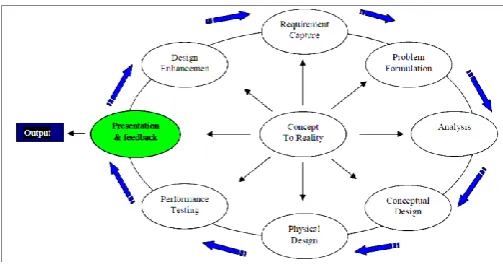
University of Cincinnati robotics student developed the illustration shown in Figure 3 of their continual improvement robot design process. For any hope of economic success, the required time for completing not only the design but also the manufacturing of new product must be shorter than the useful life of the product. The entire step in this process need to be easy so that they can be done correctly. This is not currently the case. The .Net strategy promise to make this step easy and all accomplishable from our computer terminal.
Figure 3.Cincinnati robot design process
REFERENCES
1. Robotics International of the Society of Manufacturing Engineers, “RI/SME Technology Trends,” March 2001. www.sme.org. 2. Kevin Ostby, “The Robotics Market in 2001: A Rocky Start, A Strong Finish?” http://www.robotics.org/
3. Donald A. Vincent, “The Robotics Industry: Leading the Charge to a Productive 21st Century,”
http://www.robotics.org/
4. Devdas Shetty and Richard A. Kolk, Mechatronics Systems Design, PWS Publishing, Boston, MA,1998. 5. Manufacturing Engineering, July 1997, pp. 18.
6. Ari Requicha, Laboratory for Molecular Robotics, USC, [email protected]
7. Adept MV Partner Catalog, March 1, 1997, Vol. No 3, San Jose, CA, http://www.adept.com
8. Z. L. Cao, et. al., “Omni-vision based autonomous mobile robotic platform, Proceedings of the Intelligent Robots and Computer Vision Conference, Boston, MA, 2001.
9. Wanek Golnazarian and Ernest L. Hall, “Intelligent Industrial Robots”, R.L. Shell and E.L. Hall, Eds., Handbook of Industrial Automation, Marcel Dekker, New York, 2000.
10. E.L. Hall and B.C. Hall, Robotics – A User Friendly Introduction, Holt, Rinehart and Winston, 1985, pp. 66 11. http://www.nsf.gov/nsb/documents/2001/nsb0139/nsb0139_4. htm