Capacity Estimation of RCC Frame
Structured Building for Seismic Vulnerability
with Reference to Structural Assessment using
NDT – A Case Study
Sanket Padishalwar1, Dr.Abhay Patil2
P.G. Student, Department of Civil Engineering, Yeshwantrao Chavan College of Engineering, Nagpur,
Maharashtra, India1
Professor, Department of Civil Engineering, Yeshwantrao Chavan College of Engineering, Nagpur, Maharashtra, India2
ABSTRACT:As time passes, there is a degradation of concrete structures. This may be due to various diffusive environmental actions such as carbonation, alkali aggregate reactions, etc. The load carrying capacity and strength of concrete decreases due to degradation. On the other hand seismic codes are also frequently revised with the advancement in research and technology and knowledge gained after recent earthquakes. Hence, the old structures need to be evaluated from the point of its seismic vulnerability. In this paper, seismic vulnerability assessment of J P Tower, Wing C, Nagpur has been presented. The assessment has been carried out using E-Tabs software as per IS 1893-2016 using the strength of concrete obtained by Rebound Hammer test. After analysis, it was observed that the building was stable for earthquake loading.
KEYWORDS:Degradation, carbonation, alkali aggregate reaction, seismic vulnerability, retrofitting. I. INTRODUCTION
In this era of modern development, the safety and serviceability of structures is an important parameter. Most of the existing structures that are designed as per old codes do not satisfy the requirements of modern code. Hence it is very important to see whether all the buildings satisfy current standards for following purposes:
• Pre earthquake vulnerability check.
• Post-earthquake vulnerability check.
• Additions and alterations in existing buildings.
• Safety and Stability check for buildings.
In India, the seismic risk has been increasing rapidly in the recent years and country has failed in ensuring earthquake-resistant constructions in high seismic regions. Major earthquake events in India are rare but casualties caused in these are very high and each earthquake is characterized by high exposure and their economic and social effects cannot be neglected.
In India, in last few years various old structures have been collapsed. This is because these structures have become too old and due to which the strength of the structure got reduced. This has also led to loss of lives in our country.
Hence, in order to prevent this, it is very essential to assess the structural parameters of existing old structures and reanalyse it and thus check for safety and stability of such structures. Hence prevent the structure from collapsing by using suitable retrofitting measures.
II. RELATEDWORK
As per H. D. Shrestha, R. Yatabe, N. P. Bhandary and J. Subedi et.al.[1], Preliminary physical assessment and drawing verification of 58 school buildings was done. Schmitt hammer test was performed to obtain compressive strength. Core drilling, Profometer, SPT was done to obtain other properties of material. Then bending capacity and Shear capacity was calculated. Modelling of building was done in SAP 2000 and analysed. Experimental and software results were compared. Replacement cost and Retrofitting cost was also compared based on results and Retrofitting was suggested.
As per T. Srikanth, R. P. Kumar, A. P. Singh, B. K. Rastogi and Santosh Kumar et.al [5], 16000 buildings of Gandhidham and Adipur cities were selected and data was collected for Rapid Visual Screening of all buildings. RVS score for all buildings was calculated and detailed analysis of 300 buildings was suggested with RVS score less than 120.
As per chandrabhakuni [10], assessment was carried out on 160 schools of Gujarat. 90 % of schools were RCC and CM type. Based on visual assessment seismic behavior was estimated considering building type and performance modification factor. Expected seismic performance was found to be in vulnerability class C, D and E. School population was then correlated with expected seismic behaviour. School with higher population was considered more vulnerable. Degree of vulnerability was found very high for 19% buildings and high for 41% buildings.
III.GENERALDATAOFBUILDING
The building is a residential building situated at Nagpur. The building is 28.16 m long and 12.98 m wide. The building can be categorized as RCC framed structure residential building.
The building is constructed on fairly level ground with foundation strata having the SBC of 250 – 300 kN/Sq.m. The building is a Ground + 5 storied RCC framed structure with 230 mm thick External and 150mm / 115 mm thick
brick masonry walls with RCC slab provided at top.
IV.NON-DESTRUCTIVETESTONBUILDING
The building had become too old and cracks were also noticed in many parts of the building. Hence, NDT was suggested to evaluate the strength of the building and also to evaluate seismic stability of building.
Following conclusions were drawn from the results of Non-destructive tests performed on building. 1. Cracks were noticed on some of the columns, especially those located on outer side.
2. Spalling of concrete was noticed in beams and at places, the reinforcement is exposed and is undergoing corrosion. 3. The UPV test indicated deficiency in homogeneity at some places.
4. The cover to the reinforcement appears to be adequate but depth of carbonation is high. 5. The chances of corrosion of rebars is over 50%.
6. The characteristic compressive strength of building is found to be 17.50 MPa.
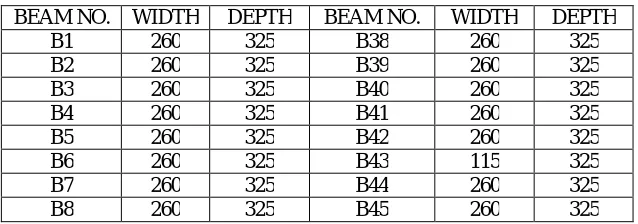
TABLE 1. Existing schedule beam at floor level
BEAM NO. WIDTH DEPTH BEAM NO. WIDTH DEPTH
B1 260 325 B38 260 325
B2 260 325 B39 260 325
B3 260 325 B40 260 325
B4 260 325 B41 260 325
B5 260 325 B42 260 325
B6 260 325 B43 115 325
B7 260 325 B44 260 325
BEAM NO. WIDTH DEPTH BEAM NO. WIDTH DEPTH
B9 260 325 B46 260 325
B10 260 325 B47 260 325
B11 260 325 B48 260 325
B12 260 325 B49 260 325
B13 260 325 B50 260 325
B14 260 325 B51 260 325
B15 260 325 B52 260 325
B16 260 325 B53 260 325
B17 260 325 B54 260 325
B18 260 325 B55 260 325
B19 260 325 B56 260 325
B20 260 325 B57 260 325
B21 260 325 B58 115 325
B22 260 325 B59 260 325
B23 260 325 B60 260 325
B24 260 325 B61 260 325
B25 260 325 B62 260 325
B26 260 325 B63 260 325
B27 260 325 B64 260 325
B28 260 325 B65 260 325
B29 260 325 B66 260 325
B30 260 325 B67 260 325
B31 260 325 B68 260 325
B32 260 325 B69 260 325
B33 260 325 B70 260 325
B34 260 325 B71 260 325
B35 260 325 B72 260 325
B36 260 325 B73 260 325
B37 260 325 B74 260 325
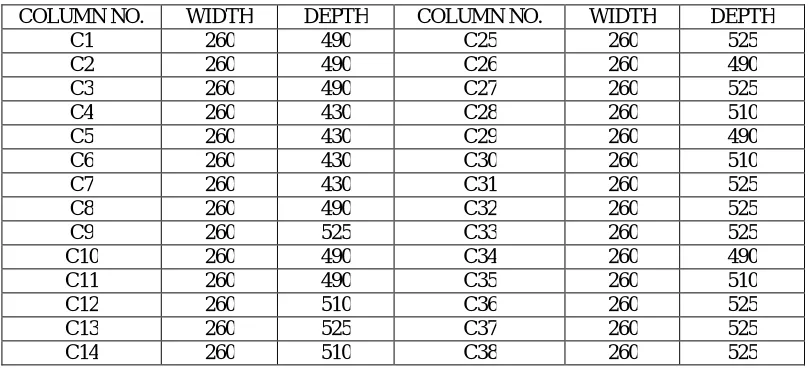
TABLE 2. Existing schedule of Columns
COLUMN NO. WIDTH DEPTH COLUMN NO. WIDTH DEPTH
C1 260 490 C25 260 525
C2 260 490 C26 260 490
C3 260 490 C27 260 525
C4 260 430 C28 260 510
C5 260 430 C29 260 490
C6 260 430 C30 260 510
C7 260 430 C31 260 525
C8 260 490 C32 260 525
C9 260 525 C33 260 525
C10 260 490 C34 260 490
C11 260 490 C35 260 510
C12 260 510 C36 260 525
C13 260 525 C37 260 525
COLUMN NO. WIDTH DEPTH COLUMN NO. WIDTH DEPTH
C15 260 510 C39 260 510
C16 260 490 C40 260 490
C17 260 510 C41 260 490
C18 260 490 C42 260 425
C19 260 510 C43 260 425
C20 260 510 C44 260 450
C21 260 510 C45 260 450
C22 260 525 C46 260 475
C23 260 510 C47 260 510
C24 260 510 C48 260 510
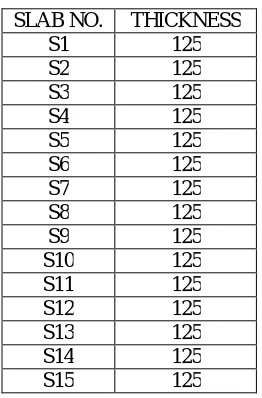
TABLE 3. Existing schedule of Slab
SLAB NO. THICKNESS
S1 125
S2 125
S3 125
S4 125
S5 125
S6 125
S7 125
S8 125
S9 125
S10 125
S11 125
S12 125
S13 125
S14 125
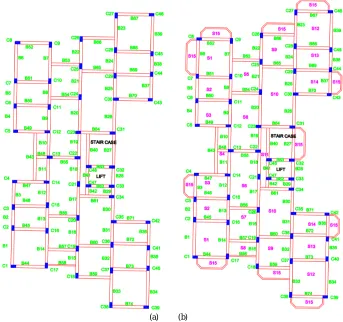
(a) (b)
Fig. 1. Existing structural layout of building (a) At Plinth Level (b) At floor levels
V. OBSERVATIONS
After collecting all the information such as existing plans of building as shown in fig. 1and schedules of building as given in tables 1-3, the building was analysed using ETABS software by using the above mentioned details of building for Earthquake loading
.
From the analysis it was found that the building was stable for earthquake loading.Similarly depth of slab and footing were also compared in order to check for the safety of the same for the earthquake loading.
TABLE 4. Comparison for Slab depth
SLAB NO.
THICKNESS PROVIDED
THICKNESS
REQUIRED REMARKS
S1 125 88 PASS
S2 125 65 PASS
S3 125 71 PASS
S4 125 77 PASS
S5 125 81 PASS
SLAB NO.
THICKNESS PROVIDED
THICKNESS
REQUIRED REMARKS
S7 125 81 PASS
S8 125 54 PASS
S9 125 83 PASS
S10 125 89 PASS
S11 125 55 PASS
S12 125 93 PASS
S13 125 70 PASS
S14 125 64 PASS
S15 125 77 PASS
VI. CONCLUSION
From the above observations it is clear that all sections of the existing building are safe. Hence the building is stable for earthquake loading. However, from the results of NDT it is observed that various sections are deteoriated from their original sizes at some places. All such sections should be retrofitted to their original sizes by using suitable retrofitting technique.
REFERENCES
[1] HariDarshan Shrestha, RyuichiYatabe, Netra Prakash Bhandary and JishnuSubedi, “Vulnerability assessment and retrofitting of existing school
buildings: a case study of Aceh”, International Journal of Disaster Resilience in the Built Environment, Vol. 3 No. 1, 2012, pp. 52-65.
[2] Luisa Berto, Renato Vitaliani, Anna Saetta and Paola Simioni, “Seismic assessment of existing RC structures affected by degradation
phenomena”, Structural Safety 31 (2009) 284–297, 2008.
[3] Hua-Peng Chen and NenadBicanic, “Identification of structural damage in buildings using iterative procedure and regularisation method”, International Journal for Computer-Aided Engineering and Software, Vol. 27 No. 8, 2010, pp. 930-950.
[4] D. Coronelli and P. Gambarova, “Structural Assessment of Corroded Reinforced Concrete Beams: Modeling Guidelines”, J. Struct. Eng. 2004,
130:1214-1224.
[5] TeralaSrikanth, Ramancharla Pradeep Kumar, Ajay Pratap Singh, Bal Krishna Rastogi and Santosh Kumar, “Earthquake Vulnerability
Assessment of Existing Buildings in Gandhidham and Adipur Cities Kachchh, Gujarat (India)”, European Journal of Scientific Research, ISSN 1450-216X Vol.41 No.3 (2010), pp.336-353.
[6] Clotaire Michel, Philippe Gue´guena and Pierre-Yves Bard, “Dynamic parameters of structures extracted from ambient vibration
measurements: An aid for the seismic vulnerability assessment of existing buildings in moderate seismic hazard regions”, Soil Dynamics and Earthquake Engineering 28 (2008), 593–604.
[7] Subhamoy Bhattacharya, “Safety assessment of existing piled foundations in liquefiable soils against buckling instability”,ISET Journal of
Earthquake Technology, Technical Note, Vol. 43, No. 4, December 2006, pp. 133-147.
[8] AtikSarraz, Md. Khorshed Ali and Debesh Chandra Das, “Seismic Vulnerability Assessment of Existing Building Stocks at Chandgaon in
Chittagong city, Bangladesh”, American Journal of Civil Engineering 2015; 3(1): 1-8.
[9] Brian J. Pashina’t Paul E. Gaudettc, “Strength Evaluation of Existing Concrete Buildings”, Reported by ACI Committee 437.
[10] Chandra Bhakuni, “Seismic vulnerability assessment of school buildings”, Proceedings of the SECED Young Engineers Conference 21-22
March 2005.
[11] S.J. Welsh-Huggins, J. Rodgers, W. Holmes, A.B. Liel, “Seismic vulnerability of reinforced concrete hillside buildings in northeast India”,16th
World Conference on Earthquake, 16WCEE 2017 Santiago Chile, January 9th to 13th 2017.
[12] Kerstin Langa and Hugo Bachmann, M.EERI, “On the Seismic Vulnerability of Existing Buildings: A Case Study of the City of
Basel”,Earthquake Spectra, Volume 20, No. 1, pages 43–66, February 2004.
[13] Jerry E. Stephens, M. ASCE and James T. P. Yao, “Damage Assessment Using Response Measurements”, J. Struct. Eng. 1987.113:787-801.
[14] Miguel Branco and Luís Manuel Guerreiro, “Seismic rehabilitation of historical masonry buildings”, Engineering Structures 33 (2011) 1626–
1634.
[15] VV Sakhare, SP Raut, SA Mandavgane and RV Ralegaonkar, “Development of sustainable retrofitting material for energy conservation of
existing buildings”, International Journal of Civil Engineering 13 (4), pp 411-418.
[16] SB Trupti K. Talwekar, Ms. V.N. Mendhe, “Analytical Study on Seismic Response of Retrofitting Multistoried RC building through using steel
wrapping”, International Journal of Research Eissn : 2348-6848 &Plssn: 2348-795X.
[17] V.V. Sakhare, S.P. Raut, S.A. Mandavgane, R.V. Ralegaonkar, “Development of sustainable retrofitting material for energy conservation of
[18] A.V. Patil, Arjun Mudkondwar, “Performance analysis and behavior of steel framed building with reference to variation in bracing type”, International Journal of Modern Trends in Engineering Research (IJMTER), ISSN 2349-9745, vol. 2, issue 4, 2015.
[19] A.V. Patil, S.M. Hardwani, “Low cost Earthquake resistant house using Cold formed Steel (CFS) member A case study”, International Journal
of Engineering Research & Technology (IJERT), ISSN 2278-0181, vol. 2, issue 9, 2013.
[20] A.V.PATIL & S.P. RAUT, “Pre-Engineered Reinforcement-Studies in use of Expanded Metal Mesh as Reinforcement in RCC Slabs”, 3rd