ISSN(Online): 2320-9801
ISSN (Print): 2320-9798
I
nternational
J
ournal of
I
nnovative
R
esearch in
C
omputer
and
C
ommunication
E
ngineering
(An ISO 3297: 2007 Certified Organization)
Vol. 3, Issue 7, July 2015
Reliable Data Delivery using Trusted RPL in
Low Power and Lossy Network
Archana R. Chemate, Prof. S. P. Pingat
PG Student, Dept. of Computer Engineering, SKNCOE, Savitribai Phule Pune University, Pune, India
Assistant Professor, Dept. of Computer Engineering, SKNCOE, Savitribai Phule Pune University, Pune, India
ABSTRACT: Wireless sensor networks (WSNs) bring significant preferences over conventional changes in todayˆas applications, for example, natural observing, homeland security, and human services. A wireless sensor network (WSN) has critical applications, for example, remote natural observing and goal tracking. This has been empowered by the availability, especially in late years, of sensors that are smaller, less expensive, and intense. The Internet Engineering Task Force (IETF) immediately perceived the need to structure a new Working Group to standardize an Ipv6-based directing answer for IP strong article networks, which prompted the arrangement of another Working Group called ROLL (Routing over Low power and Lossy) networks. We have additionally proposed another technique to expand the dependability of the network.
For this, we discovered the bad links, i.e. links where, packets are lost. Such links will be expelled from the network and will discover all the substitute paths. At the same time the connection will be chosen on the premise of the trust estimations of the links. Thusly we accomplished to a reliable communication in the network.
KEYWORDS: Wireless Sensor Networks(WSN), Routing Over Low power and Lossy (ROLL), Internet Engineering Task Force (IETF), Ipv6, Reliable communication.
I. INTRODUCTION
Wireless sensor network (WSN) is the network for the physical situation with the digital world. WSNs were made with the formation and advances of cheap, low power, multifunctional sensor nodes. WSNs are consumed as a part of diverse modern, military, home monitoring and ecological monitoring applications and give several benefits. The IETF received the new working group to standardized an Ipv6-based routing answer for IP smart object networks, which planning to another planning group called ROLL (Routing Over Low Power & Lossy) network. The ROLL working group conducted enquiry of the routing applications like urban network including brilliant lattice, current mechanization, and home and building computerization. The main goal of WG was to outline a routing protocol for LLNs, supporting a mixed bag of link layers, qualities of bandwidth, Lossy & low power. So the routing protocol is used to evaluation on the link layer, which could be wireless like IEEE 802.15.4, IEEE 802.15.4g, (low power) Wi-Fi or power line communication (PLC) exploiting IEEE 802.15.4, for example, IEEE P1901.2.
Link Estimation
RPL usage combines a library of link monitoring procedure. Our library incorporates a detached monitoring plan that cleverly misuses data packets sent by neighbours as test packets. Sometimes, parcel catching may prompt incorrect link-quality evaluations in light of the fact that:
1. It is by and large intertwined for asset compelled gadgets to process all overhead traffic; 2. Most MAC protocols for LLNs don’t support retransmission arrangement;
3. Packet losses happen on the overhead link from the monitoring node & neighbourhood bundle.
ISSN(Online): 2320-9801
ISSN (Print): 2320-9798
I
nternational
J
ournal of
I
nnovative
R
esearch in
C
omputer
and
C
ommunication
E
ngineering
(An ISO 3297: 2007 Certified Organization)
Vol. 3, Issue 7, July 2015
II. MOTIVATION
The RPL standard offers a high level of implementation adaptability. In spite of the fact that this empowers the appropriation of implementation-particular decisions that are enhanced for the focused on application, it likewise opens the route for implementation tradeoffs that may contrarily influence RPL execution. But in a few cases, packet overhearing may prompt wrong link-quality estimates in light of the fact that it is for the most part entangled for resource-obliged devices to process all overhead traffic, most MAC protocols for LLNs don’t help retransmission sequence numbers, yet they utilize an one-bit flag to recognize beginning transmissions and retransmissions and packet misfortunes happen on the overhead link and not on the link from the monitoring node and its neighbour that has sent the overhead packet. This motivates to propose another RPL usage for the Jung OS to enhance the reliability of data transmissions and a new method to increase the reliability of the network.
III. RELATED WORK
In data collection applications of low end sensor networks, a major challenge is ensuring reliability without a significant good put degradation. Due to their resource limitations, low-power Wireless Sensor Networks (WSNs) pose considerable communication challenges.
The IETF has arranged the general Low Power and Lossy Networks by following attributes:
1) LLNs are the networks, which have several wireless inserted gadgets, which are having controlled battery, memory, and handling power.
2) LLNs make consumption of distinctive low-power innovations for message, power line communication. These are influenced by the network.
3) In LLNs, the prevalent traffic examples are more successive, i.e. Multito point; while the unicast and point-to-multipoint are less frequent.
RPL is a gradient-based routing that makes a Destination Oriented (DO) DAG recognized at a data power or sink node. The gradient is called rank, and it is in extensive way a representation of the node to diverse nodes concerning the DODAG root. A routing Target Function (OF) describes how RPL nodes figure their rank abilities and select their guardians. A couple of demands are recognized in RPL. The essential problem in RPL is the approach that is used to gather link insights. On account of the Trickle calculation, DIO messages are not discontinuous. the exchange between the little data structures that are used for keeping up neighborhood data at diverse layers of the protocol stack, which may provoke RPL using clashing or out of date link data. Packet catching may provoke wrong link-quality gauges in light of the way that:
1) It is generally fixed for resource-obliged gadgets to process all overhead traffic;
2) Most MAC protocols for LLNs don’t support retransmission succession numbers, yet they use a one-bit flag to perceive starting transmissions and retransmissions.
3) Packet incidents happen on the overhead link and not on the link from the monitoring node and its neighbor that has sent the overhead packet.
A thick network a hub may have several extraordinary neighbors and many individual’s low-quality links to diverse nodes, neighborhood administration approaches are principal to pick whether to keep up bits of knowledge to newly discovered nodes. Lundgren et al. coin the expression “gray zones” to indicate to links that convey routing protocol data yet not data traffic. They propose link handshaking and counting course telecast to channel out gray zone links. Johnson depicts how to preemptively issue DSR course demands, based on link SNR values. Yarvis et al. watch that hop-count performs ineffectively as a routing metric for a sensor network. Awerbuch et al. present a metric to help discover high through put paths when diverse links can run at distinctive bit-rates.
IV.PROPOSED SYSTEM
ISSN(Online): 2320-9801
ISSN (Print): 2320-9798
I
nternational
J
ournal of
I
nnovative
R
esearch in
C
omputer
and
C
ommunication
E
ngineering
(An ISO 3297: 2007 Certified Organization)
Vol. 3, Issue 7, July 2015
the RPL protocol .It provides solution which minimizes energy and memory usage with quality of services and helps in selecting link for data transmission.
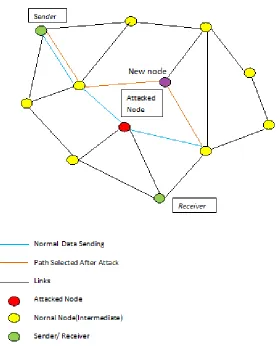
Fig 1: Proposed System Architecture.
In above architecture we are finding the bad links, i.e. links where, packets are lost. Such links will be removed from the network and will find all the alternate paths. But the link will be selected on the basis of the trust values of the links. To calculate trust value we consider following parameter:
Data Rate Error Rate
Power Consumption Distance
In this way we achieve a reliable communication in the network.
V. MATHEMATICAL MODEL
1) Let S represent as a System, Where S= {P; N; D; L; R; K; T}
2) Set of source packets to be send, P = {P1; P2; P3; Pn}
ISSN(Online): 2320-9801
ISSN (Print): 2320-9798
I
nternational
J
ournal of
I
nnovative
R
esearch in
C
omputer
and
C
ommunication
E
ngineering
(An ISO 3297: 2007 Certified Organization)
Vol. 3, Issue 7, July 2015
4) D is set of Shortest Path Detection, D= {D1; D2; D3; Dn}
5) L is the set of loss packets, L = {L1; L2; L3; Ln}
6) R is the Set of received Packet, R = {R1; R2; R3; Rn}
7) K is the Set of links which are removed from the Network due to found of packet loss,
K = {K1; K2; K3; Kn}} 8) T is the Set of trusted links, T = {T1; T2; T3; Tn}}
Packet loss rate is formulated as follows
=
P
TP
Where, is the packet loss rate,
P
is the no of Packets received successfully,TP
is the Total No of Packet Send.For Link L,
is the Trust value of Link
=
NTi
NTi is Trust-value of ith node I is ith node present in the link
Avg (
) =
is number of nodes present in the link Avg ( ) i is the average trust for link.
is the Trust value of Link For all links
∀
L=
∑
Avg ( )
Where
Avg ( )
Average Trust for Link i
ISSN(Online): 2320-9801
ISSN (Print): 2320-9798
I
nternational
J
ournal of
I
nnovative
R
esearch in
C
omputer
and
C
ommunication
E
ngineering
(An ISO 3297: 2007 Certified Organization)
Vol. 3, Issue 7, July 2015
VI.RESULT AND DISCUSSION
The following figure shows the average packet loss and no of packets send with IETF routing with lossy network and our proposed scheme. Our Proposed scheme i.e. by using maximum trust based link selection scheme shows low packet loss rate and maximizing the throughput for the network.
Fig2. Average Packet Loss Graph
In the Result section we are describing the outcomes from the our proposed system .The limitation of the existing system is the routing protocol has high packet loss rate and by using trust based scheme we are achieving the minimum packet loss rate.
VII. CONCLUSION AND FUTURE WORK
The RPL meets high packet disaster rates. Packet incidents not on a very basic level increase with way length. Besides when a node choices a guardian with an outrageous link, it may be not ready to change to a better parent in light of the way that RPL holds a progressive approach for link estimation. It simply surveys the links that are at this moment being used. To address the aforementioned issues, we have gotten a crosslayering configuration procedure to support overhauled limits for link-quality appraisal; and a more capable and adaptable organization of neighborhood data. These new frameworks allow a RPL node to adequately research the nature of individual links and to execute a more taught next-hop determination. The proposed RPL execution achieves recognizable updates of packet delivery rates. We are accomplishing the reliability in the network by uprooting the bad links. This study is a dare to perceiving how to upgrade course disclosure in RPL networks.
REFERENCES
[1] Woo, T. Tong, and D. Culler, “Taming the underlying challenges of Reliable multichip routing in sensor networks,” in Proc.
ACM Conf. Embedded Netw. Sens. Syst. (ACM SenSyns-03), 2003, pp. 14-27.
[2] D. S. J. De Couto, D. Aguayo, J. Bicket, and R. Morris, “A high throughput Pathmetric for multi-hop wireless routing,” in Proc. ACM Int. Conf. Mobile Comput. Netw. (ACM Modicum? 03), 2003, pp. 134-146.
[3] E. Ancillotti, R. Bruno, and M. Conti, “Reliable Data DeliveryWith The IETF Routing Protocol for Low-Power and Lossy Networks”, IEEE Transactions on Industrial Informatics, Vol. 10, No. 3, August 2014.
[4] E. Ancillotti, R. Bruno, and M. Conti, “The role of the RPL routing Protocol in smartgrid communications”, IEEE Comm. Mag., vol. 51, no. 1, pp. 75-83, Jan. 2013.
[5] G. Anastasi, M. Conti, and M. Di Francesco, “A comprehensive analysis Of the MAC unreliability problem in IEEE 802.15.4
ISSN(Online): 2320-9801
ISSN (Print): 2320-9798
I
nternational
J
ournal of
I
nnovative
R
esearch in
C
omputer
and
C
ommunication
E
ngineering
(An ISO 3297: 2007 Certified Organization)
Vol. 3, Issue 7, July 2015
[6] G. E. Moore, “Moore’s Law or How Overall Processing Power for Computers will Double Every Two Year”, 1970. Accessed
on 13th Dec, 2014,http://www.mooreslaw.org/
[7] G. Moritz, F. Golatowski, C. Lerche, and D. Timmermann, “Beyond 6LowPAN: Web Services in Wireless Sensor Networks,”
IEEE Trans. Ind. Informat. vol. 9, no.4, pp. 1551-3203, Nov. 2013.
[8] H. Zhang, A. Arora, and P. Sinha, “Link estimation and routing in sensor Network backbones: Beacon-based or data-driven”
IEEE Trans. Mobile Comput. vol. 8, no.5, pp. 653?-667, May 2009.
[9] I. Demirkol, C. Ersoy, and F. Alagoz, “MAC protocols for wireless sensor Networks: A survey,” IEEE Commun. Mag., vol.
44, no. 4, pp. 115-121, Apr. 2006.
[10] J. Hui and P. Thubert, “Compression Format for IPv6 Datagrams over IEEE 802.15.4-Based Networks”, IETF RFC 6282, Sep.
2011.
[11] J. KO Et Al., “ContikiRPL and TinyRPL: Happy together,” in Proc. Workshop Extend. Int. Low power and LossyNetw. (IP+SN-11), Chicago, IL, USA, Apr. 2011, pp. 16.
[12] K.-H. Kim and K. Shin, “On accurate and asymmetry-aware measurement Of link quality in wireless mesh networks”, IEEE/ACM Trans. Netw. vol. 17, no. 4, pp. 1172-1185, Aug. 2009.
[13] Ms. Archana Chemate, Prof. S. P. Pingat,” Rliable Data Delivery In Low-Power and Lossy Network Using Trust Based Link