ISSN(Online): 2320-9801
ISSN (Print): 2320-9798
I
nternational
J
ournal of
I
nnovative
R
esearch in
C
omputer
and
C
ommunication
E
ngineering
(An ISO 3297: 2007 Certified Organization)
Vol. 3, Issue 7, July 2015
A Novel VLSI Based Eigen Background Using
Background Subtraction for Real Time Image
Processing Applications
P.Swetha1, Dr.P.V.N.Reddy2
PG Student (VLSI Design), Dept of ECE, SV Engineering College for Women, Tirupati, India1
Professor, Dept of ECE, SV Engineering College for Women, Tirupati, India2
ABSTRACT: In this paper a new background subtraction algorithm was developed to detect moving objects from a stable system in which visual surveillance plays a major role. However background subtraction in crowded scenes remains challenging especially when a large number of foreground objects move slowly. Among all existing algorithms it was chosen because of low computational complexity which is the major parameter of time in VLSI. The concept of the background subtraction is to subtract the current image with respect to the reference image and compare it with to the certain threshold values. Here we have written the core processor Micro blaze is designed in VHDL (VHSIC hardware description language), implemented using model sim SE 6.5 Design suite the algorithm is written in system C Language and tested in SPARTAN-3 FPGA kit by interfacing a test circuit with the PC using the RS232 cable. The test results are seen to be satisfactory.
KEYWORDS: Background subtraction, selective Eigen back- Ground, virtual frames, selective model initialization, selective Reconstruction, Micro blaze, Spartan-3 fpga kit etc.
I. INTRODUCTION
Object detection and tracking is one the most important tasks in computer vision. In video surveillance, it assists understanding the movement patterns of people to uncover suspicious events. It is a key technology in traffic management to estimate flux and congestion statistics. Advanced vehicle control systems depend on the tracking information to keep the vehicle in lane and prevent from collisions. In physical therapy, analyzing the mobility of patients improves the accuracy of their diagnosis. Learning the shopping behavior of customers by tracking assists the architecture design in retail space instrumentation. In robotics, tracking bridges the gap between the raw visual information and environmental awareness. In video summarization, it is applied to generate object-based representations and automatic content annotations. Tracking is also a fundamental technology to extract regions of interest and video object layers as defined in JPEG-2000 and MPEG-4 standards. Even though it is essential to many applications, robust object tracking under uncontrolled conditions still poses a challenge . Real-life systems are required to track objects not only when the background scene is static but also when lighting changes suddenly, camera-object motion becomes large, color contrast becomes low, image noise soars to an unacceptable level, etc.In addition, the computational complexity is required to be kept minimum for real-time performance.
II. REVIEW OF PREVIOUS ALGORITHMS
This paper is organized as follows in the section I. introduction to object detection in video surveillance and in the section II. previous algorithms and disadvantages after that in section III. Proposed background modeling. IV. Experimental setup V. Results and finally VI. conclusion.
ISSN(Online): 2320-9801
ISSN (Print): 2320-9798
I
nternational
J
ournal of
I
nnovative
R
esearch in
C
omputer
and
C
ommunication
E
ngineering
(An ISO 3297: 2007 Certified Organization)
Vol. 3, Issue 7, July 2015
A. Optical Flow Method
In a video frame, the field of motion vector per pixel or sub-pixel is called optical flow. There are many a methods for computing optical flow among which few are partial differential equation based methods, gradient consistency based methods and least squared methods. The objective in optic flow calculation is to find the 2D-motion field in an image
sequence. As a pixel at location (x,y,t) with intensity I (x,y,t) will have moved by δx,δy and δt between the two frames
the following image constraint equation can be given:
I(x,y,t)=I(x+Δx,y+Δy,t+Δt)
Assuming that the movement is small enough, the image constraint at I(x, y, t) with Taylor series can be derived as
I(x+Δx,y+Δy,t+Δt)=I(x,y,z)+∂I/∂x(Δx)+∂I/∂y(Δy)+ ∂I/∂t(Δt)+HOT
where H.O.T. means those higher order terms, which are large enough to be ignored. From these equations follows that
Δx+Δy+Δt=0
+ + = 0
The main disadvantage of this Optical flow approach is hard to a apply in real-time due to its high computational cost.
III. REVIEW OF PREVIOUS ALGORITHMS
B. Temporal Difference Method
The Frame difference is arguably the simplest form of background subtraction. The current frame is simply subtracted from the previous frame, and if the difference in pixel values for a given pixel is greater than a threshold (Th), the pixel is considered part of the foreground. A major flaw of this method is that for objects with uniformly distributed intensity values (such as the side of a car), the interior pixels are interpreted as part of the background. Another problem is that objects must be continuously moving. Let Fi-1 be the previous frame and Fi be the consecutive frame, where i= 1 to n. The pseudopodia is given below:
Where „Th‟ is called as Threshold value. Temporal differencing is very adaptive to dynamic environments, but generally does a poor job of extracting all relevant feature pixels. Due to the disadvantages of this two algorithms we go for background subtraction algorithm
IV. PROPOSED BACKGROUND MODELING
ISSN(Online): 2320-9801
ISSN (Print): 2320-9798
I
nternational
J
ournal of
I
nnovative
R
esearch in
C
omputer
and
C
ommunication
E
ngineering
(An ISO 3297: 2007 Certified Organization)
Vol. 3, Issue 7, July 2015
Selecting the best Eigen background. For each pixel to reconstruct its background pixel(called pixel-level reconstruction)using thresholding mechanisms our method can significantly increase the purity of the trained Eigen background and obtain an improved quality of reconstructed background image. Moving(i; j) = | Foreground(i; j) - Background(i; j)| When the difference value is greater than the threshold value it is considered as a foreground otherwise it is background object.
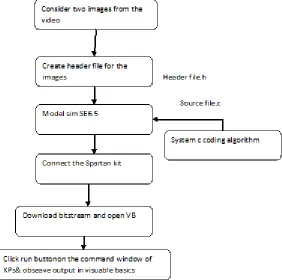
Fig 1: Flow diagram for proposed algorithm
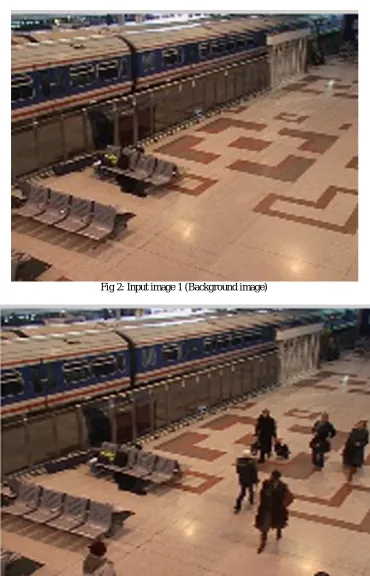
In the first step we consider the video and convert it into frames, from that frames we can select any of two images for that two images we create a header file .And then we can write an algorithm for back ground subtraction in the XPS tool by using system „C‟ language. In the XPS we are giving two inputs of header file.h and source file.c. XPS is a tool
used to link a program to hardware like FPGA. After downloading the bit stream open the visual basics application and click run button on the command window of XPS .Finally with the help of UART port and RS232 cable we made a communication between hard ware and our PC and we can see the output image in the PC with the help of visual basic tool.
V. EXPERIMENTAL RESULTS
ISSN(Online): 2320-9801
ISSN (Print): 2320-9798
I
nternational
J
ournal of
I
nnovative
R
esearch in
C
omputer
and
C
ommunication
E
ngineering
(An ISO 3297: 2007 Certified Organization)
Vol. 3, Issue 7, July 2015
ISSN(Online): 2320-9801
ISSN (Print): 2320-9798
I
nternational
J
ournal of
I
nnovative
R
esearch in
C
omputer
and
C
ommunication
E
ngineering
(An ISO 3297: 2007 Certified Organization)
Vol. 3, Issue 7, July 2015
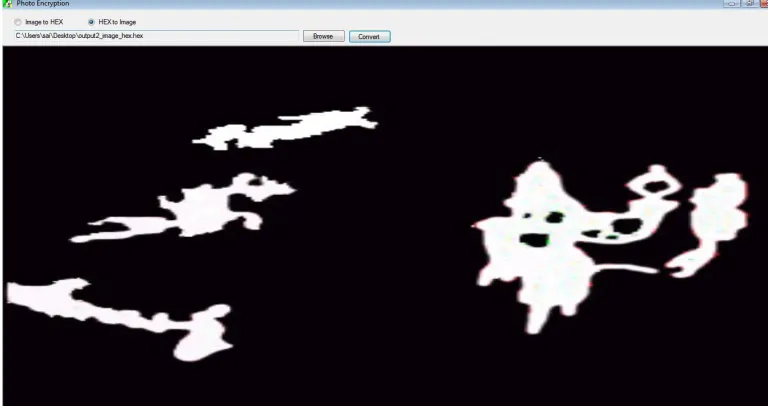
Fig 4: Output image (Background subtraction image)
ISSN(Online): 2320-9801
ISSN (Print): 2320-9798
I
nternational
J
ournal of
I
nnovative
R
esearch in
C
omputer
and
C
ommunication
E
ngineering
(An ISO 3297: 2007 Certified Organization)
Vol. 3, Issue 7, July 2015
Fig 6: final Output image (Background subtraction image)
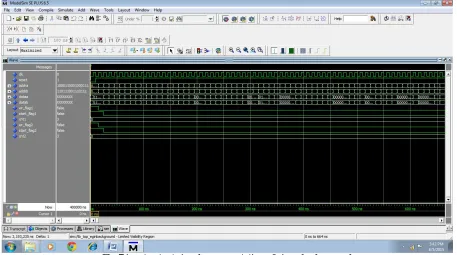
Fig 7:input output signals representation of eigen back ground
VI. CONCLUSION
ISSN(Online): 2320-9801
ISSN (Print): 2320-9798
I
nternational
J
ournal of
I
nnovative
R
esearch in
C
omputer
and
C
ommunication
E
ngineering
(An ISO 3297: 2007 Certified Organization)
Vol. 3, Issue 7, July 2015
REFERENCES
[1] K. Toyama, J. Krumm, B. Brumitt, and B. Meyers,“Wallflower: principles and practice of backgroundmaintenance,” in Proc. 7th IEEE Conf. Computer Vision, 1999, vol. 1, pp. 255–261.
[2] G. Backer, B. Mertsching, and M. Bollmann, “Data- and model-driven gaze control for an active-vision system,” IEEE Trans. Pattern Anal [3]G.L.Foresti,”A Real Time System for Video Surveillance of Unattended Outdoor Environments”.
[4] J. M. Ferryman, Ed., in Proc. 9th IEEE Int. Workshop on Performance Evaluation of Tracking and Surveillance, 2006.
[5] R.T. Collins, A. J. Lipton, T. Kanade, H. Fujiyoshi, D. Duggins, Y. Tsin, D. Tolliver, N. Enomoto, O. Hasegawa, P. Burt, and L. Wixson, “A system for video surveillance and monitoring,” Tech. Rep. CMU-RI-TR-00-12, The Robotics Inst., Carnegie Mellon Univ., Pittsburgh, PA, 2000. [6] J. L. Barron, D. J. Fleet, and S. S. Beauchemin, “Performance of optical flow techniques,” Int. J. Comput. Vis., vol. 12, no. 1, pp. 42–77, 1994 [7] L. Maddalena and A. Petrosino, “A self-organizing approach to detection of moving patterns for real-time applications,” in Proc. 2nd Int. Symp. Brain, Vision, and Artificial Intelligence, 2007, pp. 181–190, Lecture Notes Comput. Sci. 4729
[8] S.-C. Cheung and C. Kamath, “Robust techniques for background subtraction in urban traffic video,” in Proc. EI- VCIP, 2004, pp.881–892. [9] M. Piccardi, “Background subtraction techniques areview,” in Proc.IEEE Int. Conf. Systems, Man, Cybernetics, 2004, pp. 3099–3104. [10] B. P. L. Lo and S. A. Velastin, “Automatic congestion detection system for underground platforms,” in Proc. ISIMP, 2001, pp. 158–161. [11] R. J. Radke, S. Andra, O. Al-Kofahi, and B. Roysam, “Image change detection algorithms: a systematic survey,”IEEE Trans. Image Process., vol. 14, no. 3, pp. 294– 307, Mar. 2005.
[12] C. Wren, A. Azarbayejani, T. Darrell, and A. Pentland, “Pfinder: Realtime tracking of the human body,” IEEE Trans. Pattern Anal. Mach. Intell., vol. 19, no. 7, pp. 780–785, May 1997.
[13] A. Elgammal, D. Hanvood, and L. S. Davis, “Nonparametric model for background subtraction,” in Proc. ECCV, 2000, pp. 751–767
[14] K. Kim, T. H. Chalidabhongse, D. Harwood, and L. S. Davis, “time foreground-background segmentation using codebook Model,” Real-Time Imag., vol. 11, pp. 172–185, 2005.
[15] G. Backer, B. Mertsching, and M. Bollmann, “Data- and model-driven gaze control for an active-vision system,” IEEE Trans. Pattern Anal [16]G.L.Foresti,”A Real Time System for Video Surveillance of Unattended Outdoor Environments”.