Efficient Scheduling Policy for Delay Tolerant
Network Using Store Carry Forward
Protocols
Priya Packialatha
1, G. Michael
*21Assistant Professor, Department of CSE, Jerusalem College of Engineering, Chennai, Tamil Nadu, India
2 Assistant Professor, Department of CSE, Bharath University, Chennai, Tamil Nadu, India
*Corresponding Author
ABSTRACT: In order to achieve data delivery in Delay Tolerant Networks (DTN), researchers have proposed the use of store-carry- and-forward protocols that is a node may store a message in its buffer and carry it along for long periods of time, until an appropriate forwarding opportunity arises. The combination of long-term storage and message replication imposes a high storage and bandwidth overhead. Thus, efficient scheduling and drop policies are necessary to decide on which messages should be discarded when node buffers operate close to their capacity.
KEYWORDS: DTN, AODV, Optimal Scheduling.
I. INTRODUCTION
A wireless ad-hoc network is a decentralized type of wireless network. An ad hoc network is a collection of wireless mobile hosts forming a temporary network without the aid of any established infrastructure or centralized administration. In such an environment, it may be necessary for one mobile host to enlist the aid of other hosts in forwarding a packet to its destination, due to the limited range of each mobile host’s wireless transmissions. Delay-Tolerant Networks (DTN) have introduced new security issues emerging from high communication delays, as well as from decentralized design.
II. RELATEDWORKS
Delay Tolerant Networks are wireless networks where disconnections may occur frequently due to propagation phenomena, node mobility and power outages. Propagation delays may also be long due to the operational environment (e.g. deep space, underwater). In order to achieve data delivery in such challenging networking environments, researchers have proposed the use of store-carry-and-forward protocols: there, a node may store a message in its buffer and carry it along for long periods of time, until an appropriate forwarding opportunity arises. Additionally, multiple message replicas are often propagated to increase delivery probability. This combination of long-term storage and replication imposes a high storage overhead on untethered nodes (e.g. handhelds).Their simulations were based on synthetic model and real world mobility traces. They are based on the Random Waypoint model, ZebraNet wildlife tracking experiment and San Francisco’s Yellow Cab Taxi Trace.
only (i.e. no bandwidth or scheduling concerns) using a similar analytical framework, and have compared it extensively against the Simple Scheduling Policy.
III.PROPOSEDSYSTEM
In this paper, we propose an efficient joint scheduling and drop policy that can optimize different performance metrics. We first introduce a congestion based scenario that estimates and divides the buffer size of the nodes. Based on this, we derive a distributed scheduling and drop policy that can approximate the performance of the optimal policy in practice. Using simulations based on synthetic traces, we show that our optimal scheduling and drop policy outperforms the existing Scheduling scheme i.e., First-In-First-Out scheme for DTNs. Also we add an enhancement to the AODV routing by allowing it to search the best path based on buffer size of the intermediate nodes[8]. Finally, we examine the drop count under different scheduling regimes and prove the optimality of the proposed Joint Scheduling and Drop Policy.
An optimal scheduling and drop policy algorithm for Delay Tolerant Networks has been proposed which maximizes packet delivery rate and minimize delay. Delay Tolerant Networks are those which uses “store-carry-and-forward” protocol. When no forwarding opportunity is available, instead of dropping the respective packets, nodes store and carry messages until new communication opportunities arise.
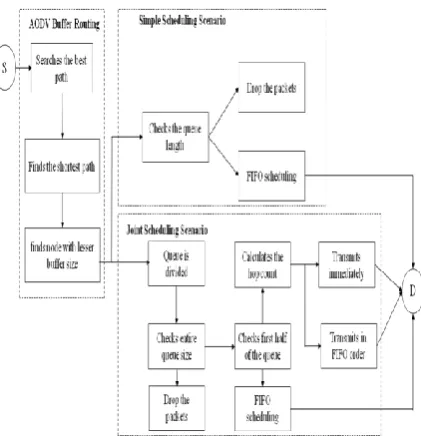
Fig 1.Proposed Architecture
The system architecture Fig.1. consists of the flow from source node and destination node, the blocks of AODV Buffer Routing, Simple scheduling scenario and Joint Scheduling Scenario. In the above system architecture fig 1 'S' refers to the source node and 'D' refers to the destination node.
A. AODV Buffer Routing
The AODV Routing protocol uses an on-demand approach for finding routes, that is, a route is established only when it is required by a source node for transmitting data packets. It employs destination sequence numbers to identify the most recent path. The major difference between AODV and Dynamic Source Routing (DSR) stems out from the fact that DSR uses source routing in which a data packet carries the complete path to be traversed.
packet in the network when a route is not available for the desired destination[9]. It may obtain multiple routes to different destinations from a single RouteRequest. The major difference between AODV and other on-demand routing protocols is that it uses a destination sequence number (DestSeqNum) to determine an up-to-date path to the destination. A node updates its path information only if the DestSeqNum of the current packet received is greater or equal than the last DestSeqNum stored at the node with smaller hop count.
A RouteRequest carries the source identifier (SrcID), the destination identifier (DestID), the source sequence number (SrcSeqNum), the destination sequence number (DestSeqNum), the broadcast identifier (BcastID), and the time to live (TTL) field. DestSeqNum indicates the freshness of the route that is accepted by the source[10]. When an intermediate node receives a RouteRequest, it either forwards it or prepares a RouteReply if it has a valid route to the destination. The validity of a route at the intermediate node is determined by comparing the sequence number at the intermediate node with the destination sequence number in the RouteRequest packet[11]. If a RouteRequest is received multiple times, which is indicated by the BcastID-SrcID pair, the duplicate copies are discarded. All intermediate nodes having valid routes to the destination, or the destination node itself, are allowed to send RouteReply packets to the source. Every intermediate node, while forwarding a RouteRequest, enters the previous node address and its BcastID.
A timer is used to delete this entry in case a RouteReply is not received before the timer expires. This helps in storing an active path at the intermediate node as AODV does not employ source routing of data packets[12]. When a node receives a RouteReply packet, information about the previous node from which the packet was received is also stored in order to forward the data packet to this next node as the next hop toward the destination.
Pseudo code for AODV Buffer Routing:
Sends Request if(new request)
{ //searches for the best path
if(shortest path && less buffer size) {
selects the path; }
sends back the response; }
B.Simple Scheduling Scenario
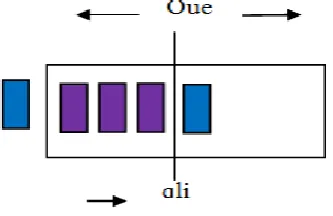
Fig 2. Scheduling based on FIFO
CJoint Scheduling Scenario
In Joint Scheduling Scenario, queue is logically divided into two and is denoted by qlim/2. In the first half of the queue, packets are enqueued based on First in First out Scheduling fig 3.5[13]. Once the first half of the queue is full, the hop count of the arriving packets is identified first half of the queue
Fig 3. Forwarding packets in FIFO order
If the hop count of the arriving packet is less than two, then the packet is enqueued normally fig 6. Otherwise if the hop count of the arrivng packet is greater than two, then the packet is transmitted immediately fig 7. Thus Joint Scheduling has FIFO in the first half of the queue and Priority Scheduling in the second half of the queue.
IV. RESULTS AND IMPLEMENTATION
The source nodes searches for the best path using AODV Buffer Routing. In AODV Buffer Routing, the optimal path is chosen based on the shortest path and the buffer size of the intermediate nodes.
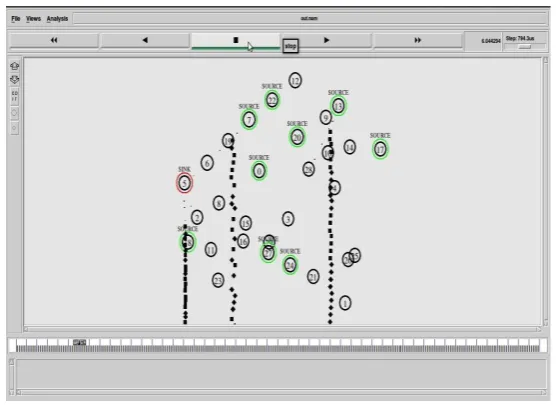
Transmission of Packets from Source to Sink :
After routing, source nodes transmit the packets to the destination node through the optimal path.
Fig 6. Transmission of Packets from Source to Sink
During packet transmission through intermediate nodes, some new packets may be dropped due to unavailability of space in the buffer.
.
Fig 7. Dropping of Packets during transmission
Fig 8. Dropping of Packets at the end of the transmission
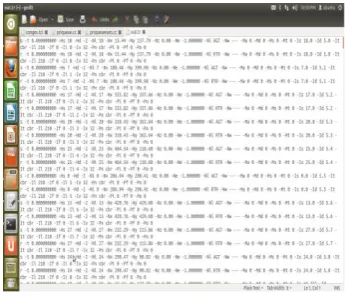
The trace files for basic communication, existing scheme and proposed schemes are shown below. Trace file consists of event type(t), receive(r), send(s), forward(f), drop(d), timestamp of the event. Packet types are AGT and RTR. AGT refers to data packets and RTR refers to control packets or router packets.
Fig 9. Trace file for Simple Scheduling
The following graph depicts the comparison of Drop counts maintaining the sending rate as constant. The number of nodes are plotted in the x axis and the drop counts are plotted in the y axis. The values are tabulated in Table 1.
Number of Nodes
Simple Scheduling
Joint Scheduling
30 27414 26446
40 29265 29157
50 19844 17543
60 31157 27532
Sending Rate Simple Scheduling
Joint Scheduling
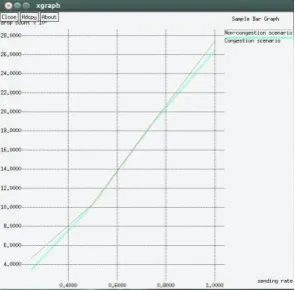
0.25 Mb 4698 3458
0.50 Mb 10356 10283
0.75 Mb 19000 18912
1.00 Mb 27414 26446
TABLE 2 Sending Rate - Simple Scheduling Vs Joint Scheduling
Fig 10. Number of Nodes - Simple Scheduling Vs Joint Scheduling
This graph, fig 14, depicts the comparison of Drop counts maintaining the number of nodes as constant. The sending rates are plotted in the x axis and the drop counts are plotted in the y axis. The values are tabulated in Table 2.
Fig11. Sending Rate - Simple Scheduling Vs Joint Scheduling
REFERENCES
1. Amir Krifa,ChadiBarakat, Senior Member, IEEE, and Thrasyvoulos Spyropoulos, Member, IEEE,Dec. 2010 "Message Drop and Scheduling in DTNs": Theory and Practice.
2. Vidyalakshmi K., Kamalakannan P., Viswanathan S., Ramaswamy S., "Antinociceptive effect of certain dihydroxy flavones in mice", Pharmacology Biochemistry and Behavior, ISSN : 0091-3057, 96(1) (2010) pp. 1-6.
3. H. P. Dohyung Kim and I. Yeom, 2008, “Minimizing the impact of buffer overflow in dtn,” in Proceedings International Conference on Future Internet Technologies (CFI).
5. S.JAIN,K.FALL, AND R.PATRA,AUG.2004,“ROUTING IN A DELAY TOLERANT NETWORK,” IN PROCEEDINGS OF ACMSIGCOMM.
6. VIJAYARAGAVAN,S.P.,KARTHIK,B.,KIRAN KUMAR,T.V.U.,SUNDAR RAJ,M."ANALYSIS OF CHAOTIC DC-DC CONVERTER USING WAVELET TRANSFORM",MIDDLE -EAST JOURNAL OF SCIENTIFIC RESEARCH,ISSN:B27,16(12)(2013) PP.1813-1819.
7. AKRIFA,C.BARAKAT, AND T.SPYROPOULOS,2008,“OPTIMAL BUFFER MANAGEMENT POLICIES FOR DELAY TOLERANT NETWORKS,” IN IEEE SECON.
8. UDAYAKUMAR R.,KHANAA V.,SARAVANAN T.,"CHROMATIC DISPERSION COMPENSATION IN OPTICAL FIBER COMMUNICATION SYSTEM AND ITS SIMULATION",INDIAN JOURNAL OF SCIENCE AND TECHNOLOGY,ISSN:0974-6846,6(S6)(2013) PP.4762-4766.
9. A.Lindgren, A. Doria, and O. Schelen, 2003, “Probabilistic routing in intermittently connected networks,” SIGMOBILE Mobile Computing and Communication Review, vol. 7, no. 3.
10. Udayakumar R., Khanaa V., Kaliyamurthie K.P., "Optical ring architecture performance evaluation using ordinary receiver", Indian Journal of Science and Technology, ISSN : 0974-6846, 6(S6) (2013) pp. 4742-4747.
11. A.Lindgren and K. S. Phanse, 2006, “Evaluation of queuing policies and forwarding strategies for routing in intermittently connected networks,” in Proceedings of IEEE COMSWARE.
12. Prof.S.P. Setti Vijay Kumar D V Nagendra Prasad G S M Narasimha Raju KCS&SE Dept., AU College of Engineering, Andhra University, India "Implementation of Fuzzy Priority Scheduler for MANET and Performance Analysis with Reactive Protocols".
13. T. Spyropoulos, K. Psounis, and C. S. Raghavendra, 2008, “Efficient routing in intermittently connected mobile networks: The multiple copy case,” IEEE/ACM Transactions on Networking, vol. 16, no. 1, pp. 77–90.[9] A. Vahdat and D. Becker,2000, “Epidemic routing for partially connected ad hoc networks,” Duke University, Tech. Rep. CS-200006.
14. Dr. T.Nalini, Dr.K.Manivannan, Vaishnavi Moorthy, Efficient Remote Data Possession Checking In
Critical Information Infrastructures Ensuring
Data Storage Security In Cloud Computing, International Journal of Innovative Research in Computer and Communication Engineering, ISSN (Online): 2320 – 9801,pp 12-18, Vol. 1, Issue 1, March 2013
15. Dr.K.P.Kaliyamurthie, Cervical Cancer Screening and Classification
Using Acoustic Shadowing, International Journal of Innovative Research in Computer and Communication Engineering, ISSN(Online): 2320-9801,pp 1659-1662, Volume 1, Issue 8, October 2013
16. Dr.K.P.Kaliyamurthie, Automated Information Retrieval System Using Correlation Based Multi- Document
Summarization Method, International Journal of Innovative Research in Computer and Communication Engineering, ISSN(Online): 2320-9801,pp 4328-4335, Vol. 1, Issue 7, September 2014
17. Dr.K.P.Kaliyamurthie, D.Parameswari, Modelling Cloud Storage, International Journal of Innovative Research in Computer and Communication Engineering, ISSN: 2249-2651,pp 1-5, Volume1 Issue3 Number2–Dec2011
18. Dr.K.P.Kaliyamurthie, D.Parameswari, Implementation of Customized Greencall
Algorithm for Energy-Efficient Of Wireless