The Outdoor LED Lighting Driven By the
ILFC
Diana D Souza1, Dr Sheryl Grace Colaco2
PG Student, Department of EEE, St. Joseph Engineering College, Mangaluru, Karnataka, India1
Professor, Department of EEE, St. Joseph Engineering College, Mangaluru, Karnataka, India2
ABSTRACT: The LEDs are widely used in the lighting systems due to its long life span and being eco-friendly. The power rating of the LED varies. Hence an appropriate control method is essential. The DCM based flyback converter is propounded in this paper to obtain high power factor and low THD along with a pulse Frequency Modulation controller which provides high efficiency for the wide range of the output power. This is validated using the MATLAB Simulink and the various parameters are observed.
KEYWORDS: Efficiency, Interleaved Flyback Converter (ILFC), Light Emitting Diode (LED), Power Factor, Total Harmonic Distortion (THD).
I. INTRODUCTION
The Light Emitting Diodes (LEDs) are replacing the existing lighting systems due to its features like being reliability, eco-friendly and lasts for a long duration. The aim of this paper is to present a topology for driving the outdoor LEDs that uses the ac source. In a single stage structure all the power factor correction, output regulation and controlling takes places simultaneously in a single step[1]. Hence no additional control is required which reduces the component counts. The converter can either operates in Discontinuous Conduction Mode (DCM) and Continuous Conduction Mode (CCM). The CCM provides high efficiency whereas the DCM provides the high power factor and low THD[2]. Hence the Pulse Frequency Modulation is employed with DCM to obtain the high efficiency and better power factor and THD.
The flyback converter is similar to the buck-boost converter. It consists of a flyback transformer which is made of the inductor. The windings of this transformer will not conduct simultaneously like the normal transformer. When this transformer operates in DCM, the switch voltage will decrease to zero. The LEDs are driven by the dc supply. Hence the conversion from ac to dc is essential. The ac to dc converter is basically the bridge diode rectifier followed by a capacitor to smoothen the regulated voltage. The rectifier absorbs energy from the ac line and will result in harmonics in the input line current. The power factor should be greater than 0.9 and THD should satisfy the IEC61000-3-2[3]. The PFC reduces the ripple content in the output voltage.
II. PROPOSED SYSTEM
CIRCUIT DESCRIPTION
where is the turn-on time, is the switching frequency and m is a constant. This method will lead to increase in switching frequency and the on time for heavy load at low ac line and decreases the switching frequency and turn-on time for light load at high ac line[5]. Hence the frequency between these lines is expressed in (2)
where Dmin and Dmax are the duty cycles at full load with high ac and low ac line respectively. Their ratio will be less
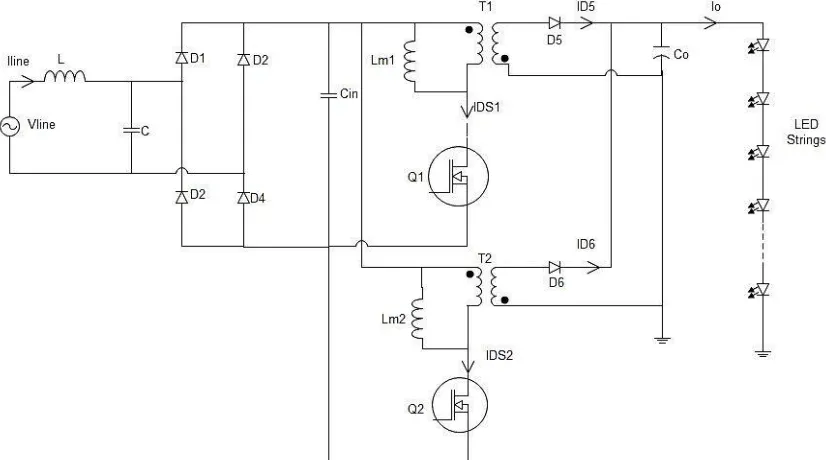
than unity and hence the propound method will reduce the switching frequency. The equivalent circuit for the interleaved converter is shown in Figure 1.
Figure 1: Interleaved flyback converter to drive LED
OPERATION OF THE TOPOLOGY
The current flows through CIN. The diode current ID5 starts to decrease and the drain current IDS1 of Q1 increases. Here both Q1 and Q2 are off. But the internal capacitor CDS2 of Q2 will start to charge, thus causing the current IDS2 to increase which makes the operation to enter the next mode.
Figure 2: Modes of operation
III.EXPERIMENTAL RESULTS
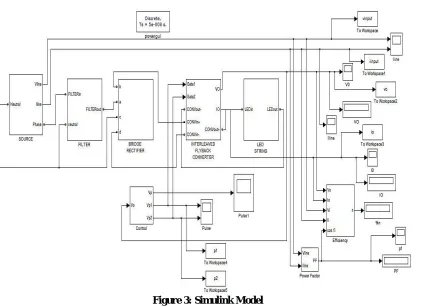
The operation of this propound topology is validated an analysed using the MATLAB Simulink. The Simulink model for this topology is shown in the Figure 3. The LEDs units are connected in series and the count will vary based on the requirements.
Figure 3: Simulink Model
For a particular time period, the gating pulse of one MOSFET will be 180 degrees out of phase with the other MOSFET. This is done by using equation (1) by taking a constant value m.
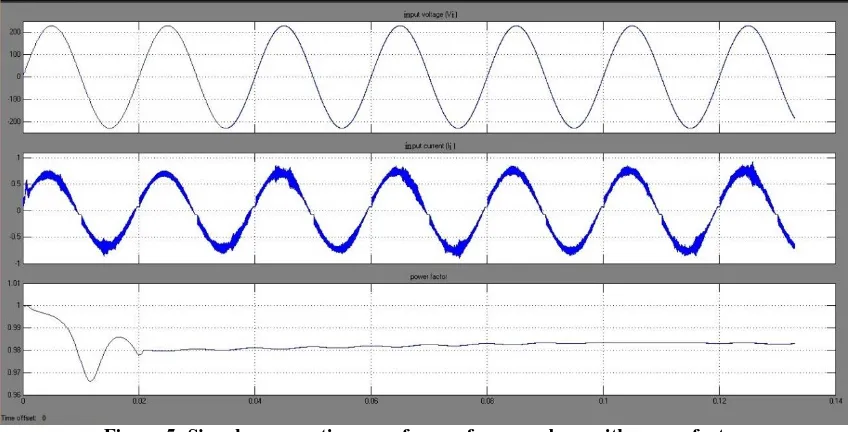
Figure 5: Signal representing waveforms of source along with power factor
The output voltage (V0) and output current (I0) for 30 LEDs connected in series is observed in MATLAB Simulink. This is illustrated by the waveform shown in Figure 6.
Figure 6: Output waveforms
Figure 7: FFT analysis to determine THD
The analysis and the proper validation of this proposed topology which is observed using MATLAB Simulink can be summarised using the Table 1.
Table 1: Observed results
Specifications Values
Input Voltage 230V ac
Turns Ratio 29:14
Switches N type MOSFET
Output Voltage 87.32V
Output Current 0.9105
Output Power 80W
Power Factor 0.9833
Efficiency 86.92%
THD 6.30%
IV. CONCLUSION
The outdoor lighting using the LED driver is proposed in this paper. This proposed converter will give the output which is having minimum ripples. Also this proposed topology has higher efficiency, lower THD and best power factor. Using the pulse frequency modulation technique, this proposed conveyer can be used for wide range of output.
REFERENCES