Fuel transient behavior analysis
Gheorghe Negut , TRIGA Research Reactor Dept, Institute for Nuclear Research (INR), 1, Campului Str, Mioveni, PO Box 78, 0300 Pitesti, Romania ([email protected])
Ilie Prisecaru, Daniel Dupleac, Dept of Nuclear Engineering, University Politehnica (UPB) Bucharest, Romania
ABSTRACT
Some Romanian research programs require the study of fuel behavior during transients. Romanian TRIGA Annular Core Pulse Reactor (ACPR) is provided with capabilities to produce short pulses that simulate Reactivity Initiated Accidents (RIA). A program was initiated to study CANDU type fuel in transient situations by using these reactor capabilities. Since 1984, over 54 tests were performed with fresh un-irradiated fuel specimens, placed in a special capsule. The goal of these tests was to determine the clad failure threshold and to determine fuel-clad-coolant interaction during transients.
The irradiation tests conditions for this special capsule are atmospheric pressure and environmental temperature. This capsule is placed in the ACPR central dry cavity during the tests.
During the pulse, in a very short time a significant energy is deposed in the fuel, which heats up the fuel. The clad temperature rises to over 1000 C. Due to the high temperature, quickly the clad will be covered with a vapor layer. Subsequent cooling of the clad is described as rewetting, involving thermal hydraulic phenomena which take place in the re-flooding phase following a LOCA accident, when on the fuel elements, covered with steam, cold water is injected from the emergency cooling system.
The capsule and the fuel specimen was modeled using RELAP5-SCDAP code.
To document our SCDAP model we used some JAERI experiments. These evaluations show a good agreement. The SCDAP model developed for clad temperature prediction for the tests in Romania’s ACPR, with the atmospheric capsule and fresh fuel, as well as for similar JAERI reactor (Japan) tests proved to have good predictions and, also, gave a good prediction for clad failure threshold energy. The predicted failure threshold is confirmed both for the ACPR tests and for the JAERI tests.
INTRODUCTION
Nuclear power reactors behavior during a severe accident is an important topic. Connected with this issue, fuel behavior during severe transients is very important. Annular Core Pulse Power Reactor (ACPR) is an important facility allowing such kind of experiments. This reactor has special features that allows pulsing a fuel specimen which result in a, almost instant, important quantity of energy deposing, similar with a Reactivity Initiated Accident (RIA) [1]. Using a special capsule, with stagnant water at environmental parameters, atmospheric pressure and room temperature, placed in the ACPR central dry cavity were made tests in the ACPR pulsing for 40 fuel specimen. The goal of these tests is to establish the clad failure threshold. The fuel specimen is equipped is thermocouple to measure clad temperature and a pressure gauge to measure fuel inside pressure during the pulse [1].
Our paper present the RELAP-SCDAP models of the tested fuel transient behavior.
TRANSIENT THERMAL HYDRAULIC FUEL CLAD BEHAVIOR
The fuel during ACPR pulsing suffers very fast thermal hydraulic transients. The fuel heats up quickly due to important energy deposed in it. The fuel clad reaches high temperature levels and covers with vapors. The water surrounding fuel cools down fuel clad in the quench mode. The quench thermal hydraulic mode determines clad temperature fast decrease. The quenching temperature in named, also, Leidenfrost temperature [2]. This temperature named, also, minimum film boiling temperature TMFB is important in the cooling process. When the quenching reach minimum film boiling temperature the heat transfer mode switches to transition boiling characterized by high heat transfer coefficients and clad temperature steep decrease. When quench temperature is reached, the vapor film is broken and the liquid reach again the clad surface. It is found by Carbajo [2] that in the case of a Zircaloy clad the minimum film boiling can be expressed by the following equation:
b
T
a
T
MFB=
∆
sub+
(1)Mori [3] gives for the above conditions gives:
a = 7.5 and b = 140.0 (2)
For a sub-cooling of
∆
T
sub = 80 C, as in our tests, the minimum film boiling temperature is:740
140
80
*
5
.
7
+
=
=
MFB
T
C (3)RELAP-SCDAP MODEL FOR THE ACPR TESTS
RELAP5 code was successfully used to model ACPR reactor pulse mode [3], using data provided by the ACPR Safety Analysis Report [4].
The capsule and fuel used in the ACPR experiments was modeled using the RELAP-SCDAP [5] code.
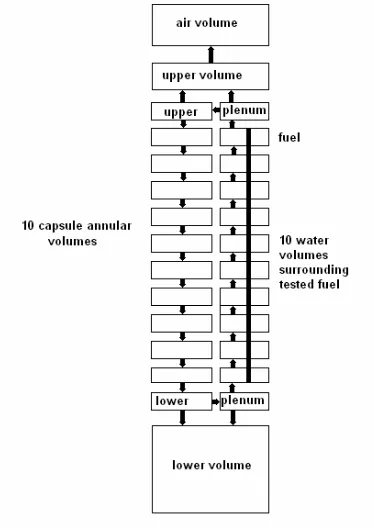
The capsule thermal hydraulic model is presented in Figure 2. The geometrical model of the capsule includes several volumes as follows:
- upper volume of air
- upper volume of water above the fuel element - upper plenum volume surrounding fuel upper end - annular upper plenum at the same level with the volume surrounding fuel upper end
- multiple volume RELAP5 type pipe of 10 volumes equal with the height of fuel pellets surrounding the fuel
- multiple annular RELAP5 type pipe volume with the pipe volume of surrounding fuel. The heat transfer is between the inferior and superior volumes of water, also, between the annular volumes surrounding the fuel where there is cross flow.
- lower plenum volume surrounding fuel upper end - annular lower plenum at the same level with the volume surrounding fuel lower end
- one lower volume of water
The water inventory is approximately 7x10⁻³ m3. Water temperature is around 200C (293K) and atmospheric pressure 0.1 MPa.
SCDAP CANDU type fuel used for modeling has the following characteristics presented in [1].
The fuel pellet shape of the flux due to the fact that is a content of 10% of U235, which absorbs the thermal neutrons, less at the edge and more at the pellet centre.
Figure 1 RELAP-SCDAP model for the ACPR capsule
JAERI Tests
Due to the low confidence of the data obtained from our ACPR tests, thermocouples for clad temperatures recording and pulse energy deposed in the fuel assessment we find JAERI tests as means of comparison [6, 7].
The ACPR capsule is quite the same. The only difference is for the fuel used in the tests. The fuel samples are type standard PWR, and have the characteristics, presented in [7]. These tests were made in the atmospheric condition and stagnant water.
JAERI forced flow tests
A special capsule with forced flow conditions was used for another set of tests in pulsing conditions.
The capsule model and its characteristics are quite similar with the stagnant water capsule but forced flow is used. The water flow speed in the JAERI tests is 1.8 m/s [6].
The RELAP5-SCDAP JAERI forced flow capsule model is presented in the Figure 2.
The fuel used in these tests is similar with standard PWR fuel samples used in the stagnant water tests.
RESULTS AND DISCUSSIONS
ACPR CANDU fuel sample tests A10 fuel sample
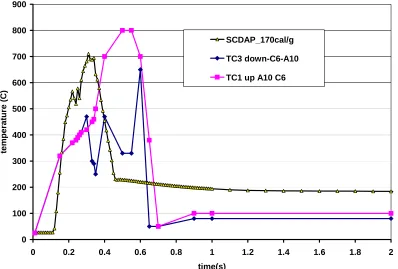
The CANDU type A10 fuel sample was tested in ACPR in the pulse # 341, the energy deposed during the pulse was estimated to be 170 cal/g. Clad temperatures recorded by thermocouples are presented in the Figure 3. The estimated SCDAP clad temperatures, also, are plotted.
SCDAP clad temperature has similar shapes with A10 recorded temperatures. SCDAP code estimates temperatures around quench temperatures of 740 C. The benchmark shows that SCDAP code cannot assess temperatures in the range 750C to 1000C due to the special conditions of the heat transfer around quench temperature. In this respects the code estimates clad temperature lower than 740 C and/or greater than 1000 C.
Compared with fuel inside pressure recorded during A10 pulse SCDAP code predicts a higher peak pressure but the pressure histories are quite similar.
B11 fuel sample
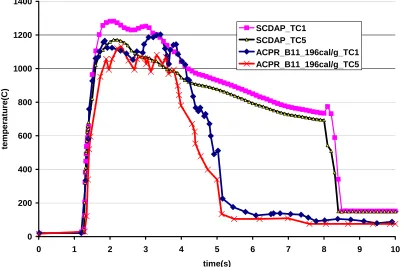
B11 fuel sample was tested in ACPR pulse #457, the fuel sample energy deposed during the pulse was estimated to be 196 cal/g. B11 clad temperatures recorded during the pulse, compared with SCDAP clad temperatures estimations are presented in the Figure 4. The SCDAP TC1 prediction has a higher peak value but the shape is quite similarly; same also for TC5 prediction. SCDAP predicts a longer film boiling, clad temperatures reach quench threshold, approximately, with 3 second delay than recorded temperatures.
SCDAP predicts a higher peak fuel pressure and a shorter pressure decrease after fuel failure than recorded during the pulse.
0 100 200 300 400 500 600 700 800 900
0 0.2 0.4 0.6 0.8 1 1.2 1.4 1.6 1.8 2
time(s)
te
mp
er
a
tur
e (C
)
SCDAP_170cal/g
TC3 down-C6-A10
TC1 up A10 C6
Figure 3 Comparison between A10 fuel clad recorded temperatures and 170 cal/g UO2 SCDAP estimated clad temperatures
0 200 400 600 800 1000 1200 1400
0 1 2 3 4 5 6 7 8 9 10
time(s)
te
mp
eratu
re(C
)
SCDAP_TC1 SCDAP_TC5
ACPR_B11_196cal/g_TC1 ACPR_B11_196cal/g_TC5
Figure 4 B11 clad temperatures recorded during the #457 ACPR pulse compared with SCDAP clad temperatures prediction
JAERI tests Stagnant tests
Some clad temperatures with for standard PWR fuel samples in stagnant conditions are presented in the ref [4]. Based on these plots some SCDAP assessments were made.
JAERI 145 cal/g test
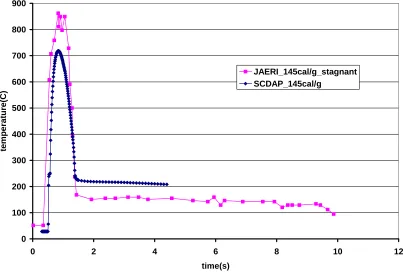
Clad temperature recorded in this JAERI test [Fig 2.2.1 ref. 6] compared with SCDAP prediction for 145 cal/g energy deposed in UO2 are presented in the Figure 5. The SCDAP predicted clad temperature is lower than recorded. Same as for the A11 CANDU type fuel sample the SCDAP doesn’t predict temperatures in the 740 to 1000 C range due to heat transfer correlations. Anyway the clad temperature decrease takes place simultaneously with recorded JAERI clad temperature.
JAERI 195 cal/g test
Clad temperature recorded in JAERI 195 cal/g test [Fig 2.2.2 ref. 6] compared with SCDAP prediction for 145 cal/g energy deposed in UO2 is presented in the Figure 6.
SCDAP fuel clad predicted temperature is somewhat higher than JAERI fuel clad recorded temperature but the trend are similar, SCDAP quenching temperature is delayed with approximately 3 seconds.
JAERI 245 cal/g #103-9 test
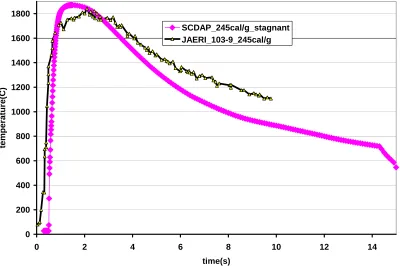
In this test the energy deposed in the fuel sample is 245 cal/g. The clad temperature recorded in JAERI 103-9 test [Fig 2.3.1 ref. 6] compared with SCDAP prediction for 245 cal/g energy deposed in UO2 is presented in the Figure 7. The predicted SCDAP fuel clad peak temperature is quite similar with JAERI fuel clad temperature but SCDAP prediction is smaller, with the same trend.
JAERI 220 cal/g test
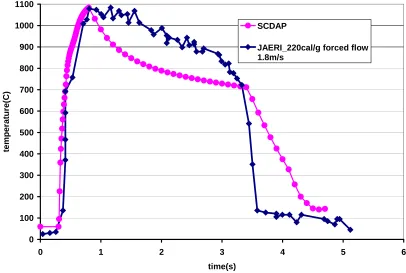
The clad temperature recorded in JAERI 220 cal/g forced flow test [Fig 2.3.4 (b) ref. [ 6] compared with SCDAP prediction for 220 cal/g energy deposed in UO2 are presented in the Figure 9. Predicted SCDAP peak fuel clad temperature is reached in the same time as in the test but tends to decrease at lower values. Anyway, the quench temperature is reached in the same time by SCDAP predicted temperature.
Clad failure threshold
A goal for these tests is to establish threshold energy deposed in the fuel samples to cause the clad failure. For ACPR tests, statistics says that CANDU type fuel sample clad failure takes place at a 170 cal/g energy deposed during the pulse. SCDAP prediction is in the same range of values. It is very interesting that SCDAP predicts that the failure takes place at the fuel upper end which is proved by the tests. This can be seen in the Figure 10 [1].
For the JAERI tests, with standard PWR samples, fuel clad failure energy threshold of 260 cal/g was established [6], [7]. SCDAP energy threshold prediction for standard PWR fuels samples in stagnant condition is 270 cal/g. So the SCDAP gives a fair prediction of fuel clad energy failure threshold.
CONCLUSIONS
The 740 C value for minimum boiling temperature TMFB for sub-cooling at room temperature and 0.1 MPa atmospheric pressure is confirmed both by experiments in our ACPR reactor and by JAERI tests. This value is confirmed also in the SCDAP predictions.
0 100 200 300 400 500 600 700 800 900
0 2 4 6 8 10 12
time(s)
te
mp
eratu
re(C)
JAERI_145cal/g_stagnant SCDAP_145cal/g
0 200 400 600 800 1000 1200
0 2 4 6 8 10 12 14 16
time(s)
te
mperat
ure(C
)
JAERI_195cal/g SCDAP1_195cal/g
Figure 6 JAERI 195 cal/g test clad temperature compared with SCDAP prediction
200 400 600 800 1000 1200 1400 1600 1800
te
mp
er
a
tur
e(C
)
0 100 200 300 400 500 600 700 800 900
0 0.5 1 1.5 2 2.5 3 3.5 4 4.5 5
time(s)
te
mp
eratu
re(C
)
SCDAP
JAERI 190cal/g_forcedflow
Figure 8 JAERI 190 cal/g forced flow test (coolant flow =1.8 m/s) fuel clad temperature compared with SCDAP prediction
0 100 200 300 400 500 600 700 800 900 1000 1100
0 1 2 3 4 5 6
time(s)
te
m
p
e
ratu
re(
C
)
SCDAP
JAERI_220cal/g forced flow 1.8m/s
The SCDAP model developed for clad temperature prediction for the tests in Romania’s ACPR, with the atmospheric capsule and fresh fuel, as well as for similar JAERI reactor (Japan) tests proved to have good predictions and, also, gave a good prediction for clad failure threshold energy. The predicted failure threshold is confirmed both for the ACPR tests and for the JAERI tests. The SCDAP stagnant model seems to give better prediction than the forced flow model for JAERI tests.
These SCDAP predictions are very useful when new tests are projected, giving to the experimenter to assess quite well the future experiments.
Figure 10 Aspect of the fuel samples tested in ACPR
ACKNOWLEDGMENTS
This paper was done on behalf of Romania’s Ministry for Economy and Commerce.
NOMENCLATURE
MFB
T
= minimum film boiling temperaturesub
T
∆
= Sub-cooling temperaturea
- Constant for minimum boiling temperature equationb
- Constant for minimum boiling temperature equationREFERENCES
[1] Gheorghe Neguţ, Mircea Popov - UO2 RIA Type Test, Journal of Nuclear Materials Vol. 188, 1992, 168-176.
[2] J.J. Carbajo & A.D. Siegel, Review and comparison among the different model for rewetting in LWRs, Nuclear Engineering & Design, Vol. 58, 1998 33-44.
[3] Gheorghe Neguţ - TRIGA ACPR Pulse Mode Analysis, Jahrestagung Kerntechnik 25-27 May, 2004, Duesseldorf, Proceedings, Edited by Deutsches Atomforum, e.V.,Kerntechnische Gesellschaft e.V. Published by INFORUM Verlags- und Verwaltungsgesellschaft mbH, Berlin, © Copyright 2004 by INFORUM GmbH,Copy Editor: Dr. Karl G. Bauer, dbcm GmbH, Sankt Augustin, First printing: May 2004, 442-445.
[4] ***, Safety Analysis Report of the TRIGA ACPR, Feb1974, General Atomics Company Report, San Diego, Ca , USA, EL-1174, Volume II.