MMPM for Single Image Super-Resolution
Madhura M. Agashe
1, Sanjeevani K. Shah
2PG Student, Dept. of E & TC Engineering, STES’S Smt. Kashibai Navale College of Engineering, Pune, India1
HOD E&TC, Dept. of E & TC Engineering, STES’S Smt. Kashibai Navale College of Engineering, Pune, India2
ABSTRACT: The MMPM (Multiple Mixture Prior Model) is learning based SR method which is used for converting Low Resolution (LR) image to High Resolution (HR) image. Other time or space intensive SR methods have limitations on practical applications. So to improve these limitations researchers focused subspace view and delivered State-of-art results. In this paper, the HR image degraded to LR and then that image is up-scaled to the size of HR image. The Selective Patch Processing (SPP) method used to make image patch pairs with different degree of information and then learning the mixture prior models in each group. The different prior distributions are compared to achieve better results like Student-t prior, Gaussian prior etc. The image is reconstructed by mapping input LR features in appropriate subspace and construct HR image in mixed matching way. The results show that proposed multiple mixture prior model have better quality as compared to some other State-of-the-art methods.
KEYWORDS: Student-t distribution, SPP, Gaussian distribution, mixed matching
I. INTRODUCTION
There are techniques that construct high-resolution images from low-resolution images, thereby increasing the high frequency components and removing the degradations caused by the imaging process of the LR camera it is called image super resolution. The down-sampling and blurring of image is used to achieve Super-Resolution. From many years gets attention of many scientist and its aim to recover HR images from low cost imaging devices (eg. Mobile phone camera).
Interpolation-based SR is a basic and direct approach which uses fixed re-sampling kernels or edge-guided approaches. The missing pixels in HR grid are estimated from LR input image. The existing methods are efficient for real-time SR but many times it is visually unsatisfactory. Therefore, these methods are only used for preprocessing of LR images. Reconstruction-based SR methods are developed for reverse degradation from HR image to LR image.
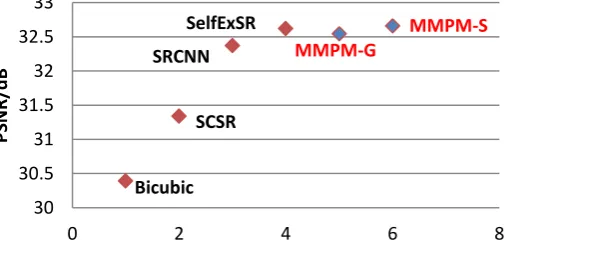
Fig. 1: The performance comparison between MMPM method (MMPM-G and MMPM-S) with some state-of-the-art SR methods, for X3 magnification on Set 5 dataset.
Bicubic SCSR SRCNN SelfExSR MMPM-G MMPM-S 30 30.5 31 31.5 32 32.5 33
0 2 4 6 8
PS
N
R
/d
This method is based on assumptions or prior knowledge about models. The drawback of this method is sharp edges and aliasing effect. Example learning-based SR methods are more superior to other SR methods in many cases. They can produce novel details which are deficiency in LR input. The example learning-based methods create millions of patch pairs from large image database for learning mapping function.
II. RELATEDWORK
In recent years, there has been extensive research on the single image super-resolution. Therefore, several researches have done for reducing processing time and improvement of quality of the image by learning relationship of mapping between LR and HR patches [1] in subspace view. Specially, the ANR (anchored neighborhood regression) SR method proposed by Timofte et al. [1]–[3] learned the mapping functions between the LR and HR feature subspaces by grouping the correlative neighbors.
Sandeep et al. [4] shown GMM (Gaussian mixture model) to lead to a mapping regression between low resolution and high resolution patches, and receive good performance over the state-of-the-art SR methods. GMM can represent the patches with a softer weighting mechanism and represent the image patch prior naturally [5]. In addition, other mixture prior model such as the Student-t mixture model (StMM) which has more robust and suitable for image patch prior [5], [6]. Recently, few researches made on the informative patches sampling, called as selective patch processing (SPP).
Although, SPP consider only the standard deviation of LR patch. The better way which is based on difference curvature, since it can represent the informative details better than the SPP. Jia-Bin Huang et al. demonstrated Single Image Super-resolution from Transformed Self-Exemplars. Self-similarity based SR algorithms are able to produce visually pleasing results without excessive training on external databases.
III.PROPOSEDMETHODOLOGY
The proposed method of MMPM (Multiple Mixture Prior Model) works on 2 phases: training and testing, respectively.
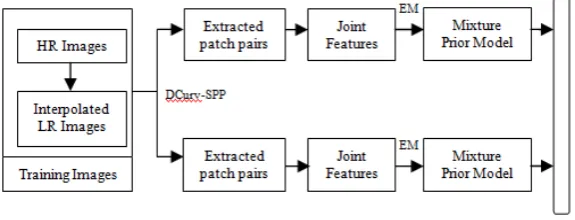
In the training phase, firstly we down-sample HR training image to copy the loss of image, and then upscale the degraded LR images to the size of HR image, where the Bicubic method is used for these two interpolated procedure. Then, with the different degree of informative structures we extract groups of the patch pairs through the proposed difference-curvature based SPP method.
Fig. 2: Training Phase –The framework of proposed MMPM method.
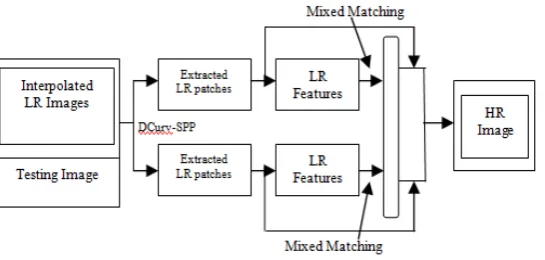
Fig. 3: Testing Phase –The framework of proposed MMPM method.
In the testing phase, we first interpolate the input LR image to the desired HR size by using Bicubic method. After that we extract groups of LR patches under the SPP thresholds, and then collect the corresponding features by operation as in the training phase. Mixed matching way is used to reconstruct the HR parts and then combine them into the whole image.
In this paper, the main focus is on example learning-based SR, especially learning multiple mixture prior models for modeling image. For building an efficient mapping between LR and HR features the proposed method is used. This method is relatively accurate and fast in comparison with state-of-the-art SR methods as illustrated in Fig. 1. The major contributions of the proposed MMPM SR method are:
1) Introduction to difference-curvature-based SPP method for partitioning the whole feature space into several groups for further processing;
2) Learning the mixture prior model on each groups, and recovering the HR patches;
3) Proposing a mixed matching strategy to enhance the performance.
A. Difference-Curvature-based SPP
The example leaning-based SR approaches analyze the image properties in the form of patches. In this point, first divide the input LR image Xl into N patches. Assuming the magnification factor is s. Then we expect to obtain a set of HR patches. In the training phase, we have the HR images Xh only, then blur and down sample them to LR size by the Bicubic interpolation, to be convenient to extract the features, we then upscale these LR images to the size of the HR images by also the Bicubic, denotes as Xl. Besides, those LR images could also be obtained by some filtering operations before down sampling, e.g., Gaussian filtering.
The difference curvature is an excellent way for identifying the high-frequency information in image with a good robustness to noise; we can compare each pure patches and noised patches. Obviously, DCurv-SPP could represent the informative patches better than the standard-deviation-based SPP (STDSPP).
B.
Learning Mixture Prior Model
The mixture prior model is a widespread method for clustering, and has been used recently in image processing field since it could represent the image patch prior well.
C.
SR via Mixture Prior Model and Mixed Matching
In the testing phase and practical applications, we generally could obtain only low-resolution images as the limited devices and aim to reconstruct the high-resolution counterparts. In some cases, the HR feature vectors can be interpreted by the LR counterparts through these joint parameters.
Some researches select the appropriate component by choosing the one with highest posterior likelihood, we call it mono matching. However, all the components should also pay some contributions in some degree, but with paying for running time. If we find a trade-off, an excellent performance with lower time is available. As this procedure, we call it mixed matching. Mono matching: like, a mono matching strategy is a special case in our mixed matching, Mixed matching: more generally, in order to improve the performance during reconstructing, we put K0 components with higher 0 ik from all the K components into consideration.
IV.EXPERIMENTALRESULTS
In order to check quality of proposed MMPM method, we compare its performance with several SR methods like, some Example learning-based SR method: Self-example learning method as SelfExSR [10]. In the deep learning field, SR have branch, which boost High-efficiency SR method, like SRCNN [9]. Also results are compared to Bicubic method and SCSR method [11]. All the experiments are conducted on the Matlab R2018a.
V. CONCLUSION
Here we proposed a Super-Resolution method using learning MMPM technique for training and mixed matching for testing of image. The DCurv-SPP method is used to group the training joint features into several groups, and further learning MMPM are performed on those groups. Besides, we observed that different prior distribution could lead different performance, and then we tested Student-t prior to substitute the common Gaussian prior since it could represent patch information better. Moreover instead of mono matching way the mixed matching way is used to get better results. As the rapid development and state-of-the-art performance of deep learning methods, it can be possible to utilize the superior quality of probabilistic optimization and powerful feature representation of deep neural networks together to improve the performance of natural texture reconstruction of images for human vision.
REFERENCES
[1] R. Timofte, V. De, and L. V. Gool, “Anchored neighborhood regression for fast example-based super-resolution,” in Proc. IEEE Int. Conf. [2] R. Timofte, V. De, and L. V. Gool, “A+: Adjusted anchored neighborhood regression for fast super-resolution,” in Proc. 12th Asian Conf.
Comput. Vis. (ACCV), Nov. 2014, pp. 111–126.
[3] R. Timofte, R. Rothe, and L. V. Gool, “Seven ways to improve examplebased single image super resolution,” in Proc. IEEE Conf. Comput. Vis.Pattern Recognit. (CVPR), Jun. 2016, pp. 1865–1873.
[4] P. Sandeep and T. Jacob, “Single image super-resolution using a joint gmm method,” IEEE Trans. Image Process., vol. 25, no. 9, pp. 4233– 4244, Sep. 2016.
[5] A. Oord and B. Schrauwen, “The student-t mixture as a natural image patch prior with application to image compression,” J. Mach. Learn. Res., vol. 15, no. 1, pp. 2061–2086, Jan. 2014.