LBB Applicability Review and Basic Implementation Engineering for Primary
Coolant Loop & Surge Line of VVER-1000/320 NPP: TACIS Project R2.09/96.
MAIN ACTIVITIES AND RESULTS
Piero Zanaboni 1) , Leonid Sokov 2), Narciso Garate 3)
1) ANSALDO NUCLEARE DIVISION of ANSALDO ENERGIA, C.so Perrone 25,Genova, Italy 2) OKB-GIDROPRESS , 142103 Moscow District, Street Ordzhonikidze, 21 Podolsk, RF
3) EMPRESARIOS AGRUPADOS, Magallanes,3, 28015 Madrid, Spain
Abstract
This work was carried out within the frame of TACIS-96 Program (Project R2.09/96); in accordance with the Technical Terms of Reference (TOR) the main objective of the Project was to perform a Leak Before Break (LBB) assessment for the Main Coolant Pipe (MCP) and the Pressurizer Surge Line (SL) of the Reactor Coolant System of a selected “reference“ Unit of a VVER 1000, type V-320 NPP (assumed as the Balakovo NPP Unit 2). This has included the following:
♦ definition of a “reference” methodology for primary piping systems with cladding;
♦ verification of LBB approach applicability to MCP/SL according to the ”reference” methodology defined;
♦ preparation of necessary materials data and validation files;
♦ evaluation of effectiveness and reliability of the leak detection system and the In-service Inspection (ISI)
programs (methodologies and qualification);
♦ preparation of a recommendations list to improve the existing information and diagnostic systems;
♦ transfer of know-how from Consortium to Sub-Contractor, integrating the feedback of Western LBB
experience.
One of the main highlights of the Project was the definition and execution of a comprehensive Material Testing Program (MTP) in order to establish the actual tensile and fracture properties of the MCP and SL materials: base materials, weld metals, and “heat affected zones” were tested. Compact tests (CT) and standard specimens for J-R curves determination (ASTM E-1737) were used; special attention was paid to the dissimilar typical joints of the SL (carbon steel base metal with stainless steel weld). Fracture properties as J-R curves were determined both at room and operating temperatures. The “reference” methodology defined has taken into account both Western and Russian LBB approaches. The analysis has shown that criteria for LBB concept applicability to the primary MCP/SL, presented in the reference methods developed in the frame of this Project, are met.
In particular the LBB concept can be applied to MCP/ SL piping of the Balakovo Unit 2 considering that:
♦ The LDS in Surge Line piping shall be capable of detect leaks of 0,5 gpm (1,9 l/min) instead of the general
adopted value of 1gpm;
♦ Leak Detection and In-Service Inspection systems shall be improved following the recommendations
provided, since they do not meet, in their existing status, the requirements for LBB application.
KEYWORDS
Leak Before Break, Primary Circuit, Surge Line, VVER 1000/320, Pipe Cracks, Pipe Integrity, Stress Analysis, Crack Opening Area, Elastic Plastic Fracture Mechanics, Fully Plastic Moment Methods, Material Testing, Material Properties, Heat Affected Zone, Piping with Cladding, Dissimilar Welded Joints, Leak Detection and Diagnostic Systems.
1. PROJECT STRUCTURE
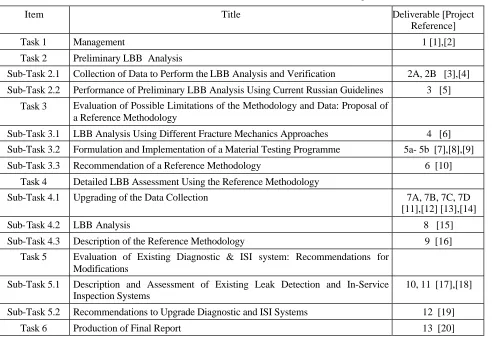
The Contractor of the TACIS R2.09/96 Project was the Consortium between ANSALDO NUCLEARE, a Finmeccanica Company, and EMPRESARIOS AGRUPADOS, being ANSALDO NUCLEARE the Project Leader in front of the European Commission. The local Subcontractor Organization was the OKB-GIDROPRESS Company and the Beneficiary was ROSENERGOATOM. According to technical terms of references, the Project was organized in six integrated tasks, whose sub-task definitions, titles and related deliverables are summarized in Tab.1.
2. INTRODUCTION: RATIONALE BASIS FOR LBB APPLICATION
The approach for mechanistic pipe break evaluations is aimed to demonstrate that for the piping satisfying the Leak Before Break (LBB) criteria, the sudden Double Ended Guillotine Break (DEGB) and the catastrophic rupture of the piping is not a credible event as clearly demonstrated, for instance, in several U.S. reports [21],[26],[27].
In fact, the piping which satisfies the LBB criteria leaks with a detectable leak rate, through the postulated flaw, prior that the crack growth to critical size, that would fail under the application of normal operating, design transients and SSE (Safe Shutdown Earthquake) loads. In the typical Western Plant, the application of LBB approach allows the elimination of all structural and fluid-dynamic mechanical analysis associated with the effects of a DEGB in the
Transactions of the 17th International Conference on
Structural Mechanics in Reactor Technology (SMiRT 17)
Prague, Czech Republic, August 17 –22, 2003
design basis analysis of structures, systems and components. The elimination of dynamic evaluations associated with DEGB produces a reduction in protective shields and eliminates the use of pipe whip restraints, thus making easier the In-Service Inspection of the welds. The application of this procedure to the VVER 1000-320 Primary Circuit, Main Coolant Pipe (MCP) OD=990mm, thickness=70mm and Surge Line (SL), OD= 426mm, thickness 70mm (both including 5 mm of stainless steel cladding), the most similar Eastern Reactor Units compared to the Western NPP’s, could provide similar benefits and thus have a great significance for this type of plants.
The LBB analysis is either an elastic-plastic fracture mechanics stability analysis or a plastic-instability limit load analysis; normal and abnormal loads (including seismic load) are combined to calculate a “critical” crack size for a postulated through-wall crack. The critical crack size is compared with the size of a “reference-leakage” crack, that is characterized by a leakage which is detected by a dedicated Leak Detection System (LDS); when the “critical” crack is larger than the “reference” leakage crack, the LBB requirements are satisfied.
Table 1 List of Tasks, Sub-Tasks and Deliverables for the TACIS Project R2.09/96
Item Title Deliverable [Project
Reference]
Task 1 Management 1 [1],[2]
Task 2 Preliminary LBB Analysis
Sub-Task 2.1 Collection of Data to Perform the LBB Analysis and Verification 2A, 2B [3],[4] Sub-Task 2.2 Performance of Preliminary LBB Analysis Using Current Russian Guidelines 3 [5]
Task 3 Evaluation of Possible Limitations of the Methodology and Data: Proposal of a Reference Methodology
Sub-Task 3.1 LBB Analysis Using Different Fracture Mechanics Approaches 4 [6] Sub-Task 3.2 Formulation and Implementation of a Material Testing Programme 5a- 5b [7],[8],[9]
Sub-Task 3.3 Recommendation of a Reference Methodology 6 [10]
Task 4 Detailed LBB Assessment Using the Reference Methodology
Sub-Task 4.1 Upgrading of the Data Collection 7A, 7B, 7C, 7D
[11],[12] [13],[14]
Sub-Task 4.2 LBB Analysis 8 [15]
Sub-Task 4.3 Description of the Reference Methodology 9 [16]
Task 5 Evaluation of Existing Diagnostic & ISI system: Recommendations for Modifications
Sub-Task 5.1 Description and Assessment of Existing Leak Detection and In-Service Inspection Systems
10, 11 [17],[18] Sub-Task 5.2 Recommendations to Upgrade Diagnostic and ISI Systems 12 [19]
Task 6 Production of Final Report 13 [20]
3. PROJECT ACTIVITIES AND LBB LOGICAL STEPS
In the frame of the Project, the activities were performed in accordance with the following LBB logical steps:
Ø Identification of material properties; determination of the MCP/SL base and weld metal “design” and “actual”
material properties, including fracture toughness; test data in Sub-Task 4.1- Deliverable 7 Part A report [11];
Ø Calculation of the applied loads; identification of the locations at which the highest stress occurs by means of:
MCP/SL piping stress analysis results in Sub-Task 4.1-Deliverable 7 Part B report [12];
Ø Review of the operating Load History to ascertain the MCP/SL piping have no particular susceptibility to failure
from the effects of corrosion, erosion, water hammer events, thermal stratification, and low/high cycle fatigue: results in Sub-Task 4.1, Deliverable 7 Parts B, C, D [12], [13], [14];
Ø Postulation of a surface flaw at the governing location; determine the fatigue crack growth and show that a
through-wall-crack (TWC) will not result; Postulation of a TWC at the governing location; the flaw size should be large enough that leakage detection is assured with defined margin (10 according to [22]) in respect to installed LDS capability, when the pipe is subjected to normal operating loads: results in Deliverable 8, Sub-Task 4.2 [15];
Ø Demonstration of the margin on applied faulted load: a defined margin of 2 between leakage size flaw and
Ø Evaluation of LD and ISI systems; analyze the capabilities of these systems according to LBB application requirements, proposing improvements if necessary in Task 5, Deliverables 10, 11, and 12 [17], [18], [19]. It should be pointed out that, without considering administrative ad managerial documents [1], [2], two main different reports of results, were issued during the project, as described below:
1. Main Project results reports:
Ø “Reference” methodology development: Deliverable 6 (basic version) and Deliverable 9 (final version with
summary of results, compliance of requirements and extension to further VVER100/320 NPP’s) [10],[16];
Ø “Reference” methodology application: Analytical fracture mechanics calculations by Deliverable 3 (preliminary
version, using Russian guidelines [23] and Deliverable 8 (final version, using “Reference” methodology) [5],[15]; improvements in Leak Detection and in In-Service Inspection systems, by Deliverable 11 and description of activities for their implementation, by Deliverable 12 [18],[19];
Ø Final Project Report: Deliverable 13 [20];
2. Supporting data results reports:
Ø Fracture mechanics methodology assessment: Fracture mechanics, crack opening area methodology & computer
codes benchmark, by Deliverable 4 [6];
Ø Material Testing Program Definition and Execution: definition by Deliverable 5a [7] and actual material
properties test results by Deliverable 5b (part 1: MCP [8]; part 2: SL [9]);
Ø Input data collection: Material properties and stress analysis data made by Deliverable 2 (parts A & B,
preliminary version [3],[4] and by Deliverable 7 (parts A, B, C & D, final version ) [11],[12],[13],[14];
Ø Current Leak Detection and ISI Systems Description: Description of present situation by Deliverable 10 [17];
4. PRELIMINARY PHASE: TASK 2
The main objectives of the preliminary phase (Task 2), whose activities were mainly performed by Subcontractor, OKB-Gidropress, under the supervision of the Consortium Team, were:
Ø To define a well documented set of “basic” design input data for the MCP/SL and to prepare the documentation, organized in a sort of input data report, and translated in English language and
Ø To conduct a complete preliminary LBB analysis based on the current version of the Russian Guidelines, [23], for the evaluation of the integrity of MCP/SL piping of the VVER 1000/320 with postulated crack.
Following the definition of list of input data available, the Consortium Team performed an independent assessment of consistency and completeness of the input data, in order to assure that the integrated LBB evaluation of the Balakovo VVER Unit 2 would be achieved.
The following main results and conclusions were obtained:
Ø The relevant input data required to perform the LBB preliminary analysis and verifications were obtained; design and “as-built” data for MCP/SL, manufacturing process and material properties for Balakovo Unit 2 NPP were available. Regarding the applied loads, a new MCP/SL static and dynamic piping stress analysis was performed within the scope required for the preliminary justification of the LBB concept application, using the Russian approach. The NOC and SSE stresses were obtained at all piping cross-sections corresponding to the MCP/SL welds. In addition to this, an analysis of fulfilment of Russian Standards [25] was made and the results indicated that the criteria for strength calculation were satisfied [3],[4];
Ø The preliminary assessment of LBB concept applicability to MCP/SL of Balakovo NPP Unit 2 was performed related to design, manufacturing technologies and materials used, according to Russian Guidelines. Critical trough wall cracks (TWC) under SSE conditions and detectable flow rate estimations under NOC were established for all relevant regions. The analysis has shown the possibility of LBB application; for MCP the LBB margins are satisfied, being the sensitivity of Leak Detection Systems equal to 3.8 l/min, while for SL the required sensitivity shall be 1.9 l/min, in order to comply with the margin of 10 on the leakage flow rate [23],[5].
5. INTERMEDIATE PHASE: EVALUATION OF POSSIBLE LIMITATIONS OF THE METHODOLOGY AND DATA: PROPOSAL OF A REFERENCE METHODOLOGY: TASK 3
The main objectives of the intermediate phase (Task 3), whose activities were shared between OKB-Gidropress and Consortium Team, which have also provided support for software and corresponding hardware, were:
Ø To analyze the LBB behaviour with several analytical approaches, evaluating both the TWC stability and the flow rate from leaking flaws and to assess the Russian methodological approach used in preliminary phase and its possible limitations;
Ø To perform the qualification, trough a detailed benchmark process, of the Russian computer programs, both for crack stability and for leakage flow rate, against the Western computer programs and to transfer the LBB Consortium experience, namely the Spanish-one, providing data on different Spanish NPP’s, description of their methodology and application of LBB concept to operating NPP’s;
true stress/strain diagram), for SL base material (BM), weld metal (WM) and “heat affected zones” ( HAZ);
Ø To develop, describe and propose a “reference” methodology that will be recommended for the justification of LBB concept applicability to primary piping of a VVER-1000/320 NPP Reactor types.
As a first step the benchmark of the Russian computer programs and the validation of Russian methodology were performed; comparison of results obtained both with NRCPIPE-SQUIRT 1[31][33] codes from one side, and FRACTURE-CRACK_L [32][34] from other side, was done, using literature data from Western pipe experiments with trough wall cracked (TWC) pipes and data from international benchmark [26][[28].
The second step was the “Formulation and Implementation of a Material Testing Program“; it should be pointed out that the MTP execution was made in order to obtain additional pipe material data to supplement the ones already obtained in Sub-Task 2.1, that were considered insufficient to have a reliable LBB justification for the MCP/SL of the Balakovo Unit 2 NPP. The execution of MTP was carried out by the Russian Institutes, NPO CNIITMASH (Moscow) and OKB Gidropress (Podolsk), under supervision and control of the Consortium. The MTP was divided in two main parts; the first-one related to tests on Main Coolant Pipe materials (base metal 10GN2MFA carbon steel: deposited weld by electrode PT-30) and the second-one to tests on Surge Line pipe (same base metal, deposited weld material by electrode EA400/10T). For the two parts, both the processing of results, data verification, and preparation of tests report of previous Russian tests [29] and the execution of new tests were made. Main attention of the MTP was focused on SL pipes material and especially on the heterogeneous, “dissimilar” welds (carbon steel ferritic pipe welded seam made with austenitic material), for which no literature data are available.
The third step was the development of a “reference“ methodology for the LBB assessment of the MCP/SL piping; its basis were the Russian Regulatory documents [23][24] and the U.S. Standards for LBB concept applicability, which are based on the Nuclear Regulatory Commission (NRC) approach [21][22]. The “reference” methodology report was prepared jointly by Consortium Team and Subcontractor and was used for the justification of LBB concept applicability to the MCP/SL piping in subsequent activities of this Project.
The following main results and conclusions were obtained:
Ø The NRCPIPE & SQUIRT programs were tested and the results of present calculations were well in accordance with published data and judged sufficiently reliable (Fig.1); the Russian computer programs FRACTURE & CRACK_L were tested against NRCPIPE & SQUIRT using several test cases; good agreement and rather conservative predictions were found in terms of crack opening area, leakage flow rate, maximum load and critical crack length evaluations (Fig.2);
Ø Among the usage of different fracture mechanics methods to provide conservative predictions of maximum loads,
two elastic-plastic methods from NRCPIPE - the GE/EPRI and LBB.ENG2 and two fully plastic methods from FRACTURE - the moments method (MM-1) and the MR125, were selected (Fig.1); it was noted that the “engineering” simplified methods for detectable crack length determination provided in Russian guideline may provide not conservative results; for such reason an analysis using computer programs, such as SQUIRT and/or CRACK_L, shall always be done (Fig.3)[6];
Ø The execution of tests, according to MTP specification [7] and appropriate Codes and Standards (ASTM and GOST) provided acceptable results for the application to MCP/SL materials - base, weld metal and “heat affected zone” - to allows the LBB justification; actual values of mechanical properties, stress-strain diagrams and J resistance curves were obtained to perform the plastic and/or elastic-plastic calculations of the pipes with postulated cracks, according to methodology report;
Ø The comparison of test results of full-scale specimens - with through and surface cracks in MCP circumferential welds [29] - and compact specimens (CT-1T) have shown that, for similar TWC extensions, the minimum J values are observed for CT-1T specimens; the usage of J-R curves obtained from CT-1T specimens was recommended for a reliable justification of LBB concept;
Ø For SL test execution a welded pipe with DN 350 was fabricated from cuts of bimetallic pipes of low, intermediate and high strength; bimetallic pipes of carbon steel were welded by two circumferential austenitic welds, realizing a “dissimilar” welded joint according to standard manufacture procedure deve loped and applied at Balakovo Unit 2 (Fig. 4,5,6);
Ø The CT-1T J-R curves, obtained by test results at 20°C and 350°C, have shown, both for MCP and SL, considerable scattering; therefore lower envelopes for BM, WM and HAZ were considered as the “guaranteed” J-R curves to be used for the elastic plastic analyses (Fig. 7,8).
1
6. DETAILED PHASE: LBB ASSESSMENT USING THE REFERENCE METHODOLOGY: TASK 4
The main objectives of detailed phase (Task 4), shared between the Consortium and the Local Subcontractor, were:
Ø To collect and certify all the material data selected in preliminary phase, and validated by tests carried out in MTP, to provide a fully consistent set of input data reports required to carry out the LBB analysis;
Ø To apply the LBB “reference” methodology, previously agreed upon, to the MCP/SL piping and to carry out all the analyses required for the assessment of surface and through-wall cracks, as well as of the capability of Leak Detection Systems, required to allow adequate safety margins in the application of the LBB concept, in order to confirm the results obtained in preliminary phase;
Ø To update the “reference” methodology, including a summary of the results of its application to Balakovo Unit 2 and recommendations for extension to other VVER 1000/320 NPP’s.
The following main results and conclusions were obtained:
Ø The full set of input data required to perform the LBB analysis and verifications were obtained; all these data were certified and had covered chemical and mechanical characteristics of materials, loads, piping stresses for normal operation and seismic events, as well as the fatigue assessment for the most significant points of the MCP/SL piping; water hammer and stress corrosion evaluation have also been performed [11,12,13,14];
Ø The MCP preliminary LBB results were confirmed using both Western and Russian computer codes; the required
crack length margins - between critical and detectable crack length - are met with sensitivity of leak detection
systems equal to 3.8 l/min (the imposed margin of 10 on detectable leak rate being verified); rather large values were found, the minimum being at weld n°9, equal to 3.99 (Fig.9,11), which is almost double than the required
value of 2; the results are well in accordance with published results for VVER 1000/320 NPP’s [30];
Ø Also for SL piping the preliminary LBB results were confirmed, in this case, the required crack length margins
are met only using a LDS capable to record the flow rate of 1.9 l/min (margin of 10 on detectable leak rate); in Fig.10 the results are shown with (and without) the effect of SL thermal stratification; the criteria is met for all SL welds in both cases - minimum value being equal to 2.25 at weld 2 - and the effect of stratification seems to influence insignificantly the obtained values [15];
Ø Both for MCP and SL piping, additional elastic-plastic calculations were performed at most critical locations, using the guaranteed J-R curves for weld metal - obtained from tests of CT-1T specimens - and the true stress-strain for base metal [27],[33];
Ø The Deliverable 9 report is the final “reference” methodology report of this Project [16].
7. DETAILED PHASE: EVALUATION OF EXISTING DIAGNOSTIC AND IN-SERVICE INSPECTION SYSTEMS; RECOMMENDATIONS FOR MODIFICATION: TASK 5
The main objectives of this phase (Task 5), whose activities were mainly performed by Subcontractor, under the supervision of Empresarios Agrupados team, were:
Ø To analyze and evaluate the existing Leak Detection (LD) and In-Service Inspection systems (ISI);
Ø To provide recommendation for improving and upgrading the leak detection components and systems and inspection programs to satisfy LBB requirements and to make proposal for implementing the recommendations. The following main results and conclusions were obtained [17],[18],[19]:
Ø A methodology for evaluation of the applicability of LD and ISI systems to LBB concept was developed; the evaluation of the existing LDS was performed and has shown that they cannot be used for LBB concept application; the assessment on ISI provided the evidence that LBB requirements were met but not to a full extent;
Ø Nowadays for the updated VVER-1000 design, new leak monitoring systems - including three detection systems based on acoustic, humidity and radiation methods - are being developed, to meet the LBB requirements on leak size and location; similar considerations applies for ISI, since automated inspection systems are being developed, which meet the LBB requirements, in particular the ultrasonic examination system;
Ø A list of recommendations to implement the proposed systems for LD and ISI, in order to achieve the Project required improvements, was proposed; it should be noted that, presently, the recommended systems are at the stage of development and have not been operationally tested [18],[19];
Ø For each one of the proposed LD and ISI systems, a summary table for planning the implementation activities and the complete systems functions description were presented;
Ø A general plan for implementation of the recommended LD and ISI systems was presented, including preparatory activities, equipment performance and ways for qualification tests, implementation activities, and trial operation.
8. PROJECT GOALS AND CONCLUSIONS
The analyses perfomed have shown that the criteria - stated by methodology documents for LBB concept applicability to MCP&SL - are met for the reference VVER 1000/320 Balakovo Unit 2 NPP [20]; in particular the LBB concept can be successfully applied to MCP/SL piping provided that:
Ø the Leak Detection System in Surge Line pipingshall be capable of detect leaksof 0.5 gpm (1.9 l/min) instead of
the general adopted value of 1gpm (3,8 l/min), which is indeed suitable for the Main Coolant Loops piping;
Ø the Leak Detection and In-Service Inspection systems shall be improved following the recommendations
provided, since they do not meet, in their present status, the r equirements for LBB application.
9. TACIS PROJECT R2.09/96 DELIVERABLE-REFERENCES
[1] Technical Terms of Reference. TACIS Nuclear Safety R2.09/96. LBB applicability review and basic implementation engineering for VVER-1000 model 320 NPP, 1998; [2] Inception Report, Rev.0, September, 2000 [3] [4] Deliverable 2 Parts A, B: “Design manufacturing process and material properties and Preliminary Stress analysis for MCP/SL of Balakovo Unit 2” (Gydropress reports M-LBB-T-0008, / T-009 Rev.0, 2001)
[5] Deliverable 3: “Preliminary Justification of LBB concept applicability to MCL/SL of the Balakovo Unit 2, according to Russian Guidelines” (Gydropress report M-LBB-T-0010, Rev.0, 2001)
[6] Deliverable 4: “Comparisons on critical crack initiation size crack opening areas and flow rate determination using different fracture mechanics and thermohydraulic approaches” (Ansaldo report TAC-LBB-IMP-T 0008 Rev.0) [7] Deliverable 5a: “Material Testing Program Specification “ (Gydropress report M-LBB-T-0007, Rev.2,2001). [8] [9] Deliverable 5b: Materials testing program: Parts 1& 2 Analysis and evaluation of testing data on determination of the MCP and Surge line material characteristics; (Gydropress reports M-LBB-T-020 /021, Rev.0, 2001)
[10] Deliverable 6: “Description of the Reference Methodology for the LBB assessment of the Main Coolant Piping of VVER 1000/320” (Ansaldo report TAC LBB-IMP-T-0011/Rev.0, 2001)
[11] [12] [13] [14] Deliverable 7: Updating of input data collection: Part A: Design, Manufacturing Process, Material Properties; Part B Analysis of stresses and evaluation of MCP /SL fatigue damage; Part C: Consideration of water hammer possibility in MCP/SL; Part D Analysis of primary piping corrosion mechanism for Balakovo NPP Unit 2 (Gydropress reports M-LBB-T-0013/ Rev.1; -0014/Rev.1; -0015/rev.1; M-LBB-T-0018/Rev.0)
[15] Deliverable 8:Justification of LBB concept applicability to the MCP and SL of Balakovo NPP Unit 2 (Gydropress report: M-LBB-T-0019/ Rev.0)
[16] Deliverable 9: Description of the Reference Methodology for the LBB assessment of the Main Coolant Piping, summary of application to Balakovo NPP Unit 2 and recommendations for implementing at other VVER 1000 NPP’s. (Ansaldo report: TAC LBB-IMP-T-0015/Rev.0, 2002)
[17] Deliverable 10: “Description and assessment of the current Leak detection and In-Service Inspection systems in Balakovo NPP Unit 2 (Gydropress report: M-LBB-T-0017/ Rev.1,2002)
[18] Deliverable 11:“Recommendations and improvements of the Leak detection and In-Service Inspection systems in Balakovo NPP Unit 2 (Gydropress report: M-LBB-T-0022/ Rev.0,2002)
[19] Deliverable 12:“On site activities fort upgrading the leak detection and in-service inspection systems to Balakovo NPP unit 2,recommendations for modification”, (Gidropress Report M-LBB-T-0023 Rev.0, 2002)
[20] Deliverable 13: Final report on TACIS Project:«Leak Before Break Concept Applicability Review and Basic Implementation Engineering for NPP- VVER-1000/V-320 »(Ansaldo report: TAC LBB-IMP-T 0016 Rev.0, 2002)
10. REFERENCES
[21] US Nuclear Regulatory Commission “Evaluation of Potential for Pipe Breaks” NUREG-1061,vol.3,1984. [22] US NRC Standard Review Plan, 3.6.3” Leak Before Break Evaluation Procedures”, Washington, DC (1986). [23] Procedure for analysis of NPP piping within the frames of LBB concept, M-LBB-01-93, NIKIET, 1993. [24] LBB Application Guide for NPP pipelines, M-LBB-01-99, RD 95 10547-99 (MAE), Moscow, 1999(in Russian) [25] Norms of design and safe operation of nuclear power plant equipment and piping, PNAE G-7-008-89, 1990. [26] NUREG/CR 4082 “Degraded Piping program” phase II” Vol. 8 March, 1989
[27] NUREG/CR-6540, «State-of-the-Art-report on Piping Fracture Mechanics», January 1998.
[28] G.Wilkowsky… “Recent Results of Fracture Experiments on Carbon Steel” Int J. Pres. Ves. & Piping 43 (1990) [29] Vasilchenko G.S….”The Nature Thickness Pipe Element Testing Method to Validate the Application of LBB Conception.” Proceedings of the Specialist meeting on Lear before Break in Reactor Piping and Vessels. 1995, Lyon. [30] J.Zdarek …”Application of the LBB concept to nuclear power plants with WWER 440 and WWER 1000”. Proceedings of the Seminar on LBB in Reactor Piping and Vessels. US NRC, NUREG/CP-0155, p. 101-125,1997. [31] NRCPIPE (Version 2.0) “A personal Computer Code for Piping Fracture Mechanics Analysis User’s Guide”: Contract NRC-04-90-069 FIN n° B5702 - BATTELLE Institute December, 30, 1994
[32] Computer Code “Fracture 1.0” for Flaw Stability Analysis, Crack Opening Area Calculation. ENES Report, 1999 [33] ”SQUIRT” Seepage Quantification of Upset in Reactor Tubes :User’s Manual Version 2.4 International Piping Integrity Research Group Program (IPIRG) Contract NRC- 04-91-063 Battelle Institute, April, 30,1996
FIG.1 Histogram of ratio of maximum predicted and experimental moments from NRCPIPE & FRACTURE programs for large carbon steel pipe diameter - group I from Degraded Piping Program [6] [26-27]
FIG.2 Dependence of crack length on crack surface parameter N for imposed flow rate (N =number of turns on the leakage pathway of fatigue crack, per 1 mm length: recommended value for ferritic steels from SQUIRT program Vers.2.4 is N=0.673. Roughness is fixed at 40 µm) [6], [23], [33-34]
FIG.3 Dependence of coolant flow rate on crack opening area: crack surface parameter and roughness fixed; N=0,673, R=40 µm) [6],[33-34]
FIG.4 Scheme of cutting specimens from rings 1, 3, 5 of the test pipe for Surge Line (Dnom 350) for CT-1T [9]
FIG.5 Fracture surfaces of three CT-1T specimens from a 10GN2MFA steel (Dn-350) experimental pipe with EA-400/10welds: left specimen, crack in BM, middle, crack in WM, right , crack in HAZ [9]
FIG.6 Specimen H3 from the 10GN2MFA steel (Dn-350) experimental pipe with crack in EA-400/10 welded metal [9]
0 10 2 0 3 0 4 0 5 0 6 0 7 0 8 0
0 10 2 0 3 0 4 0 5 0 6 0 7 0 8 0 9 0 1 0 0 110 C r a c k o p e n i n g a r e a A , m m2
Coolant flow rate Q, l/min
FIG.7 J-R curves of HZA - MCP material; CT-1T specimen tests: M3-CT1-45/57: temperature 350°C [8]
FIG.8 J-R curves of fusion line of welded joints for Surge Line material; CT-1T specimen tests: R4-CT1-09/12 at temperature 350°C [9]
0 1 2 3 4 5 6
1 2 3 4 5 6 7 8 9 10 11 12 13
weld number
Margins
FIG.9 Through wall crack length margins for MCP, detectable leak flow rate 38 l/min (10gpm) evaluated with MM & Paris-Tada methods: CRACK_L Code [15]
0 0 . 5 1 1 . 5 2 2 . 5 3
1 2 3 4 5 6 7
Weld number
Margin
With stratification Without stratification
FIG.10 Through wall crack length margins for Surge Line: detectable leak flow rate 19 l/min (5gpm), (MM & Kastner methods: CRACK_L Code): with and without thermal stratification effects [15]