DOI: 10.15662/ijareeie.2014.0307020
Texture Extraction for Image Retrieval Using
Local Tetra Pattern
Nitin Narayankar1, Sanjay Dhaygude2
Lecturer , Dept. of ELN, Walchand College of Engineering, Sangli, Maharashtra , India1 Associate Professor, Dept. of ELN, Walchand College of Engineering, Sangli, Maharashtra , India2
ABSTRACT: Content Based Image Retrieval(CBIR) is one of the prominent area to retrieve images from a large collection of database. There is wide range of texture analysis techniques used for feature extraction of an image. In this paper, we have proposed image indexing and retrieval algorithm for texture extraction using Local tetra pattern (LTrP). The local binary pattern (LBP) and local ternary pattern (LTP) encode the texture features of an image depending on the grey level difference between reference pixel and its neighbors. The LTrP encodes the relationship between the reference pixel and its neighbors by using the first-order derivatives in vertical and horizontal directions. Local tetra pattern (LTrP) extracts information based on the distribution of edges which are coded using four directions. To get the retrieval result we used Corel 1000 database. The performance of the proposed method is measured in terms of average precision and average recall. The performance analysis shows that the proposed method improves the retrieval result as compared with standard LBP.
KEYWORDS: Content Based Image Retrieval, Local Tetra Pattern (LTrP), Magnitude Pattern, Precision, Recall.
I.INTRODUCTION
A.General
Recent years have seen a rapid increase in the size of digital image collections. The image retrieval techniques are becoming very important part in the multimedia information retrieval, and they are most widely used in applications, such as in web related applications, agricultural applications, biomedical applications, earth and space sciences etc. Basically there are two research communities, the first one is text based image retrieval and the other is content based image retrieval (CBIR). Text based image retrieval gives less complexity method and they are widely used in image retrieval. But manual annotation is required to assist the text based retrieval process. Due to that, the text based image retrieval is not preferable in case of images. The feature extraction in CBIR is a prominent step whose effectiveness depends upon the method adopted for extracting features from given images. The CBIR utilizes visual contents of an image such as color, texture, shape, faces, spatial layout, etc., to represent and index the image database [1].Feature (content) extraction is the basis of content-based image retrieval. In this work, we propose a novel image texture feature extraction algorithm using local tetra patterns (LTrPs) for content-based image retrieval (CBIR).
The proposed method encodes the relationship between the referenced pixel and its neighbours, based on the directions that are calculated using the first-order derivatives in vertical and horizontal directions. In retrieval process, every pixel value of query image is compared with every pixel of test image using a distance measure to find some similar pictures to the query image. Two major approaches including spatial and transform domain based methods can be identified in CBIR systems. The first approach usually uses pixel or a group of adjacent pixels features like color, texture, and shape. Other uses different transforms like Gabor transform, Wavelet transform &Daubechieswavelet coefficients etc.[2][3].
B. Related work:
DOI: 10.15662/ijareeie.2014.0307020
(LTrPs) for CBIR. The versions of the LBP and the LDP in the open literature cannot adequately deal with the range of appearance variations that commonly occur in unconstrained natural images due to illumination, pose, facial expression, age, etc. In order to address this problem, the local ternary pattern (LTP) has been introduced for face recognition under different lighting conditions. The local binary pattern (LBP) feature has emerged as a silver lining in the field of texture classification and retrieval which are converted to a rotational invariant version for texture classification. The LBP operator on facial expression analysis and recognition is successfully reported in proposed a multiscale heat-kernel-based face representation as heat kernels are known to perform well in characterizing the topological structural information of face appearance. The LBP operator on facial expression analysis and recognition is successfully reported and proposed a multiscaleheatkernel- based face representation as heat kernels are known to perform well in characterizing the topological structural information of face appearance. Various techniques for extraction and representation of image features like histograms local (corresponding to regions or sub-image) or global, color layouts, edges, boundaries & regions, textures and shapes have been reported in the literature.
II. DIFFERENT PATTERNS USED FOR TEXTURE
The different patterns used to extract texture feature are summarized in following sections.
A .Local Binary Pattern(LBP) :The standard local binarypattern (LBP) encodes the relationshipbetween the referenced pixel and its surrounding neighborsby calculating gray-level difference.The Local Binary Pattern was introduced for texture classification. It has at most two bitwise transitions from 0 to 1 or vice versa [4].
B .Local Ternary Pattern(LTP) : Local Ternary Pattern is extended version of LBP. It has three-valued code in accordance with grey values of its neighbors. In Local Ternary Pattern, gray values in the zone of width (±) t around are quantized to zero, those above ( + t) are quantized to +1, and those below are quantized to 1, i.e., indicator is replaced with three-valued function and the binary code is replaced by a ternary code[5].
C .Local Derivative Pattern(LDP) : The local Derivativepattern (LDP) encodes the pattern features based on local derivative variations. It gives more detailed information as LBP cannot obtain from image. The order LDP captures the detailed relationship in local neighborhood. LDP is micro pattern Representation modeled by histogram to preserve the information [6].
D .Local Tetra Pattern(LTrP) : The LBP, the LDP, and the LTP extract the texture features of an image based on the distribution of edges, which are coded using only two directions. The possible directions may be positive direction or negative direction. It is clear that the performance of these methods can be improved by differentiating the edges in more than two directions. So, The local tetra patterns (LTrPs) are adopted to encode information based on the four direction.
The idea of LTrP is based on local patterns described in LBP, LTP & LDP. The LTrP gives the spatial structure of the local texture using the direction of the centergraypixel .
Consider an image I , the first-order derivatives along
0
and90
directions are denoted as|
,.
Let denotes the center pixel in I , and let & denote the horizontal and verticalneighborhoods of respectively. Then, the first-order derivatives at the center pixel can be written as
= ( − )
= ( − ) (1)
the direction of the center pixel can be formulated as
( ) =
⎩ ⎪ ⎨ ⎪
⎧ 1 ( )≥0 ( )≥0
2 ( ) < 0 ( )≥0 3 ( ) < 0 ( ) < 0 4 ( )≥0 ( ) < 0⎭⎪
⎬ ⎪ ⎫
DOI: 10.15662/ijareeie.2014.0307020
From above equation (5) we have four possible direction depending on first order derivatives for each center pixel. The possible values can be either 1, 2, 3, or 4, and finally, the image is converted into four values, i.e., directions. The second-order
(
)
is defined as( ) =
⎩ ⎪ ⎪ ⎨ ⎪ ⎪
⎧ ( ( ), ( )
( ( ), ( )
( ( ), ( )
. . .
( ( ), ⎭
⎪ ⎪ ⎬ ⎪ ⎪ ⎫
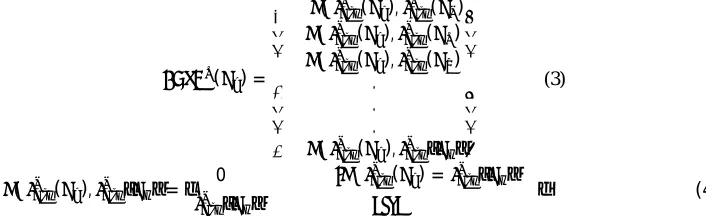
(3)
( ( ), = 0 ( ) =
(4)
From (3) and (4), we get 8-bit tetra pattern for each center pixel. Then, we separate all patterns into four parts depending on the direction of center pixel. Finally, the tetra patterns for each part (direction) are converted to three binary patterns.
Let the direction of center pixel
( )
obtained using (4) be “1”; then, can be defined by separating it into three binary patterns as follows:| , , = 2( )× ( ) | ∅
( ) | ∅= 1 ( ) =∅
0 (5)
Similarly, the other three tetra patterns for remaining three directions of center pixels are converted to binary patterns. Hence, we get 12 binary patterns (4 directions
×
3 Patterns of each direction).E .Advantages of the LTrPOver Other Patterns.
The advantages of the LTrP over the LBP, the LDP, and the LTP are as follows.
1) The LBP, the LDP, and the LTP are able to encode images with only two and three distinct values. However, the LTrP is able to encode images with four distinct values as it is able to extract more detailed information.
2) The LBP and the LTP encode the relationship between the gray value of the center pixel and its neighbors, whereas the LTrP encodes the relationship between the center pixels and its neighbors based on directions.
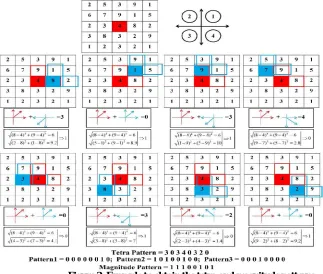
Figure 1. Calculation of tetra pattern bits for the center-pixel direction “1” using the direction of neighbors.
III. ESTIMATION OF MAGNITUDE COMPONENT & HISTOGRAM
The magnitude component & sign component extracts more useful information, as it is proved that the combination can provide better results which are not evident in any one individual component. So we used the Thirteenth binary pattern which is calculated by using the magnitudes of horizontal and vertical first-order derivatives[7].
DOI: 10.15662/ijareeie.2014.0307020
= 2( )× ( − ( )|
(6)
For the local pattern a pixel with P neighbourhoods, 2 combinations of LBPs are possible, which results the feature vector length of 2 . The computational cost of this feature vector is very high. In order to reduce the computational cost, we use the uniform patterns [8].The uniform appearance of pattern that has limited discontinuities in the circular binary representation is referred as uniform pattern.
In this paper, those patterns which have less than or equal to two discontinuities in the circular binary representation is referred to as the uniform patterns, and the remaining patterns are referred to as nonuniform. Therefore, the uniform patterns for a given query image would be ( −1) + 2. The possible uniform patterns for
= 8 would be 58.
Finally, after getting the local pattern the whole image is represented by constructing a histogram
( )
=
×
∑
∑
(
( , ), );
∈[0, ( −1) + 2] ( , ) = 1 =
0 (7)
Where × represents the size of the input image.
Figure 2. Example to obtain the tetra and magnitude patterns
The possible local pattern transitions resulting in an LTrP for direction “1” of the center pixel are illustrated in figure 3.When the direction of center pixel is equal to neighboring pixel then the value of LTrP is coded to “0”, otherwise it is coded as the direction of neighborhood pixel. Similarly, LTrPs are calculated for center pixels having directions 2, 3, and 4.
DOI: 10.15662/ijareeie.2014.0307020
pattern, we separate it into three binary patterns as follows. Referring to the generated LTrP, the first pattern is obtained by keeping “1” where the tetra pattern value is “2” and “0” for other values, i.e., “0 0 0 0 0 0 1 0.” In the same way, the other two binary patterns “1 0 1 0 0 1 0 0” and “0 0 0 1 0 0 0 0” are computed for tetra pattern values “3” and “4,” respectively. Similarly, tetra patterns for center pixels having directions 2, 3, and 4 are computed. Hence, we get four tetra patterns and 12 binary patterns. The magnitude of the first-order derivatives is used to get 13th binary pattern.
IV.ALGORITHM FOR FEATURE EXTRACTION
A. Algorithm:
Input: Query image; Output: Retrieval result
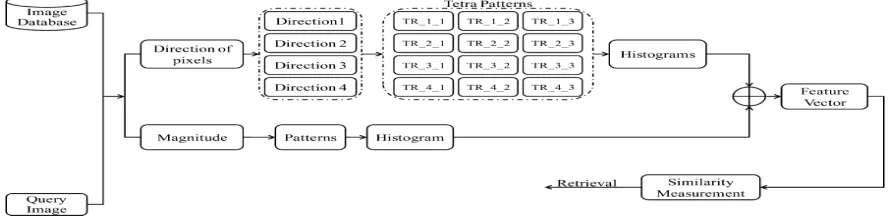
1. Initially load the image, and convert it into gray scale. 2. In horizontal and vertical axis apply the first-order derivatives. 3. Find the direction for every pixel whether it is 1,2,3 or 4.
4. Based on the direction of the center pixel divide the patterns into four parts. 5. Calculate the tetra patterns, and separate them into three binary patterns. 6. Calculate the histograms of binary patterns.
7. Calculate the magnitudes of center pixels.
8. Construct the binary patterns, and plot their histogram. 9. Combine all histograms calculated from steps 6 and 8. 10. Construct the feature vector.
11. Compare the query image with the images in the database used. 12. Based on the best matches retrieve the images from database.
B. Sample images from database DB (one image per category).
Figure 3 : Sample images from database DB
C. . Image retrieval system framework
Figure 6 illustrates the flowchart of the proposed image retrieval system.
DOI: 10.15662/ijareeie.2014.0307020
In order to analyze the performance of the proposed method, experiments were conducted on Corel databases. This database consists of a large number of images of various categories such as animals, sceneries, foods, sketches etc. These images have been preclassified into different categories each of size 100 by domain professionals. Some researchers have the opinion that the Corel database [9] meets all the requirements to evaluate an image retrieval system, due to its large size and heterogeneous content. For our experiment, we have collected 1000 images to form database DB. These images are collected from ten different domains, namely, Africans, beaches, buildings, buses,
dinosaurs, elephants, flowers, horses, mountains, and food. It has resolution of either 256
×
384 or 384×
256. Fig. 5 shows the sample images of DB database (one image from each category). The results are discussed in the following subsections.V.QUERY MATCHING
The feature vector for the query image represented as = ( , ,… . . , ,) is obtained from feature extraction. Similarly, each image belongs to database is represented with the feature vector
= , ,… . . , , = 1,2, … . . . The aim is to select best images that resemble the query image. This can be done by selecting top-matched images by measuring the distance between the query image and the images in database . So similarity distance metric is used to match images.
( ,
) =
∑
(8)VI. RETRIEVAL RESULT AND PERFORMANCE OF PROPOSED METHOD
The performance of this method is calculated in terms of average precision and average recall, and it is defined as.
=
=
ℎ
In this experiment, every image in the database is used as the query image. For each query, the system collects database images with the shortest distance computed using (11). If the retrieved image belongs to same category as that of the query image, then we can conclude that the system has correctly identified the expected image, otherwise , the system has failed to find the expected image.
A. Table 1 : Average Precision
Class = 2 = 4 = 6 = 8 = 10
Africans 83.50 68 62.50 58.87 54.90
Beaches 81 65.75 61.33 57.25 54.20
Buildings 82.50 71.50 65.83 61.62 58.40
Buses 97.50 94.75 92.50 91.75 90.80
Dinosaurs 98 97 96.50 95.75 95.50
Elephants 83.50 61.75 50.83 44.75 40.50
Flowers 96 93 90.83 89.13 87.40
Horses 93 84.50 78.66 73.50 71.10
Mountains 72.50 54.75 47.50 42.75 40.90
DOI: 10.15662/ijareeie.2014.0307020
B. Table 2 : Average Recall
Class = 2 = 4 = 6 = 8 = 10
Africans 1.67 2.72 3.75 4.71 5.49
Beaches 1.62 2.63 3.68 4.58 5.42
Buildings 1.65 2.86 3.95 4.93 5.83
Buses 1.95 3.79 5.54 7.34 9.07
Dinosaurs 1.96 3.88 5.78 7.66 9.54
Elephants 1.67 2.47 3.05 3.58 4.05
Flowers 1.92 3.72 5.44 7.13 8.73
Horses 1.86 3.38 4.72 5.88 7.11
Mountains 1.45 2.19 2.85 3.42 4.09
Food 1.52 2.51 3.45 4.37 5.25
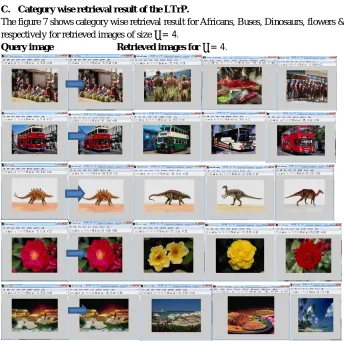
C. Category wise retrieval result of the LTrP.
The figure 7 shows category wise retrieval result for Africans, Buses, Dinosaurs, flowers & food respectively for retrieved images of size = 4.
Query image Retrieved images for = 4.
DOI: 10.15662/ijareeie.2014.0307020 VII.CONCLUSION
In this paper, we have presented an approach for texture feature for CBIR using LTrPs. The LTrP encodes the images based on the direction of pixels that are calculated by horizontal and vertical derivatives. The magnitude of the binary pattern is collected using magnitudes of derivatives. The effectiveness of this method is measured in terms of average precision and average recall.
REFERENCES
[1] SubrahmanyamMurala, R.P.Maheshwari and R.Subramanian,” Local Tetra Patterns: A New Feature Discriptor for Content-Based Image Retrieval”, IEEE Trans.on Image Processing,vol.21,No.5,May2012.
[2] Y. Rui and T. S. Huang, “Image retrieval: Current techniques,promising directions and open issues,” J. Visual Commun. ImageRepresent., vol. 10, no. 1, pp. 39–62, Mar. 1999.
[3] M. Kokare, B. N. Chatterji, and P. K. Biswas, “A survey on current content based image retrieval methods,” IETE J. Res., vol. 48, no. 3&4, pp. 261–271, 2002.
[4] T. Ojala, M. Pietikainen, and T. Maenpaa, “Multiresolutiongray-scale and rotation invariant texture classification with local binary patterns,”
IEEE Trans. Pattern Anal. Mach. Intell., vol. 24, no. 7, pp. 971–987, Jul. 2002.
[5] X. Tan and B. Triggs, “Enhanced local texture feature sets for face recognition under difficult lighting conditions,” IEEE Trans. ImageProcess., vol. 19, no. 6, pp. 1635–1650, Jun. 2010.
[6] B. Zhang, Y. Gao, S. Zhao, and J. Liu, “Local derivative pattern versus local binary pattern: Face recognition with higher-order local pattern descriptor,” IEEE Trans. Image Process., vol. 19, no. 2, pp. 533–544, Feb. 2010.
[7] Z. Guo, L. Zhang, and D. Zhang, “A completed modeling of local binary pattern operator for texture classification,” IEEE Trans. ImageProcess., vol. 19, no. 6, pp. 1657–1663, Jun. 2010.
[8] Z. Guo, L. Zhang, and D. Zhang, “Rotation invariant texture classification using LBP variance with global matching,” Pattern Recogn., vol. 43, no. 3, pp. 706–719, Mar. 2010.