Neural Network- A Study
Nikita Pahuja, Rashmi Dewan, Shivangi Kukreja
Student, Computer Science& Engineering, Maharshi Dayanand University, India Gurgaon , Haryana, India
[email protected] [email protected] [email protected]
ABSTRACT
The intention of this paper is to provide an overview on the subject of NEURAL NETWORK. The overview includes previous and existing concepts, current technologies. This paper also covers definition, history of neural network, application, architecture and learning process of neural network. Through this paper we are creating awareness among the people about this rising field of compiler design. This paper also offers a comprehensive number of references for each concept of NEURAL NETWORK
1)
INTRODUCTION
An Artificial Neural Network (ANN) is an information processing paradigm that is inspired by the way biological nervous systems, such as the brain, process information. The key element of this paradigm is the novel structure of the information processing system. It is composed of a large number of highly interconnected processing elements (neurones) working in unison to solve specific problems. ANNs, like people, learn by example. An ANN is configured for a specific application, such as pattern recognition or data classification, through a learning process. Learning in biological systems involves adjustments to the synaptic connections that exist between the neurones. This is true of ANNs as well.
1.1)
HISTORICAL
BACKGROUND
Neural network simulations appear to be a recent development. However, this field was established before the advent of computers,
and has survived at least one major setback and several eras.
Many importand advances have been boosted by the use of inexpensive computer emulations. Following an initial period of enthusiasm, the field survived a period of frustration and disrepute. During this period when funding and professional support was minimal, important advances were made by relatively few reserchers. These pioneers were able to develop convincing technology which surpassed the limitations identified by Minsky and Papert. Minsky and Papert, published a book (in 1969) in which they summed up a general feeling of frustration (against neural networks) among researchers, and was thus accepted by most without further analysis. Currently, the neural network field enjoys a resurgence of interest and a corresponding increase in funding
The first artificial neuron was produced in 1943 by the neurophysiologist Warren McCulloch and the logician Walter Pits. But the technology available at that time did not allow them to do too much.
1.2)
WHY
USE
NEURAL
NETWORKS?
provide projections given new situations of
interest and answer "what if" questions. Other advantages include:
• Adaptive learning: An ability to learn how to do tasks based on the data given for training or initial experience.
• Self-Organisation: An ANN can create its own organisation or representation of the information it receives during learning time.
• Real Time Operation: ANN computations may be carried out in parallel, and special hardware devices are being designed and manufactured which take advantage of this capability.
• Fault Tolerance via Redundant Information Coding: Partial destruction of a network leads to the corresponding degradation of performance. However, some network capabilities may be retained even with major network damage.
1.3)
NEURAL
NETWORKS
VERSUS
CONVENTIONAL
COMPUTERS
Neural networks take a different approach to problem solving than that of conventional computers. Conventional computers use an algorithmic approach i.e. the computer follows a set of instructions in order to solve a problem. Unless the specific steps that the computer needs to follow are known the computer cannot solve the problem. That restricts the problem solving capability of conventional computers to problems that we already understand and know how to solve. But computers would be so much more useful if they could do things that we don't exactly know how to do.
Neural networks process information in a similar way the human brain does. The network is composed of a large number of highly interconnected processing elements(neurones) working in parallel to solve a specific problem. Neural networks learn by example. They cannot be programmed to perform a specific task. The examples must be selected carefully otherwise useful time is wasted or even worse the network might be functioning incorrectly. The disadvantage is that because the network finds out how to solve the
problem by itself, its operation can be unpredictable.
On the other hand, conventional computers use a cognitive approach to problem solving; the way the problem is to solved must be known and stated in small unambiguous instructions. These instructions are then converted to a high level language program and then into machine code that the computer can understand. These machines are totally predictable; if anything goes wrong is due to a software or hardware fault. Neural networks and conventional algorithmic computers are not in competition but complement each other. There are tasks are more suited to an algorithmic approach like arithmetic operations and tasks that are more suited to neural networks. Even more, a large number of tasks, require systems that use a combination of the two approaches (normally a conventional computer is used to supervise the neural network) in order to perform at maximum efficiency
.
2)
MODELS
Neural network models in artificial intelligence are usually referred to as artificial neural networks (ANNs); these are essentially simple mathematical models defining a function or a distribution over or both and , but sometimes models are also intimately associated with a particular learning algorithm or learning rule. A common use of the phrase ANN model really means the definition of a class of such functions (where members of the class are obtained by varying parameters, connection weights, or specifics of the architecture such as the number of neurons or their connectivity).
2.1) NETWORK FUNCTION
increased layers of input neurons and output
neurons. The synapses store parameters called "weights" that manipulate the data in the calculations.
An ANN is typically defined by three types of parameters:
• The interconnection pattern between the different layers of neurons
• The learning process for updating the weights of the interconnections
• The activation function that converts a neuron's weighted input to its output activation.
Mathematically, a neuron's network function is defined as a composition of other functions , which can further be defined as a composition of other functions. This can be conveniently represented as a network structure, with arrows depicting the dependencies between variables. A widely used type of composition is the nonlinear
weighted sum, where
, where (commonly referred to as the activation function) is some predefined function, such as the hyperbolic tangent. It will be convenient for the following to refer to a collection of functions as simply a vector
.
The first view is the functional view: the input is transformed into a 3-dimensional vector , which is then transformed into a 2-dimensional vector , which is finally transformed into . This view is most commonly encountered in the context of optimization.
The second view is the probabilistic view: the random variable depends upon the random variable , which depends upon , which depends upon the random variable . This view is most commonly encountered in the context of graphical models.
The two views are largely equivalent. In either case, for this particular network architecture, the components of individual layers are independent of each other (e.g., the components of are independent of each other given their input ). This naturally enables a degree of parallelism in the implementation.
Networks such as the previous one are commonly called feedforward, because their
graph is a directed acyclic graph. Networks with cycles are commonly called recurrent. Such networks are commonly depicted in the manner shown at the top of the figure, where is shown as being dependent upon itself. However, an implied temporal dependence is not shown.
FIG 1)
2.2) LEARNING
What has attracted the most interest in neural networks is the possibility of learning. Given a specific task to solve, and a class of functions , learning means using a set of observations to find which solves the task in some optimal sense. This entails defining a cost function
such that, for the optimal solution , – i.e., no solution has a cost less than the cost of the optimal solution .
The cost function is an important concept in learning, as it is a measure of how far away a particular solution is from an optimal solution to the problem to be solved. Learning algorithms search through the solution space to find a function that has the smallest possible cost.
necessarily be a function of the observations,
otherwise we would not be modelling anything related to the data. It is frequently defined as a statistic to which only approximations can be made. As a simple example, consider the problem of finding the model , which minimizes
, for data pairs drawn from some distribution . In practical situations we would only have samples from and thus, for the above example, we would only minimize
. Thus, the cost is minimized over a sample of the data rather than the entire data set.
When some form of online machine learning must be used, where the cost is partially minimized as each new example is seen. While online machine learning is often used when is fixed, it is most useful in the case where the distribution changes slowly over time. In neural network methods, some form of online machine learning is frequently used for finite datasets.
2.2.1) CHOOSING A COST
FUNCTION
While it is possible to define some arbitrary ad hoc cost function, frequently a particular cost will be used, either because it has desirable properties (such as convexity) or because it arises naturally from a particular formulation of the problem (e.g., in a probabilistic formulation the posterior probability of the model can be used as an inverse cost). Ultimately, the cost function will depend on the desired task.
2.3) LEARNING PARADIGMS
There are three major learning paradigms, each corresponding to a particular abstract learning task. These are supervised learning, unsupervised learning and reinforcement learning.
2.3.1)
SUPERVISED
LEARNING
In supervised learning, we are given a set of example pairs and the aim is to find a function in the allowed class of functions that matches the examples. In other words, we wish to infer the mapping implied by the data; the cost function is related to the mismatch between our mapping and the data and it implicitly contains prior knowledge about the problem domain.
A commonly used cost is the mean-squared error, which tries to minimize the average squared error between the network's output, f(x), and the target value y over all the example pairs. When one tries to minimize this cost using gradient descent for the class of neural networks called multilayer perceptrons, one obtains the common and well-known backpropagation algorithm for training neural networks.
Tasks that fall within the paradigm of supervised learning are pattern recognition (also known as classification) and regression (also known as function approximation). The supervised learning paradigm is also applicable to sequential data (e.g., for speech and gesture recognition). This can be thought of as learning with a "teacher," in the form of a function that provides continuous feedback on the quality of solutions obtained thus far.
2.3.2)
UNSUPERVISED
LEARNING
In unsupervised learning, some data is given and the cost function to be minimized, that can be any function of the data and the network's output, .
model) and our a priori
assumptions (the implicit properties of our model, its parameters and the observed variables).
As a trivial example, consider the model where is a constant
and the cost .
Minimizing this cost will give us a value of that is equal to the mean of the data. The cost function can be much more complicated. Its form depends on the application: for example, in compression it could be related to the mutual information between and , whereas in statistical modeling, it could be related to the posterior probability of the model given the data. (Note that in both of those examples those quantities would be maximized rather than minimized). Tasks that fall within the paradigm of unsupervised learning are in general estimation problems; the applications include clustering, the estimation of statistical distributions, compression and filtering.
2.3.3)
REINFORCEMENT
LEARNING
In reinforcement learning, data are usually not given, but generated by an agent's interactions with the environment. At each point in time
, the agent performs an action and the environment generates an observation and an instantaneous cost , according to some (usually unknown) dynamics. The aim is to discover a policy for selecting actions that minimizes some measure of a long-term cost; i.e., the expected cumulative cost. The environment's dynamics and the long-term cost for each policy are usually unknown, but can be estimated.
More formally the environment is modelled as a Markov decision process (MDP) with states and actions
with the following probability distributions: the instantaneous cost distribution , the observation distribution and the transition , while a policy is defined as conditional distribution over actions given the observations. Taken together, the two then define a Markov chain (MC). The aim is to discover the policy that minimizes the cost; i.e., the MC for which the cost is minimal.
ANNs are frequently used in reinforcement learning as part of the overall algorithm. Dynamic programming has been coupled with ANNs (Neuro dynamic programming) by Bertsekas and Tsitsiklis and applied to multi-dimensional nonlinear problems such as those involved in vehicle routing, natural resources management or medicine[36] because of the ability of ANNs to mitigate losses of accuracy even when reducing the discretization grid density for numerically approximating the solution of the original control problems.
Tasks that fall within the paradigm of reinforcement learning are control problems, games and other sequential decision making tasks.
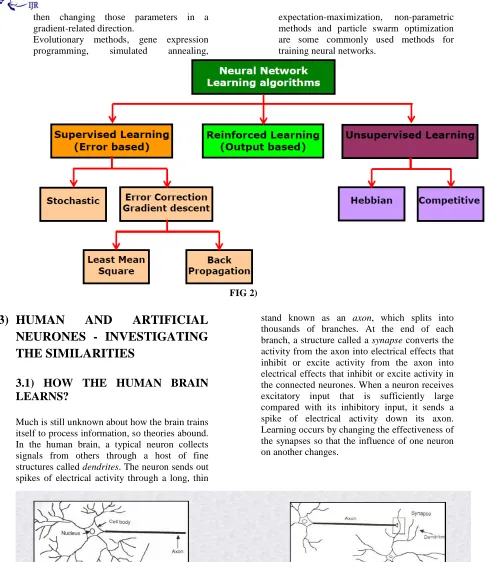
2.4) LEARNING ALGORITHMS
Training a neural network model essentially means selecting one model from the set of allowed models (or, in a Bayesian framework, determining a distribution over the set of allowed models) that minimizes the cost criterion. There are numerous algorithms available for training neural network models; most of them can be viewed as a straightforward application of optimization theory and statistical estimation.
then changing those parameters in a
gradient-related direction.
Evolutionary methods, gene expression programming, simulated annealing,
expectation-maximization, non-parametric methods and particle swarm optimization are some commonly used methods for training neural networks.
FIG 2)
3)
HUMAN
AND
ARTIFICIAL
NEURONES - INVESTIGATING
THE SIMILARITIES
3.1) HOW THE HUMAN BRAIN
LEARNS?
Much is still unknown about how the brain trains itself to process information, so theories abound. In the human brain, a typical neuron collects signals from others through a host of fine structures called dendrites. The neuron sends out spikes of electrical activity through a long, thin
stand known as an axon, which splits into thousands of branches. At the end of each branch, a structure called a synapse converts the activity from the axon into electrical effects that inhibit or excite activity from the axon into electrical effects that inhibit or excite activity in the connected neurones. When a neuron receives excitatory input that is sufficiently large compared with its inhibitory input, it sends a spike of electrical activity down its axon. Learning occurs by changing the effectiveness of the synapses so that the influence of one neuron on another changes.
3.2) FROM HUMAN NEURONES
TO ARTIFICIAL NEURONES
We conduct these neural networks by first trying to deduce the essential features of neurones and their interconnections. We then typically
program a computer to simulate these features. However because our knowledge of neurones is incomplete and our computing power is limited, our models are necessarily gross idealisations of real networks of neurones.
FIG 4)
4)
ENGINEERING APPROACH
4.1) A SIMPLE NEURON
An artificial neuron is a device with many inputs and one output. The neuron has two modes of operation; the training mode and the using mode. In the training mode, the neuron can be trained to
FIG 5)
4.2)
Firing rules
The firing rule is an important concept in neural networks and accounts for their high flexibility. A firing rule determines how one calculates whether a neuron should fire for any input pattern. It relates to all the input patterns, not only the ones on which the node was trained. A simple firing rule can be implemented by using Hamming distance technique. The rule goes as follows:
Take a collection of training patterns for a node, some of which cause it to fire (the 1-taught set of
patterns) and others which prevent it from doing so (the 0-taught set). Then the patterns not in the collection cause the node to fire if, on comparison , they have more input elements in common with the 'nearest' pattern in the 1-taught set than with the 'nearest' pattern in the 0-taught set. If there is a tie, then the pattern remains in the undefined state.
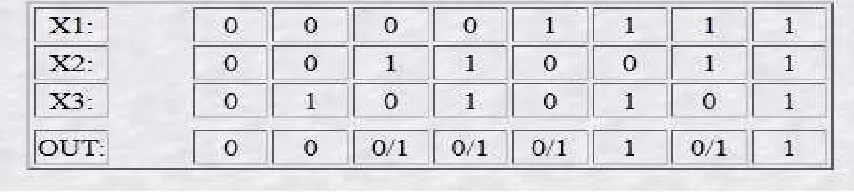
For example, a 3-input neuron is taught to output 1 when the input (X1,X2 and X3) is 111 or 101 and to output 0 when the input is 000 or 001. Then, before applying the firing rule, the truth table is;
FIG 6)
4.3) PATTERN RECOGNITION
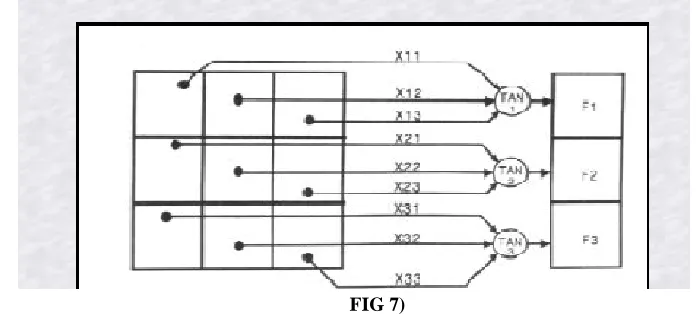
An important application of neural networks is pattern recognition. Pattern recognition can be implemented by using a feed-forward (figure 1)
The power of neural networks comes to life
when a pattern that has no output associated with it, is given as an input. In this case, the network
gives the output that corresponds to a taught input pattern that is least different from the given pattern.
FIG 7)
4.4)
A
MORE
COMPLICATED
NEURON
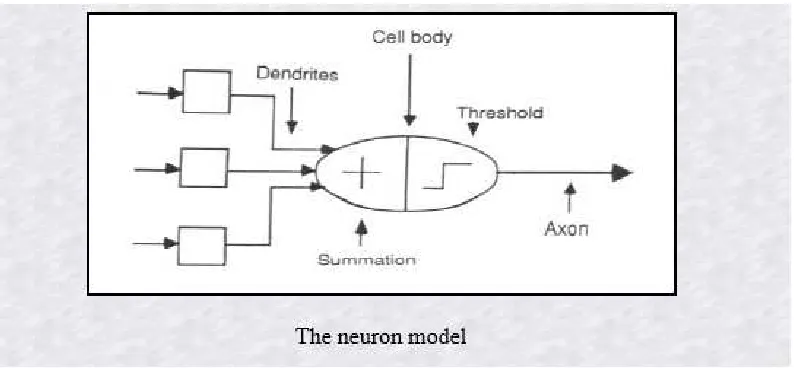
The previous neuron doesn't do anything that conventional conventional computers don't do already. A more sophisticated neuron (figure 2) is the McCulloch and Pitts model (MCP). The difference from the previous model is that the
inputs are 'weighted', the effect that each input has at decision making is dependent on the weight of the particular input. The weight of an input is a number which when multiplied with the input gives the weighted input. These weighted inputs are then added together and if they exceed a pre-set threshold value, the neuron fires. In any other case the neuron does not fire.
5)
ARCHITECTURE OF NEURAL
NETWORKS
5.1) FEED-FORWARD NETWORKS
Feed-forward ANNs (figure 1) allow signals to travel one way only; from input to output. There is no feedback (loops) i.e. the output of any layer does not affect that same layer. Feed-forward ANNs tend to be straight forward networks that associate inputs with outputs. They are extensively used in pattern recognition. This type of organisation is also referred to as bottom-up or top-down.
5.2) FEEDBACK NETWORKS
Feedback networks (figure 1) can have signals travelling in both directions by introducing loops in the network. Feedback networks are very powerful and can get extremely complicated. Feedback networks are dynamic; their 'state' is changing continuously until they reach an equilibrium point. They remain at the equilibrium point until the input changes and a new equilibrium needs to be found. Feedback architectures are also referred to as interactive or recurrent, although the latter term is often used to denote feedback connections in single-layer organisations.
FIG 9)
6)
THE LEARNING PROCESS
The memorisation of patterns and the subsequent response of the network can be categorised into two general paradigms:
• associative mapping in which the network learns to produce a particular pattern on the set of input units whenever another particular pattern is applied on the set of input units. The associtive mapping can generally be broken down into two mechanisms:
o auto-association: an input pattern
is associated with itself and the states of input and output units coincide. This is used to provide pattern completition, ie to produce a pattern whenever a portion of it or a distorted pattern is presented.
In the second case, the network actually stores pairs of patterns building an association between two sets of patterns.
o
hetero-association: is related to two recall mechanisms:
nearest-neighbour recall, where the output pattern produced corresponds to the input pattern stored, which is closest to the pattern presented, and
another paradigm, which
is a variant associative mapping is classification, ie when there is a fixed set of categories into which the input patterns are to be classified.
• regularity detection in which units learn to
respond to particular properties of the input patterns. Whereas in asssociative mapping
the network stores the relationships among patterns, in regularity detection the response of each unit has a particular 'meaning'. This type of learning mechanism is essential for feature discovery and knowledge representation.
Every neural network posseses knowledge which is contained in the values of the connections weights. Modifying the knowledge stored in the network as a function of experience implies a learning rule for changing the values of the weights.
Information is stored in the weight matrix W of a neural network. Learning is the determination of the weights. Following the way learning is performed, we can distinguish two major categories of neural networks:
• fixed networks in which the weights cannot
be changed, ie dW/dt=0. In such networks, the weights are fixed a priori according to the problem to solve.
• adaptive networks which are able to
change their weights, ie dW/dt not= 0.
All learning methods used for adaptive neural networks can be classified into two major categories:
• Supervised learning which incorporates an
external teacher, so that each output unit is told what its desired response to input signals ought to be. During the learning process global information may be required. Paradigms of supervised learning include error-correction learning, reinforcement learning and stochastic learning.
An important issue concerning supervised learning is the problem of error convergence, i.e. the minimization of error between the desired and computed unit values. The aim is to determine a set of weights which minimizes the error. One well-known method, which is common to many learning paradigms is the least mean square (LMS) convergence.
• Unsupervised learning uses no external
supervised learning is performed off-line,
whereas unsupervised learning is performed on-line.
6.1) TRANSFER FUNCTION
The behavior of an ANN (Artificial Neural Network) depends on both the weights and the input-output function (transfer function) that is specified for the units. This function typically falls into one of three categories:
• linear (or ramp)
• threshold
• sigmoid
For linear units, the output activity is proportional to the total weighted output. For threshold units, the output is set at one of two levels, depending on whether the total input is greater than or less than some threshold value.
For sigmoid units, the output varies
continuously but not linearly as the input changes. Sigmoid units bear a greater resemblance to real neurones than do linear or threshold units, but all three must be considered rough approximations.
To make a neural network that performs some specific task, we must choose how the units are connected to one another, and we must set the weights on the connections appropriately. The connections determine whether it is possible for one unit to influence another. The weights specify the strength of the influence.
7) APPLICATIONS
7.1) NEURAL NETWORKS IN
PRACTICE
Given this description of neural networks and how they work, what real world applications are they suited for? Neural networks have broad applicability to real world business problems. In fact, they have already been successfully applied in many industries.
Since neural networks are best at identifying patterns or trends in data, they are well suited for prediction or forecasting needs including:
• sales forecasting
• industrial process control
• customer research
• data validation
• risk management
• target marketing
But to give you some more specific examples; ANN are also used in the following specific paradigms: recognition of speakers in communications; diagnosis of hepatitis; recovery of telecommunications from faulty software; interpretation of multimeaning Chinese words; undersea mine detection; texture analysis; three-dimensional object recognition; hand-written word recognition; and facial recognition.
7.2) NEURAL NETWORKS IN
MEDICINE
Artificial Neural Networks (ANN) are currently a 'hot' research area in medicine and it is believed that they will receive extensive application to biomedical systems in the next few years. At the moment, the research is mostly on modeling parts of the human body and recognizing diseases from various scans (e.g. cardiograms, CAT scans, ultrasonic scans, etc.).
Neural networks are ideal in recognizing diseases using scans since there is no need to provide a specific algorithm on how to identify the disease. Neural networks learn by example so the details of how to recognize the disease are not needed. What is needed is a set of examples that are representative of all the variations of the disease. The quantity of examples is not as important as the 'quantity'. The examples need to be selected very carefully if the system is to perform reliably and efficiently.
•
MODELLING
AND
DIAGNOSING
THE
CARDIOVASCULAR
SYSTEM
and comparing it with the real time
physiological measurements taken from the patient. If this routine is carried out regularly, potential harmful medical conditions can be detected at an early stage and thus make the process of combating the disease much easier.
A model of an individual's cardiovascular system must mimic the relationship among physiological variables (i.e., heart rate, systolic and diastolic blood pressures, and breathing rate) at different physical activity levels. If a model is adapted to an individual, then it becomes a model of the physical condition of that individual. The simulator will have to be able to adapt to the features of any individual without the supervision of an expert. This calls for a neural network.
Another reason that justifies the use of ANN technology is the ability of ANNs to provide sensor fusion which is the combining of values from several different sensors. Sensor fusion enables the ANNs to learn complex relationships among the individual sensor values, which would otherwise be lost if the values were individually analyzed. In medical modeling and diagnosis, this implies that even though each sensor in a set may be sensitive only to a specific physiological variable, ANNs are capable of detecting complex medical conditions by fusing the data from the individual biomedical sensors.
•
ELECTRONIC NOSES
ANNs are used experimentally to implement electronic noses. Electronic noses have several potential applications in telemedicine. Telemedicine is the practice of medicine over long distances via a communication link. The electronic nose would identify odours in the remote surgical environment. These identified odours would then be electronically transmitted to another site where a door generation system would
recreate them. Because the sense of smell can be an important sense to the surgeon, telesmell would enhance telepresent surgery.
•
INSTANT PHYSICIAN
An application developed in the mid-1980s called the "instant physician" trained an auto associative memory neural network to store a large number of medical records, each of which includes information on symptoms, diagnosis, and treatment for a particular case. After training, the net can be presented with input consisting of a set of symptoms; it will then find the full stored pattern that represents the "best" diagnosis and treatment.
7.3) NEURAL NETWORKS IN
BUSINESS
Business is a diverted field with several general areas of specialization such as accounting or financial analysis. Almost any neural network application would fit into one business area or
financial analysis.
There is some potential for using neural networks for business purposes, including resource allocation and scheduling. There is also a strong potential for using neural networks for database mining, that is, searching for patterns implicit within the explicitly stored information in databases. Most of the funded work in this area is classified as proprietary. Thus, it is not possible to report on the full extent of the work going on. Most work is applying neural networks, such as the Hopfield-Tank network for optimization and scheduling.
•
MARKETING
expression. Additionally, the application's
environment changed rapidly and constantly, which required a continuously adaptive solution. The system is used to monitor and recommend booking advice for each departure. Such information has a direct impact on the profitability of an airline and can provide a technological advantage for users of the system. [Hutchison & Stephens, 1987]
While it is significant that neural networks have been applied to this problem, it is also important to see that this intelligent technology can be integrated with expert systems and other approaches to make a functional system. Neural networks were used to discover the influence of undefined interactions by the various variables. While these interactions were not defined, they were used by the neural system to develop useful conclusions. It is also noteworthy to see that neural networks can influence the bottom line.
•
CREDIT EVALUATION
The HNC company, founded by Robert Hecht-Nielsen, has developed several neural network applications. One of them is the Credit Scoring system which increase the profitability of the existing model up to 27%. The HNC neural systems were also applied to mortgage screening. A neural network automated mortgage insurance underwritting system was developed by the Nestor Company. This system was trained with 5048 applications of which 2597 were certified. The data related to property and borrower qualifications. In a conservative mode the system agreed on the underwritters on 97% of the cases. In the liberal model the system agreed 84% of the cases. This is system run on an Apollo DN3000 and used 250K memory while processing a case file in approximately 1 sec.
8) CRITICISM
A common criticism of neural networks, particularly in robotics, is that they require a large diversity of training for real-world operation. This is not surprising, since any learning machine needs sufficient representative examples in order to capture the underlying structure that allows it to generalize to new cases. Dean Pomerleau, in his research presented
in the paper "Knowledge-based Training of Artificial Neural Networks for Autonomous Robot Driving," uses a neural network to train a robotic vehicle to drive on multiple types of roads (single lane, multi-lane, dirt, etc.). A large amount of his research is devoted to (1) extrapolating multiple training scenarios from a single training experience, and (2) preserving past training diversity so that the system does not become overtrained (if, for example, it is presented with a series of right turns – it should not learn to always turn right). These issues are common in neural networks that must decide from amongst a wide variety of responses, but can be dealt with in several ways, for example by randomly shuffling the training examples, by using a numerical optimization algorithm that does not take too large steps when changing the network connections following an example, or by grouping examples in so-called mini-batches.
Arguments for Dewdney's position are that to implement large and effective software neural networks, much processing and storage resources need to be committed. While the brain has hardware tailored to the task of processing signals through a graph of neurons, simulating even a most simplified form on Von Neumann technology may compel a neural network designer to fill many millions of database rows for its connections - which can consume vast amounts of computer memory and hard disk space. Furthermore, the designer of neural network systems will often need to simulate the transmission of signals through many of these connections and their associated neurons - which must often be matched with incredible amounts of CPU processing power and time. While neural networks often yield effective programs, they too often do so at the cost of efficiency (they tend to consume considerable amounts of time and money). Arguments against Dewdney's position are that neural nets have been successfully used to solve many complex and diverse tasks, ranging from autonomously flying aircraft to detecting credit card fraud.
Technology writer Roger Bridgman commented on Dewdney's statements about neural nets:
are just trying to be good engineers. An unreadable
table that a useful machine could read would still be well worth having.
In response to this kind of criticism, one should note that although it is true that analyzing what has been learned by an artificial neural network is difficult, it is much easier to do so than to analyze what has been learned by a biological neural network. Furthermore, researchers involved in exploring learning algorithms for neural networks are gradually uncovering generic principles which allow a learning machine to be successful. For example, Bengio and LeCun (2007) wrote an article regarding local vs non-local learning, as well as shallow vs deep architecture.
Some other criticisms came from believers of hybrid models (combining neural networks and symbolic approaches). They advocate the intermix of these two approaches and believe that hybrid models can better capture the mechanisms of the human mind (Sun and Bookman, 1990).
SUMMARY
Neural networks are similar to biological neural networks in performing functions collectively and in parallel by the units, rather than there being a clear delineation of subtasks to which various units are assigned. The term "neural network" usually refers to models employed in statistics, cognitive psychology and artificial intelligence. Neural network models which emulate the central nervous system are part of theoretical neuroscience and computational neuroscience.
In modern software implementations of artificial neural networks, the approach inspired by biology has been largely abandoned for a more practical approach based on statistics and signal processing. In some of these systems, neural networks or parts of neural networks (like artificial neurons) form components in larger systems that combine both adaptive and non-adaptive elements. While the more general approach of such systems is more suitable for real-world problem solving, it has little to do with the traditional artificial intelligence connectionist models. What they do have in common, however, is the principle of non-linear, distributed, parallel and local processing and adaptation. Historically, the use of neural networks models marked a paradigm shift in the late eighties from high-level (symbolic) artificial intelligence, characterized by expert systems with knowledge embodied in if-then rules, to low-level (sub-symbolic) machine learning, characterized by knowledge embodied in the parameters of a dynamical system.
DISCLOSURE STATEMENT
There is no financial support for this research work from the funding agency.
ACKNOWLEDGMENTS
We thank our guide for his timely help, giving outstanding ideas and encouragement to finish this research work successfully.
SIDE BAR
Comparison: it is an act of assessment or evaluation of things side by side in order to see to what extent they are similar or different. It is used to bring out similarities or differences between two things of same type mostly to discover essential features or meaning either scientifically or otherwise.
Content: The amount of things contained in something. Things written or spoken in a book, an article, a programme, a speech, etc.
DEFINITION
• Interact - act in such a way as to have an effect on each other.
• Credit - the ability of a customer to obtain goods or services before payment, based on the trust that payment will be made in the future.
• Application - the action of putting something into operation.
• Algorithm - a process or set of rules to be followed in calculations or other problem-solving operations, especially by a computer.
REFERENCES
1. http://www.doc.ic.ac.uk/~nd/surprise_96/jou rnal/vol4/cs11/report.html#Introduction%20 to%20neural%20networks
3. Bain (1873). Mind and Body: The Theories
of Their Relation. New York: D. Appleton and Company.
4. James (1890). The Principles of Psychology. New York: H. Holt and Company.
5. "PLoS Computational Biology Issue Image | Vol. 6(8) August 2010". PLoS Computational Biology 6 (8): ev06.ei08. 2010
6. Sherrington, C.S. "Experiments in Examination of the Peripheral Distribution of the Fibers of the Posterior Roots of Some Spinal Nerves". Proceedings of the Royal Society of London 190: 45–186.
7. McCulloch, Warren; Walter Pitts (1943). "A Logical Calculus of Ideas Immanent in Nervous Activity". Bulletin of Mathematical Biophysics 5 (4): 115–133.
8. Hebb, Donald (1949). The Organization of Behavior. New York: Wiley.
9. Farley, B; W.A. Clark (1954). "Simulation of Self-Organizing Systems by Digital Computer". IRE Transactions on Information Theory 4 (4)
10. Rochester, N.; J.H. Holland, L.H. Habit, and W.L. Duda (1956). "Tests on a cell assembly theory of the action of the brain, using a large digital computer". IRE Transactions on Information Theory 2 (3): 80–93.
RELATED REFERENCES
[1] An introduction to neural computing. Aleksander, I. and Morton, H. 2nd edition [2] Neural Networks at Pacific Northwest
National Laboratory
http://www.emsl.pnl.gov:2080/docs/cie/neur al/neural.homepage.html
[3] Industrial Applications of Neural Networks (research reports Esprit, I.F.Croall, J.P.Mason)
[4] A Novel Approach to Modelling and Diagnosing the Cardiovascular System http://www.emsl.pnl.gov:2080/docs/cie/neur al/papers2/keller.wcnn95.abs.html
[5] Artificial Neural Networks in Medicine http://www.emsl.pnl.gov:2080/docs/cie/tech brief/NN.techbrief.ht
[6] Neural Networks by Eric Davalo and Patrick Naim
[7] Learning internal representations by error propagation by Rumelhart, Hinton and Williams (1986).
[8] Klimasauskas, CC. (1989). The 1989 Neuro Computing Bibliography. Hammerstrom, D. (1986). A Connectionist/Neural Network Bibliography.
[9] DARPA Neural Network Study (October, 1987-February, 1989). MIT Lincoln Lab. Neural Networks, Eric Davalo and Patrick Naim
[10]Assimov, I (1984, 1950), Robot, Ballatine, New York.
[11]Electronic Noses for Telemedicine http://www.emsl.pnl.gov:2080/docs/cie/neur al/papers2/keller.ccc95.abs.html
[12]Pattern Recognition of Pathology Images