A Review on Enhanced Inter-cell Interference Coordination in
Long Term Evolution Heterogeneous Networks
Mr. Dipak V Bhosale1, Prof. Vanita D Jadhav2
1 Computer Science and Engineering, SVERI’s COE Pandharpur,
Pandharpur, Maharashatra, India
2
Computer Science and Engineering, SVERI’s COE Pandharpur, Pandharpur, Maharashatra, India
Abstract
The success of LTE heterogeneous networks (Het- Nets) with macrocells and picocells critically is contingent on efficient spectrum division between high-power macros and low-power picos. Two important tasks in this situation are: 1) Determining the amount of radio resources that macrocells should offer to picocells, and 2) Influential the association rules that resolve which user equipments (UEs) should associate with picos. In this system, progress a novel algorithm to solve these two joined problems in a dual manner. Proposed algorithm has provable guarantee, and furthermore, it explanations for network topology, traffic load, and macro-pico interference map. Our result is standard compliant and can be executed using the notion of Almost Blank Subframes (ABS) and Cell Selection Bias (CSB) proposed by LTE standards. Simulation result also show general evaluations using RF plan from a real network and discuss self-optimized networking (SON)-based improved inter-cell interference coordination (eICIC) employment.
Keywords: 4G LTE, enhanced inter-cell interference coordination (eICIC), heterogeneous cellular systems, Almost Blank Subframes, Self-optimized networking (SON).
1. Introduction
1.1
Traffic Explosion:
In recent years, mobile broadband traffic has grown exponentially, exceeding voice, thanks to the new generation of mobile terminals, such as smart phones, tablets and laptops, and to the new services and capabilities they offer. Mobile users have also increased and, with them, the number of connections. Furthermore, cellular operators have in general reported non-uniform traffic distributions in their networks, stating that for instance 50% of the total traffic volume is carried on only 30% of the macro sites. Exact percentages of course vary from network to network [6]. The required capacity has augmented faster than progress in spectral efficiency. In addition, the service is migrating from a voice-centralized
model to a data centralized model. Subscribers use connected devices not only to access the Internet, but also to access applications and cloud-based services, including video and other bandwidth-intensive content. As a result of these trends, overall mobile data traffic is expected to grow tenfold by 2016.
Users’ expectations for mobile broadband are growing parallel to traffic and, increasingly, users expect a robust, high-quality and seamless service. Further, more and more, customers are operating inside offices and buildings, where about 70 percent of today’s data traffic is generated and where coverage represents a major problem for mobile operators. Meet the demand for mobile broadband is specially challenging in certain scenarios; such as:
Large outdoor hotspots with high traffic demand and a dense macro network, implying high interference. E.g., town squares and commercial streets.
Large, isolated indoor hotspots, which may be difficult to reach from an outdoor macro network. E.g., businesses and hotels
Large indoor hotspots, where mobility demands and interference are high. E.g., shopping canters, airports and subway stations.
Localized, indoor hotspots or minor coverage holes, which represent a challenge of implementation and cost to conventional cellular networks. E.g., small offices and restaurants.
ISSN 2348 – 7968
improve coverage, capacity and power signal when necessary.
1.2 Long Term Evolution (LTE):
In order to support this galloping demand for data traffic, Third Generation Partnership Project (3GPP) Long Term Evolution (LTE) Release 8 is under field trial by most cellular operators. This standard offers significant advantages with respect to its predecessor, High Speed Packet Access (HSPA), such as higher spectral efficiency, lower latency due to its flat all-Internet Protocol (IP) architecture, and larger throughputs. However, the performance of Release 8 does not meet the International Mobile Telecommunications (IMT)-Advanced requirements for the fourth generation of mobile networks defined by the International Telecommunication Union (ITU). Thus, in order to meet such requirements (e.g., downlink data rates of up to 100 Mb/s and 1 Gb/s for mobile and nomadic users, respectively), LTE-Advanced (i.e., LTE Release 10) is currently under standardization. In order to enhance the performance of the overall network, LTE-Advanced proposes the use of advanced technologies. For instance, carrier aggregation (CA) allows the concurrent utilization of different frequency carriers, hence efficiently increasing the bandwidth that can be allocated to end users. Another trend is the enhancement of multi-antenna techniques, where using multiple-input multiple-output (MIMO) systems with up to 8 × 8 antenna arrays has gained significant attention. Coordinated multipoint (CoMP) transmission and reception, where multiple cells are able to coordinate their scheduling or transmission to serve users with adverse channel conditions, is also envisioned to notably mitigate outages at the cell edge. However, all these advanced technologies do not allow significant enhancements as they are reaching theoretical limits.
The smaller cell concepts can be viable solutions if these are deployed and operated by subscribers in their indoor environment, and cell nodes are made self- configuring and self-organizing. During the past decade, standard development organizations (SDOs) such as third generation partnership project (3GPP/3GPP2) and broadband forum (BBF), had started shaping smaller cell (femto cell) concepts for UMTS/WCDMA, cdma2000, and WiMAX standardizations respectively. The emerging 4G and beyond-4G cellular air-interface technologies such as Long Term Evolution Advanced (LTE-A) and IEEE 802.16m based WiMAX have adopted these new approaches in multitier heterogeneous network architecture (so called 4G HetNets) that would integrate the overlapping tiers of cells and base stations with different transmission powers and coverage sizes but sharing the
same spectrum. This brings new challenges to the more complex but efficient communication technologies for: intelligent radio resource sharing among heterogeneous cell nodes and mobile subscribers; distributed cooperative control over transmissions; increased dynamics of inter-cell interworking.[6]
The pervasively increasing trends of wireless mobile subscribers worldwide and the emerging highly data hungry telecommunication services warrant for consistent improvement in the radio coverage and capacities of existing and forth-coming wireless systems and networks. Improving the radio links, especially in radio coverage holes, is necessary for successful deployment (i.e., achieving close to theoretical data rates) of high data rate transmission technologies in the emerging 4G cellular systems and networks.
1.3 Heterogeneous networks (HetNets):
A traditional homogeneous cellular network consists of a group of high - power nodes (macro nodes). Heterogeneous networks instead include not only macro but also low - power nodes A traditional homogeneous cellular network consists of a group of high -power nodes (macro nodes).
Heterogeneous networks instead include not only macro but also low- power nodes. This deployment allows improving the spectral efficiency per unit area, as the low- power cells make possible to remove coverage holes in the macro - only network and increase the capacity in zones with very high traffic volume.
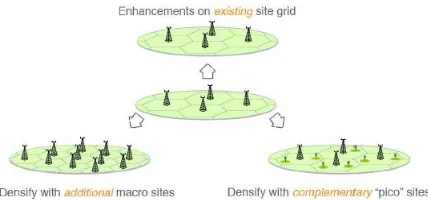
Figure 1 Key options to expand network capacity
the macro and low power layer. Each one presents technical challenges as well as advantages. [7]
Figure 2 HETNET architecture – low power node 1 is used capacity improvement in a hot-spot; low power node-2 and low power node-3 are used for improving edge throughput
With more than one billion wireless subscribers today and predictions for this number being tripled over the next five years, the wireless industry is confronted with an increasing demand for ubiquitous wireless coverage and larger data rates. The exponential traffic growth in broadband wireless networks is a well established fact, and this unprecedented trend is accelerated by the proliferation of advanced user terminals and bandwidth-greedy applications (e.g., mobile TV, file transfer).
1.4 Enhanced Inter cell Interference Coordination
(eICIC):
In order to maximize spectrum efficiency, it is desired that LTE uses a frequency reuse 1, which means that all the cells are using the same frequency channels. However, this also means that QoS will largely depend on the geographical position of the user equipment with a particular degradation on the cell edge. ICIC is introduced in 3GPP LTE Release 8 to deal with interference issues especially at cell-edge.[10]
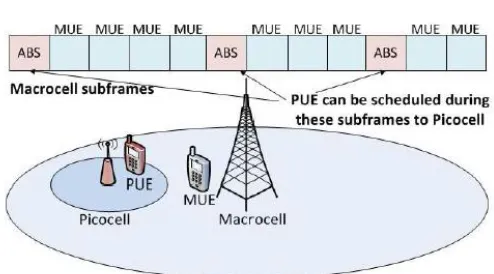
Enhanced Inter cell Interference Coordination (eICIC) is a framework by the 3GPP project to handle inter cell interference in Het-Net environments. In this approach transmissions from Macro-eNBs inflicting high interference onto Pico- eNBs users are periodically muted (stopped) during entire subframes, by this strategy, the Pico-eNB users that are suffering from a high level of interference from the aggressor Macro-eNB have a chance to be served. Since RE pico UEs are only scheduled during mandatory ABS in the macro eNB, the number of mandatory ABS (i.e. TDM muting ratio) in the macro eNB should increase or decrease accordingly with the RE in the pico eNB and, consequently, with the number of cell edge UEs in the cluster. The eICIC mechanism, and analyzes the necessary conditions for achieving gain using eICIC. Two implementation alternatives of eICIC are also proposed.
Figure 3 Almost Blank Subframes (ABS) technique
1.5 Self-organizing Networks (SONs):
Self-Organizing Networks (SONs) are a step forward towards automated operation in mobile networks, which reduce the Operation and Maintenance (O&M) cost of mobile networks by using automated and intelligent procedures to replace human intervention without compromising network performance. Some LPNs such as femto cells are user deployable and
no cellular operator intervention is needed, this approach is conceptualized by SONs features[8] [9].
SONs features of HetNets can be categorized in to three processes:
Self-configuration, newly deployed cells download required software and self-configure automatically before entering them into the operational mode.
Self-healing, where cells are auto-recovered whenever failures occur.
Self-optimization, where cells monitor the network status and adapt their settings to improve performance and reduce interference.[11]
2. System Analysis
2.1 Existing System
A. Stolyar el at. [1] used Subgradient method.
Advantage: Subgradient methods have been used with great success in developing decentralized cross-layer resource allocation mechanisms
Disadvantage: Preferred to more complex stepsize choices involving several stepsize parameters without a guidance on their selection
ISSN 2348 – 7968
Advantage: Demonstrated that the algorithm indeed achieves efficient interference avoidance, without any prior planning
Disadvantage: Papers do not consider the effect of out-of-cell interference
T. Tran et al. [3] used coordinated multipoint (CoMP) transmission /reception technique.
Advantage: The potential advantage, CoMP techniques received a lot of attention at the initiatory stage of the LTE-Advanced standardization.
Disadvantage: The half-duplex mode to avoid self-interference problem, unless sufficient physical isolation or interference cancellation is secured between transmit antennas and receive antennas
Y. Hong et al. [4] used Inter-cell interference coordination.
Advantage: Multi-layer transmission and the inter-cell interference from macro/pico deployment finally, this achieved data rate.
Disadvantage: The limitation in power of cell-edge users is also the reason why a rise in the level of interference does not provide a substantial improvement in outage, and it is only profitable for cell-center users who are able to power up.
The interference problems summarized above may significantly degrade the overall HetNet performance, which requires the use of eICIC schemes to guarantee its proper operation with help of effective algorithm.
3. Proposed System
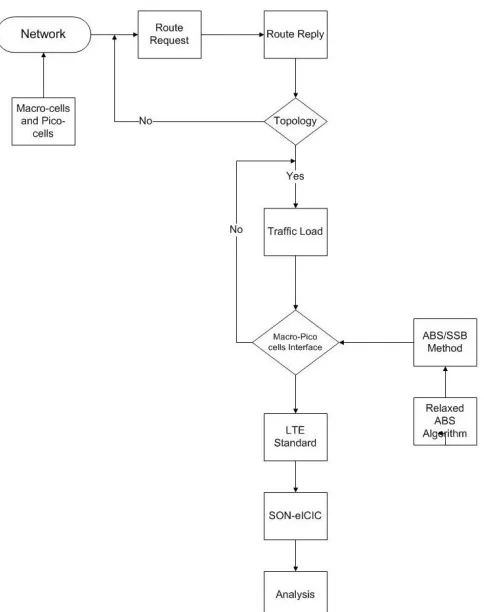
In this paper, we develop a novel algorithm to solve two coupled problems 1) Determining the amount of radio resources that macrocells should offer to picocells, and 2) Influential the association rules that resolve which user equipments (UEs) should associate with picos. in a joint manner.
4. Proposed System Modules
4.1 Network formation:
Our system model consists of a network of macro and pico (also called pico in this paper) eNBs denotes the set of macros, and denotes the set of picos. We also use and to denote a typical macro and a typical pico, respectively.
4.2 Traffic:
While the macros and the propagation map used in our evaluation are for area network, we create synthetic UE locations for our evaluation because LTE pico deployments are still not very prevalent. In the area under consideration, we chose a nominal UE density of around 450 active UEs/sq-km (dense urban density). In addition, we created UE hot spots around Pico-10, Pico-3, Pico-5, and 9. The hotspots around 3, 5, and Pico-9 have double the nominal UE density, and the traffic hotspot around Pico-10 has 50% more UE density than nominal. We also performed evaluation by varying the UE density around the macrocells to 225 active UEs/sq-km (urban density) and 125 UEs/sq-km (suburban density) without altering the hotspot UE densities around the selected picos.
Figure 4 Flow diagram of proposed system
4.3
Microcell-picocell interface:
4.4 SON-eICIC:
A key aspect of LTE networks is its SON capability. Thus, it is imperative to establish a SON based approach to eICIC parameter con figuration of an LTE network. The main algorithmic computations of SON may be implemented in an centralized or a distributed manner.
5. Conclusions
To overcome the Inter-cell Interference problem in macrocell- picocell, several eICIC techniques have recently been proposed for time domain. Approaches with a dynamic subframe ratio selection have better performance among proposed time domain eICIC techniques. To enhance the performance of system, we proposed a scheme combining CRE and ABSs scheme. By this scheme, the offset value and ABS ratio can be selected simultaneously based on system throughputs which can lead to improve the system performance.
The performance analysis shows that the eICIC performance for various load condition has been used to reduce the interference between the picocell and macrocell. The pico layer range extension offset should be properly chosen according to the scenario, and especially be adapted to the UE distribution.
Acknowledgments
I would like to express my heartfelt gratitude to my guide Prof. Vanita D. Jadhav who acted as a source of inspiration in all spheres of my project development phase & necessarily providing all resources along with a great platform to accomplish project analysis. I am also thankful to madam for her constant valuable guidance and encouragement during the course period. Besides her entire busy schedule madam always gave me enough time to discuss and sort out my queries. With whatever little progress I made, Madam appreciated and constantly guided me towards the next optimum level in the dissertation phase. Apart from technical skills, Madam also introduced professional skills in me.
I would like to express my thanks to the editorial board for giving me chance to publish the paper.
References
[1] A. Stolyar and H. Viswanathan, “Self-organizing dynamic
fractional frequency reuse in OFDMA systems,” in Proc. IEEE INFOCOM, 2008, pp. 691–699
[2] A. Nedic and A. E. Ozdaglar, “Subgradient methods in
network resource allocation: Rate analysis,” in Proc. CISS, 2008, pp. 1189–1194
[3] T. Tran, Y. Shin, and O. Shin, “Overview of enabling
technologies for 3GPP LTE-Advanced,” EURASIP J. Wireless Commun. Netw., vol. 2012, no. 2, 2012.
[4] Y. Hong, N. Lee, and B. Clerckx, “System level
performance evaluation of inter-cell interference coordination schemes for heterogeneous networks in LTE-A system,” in Proc. IEEE GLOBECOM, 2010, pp.690–694.
[5] Alcatel-Lucent 9955 Radio Network Planning Tool.
[6] Klaus I. Pedersen, Yuanye Wang, Beatriz Soret, Frank Frederiksen, Nokia Siemens Networks and Aalborg University “eICIC Functionality and Performance for LTE HetNet Co-Channel Deployments” in Vehicular Technology Conference (VTC Fall), 2012 IEEE, 3-6 Sept. 2012
[7] L. Chen, S. H. Low, M. Chiang, and J. C. Doyle,
“Cross-layer congestion control, routing and scheduling design in ad hoc wireless networks,” in Proc. IEEE INFOCOM, 2006, pp. 1–13.
[8] M. I. Kamel and K. Elsayed, “Performance evaluation of a coordinated time-domain eICIC framework based on ABSF in heterogeneous LTE-advanced networks,” in Proc. IEEE GLOBECOM, 2012, pp. 5548–5553.
[9] D. Lopez-Perez, I. Guvenc, G. de la Roche, M. Kountouris, T. Q. S. Quek, and J. Zhang, “Enhanced intercell interference coordination challenges in heterogeneous networks,” IEEE Wireless Commun., vol. 18, no. 3, pp. 22– 30, Jun. 2011.
[10] J. T. J. Penttinen, The LTE/SAE Deployment Handbook. Hoboken, NJ, USA: Wiley, Jan. 2012.
[11] S. Sesia, I. Toufik, and M. Baker, LTE, The UMTS Long Term Evolution: From Theory to Practice. Chichester, U.K.: Wiley, Feb. 2009.
Mr. Dipak V Bhosale is student of Master of Engineering in Computer
Science and Engineering. He has completed his Bachelor of Engineering in Computer from Pune University in 2011. Currently he is working as Assistant Professor in Karmayogi Engineering College, Shelve-Pandharpur. In Dipex 2014, his project was selected under Srijan category.