ISSN 2348 – 7968
Design of a Case Processing System
Richard Bemile
Information Technology Department, Methodist University College Ghana Dansoman, Accra Ghana
Abstract
This paper sought to design a case processing system for a Police Station. The main activities are capturing data of reported cases, processing them and storing case dockets in order to improve a police station administration and service delivery. The paper has the view of addressing the need to digitize and automate manual document processing within a Police Station in Ghana. Methods are applied to perform a system analysis of the existing and proposed system. The findings are used to design a case processing system. This design wants to make it possible to update data entries, create reports and keep better track of cases at the police station.
Keywords: Complainant, Case, Processing.
1 Background
The status quo at a police station in Ghana is that when a complainant reports a case, he is made to first write a statement. The next step is to take a Policeman to the culprit to be invited to the Station to also write a statement. Afterwards, the complainant brings a witness to also write a report. Depending on the gravity of the accusation, the culprit may be put in a cell awaiting the next action and also he may either be bailable or not.
What pertains now at most police stations in Ghana is cumbersome, as the processes involved are paper-based. Though records are kept, it is difficult to identify the category of inmates, the number of each category, etc at the time of need. This usually leads to innocent people being kept in cells, sometimes up to seven years, unattended to, as is sometimes reported in the news. Additionally, a criminal who has relocated is giving a fertile ground to operate since no data of him can be easily traced, thus promoting crime wave within the country.
The Information Technology deployed is very minimal, including typing of letters and reports and very basic excel operations that are due for high ranking Officers. This does not augur well in this current Information Age and thus this paper to look for an alternative for the Police Service.
The motto of the Ghana Police Service is “Service with Integrity” (www.ghana.gov.gh). The functions of the Ghana Police Service as stated in the Police Service Act,
1970 [Act 350] of Ghana are as follows (www.eservices.gov.gh):
• To protect life and property,
• To prevent and detect crime,
• To apprehend and prosecute offenders, and
• To maintain public order.
The Police Service is a single cohesive unit, organised on national basis with a unified command under the leadership of the Inspector-General of Police (IGP), who, subject to any direction/directives from the Police Council, is responsible for exercising general day-to-day supervision and control over the Administration and Operation of the Police Service (Pokoo-Aikins, 2002).
For efficient and effective policing and maintenance of law and order, the whole country is divided into thirteen (13) Police Regions (Pokoo-Aikins, 2002). Each Regional Police has a Regional Commander in charge of both administrative and operational concerns. He is directly responsible for all policing activities in the region. Administratively, the Regional Commander reports to the IGP via the Deputy IGP/Administration, who is assisted by the Commissioner of Police/Administration. All operational matters are reported to the IGP through the Deputy IGP/Operations, assisted by COP/Operations.
Every region, except the National Headquarters, is divided into divisions with each division headed by a Divisional Commander. Each division is divided into districts with a District Commander in charge. Each district has direct control and supervisory responsibilities over all Police Stations and Posts placed under it.
1.1 Criminal Offences
Conducts considered to be criminal offences as described by Act 29/60 include: Murder, Attempted Murder, Manslaughter, Threatening, Causing Harm, Assault, Robbery, Stealing, Causing Damage, Dishonestly Receiving, Rape, Possessing Indian Hemp, Possessing Dangerous Drug, Abduction, Forgery, Cocaine, Heroin, Extortion, Unlawful Entry, Fraud, Smuggling, Defilement,
ISSN 2348 – 7968
Other Offences. The commonest of criminal offenses today is assault as mentioned by the Station Commander during the interview and also evident in Pokoo-Aikins (2002).
2. Existing System
On conducting an interview at a Police Station with regards to what pertains now, a case is lodged at the Charge Office by complainant no matter his status. The reported case which the complainant writes is called the Complainant Statement, and is made up of: Register of Offences (RO) Number, Station, Section, Complainant Name, Date and Time of Incident, Address, Occupation, Age, Sex, Native of, Incident Report.
The next step is for the Officer-in-Charge to form a Diary of Action, which contains: Details of Police Action Taken, Given dates and times, Particulars of arrests, Other documents. After the complaint has been made, the culprit is invited to the station and he writes a Caution Statement made up of: Register of Offences (RO) Number, Station, Section, Culprit Name, Date and Time, Address, Occupation, Age, Sex, Native of, Culprit Report.
The complainant is then asked to bring a witness to write a Witness Statement, made up of: Register of Offences (RO) Number, Station, Section, Witness Name, Date and Time of Incident, Address, Occupation, Age, Sex, Native of, Witness Report. These are put together to form a Docket. A docket therefore encompasses the following, depending on the type of Crime: The Diary of Action, The Report or Statement of the Officer in Charge of the case (mostly an Investigator), Complainant Statement, Caution Statement, Witness Statement, Other Relevant Documents. An inmate can either be in Counter back, Detention, on Remand or a Convict.
2.1 Role Analysis
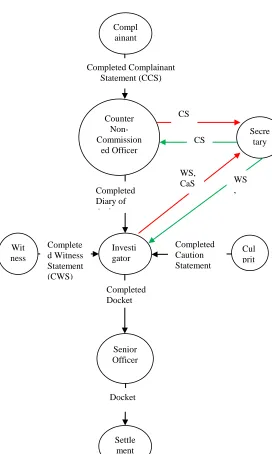
A complainant submits a completed complainant form to the Non Commissioned Officer (NCO); who makes a Diary of Action and forwards it to the Investigator. The Investigator invites a witness and the culprit to write a Witness Statement and a Caution Statement respectively. The Investigator then completes a Docket and forwards it to a Senior Officer who decides whether the case should go to court or be settled out of court.
2.2 Information Analysis
The Police Station survives on information from both internal and external sources. Internally, reports and others are sent from one department to the other, for example, Daily Situation Report (DSR) and Disciplinary Action Report (DAR) are sent to the Divisional Commander. A bulk of the information is gotten from external sources including the complainant statement, caution statement, witness statement and others that constitute the docket. Information is also gotten from investigations and tip offs from citizens. The diagram below shows how required information flows at the station.
2.3 Information Flow Diagram (IFD)
Fig. 1: Information Flow Diagram
Compla inant
Counter Non-Commissio ned Officer
Witness Culprit
Senior Officer Investi gator
Settlem ent
Completed Complainant Statement
Complet ed Witness Stateme
nt
Completed Caution Statement Completed Diary
of Action
Completed Docket
ISSN 2348 – 7968
2.4Technology
At the visited Police Station, there were two official computers and printers and a few other computers which were personal properties of some staff, which they use to support their work. Some staff have found it necessary to acquire PCs for usage in the office as more were not forthcoming. They will take these PCs along when transferred. There were telephones too; both mobile and land lines, and radio sets for communication. Most of the work done was paper-based making their operation quite laborious. The few computers available are not networked thus making their work even more difficult.
2.5 Processes
There are two main processes: proactive and reaction. Proactive process deals with the protection of life and property. Reaction process deals with the apprehension and prosecution of criminals, investigation of criminals and it involves the formation of a Docket. Other processes include: financial functions of the station, and preparation of duty roster for the Police personnel.
2.6 Stakeholder comments
The Divisional Commander admitted that they were aware of the problems of the existing system and had been looking for an opportunity to solve them.
2.7 Improvement needs
From the weaknesses observed in the IS Audit and the analysis of IFD, it is realised that;
1. Detained inmates are sometimes left unattended to, since no right process to update their records 2. The manual-based system delays report
processing
3. No proper keeping of dockets 4. Data is scattered
5. No intranet to facilitate communication
3. The Proposed System
3.1 Information Design
This helped to settle on the information requirements needed to meet system objectives.
Fig. 2: Information Flow Diagram of Proposed System
Compl ainant
Counter Non-Commission
ed Officer
Wit ness
Cul prit
Senior Officer Investi gator
Settle ment
Secre tary Completed Complainant
Statement (CCS)
Completed Diary of A ti
Complete d Witness Statement (CWS)
CS
CS
WS,
CaS WS
,
Completed Caution Statement
Completed Docket
Docket
ISSN 2348 – 7968
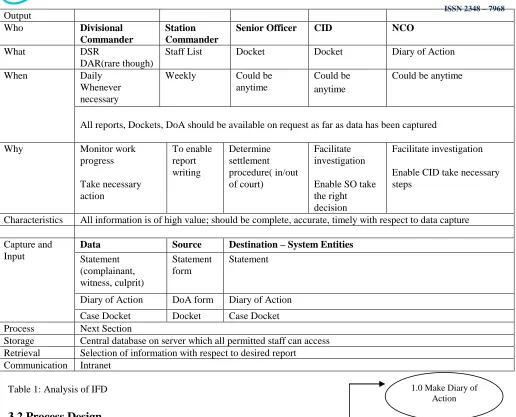
Table 1: Analysis of IFD
3.2 Process Design
Capture: Receiving statements
Input: Typing details into relevant database Storage: Saving to commit data into database Processes: Computerisation of all processes
Output: Desired output would initiate or integrate relevant processes to be generated
3.3 Conceptual Process Model
This is a model of what the new system should be in concept.
Fig. 3: Conceptual Process Model Output
Who Divisional
Commander
Station Commander
Senior Officer CID NCO
What DSR
DAR(rare though)
Staff List Docket Docket Diary of Action
When Daily
Whenever necessary
Weekly Could be anytime
Could be anytime
Could be anytime
All reports, Dockets, DoA should be available on request as far as data has been captured
Why Monitor work
progress
Take necessary action
To enable report writing
Determine settlement procedure( in/out of court)
Facilitate investigation
Enable SO take the right decision
Facilitate investigation
Enable CID take necessary steps
Characteristics All information is of high value; should be complete, accurate, timely with respect to data capture
Capture and Input
Data Source Destination – System Entities
Statement (complainant, witness, culprit)
Statement form
Statement
Diary of Action DoA form Diary of Action
Case Docket Docket Case Docket Process Next Section
Storage Central database on server which all permitted staff can access Retrieval Selection of information with respect to desired report Communication Intranet
1.0 Make Diary of Action
2.0 Make Docket
3.0 Process Docket
ISSN 2348 – 7968
3.4 Data Flow Diagram
Fig. 4: DFD
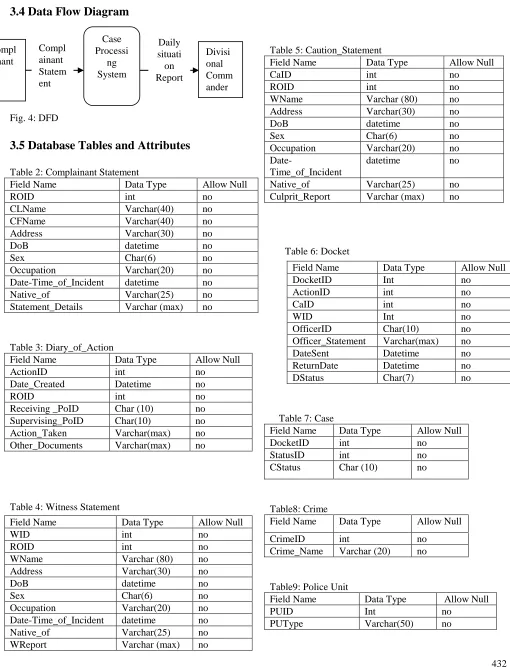
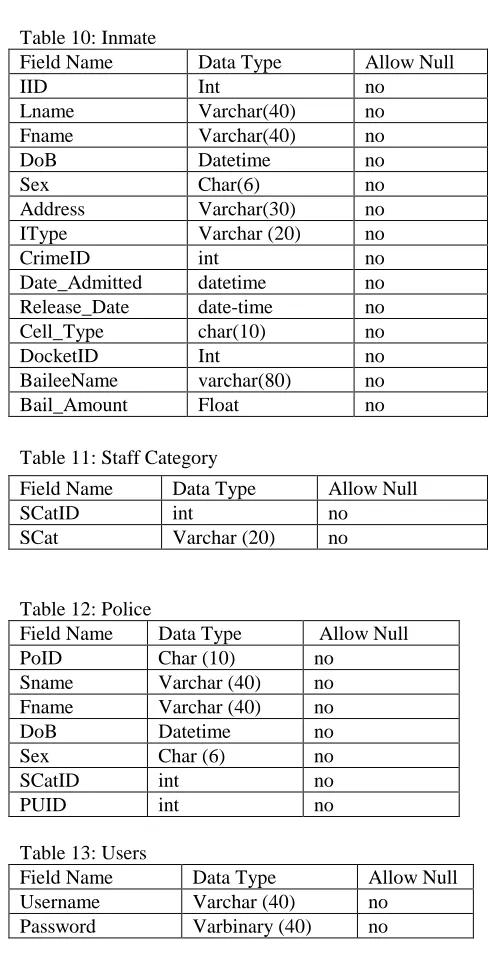
3.5 Database Tables and Attributes
Table 2: Complainant Statement
Field Name Data Type Allow Null
ROID int no
CLName Varchar(40) no
CFName Varchar(40) no
Address Varchar(30) no
DoB datetime no
Sex Char(6) no
Occupation Varchar(20) no
Date-Time_of_Incident datetime no
Native_of Varchar(25) no
Statement_Details Varchar (max) no
Table 3: Diary_of_Action
Field Name Data Type Allow Null
ActionID int no
Date_Created Datetime no
ROID int no
Receiving _PoID Char (10) no Supervising_PoID Char(10) no Action_Taken Varchar(max) no Other_Documents Varchar(max) no
Table 4: Witness Statement
Table 5: Caution_Statement
Field Name Data Type Allow Null
CaID int no
ROID int no
WName Varchar (80) no
Address Varchar(30) no
DoB datetime no
Sex Char(6) no
Occupation Varchar(20) no
Date-Time_of_Incident
datetime no
Native_of Varchar(25) no
Culprit_Report Varchar (max) no
Table 6: Docket
Table 7: Case
Field Name Data Type Allow Null
DocketID int no
StatusID int no
CStatus Char (10) no
Table8: Crime
Field Name Data Type Allow Null
CrimeID int no
Crime_Name Varchar (20) no
Table9: Police Unit
Field Name Data Type Allow Null
PUID Int no
PUType Varchar(50) no
Field Name Data Type Allow Null
WID int no
ROID int no
WName Varchar (80) no
Address Varchar(30) no
DoB datetime no
Sex Char(6) no
Occupation Varchar(20) no
Date-Time_of_Incident datetime no
Native_of Varchar(25) no
WReport Varchar (max) no
Field Name Data Type Allow Null
DocketID Int no
ActionID int no
CaID int no
WID Int no
OfficerID Char(10) no
Officer_Statement Varchar(max) no
DateSent Datetime no
ReturnDate Datetime no
DStatus Char(7) no
Compl ainant
Case Processi
ng System
Divisi onal Comm ander Compl
ainant Statem ent
Daily situati on Report
ISSN 2348 – 7968
Table 10: Inmate
Field Name Data Type Allow Null
IID Int no
Lname Varchar(40) no
Fname Varchar(40) no
DoB Datetime no
Sex Char(6) no
Address Varchar(30) no
IType Varchar (20) no
CrimeID int no
Date_Admitted datetime no Release_Date date-time no
Cell_Type char(10) no
DocketID Int no
BaileeName varchar(80) no
Bail_Amount Float no
Table 11: Staff Category
Table 12: Police
Field Name Data Type Allow Null
PoID Char (10) no
Sname Varchar (40) no Fname Varchar (40) no
DoB Datetime no
Sex Char (6) no
SCatID int no
PUID int no
Table 13: Users
Field Name Data Type Allow Null Username Varchar (40) no
Password Varbinary (40) no Field Name Data Type Allow Null
SCatID int no
ISSN 2348 – 7968
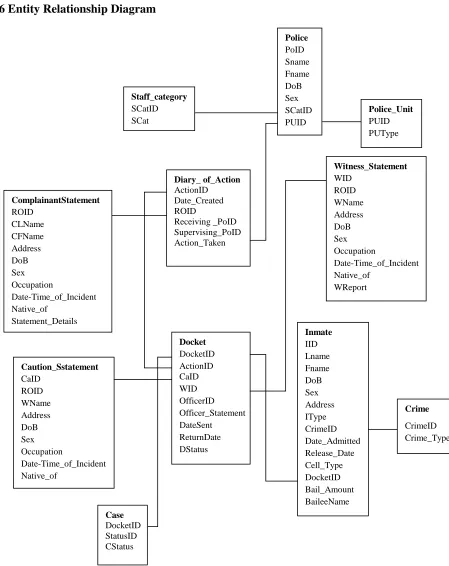
3.6 Entity Relationship Diagram
Fig. 5: ERD
Witness_Statement WID
ROID WName Address DoB Sex Occupation
Date-Time_of_Incident Native_of
WReport
Docket DocketID ActionID CaID WID OfficerID Officer_Statement DateSent ReturnDate DStatus
Case DocketID StatusID CStatus
Crime
CrimeID Crime_Type Inmate
IID Lname Fname DoB Sex Address IType CrimeID Date_Admitted Release_Date Cell_Type DocketID Bail_Amount BaileeName Police
PoID Sname Fname DoB Sex SCatID PUID Staff_category
SCatID SCat
Police_Unit PUID PUType
Diary_ of_Action ActionID Date_Created ROID
Receiving _PoID Supervising_PoID Action_Taken ComplainantStatement
ROID CLName CFName Address DoB Sex Occupation
Date-Time_of_Incident Native_of
Statement_Details
Caution_Sstatement CaID
ROID WName Address DoB Sex Occupation
Date-Time_of_Incident Native_of
ISSN 2348 – 7968
Conclusion
There is a real need for a design of a case processing system for a country like Ghana. The Police Stations in Ghana still run a paper-based system which creates room for delays in the dispensation of justice. With such a design, data needed for processing a case are obtained with ease. This designed system can bring about a change in the way cases are handled at the police station. It is to enable quick report creation for the officer in charge to execute the right actions leading to the settlement of a case.
References
[1] R. Boateng, CCC Database Management System (CBASE) Project, 2003/4.
[2] J. Kasprzak, The Use of SGML for a Police Information System, Luxembourg.
[4] A. Molla, and R. Heeks, Introducing Information Systems in Organisations Handout 2: IS Project Assessment’, Course Handout, IDPM, University of Manchester, Manchester, 2004.
[5] E. Owusu-Oware, Contemporary Application Development Handout, 2009.
[6] J.B. Pokoo-Aikins, The Police in Ghana 1939–1999,
Accra, 2002.
[7] ‘Criminal Code, 1960 (ACT 29), Acts of Ghana’. [8] ‘Ghana Police Service Instructions’.
[9] ‘What is CATWOE Analysis?’
http://bpmgeek.com/blog/what-catwoe-analysis. Accessed: 01/12/13.
[10]http//:www.ghanapolice.info, Accessed: 01/11/13. [11]
http://www.ghana.gov.gh/index.php/public-service-directory/624-ghana-police-service. Accessed: 30/11/13.
[12] http://www.eservices.gov.gh/GPS/SitePages/GPS-Home.aspx. Accessed: 30/11/13.