ISSN (Print) : 2320 – 3765 ISSN (Online): 2278 – 8875
I
nternational
J
ournal of
A
dvanced
R
esearch in
E
lectrical,
E
lectronics and
I
nstrumentation
E
ngineering
(An ISO 3297: 2007 Certified Organization)
Vol. 5, Issue 7, July 2016
Designing and Simulation of a Novel
Multiband Antenna for Wireless
Communication
Payal Jain1, Rajeev Mathur2
PG Student, Department of ECE, Geetanjali Institute of Technical Studies, Dabok Udaipur, (Raj.), India1
Research Scholar, SGVU, Jaipur, India 2
ABSTRACT: An antenna is the most important element of any wireless communication. Various antennas for wide band operation have been studied & designed for communication. In this paper, a multibandmicrostrip patch with simple strip line feeding is proposed to support different wireless application. The antenna is fabricated on a FR4 substrate. To obtain multiple bands, multiple square slots are provided with the rectangular patch. The performance of the proposed antenna design is analysed with HFSS(High Frequency Structure Simulator). The relevant antenna performance parameters of the proposed design viz. resonant bands, return loss, gain, and radiation pattern are reported and discussed. The VSWR of the antenna is less than 2 for seven resonant bands in the vicinity of 1.48 GHz, 1.89 GHz, 2.06 GHz ,3.47 GHz, 4.47 GHz, 4.86 GHz and 5.31 GHz. The performance results exhibited by the proposed antenna make it extremely useful for the future generation of wireless broadband communication systems.
KEYWORDS: Microstrip, Broadband antenna, Multiband antenna, Square shaped.
I.INTRODUCTION
In any communication system, antenna is the most important components. A microstrip antenna contains very extensive applications in recent times because of its light weight, small size, easy reproduction and integration ability with the circuitry.The rapid development of electronics and wirelesscommunications led to great demand for wireless devices that can operate at different standards such as the universal mobile telecommunications system UMTS, Bluetooth, wireless local-area network (WLAN) and also satellite communications. Compact small size is a demand factor for several applications as mobile devices. This requirements have triggered research on the design of compact and single or multiband antennas operation [5]. Microstrip patch antennas are widely used because of their many merits, such as the low profile, light weight and conformity. However, patch antennas have a main disadvantage: narrow bandwidth. Researchers have made many efforts to overcome this problem and many configurations have been presented to extend the bandwidth [6]. Microstrip patch antennas are widely used in wireless devices and other compact sizes with multiband antenna operation.
In this paper, a novel microstrip radiating patch with square slots are proposed.
II.ANTENNA DESIGN
The main objective of our work is to design a square shaped antenna which will be small in size and exhibits multiband
performance. The transmission line model represents the microstrip antenna by two slots each of width W and height h
separated by low-impedance Zctransmission line of length L. The essential parameters for the design an antenna according the transmission line method are; dielectric constant of the substrate (ɛr), resonant frequency (fr), loss
tangent(δ) and theheight of substrate h. The conventional microstrip rectangular patch antenna is designed by following the standard procedures.
(1) Calculation of the width W of antenna, which is given by:
ISSN (Print) : 2320 – 3765 ISSN (Online): 2278 – 8875
I
nternational
J
ournal of
A
dvanced
R
esearch in
E
lectrical,
E
lectronics and
I
nstrumentation
E
ngineering
(An ISO 3297: 2007 Certified Organization)
Vol. 5, Issue 7, July 2016
Where vois the free-space velocity of light.
(2) Calculation of effective dielectric constant, ɛreff, which is given by:
ɛreff= + [1+12 ]- (2)
(3) Calculation of the effective length, Leff, which is given by:
Leff= √ (3)
(4) Calculation of the length extension ∆L, which is given by:
∆L=0.412h(ɛ . )( . )
(ɛ . )( . ) (4)
(5) Calculation of actual length of patch, L which is given by:
L=Leff–2∆L (5)
The parameters taken into account for the design are the resonant frequency (fr= 2.4GHz), dielectric constant (ɛr= 4.4)
and thickness of the Substrate (h = 1.588 mm). The conventional patch antenna is shown in Fig. 1 with dimensions.
37mm
28mm
Fig. 1.Conventional Rectangular Microstrip Patch Antenna
ISSN (Print) : 2320 – 3765 ISSN (Online): 2278 – 8875
I
nternational
J
ournal of
A
dvanced
R
esearch in
E
lectrical,
E
lectronics and
I
nstrumentation
E
ngineering
(An ISO 3297: 2007 Certified Organization)
Vol. 5, Issue 7, July 2016
III. SIMULATION RESULTS AND DISCUSSION
The proposed antenna is designed and simulated on commercially available softwareHFSS 12.1, which is very good
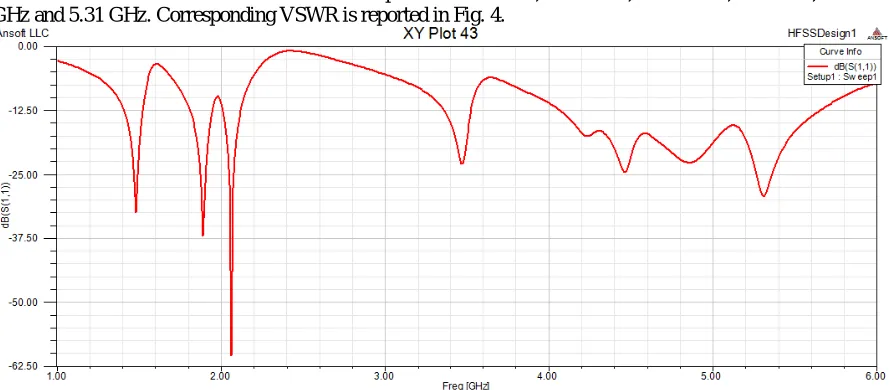
simulator for antennas. Return Loss (S11) plot of this antenna is as shown in Fig. 3. We observed seven resonant bands
which have less then 10dB return loss i.eat frequencies 1.48 GHz, 1.89 GHz, 2.06 GHz ,3.47 GHz, 4.47 GHz, 4.86 GHz and 5.31 GHz. Corresponding VSWR is reported in Fig. 4.
Fig. 3.Return Loss (s11) of antenna
Fig. 4.VSWR of antenna
1.00 2.00 3.00 4.00 5.00 6.00
Freq [GHz] 0.00
5.00 10.00 15.00 20.00 25.00 30.00
d
B
(V
S
W
R
(1
))
Ansoft LLC XY Plot 46 HFSSDesign1 ANSOFT
ISSN (Print) : 2320 – 3765 ISSN (Online): 2278 – 8875
I
nternational
J
ournal of
A
dvanced
R
esearch in
E
lectrical,
E
lectronics and
I
nstrumentation
E
ngineering
(An ISO 3297: 2007 Certified Organization)
Vol. 5, Issue 7, July 2016
Table 1 shows values of Return Loss (S11) and VSWR in dB fordifferent bands with their frequency.
TABLE 1 Simulation Results
S.N. Freq S11 VSWR
I. 1.48 -32.4 0.41
II. 1.89 -36.9 0.54
III. 2.06 -60.3 0.01
IV. 3.47 -22.9 1.24
V. 4.47 -24.5 1.02
VI. 4.86 -22.7 1.29
VII. 5.31 -29.2 0.63
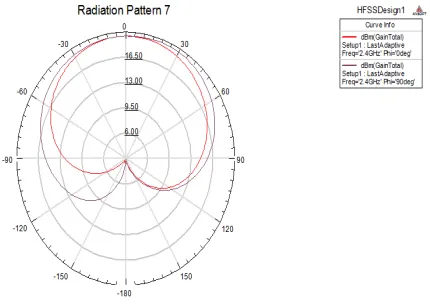
Radiation pattern of the proposed antenna is as shown in the Fig. 5. A high gain of 16dbm has been observed. This antenna gives omnidirectional pattern in azimuth plane and direction pattern of high beamwidth in elevation plane.It is thus deduced that this antenna could be a very good candidate for advanced wireless application.
Fig. 5.Radiation Pattern of 2nd iteration Fractal Antenna
ISSN (Print) : 2320 – 3765 ISSN (Online): 2278 – 8875
I
nternational
J
ournal of
A
dvanced
R
esearch in
E
lectrical,
E
lectronics and
I
nstrumentation
E
ngineering
(An ISO 3297: 2007 Certified Organization)
Vol. 5, Issue 7, July 2016
IV. CONCLUSIONS
In this paper, a novel multiband antenna is designed. Seven resonant bands have been obtained for this antenna i.e. at frequencies 1.48 GHz, 1.89 GHz, 2.06 GHz ,3.47 GHz, 4.47 GHz, 4.86 GHz and 5.31 GHz. The VSWR of the designed antenna is less than 2 for all the bands above.Gain of this antenna is also more than 16dBm for frequency of 2.4 GHz. A Significant enhancement in the impedance bandwidth is observed at frequency from 3.30GHz to 3.54GHz i.e. 240 MHZ. However at frequency 3.97GHz to 5.79GH the bandwidth is 1820 MHz.As clearly seen from the results this antenna could be a good candidate for wireless mobile communication, WiMAX application, WiFi services.
V. FUTURE SCOPE
This antenna further can be analysed for MIMO specific applications after finding out correlation co-efficient of array of two or more antenna.
REFERENCES
[1]Rajeev Mathur, Sunil Joshi, “A Novel Multiple Element Patch Antenna for Wireless MIMO Beamforming&WiMAX Applications” presented in
“International Conference on Emerging Trends in Networks and Computer Communications (ETNCC-2011), MPUAT, Udaipur” on 22-23 April 2011, Page(s):110 - 114 and published in IEEE Explorer Digital Library. Print ISBN: 978-1-4577-0239-6 DOI: 10.1109/ETNCC.2011.5958497
[2] Rajeev Mathur, Dr. Sunil Joshi, “Ultra Wideband Antenna Design & Characteristics: A Review” presented in International Conference
organized by “Antenna Measurement & Test Society” and published in proceedings of “AMTS 2011 Ahmedabad” 10-11 Feb 2011.
[3] Rajeev Mathur, Sunil Joshi, Krishna C Roy “A Novel Multiband Koch Loop Antenna Using Fractal Geometry for Wireless Communication
System”AIRCC'sInternational Journal of Wireless & Mobile Networks (IJWMN)Journal, Vol. 3, No. 5, October 2011, PP. 161-172.ISSN :0975-4679e-ISSN:09753834DOI:10.5121/ijwmn.2011.3203
[4]Rajeev Mathur, Sunil Joshi, “Split Ring Array Antenna for WLAN Applications using MIMO Techniques” published in IJCA Special Issue on
Evolution in Networks and Computer communications. http://www.ijcaonline.org/specialissues/encc/number2/3726-encc015. ISBN: 978-93-80864-97-5.
[5] Lui, G. K. H., and Murch, R. D., “Compact dual frequency PIFA Designs using LC resonator," IEEE Trans. Antennas Propag. Vol. 49, pp.1016-1019, 2001.