PRIVACY PROTECTION USING ENCRYPTED IMAGESDr.B Raveendranadh Singh, M.Sangeetha & Addula Sandhya P a g e | 521
Privacy Protection Using Encrypted Images
Dr.B Raveendranadh Singh
1, M.Sangeetha
2& Addula Sandhya
31Principal, Prof. in CSE
Visvesvaraya College of Engineering and Technology,
M.P Patelguda, Ibrahimpatnam (M), RangaReddy (D)-501510, India
Email:[email protected]
2Head of the Dept,
Department of Computer Science & Engineering
Assoc.Professor (CSE), Visvesvaraya College of Engineering and Technology, M.P Patelguda, Ibrahimpatnam (M), Ranga Reddy (D)-501510, India
Email:[email protected]
3M.Tech Student, Department of Computer Science & Engineering,
Visvesvaraya College of Engineering and Technology,
M.P Patelguda, Ibrahimpatnam (M), Ranga Reddy (D)-501510, India
Email: [email protected]
Abstract—
Privacy has got considerable attention but is still there is a problem inside multimedia local community. Consider some sort of cloud research scenario the spot that the server can be resource-abundant, and is also capable regarding finishing the particular designated duties. It can be envisioned in which secure advertising applications using privacy preservation is going to be treated seriously. In view that the scale-invariant characteristic transform (SIFT) has become widely adopted in several fields, this project may be the first to the fact that privacy-preserving SORT (PPSIFT) and to address the condition of safeguarded SIFT characteristic extraction and also representation inside encrypted domain.
Keywords— Feature Extraction, Privacy Preservation, Security
Introduction
PRIVACY PROTECTION USING ENCRYPTED IMAGESDr.B Raveendranadh Singh, M.Sangeetha & Addula Sandhya P a g e | 522
but has a very interactive mechanism. This scenario is comparable to cloud computing and is particularly of useful use intended for multimedia info that demand immense computation and transmission. Under these kinds of framework, the transmitting of individual data in addition to permission on the server throughout accessing your stored info pose the challenge of privacy-preserving which is usually ignored inside multimedia neighborhood.
Although encryption is really a prevalent approach to securing transmitted data, the information in your encrypted form (i.e electronic., ciphertext) can impede operations which are usually conducted for the plaintexts. As a way to further procedure ciphertexts and have the corresponding leads to the plaintext domain, some studies have been devoted to several aspects involving encrypted domain operations. Only recently, secure word document search inside encrypted domain has become extended for you to secure multimedia systems data look for. While these studies have been done with content-based multimedia systems retrieval over either encrypted query, or the two encrypted query and databases, the applicable scale-invariant function transform (SIFT) conducted inside encrypted domain still will never be addressed. In below are a few, we can target benefit of privacy-preserving SORT (PPSIFT) in addition to explore its broad software. SIFT is surely an algorithm intended for detecting in addition to describing regional features throughout images, and contains been traditionally used in the community of computer vision in addition to pattern recognition automobile powerful attack-resilient function point discovery mechanism.
The contributions in this project throughout realizing comfort preserving SORT are summarized as follows. The Difference-of-Gaussian (DoG) transform has to be executed inside encrypted
domain. We look into how Doggy transform can be performed within your Paillier cryptosystem, that's associated with the error chance analysis. Our setup of DoG inside encrypted domain is analog for you to implementations involving DCT in addition to DWT inside encrypted domain. We provide a homomorphic comparability strategy that can be conducted inside encrypted domain to ensure local extrema might be securely diagnosed for SORT feature place extraction. PPSIFT has the ability to achieve regional extrema extraction, descriptor working out, and descriptor related, all inside encrypted domain, without numerous rounds involving communication between your user in addition to server. On the other hand, only one-round involving pre-communication is important for synchronization involving data. PPSIFT has become evaluated to uncover its fineness in accomplishing both comfort and robustness within benchmark violence and datasets, in comparison with the authentic SIFT
Previous Work
In the last decade biometric detection and validation has increasingly gained importance for a variety of endeavour, resident and law enforcement applications. Illustrations vary from mark on finger and retinal scan systems, to voice and face recognition systems etc. Many governments have already proposed electronic passports and IDs that contain biometric information of their legal holders[7]. In particular it seems that face detection systems have fashionable and aimed to be installed in observation of public places, access and border control at airports. For some of these use cases one needs online search with short response and least amount of online transmission [6].
PRIVACY PROTECTION USING ENCRYPTED IMAGESDr.B Raveendranadh Singh, M.Sangeetha & Addula Sandhya P a g e | 523
public network platforms such as Face book which have become popular to share photos with the people in our world. These platforms support automatic detection and tagging of face in uploaded images[7]. Additionally, images can be tagged universally. The widespread use of such face recognition systems, however, raises privacy risks since biometric information can be collected and misused such as tracking against one`s will. These issues raise the desire to construct privacy-preserving face recognition systems[1]
Reversed Index Encryption: Since the vocabulary tree is created by and thus known to the service provider, proper encryption of the inverted indexes generated by the content owner is needed. Otherwise, the server can look up the visual words present in each image from the word IDs, and thus infer the image content. We protect the inverted index by first performing a random permutation on the word IDs so that the ith word will now have an ID. Computing random permutation takes O(N) time and needs to be done only once on the user side. However, the server needs to guess the correct IDs from O(N!) possibilities, which is computationally infeasible given the typically large value of N. Scrambling word IDs alone is not secure enough, because the server can still use visual word frequencies to identify the words that appear more frequently. [2]
Recently, people are getting used to accessing and querying multimedia data on a server due to the increase of bandwidth capacity over the Internet. In addition, if the remote server has strong computation/storage capability with abundant resources, the users can store their data on the server side and exploit the computation power provided by the server to execute their intended tasks. Under this circumstance, Web not only provides passive search service but also is equipped with high interactive mechanism. This scenario is analogous to cloud
computing, and is of practical use for multimedia data that demand immense computation and communication.
Under this kind of framework, the transmission of personal data and permission of the server in accessing the stored data, however, create the privacy issue that is usually ignored in the multimedia community. Although encryption is a prevalent way in securing the transmitted data, the data in the encryption form (i.e., cipher text) will impede the operations that are usually conducted on the plaintexts. In order to further process cipher texts and obtain the corresponding results in the plaintext domain, some studies have devoted to encrypted domain operations on several aspects. [3]
In order to execute SIFT in a cipher text domain and still obtain results equivalent to those generated in the corresponding plaintext domain, the prerequisite is to seek a cryptosystem that can provide the required operations, such as addition, multiplication, and so on. In the original SIFT, in addition to common additive and multiplicative operations, the comparison operation is a must for finishing feature point detection. Nevertheless, the design of a cryptosystem that can possess homomorphic comparison is still a challenging issue. Therefore, our goal is to seek a cryptosystem that can provide additive and multiplicative homomorphism, and develop a new approach to achieve homomorphic comparison
∗
.PRIVACY PROTECTION USING ENCRYPTED IMAGESDr.B Raveendranadh Singh, M.Sangeetha & Addula Sandhya P a g e | 524
computationally comparable to RSA. In fact, Paillier cryptosystem has been widely adopted in various applications. Some recent promising privacy-preserving applications include secure transform, face recognition, secure watermark detection, sensor network surveillance, and secure distortion computation. [3]
In SIFT detection, a key point is a pixel if and only if it is a local extreme in the scale space defined by difference-of-Gaussian (DoG) functions. A local extremism at a pixel is found if its DoG magnitude is larger than those of its neighbours. The idea behind our method is based on the observation that an original key point will not be detected by SIFT if another extremism is maliciously generated to hand[8]. In other words, there are two equal extreme in a finding region such that the duplicate extremism is enforced to be at one of the eight neighbours in the scale space to evade key point recognition[8].
Currently having solutions for protect signal modifications use cryptographic primitives in order to construct a protected layer on top of the processing signal modules. This approach is represented with An example by the encryption of compressed multimedia signals: the multimedia content is first of all compressed through a state-of-the-art compression scheme, and next encryption of the compressed bit stream is carried out[8]. Therefore. The content can be processed before the bit stream must be decrypted. These results typically assume that the involved parties or devices[9] faith on all, and thus cryptography is used only to keep the data safe against third parties or to provide authenticity. Unfortunately, this may not be sufficient in some applications, since the owner of the data may haven’t hope the dispensation devices, or those factors that are required to manipulate them. As a first example, let us consider a situation where a user (say Alice) resorts to a continuous monitoring healthcare system
to analyse her medical/biological data in order to get a fast pre alert diagnosis helping her to stay healthy[8]. Moreover she will not trust the service provider that will be required to analyse Alice’s data while they are encrypted[8]. On other side, they represent processing algorithms for its business to keep secret by the service provider
As a second example, we may consider a situation where a user wants to query a database (e.g. a database containing biometric data) without revealing to the database owner (say Bob) what he/she is looking for (again this necessity may be due to privacy reasons)[8]. It is evident that the availability of tools that allow to process an encrypted query would represent a valuable help to solve this obstacle. [5]
Proposed System
A. Cryptosystem Using Paillier Method
PRIVACY PROTECTION USING ENCRYPTED IMAGESDr.B Raveendranadh Singh, M.Sangeetha & Addula Sandhya P a g e | 525
modulo. We additionally select grams Z∗N to satisfy gcd and also λ = lcm(p − 1, q − 1) could be the private key. The couple of N and also g defines people keys. Allow message for being encrypted always be denoted since m. The ciphertext springs with your uniformly decided on key and also integer amounts modulo is required. Decrypting your ciphertext h, we make use of the private key λ and acquire the plaintext l..
B. Encryption By Gaussian
In this particular module initial step on the SIFT framework for taking out the element points would be to execute Difference-of-Gaussian turns. For this, the image is convolved along with Gaussian filters, which are assigned unique variances equivalent to weighing machines, and this differences in between two neighboring Gaussian-blurred photographs are taken. Feature things are then chosen because local extrema on the DoG photographs, which come about at a number of scales. Especially, a Canine image made at 2 neighboring weighing machines ρi and also ρj. To be able to preserve this users privateness, the image I is usually encrypted utilizing homomorphic encryption. This resultant encrypted information are portrayed as: Ie(x, y) where by E means the Paillier cryptosystem and also r could be the uniformly chosen key. Pertaining to implementation, the first Gaussian filtering coefficients are adjusted because integers considering that the Paillier cryptosystem can only operate inside the integer website.
C. Feature Point Detection
In this particular module the particular challenging task may be the local extrema removal operating within the encrypted sector. The uniformly chosen crucial r should be variable in order to meet semantic security. Under this particular circumstance, provided the plaintext meters, the resulting ciphertexts c’s will change according towards used
individual keys r’s, resulting in one-to-many mapping. In the two-dimensional situation, like the particular images regarded here, the particular uniformly chosen key, influenced by the location of your pixel, is needed. Hence, a Canine image within the encrypted sector using various r’s could be derived that is a function on the uniformly chosen key r that may be dependent on a pixel’s position (x, y). Since the particular Gaussian kernel H is mixed up in calculation associated with Rρ, we know that Rρ is dependent upon the support of G() instead of the image dimension. In the particular proposed technique, in addition towards encrypted query data, the extra data would have to be sent to server with regard to subsequent privacy-preserving processing would be the secure thresholds To ’s..
D. Feature Point Descriptor
PRIVACY PROTECTION USING ENCRYPTED IMAGESDr.B Raveendranadh Singh, M.Sangeetha & Addula Sandhya P a g e | 526
vector. Since quite a total involving sixteen four × four blocks in a very 16×16 area, a 64-dimensional function descriptor is made. It need to be noted that no more than four hard to follow directions are used in this project as the operation from the secure intrinsic product5 is necessary to derive the actual included angle using the two sides not both equally coinciding using the x in addition to y axes..
Results
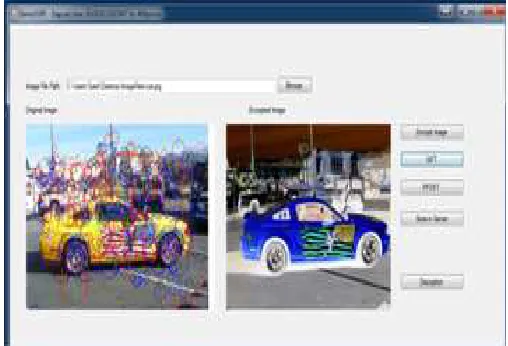
This paper is implemented in the fallowing concept and different results are shown as fallowing, The proposed paper is implemented in .Net on a P-4 System with least of 25 GB Memory and 1.5GB Random Access Memory. The propose paper’s concepts give accurate results and has been efficiently tested on different Image Datasets.
Fig 1
Fig. 1 Data Set for Proposed system
Fig. 1 Proposed system performing Privacy
Fig. 3 Features of Original Image
Fig. 4 Comparative Features of Original and Privacy Image
Conclusions
PRIVACY PROTECTION USING ENCRYPTED IMAGESDr.B Raveendranadh Singh, M.Sangeetha & Addula Sandhya P a g e | 527
complexity needs to be further lessened, even when the current method is built to be executed within the server part that are the owners of powerful methods. We think that the offered work is definitely an important step toward privacy-preserving multimedia applications within an environment where by privacy is really a major concern.
References
[1] W. Lu, A. Swaminathan, A. L. Varna, and M. Wu, “Enabling search over encrypted multimedia databases,” Proc. SPIE, vol. 7254, pp. 1–11, Jan. 2009.
[2] J. Shashank, P. Kowshik, K. Srinathan, and C. Jawahar, “Private content based image retrieval,” in
Proc. IEEE Conf. Comput. Vis. Pattern Recognit.,
Jun. 2008, pp. 1–8.
[3] C. Y. Hsu, C. S. Lu, and S. C. Pei, “Homomorphic encryption-based secure sift for privacy-preserving feature extraction,” Proc. IS&T/SPIE Media Watermark., Forensics, Security,
vol. 7880, pp. 788005-1– 788005-17, Jan. 2011. [4] Z. Yang, S. Kamata, and A. Ahrary, “NIR: Content based image retrieval on cloud computing,” in Proc. IEEE Int. Conf. Intell. Comput. Intell. Syst., vol. 3. Nov. 2009, pp. 556–559. [5] B. Moskovich and M. Osadchy, “Illumination invariant representation for privacy preserving face identification,” in Proc. IEEE Comput. Vis. Pattern
Recognit. Workshop, Jun. 2010, pp. 154–161.
[6]kede ma, weiming zhang, xianfeng zhao, member, ieee, nenghai yu, and fenghua li “reversible data hiding in encrypted images byReserving room before encryption” ieee transactions on information forensics and security, vol. 8, no. 3, march 2013 [7] Ahmad-Reza Sadeghi, Thomas Schneider, and Immo Wehrenberg
Horst G¨ortz Institute for IT-Security, Ruhr-University Bochum, Germany
{ahmad.sadeghi,thomas.schneider}@trust.rub.de??, [email protected]
[8] Tiziano Bianchi, Member, IEEE, Alessandro Piva, Member, IEEE, and Mauro Barni, Senior Member, IEEE
[9] Chao-Yung Hsu,1,2 Chun-Shien Lu,2,∗ and Soo-Chang Pei 11Graduate Institute of Communication Eng., National Taiwan University, Taipei, Taiwan, ROC
PRIVACY PROTECTION USING ENCRYPTED IMAGESDr.B Raveendranadh Singh, M.Sangeetha & Addula Sandhya P a g e | 528
Authors Biography
Sri. Dr. Bhaludra Raveendranadh Singh
M.Tech,Ph.D.(CSE),MISTE,MIEEE(USA),MCSI Principal.He obtained M.Tech,
Ph.D(CSE)., is a young, decent, dynamic
Renowned Educationist and Eminent Academician, has overall 20 years of teaching experience in different capacities. He is a life member of CSI, ISTE and also a member of IEEE (USA). For his credit he has more than 50 Research papers published in Inter National and National Journals. He has conducted various seminars, workshops and has participated several National Conferences and International Conferences. He has developed a passion towards building up of young Engineering Scholars and guided more than 300 Scholars at Under Graduate Level and Post Graduate Level. His meticulous planning and sound understanding of administrative issues made him a successful person.
M.Sangeetha
M.Tech(CSE), Head of the Dept,Department of Computer Science & Engineering, Assoc.Professor(CSE).
Professor and Head of CSE
department,completed bachelor of technology from Swamy Ramananda Theertha Institute of Science & Technology and Post-graduation from Jawaharlal Nehru Technological University, Kakinada campus and is having 12 years of teaching experience. She also published technical papers in various National & Inter National Journals.
Addula Sandhya
M. Tech Scholar, Department of Computer Science & Engineering,Visvesvaraya College of Engineering and Technology,
M.P Patelguda, Ibrahimpatnam(M), RangaReddy(D)-501510.
Email: [email protected]