ISSN 2286-4822
www.euacademic.org DRJI Value: 5.9 (B+)
Evaluation of the Philippine Expanded Senior
Citizens Act (RA 9994) on Mandated Privileges for
the Elderly
APRIL KYLE A. INABANGAN1
Instructor, College of Nursing, Cebu Normal University Cebu City, Philippines
LAURENCE L. GARCIA2
Associate Professor, College of Nursing, Cebu Normal University Cebu City, Philippines
FERDINAND T. ABOCEJO3
Associate Professor, Graduate School Eastern Visayas State University Tacloban City, Philippines
Abstract
This study examined how the Philippine government implemented Republic Act 9994 known as the “Expanded Senior Citizen’s Act” of 2010. It evaluated the compliance of concerned establishments on selected privileges accrued to Filipino senior citizens. We employed the Provus discrepancy model (PDM) in the evaluation and analysis of gathered data. Thirty senior citizens from Cebu City, Philippines were identified as respondents and twenty establishments were surveyed. A content-validated semi-structured interview guide was used to gather the needed data from both groups.
1April Kyle A. Inabangan is a faculty member of the College of Nursing, Cebu Normal University (CNU), Cebu
City, Philippines. She is a duly licensed and a professional nurse who currently teaches in the undergraduate level. Her recent publication and conducted researchers are focused on the different aspects of gerontology nursing.
2Laurence L. Garcia is a faculty member of the College of Nursing, Cebu Normal University (CNU), Cebu City,
Philippines. His works centred on mental health and care of the older persons. His focus is on understanding human behaviour throughout life, inspired by his exposure to people of different ages from his childhood to the present. Currently, he is the Director of the Centre for Research and Development (CRD) and the Research Institute for Ageing and Health (RIAH).
3Ferdinand T. Abocejo is an Associate Professor of Eastern Visayas State University (EVSU) in Tacloban City,
Findings revealed discrepancy along the process of policy dissemination and implementation, notably among hospitals, grocery stores and in the transport sector. Documents such as administrative orders (AOs) and memorandum circulars furnished to concerned government agencies were not effectively disseminated to the elderly senior citizens as intended beneficiaries of RA 9994. Even if concerned establishments were compliant in giving the mandated discounts, Filipino values and cultural background such as jackpot mentality and shyness among senior citizens casted shadows in the implementation of the law. The implementing establishments like pharmacies and restaurants enjoyed the value added tax (VAT) exemptions upon compliance to the law, while no benefit was afforded for compliant hospitals, grocery stores and those in the transport sector. Still, crucial issues concerning implementation of the law persist until the present. In conclusion, the implementation of the RA 9994 was effective at the establishments’ level with no discrepancy between mandated and provided benefits to senior citizens. However, there is no clear provision in the law which is silent about the derivable benefits accrued to establishment implementers particularly among public utility jeepneys and taxicab drivers.
Key words: Senior citizens, senior citizen, Republic Act 9994, 20 percent discount privilege, 5 percent VAT exemption, Provus discrepancy model
1: INTRODUCTION
(United Nations Population Fund, 2012). With the challenges faced by the elderly, the Philippine government implemented laws to help senior citizens (Philippines Statistics Authority, 2012; Garcia, 2013). However, several issues abound concerning the implementation of the law. Less privileged individuals are more prone to discrimination whose access to social resources are limited with large variations among social groups (Abocejo and Gubalane, 2013; Almazan et al., 2018; Abocejo et al., 2012). In 2010, the Philippine government amended Republic Act (RA) No. 7432 to RA 9994 or the Expanded Senior Citizens Act of 2010 (Government of the Philippines [GOP-RA 9994], 2010). RA 9994 aims to provide more benefits to the elderly and deliver full support to their well-being as integral members of Philippine society. These benefits include discounts in medicines, ailment treatments, professional fees, basic commodities, among others. Philippines is one of the 21 countries worldwide that have implemented age-specific policies and one of the 12 countries which passed national laws concerning the elderly (United Nations Population Fund, 2012, Philippine Statistics Authority, 2012). In spite of the aim to provide benefits to the elderly, issues concerning their benefits still abound.
private hospitals and health service care providers (Garcia, 2018)
Transportation is also covered by 20 percent discount which includes public utility jeepneys (Arnado, Gogo and Abocejo, 2017), public utility vehicles, taxicabs, domestic sea fare and domestic air fare. The elderly can also avail of 20 percent discount in restaurants, hotels, recreational centres and places of leisure (GOP-RA 9994, 2010). Besides, an elderly can avail of five percent discount on basic necessities, prime commodities and discount in their monthly water and electricity bills given that they are supplied by public utilities and they qualify to the criteria set under RA 9994 (Garcia, 2013).
In this study, we evaluated the implementation of the RA 9994 by assessing the implementation of the law in view of the selected privileges afforded to senior citizens following the Provus discrepancy model [PDM] (Provus, as cited in Lindahl and Beach, 2013). We argued that implementation of the law (RA 9994) brings about positive and favourable changes in the quality of life of Filipinos whom the government commits to provide optimum access to resources in their late stage of life.
1.1: Study Objectives
The study evaluated the implementation of the Expanded Senior Citizen Act of 2010 (RA 9994) on selected privileges of senior citizen following the Provus discrepancy model (PDM). It also investigated the extent of compliance of establishments, assessed policy dissemination, benefits and discrepancies on the mandates of RA 9994.
2: REVIEW OF LITERATURE
products (Salenga, Loquias, and Sarol, 2016). It is noted that 75 percent of surveyed drug outlets claimed to have provided the mandated discount provision while half claimed to have provided the 12 percent VAT exemption (Salenga et al., 2016). Problems in the implementation were experienced when elderly citizens were not able to take advantage of the law because of their lack of awareness (Haber, Lobiondo-Wood, 2002) or noncompliance of drug outlets (Government of the Philippines-Implementing Rules and Regulation of RA 9994 [GOP-IRR of RA 9994], 2010; Alvarez, Ong, and Abocejo, 2017).
As stipulated, RA 9994 provides more benefits and privileges to senior citizens affording them benefits such as 20 percent discount and VAT exemption on purchases of medicines, vaccines, essential medical supplies, accessories and equipment as determined by the Department of Health (GOP-IRR of RA 9994). The law applies to physician’s professional fees and services which can be availed in private hospitals including laboratory, diagnostic, medical and dental services, out-patient check-up fee and home health care services (GOP-RA 9994, 2010). The law also covers the transportation sector, specifically for domestic air, sea and land fares. It also include discount for leisure activities such as hotel accommodations, admission fees in theatres, cinema houses, among others (GOP-RA 9994, 2010).
meter; and (3) five percent discount applies regardless of the number of elderly citizens in the household (GOP-RA 9994, 2010).
They can also avail the same discount for prime commodities and basic necessities determined by the Department of Trade and Industry (DTI) and the Department of Agriculture (DA) in accordance with the RA 7581 or the Price Act (Department of Trade and Industry, 2010). These basic necessities include fresh and canned marine products, fruits, vegetables and all drugs not classified as essential drugs.
RA 9994 likewise stipulates that senior citizen centres, residential/group homes and other institutional supports can be provided with 20 percent discount in their utilities (electricity, water and telephone consumption). Financially, elderly citizens can also avail of the five hundred pesos (Php500.00) monthly pension if considered indigent (Department of Social Welfare and Development [DSWD], 2010). However, a PhP2,000.00 death assistance is given to the nearest surviving relative who cared for the deceased elderly (GOP-RA 9994, 2010).
using the model, she was able to identify the discrepancy and derived solutions from it. Aside from the good points, critics (Barrett, 1998; Steinmetz, 2002; Ambida and Cruz, 2017) found out disadvantages of the model. They pointed out some shortcomings or failures noted on the process of using the evaluation model.
2.1: Theoretical-Conceptual Framework
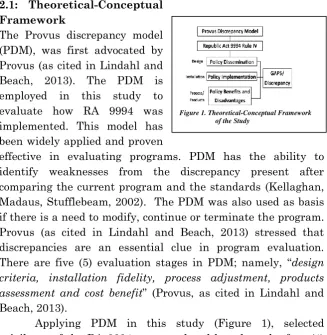
The Provus discrepancy model (PDM), was first advocated by Provus (as cited in Lindahl and Beach, 2013). The PDM is employed in this study to evaluate how RA 9994 was implemented. This model has been widely applied and proven
effective in evaluating programs. PDM has the ability to identify weaknesses from the discrepancy present after comparing the current program and the standards (Kellaghan, Madaus, Stufflebeam, 2002). The PDM was also used as basis if there is a need to modify, continue or terminate the program. Provus (as cited in Lindahl and Beach, 2013) stressed that discrepancies are an essential clue in program evaluation. There are five (5) evaluation stages in PDM; namely, “design criteria, installation fidelity, process adjustment, products assessment and cost benefit” (Provus, as cited in Lindahl and Beach, 2013).
Applying PDM in this study (Figure 1), selected privileges of the RA 9994 were analysed based on the four (4) stages of PDM. Initially, policy dissemination serves as the design stage of the evaluation study on RA 9994 where it is expected that, prior to the implementation of the law on the selected privileges for elderly citizens, mass dissemination of
information were undertaken to promote awareness among the elderly about their welfare and benefits. These privileges include 20 percent discount, VAT exemption in restaurants and pharmacies, 20 percent discount in hospitals and transportation, and five percent discount in grocery stores (GOP-RA 9994, 2010).
The second stage of PDM is equated with the policy implementation phase in this study where actual implementation practices were investigated based on the mandates of the law. The third and fourth stages of the PDM are taken together as represented by the policy, benefits and disadvantages (Provus, as cited in Lindahl and Beach, 2013). Pros and cons were considered from both the consumers (senior citizens) and the provider (establishments).
3: RESEARCH METHODOLOGY
The study utilized evaluative research design and implemented in Cebu City, Philippines. Thirty (30) senior citizen respondents were identified while 20 establishments were surveyed using purposive sampling. The inclusion criteria in selecting senior citizens were as follow: (1) a senior citizen card provided by the Office of Senior Citizen Affairs (OSCA); and (2) availed of senior citizen discount regardless of establishment (OSCA, 2017).
4: RESULTS AND DISCUSSION
4.1: Policy Dissemination
Upon enactment of RA 9994, it was officially published in national daily newspapers. The concerned government departments issued circulars and directives to concerned establishments and companies within 30 days from the affectivity of RA 9994 for implementation and compliance. The concerned establishments received the various administrative orders and memoranda emanating from respective government agency head offices. With the dissemination of the law as amended, all establishments which applied for business were automatically required to give discounts to elderly citizens.
Memorandum Circular number 23, series of 1994, provided by the Bureau of Food and Drug (BFAD) was distributed to pharmacies and posted by concerned establishments to guide senior citizens of their privileges on discounted purchases of goods and services (Bureau of Food and Drug, 1994). Meanwhile, grocery stores provide the discounts based on what is mentioned in the purchase booklets jointly determined by the DTI and DA through joint Administrative Order no. 10-02 series of 2010.
Hospitals were notified of elderly discounts through Administrative Order number 2012-0007 (DOH, 2012) and Memorandum Circular No. 056-2012 provided by the Philippine Health Insurance Corporation (PhilHealth, 2012). For Restaurants, they were provided with Revenue Regulations no. 7-2010 and Revenue Memorandum Circular no. 38-2012 (Bureau of Internal Revenue, 2012)
Memorandum Circular No. 2009-010 (LTFRB, 2009). A discrepancy was noted in the transport sector, specifically among taxicabs. In an interview with taxicab drivers, they confirmed to know about the 20 percent discount for senior citizens through the AM frequency radio broadcasts and upon compulsory attendance to seminar when caught for driving violation. They also revealed that no seminar was conducted about the discount privilege for the elderly when applying to be a taxicab driver. Neither, they received any memorandum from the Land Transportation Office (LTO) nor from the LTFRB. Their taxicab operators also never mentioned to them about senior citizen discount privileges.
Evidently, there was lack of information advocacy in the transport sector and the memorandum order was not properly disseminated. The memorandum order did not reach the intended recipient who were responsible in providing the discounts to senior citizens. Fortunately, other subsectors in transportation (shipping lines and airlines) were aware of the discount accrued to the elderly. PUJ drivers, on the other hand, were provided with fare matrix from the Land Transportation Office.
For the elderly, they knew their benefits and privileges through senior citizen identification card (ID), purchase booklets, word of mouth and sometimes through the radio, newspapers and news programs. They also mentioned that there was no seminar provided about their benefits and privileges when they claimed their identification card issued by the OSCA. This is an indication that senior citizens are not fully aware of the benefits they are entitled to. This was noted during the interviews when some elderly got amazed to know the full list of benefits accrued to them.
because they were asked to pay PhP100.00, in a way hindering full advantage for those who have not acquired the booklets. Verifications with the OSCA revealed that such allegation was not true and purchase booklets are free of charge. The office mentioned that they only need to present their senior citizen ID to be given a purchase booklet. Operationally, many senior citizens have no proper knowledge due to lack of information dissemination. They were not properly informed that they would need to present their senior citizen ID at the OSCA to get the purchase booklet for free.
4.2: Policy Implementation
Senior citizens in the Philippines are entitled to some benefits and privileges. They can enjoy these privileges as long as they comply with the requirements mandated by the law. Table 1 shows the actual discounts afforded to the senior citizens by the establishments under study and their discrepancy. The numbers shown in the table is the average of the 5 establishments surveyed by category.
Table 1: Actual senior citizens’ discount and discrepancy by establishments’ category
Establishment
Standard Discount (%)
Discount Provided (%)
Standard VAT Exemption (%)
VAT Exemption (%)
Discrepancy (%)
Pharmacy duty upon
survey 20 20 12 12 0
Restaurant manages 20 20 12 12 0
Hospital lab info desk 20 20 - - 0
Grocery Store manager 5 5 - - 0
Transportation, Taxicab & jeepney, Ticket agent, Shipping line
20 20 - - 0
All pharmacies gave 20 percent discount to senior citizens on the purchases of medicines and other medical supplies. A twelve percent VAT exemption for the selling establishments was also provided on senior citizens’ purchases. Majority of pharmacies complied and provided a total of 32 percent discount to senior citizens as mandated by RA 9994, Rule IV article 7 section 1 (paragraph A). There was no discrepancy in terms of the 20 percent discount and VAT exemption. All senior citizens are ensured to save substantial proportion of their budget with 32 percent discounts, a considerable assistance in lowering their expenditures.
to visit the pharmacy again once the month-long supply of medicines has been consumed.
Purchases are documented in the pharmacy’s logbook where the name of the senior citizen, total amount purchased, discount, senior citizen ID number and signature of the elderly or the representative are reflected. In the case of the elderly, their purchases are recorded on their purchase booklets. Majority of the pharmacies have a special lane or a counter designed to give priority to senior citizens thereby make their transactions faster without queuing with younger customers. The lane also caters to person with disabilities (PWD) and pregnant women.
A discrepancy was noted in the policy implementation where the elderly claimed to have experienced being provided with the mandated discount but with increased price on the purchased medicines. Verifications conducted with the pharmacy establishments revealed that the medicines were already discounted and senior citizens availed the 20 percent discount and VAT exemption from the original price. Pharmacies also placed a printed copies of the policy along their customer counters for everyone to see, read and comply.
Notwithstanding affirmation by the Department of Trade and Industry (DTI) that double discount is not allowed, some elderly still get confused. No clear information is evident per DTI Administrative Order released to the pharmacies. Of the five surveyed pharmacy establishments, only one has a copy of Administrative Order. Disseminating clear information would lessen or most probably clear such confusion regarding this issue. Appropriately addressing this concern will not only ensure full implementation of the law but also confirmed harmonious and proper implementation (GOP-IRR of RA 9994, 2010).
f, g and h) and provided both 20 percent discount and VAT exemption. A total of 32 percent discount is given to senior citizen by pharmacies. There is no discrepancy both in standard discount and VAT exemption. Discount and VAT exemption are reflected in their receipts. Upon verification, all elderly respondents confirmed that their senior citizen IDs were honoured. They also added that they were able to avail of the full 32 percent discount.
In quick service restaurant or commonly known as fast food, the establishments complied with article 7, section 3 (paragraph e) that the meal of the senior citizen is charged separately independent from his/her non-senior citizen companions. Only the meal of the elderly is discounted. Senior citizens easily avail of the discount and find it very convenient, they just need to present their senior citizen ID to avail of the mandated discount. In hospitals, every admitted elderly benefits from the 20 percent discount on laboratory and diagnostic exams, medical services, medicines and professional fees of their attending physicians. No discrepancy was noted among hospitals which were compliant to the mandated senior citizens discount provision. The elderly affirmed convenient processes afforded to them in hospitals and other health service delivery establishments.
Meanwhile, if the elderly is with the family or any group, the total bill is divided to the number of diners and the 32 percent discount will be applied to the quotient. When diners are elderly, they just have to present their senior citizen IDs and total bill will be entitled to a 20 percent discount and exemption from VAT or a total of 32 percent discount. Children’s meal, bulk orders or party packages are not discounted.
date. Meanwhile, grocery stores give five percent discount on regular retail price of basic necessities and prime commodities but no exemption is given on the value added tax (Table 1). No discrepancy occurred among grocery establishments since they complied with the law specifically on Rule III article 5 of RA 9994 and with Joint DTI-DA Administrative Order no. 1`0-02 series of 2010 Section 3 (Department of Trade and Industry, 2010).
Pharmacies and grocery stores require the elderly to bring their purchase booklets and senior citizen ID to avail of the discount on basic necessities and prime commodities. If an elderly is unable to purchase by himself/herself, a representative can do the purchase by just presenting an authorization letter and a government-issued ID in accordance with Joint DTI-DA Administrative Order no. 10-02 series of 2010 section 9 (Department of Trade and Industry, 2010). When one of the requirements is missing, no discount can be afforded. The grocery stores clarified that the allowable amount to be discounted from elderly purchases should not exceed PhP1,300.00 per calendar week without carry-over of the unused amount. This is also reflected in their purchase booklets based on Joint DTI-DA Administrative Order no. 10-02 series of 2010 section 3 (Department of Trade and Industry, 2010). Purchased items are logged in their purchase booklets and reflected in the official receipt. Special lanes are provided in many establishments as discount counters to make transactions faster and convenient for the elderly. Counter computers are also specifically programmed to provide the discounts.
Filipino society is “shyness”, as respondent said: “I am purchasing a few items only. I’m shy to ask for discount”. Those without regular income are the ones who feel shy in availing of the discount. Senior citizens also don’t ask for discounts to maintain good rapport and avoid conflict.
Filipino values and cultural background somehow affect the full implementation of the law. Three issues were noted during the interviews: jackpot mentality; helpfulness; and shyness. Jackpot mentality is defined as the “get rich quick” mentality of some Filipinos who prefer to engage in easy ways of getting money (Quizlet, 2015). This concept is akin to some Filipinos who prefer the easy way to get purchase discount the fastest way possible. From the interview, one respondent said that “asking for discounts is such a hassle because of the requirements needed. It takes too much time waiting for others to be given their discount. I rather go to other fast lane counter without discount”. Arguably, the process of getting the discount is easy than what some elderly complained about. Yet, some senior citizens consider the process a hassle so they prefer not to avail. In some cases, they don’t avail the discount because they only use their senior citizen ID to get financial assistance. On the transportation services, there is no discrepancy with the mandated discount since shipping and air lines are complaint, specifically to Rule IV article 7 Section 2 [a and b] of RA 9994 (GOP-RA 9994, 2010). Senior citizens are just required to present their senior citizen ID to avail of the discount. Those who experienced travelling by air and sea were to avail of the full 20 percent discount on their base fares. It was very convenient since they only need to present their senior citizen ID. Flights which are on promotion are not entitled for the senior citizens’ discount.
of RA 9994. Taxicab drivers justify that the discount is inherent to their income since taxicab operators do not reimburse them on the provided discounts. Some senior citizens are also not aware that they can avail fare discount when riding a taxicab. The value of altruism and being helpful are strongly inculcated among elderly Filipinos. In many cases, senior citizens don’t anymore ask for discounts to help the common people, especially jeepney and taxicab drivers. One respondent said that “It’s just a few pesos anyway, I’ll just give it to them”. They are convinced that a peso is already a big help for taxicab drivers.
4.2: Policy Benefits and Disadvantages
Senior citizen affirmed that the discount is really a big help in lessening their expenses in buying medicines whose prices are too expensive. Yet, they pointed out that the process of acquiring discount is a hassle and take too much time.
One taxicab driver reasoned: “It’s okay to have 3 to 5 passengers a day but if it exceeds, it’s a loss on our side”. Practically, taxicab drivers provide the discount taken away from their earnings and when they have plenty of senior citizen passengers a day, their income are substantially cut back. Another taxicab driver said: “We pay for the full car rent. It would have been better if taxicab operators also reduce the car rent whenever we give discounts but this is happening”. This shows that the taxicab drivers don’t really get any benefit from giving discounts to their elderly passengers. Taxicab owners and operators don’t share the expenses incurred in providing discount fares to the elderly.
representative from the DTI checked its company logbook randomly he is not aware of the entire process. Some establishment managers admitted that the discount they provided to elderly citizens is subtracted from their taxable income but they could not show the data due to confidentiality.
This was explained more in Revenue Memorandum Circular No. 38-2012 (Bureau of Internal Revenue, 2012). Establishments were mandated to keep a separate record of sales where names of senior citizens (purchasers), OSCA ID, gross sales receipts, sales discounts granted, dates of transactions and invoice/OR number are documented. The memorandum order also clarified that both the 20 percent discount and VAT exemption are expense accounts absorbed by the government.
4.9: Discrepancies
Of the three assessed areas, discrepancies were noted on policy dissemination and policy implementation as reflected in Table 2. Senior citizens are not fully aware of their benefits and privileges. They are also not aware how to avail some discounts on specific goods and services. Another discrepancy is the lack of information dissemination among taxicab drivers. Though memoranda were distributed, these failed to reach the concerned individual implementers of various establishments who were supposed to give the mandated discounts to senior citizens.
Table 2: Discrepancies in the assessed areas of RA 9994. Areas Discrepancy
Policy dissemination
For transportation, taxicab drivers and operators did not receive advice from LTFRB.
Senior citizens did not have seminars on their welfare and benefits; information was disseminated more by word of mouth.
Policy implementation
Limitations of senior citizen’s availing discounts on the purchases of medicines due to the requirements of purchase booklets, prescription and valid IDs
Senior citizen considered the process of acquiring discount a hassle. Personal decision of some senior citizens not availing the discount
to help other people. Policy benefits
and
disadvantages
No clear benefits for taxicab drivers.
On policy implementation, Filipino values and cultural considerations were noted. These are the reasons why some elderly prefer not to avail of their discounts privileges believing that not getting their discount could help others even in small amount. As to policy benefits and disadvantages, the taxicab drivers clamoured to loss a portion of their daily earnings when providing discounts to the elderly. They took it from their own income and their operators collect the full amount for the car boundary rent for the day.
4.10: Policy recommendations
Intensive campaign and information ads about RA 9994
as a form of policy dissemination. The discrepancies noted
boil down to lack of information for both implementers and beneficiaries. We suggest that a lectures about the senior citizen discounts may be included during the job orientation of establishment employees. This will educate frontline service providers of business about the law. If employees are well informed, there will be no confusions and discounts will be afforded accordingly. Similarly, senior citizens should be educated about the benefits they are entitled to. By rightfully knowing the full benefits and privileges, no elderly can be misled by establishments thereby encouraged to exert his/her rights.
Hassle-free processes and transparency on policy
implementation.Uniform implementing rules and regulations
anywhere in the Philippines, establishments must apply uniform implementing rules and regulations of RA 9994. This will bring a harmonised processes and the same requirements for senior citizens to bring always with them especially those who often travel. They will be ensured to avail of their discount privileges. It is also recommended that transparency through posting stickers or banners to inform the elderly how they can avail discount from concerned establishments. In so doing, the elderly can be reminded of their rights thereby lessen complaints. Grocery stores may put price checkers not only the price of the item but also the five percent discount for the elderly citizens of items eligible for the discount.
Policy monitoring.There should be regular monitoring of the
implementation of RA 9994 from concerned regulatory boards like, DTI, DOTC, LTFRB, among others. OSCA should also be vigilant and aggressive in addressing concerns on non-provisions of privileges to senior citizens as mandated by the law. The regulatory boards should use uniform and standard evaluation tool to ensure that the law is properly observed and
implemented. This will facilitate identification of
establishments which need improvements. An annual random check have to be put in place to ensure implementing establishments are consistent in providing the mandated discounts.
5: CONCLUSION
Establishments are compliant with RA 9994 and provided senior citizens with the mandated discounts in their purchases of goods and services. Policy dissemination, implementation and monitoring of concerned establishments are crucial to the compliance and effectiveness of the law. Some discrepancies occurred along policy implementation. Granted discounts on purchases of goods and services were indeed beneficial to senior citizens especially on highly priced medicines and other commodities. However, procedural processes and required transaction recordings were hassle to many senior citizens. Limited awareness level among the elderly beneficiaries downplayed the full benefits of RA 9994 implementation. Pharmacies and restaurants have benefitted from the VAT exemptions upon compliance to RA 9994. Taxicab drivers who abide to give the discounted fare rates do not have concrete returned benefits, a clear limitation of the policy implementing rules and regulations. The full benefits of the law is not optimized due to some implementation procedural processes impediments, issues on transparency, regular product and process monitoring and no clear benefits for PUJ and taxicab implementers.
6: RECOMMENDATIONS FOR FUTURE RESEARCH
REFERENCES
1. Abocejo, F. T., & Gubalane, F. K. (2013).
Implementation of the anti-human trafficking law in Cebu city, Philippines. International Forum, 16(1),36-48. Retrieved from http://ojs. aiias.edu/ index.php/ojs/article/ view/143
2. Abocejo, F. T., Pañares, Z. A., Dotillos, L. T., & Diones,
L. L. (2012). Microfinance Lending Program of Cooperatives in Cebu, Philippines: Realities, Benefits
and Women’s Participation. CNU Journal of Higher
Education, 6(1),25-39. Retrieved from http://www. jhe.cnu.edu.ph/index.php/cnujhe/article/view/119/82
3. Almazan, J. U., Cruz, J. P., Alamri, M.S., Alotaibi, J. S.
M., Albougami, A.S.B., Gravoso, R., Abocejo, F.T., Allen, K., & Bishwajit, G. (2018). Predicting patterns of disaster-related resiliency among older adult Typhoon Haiyan survivors. Geriatric Nursing. 39(6),629-624. doi: 10.1016/ j.gerinurse.2018.04.015
4. Ambida, R. S. Cruz, R. A. (2017). Extent of Compliance
of a Higher Education Institution for a University
System. Science Journal of Education. 5(3),90-99. doi:
10.11648/j.sjedu. 2017 0503.13
5. Arnado, J. D. D., Gogo, H. B., & Abocejo, F. T. (2017). Public utility jeepneys in Cebu city, central Philippines: Regulations and implications to traffic congestion. Research Conference Paper Presentation during the International Conference on Law, Busines, Education and Social Responsibility at the Hotel Benilde Maison De La Salle, Malate, Metro Manila, Philippines.
Retrieved from
http://uruae.org/siteadmin/upload/6393UH 0117829.pdf 6. Alvarez, I. C. C., Ong, M. B., & Abocejo, F. T. (2017).
caregivers and elderly patients of Guadalupe, Cebu City,
Central Philippines. European Scientific Journal,
ESJ, 13(24),356-376. DOI: 10.19044/esj.2017
.v13n24p356
7. Barrett, G. W. (1998). Educational evaluation: Two
theoretical models in a corporate based application. (Master’s Thesis, The University of British Columbia).
Retrieved from
https://open.library.ubc.ca/media/download/pdf/831/1.007 8149/1
8. Bureau of Food and Drug [BFAD]. (1994). BFAD
Memorandum Circular No. 23, Series of 1994 for all drugstore, Food-Drug Regulation Officers and Parties Concern Amending Memorandum Circular No. 4, series of 1994. Retrieved from https://ww2.fda.gov.ph/at tachments/article/28992/bfad%20circular%2023%20s.%2 01994.pdf
9. Bureau of Internal Revenue [BIR]. (2012). Revenue
Memorandum Circular No. 38-2012 Retrieved from http://www.bir.gov.ph/images/bir_files/old_files/pdf/6465 5RMC%20No%2 038-2012.pdf
10.Dantes, R. B. (1991). The new Philippine generic drugs
act: A physician's viewpoint. Journal of Clinical
Epidemiology, 45(2),29-30. doi:
10.1016/0895-4356(91)90109-M
11.Department of Social Welfare and Development. (2010).
Social pension for senior citizens. Retrieved from https://www.dswd.gov.ph/programs/social-pension/
12.Department of Health [DOH]. (2012). Administrative
Order number 2012-0007: Guidelines on the Grant of Twenty Percent (20%) Discount to Senior Citizens on Health Related Goods and Services and for Other
ph/attachments/article/172045/Administrative%20Order %20No.%202012-0007%20Part 1.pdf
13.Department of Trade and Industry [DTI]. (2010).
Department Administrative Order No. 10-02. The Rules and Regulation Implementing Republic Act No. 7394: The Consumer Act of the Philippines. Retrieved from https://www.scribd.com/doc/61416593/DTI-DAO-10-02- series-of-2010-Addenda-to-DAO-2-series-of-1993-or-the- Rules-and-Regulations-Implementing-Republic-Act-7394-otherwise-known-as-the-Cons
14.Garcia, L. L. (2013). Readiness for retirement: A theory
development approach. CNU Journal of Higher
Education, 7(1),45-54. Retrieved from
http://jhe.cnu.edu.ph/index. php/cnujhe/
article/view/71/49
15.Garcia, L. L. (2018). Influence of Individuals and the
Environment to Perceptions of Success in Old Age. Malaysian Journal of Medical Research. 2(3),36-44. doi:
10.31674/ mjmr.2018.v02i02.
00110.31674/mjmr.2018.v02i02.001
16.Government of the Philippines - Republic Act 7581
[GOP-RA7681], 1992). The Price Act of 1992. Retrieved from
https://www.officialgazette.gov.ph/1992/05/27/republic-act-no-7581/
17.Government of the Philippines - Republic Act 9994
[GOP-RA9994], 2010). Expanded Senior Citizens Act of
2010. Retrieved from
https://www.officialgazette.gov.ph/2010/02/ 15/ republic-act-no-9994/
18.Government of the Philippines [GOP-IRR of RA9994].
(2010). Implementing Rules and Regulations of Republic
Act No. 9994. Retrieved from
Philippines/IRR%20of%20the%
20Expanded%20%20Senior%20Citizens%20Act.pdf
19.Gwynne-Atwater, A. (2011). An evaluation of a special
education preschool program serving children with
autism or autistic-like behaviors. (Doctoral
Dissertation). Retrieved from
https://vtechworks.lib.vt.edu/bitstream/handle/10919/_26 635/Atwater_A_D_2011.p df?sequence=1
20.Haber, J., & Lobiondo-Wood, G. (2002). Nursing
Research Methods, Critical Appraisal and utilization. 5th edition. United States of America, Mosby Inc.
21.Kellaghan, T., Madaus, G.F. Stufflebeam, D.L. (Eds).
(2002). Evaluation models: Viewpoints on Educational
and Human Services Evaluation, 2nd Edition. Kluwer
Academic Publishers. Retrieved from
http://ebooks.kluweronline.com
22.Land Transportation Franchising and Regulatory Board
[LTFRB]. (2009). Memorandum Circular No. 2009-010:
Granting of transport fare discount to all senior citizens.
Retrieved from
http://ltfrb.gov.ph/wp-content/uploads/Memorandum%20/2009/2009-010 .pdf
23.Lindahl, R. A., & Beach, R. H. (2013). The role of
evaluation in the school improvement process. Planning
and Changing, 44(1), 56-72. Retrieved from
https://search.proquest.
com/docview/1506941239?accountid=173015
24.National Council on Disability Affairs. (2011). DOT
Memorandum Circular No. 2011-04, series of 2011. Adopting the guidelines on the grant of special discounts to persons with disabilities pursuant to the provisions of
Republic Act No. 9442. Retrieved from
http://www.ncda.gov.ph/
25.Office for Senior Citizens Affairs [OSCA]. (2017). Cebu City - Apply for Senior Citizen ID Card. Ground Floor, Executive Bldg., Cebu City Hall, Cebu City, Philippines.
26.Philippine Health Insurance Corporation [PhilHealth].
(2012). Memorandum Circular No. 056-2012: Updated
Guidelines on the Application of the Senior Citizens' Discount Relative to PhilHealth Reimbursements. Retrieved from https://www.philhealth.gov.ph/ circulars/ 2012/circ56_2012.pdf
27.Philippine statistics Authority (2012).The 2010 Census
of Population and Housing Reveals the Philippine
Population at 92.34 Million. Retrieved from
http://census.gov.ph/
content/-census-population-and-housing-reveals-philippine-population-9234-million
28.Quizlet (2015). Society and culture with family planning:
quiz for July 8, 2014 (theories and culture). Retrieved from http://quizlet.com/ 60299932/society-and-culture- with-family-planning-quiz-for-july-8-2014-theories-and-culture-flash-cards/
29.Rough Guides (2015). Philippines: Culture and Etiquette.
Retrieved from http://www. rough
guides.com/destinations/asia/philippines/culture-etiquette/
30.Salenga, R. L., Loquias, M. M., and Sarol, J. N. (2016).
Effect of the expanded senior citizens act of 2010 (Republic Act 9994) on drug accessibility among the
elderly. Acta Medica Filipina, 50(2),38-43. Retrieved
from http://actamedicaphilippina.com.ph/sites/
default/files/ fulltexts/50-02/effect-expanded.pdf
31.Sampong, K. (2009). An evaluative study of a distance
32.Steinmetz, A. (2002). The Discrepancy Evaluation Model. In Evaluation models: Viewpoints on educational and human services evaluation, 127-143. Kluwer Academic Publishers. doi: 10.1007/0-306-47559-6_7.
33.United Nations. (2013). World Population Ageing 2013.
Retrieved from http://www.un.
org/en/development/desa/population/publications/pdf/age ing/WorldPopulationAgeing2013.pdf
34.United Nations Population Fund. (2012). Ageing in the