International Journal of Research (IJR)
e-ISSN: 2348-6848, p- ISSN: 2348-795X Volume 2, Issue 4, April 2015 Available at http://internationaljournalofresearch.org
Environmental Education Awareness in Relation to Level
and Subject Specialization
Dr.(Mrs.) Vipinder Nagra
Asst. Prof. D.A.V. College of Education Hoshiarpur.
E-mail: [email protected] Abstract
The present study has been conducted on a stratified sample of 3600 school teachers to
study their environmental education
awareness with respect to their level and
subject specialization. A self-made
questionnaire was used to collect the data, which was treated with suitable statistical techniques like ANOVA and t tests. The results revealed significant variations in the
environmental education awareness of
secondary and elementary school teachers with the former scoring higher. Significant difference was noted in the environmental education awareness of science, social science and language teachers. However, interaction effects of both variables (level and subject
specialization) showed insignificant
differences upon environmental education awareness.
Key words:
Environmental education; Awareness; school teachers; level; subject specialization.
Introduction
Environment is constantly being used by man to derive benefits to fulfill his needs, expand his habitat and to improve the quality of life. Population explosion along with increased exploitation of environment has resulted in disastrous changes in the environment which may be cataclysmic for the future. To improve the quality of life for now and for the future, humans must take care of their environment. In this regard, education is
obviously a powerful vehicle and a panacea of all evils that can educate the masses to preserve the environment not only for the present but also for the future generations. Environmental education has become even more important in this aspect as it develops a sense of concern for what is happening on a local and global scale and also encourages for taking appropriate actions. Environmental education increases people’s knowledge and awareness about the environment and associated challenges, develops necessary skills and expertise to address challenges, and fosters attitudes, motivations, and commitments to make informed decisions for responsible action (UNESCO, Tbilisi Declaration, 1978).
International Journal of Research (IJR)
e-ISSN: 2348-6848, p- ISSN: 2348-795X Volume 2, Issue 4, April 2015 Available at http://internationaljournalofresearch.org
problems and their solutions. Awareness about the environment, its concept and components, problems, protection and conservation is dependent upon various demographic factors. One such factor can be the subject of specialization. Subject specialization that is specialization of a person in any one of the three groups of subjects: science group- Biology, Physics, Chemistry, Mathematics, etc; language group- English, Hindi, Punjabi, Sanskrit, or any other language etc; social sciences group- History, Geography, Political science, Economics, Sociology, Music, General studies, Religious instructions, etc. The subject background of a person influences his thinking or we can say his personality traits. Person with science background can be more scientific in his actions and thinking in comparison to a person with arts background or other group. Thus, we assume that demographic variables affect the attitude of a person and thus his awareness towards environmental education. Taking into consideration this situation, the investigator has felt a need to conduct a study to examine whether level and subject specialization has any effect on the environmental education awareness of school teachers. It is possible that the results of the study can help us to take necessary actions to enhance the efficacy of the content accordingly.
Hypotheses
The purpose of the study is to know environmental education awareness of elementary and secondary school teachers in relation to subject specialization. Based on this objective, following hypotheses has been formulated for testing:
1. There will be no significant difference between the environmental education awareness of schoolteachers in relation to level.
2. There will be no significant difference between the environmental education
awareness of schoolteachers in relation to subject specialization.
3. There will be no significant interaction between the level and subject specialization upon environmental education awareness
Method Sample
The population for the sample was school teachers of Punjab. A total sample of 3600 school teachers was selected using stratified random sampling technique from the five districts namely Amritsar, Jalandhar, Kapurthala, Nawanshahar and Gurdaspur. The sample consisted of 1800 elementary and 1800 secondary school teachers which further consisted of science, social sciences, and languages teachers.
Tool
The study was conducted with the help of self-made questionnaire whose reliability and validity was tested. The reliability coefficient of the questionnaire by test- retest method was found to be +0.99. After standardizing the tool, the final draft of the questionnaire consisted of 100 multiple-choice items. Each correct test item was given a weightage of one mark and each wrong response or omitted item received zero mark. As there were 100 items, an individual could get a maximum score of 100.
Statistical Techniques
International Journal of Research (IJR)
e-ISSN: 2348-6848, p- ISSN: 2348-795X Volume 2, Issue 4, April 2015 Available at http://internationaljournalofresearch.org
Table 2. Summary of Two- way (2*3) ANOVA Results
Source of Variation SS df MS F ratio
A (Level) 2772.03 1 2772.03 15.23**
B (Subject specialization) 73517.88 2 36758.94 202.01**
A*B 797.87 2 398.64 2.19
Within group ( Errors) 650729.49 3594 180.96
** Significant at 0.01 level
Table-3. Significance of Difference between the Mean Scores.
**Significant at 0.01 level
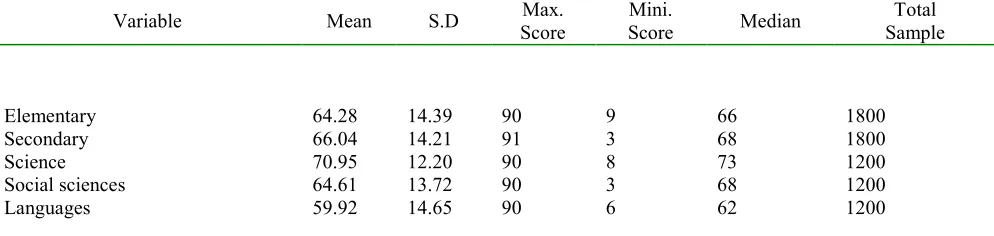
Table-4. Means, Standard Deviations, Maximum Scores, Minimum Scores and Medians of School Teachers.
Variable Mean S.D Score Max. Score Mini. Median Sample Total
Elementary Secondary Science Social sciences Languages
64.28 66.04 70.95 64.61 59.92
14.39 14.21 12.20 13.72 14.65
90 91 90 90 90
9 3 8 3 6
66 68 73 68 62
1800 1800 1200 1200 1200
Results and Discussion
The data was analyzed to find answers to the hypotheses set for the study. The results obtained for the main effects and interactions of factors have been presented as follows:
Main Effects Level
ANOVA results presented in Table- 2 show the F-value for level of schoolteachers in the mean environmental education awareness test
scores to be 15.23, which is statistically significant at both levels (P<.01and P<.05). Hence, it was concluded that level of school teachers effect their environmental education awareness. Further from Table 4, it is noted that the mean of elementary school teachers (64.28) is lower (p<0.01) than that of secondary school teachers (66.04) showing a difference of 1.76. The value of‘t’ calculated (Table 3) for this group difference was 3.90, which was significant at 0.01 level. This Pair of Comparison Mean Difference ‘t’ value
Elementary - Secondary -1.76 3.90**
Sciences- Social sciences 6.34 10.9**
Sciences- Languages 11.02 18.4**
International Journal of Research (IJR)
e-ISSN: 2348-6848, p- ISSN: 2348-795X Volume 2, Issue 4, April 2015 Available at http://internationaljournalofresearch.org
significant difference showed that secondary school teachers had a higher level of environmental education awareness than elementary school teachers. The findings of Fong (1994), Rai (2002) and Rajakumari (2002) also highlighted that higher environmental awareness is due to higher level of education.
It can also be seen from Table 5 that the percentage distribution of the respondent’s scores in the highest quartile of secondary teachers was 26.8% which was higher than that of elementary teachers, which was 22.2%. All these findings prove that there exists significant difference between both the levels of school teachers, thus, H1 was rejected. Table-5. Distribution of the Scores into Various Quartiles with Percentage.
Quartile
(Scores) Ele. School teacher Sec. School techer Science Social science Language 0-25
%(low`)
31 1.7
28 1.6
14 1.2
22 1.8
23 1.9 26-50
%(moderate) 13.9 251 10.4 187 4.5 54 10.6 127 21.4 257
51-75 %(high)
1119 62.2
1102 61.2
639 53.3
828 69.0
755 62.9 76-100
%(very high) 22.2 399 26.8 483 41.1 493 18.6 223 13.8 165 Total
%
1800 100
1800 100
1200 100
1200 100
1200 100
Subject specialization
ANOVA results presented in Table 2 show the F-value for subject specialization of schoolteachers in the mean environmental education awareness test scores to be 202.01, which is statistically significant at both levels (P<.01and P<.05). Hence, it was concluded that subject specialization of school teachers effect their environmental education awareness. The main effect of this variable represents a comparison between the means for science subject, social science subject and language subject schoolteachers. As there are three subjects there are three mean comparisons. From Table 4, it is noted that the mean of science subject teachers (70.95) is higher (p<0.01) than that of social sciences subject teachers (64.61) showing a difference of 6.34. The value of‘t’ calculated (Table 3) for this group difference was 10.9, which was significant at 0.01 level. This significant difference showed that science subject teachers had a higher level of environmental education awareness than social sciences subject teachers.
International Journal of Research (IJR)
e-ISSN: 2348-6848, p- ISSN: 2348-795X Volume 2, Issue 4, April 2015 Available at http://internationaljournalofresearch.org
It can also be seen from Table 5 that the percentage distribution of the respondent’s scores in the highest quartile of science teachers was 41.1% which was higher than that of social science and language teachers, which was 18.6% and 13.8% respectively. All these findings prove that there exists significant difference between the three subject specialised school teachers, thus, H2 was rejected.
Interaction Effect
The F value for the interaction of variable, level and subject specialization of school teachers (A x B), given in Table 2 is 2.19, which was insignificant at both the levels (P<.01 and P<.05). This showed that there exists no interaction effect between the variables i.e., the level of schoolteachers along with subject specialization on the environmental education awareness. Hence, H3 is accepted.
Conclusions
The present study revealed following significant conclusions with respect to the environmental education awareness of school teachers in relation to level and subject specialization: - The secondary school teachers showed significant variation in environmental education awareness than elementary school teachers. This suggests that level influences the awareness of teachers.
- The science subject teachers showed significant variation in environmental education awareness than social science and language teachers. Likewise, the social science teachers showed significant variation in environmental education awareness than language teachers. This suggests that subject specialization influences the awareness level of teachers. - The interaction analysis highlighted that level factor was not dependent of subject specialization factor or, equivalently that subject specialization factor was not dependent of the level factors. That means there was insignificant interaction between level and subject
specialization upon environmental education awareness. However, independently both vary in their results. This suggests that the independent effects of A and B should be interpreted cautiously.
Educational implications
Teacher can play an important role in educating their students about environment, which is only possible only when the teacher themselves have the necessary level of environmental education awareness. For this purpose, the government should pay greater attention towards teachers teaching at elementary levels. They should introduce and enrich environmental education programmes in both in-service and pre- service teacher education programmes. More effort has to be implemented in the curriculum to encourage social sciences and language subject teachers for performing and participating in environmental activities and actions.
References
[1.] Fong, T.Y. (1994). Environmental awareness and action at elementary schools in Taiwan-The Republic of China. Dissertation Abstract International, 54(11), 4052-A.
[2.] Nagra, V. (2010). Environmental education awareness among school teachers. The Environmentalist, 30 (2), 153-162.
[3.] Pradhan, G.C. (1995). Environmental awareness among teacher trainees. University News, 33(40), 10-4.
[4.] Pradhan, G.C. (2002). Environmental awareness among secondary school teachers: a study. The Educational Review, 45(2), 25-27. [5.] Rai, D.K. (2002). Role of education and cultural practices in creating environmental awareness. Indian Educational Abstracts, 2 (1), 66. [6.] Raja Kumari, T.S. (2002). Environmental concern and sustainable development: The role of NGO’s. Indian Educational Abstracts, 2(1), 65-66.