International Journal of Research (IJR)
e-ISSN: 2348-6848, p- ISSN: 2348-795X Volume 2, Issue 06, June 2015Available at http://internationaljournalofresearch.org
Simulating and Optimizing the Response of a Sine Wave Finite
state Machine with Timestamp Simulation Using Simulink
Kalpna
1& Mr. Amit Varma
21
M. Tech scholar, SGI, Samalkha, Haryana
2
Assistant Professor, Computer Science deptt, SGI Samlkha
ABSTRACT –
Objective - we have been using sine wave functions from our high school calculus.
Simulation is a integral part of anyone’s life now. We will program in simulink to see how can we simulate a sine wave and obtain a optimized wave. Also we will see how can we change the initial conditions of our parameters in simulation on the run. Secondly we will build a finite state machine that will show a tradeoff between position and velocity using sine wave. It is encountered with many usual problems. We will fix those problems using simulation in simulink at small intervals of time.
CHAPTER – 1
INTRODUCTION
1.Finite State System
An FSM can be represented by a state transition diagram, a directed graph whose vertices correspond to the states of the machine and whose edges correspond to the state transitions; each edge is labeled with the input and output associated with the transition. Suppose that the machine is currently in state 1. Upon input b, the machine moves to states 2 and output 1. Equivalently, an FSM can be represented by a state table with one row for each state and one column for each input symbol (Gillespie, 2008). For a combination of a present state and input symbol, the corresponding entry in the table specifies the next state and output. A state machine represents a system as a set of states, the transitions between them, along with the associated inputs and outputs. So, a state machine is a particular conceptualization of a particular sequential circuit. State machines can be used for many other things beyond logic design and computer architecture.
Circuit with memory is a Finite State Machine. Even computers can be viewed as huge FSMs. Design of FSMs Involves: Defining states, Defining transitions between states, Optimization /Minimization. (Hasheim, 2012)
State Diagram
Illustrates the form and function of a state machine. Usually drawn as a bubble-and-arrow diagram. State
A uniquely identifiable set of values measured at various points in a digital system. (Kumar, 2013) Next State
The state to which the state machine makes the next transition, determined by the inputs present when the device is clocked.
Branch
A change from present state to next state.(Kumar, 2013)
Mealy Machine
A state machine that determines its outputs from the present state and from the inputs.
Moore Machine
A state machine that determines its outputs from the present state only. (Singh et. al., 2012)
On a well-drawn state diagram, all possible transitions will be visible, including loops back to the same state. From this diagram it can be deduced that if the present state is State 5, then the previous state was either State 4 or 5 and the next state must be either 5, 6, or 7. .(Singh et. al., 2012)
Moore and Mealy Machines
International Journal of Research (IJR)
e-ISSN: 2348-6848, p- ISSN: 2348-795X Volume 2, Issue 06, June 2015Available at http://internationaljournalofresearch.org
Moore Machine
Outputs are independent of the inputs, i.e. outputs are effectively produced from within the state of the state machine. (Kumar, 2013)
Mealy Machine
Outputs can be determined by the present state alone, or by the present state and the present inputs, i.e. outputs are produced as the machine makes a transition from one state to another. (Aljeaid et. al., 2014)
SIMULATION - The component-based approach is an important design principle in software and systems engineering. In order to document, specify, validate, or verify components, various formalisms that capture behavioral aspects of component interfaces have been proposed. These formalisms capture assumptions on the inputs and their order, and guarantees on the outputs and their order. (Hasheim, 2012) For closed systems (which do not interact with the environment via inputs or outputs),
a natural notion of refinement is given by the simulation preorder. For open systems, which expect inputs and provide outputs, the corresponding notion is given by the alternating simulation preorder. (Ivan et. Al., 2011) Under alternating simulation, an interface A is refined by an interface B if, after any given sequence of inputs and outputs, B accepts all inputs that A accepts, and B provides only outputs that A provides. (Hasheim, 2012) The alternating simulation preorder is a Boolean notion. Interface A either is refined by interface B, or it is not. However, there are various reasons for which the alternating simulation can fail, and one can make quantitative distinctions between these reasons. For instance, if B does not accept an input that A accepts (or provides an output that A does not provide) at every step, then B is more different from A than an interface that makes a mistake once, or at least not as often as B. (Cerny et al., 2000)
CHAPTER - 2
LITERATURE SURVEY -
WORK DONE BY DIFFERENT RESEARCHERS ON FINITE STATE MACHINE AND SIMULATION IN PREVIOUS YEARS
RESEARCHER OBJECTIVE METHODOLOGY RESULT
Stewart Robinson, (1993)
Discusses simulation, its benefits
and the range of manufacturing
issues to which it can be applied.
A case study Improve work
organization and
determine human
resource requirements.
Horta‐Rangel et al. (2008)
The study of
pressure‐volume‐temperature
(PVT) process is necessary to
understand the physical behavior
of materials. This paper seeks to
Software Analysis. This
simulation procedure
allows one in a simple
way to vary the
International Journal of Research (IJR)
e-ISSN: 2348-6848, p- ISSN: 2348-795X Volume 2, Issue 06, June 2015Available at http://internationaljournalofresearch.org
develop a simulation procedure
to predict phase behavior.
characteristics of the
sample. This makes the
computer simulation a
useful tool together
with the experimental
test, in the development
of novel materials.
R.A. Proctor, (1991)
Development in micro
computer software packages is
examined as they impinge on the
area of creative problem solving
in business. I
Computer modeling A review is provided of
different computer aids
to creative problem
solving and an
overview is given of the
different approaches to
management games.
Many of the different
kinds of management
game are amenable to
computerization.
Dolęga et al. (2012)
To enable the correct selection of
the radiofrequency thermal
ablation (RFTA) process
parameters for an individual
patient by applying a
computer modeling of RFTA.
professional package
of FLUX3D to generate
the geometric models
The computational
results show that the
RFTA algorithm is
effective in solving this
practical problem. The
computational results
show that the selection
of the type of electrodes
International Journal of Research (IJR)
e-ISSN: 2348-6848, p- ISSN: 2348-795X Volume 2, Issue 06, June 2015Available at http://internationaljournalofresearch.org
process is as important
as the correct selection
of the process
parameters, i.e. voltage
and frequency.
G. Southern, (1986)
Demonstrates the techniques of
CAPM by means of manual
simulation.
Computer simulation
model
the CAPM system is
presently installed on
the ACT Sirius and the
IBM personal
microcomputers. It
consists of a series of
basic programs and data
files in four modules.
There is wide scope for
using both versions in
degree courses in
mechanical and
production engineering
and production
management.
Brian Leaned, (1993)
Provides an introduction to
simulation, and discusses the use
of a modern simulation
environment.
simulation tools The gap is even further
reduced if the manager
understands something
of simulation
terminology and
methods. simulation is
International Journal of Research (IJR)
e-ISSN: 2348-6848, p- ISSN: 2348-795X Volume 2, Issue 06, June 2015Available at http://internationaljournalofresearch.org
managers in policy
making and decision
making.
McWaters et al. (1994)
Describes how simulations were
executed for all combinations of
eight fabrics and three contact
surfaces, and presents the
experimental results obtained for
similar conditions and fabrics.
Computer simulation
model
Proves the validity of
the computer model by
comparing the
experimental results
with those obtained
by simulation.
Describes how the
computer model could
be used to choose the
optimum diameter of a
fabric feeder picking
roller.
CHAPTER -3
PAPER OBJECTIVES
Finite state machine response is simulated for corresponding sine wave also simulating the working by simulation using Simulink and Mat lab.
Finite state performance is simulated using simulation in Simulink.
CHAPTER – 4
METHODOLOGY
1. Building a simulation interface for sine wave with appropriate multiplexer and integrator using simulink as a tool.
2. Obtaining the curve for sine wave
3. Varying parameters of simulator on the go. 4. Generating a chart as output of the integrator 5. Designing a state flow structure in the chart
using 3 different states.
6. Designing the tradeoff between 2 basic parameters in the chart.
7. Analyzing the output of finite state machine 8. Output showed when position symbol
becomes positive output does not go to 1. 9. This is called simulation overstepping the
critical time instant.
10. Removing the problem using simulink 11. Obtaining the output curve again at different
small intervals of time.
International Journal of Research (IJR)
e-ISSN: 2348-6848, p- ISSN: 2348-795X Volume 2, Issue 06, June 2015Available at http://internationaljournalofresearch.org
CHAPTER – 5
RESULT AND CONCLUSION
1. Here we have build a model for simulation of continuous sine wave. We are studying how a sine function respnds when simulated in simulink. Structure is shown in figure 2
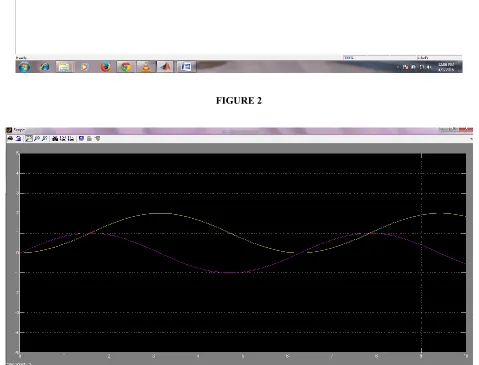
2. When we run this model for time t = 10 units we get the output shown in figure 3
3. Here yellow curve = Velocity sine wave 4. pink curve = Position waveform (Integral
form of velocity sine wave).
5. Now here is an error. Position wave which is obtained by integrating velocity sine wave is starting from point zero.
6. We know integral of sine starts from -1 rather than 0.
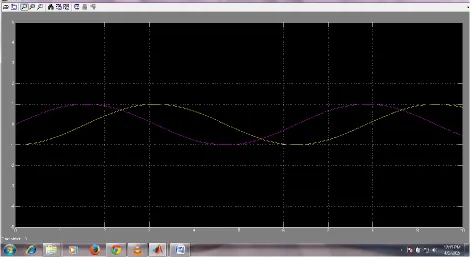
7. We can model this error by using simulink. Which gives the corrected output as shown in figure 4
8. Figure 4 shows Position waveform starting from -1 rather then 0.
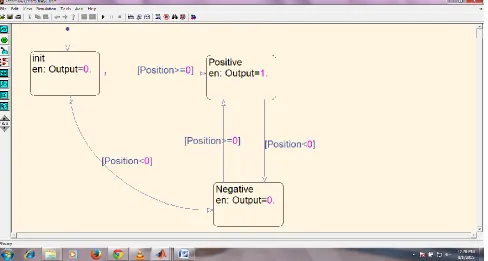
9. Using the existing system shown in figure f1 we will now build a velocity – position finite state machine and chart as shown in figure 5 and 6
10. Figure 5 shows Model for implementing position – velocity finite state machine
11. Figure 6 shows Finite state chart used in the model shown in figure f4
12. Now when we run the above velocity position finite state machine for time units t = 10.0 we get the output shown in figure 7
CHAPTER -6 REFERENCES
[1.]Aljeaid et al., 2014, Modelling and Simulation of a Biometric Identity-Based Cryptography, International Journal of Advanced Research in Artificial Intelligence, Vol. 3, No.10.
[2.]Amr Hasheim , Simulation of Radial Variation of Neutral Atoms on Edge Plasma of Small Size Divertor Tokamak, Bekheit, Journal of Modern Physics, 2012, 3, 145-150 February 2012
[3.]Brian Leaned, (1993) "A Guide to Computer‐based Simulation", Industrial Management & Data Systems, Vol. 93 Iss: 4, pp.8 – 10
[4.]Cerny,(2009) "Comparison between continuous and discrete frequency domain solution methods for structural steady state calculations with the finite element method", COMPEL - The international journal for computation and mathematics in electrical and electronic engineering, Vol. 28 Iss: 4, pp.1068 – 1080
[5.]Dagmara M. Dołęga, Jerzy Barglik, (2012) "Computer modeling and simulation of radiofrequency thermal ablation", COMPEL - The international journal for computation and mathematics in electrical and electronic engineering, Vol. 31 Iss: 4, pp.1087 – 1095
[6.]G. Southern, (1986) "Teaching the Techniques of Computer Aided Production Management and Simulation Modelling", International Journal of Operations & Production Management, Vol. 6 Iss: 1, pp.15 – 24
[7.]Gillespie, Implementing the Stochastic Simulation Algorithm, Journal of Statistical Software, April 2008, Volume 25, Issue 12
International Journal of Research (IJR)
e-ISSN: 2348-6848, p- ISSN: 2348-795X Volume 2, Issue 06, June 2015Available at http://internationaljournalofresearch.org
Journal of Computer Science Issues, Vol. 10, Issue 1, No 1, January 2013
[9.]Ivan et. Al., 2011, Collaborative Systems – Finite State Machines, Informatica Economică, vol. 15, no. 2.
[10.] J.Horta‐Rangel (2008) "Computer simulation of a pressure‐volume‐temperature process", International Journal of Numerical Methods for Heat & Fluid Flow, Vol. 18 Iss: 1, pp.24 – 35
[11.] S.D. McWaters, T.G. Clapp, J.W. Eischen, (1994) "Automated Apparel Processing: Computer Simulation of Fabric Deformation for the Design of Equipment", International Journal
of Clothing Science and Technology, Vol. 6 Iss: 5, pp.30 – 38
[12.] R.A. Proctor, (1991) "Can Computers Simulate Managerial Creativity?", Leadership & Organization Development Journal, Vol. 12 Iss: 4, pp.13 – 16
[13.] Singh et. al.,2012, Finite State Testing and Syntax Testing, International Journal of Computers & Technology, Volume 3. No. 1
[14.] Stewart Robinson, (1993) "The Application
of Computer Simulation in
Manufacturing", Integrated Manufacturing Systems, Vol. 4 Iss: 4, pp.18 – 23
FIGURES USED IN THE PAPER
CONDITION/STATE STATE 1 STATE 2 … STATE i … STATE p
CONDITION 1
CONDITION 2 STATE 3
….
CONDITION j STATE K
….
International Journal of Research (IJR)
e-ISSN: 2348-6848, p- ISSN: 2348-795X Volume 2, Issue 06, June 2015Available at http://internationaljournalofresearch.org
FIGURE 1 - The state diagram for a finite state machine
FIGURE 2
International Journal of Research (IJR)
e-ISSN: 2348-6848, p- ISSN: 2348-795X Volume 2, Issue 06, June 2015Available at http://internationaljournalofresearch.org
FIGURE 4
International Journal of Research (IJR)
e-ISSN: 2348-6848, p- ISSN: 2348-795X Volume 2, Issue 06, June 2015Available at http://internationaljournalofresearch.org
FIGURE 6