ISSN 2286-4822 www.euacademic.org
Impact Factor: 3.4546 (UIF) DRJI Value: 5.9 (B+)
Efficent management of time as an improvement
factor of performance
M.Sc. MUHAMET KELMENDI, PhD.c.
Abstract:
Time is an essential resource for every manager to effectively use it for achieving the goals and objectives of a business organization. Timing is so delicate that it can not be stored, but can only be spent once and if you abuse it and it can never be regained. Every manager is looking for ways to improve time management. No matter if management of an organization is seeking to improve the business or an individual is looking for ways to better spend his time, time management is important in both cases.
As a manager, time is an important factor needed to boost different organizational performance i.e. how time is being managed in an organization will be reflected in its work either positively or negatively. The performance of a business organization is evaluated based on the degree of achievement of organizational goals and objectives compare to monetary cost and efficiency. Effective time management is a big challenge for managers in Kosovo since they are facing a multitude of tasks within a limited time.
Therefore, our research problem is to study the efficient management process of time within a business organization to achieve high performance at work.
Key words: Management, time management, performance, organization.
ENTRY
of an organization, namely its human resources should be managed currently with different methods and techniques from those used earlier. Today's business first and foremost, is conditional on effective time management as a key factor in achieving the objectives of a business. As a result, effective management of time remains to be one of the important ways to achieve this goal, this is aimed by any enterprise in today's economy.
Time management can be defined as a period, short or long, which looks at how employees use their time to produce results. Time management begins with a commitment to change. The value of time management lies in the fact that people have many tasks to do, but time is not enough for the things they want to do. Time management helps to identify the needs and requirements in terms of their importance and their adaptation to time and available resources. Time management brings order and allows employees to be more productive and more fulfilling.
The presented proposal to the topic in the master program, will focus on the area of effective time management in business organizations and its relation with the growth of business performance, and will have as an object for study the issue of the importance and necessity of efficient time management time in business organizations with special focus on private company Devolli in Kosovo and policies that this company implements for efficient time management to increase work performance.
MANAGEMENT DEVELOPMENT
Old documents unearthed in the countries where antique city - states existed show that management as scientific discipline has to be about 100 years old, practical examples of its use have a millennial history. Thus, in the years 3000 - 1000 BC Egyptians built pyramids using management principles , Babylonians and Chinese within time limits of years 2700 - 500 BC used management elements for governing the country1. Examples from antiquity consistently continue until 900 AD, when Alfarabi discussed about leadership and after that Venetians used management in their marine trade2.
Although practical management experience is long, as a science it presented little interest. it was developed only during the XX th century. In the late 1800s the small businessmen were dominant in economy. This situation, over the years, began to change and their duties were taken over by different types of specialized enterprises. Meanwhile technology advanced rapidly. The vessel and steam locomotives were invented, electricity and telegraph, railroads widely spread. On the other hand, economic expansion and specialization of businesses significantly increased the number of business firms in the economy. The existence of large businesses made the problem of improving the efficiency and effectiveness to increase profits, and therefore required and increased the class of managers, who had no ownership relations to business.
It was the time of the Industrial Revolution3, during which factories appeared, by uniting together in one place a considerable number of workers, created conditions for a mass production of goods. New production methods brought problems before managers that needed acceptable solution to the new era.
1 Robo, Marsela and Beqiri, Albana (2014) “Enterprise fundamentals 2”, Tiranë, p. 18.
2 Llaci, Shyqyri, (2006) “Menagement”, Tiranë, p. 83.
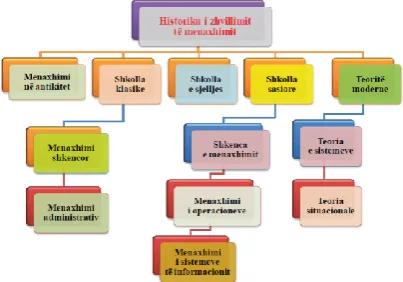
Thus, during this period conditions were created for a more systematic approach to management. Several scientists focused on various aspects of complex management phenomena. These efforts crystallized in the creation of three management schools: the classical school, the behavior school and the quantitative school. Recently we have the modern management theories that emerged.
Schematically, management development history and its respective schools, are given in Figure 1.
Figure 1. Management development background
SCIENTIFIC MANAGEMENT
of this trend. "In the past the man was the first, in future, system should be the first".
F. W. Taylor (1856-1915).
Taylor was an American engineer and management consultant, originator of the concept of "scientific management" to increase production. He drew public attention in 1880 when he reduced the number of workers in the extraction of coal without loss of production (in Bethlehem Steel Works, 500-140). According to Taylor, industrial production was lower than it should be due to two factors: deliberate simulation by workers and unscientific projection of labor practices by management. He said that workers would be obliged to make every effort at work by a combination of two factors: their motivation with higher salary, financed on the basis of high productivity, and close and continous monitoring of every of their movement, in order to become impossible to reduce the pace of work.
To achieve maximum productivity, Taylor proposed that instead of reducing the number of employees "unproductive" to a minimum (about 25% of all employees), efforts should be focused on supervision, monitoring, measurement and accounting. This was the beginning of class stratification in more and more specified layers, like; the one of supervising workers, of administrative workers, technical workers, etc., who began to enjoy the privileges and power over ordinary workers. The symbol of management methods became a stopwatch, which measured every movement, every step, every breath of workers.
Taylor, in his two major works, "Shop Management" (1903) and "Principles of Scientific Management" (1911), gave the following basic principles:
Close cooperation with the workers to ensure that all work was carried out in accordance with scientific principles.
Work was distributed almost equally between managers and workers. Managers take over the job that they do better than workers. In the past almost all of the work and major part of the responsibility was charged on workers.
Taylor's work gave high results not only in his company, but also in other companies where he later worked as an independent consultant. Besides Taylor, in the field of scientific management a number of other scholars contributed,among the most prominent are: H. Gantt (1861 - 1919); F. Gilbreth (1868 - 1924) and L.Gilbreth (1878 - 1972),
ADMINISTRATIVE MANAGEMENT
While scientific management focuses on the productivity of individuals, administrative classical approach focuses on the overall organization. The emphasis is more on the development of guiding principles, rather than working methods. Representatives of this thinking school are Max Weber, Henri Fayol, Mary Parker Follett and Chester I. Barnard. These theorists studied the flow of information within an organization and stressed the importance of understanding how an organization operates.
H. Fayol (1841 - 1925)
published in 1916. For his special contribution he is considered today as the founder of modern management theory.
Fayol classified of all business activities of their organizations in 6 functional groups:
1. Technical (production, processing) 2. Commercial (purchase, sale, exchange)
3. Financial (finding the best possible use of capital) 4. Insurance (protection of property and individual) 5. Accounting (balance sheet, inventory, cost, statistics) 6. Management.
All these groups of activities must work in a coordinated way to achieve organizational objectives. It is the duty of management activities, which are the most important to the organization to harmonize their work.
According to Fayol, five basic managerial functions are: planning, organization, command, coordination and control, a determination that retains its value even today, after nearly eight decades of work experience and study in the field of management.
The greatest contribution of Fayol are the 14 general principles of management. He noted that his principles were universal and applicable not only in business but also in politics, religion, military, or philanthropy. On the other hand, he claimed that the principles of management are not rigid but flexible and that there is no limit to the number of management principles that can influence the improvement of the work of an organization.
Fayol's principles:
The division of labor - Specialization, which increases
Authority and responsibility - These rights and tasks arise from the position that a manager holds in the hierarchy of management and should be in an equal mass between them.
Discipline - Fayol saw discipline as an important element that
encourages employees of organization to, obey, be diligent, increases energy and respect of the rules. Any deviation from agreements between employees and the company should be condemned by a hierarchy of measures defined in advance.
Unity of command - No subordinate should take instructions
and report to more than one superior, because such thing leads to confusion, it weakens discipline and violates the principle of authority.
Unity of direction - According to this principle all the
activities that have a common objective should have one manager and be included in the same plan.
Subordination of individual interest to the general
interest - the general interest of the organization is more
important than the interest of any employee or group of employees. There and then where such conflicts exist, the manager must try to find the appropriate way to harmonize them.
Remuneration - In determining the remuneration should
follow the principle of fairness and impartiality. It must be a such a mass that, according to specific opportunities, to satisfy as much as possible the self-interest of employees.
Centralization - Every manager, at every level of
management, should determine what to concentrate in his hands what to delegate to subordinates. While managers have ultimate responsibility for their own unit, subordinates are responsible to their supervisor for delegated authority.
Scalar chain - or otherwise, the chain of command,
The rule - a place for everything and everything in its place. Equality - managers should treat their subordinates with kindness and justice.4
Stability of staff - Managers must constantly look to have a
stable staff in the organization. Frequent removals or replacements are risky and costly to achieve the objectives set.
Initiative - Fayol defined the initiative as the ability to design
and implement an action plan. It is the duty of managers to encourage their staff to show initiative, that they feel themselves part of the organization's assets. Thus they will contribute more to the objectives.
"Esprit de corps" - Unity and harmony are a major force for any organization. This principle is an extension of the principle of unity of command with an emphasis on teamwork and the importance of communication.
According to Fayol to successfully implement management activities, every manager must have certain capacities. Thus, the lower in the hierarchy, the more his work depends on his technical capabilities and for high-level managers more important are the knowledge in administration area.
Other researchers who contributed in the development of administrative management are M. Weber (1864 - 1920), Ch. Barnard (1886 - 1961) and M. P. Follet (1868-1933).
TIME AND EFFICIENT MANAGEMENT OF TIME
When overall objectives are known, main tasks and roles to be performed, to the manager it is important to consider how to use time effectively. An aspect on the work of a manager is that the only real source for them is time. There are different variants that show how managers use time effectively, or spend
it meaningless. Consequently, this issue requires special attention. In this context, important issues present5:
1. Identification of priorities, 2. Work order,
3. Avoiding fatigue,
4. The need for managers to avoid loss of time to others.
Identifying Priorities
Time management of reactive managers may be ineffective due to the failure in identifying the priorities of their work. Perhaps the most inappropriate way to prioritize the work is to treat the last request in the beginning, regardless where this request derives from, or it relates to matters which are newly introduced. Unfortunately, there are many cases in which it is acted like that. Special attention should be paid when setting work priorities. In order to do that it is necessary to write and list them in a chronological way or grouped according to emergencies that they pose. Even well organized managers understand that they should respond and short-term pressures and crisis, but should have as constant reference clear possession of priority issues which deserve attention6.
Time to think about the work constitutes a particular problem for managers who are involved constantly in daily activities. However, managers need to find in one way or another the time to think about a more rational model activity, otherwise they have no chance to be effective. A problem that frequently occurs in organizations is that managers face many interruptions, which makes it difficult to find time to think in order to be focused and systematic about the work. It may be necessary that the focus be away from the workplace and use a secretary or other person to prevent interruptions.
Furthermore, it may be necessary to know persons who make continuous complaints and thus reduce the time needed for other purposes. It is one of the irrationalities of organizational life that people who spend time ineffectively are those who complain about how busy at work!7 In such cases it would be necessary to declare people at the beginning of the discussion, how much time they will have at their disposal.
Setting work priorities could include a careful analysis in the conflict between the manager's preferences and the needs of the situation. This is an issue that is addressed continuously. The consequences of inappropriate prioritization in some cases seriously threaten the survival of an organization. Personnel policies of organizations unfortunately, not always help to establish a balanced approach to their work.
Reasons for mismanagement of time
There are many reasons why managers fail to identify their priorities and the correct use of time. Analysis of roles explains how time can be used in a more effective manner. Causes for a bad use of time can be8:
Clarity of communication. Some individuals may be
more easily understood than others. But there is a risk of misunderstanding of the needs of some individuals who have trouble expressing their needs. Thus, managers will be more clearly understood by those who spend more time than is necessary.
Approximation. It is natural for people who prefer to
spend time with those who like friendship and share with them the same values. If this is exceeded, the activities of several units within the organization can be made unilaterally by not being well integrated with the overall organizational objectives.
7 Kaufman, C.J., Lane, P.M. and Lindquist, J.D. (1991), “Time congruity in the organization: a proposed quality of life framework”, Journal of Business and Psychology, Vol. 6, p. 79-106.
The conflict. People vary in their ability to address conflicts. Many individuals want to avoid them. However, it is important to highlight the different opinions and trying to find constructive solutions. It is also very important to make modifications in behavior with those colleagues where conflicts are more likely to emerge. This may require discussions on issues outside the context of work and if appropriate on social issues, in order to maintain and improve the relationship which was built. This helps maintain working relationships even when they are put "under pressure" from future conflicts.
Work preferences. People prefer to deal with the the
thing that makes them feel good and are safe with, when students learn about the exams they need to focus more on issues where they are weaker, but where the potential for improvement are greater than the issues that they like more.
Competence. Some important tasks can be quite
"demanding". It is important that people be selected carefully and their development shall treat particularly managerial responsibilities.
Changing priorities. In some cases, individuals
"suppress" in traditional priorities. Displacements of organizational priorities are not always officially declared9. Managers must analyze external pressure notably on the organization and conduct "opinion" like new priorities will emerge.
To assess the time and attention they require different individuals or groups, it is necessary to remember that in the wrong way can people may quite a lot of time in other cases less than they need e.g. subordinates may feel overcontrolled, while senior managers may not like to spend more time with subordinates10.
However, it is harmful to spend less time than it is required with the supervisor. Consideration should be taken into account about the time required to deal with individual reflection on his thoughts. Daily analyses of managers show that it is very difficult for them to find periods where they can concentrate on work or in reflective thoughts without any response. Such a time may be important if the manager also covers long-term planning.
CONCLUSIONS
The concept of time management begun to develop with the industrial revolution and became the modern notion of carrying out the tasks effectively and efficiently. This is one of the basic skills needed to be successful in life, but people, including business organizations failed to treat it as a serious factor for their survival.
Effective management of time we saw it affects improvement of productivity of employees, makes workload planning easier, makes the staff to perform duties in the highest level of their skills, helps staff prioritize and execute important tasks, registration and direction of the organization towards achieving its set goals.
Being well organized in connection with the use of time does not mean to achieve a certain level of quality. This level of quality can be achieved through learning, professional development, continuous practice and experience. Time will only work if the person is fully committed to the goals and removing any possible doubt.
way to work. If these two aspects can be achieved, then the level of effectiveness will be great.
Knowing the importance of time management and lack of significant research in this area undertook research to understand more about the importance that business organizations give to effective time management and the impact that effective management of time might have in increasing the business performance.
LITERATURE
Appelbaum, E., Bailey, T., Berg, P. dhe Kalleberg, A (2000); “Manufacturing advantage: why high performance work systems pay off”, Cornell University Press, Itaka, New York.
Barrett, Richard (2003) “Vocational Business: Training, Developing and Motivating People” Business & Economics.
Claessens, B, Roe, R. & Rutte (2009), „Time management: logic, effectiveness & challenges, In: Roe, R., Waller, M. & Clegg, S. (Eds), Time in organizational Research, London, Routledge, UK.
Cohen, R. (2004). Negotiating across cultures: International communication in an interdependent world (rev. ed.). Washington, DC: United States Institute of Peace. Currie, Wendy; Galliers Bon (1999) “Rethinking Management
Information Systems”, Oxford University Press.
Dervishi, Përparim; (2006) “Udhëheqja: Managers and Leaders”, ITAP, Tiranë.
Drucker, Peter (1977) “An Introductory View of Management”, New York.
Frank, L (1994), „Effective time management, „The Appraisal Journal, vol, 62 No 4.