ISSN (Print) : 2320 – 3765 ISSN (Online): 2278 – 8875
I
nternational
J
ournal of
A
dvanced
R
esearch in
E
lectrical,
E
lectronics and
I
nstrumentation
E
ngineering
(An ISO 3297: 2007 Certified Organization)
Vol. 5, Issue 11, November 2016
Near-Optimal Performance with a Significant
Reduction in the Complexity for MIMO
SC-FDMA Systems
R.T.Chaitra1, D.Krishna Naik2, S. Ravi Kumar3, Dr.V.Vijayalakshmi4
M.Tech Scholar, Dept. of ECE, PVKKIT, Affiliated to JNTUA, AP, India1
Associate Professor, Dept. of ECE, PVKKIT, Affiliated to JNTUA, AP, India2
Associate Professor, Dept. of ECE, PVKKIT, Affiliated to JNTUA, AP, India 3
Associate Professor, Dept. of ECE, PEC, Puducherry, India4
ABSTRACT:Large-scale multiple-input multiple output is termed to be one of the key technology in future generation
multiple cellular systems supporting the 3GPP LTE. LTE includes MIMO technology with orthogonal frequency division-multiple access technology surrounded by the downlink and single carrier-frequency division multiple access (SC-FDMA). This paper introduces a novel low-complexity multiple-input multiple-output (MIMO) detector tailored for single-carrier frequency division-multiple access (SC-FDMA) systems, suitable for efficient hardware implementations. The proposed detector starts with an initial estimate of the transmitted signal based on a minimum mean square error (MMSE) detector. Subsequently, it recognizes less reliable symbols for which more candidates in the constellation are browsed to improve the initial estimate. An efficient high-throughput VLSI architecture is also introduced achieving a superior performance compared to the conventional MMSE detectors. The performance of the proposed design is close to the existing maximum likelihood post-detection processing (ML-PDP) scheme, while resulting in a significantly lower complexity, i.e., and times fewer Euclidean distance (ED) calculations in the 16-QAM and 64-QAM schemes, respectively.
KEYWORDS: ASIC implementation, LTE, MIMO, PDP, SC-FDMA, soft decoding.
I. INTRODUCTION
ISSN (Print) : 2320 – 3765 ISSN (Online): 2278 – 8875
I
nternational
J
ournal of
A
dvanced
R
esearch in
E
lectrical,
E
lectronics and
I
nstrumentation
E
ngineering
(An ISO 3297: 2007 Certified Organization)
Vol. 5, Issue 11, November 2016
LTE, supports single-user spatial multiplexing of up to eight layers in the downlink and four layers in the uplink targeted to achieve peak data rates of 1 Gbps and 500 Mbps, respectively. The SC-FDMA utilizes a discrete Fourier transform-spread OFDM (DFT-S-OFDM) modulation with similar performance compared to the OFDM. Its main advantage is to provide a lower peak-to-average power ratio (PAPR), which makes it the technology of the choice for the uplink. However, the implementation of a MIMO detector in an SC-FDMA system is significantly more complicated than that of an OFDMA system. This occurs because that sent information is added due to the extra DFT block employed naturally in an SC-FDMA technique. Therefore, the implementation of a low-complexity MIMO detector is needed and is the main challenge in the SC-FDMA framework. Several have been proposed for SC-FDMA MIMO detectors among which the linear frequency domain equalizer (FDE) receivers, including the minimum mean square error (MMSE) and zero forcing (ZF), are often used due to their simplicity. Similar to the case of MIMO systems, successive interference cancellation and iterative techniques can be used to enhance the performance of receivers. However, these techniques introduce long delays due to their iterative nature. The maximum likelihood (ML) receiver also, offers an optimal bit error rate (BER) performance but incurs very high computational complexity particularly in the SC-FDMA receivers. Taking into account the negotiation between the BER performance and the complexity, normally suboptimal methods are engaged. In this paper, a recognition method is suggested for MIMO SC-FDMA systems, which provides near-optimal performance with an important decrease in the complication particularly for huge constellation sizes.
II. RELATED WORK
A FAST RECURSIVE ALGORITHM FOR OPTIMUM SEQUENTIAL SIGNAL DETECTION IN A BLAST SYSTEM
Jacob Benesty,Yiteng Arden Huang and Jingdong Chen (July 2003)
Bell Laboratories layered space-time (BLAST) wireless systems are multiple-antenna communication schemes that can achieve very high spectral efficiencies in scattering environments with no increase in bandwidth or transmitted power. The most popular and, by far, the most practical architecture is the so-called vertical BLAST (V-BLAST). The signal detection algorithm of a V-BLAST system is computationally very intensive. If the number of transmitters is M and is equal to the number of receivers, this complexity is proportional to 4 at each sample time. In this paper, we propose a very simple and efficient algorithm that reduces the complexity by a factor of M
ASIC IMPLEMENTATION OF SOFT-INPUT SOFT-OUTPUT MIMO DETECTION USING MMSE PARALLEL INTERFERENCE CANCELLATION
ChristophStuder,SchekebFateh and Dominik Seethaler (July 2011)
Multiple-input multiple-output (MIMO) technology is the key to meet the demands for data rate and link reliability of modern wireless communication systems, such as IEEE 802.11nor 3GPP-LTE. The full potential of MIMO systems can, however, only be achieved by means iterative MIMO decoding relying on soft-input soft-output (SISO) data detection. This paper describes the first ASIC implementation of a SISO detector for iterative MIMO decoding. To this end, we propose a low-complexity minimum mean-squared error (MMSE) based parallel interference cancellation algorithm, develop a suitable VLSI architecture ,and present a corresponding four-stream 1.5 mm detector chip in90 nm CMOS technology. The fabricated ASIC includes all necessary pre-processing circuitry and exceeds the 600 Mb/s peak data rate of IEEE 802.11n. A comparison with state-of-the-art MIMO detector implementations demonstrates the performance benefits of our ASIC prototype in practical system-scenarios.
A LOW-COMPLEXITY HIGH-THROUGHPUT ASIC FOR THE SC-FDMA MIMO DETECTORS K. Neshatpour, M. Mahdavi, and M. Shabany (May 2012)
ISSN (Print) : 2320 – 3765 ISSN (Online): 2278 – 8875
I
nternational
J
ournal of
A
dvanced
R
esearch in
E
lectrical,
E
lectronics and
I
nstrumentation
E
ngineering
(An ISO 3297: 2007 Certified Organization)
Vol. 5, Issue 11, November 2016
The performance of the proposed design is close to the existing maximum likelihood-post detection processing (ML-PDP) scheme, while achieving a significantly lower complexity, i.e., 450× less Euclidean distance (ED) calculations in 16-QAM. The ASIC implementation of the proposed architecture, the first ASIC for SC-FDMA detectors to-date, achieves a 3× higher throughput than the best design reported to-date.
III. EXISTING SYSTEM
The 3rd generation partnership project (3GPP) defined long term evolution (LTE) to meet the requirements of the 4G wireless communication. LTE combines multiple-input multiple-output (MIMO) technology with orthogonal frequency division-multiple access (OFDMA) technology in the downlink and single carrier-frequency division multiple access (SC-FDMA) in the uplink to achieve peak data rates of 300 Mbps and 75 Mbps, respectively. LTE-Advanced (LTE-A),which is an evolution of LTE, supports single-user spatial multiplexing of up to eight layers in the downlink and four layers in the uplink targeted to achieve peak data rates of 1 Gbps and 500 Mbps, respectively. The SC-FDMA utilizes a discrete Fourier transform-spread OFDM (DFT-S-OFDM) modulation with similar performance compared to the OFDM. Its main advantage is to provide a lower peak-to-average power ratio (PAPR), which makes it the technology of the choice for the uplink. However, the implementation of a MIMO detector in an SC-FDMA system is significantly more complicated than that of an OFDMA system. This is due to the fact that the transmitted data is mixed together because of the extra DFT block used naturally in an SC-FDMA system. Therefore, the implementation of a low-complexity MIMO detector is needed and is the main challenge in the SC-FDMA framework
IV. PROPOSED METHOD
ISSN (Print) : 2320 – 3765 ISSN (Online): 2278 – 8875
I
nternational
J
ournal of
A
dvanced
R
esearch in
E
lectrical,
E
lectronics and
I
nstrumentation
E
ngineering
(An ISO 3297: 2007 Certified Organization)
Vol. 5, Issue 11, November 2016
MIMO SC-FDMA MODEL
The MIMO single carrier FDMA design model has a transmitter and receiver which are discussed as follows.
A. TRANSMITTER
The transmitter side of a MIMO SC-FDMA system with Mt transmit and Mr receive antennae supporting K users as shown in figure 1.
The data stream on each transmit antenna is grouped into blocks of M symbols, as follows,
where the superscriptT represents the transpose operation,
nt is the antenna index, M is the DFT size, and S(k)nt represents the data on the transmit antenna nt for user k, whose
elements are chosen from Q-aray quadrature amplitude modulation (QAM) constellation. After the DFT operation, the frequency domain (FD) representation of data on antenna nt is obtained and is denoted by S(k)nt
B. RECEIVER
A conventional linear SC-FDMA detector for user K is depicted in Fig. 2. After the CP removal on antenna nt at
the SC-FDMA receiver with Mr receive antennae, the received signal is denoted as
The proposed system shown in figure 3 uses LBC (Linear Block Code) to detect and correct the error. Errors corrected in the message block. Encoded using more symbols with accurate original value. The LBC are used in forward error correction and applied in transmitting symbols on a communication channel. The dashed lines in the architecture denote a number of the pipelining stages. The inputs of the architecture are the channel coefficients, the outputs of the MMSE detector, and the received FD signals at the receiver. In fact, the “H” inputs represent the values of all the terms in the t-th row in Heff at the t-th clock cycle, the
Figure3 Proposed architecture
“Z” inputs are the outputs of the first stage, and the “Y” input represents the t-th element in Y at the t-th clock cycle.
The architecture performs the detection in clock cycles.
ISSN (Print) : 2320 – 3765 ISSN (Online): 2278 – 8875
I
nternational
J
ournal of
A
dvanced
R
esearch in
E
lectrical,
E
lectronics and
I
nstrumentation
E
ngineering
(An ISO 3297: 2007 Certified Organization)
Vol. 5, Issue 11, November 2016
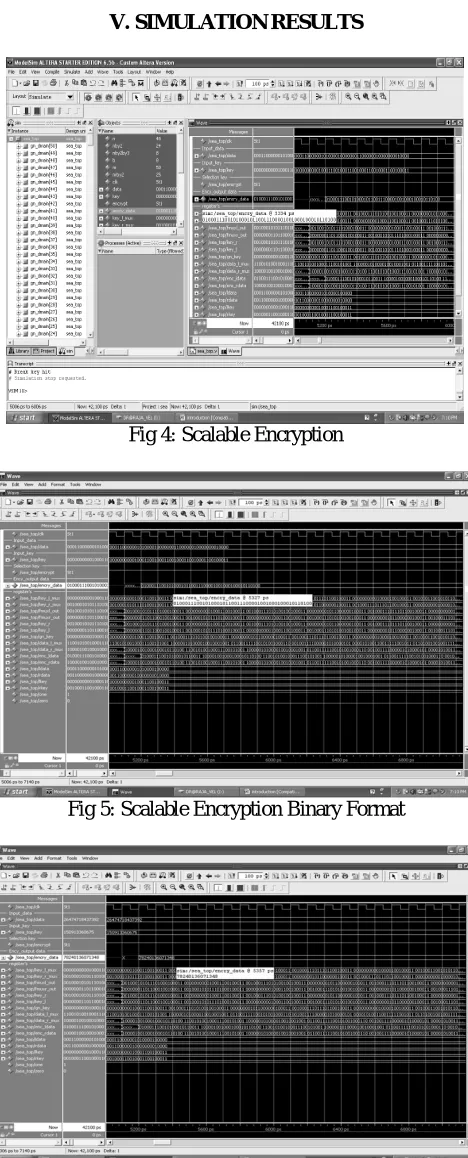
V. SIMULATION RESULTS
Fig 4: Scalable Encryption
Fig 5: Scalable Encryption Binary Format
ISSN (Print) : 2320 – 3765 ISSN (Online): 2278 – 8875
I
nternational
J
ournal of
A
dvanced
R
esearch in
E
lectrical,
E
lectronics and
I
nstrumentation
E
ngineering
(An ISO 3297: 2007 Certified Organization)
Vol. 5, Issue 11, November 2016
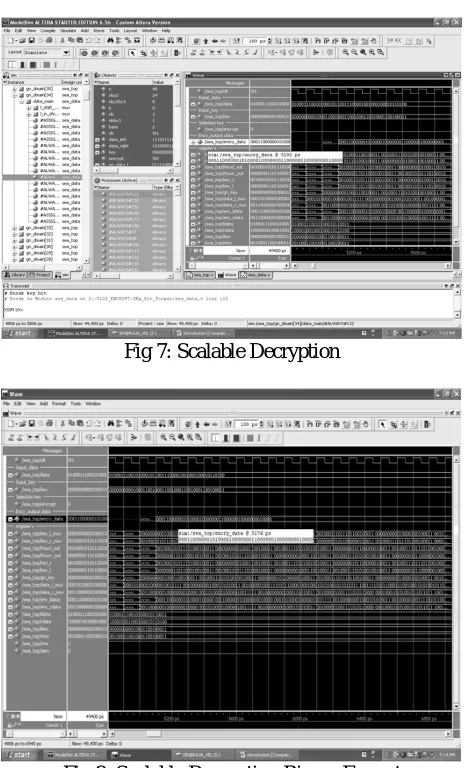
Fig 7: Scalable Decryption
ISSN (Print) : 2320 – 3765 ISSN (Online): 2278 – 8875
I
nternational
J
ournal of
A
dvanced
R
esearch in
E
lectrical,
E
lectronics and
I
nstrumentation
E
ngineering
(An ISO 3297: 2007 Certified Organization)
Vol. 5, Issue 11, November 2016
VI. CONCLUSION
The BER performance of the proposed detection scheme is close to ML-PDP while the reduction in the complexity is significant in large constellation sizes. A soft decoding MIMO detector with reasonable complexity was also implemented for a MIMO SC-FDMA coded system, resulting in significant enhancement in the performance. In future, the BER (Bit error Ratio) performance of the proposed detection scheme is close to Previous Methods that has been implemented while the reduction in the complexity is significant in large constellation sizes. A soft decoding MIMO detector with reasonable complexity was also implemented for a MIMO SC-FDMA coded system, resulting in significant enhancement in the performance. By using both the Soft and Hard Decoding methods the given sample BER (Bit error Ratio) could be comparatively reduced and so the complexity of the system.
REFERENCES
[1] Z. Pan, G. Wu, S. Fang, and D. Lin, “Practical soft-SIC detection for MIMO SC-FDMA system with co-channel interference,” inProc. Int. Conf. Wireless Commun. Signal Process. (WCSP), Oct. 2010, pp. 1–5.
[2] K. Neshatpour, M. Mahdavi, and M. Shabany, “A low-complexity high-throughput asic for the sc-fdma mimo detectors,” inProc. IEEE Int. Symp. Circuits Syst. (ISCAS)., May 2012, pp. 3065–3068.
[3].Ferdian, K. Anwar, and T. Adiono, “Efficient equalization hardware architecture for SC-FDMA systems without cyclic prefix,” inProc. Int. Symp. Commun. Inf. Technol. (ISCIT), Oct. 2012, pp. 936–941.
[4] H. Noh, M. Kim, J. Ham, and C. Lee, “A practical MMSE-ML detector for a MIMO SC-FDMA system,”IEEE Commun. Lett., vol. 13, no. 12, pp. 902–904, Dec. 2009.
[5] X. Liu, X. He, W. Ren, and S. Li, “Evaluation of near MLD algorithms in MIMO SC-FDMA system,” in Proc. Int. Conf. Wireless Commun. Netw. Mobile Comput (WiCOM), Sep. 2010, pp. 1–4.
[6] S. Lim, T. Kwon, J. Lee, and D. Hong, “A new grouping-ML detector with low complexity for SC-FDMA systems,” inProc. IEEE Int. Conf. Commun. (ICC), May 2010, pp. 1–5.
[7] X. N. Tran, A. T. Le, and T. Fujino, “Performance comparison of MMSE-SIC and MMSE-ML multiuser detectors in a STBC-OFDM system,” in Proc. IEEE Int. Symp. Pers., Indoor, Mobile Radio Commun. (PIMRC), Sep. 2005, vol. 2, pp. 1050–1054.
[8] H. Noh, M. Kim, J. Ham, and C. Lee, “A practical MMSE-ML detector for a MIMO SC-FDMA system,”IEEE Commun. Lett., vol. 13, no. 12, pp. 902–904, Dec. 2009.
[9] X. Liu, X. He, W. Ren, and S. Li, “Evaluation of near MLD algorithms in MIMO SC-FDMA system,” in Proc. Int. Conf. Wireless Commun. Netw. Mobile Comput (WiCOM), Sep. 2010, pp. 1–4.
[10] S. Lim, T. Kwon, J. Lee, and D. Hong, “A new grouping-ML detector with low complexity for SC-FDMA systems,” inProc. IEEE Int. Conf. Commun. (ICC), May 2010, pp. 1–5.
[11] X. N. Tran, A. T. Le, and T. Fujino, “Performance comparison of MMSE-SIC and MMSE-ML multiuser detectors in a STBC-OFDM system,” in Proc. IEEE Int. Symp. Pers., Indoor, Mobile Radio Commun. (PIMRC), Sep. 2005, vol. 2, pp. 1050–1054.
[12] S. Yoshizawa, Y. Yamauchi, and Y. Miyanaga, “A complete pipelined MMSE detection architecture in a 4 4 MIMO-OFDM receiver,” in Proc. IEEE Int Symp Circuits Syst. (ISCAS), May 2008, pp. 2486–2489.
BIOGRAPHY
R.T.CHAITRA. she received B.Tech degree in Electronics and Communication Engineering from
ISSN (Print) : 2320 – 3765 ISSN (Online): 2278 – 8875
I
nternational
J
ournal of
A
dvanced
R
esearch in
E
lectrical,
E
lectronics and
I
nstrumentation
E
ngineering
(An ISO 3297: 2007 Certified Organization)
Vol. 5, Issue 11, November 2016
Mr. Krishna Naik D. He received B.Tech degree in Electronics and Communication
Engineering from Sri Venkateswara University, Tirupati, Andhra Pradesh, India. M.E, degree in Digital Systems Engineering from University College of Engineering (A), Osmania University, Hyderabad, India and Pursuing PhD at R&D cell Pondicherry Engineering College, Affiliated to Pondicherry Central University, Puducherry, India, in the area of Low power VLSI. He is currently working as Associate Professor in Department of Electronics & Communication Engineering at P.V.K.K Institute of Technology, Anantapur, Andhra Pradesh, India. His research areas are VLSI Design, Digital Systems, Wireless Communication and Optical Communication.