ABSTRACT
GIERKA, ROBERT EUGENE. A Case Study of Veterinary Technology Students’ Experience of Continuing Human-Animal Bonds. (Under the direction of Dr. Carol Kasworm).
The purpose of this case study was to explore veterinary technology (vet tech) students’ perceptions of their special relationships with pets that died; and to better understand how these perceptions influenced their work in the vet tech program and their beliefs about their future work with pets and pet owners in veterinary practice. The following research questions were explored: 1) what are vet tech students’ perceptions of a special relationship with a pet that died; and 2) what beliefs do vet tech students hold about these perceptions and their work in the vet tech program and their future work with pets and pet owners. A conceptual model based on the continuing bonds theory of bereavement served as a framework for the study.
Qualitative data were obtained from audio-recorded interviews with 16 vet tech students enrolled in a two-year vet tech program. The researcher asked open-ended questions to elicit detailed understandings and analyzed the data using open and theoretical coding to identify patterns and themes in the data.
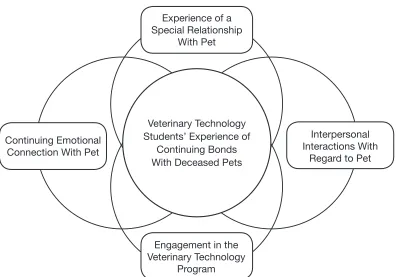
Four key findings emerged from the data: 1) participants experienced special relationships with their pets that died; 2) participants experienced continuing emotional bonds with their pets that died; 3) participants experienced supportive and unsupportive interpersonal interactions with regard to their pets; and 4) participants' love of animals and continuing bonds with their pets influenced their engagement in the vet tech program.
continuing bonds with their pets had a positive, generative influence on their desire to help pets and pet owners. Third, participants expressed a deeply felt calling to pursue careers in veterinary medicine.
A Case Study of Veterinary Technology Students’ Experience of Continuing Human-Animal Bonds
by
Robert Eugene Gierka
A dissertation submitted to the Graduate Faculty of North Carolina State University
in partial fulfillment of the requirements for the Degree of
Doctor of Education
Adult and Community College Education
Raleigh, North Carolina
2015
APPROVED BY:
______________________________ ______________________________
Carol Kasworm, EdD Barbara Ambros, PhD
Committee Chair
DEDICATION
Dedicated in loving memory to my mother, Helen, who never met
BIOGRAPHY
Robert (Rob) Gierka received his Bachelor of Arts degree in Rhetoric and
ACKNOWLEDGEMENTS
I am grateful to all the people who have supported me on this journey. This work would not have been possible without the support of 16 dedicated veterinary technology students who shared their incredible stories of enduring love for their pets.
I owe special thanks to the late Dr. Colleen Weissner, who supported me at the start of my doctoral journey, and to my dissertation chair, Dr. Carol Kasworm, for her support and encouragement to complete the journey. Thanks also to my doctoral committee – Dr. Barbara Ambros, Dr. Jennifer Campbell, and Dr. Matthew Militello – for their time and helpful feedback. My time in NC State’s College of Education was marked by a good deal of hard work, learning, laughter and sharing with colleagues and friends.
Certainly this work would not have been possible without the steadfast support of Vanessa Budnick of the SPCA of Wake County. I would also like to thank the many pet owners whose stories of love for their pets inspired this work.
TABLE OF CONTENTS
LIST OF TABLES... viii
LIST OF FIGURES ... ix
CHAPTER ONE: INTRODUCTION... 1
Mollie’s Story ... 1
Introduction to the Study ... 2
The Significance of the Human-Animal Bond ... 4
Bereavement and the Human-Animal Bond ... 5
A Change in the Science of Bereavement: Continuing Bonds ... 6
Continuing Bonds and the Human-Animal Bond... 9
Responses to Pet Bereavement in Veterinary Education... 10
Purpose of the Study ... 12
Conceptual Framework... 13
Connecting Emotionally With a Deceased Pet ... 14
Communicating Emotional Connections to Create Social Meanings... 15
Coping With the Death of a Pet ... 16
Research Questions... 17
Significance... 18
Limitations of the Study... 19
Summary ... 20
CHAPTER TWO: LITERATURE REVIEW... 22
The Human-Animal Bond and Social Engagement With Pets ... 24
Attachment Theory ... 30
Detachment and Continuing Bonds Theories of Bereavement... 31
Detachment Theory of Bereavement ... 32
Continuing Bonds Theory of Bereavement ... 34
Continuing Bonds Theory and Pet Bereavement... 37
Continuing Bonds Theory and Veterinary Education... 39
CHAPTER THREE: METHODOLOGY ... 44
Case Study Method ... 44
Sampling ... 46
Purposive Sampling ... 46
Selection Criteria ... 46
Research Participants ... 48
Institutional Review ... 49
Data Collection ... 49
Data Analysis Methodology ... 53
Trustworthiness, Validity, and Reliability ... 55
Ethical Considerations ... 57
Researcher Bias... 57
Summary ... 59
CHAPTER FOUR: FINDINGS... 61
Study Site and Participant Demographics... 62
Overview of Findings ... 65
The Experience of a Special Relationship With a Pet ... 69
A Unique Relationship... 70
Terms of Endearment... 73
Emotional Attachments With Pets ... 77
Grief Responses to the Death of the Pet ... 81
Continuing Bonds: Expressions of Attachment... 84
Behaviors Associated With the Continuing Bond ... 84
Thoughts and Physical Sensations Associated With the Continuing Bond... 87
Interpersonal Interactions With Regard to the Pet... 88
Pets as Family Members or Commodities ... 89
Sympathetic and Unsympathetic Responses to Pet Loss... 97
Continuing Interpersonal Interactions Regarding the Pet During the Years Following its Death ... 105
Engagement and a Love of Animals... 108
Engagement and Continuing Bonds... 109
Summary ... 123
CHAPTER FIVE: CONCLUSIONS, IMPLICATIONS, AND RECOMMENDATIONS... 126
Summary of Findings... 128
Key Conclusions ... 131
Perceptions of Continuing Bonds Were Socially Influenced ... 132
The Generative Influence of the Continuing Bond... 147
A Calling to be a Vet Tech ... 150
Implications and Recommendations for Research and Practice ... 152
Implications and Recommendations for Research... 153
Implications and Recommendations for Education Practice ... 156
Summary ... 170
REFERENCES ... 172
APPENDICES ... 191
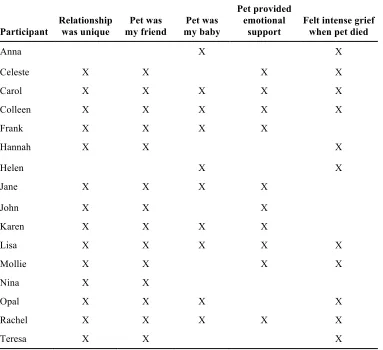
Appendix A: Contributing Factors to Veterinary Technology Students’ Experience of a Special Relationship With a Pet That Died ... 192
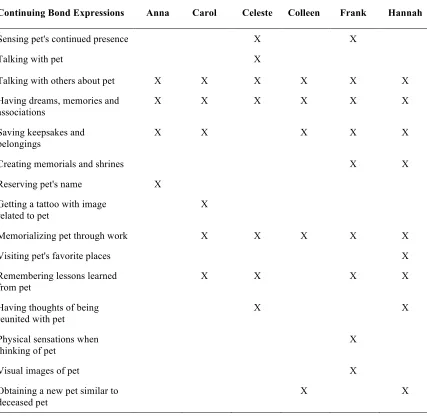
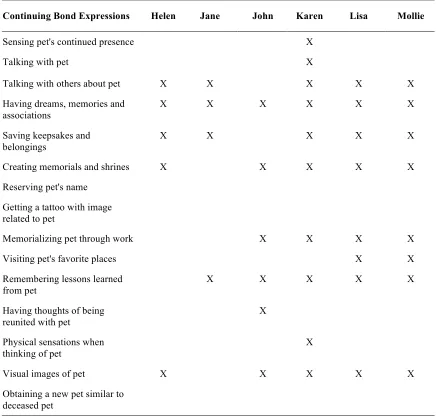
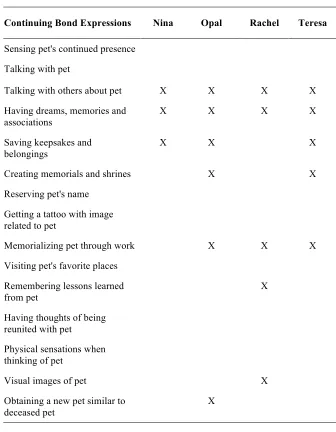
Appendix B: Continuing Bond Expressions by Participant... 193
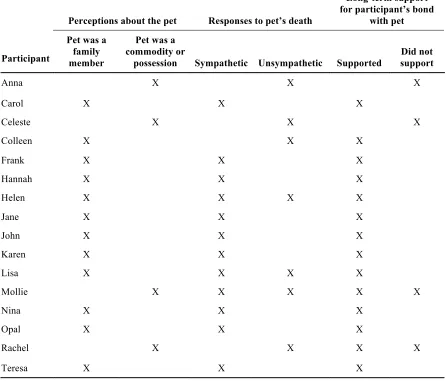
Appendix C: Veterinary Technology Students’ Interpersonal Interactions With Regard to Their Pets... 196
Appendix D: Factors That Influenced Student Engagement in the Veterinary Technology Program... 197
Appendix E: Years Since Pet’s Death by Participant ... 198
Appendix F: Classroom Recruitment Presentation... 199
Appendix G: Participant Recruitment Letter ... 201
Appendix H: Informed Consent Form for Research... 202
Appendix I: Participant Questionnaire... 204
Appendix J: Interview Guide for Semi-Structured Interviews ... 205
LIST OF TABLES
Table 1 Demographics of Veterinary Technology Student Participants,
Pet Pseudonyms and Species ...64 Table 2 Contributing Factors to Veterinary Technology Students’
Experience of a Special Relationship With a Pet That Died ...192 Table 3 Continuing Bond Expressions by Participant ...193 Table 4 Veterinary Technology Students’ Interpersonal Interactions
With Regard to Their Pets...196 Table 5 Factors that Influenced Student Engagement in the Veterinary
LIST OF FIGURES
Figure 1 Conceptual framework of the continuing bonds theory of bereavement...14 Figure 2 A conceptual model of the human-animal bond ...27 Figure 3 Conceptual model of veterinary technology students’
CHAPTER ONE: INTRODUCTION
People love to tell stories about their pets. In the following pages, you'll hear 16 stories and meet the students who told them. You’ll hear stories about hamsters, dogs, and cats, horses, pigs and rats. Each story begins with love and joy and a very special
relationship. Death and heartbreak are also part of the stories, but not the end of them. In the end is love. For these students, their pets remained a living and loving presence in their lives. They continued to love their pets and passionately expressed their love through their
schoolwork and in their calling to the veterinary profession. Engaged and empowered through continuing bonds with their pets, these students studied hard and looked forward to the day when they would become veterinary technicians (vet techs) and help pets and pet owners. We begin these stories of love, loss and love again with Mollie and Honey.
Mollie’s Story
Small in stature but strong and resilient, Mollie spoke with a distinctive twang as she told stories about her quarter horse Honey and life on the family farm. For Mollie, there was no other horse like Honey. “She wanted to play all the time,” Mollie said. “She was very, very playful. And she was full of life. And I ain’t never seen a horse with the personality she had. She had a one-of-a-kind personality.” Mollie rode Honey in competition, and, together, they won many awards. She also had a dog, Buck, and the three took walks together around the farm. “They were my best friends,” she said.
keep their connection alive by recalling the happy times they shared. “I know she’s gone. I understand that part,” she said. “... [When] I found out she died and sitting there and remembering the feelings that I had that time, that’s the part that hurts. But...I have joy in remembering her.”
Mollie finds inspiration for her work in Honey:
Sometimes when I get stressed out over my classes and stuff, I’ll look back at…the pictures of Honey and me, and I’m like, “Gotta do it.” Because there’s going to be a little girl one day…who loves her little pony so much, and her pony’s going to be sick…. And [she’s going to] end up calling the veterinarian and me, and I want to save that pony for that little girl. So basically I want to do for someone else [what] couldn’t be done for me.
Introduction to the Study
In the past few decades the meanings that Americans ascribe to pets have undergone significant change. Part of this change is the greater emotional attachment that Americans experience with pets. As attachment to pets has grown, interest in the study of human-animal attachment has increased. A concern of human-animal studies is the grief pet owners
experience for the death of a pet and the need for emotional support.
of grief” theory of bereavement (see McCurnin and Bassert, 2014). This theory is based upon Freudian psychoanalytic theory (Freud, 1957), which argues that human grief resolves in detachment (see Worden, 1982; Walsh & McGoldrick, 2004). However, the detachment theory currently used in veterinary bereavement education fails to account for or utilize a new understanding of bereavement represented by continuing bonds theory.
The continuing bonds theory of bereavement challenges Freudian conceptions of bereavement by claiming that the maintenance of a continuing emotional connection with a deceased loved one is normative human behavior and constitutes healthy coping and loss recovery (Silverman & Klass, 1996). In recent bereavement research, the experience of a continuing emotional connection with a deceased loved one has been suggested to apply within a context of pets and the human-animal bond (Carmack & Packman, 2011; Packman, Field, Carmack & Ronen, 2011).
This study may offer direction for future research into the continuing human-animal bond and veterinary education as well as the development and delivery of educational materials based on continuing bonds theory. In addition, this study has potential value for veterinary practice. The ability of vet techs to provide effective emotional support for grieving pet owners based on continuing bonds theory may have a significant impact on client satisfaction.
In this chapter, five areas of concern for this study are explored: the significance of the human-animal bond in Western society; bereavement and the human-animal bond; traditional and contemporary theories of bereavement; the continuing bonds theory of bereavement relative to the human-animal bond; and veterinary education efforts regarding pet loss and bereavement. In addition, this chapter outlines the study purpose, research questions, conceptual framework, significance and limitations.
The Significance of the Human-Animal Bond
Interest in the human-animal bond, or the emotional connection between humans and animals, has increased in recent decades. Over the past 20 years, colleges and universities have implemented 23 Human-Animal Study (HAS) programs internationally and eight HAS programs veterinary schools in North America (Shapiro & DeMello, 2010).
The human-animal bond has been studied in a wide variety of human-animal relationships. It has been the focus of much research of late on the connection between humans and a wide variety of animal species. For example, researchers have studied
The emotional connection that humans have with animals and the sense of wellbeing that this connection offers is voiced in the American Veterinary Medical Association’s definition of the human-animal bond. The American Veterinary Medical Association (1998) defines the human-animal bond as:
a mutually beneficial and dynamic relationship between people and animals that is influenced by behaviors that are essential to the health and well-being of both. This includes, but is not limited to, emotional, psychological, and physical interactions of people, animals, and the environment. (p. 1675)
Research supports the position that Americans have strong emotional attachments to their pets. The emotional connection that pet owners have with their animals is described as deep and meaningful (Meyers, 2002). Serpell (2002) points to a 1996 survey by the
American Animal Hospital Association and writes that, “nearly half of the women…said that they relied more on their dogs and cats for affection than on their husbands or children” (p. 84). Further, the National Pet Owner’s Survey by the American Animal Hospital Association (2004) found that 97% of American families regard their pet as a family member.
Bereavement and the Human-Animal Bond
that a strong attachment bond with a pet can significantly predict psychological distress in the owner when the animal dies (Field, Orsini, Gavish, & Packman, 2009; Kaufman & Kaufman, 2006; Margolies, 1999). The National Pet Owners Survey (2004) found that the death of a pet can result in a similar grief response as might result from the death of a human family member. Other research asserts that the grief reaction to the death of a significant animal companion is comparable to the grief reaction to the death of a significant human companion (Archer, 1997; Carmack, 2003; Clements, Benasutti, & Carmone, 2003; Cowles, 1985; Field, 2008; Gerwolls & Labott, 1994; Field et al., 2009). When losing a companion animal,
“…you can expect to grieve for your pet as you would for a human family member” (Quackenbush & Graveline, 1985, p. 34).
A Change in the Science of Bereavement: Continuing Bonds
Given the increased emotional attachment Americans have with their pets and the significant grief they can experience when pets die, a deeper understanding of recent changes in the science of bereavement is needed. Evolving understandings of the way humans cope with loss are gaining ground, leading to new insight in the science of bereavement. Interest is growing in the new field of continuing bonds, which is a sub-area of attachment theory (Bowlby, 1969, 1973, 1980, 1982).
The capacity to make intimate emotional bonds with other individuals, sometimes in the careseeking role and sometimes in the caregiving one, is regarded as a principal feature of effective personality functioning and mental health. (pp. 120-121)
During his development of attachment theory, Bowlby (1980) studied the psychological effects of human separation and death. He observed that both adults and children experience continuing thoughts and fantasies about a lost love object well after the loss of the object. Bowlby (1980) suggested that continuing thoughts and fantasies about a deceased loved one are not forms of pathological mourning and grief because pathological forms are not defined by a continuing psychological relationship with the love object.
A subset of attachment theory, the continuing-bonds perspective of bereavement is challenging traditional detachment conceptions of bereavement and loss recovery.
Detachment theories of loss and bereavement, grief and mourning generally focus on detachment from a significant attachment object (Lindemann, 1944; Freud, 1957). In detachment theories, loss recovery is characterized as the culmination of a process of psychologically separating from a love object. These theories describe recovery as doing one’s “grief work,” gradually processing and divesting the psychological energy (libido) that is invested into a relationship with a love object (Freud, 1957). For examples of detachment theories of bereavement, see the work of Lindemann (1944) and Freud (1957).
psychologically reorganizing the relationship as an internal attachment object and continuing an emotional connection with that object (Field, 2008). Research supports the idea that bereavement and recovery entails the maintenance of a continuing emotional connection with a lost love object. Rees (1971) found that 50% of bereaved individuals regularly sensed the presence of their deceased partner up to ten years after their loss. Similarly, a study by Shuchter and Zisook (1993) found that bereaved widows and widowers frequently felt the “presence” of their deceased spouses and regularly interacted with them in dreams and in conversations.
Others suggest that psychological recovery and coping may be achieved through maintaining some form of continuity in the relationship with a deceased love object (e.g., Bowlby, 1969, 1973, 1980, 1982; Gaines, 1997; Hagman, 1995, 2001; Kaplan, 1995; Parkes, 1970, 2009; Parkes & Weiss, 1983). A new acceptance has emerged in the field of
Continuing Bonds and the Human-Animal Bond
In recent bereavement research, the experience of a continuing emotional connection with a deceased loved one has been suggested to apply within a context of human-animal bonds (Carmack & Packman, 2011; Packman et al., 2011). From a continuing human-animal bonds perspective, grief for the death of a pet is not resolved by working to “get over” the loss, by forgetting the pet, or by getting a new pet. Rather, a person copes with their loss through reorganized meanings (Silverman & Klass, 1996). These meanings find their
expression in the beliefs and actions of bereaved pet owners. Researchers have proposed that continuing-bond expressions (CBE) demonstrated by some pet owners after a pet’s death help them cope with their grief (Packman et al., 2011). Types of CBE include talking with the deceased pet; creating memorials, shrines or tributes; or having thoughts of being reunited with a pet (Packman et al., 2011). Through these expressions, human-animal attachment bonds are creatively reworked to transform the loss into “an internal
representation that is based on meaning, memory, or emotional connection” (Packman et al., 2011, p. 338).
Other research into the continuing human-animal bond has addressed the grief
(Doka, 1989). Field et al. (2009) suggests that, although the majority of Americans who lose a pet maintain a continuing bond with the animal, many are afraid to express their continuing connection for fear they will be thought of as “crazy.”
A growing body of bereavement literature has also addressed the value of continuing bonds as a coping mechanism for the loss of a pet. This literature holds that the grieving individual may draw emotional sustenance by maintaining a continuing emotional bond to the deceased (Field et al.,1999). Researchers also suggest that grieving pet owners could receive validation for their feelings through supportive encouragement to share their continuing bond experiences in a safe, non-judgmental environment (Field et al., 2009). However, research also indicates that bereavement support providers and others who interact with grieving pet owners are not well prepared to deal with grief associated with pet loss. One study reported that bereaved pet owners believe that veterinarians display considerably less support for their feelings of grief than partners or spouses (Field et al., 2009). Similary, a quantitative study of pet loss (Packman et al., 2011) found that:
The greatest source of support for our respondents was spouses/partners and pets. These respondents received considerably less support from clinicians, clergy/spiritual counselors, and veterinarians. (p. 350)
Responses to Pet Bereavement in Veterinary Education
emotional attachment people have with their pets and the grief that comes from losing them. Part of this support includes increased bereavement care for clients who experience pet loss (JAVMA News, 2007).
In addition, increasing numbers of American veterinary colleges and universities are responding to the need for bereavement support for pet owners by including training in end-of-life and bereavement care to educate students who will interact with bereaved pet owners in their work. For example, a review of veterinary programs in the United States shows that, within a span of a decade, 96% of the 28 veterinary colleges in the country have added at least some bereavement training to the curriculum (Dickinson, 2010). Dickinson also found that 80% of veterinary students were exposed to bereavement instruction. This new
educational emphasis reflects a significant change in veterinary education curricula. Slightly more than two decades prior, a study by Weirich (1988) reported a complete absence of end-of-life or bereavement education in veterinary schools.
Because this study is focused on vet techs, it is also important to consider how vet tech educational programs address pet loss and bereavement. Objectives of a vet tech introductory course include pet loss and its impact on clients (Sherrod, 2013). In addition, a popular book for training vet techs (McCurnin and Bassert, 2014) addresses pet loss and bereavement, but focuses on the detachment theory of bereavement and does not include any information on the continuing bonds theory of bereavement. Research indicates that
In summary, in response to the increased emotional attachments Americans maintain with their pets, veterinary education has bolstered the training of veterinary practitioners and support personnel in bereavement concepts and support. In veterinary practice, bereavement support is typically the responsibility of vet techs. Vet tech training focuses on traditional detachment theories of bereavement and does not currently incorporate a continuing bonds view of bereavement.
Purpose of the Study
The purpose of this study was to explore vet tech students’ perceptions of their special relationships with pets that died; and to better understand how these perceptions influenced their work in the vet tech program and their beliefs about their future work with pets and pet owners in veterinary practice.
Bereavement for the loss of a pet is a relevant topic of study because of its
significance to a large and growing population of Americans who keep pets. Pets are growing in popularity as intimate companions and trusted family members. However, the loss of a pet can lead to intense feelings of sadness and grief for pet owners as well as social alienation, isolation and loneliness. Research indicates that the grief felt for the death of a pet is
Existing research does not address vet tech students’ perceptions of their continuing bonds with their deceased pets nor how these perceptions influence their beliefs about their work in veterinary medicine. Vet techs are a relevant audience for this study because they are often responsible for working with bereaved pet owners in veterinary practice. This study adds to the literature by offering an in-depth exploration of vet tech students’ personal experience of continuing emotional connections with their pets. In addition, this study appears to be the first to explore the impact of vet techs' experience of continuing bonds on their beliefs about their work.
Conceptual Framework
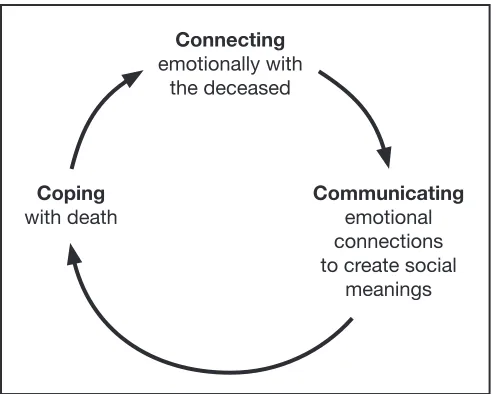
Most humans normatively experience an emotional connection with a loved one after loss. Researchers who study this experience call it continuing bonds. The experience of a continuing bond is suggested for humans who experience the death of a pet (Field et al., 2009). This study used a conceptual framework based on the researcher’s interpretation of continuing bonds theory in exploring vet tech students’ experience of continuing emotional connections with their deceased pets and how these experiences influenced their beliefs about their work in the vet tech program. The conceptual framework identified three social
connection with the deceased pet and communicating this connection to others. This conceptual framework is presented in Figure 1.
Figure 1. Conceptual framework of the continuing bonds theory of bereavement.
The three activities outlined in the conceptual framework are explored in the following sections: 1) connecting emotionally with a deceased pet; 2) communicating emotional connections to create social meanings; and 3) coping with the death of a pet. Connecting Emotionally With a Deceased Pet
Literature suggests that a continuing human-animal bond is a personal experience of emotional connection with a deceased companion animal, not a social experience. According to Silverman and Klass (1996), the continuing bonds theory holds that “the bereaved remain involved and connected to the deceased, and that the bereaved actively construct an inner representation of the deceased that is part of the normal grieving process” (p. 16).
Connecting emotionally with
the deceased
Coping with death
Communicating emotional connections to create social
In contradistinction to the detachment theory of bereavement, which focuses on a process of severing connections and moving on from the lost loved one, the continuing bonds theory focuses on activities or behaviors of survivors constructing and maintaining an
internal representation of the deceased. Shuchter and Zisook (1993) describe continuing bonds activity as symbolizing “living and breathing” connections with the deceased as internal forms and images. For a bereaved pet owner, this connection might take conceptual form, such as the idea of a horse’s spirit; feelings or sensations, such as the remembered sound of a dog’s bark; and physical objects such as a dog’s favorite toy.
Communicating Emotional Connections to Create Social Meanings
The social interaction in which a bereaved person shares private forms and images of their ongoing emotional connection to a deceased pet with others is a critical activity of continuing bonds. People engaged with the bereaved in this activity witness and participate in the individual’s personal story of connection. This can take the form, for example, of a family memorial service for a deceased pet or a wider community activity, such as a “blessing of the animals.”
A primary means by which bereaved individuals communicate their emotional connection with a deceased companion is through storytelling. Nadeau (1998, 2001) studied the meaning making of bereaved families who had lost a human companion and grouped her findings into sense-making strategies, a typology of meaning making, and patterns of
activities of recalling stories and sharing memories as a means of constructing and
maintaining ongoing connections with a deceased loved one (Gowensmith, 1999; Castle & Phillips, 2002; and Hedtke, 2002). Significant for this study, research into human-animal relationships suggests that storytelling and sharing memories provide coping value for bereaved pet owners (Blazina, 2011).
Coping With the Death of a Pet
disenfranchised grief, which can complicate bereavement and result in feelings of isolation and alienation (Doka, 1989).
In summary, according to this study’s conceptual framework of continuing bonds, coping with pet death is predicated on a grieving individual’s continuing emotional connection with a deceased pet and the responses of others to the individual’s loss experience.
Research Questions This study explored the following research questions:
• What are vet tech students’ perceptions of a special relationship with a pet that died?
• What beliefs do vet tech students hold about these perceptions and their work in the vet tech program and their future work with pets and pet owners?
Because this study was participant focused, it was concerned with understanding the participants’ experiences, and it adopted an interpretive, hermeneutic approach (see Dilthey, 1976; and Gadamer, 1975). Interpretive social research is rooted in the German idealist tradition, which has the salient feature of challenging the validity of researcher-focused, functionalist approaches. That is, interpretive research seeks to understand subjective human experience “within the realm of individual consciousness and subjectivity, within the frame of reference of the participant as opposed to the observer of action” (Burrell & Morgan, 1979, p. 28).
Significance
The present study is one of only a few studies that has specifically explored and explicated continuing bonds in regard to the loss of a companion animal. Continuing human-animal bonds is an important topic of study because of its significance to a large and growing population of Americans who have strong emotional attachments to their pets and struggle to cope with the loss of their pets.
loss, veterinary educators may gain insight into the development and delivery of programs and course materials based on continuing bonds theory.
This study also has potential value for veterinary practice. The ability of vet techs to provide effective emotional support for grieving pet owners based on continuing bonds concepts may have a significant impact on client satisfaction. Veterinary practice managers may have a vested interest in understanding vet techs’ personal experiences of pet loss and how these experiences inform their approach to bereavement support. In addition, study findings are also relevant to other practitioners who may work with individual's grieving the loss of a pet, such as counselors, social workers, and clergy. Such individuals may benefit from training in continuing bonds with a focus on pet loss and berevement.
Limitations of the Study
Limitations exist for all research studies and may spring from various sources. This study, which used qualitative methodology and case study, was no exception. Limitations may spring from both the qualitative method or from case study.
unable to generate verifiable truth claims. However, all qualitative research risks the same criticism from a strictly positivist view of social science. Qualitative researchers generally dismiss this perceived limitation as “an attempt to legislate one version of truth over another” (Denzin & Lincoln, 2011, p. 2). Moreover, qualitative research method is well suited to case study since it eschews separation between a researcher and their subject found in positivist research methods.
In addition, a limitation may spring from the case study method in the form of what Spence (1993) describes as an over reliance upon anecdote and narrative, which could seem to lead to only one possible explanation, rather than a thorough investigation of all
possibilities leading to the most plausible explanation. Somewhat related to this limitation is what Spence (1993) considers an argument from authority, where the authoritative voice of the researcher, which may for various reasons withhold or selectively report information, seems to lead to a singular conclusion. Avoiding both of these situations required close attention to data collection and reporting. The researcher accomplished this goal by
exhaustively investigating all available narrative data as well as thickly describing the data as openly and thoroughly as possible without divulging participants’ sensitive, personal
information.
Summary
bereavement. We have seen the rapid growth in interest and research into the human-animal bond in Western society. We have identified a shift in bereavement theory from traditional detachment theories toward new understandings of continuing bonds. We also have observed an increase in bereavement training in veterinary education programs. Vet tech education materials were also examined, and the researcher found that these materials are focused on detachment models of bereavement, with no mention of continuing bonds theory.
CHAPTER TWO: LITERATURE REVIEW
The purpose of this study was to explore veterinary technology (vet tech) students’ perceptions of their special relationships with pets that died; and to better understand how these perceptions influenced their work in the vet tech program and their beliefs about their future work with pets and pet owners in veterinary practice.
Extensive research has explored the emotional connections that humans can experience with companion animals, which is described as the human-animal bond. In addition, recent bereavement theory and research suggests that humans maintain continuing emotional connections, or continuing bonds, with lost loved ones. A continuing bond is described as the maintenance, by either adults or children, of a connection with a deceased loved one (Klass et al., 1996). Research also suggests that humans experience continuing bonds with pets that have died, yet there is limited past research exploring this phenomenon. Additional research in bereavement suggests that people who experience the death of a pet often encounter feelings of loneliness, alienation and a sense of social disenfranchisement (Doka, 1989). Their grief is not respected and their loss experience not well understood.
Existing human-animal bonds research and bereavement theory do not address the experience of a continuing emotional connection with a deceased pet among vet tech students. This omission is significant since a primary task of the vet tech is to provide bereavement support to pet owners whose pets have died. This study explored this topic through the following research questions:
• What beliefs do vet tech students hold about these perceptions and their work in the vet tech program and their future work with pets and pet owners?
Areas of scholarly literature and research reviewed for this study include the fields of grief, bereavement and loss in relation to the human-animal bond. In a review of published works from 1970 to 2014, no research was found on the topic of continuing bonds in relation to students engaged in a vet tech program. This search resulted in no empirical studies of, or pertaining to, vet tech students’ perceptions of continuing emotional connections with their deceased pets. Some anecdotal reports were found in journalistic reports and stories of popular literature, but aside from these informal sources, this topic remains unexamined.
Despite a dearth of empirical research specifically addressing the topic of continuing human-animal bonds and students in professional veterinary programs, there is a nascent body of contemporary literature that centers on the continuance of a human relationship with a deceased pet. The information in this literature is applicable to the present study and will be examined and extrapolated to the extent it may shed light on vet tech students’ experience of continuing emotional connections with their deceased pets and their perceptions of these connections.
The Human-Animal Bond and Social Engagement With Pets
Research indicates that pet keeping in America is increasing in popularity. According to the American Animal Hospital Association National Pet Owner’s Survey (2004), more than 62% of U.S. households, 72.9 million, own a companion animal. The significant role that pets play in Americans lives is evident in spending patterns associated with pet
ownership. Consumer Reports (2003) found that “spending on veterinary services jumped to $18.2 billion in 2001, nearly triple the 1991 level.” In 2006, Americans spent $24 billion on veterinary medical services (Shephard, 2008). In addition, a 2005 report by the American Pet Products Manufacturers Association, Inc. (APPMA) estimates that Americans spent more than $38 billion on pets, a figure that increased to $50.96 billion by 2011 (APPMA, 2011).
In addition, research indicates that Americans have significant emotional connections with their pets. A study by the National Pet Owner’s Survey by the American Animal
Hospital Association (2004) found that 93% of pet owners are somewhat likely or very likely to risk their life to save their pet, and 64% would expect their pet to rescue them. Coren (1997) reported that, in spite of adverse health effects related to pet allergies, 80% of people advised by doctors to abandon their pets refuse to do so. An American Animal Hospital Association report (as cited in Huss, 2006) found that one-third of the respondents said that they “would spend any amount of money to save the lives of their pets. Eighteen percent . . . said they had spent more than $1,000 on veterinary care for their pets in the previous 12 months” (p. 2059).
examined the emotional benefits pets provide their human companions; pets in family systems; developmental or age-related differences in pet relationships; and social influences on pet owners’ perceptions of their bonds with their pets.
The emotional benefits of pet keeping are well documented. Research asserts that bonds with a companion animal are perceived as nonjudgmental emotional support (Allen,
Blascovich, & Mendes, 2002; Corson & Corson, 1981) and “unqualified love and
acceptance” (Nieburg & Fischer, 1982, p. 52). Further, according to Blazina (2011), “individuals with a personal history of emotional deprivation and abuse in their formative
years, or trauma or loss in adulthood, may find that pets become more consistent and reliable
others to which they can turn” (p. 4). Blazina (2011) believes the loss of significant
human-animal attachments in adulthood can be representative of the early loss of a childhood caregiver figure. He suggests a significant human-animal attachment may also represent the loss of a fulfilling attachment more meaningful than those experienced in childhood. In addition, research into the emotional significance of human relationships with companion
pets asserts that some pet owners experience stronger bonds with their pets than with humans
(Barker & Barker, 1988; Carmack, 1985).
many people think of their pets as family. Other studies of pets and families indicate that pets can play an important role in families, or what Cain (1983) referred to as the “glue” that brings family members together and increases family cohesion. Further, a study by Walsh (2009) asserts that pets can be an important part of family relationships as they “enhance daily family life and promote greater interaction and communication” (p. 481).
In keeping with research into pets and family systems, studies hold that many pet owners regard their pets as children. In describing the strong ties of affection that people have with their pets and their reliance on pets for emotional support, Serpell (2002) points to a 1996 survey by the American Animal Hospital Association, which found that 75% of pet owners consider their animals akin to children.
Research has also focused on how pet owners in different age groups regard their pets. Studies by Melson (2001, 2003) indicated that most children consider their pets to be peers. Bryant (1982) states that children feel that their pets are special friends; share favorite
activities and secrets with their pets; confide in their pets when they’re unhappy or upset; and
rely on their pets for their consistent, attentive presence. Studies of adult pet owners found
that adults enjoy many of the same benefits of pet ownership that children enjoy (Cohen,
2002; McNicholas et al., 2005; Walsh, 2009). These studies indicate that pets are an important source of companionship for adults; promote health and relaxation; provide
protection and loyalty; and serve as an outlet for playful interactions through which adults
can engage in childlike behavior.
In examining the emotional connections that pet owners maintain with their
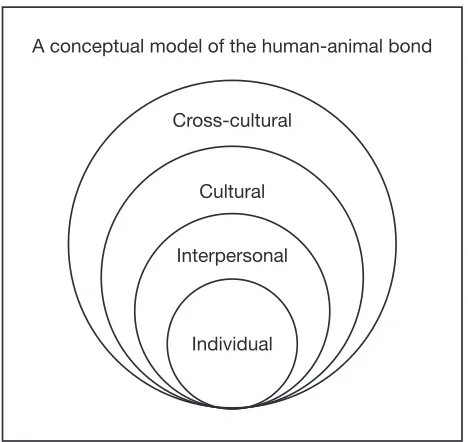
pet are socially influenced. Based on a multi-disciplinary approach with an emphasis on psychological perspectives, Blazina’s conceptual model of the human-animal bond (see Figure 2) provides a holistic view of the myriad influences that shape an individual’s perception of a bond with a pet. Using a “multilayered focus,” Blazina identifies four social contextual factors that shape the individual’s perceptions of the bond: individual,
interpersonal, cultural and cross-cultural.
Figure 2: A conceptual model of the human-animal bond. From “Introduction: Using Context to Inform Clinical Practice and Research,” by C. Blazina, G. Boyra, and D. Shen-Miller, 2011. The Psychology of the Human-animal Bond: A Resource for Clinicians and
Researchers, p. 10. Nashville, TN: Springer. Copyright 2011 by Springer. Reprinted with permission.
Blazina provides explicit understandings of each of the social contextual layers depicted in the model. He asserts that, at the individual level, a variety of factors may influence an individual’s attachment to pets, including demographics, time of life, and
A conceptual model of the human-animal bond
Individual Interpersonal
attachment history, among other factors. He identifies the individual contextual level as the focal point from which an individual makes meaning of a bond with a pet. That is, the
individual contextual level encompasses the “internal dialog”that an individual undertakes
when integrating their personal feelings about their pets with the perceptions and beliefs
about pets evident at the other contextual levels (interpersonal, cultural and cross-cultural).
At the second level of the model, Blazina posits that interpersonal influences occur primarily within the family. He notes that families can influence an individual’s perceptions of the bond with a pet in two primary ways. First, the quality and nature of an individual’s relationships with family members and significant events such as divorce or the loss of a loved one may influence an individual’s attachment to a pet. Further, family perceptions about pets can have a significant impact on an individual’s meanings. For example, family members may share an individual’s attachment to a pet and regard the pet as a member of the family. Such shared meanings validate and reinforce the individual’s feelings of attachment with the pet. In contrast, conflicting meanings regarding pets within the family can cause considerable conflict and may lead “to a lack of social support during the life of a pet companion as well as disenfranchised grief upon its death” (Blazina, 2011, p. 12).
In describing the comparative influence of these contextual factors on an individual’s perception of the bond, Blazina (2011) asserts that individual factors have the greatest impact on perceptions, followed, in order of priority, by interpersonal, cultural and cross-cultural factors. He notes that “...individuals may experience a barrage of influences at various contextual levels, and yet rely most heavily on internal dialogue to create an indelible set of beliefs regarding what the bond means” (2011, p. 11). According to Blazina (2011),
perceptions of the bond are ultimately constructed by the individual:
We propose that the seat of phenomenological experience regarding the perception and meaning of the bond is ultimately at [a] personal level. While we may have various important influences and exchanges at other levels of context, the individual, in the end, ultimately perceives and constructs his or her own experience of the bond. (p. 11)
In summary, past research offers useful understandings of the increasing importance of pet keeping in America. Pet ownership and spending on pets has increased dramatically in the last 20 years. Further, extensive research has focused on the strong emotional connections that humans maintain with companion animals. However, although the bond between
attachment theory, we first introduce attachment. Then we discuss detachment theory, the continuing bonds theory of bereavement, and the application of continuing bonds theory in veterinary education.
Attachment Theory
In his research into human attachment relationships, Bowlby (1969, 1973, 1980) suggested an adaptive evolutionary link between increased human survival rates and
behaviors exhibiting attachment bonds. Human beings who exhibit attachment behavior are more likely to survive and pass their genes on to another generation. Bowlby saw attachment behavior as an evolutionary biological advantage to humans.
Scholars maintain that human attachment can be identified through four behaviors: 1) proximity maintenance, or seeking closeness to an attachment figure, especially at times of threat or increased stress; 2) safe haven, or seeking refuge, comfort or support from an
attachment figure, especially during times of distress; 3) secure base, or using an attachment figure as a safe place from which to explore, take risks, and develop a secure, supported sense of self; and 4) separation distress, or feeling anxious when an attachment figure is unavailable (Ainsworth, 1991; Hazan & Shaver, 1987; Hazan & Zeifman, 1999; Mikulincer & Shaver, 2007; Zilcha-Mano, Mikulincer, & Shaver, 2011).
During this phase of mourning the bereaved is seized by an urge to search for and recover the lost figure. Sometimes the person is conscious of this urge, though often he is not: sometimes a person willingly falls in with it, as when he visits the grave or visits other places closely linked with the lost figure, but sometimes he seeks to stifle it as irrational and absurd. Whatever attitude a person may take towards this urge, however, he none the less finds himself impelled to search and, if possible, to recover. (p. 103)
Bowlby (2005) observes that there comes a “great restlessness, preoccupation with thoughts of the lost person combined with a sense of his actual presence, and a marked tendency to interpret signals or sounds as indicating that the lost person is now returned” (p. 102).
Thus, Bowlby suggests that attachment behavior offers humans a biological
advantage through increased rates of survival. Moreover, human attachment behavior has an enduring character and persists after the object of attachment has ceased to physically exist. These qualities, as we will see in the following discussion of detachment and continuing bonds theories of bereavement, are of singular importance for understanding the significance of an individual's maintenance of a continuing emotional connection with a lost attachment object.
Detachment and Continuing Bonds Theories of Bereavement
may entail maintaining a continuing emotional connection with a deceased love object (Klass et al., 1996). This understanding represents a shift from earlier bereavement theory based upon Freud’s (1957) detachment theory. The following sections explore the detachment theory of bereavement followed by the continuing bonds theory of bereavement.
Detachment Theory of Bereavement
The detachment theory of bereavement is based on Freud’s work and later
interpretations of this work. Although Freud introduced the concept of detachment, others have interpreted and extended his theory. Freud’s detachment theory describes grief as a normal progression of stages leading to detachment from an attachment object (Freud, 1957). Detachment is linked to the Freudian concept of libido, or psychic energy, which Freud speculated enables human attachment to an object. During detachment, the grieving individual expends libidinal energy, and as energy wanes the individual releases the attachment object (Freud, 1957).
Some contemporary psychologists following Freud’s lead have introduced the term grief work and encouraged bereaved individuals to do their work, i.e., detach and move on (see Archer, 1999). The detachment orientation is a part of so called “stage” theories of grief (see Worden, 1982; Walsh & McGoldrick, 2004). The concept of grief work is operational in postmodern reframing of Freudian theory into what is described as a diversity of grieving experience and is used as a multidimensional means of assessing normal grief (Shuchter & Zisook, 1993).
not perceive the task of grieving to be complete detachment from the deceased attachment object, but merely detachment to the fullest extent possible. He claims that Freud considered complete detachment and sublimation of libido the ideal case (Granek, 2010). In his
discussion on the topic, Granek asserts that what we actually find in Freud is the idea that detachment is never fully realized and mourning never completely finished. For example, Freud admitted his personal desire to continue a relationship with his deceased daughter, Sophie. Freud expressed the inconsolability of his loss and, in the following quote from Freud’s letter to a friend, his desire to perpetuate a relationship with his daughter (Freud, 1960):
Although we know that after such a loss the acute state of mourning will subside, we also know that we shall remain inconsolable and will never find a substitute. No matter what may fill the gap, even if it be filled completely, it nevertheless remains something else. And actually this is how it should be. It is the only way of
perpetuating that love which we do not wish to relinquish. (p. 386)
Thus, Granek (2010) argues that the idea of thorough and complete detachment from a love object found in detachment theories is foreign to Freudian thought. Freud never intended that grieving persons must thoroughly relinquish their emotional investment in a deceased loved one by working through grief and completely sublimating this attachment energy into another relationship or other aspects of their life (Granek, 2010).
Whatever the case regarding Freud and his actual understanding of detachment, there is little evidence that grief work actually helps a bereaved person cope with their loss
van den Bout, 2002; Wortman & Silver, 2001). Moreover, a systematic study of
bereavement-care literature (Forte, Hill, Pazder, & Feudtner, 2004) found no definitive and reliable guide, whatsoever, to the treatment of bereavement. The research found – with the exception of the pharmacological treatment of depression within the context of bereavement that showed some efficacy during treatment – that no bereavement treatment therapy
recommendation emerged. One of the reasons given for a failure to find a reliable guide to bereavement treatment is the excessive theoretical heterogeneity in grief and bereavement theory (Forte et al., 2004).
Thus, the detachment theory of bereavement, first implemented by Freud and later interpreted by others, has been challenged in the literature from both theoretical and practical perspectives. Contrary to detachment theory, however, the continuing bonds theory of
bereavement affirms that humans do not completely sever their connection with a deceased loved one, but maintain an ongoing connection that can help grieving persons facilitate their recovery (Silverman & Klass, 1996). Moreover, unlike detachment theory, continuing bonds theory recognizes significant psychological coping value in maintaining a continuing relationship with a deceased loved one. The following section discusses continuing bonds theory.
Continuing Bonds Theory of Bereavement
maintain emotional connections with deceased loved ones. Rees (1971) found that 50% of bereaved individuals regularly sensed the presence of their deceased partner up to ten years after their loss. Similarly, researchers found that bereaved widows and widowers frequently felt the presence of their deceased spouses and regularly interacted with them in dreams and in conversations (Shuchter and Zisook, 1993). In addition, a study by Field, Gal-Oz, and Bonanno (2003) suggests that the greater satisfaction a person feels in a relationship with someone corresponds with a stronger continuing bond with the person after they die. Thus, the continuing bonds theory of bereavement represents a significant shift from traditional detachment orientations and focuses researchers’ attention on adaptation to loss.
Unlike detachment theory, continuing bonds theory recognizes significant
psychological coping value in maintaining a continuing relationship with a deceased loved one. Studies suggest psychological value and importance in the bereaved maintaining some form of continuity in the relationship with their deceased loved one (e.g., Bowlby, 1969, 1980, 1982; Gaines, 1997; Hagman, 1995; Kaplan, 1995; Parkes, 1970, 2009; Parkes & Weiss, 1983). In addition, research asserts that the maintenance of a continuing bond enables people to “foster the continuity of identity, reinforce coping efforts, and provide comfort and support” (Bonanno & Kaltman, 1999, p. 770).
suggests that the way people maintain the connection with the lost love object is to “construct an inner representation of the deceased” (Silverman & Klass, 1996, p. 16). This inner
representation is described as a reorganized mental image that may be created in several ways. For example, someone who maintains a continuing connection with a deceased loved one may have a mental image of the whole person or maintain some sense that their self continues to relate to the person (Horowitz, 1987, 1988; Kernberg, 1976). Shuchter and Zisook (1993) describe a continuing bonds activity as symbolizing “living and breathing” connections with the deceased as internal forms and images:
The empirical reality is that people do not relinquish their ties to the deceased, withdraw their cathexes, or ‘let them go.’ What occurs for survivors is a
transformation from what had been a relationship operating on several levels of actual, symbolic, internalized, and imaging relatedness to one in which the actual (‘living and breathing’) relationship has been lost, but other forms remain or may even develop in more elaborate forms. (p. 34)
Continuing Bonds Theory and Pet Bereavement
The primary focus of continuing bonds research has been on the value of continuing bonds in helping bereaved humans cope with human loss (Field & Friedrichs, 2004; Field et al., 2005; Stroebe et al., 1992). However, research into this loss adaptation strategy has recently expanded into human-animal bereavement studies. Some researchers suggest that pet owners continue to experience their deceased pets as primary attachment figures
(Weisman, 1991). In addition, evidence exists of a sense of comfort for bereaved pet owners from belief in a continuing bond with a deceased animal (Wortman et al., 1993). Studies by Field et al. (2005, 2009) assert that maintaining a continuing bond with a pet is an adaptive component of grief. Further, a pet owner’s belief in an afterlife for their deceased pet was also found to be a comfort and an aid in their coping with the loss (Davis, Irwin, Richardson, & O’Brien-Malone, 2003).
Limited research also has examined the activities through which a bereaved pet owner maintains a continuing bond with a deceased pet. For example, one study suggests that a continuing bond with a deceased animal may include the individual having keepsakes such as photographs and personal items (Stroebe, Hansson, Stroebe, & Schut, 2001). In addition, in an empirical study of people who had lost a dog or cat within a year, researchers reported that study participants experienced increased levels of comfort from exhibiting continuing bond expressions (CBE) (Packman et al., 2011). In this study, CBE were listed as:
• sensing the pet’s continued presence; • hearing the pet’s sounds;
• having fond memories and dreams of the pet; • having keepsakes and belongings;
• creating memorials and shrines; • visiting the pet’s favorite places;
• remembering lessons learned from the pet; • responding to the pet’s influences and wishes; • having thoughts of being reunited with a pet.
The level of comfort experienced by participating pet owners as a result of using these CBE were reportedly comparable to that felt following the death of a spouse (Packman et al., 2011). In addition, a recent qualitative study of pet owners’ experience of continuing bonds with their deceased pets indicates that CBE offer comfort and solace to the bereaved (Packman, Carmack, Katz, Carlos, Field, & Landers, 2014).
In summary, the continuing bonds theory of bereavement has been shown to apply in the context of pet loss. As a loss adaptation strategy, the maintenance of continuing bonds with a deceased pet offers significant value to grieving pet owners. In turn, the understanding of continuing bonds as a coping mechanism for people who have lost pets may have
Continuing Bonds Theory and Veterinary Education
Veterinary students are receiving significant clinical training and experience in end-of-life issues and client bereavement. In a recent study of 28 veterinary schools in the United States, 96% have educational offerings in end-of-life studies, and 80% of veterinary students were exposed to this instruction (Dickinson, 2010). In one of the schools examined, a
considerable effort was made to integrate end-of-life study. At the University of Illinois College of Veterinary Medicine, first-year students received two hours of classroom lecture; second-year students, 28 hours study in bereavement; and third-year students, one hour training in role-play and client relations. Fourth-year students performed 20 hours of clinical teaching rounds and attended weekly ½-hour lectures (Dickinson, 2010). Dickinson suggests that the average time devoted to the teaching of death-and-dying issues in veterinary schools is 14.64 hours, which approximately equals the time devoted to the topic in medical and nursing schools in the United States (Dickinson, 2010). This, Dickinson further suggests, reflects a significant change in veterinary curricula. Only two decades prior, a study by Weirich (1988) reported an absence of end-of-life or bereavement education in veterinary schools.
Education programs for vet techs include training in pet loss and bereavement. For example, an introductory course in vet tech includes the following course objectives (Sherrod, 2013):
• understanding the history of veterinary medicine and organizations for veterinary technicians;
• comprehending pet loss and its impact on clients;
• identifying various clinical facilities used by veterinary technicians; • discussing client and business office practices.
Although bereavement training is included in most vet tech training programs today, there is little literature that speaks directly to the vet techs’ bereavement support task. Nor has much been written in this area for the role of the veterinary nurse, which is a
corresponding title for a similar role in the United Kingdom and other European countries (Reimer, 2007). Bereavement support, however, is a primary task for the vet tech. An ethnologist (Sanders, 2010), who studied the role of vet techs in veterinary practice, wrote:
While the attending veterinarian usually provided clients with information about what to expect and what the animal was, or was not, experiencing during the procedure, technicians often were called on to provide emotional care. (p. 256)
In his ethnographic research conducted with 22 vet techs, Sanders (2010) identified numerous tasks performed by vet techs in their work. Some of these tasks include:
• assisting veterinary doctors during patient visits (diagnosing, x-raying, intubation, anesthetization, catheterization, dispensing, euthanitizing); • caring for animals (monitoring, feeding, cleaning, exercising);
• disposing of remains (processing the animal’s body and dispensing ashes); • managing the office (answering phones, booking appointments, managing
records, collecting fees);
As previously noted, vet tech students receive training in attending the emotional needs of pet owners following pet euthanitization. The primary textbook used at the two-year college attended by the 16 vet tech students who participated in this study was McCurnin and Bassert (2014). In describing pet bereavement, this text draws primarily upon stages of grief and focuses on grief as a process of denial, bargaining, anger, depression and acceptance. This process ultimately resolves in detachment. According to McCurnin and Bassert (2014):
The term grief process [emphasis in the original] implies that there is an intended end or result to be produced through grieving. Thus the grief process is the means of letting go of the object of attachment to feel better, reinvest, emotionally grow, and attach again. (p. 1380)
The McCurnin and Bassert (2014) text omits any discussion of continuing bonds. Notably, however, in its description of the acceptance stage of the grief process, the text alludes to a continuing relationship: “[acceptance] does not mean that a pet is forgotten, but that it has been assigned to a special place in the bereaved individual’s heart” (p. 1385). In this passage, the McCurnin and Bassert (2014) text appears to suggest the bereaved pet owner may experience a continuing bond, or some form of a continuing emotional
It is worth noting that the two bereavement theories, detachment and continuing bonds, employ their own unique languages. The detachment theory uses words or phrases such as “resolve,” “accept,” “reinvest energy”, “begin a new relationship,” and “move on” (Freud, 1957). These words signify the end of the relationship and imply that the pet owner is leaving something behind. In contrast, the continuing bonds theory uses words such as
“hearing,” “talking,” “sensing,” “having” and “creating” (Packman et al., 2011). These words acknowledge the continuing presence of the relationship and imply that the pet owner is actively constructing an inner relationship with the pet. In bereavement support, the language of detachment and the language of continuing bonds may both be useful. The language of detachment helps the pet owner accept the reality of the loss. It acknowledges that the animal has died and introduces a sense of finality to the experience. In contrast, the language of continuing bonds acknowledges the love that still exists in the heart of the pet owner. It recognizes the ongoing memory of the relationship and offers an opening to a conversation about that relationship through the pet owner’s story.
Summary
on pet owners’ perceptions of their bonds with their pets. Such research indicates that people maintain strong emotional connections with their pets.
This chapter also included a review of literature regarding bereavement theory, including the traditional detachment theory and the new continuing bonds theory. Continuing bonds theory is a subset of human attachment theory and has been identified to apply in the context of human-animal relationships. Research holds that individuals maintain continuing emotional connections with pets that have died. However, studies also suggest that an individual’s experience of bereavement for his or her pet often goes unacknowledged, resulting in feelings of isolation and alienation.
CHAPTER THREE: METHODOLOGY
The purpose of this study was to explore veterinary technology (vet tech) students’ perceptions of their special relationships with pets that died; and to better understand how these perceptions influenced their work in the vet tech program and their beliefs about their future work with pets and pet owners in veterinary practice. This research study draws on the conceptual framework of the continuing bonds theory of bereavement to answer the
following two research questions:
• What are vet tech students’ perceptions of a special relationship with a pet that died?
• What beliefs do vet tech students hold about these perceptions and their work in the vet tech program and their future work with pets and pet owners?
This chapter describes the study design, including case study method, sampling, participant selection, data collection, and data analysis. It also discusses trustworthiness, validity, reliability, ethics, and researcher bias.
Case Study Method
true, because although case study can refer to a particular area of study, case study is also a commonly practiced qualitative research methodology.
This study used case study method for three primary reasons. First, as research methodology, case study is unique in that it considers social context (Yin, 1994). Others (Stake, 1995) affirm the usefulness of case study method for understanding social
interactions and human behavior. Social context is of particular interest for the present study, which, in part, examined vet tech students’ social interactions with others with regard to their pets. Second, the study is descriptive in nature because it focuses on a specific phenomenon, continuing bonds, within a real-life context of vet tech students enrolled in a two-year degree program. The study of a phenomenon or intervention within a real-life context is one
definition of descriptive case study (Yin, 2003). Third, this is a multiple case study, which is particularly well suited to studying social phenomena. According to Yin (2003), a multiple case study allows the researcher to examine similarities and differences across several instances of the same phenomenon to enable comparisons across cases. Multiple case studies can be used to predict similar or contrasting results for (theoretically) predictable reasons (Yin, 2003).
participants’ telling their pet story and remembrances. Locations included the school, coffee shops and restaurants.
In addition to interview data, this research also used photographs provided by the participants as documentation. The study provided thick description to assist readers in understanding students’ perceptions of continuing emotional connections with their deceased pets. It elicited students’ beliefs and experiences regarding their continuing bonds with their pets and their work in the vet tech program.
Sampling
This study focused on one group of vet tech students. Participants were selected purposively. In purposive sampling, participants are selected based on specified
characteristics. Because of these special characteristics, vet tech students offered an information-rich source of data specifically relevant to the object of study.
Purposive Sampling
Polkinghorne (2005) identified two criteria for purposively selecting participants: people who are likely to have had the experience under study; and those who can reflect upon and articulate the experience. In addition, participants were required to meet certain criterion. In criterion sampling, participants are selected who meet certain criterion. These criteria, selected by the researcher, ensured that participants represent optimal data value (Patton, 1990).
Selection Criteria
students’ personal experiences of the loss of a pet, the researcher had the opportunity to examine how these experiences influenced their perceptions about their work, including pet bereavement. Vet tech students were selected for this study based on five selection criteria that required that participants: 1) were 18 years of age or older; 2) were enrolled in the vet tech program; 3) experienced the death of a pet with which they had had a special
relationship; 4) experienced the death of their pet 12 months or more prior to the interview; and 5) were willing to share stories about their pets that died. These five criteria ensured that participants provided a rich data source for information regarding a continuing emotional connection with a deceased pet, perceptions of that connection, and how these perceptions influenced their work in the vet tech program with pets and pet owners.
Two of these criteria were especially important for the purposes of this study. First, when recruiting participants, the researcher defined “special relationship” as one with an animal that is a friend or companion rather than one that serves a strictly utilitarian purpose, such as a guard dog, hunting dog, service animal or a mouser (see Appendix F). Second, the researcher specified that participants had to have experienced the death of the pet 12 months or more prior to the interview in order to isolate for individuals who experienced a