A STRUCTURAL MODEL FOR COST EFFECTIVE BUILDING MAINTENANCE THROUGH DESIGN FOR MAINTAINABILITY
SHUBASHINI A/P GANISEN
A thesis submitted in fulfilment of the
requirements for the award of the degree of
Doctor of Philosophy (Facilities Management)
Faculty of Geoinformation and Real Estate
Universiti Teknologi Malaysia
DEDICATION
“To My Beloved Appa and Amma Mr. Ganisen and Mrs. Shashikala Devi
for your ever ending love and supports throughout my life.”
“To My Dearest Husband Nantha Kumar
for your unconditional love, encouragements and supports.”
“Not forgotten my three siblings Jayshini, Thulashini and Mitrashini.”
“Hopefully my hard work for the past 4 years will be your inspiration to work even harder.”
“To My Juniors Rinitah & Prabha, “My Friends Vaani and Gunavathy
for your help and supports”
“And my Almighty Nothing possible without Him”
iv
ACKNOWLEDGEMENT
First of all, my deep appreciation and gratitude dedicate to The Department of Property Management, Faculty of Geoinformation and Real Estate, Universiti Teknologi Malaysia for giving me this opportunity to experience preparing research project. A special thanks to all my lecturers who help me to go through my four years studies of PhD in Facilities Management. I extend my deepest appreciation for your knowledge, advices and support to help me complete my studies successfully.
I owe an immense debt of gratitude to my supervisors, Prof. Sr. Dr. Hakim Bin Mohammed, Dr. Izran Sarrazin and my former main supervisor Dr. Lenin Jawahar Nesan (currently external supervisor). Their sound advice, fruitful discussions and careful guidance were invaluable during the preparation of this research and gave me the motivation to perform to my maximum ability.
ABSTRACT
vi
ABSTRAK
TABLE OF CONTENTS
CHAPTER TITLE PAGE
DECLARATION ii
DEDICATION iii
ACKNOWLEDGEMENT iv
ABSTRACT v
ABSTRAK vi
TABLE OF CONTENTS vii
LIST OF TABLES xv
LIST OF FIGURES xix
LIST OF ABBREVIATIONS xx
LIST OF APPENDICES xxii
1 INTRODUCTION 1
1.1 Introduction 1
1.2 Research Background 3
1.3 Problem Statement 7
1.4 Research Questions 16
1.5 Research Objectives 17
1.6 Scope of the Research 17 1.7 Significance of the Research 19
1.8 Research Methodology 21
ix
2 INTEGRATED MAINTENANCE IN BUILDING
DESIGN 25
2.1 Introduction 25
2.2 Building Maintenance an Overview 27
2.3 Building Maintenance Practice in Malaysia 28 2.4 The Factors Causing Building Maintenance
Problems or Defects 29
2.4.1 Design Deficiencies 30
2.4.2 Poor Construction Quality and Knowledge 31 2.4.3 Inadequate Maintenance Planning and Practice 32
2.4.4 Material Limitations 32
2.4.5 External Factors 33
2.4.6 Communication Gap 34
2.5 The Effect of Design Deficiency on Building
Maintenance 35 2.5.1 Increasing Building Maintenance Cost 35 2.5.2 Impact on Building Performance 36 2.5.3 Increase in Social Consequences 37 2.5.4 Increase in Environmental Consequences 37 2.6 Design Deficiency related Building Maintenance
Defects or Problems 38
2.7 The Effect of Design Deficiency on Building Maintenance
Cost 43
2.8 Building Maintenance Cost 45
2.9 The Role of Facility Management (Facility Manager)
in Design 46
2.10 Incorporation of Building Maintenance during
Building Design 51
3 BUILDING DESIGN FOR MAINTAINABILITY AND COST
EFFECTIVE MAINTENANCE 54
3.1 Introduction 54
3.2 Maintainability in Building Research 55 3.3 The Definition of Building Maintainability 56
3.4 The Aim and Objective of Building Maintenance 58 3.5 Building Maintenance Practice in Malaysia 59
3.6 Building Design for Maintainability Practice 60 3.7 Cost Effective Building Maintenance 63 3.7.1 Cost Effective Building Maintenance Indicators 63 3.7.1.1Direct Maintenance Cost 65 3.7.1.2Indirect Maintenance Cost 74 3.8 Building Design for Maintainability Criteria and Indicators to achieve Cost Effective Building Maintenance 83 3.8.1 Accessibility 84
3.8.2 Durability 88 3.8.3 Cleanability 90
3.8.4 Availability 92 3.8.5 Standardization 94 3.8.6 Simplicity and Flexibility 97
3.8.7 Modularization 99
3.8.8 Identification 102
3.8.9 Sustainability 105
3.9 The Linkage between Building Design for Maintainability (BDM) and Cost Effective Building Maintenance (CEBM) 111
3.10 Building Design for Maintainability Criteria associated with particular Building Element 113
3.10.1 Basement 114
3.10.2 Façade 114
3.10.3 Floor 115
3.10.4 Roof 116
x
3.10.6 HVAC System 118
3.10.7 Lift 119
3.10.8 Sanitary Plumbing 121
3.10.9 Fire Protection 121
3.11 Summary of Chapter 124
4 RESEARCH METHODOLOGY 125
4.1 Introduction 125
4.2 Research Paradigms 125
4.3 Research Methodology 127
4.4 Research Design 129
4.5 Phase 1: The Identification of Building for Design Maintainability Criteria and Indicators to achieve Cost Effective Building Maintenance 129
4.5.1 Step 1: Literature Review 130
4.5.2 Step 2: Initial Study 131
4.5.3 Step 3: Extensive Literature Review 134
4.5.4 Validation of Content 136
4.5.4.1 Overview of Delphi Study 138
4.5.4.2 The Delphi Method Selection 139
4.5.5 Step 4: Delphi Study Questionnaire Preparation 141
4.5.6 Step 5: Delphi Study Selection of Expert Panel 144
4.5.7 Step 6: Delphi Study Content Validation 147
4.5.8 Step 7: Delphi Study Data Analysis 149
4.5.8.1 Certain Level Agreement 151
4.6 Phase 2: To Identify Structural Relationship among BDM Criteria and Indicators with Cost Effective Building Maintenance 152
4.6.1 Step 8: Questionnaire Preparation 152
4.6.2 Step 9: Reliability Test 153
4.6.2.1 Selection of Respondents for Pilot Survey 153
4.6.2.2 Pilot Survey 154
4.6.3 Step 10: Selection of Respondents for
Main Survey 155
4.6.4 Step 11: Questionnaire Survey 159
4.6.4.1 Questionnaire Design 159
4.6.4.2 Self-administered Questionnaire 160
4.6.4.3 Questionnaire Distribution and Collection 161
4.6.5 Step 12: Data Analysis 162
4.6.5.1 Structural Equation Modeling (SEM) 162
4.6.5.2 Partial Least Square Approach 164
4.6.5.3 The Choice of PLS as A Method of Analysis 166
4.6.5.4 Measurement Model 167
4.6.5.5 Model Validation (Two Stage Structural Equation Modelling) 168
4.6.5.6 Stage One: Assessment of Measurement Model 170
4.6.5.7Stage Two: Assessment Structural Model 174
4.7 Summary of Chapter 178
5 DATA ANALYSIS PHASE I 179
5.1 Introduction 179
5.2 Respondent Profile of Delphi Survey 179
5.3 Analysis Result of First and Second Objective: Delphi Study 181
5.3.1 Stage 1: Delphi Survey 181
5.3.1.1 1st Round of 1st Stage Delphi Survey 182
5.3.1.2 2nd Round of 1st Stage Delphi Survey 186
5.3.2 Stage 2: Delphi Survey 191
5.3.2.1 1st Round of 2nd Stage Delphi Survey 191
5.3.2.2 2nd Round of 2nd Stage Delphi Survey 194
5.4 Findings from Delphi Study 196
xii
6 DATA ANALYSIS PHASE II 199
6.1 Introduction 199
6.2 Survey Response Rate 199
6.2.1 Demographic of the Respondents 201
6.3 Preliminary Analysis 203
6.3.1 Non-response Bias 203
6.3.2 Kruskal Wallis Test 206
6.3.3 Data Screening 208
6.3.3.1 Missing Data 208
6.3.3.2 Outliers 210
6.3.3.3 Normality of the Data 211
6.3.3.4Common Method Variance 212
6.4 Analyse Results and Findings for Objective 3: PLS-SEM Approach 214
6.4.1 Research Model 214
6.4.2 Stage One: Assessing the Measurement Model 217
6.4.2.1 Indicator Reliability 218
6.4.2.2 Convergent Validity 220
6.4.2.3 Discriminant Validity 222
6.4.3 Stage 2: Assessing the Structural Model 226
6.4.3.1 Coefficient of Determination 227
6.4.3.2 Path Coefficient 229
6.4.3.3 Result of Relationship Testing 230
6.4.3.4 Effect size (f² value) 235
6.4.3.5 Predictive relevance 236
6.6 Summary of Chapter 239
7 RESULTS AND DISCUSSION 240
7.1 Introduction 240
7.2 Discussion of Findings 241
7.2.1 Findings and Achievement of the First Objective of the Research 241
7.2.3 Findings and Achievement of the Third
Objective of the Research 246
7.2.3.1 Accessibility (Acc ---> CEBM) 251
7.2.3.2 Durability (Dur ---> CEBM) 251
7.2.3.3Cleanability (Cle ---> CEBM) 252
7.2.3.4 Availability (Ava ---> CEBM) 253
7.2.3.5 Standardization (Sta ---> CEBM) 253
7.2.3.6 Simplicity (Sim ---> CEBM) 254
7.2.3.7 Modularization (Mod ---> CEBM) 255
7.2.3.8 Identification (Ide ---> CEBM) 255
7.2.3.9 Sustainability (Sus ---> CEBM) 256
7.3 Summary of Chapter 257
8 CONCLUSION AND RECOMMENDATION 258
8.1 Introduction 258
8.2 Overview of the Research 258
8.3 Contribution and Implication of the Research 260
8.3.1 Contribution to Knowledge 261
8.3.2 Practical Implications 262
8.4 Recommendation for Future Research 263
8.5 Limitation of the Research 264
8.6 Summary of Chapter 266
REFERENCES 267
xv
LIST OF TABLES
TABLE NO. TITLE PAGE
1.1 Significant of Integrating Building Maintainability 1 1.2 The Awareness of Malaysia Building Practitioners on
Building Maintainability Knowledge 9 1.3 The BDM criteria identified by previous
researches in different Maintainability Studies 11 1.4 A Review of Previous Studies on Building Design for
Maintainability Issues 14
2.1 Building Defects identified by Previous Researches due to
the Six Main Area of Design Deficiency 40 2.2 Factors attributed to the Gap between FM and
Design 47
3.1 Difference between Civil & Architectural and
Mechanical & Electrical Systems 62 3.2 Key indicators of Labour Cost to achieve CEBM 69 3.3 Key indicators of Material and Spare Parts Cost to
achieve CEBM. 71
3.4 Key indicators of Equipment and tools Cost to achieve
CEBM 74
3.5 Key indicators of Administration and management cost
to achieve CEBM 76
3.6 Key indicators of Penalties and loss of revenue cost to
achieve CEBM 79
3.7 Overall Cost Effective Building Maintenance (CEBM)
Indicators 80
3.9 Key indicators of Durability Criteria 90
3.10 Key indicators of Ceanability Criteria 92
3.11 Key indicators of Availability Criteria 94
3.12 Key indicators of Standardization Criteria 97
3.13 Key indicators of Simplicity and Flexibility Criteria 99
3.14 Key indicators of Modularization Criteria 102
3.15 Key indicators of Identification or Diagnoseability Criteria 104
3.16 Key indicators of Sustainability Criteria 107
3.17 Building Design for Maintainability (BDM) Criteria and
Indicators 109
3.18 Building elements with the associated design for
Maintainability Criteria 123
4.1 The need for an extensive Literature Reviews 135 4.2 The Delphi Technique versus the Content validity survey 137 4.3 Sample Size based on Power Analysis 156 4.4 Total Population of Registered Professionals in the Board 157 4.5 Comparison of Variance based Partial Least Square (PLS)
and Covariance based Structural Equation Modelling
(CB- SEM) 165
5.1 The number of experts involved in each round of the
Delphi Survey 180
5.2 Demographics of the Expert Panels 181
5.3 The Result of Section 2 of 1st Round Delphi Survey
(CLA 67% Analysis) 182
5.4 The Result of Section 3 of First Round Delphi Survey
(CLA 67% Analysis) 184
5.5 The Result of Section 2 of Second Round Delphi Survey
(CLA 67% Analysis) 187
5.6 The Result of Section 3 of Second Round Delphi Survey
(CLA 67% Analysis) 189
5.7 The Result of First Round Delphi Survey
xvii
5.8 The Result of Second Round Delphi Survey
(CLA 67% Analysis) 194
5.9 Final CEBM Indicators (validated) 196
5.10 Final BDM Criteria and Indicators (validated) 197
6.1 Response rate by category of the method 200
6.2 Overall response rate 201
6.3 Demographics of the Respondents 202
6.4 Independent Sample T-test 204
6.5 Dependent Sample T-test 206
6.6 Kruskal Wallis non-parametric test result
(Type of Specialisation) 207
6.7 Kruskal Wallis non-parametric test result
(Data Collection Method) 207
6.8 Missing Data Statistics 209
6.9 Outliers Cases using Standardized Z Value 211
6.10 Variance Extracted by the Factor Solution 212
6.11 The Relationship of Exogenous with Endogenous
Latent Variables 215
6.12 Assessing Reflective Measurement Model 217
6.13 The initial loadings and outer loadings of all the
indicators of each construct from the measurement model 218 6.14 The Convergent Validity - The Standardized Item
loadings, Composite Reliability (CR) and Average
Variance Extracted (AVE) of the Measurement Model 220 6.15 The Correlation Matrix for the Constructs
(Fornell and Larcker Criterion) 223
6.16 The Results of Cross Loadings 224
6.17 Assessing Structural Model 227
6.18 The Significance level (p-Value) with the t-Value 229 6.19 The Results of Path Coefficient and Relationship
Testing 230
xviii
6.21 The q2 Value of the Latent Variables 238
7.1 The Validated CEBM Indicators List 242
7.2 The Validated BDM Construct and Indicators List 243 7.3 The Final list of BDM Criteria associated with each
of the Building Elements 245
7.4 The Result of Measurement Model 247
xix
LIST OF FIGURES FIGURE NO. TITLE PAGE 1.1 Research Methodology Diagram 23
2.1 Building Life Cycle Costing Profile 44
2.2 Building Whole Life Cycle cost and Life Cycle Cost Structure 46
2.3 Current Role of Facility Manager in Design 48
2.4 Proposed Role of Facility Manager in Design 49
2.5 Proposed design/construction maintenance feedback 50
3.1 Balance in Cost effectiveness and System Effectiveness 61
3.2 The Elements of a Building from Maintainability point of View 62
3.3 The Cost of Building Maintenance Task 65
3.4 Influence of Design for Maintainability on Maintenance Cost 83
3.5 Proposed Structural Model of Design for Maintainability Criteria and Cost Effective Building Maintenance 112
4.1 Research Methodology Diagram 128
4.2 Initial Study Diagram 133
6.1 The Research Model 216
6.2 The R2 Value of Endogenous Latent Variables 228
6.3 The Results of Path Coefficient 234
6.4 Results for Redundancy Model 237
LIST OF ABBREVIATIONS
AVE - Average Variance Extracted BCA - Building Construction Authority BCA - Building Construction Authority BDM - Building Design for Maintainability BM - Building Maintenance
BMI - Building Maintenance Information BRE - Building Research Establishment BRE - Building Research Establishment
BS - British Standard
CB-SEM - Covariance based Structural Equation Modelling CEBM - Cost Effective Building Maintenance
CFA - Confirmatory Factor Analysis
CIDM - The Construction Industry Development Board CLA - Certain Level Agreement
CMV - Common Method Variances CR - Composite Reliability EFA - Exploratory Factor Analysis
FA - Factor Analysis
FM - Facility Management
FYMP - Five Year Malaysia Plan
HVAC - Heat, Ventilation and Air Condition LAM - The Board of Architects Malaysia LCC - Life Cycle Cost
LV - Latent Variables
xxi MPJBT - Majlis Perbandaran Johor Bahru Tengah
MRA - Multiple Regression Analysis MV - Manifest Variables
NPP - National Physical Plan
PA - Path Analysis
PAM - Malaysian Institute of Architects PLS - Partial Least Square
SEM - Structural Equation Modelling
SPSS - Statistical Package for Social Science UTM - Universiti Teknologi Malaysia
LIST OF APPENDICES
APPENDIX NO. TITLE PAGE
A Delphi Panels List 302
B Survey Questionnaires of the Research 308
C Cronbach’s Alpha Reliability Test Results 333
1
CHAPTER 1
INTRODUCTION
1.1 Introduction
Facility management (FM) defined as “combines skills from design disciplines, such as architecture, engineering and interiors, from business fields like, management, marketing and real estate, and from behavioral sciences as an umbrella of professions”,
Building maintenance considered huge activity in the context of emerging discipline of FM. Maintenance crucial for overall life cycle process (planning, design, construction, occupancy) of a building. However, maintenance and few other FM input such as sustainability, landscape and space are renowned in the lack of integration with building design. Based on the studies conducted by Mohammed and Hassanain (2010); Ramly (2006); Wilson (2002); Chanter and Swallow (1996), the inconsideration of maintainability during the building design has been seen as one of the major factors contributing to various problems facing the building industry. Among those problems are namely, building services related defects, early deterioration of building components, inadequate structural design (foundation), inadequate waterproofing and drainage, inadequate accessibility for repair, replacement and cleaning process, improper material selection and so on (Al-Shiha et al., 1993; Al- Hammad et al., 1997; Silva et al., 2004; Ishak et al., 2007; Das, 2010). These increasing numbers of design deficiencies can be reflected through the lofty maintenance costs (Silva and Ranasinghe, 2010; Ballast, 2010; Al- Hammad et al., 1997), high rate of environmental and biological defects (Chew and Tan, 2003) as well as social consequences (Chew et al., 2005 and 2004).
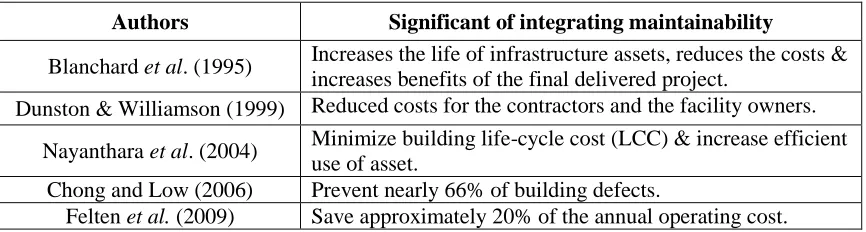
The integration of maintainability during the building design is of essence since able to pursue a balance among economic, social and functional, as well as environmental performance of a construction project. Various building scholars and literature have evidenced the significant of integrating maintainability during the building design, as shown in Table 1.1.
Table 1.1: Significant of integrating building maintainability
Authors Significant of integrating maintainability
Blanchard et al. (1995) Increases the life of infrastructure assets, reduces the costs & increases benefits of the final delivered project.
Dunston & Williamson (1999) Reduced costs for the contractors and the facility owners. Nayanthara et al. (2004) Minimize building life-cycle cost (LCC) & increase efficient
use of asset.
Chong and Low (2006) Prevent nearly 66% of building defects.
3
1.2 Research Background
In recent years, the developed world increasingly facing the overwhelming total costs of operating and managing buildings due to huge maintenance workloads during the post occupancy phase (Wood, 2012; Das et al., 2010 and Building Maintenance Information (BMI), 2000). Studies indicate that American industry spends more or less $200 billion each year on maintenance (Fogel and Petersen, 1997). Additionally, it is estimated that in the UK, up to 50% of the construction budget was spent for repair and maintenance works in buildings (Boussabaine and Kirkham, 2004). While BMI (Wood, 2005) reported in the last 10 years, building maintenance are increased about 66% and between 1989 and 2000, it’s take about 43.6% increasing (El-Haram, Marenjak and
Horner, 2002). A recent research in US, reported the increase of maintenance costs over the last ten years (1997-2007) is 3.3% for residential, non-residential and military facilities buildings (Whitestone Research, 2007). Meanwhile Hong Kong recorded an increase in the cost of maintenance work over the past 5 years. In Singapore, the average annual maintenance expenditure for residential buildings is claimed to be S$37.99 per square meter, which is significant, when compared to the average turnover in construction (Building Construction Authority (BCA) Singapore, 2000). These numbers of studies are enough to demonstrate that, there is indeed high maintenance cost burdens facing by the building industry globally.
Authors Significant of integrating maintainability
Das & Chew (2011) Able to mitigate defects to balance decreasing maintenance budgets and increasing building standards.
Saghatforoush et al. (2012) Making Project Life-cycle longer by eliminating the failures during the maintenance phase.
Wood (2012) Able to maintain a building economically & effectively through its life.
Ismail and Mohammad (2014) Building adaptable to future needs and maintain a stable usage cost throughout the building’s design life. Nicolella (2014) Lead to minimization of difficult and costly operation to
In the context of Malaysia, every year billions of ringgits were losing by the government due to the increasing building maintenance cost (Ali, 2009; Lateed, 2008). Malaysia is developed by the National Physical Plan (NPP), under which the Five Year Malaysia Plan (FYMP) is carried out. In this Malaysia Plan, focus will be given to the investigation on the preparation of annual budget for the maintenance of government-own building. In order to attain clearer picture on increasing maintenance cost of building in Malaysia, it is necessary to highlight the budget allocation for maintenance and repair works of public buildings. Under the 9th Malaysian Plan (2006 – 2010), the government has allocated the sum of US$ 330m for upgrading, renovating, and maintaining various facilities as part of the development budget (Government of Malaysia, 2006; Mohd Sidek, 2007). Under the 6th (1990-1995), 7th (1996 -2000) and 8th Plans (2001-2005), allocation for maintenance and upgrading as a percentage of the development allocation was 0.2% under each of the Plans, while under the 9th Plan (2000-2010), the allocation increased substantially to 0.5%. This marked an increment of 150%.
5
In addition, Eizzatul et al., (2012) highlighted in her research that buildings in Malaysia are suffering from ineffective building maintenance cost. Analysis by Lateef (2008) illustrates that the expenditure on maintenance in Malaysia is on the increase due to a huge backlog of building maintenance. He further stated that, buildings in Malaysia require effective maintenance; otherwise they will become liabilities. Also, it has been established that there is a gross inadequacy in the way of schools’ buildings is managed (Zainal Abidin and Roslan, 2006). Even, Mohd Zulakhmar (2006) stressed that the procedures of maintaining buildings in Malaysia are not effective. As refer to numerous building maintenance related researchers namely; Sani et al. (2012); Mohd-Noor et al., (2011); Ali et al. (2009), (2010); Lateef, Khamidi and Idrus, (2010) and Zuhairuse et al., n.d.; asserted that, the ineffective building maintenance cost issues are known among the biggest obstacle facing by the building industry in Malaysia.
Consequent from the alarming building maintenance cost (Chew and Silva, 2004), the building maintenance and management issues has arisen in mounting significance. Hence, many countries are increasingly realized the importance of understanding, recognizing and assessing the overwhelming total costs of building maintenance (Arditi and Nawakorawit, 1999(a), (b) and Wood, 2009). Along with it, one of the more impending tasks which has been increasingly become a matter of growing importance in many countries is reducing the amount of significant building defects and thus minimize the rising cost of building maintenance. Building defects were defined as results of failures or shortcomings in the function, performance, statutory, or user requirements of the structure, fabric, services, or other facilities of buildings (Low and Wee, 2001). Defects arising in a building often exhibit a chain effect, hinder performance, increase maintenance workloads and contribute to increasing building maintenance cost (Josephson and Hammarlund 1999; Ilozor et al., 2004).
Hassain, 2010; Sivanathan et al., 2012), poor construction quality and knowledge (Al-Hammad et al., 1997; Dunston, 1999; Mills et al., 2009), inadequate maintenance planning and practice (Bleanchar et al., 1995; Horner et al., 1997; Shabha, 2003), material limitations (Peacock, 1986; Olubodun, 1996; Chew et al., 1999; 2000), as well as external factors such as climate; environment, soil condition, and chemical attack (Gambardella and Moroni, 1990; Honstede, 1990; Richardson, 1991) are among the factors causing inherent maintenance problems and induce high maintenance cost. However, vast amount of researches has highlighted that, increasing cost of building maintenance is highly attributed to design limitations. Design limitations known as the defects or problems causes due to faults in building design.
7 identified by Sophia was in relation to the Taman Impian Emas public market, which has an aesthetic roof design. However, due to design faults, the roof of the market need undergo repair at the cost of RM300, 000. Further, Ramly et al. (2006) reviewed 4,389 records from 36 public housing areas in Kuala Lumpur, and found that 47% of the building defects were caused due to design faults.
Recognizing the increasing building maintenance cost due to inherent maintenance problems, building industry is moving forward on identifying the solution for this situation (Chew et al., 2004 and Wood, 2009). It is apparent that, ineffective building maintenance cost has forced the industry to recognize the immediacy to rectify and to reduce such incidences and consequently reduce the increasing building maintenance cost.
1.3 Problem Statement
Predominant amount of reports and studies signifies that, BDM is a significant issue to be considered during a building development process (Silva and Ranasinghe, 2010; Che-Ani et al., 2009; Liu, 2006). Lack of BDM consideration, has been seen as one of the major factors contributing to various problems facing by the building industry (Wilson, 2002; Chanter and Swallow, 1996; Ramly, 2006). It is substantiate that, the consideration of BDM able to reduce the building defects decrease the increasing building maintenance cost and consequently achieve cost effectiveness. This statement is supported by a case study conducted by Chong and Low (2006), which found that design integrated maintenance able to prevent nearly 66% of building defects. In addition, investigation of Dunston and Williamson (1999) revealed evidence that, few projects in the building construction industry that have focused on the maintenance concerns during the design have typically realized reduced maintenance costs. Even Ismail and Mohammad (2014) highlighted that, incorporating maintainability consideration into building design lead to cost effectiveness throughout the building life. Further, Emirates Business (2009) declared, 10% of investment cost and 30% of operating cost can be saved if maintenance incorporated during the design phase. Thus, one prospective solution to address the issue of higher maintenance cost is to make certain the marriage of maintainability with the building design.
9 (Ramly, 2006; Razak and Jafar, 2012), although in the 2009 manual of asset management, the Government of Malaysia has published that, requirements such as maintenance, space, landscape and energy should be considered in the design stage.
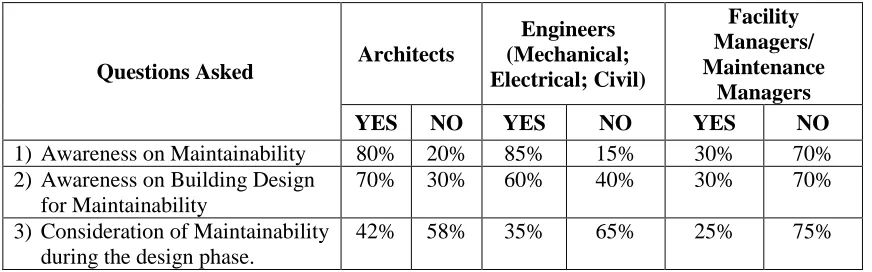
The statement by Ramly (2006); Razak and Jafar (2012) is also supported by Rozita (2006). In her study, that involved 38 designer firms (architectural, civil and structural) and 30 maintenance firms in Malaysia, Rozita (2006) concluded that maintainability is rarely considered during the building design phase by architects in Malaysia. In the effort to validate the relevance of Rozita’s findings after an 8 year gap the author of this research conducted a preliminary survey (refer section 4.5.2, Chapter 4) that involved architects, engineers (mechanical, electrical and civil) and facility managers/ maintenance managers to study the awareness on maintainability and its consideration during the design phase. The result of the survey reveals that building practitioners in Malaysia are still oblivious in considering BDM strategies. The summary of the preliminary survey is shown in Table 1.2.
Table 1.2: The Awareness of Malaysia Building Practitioners on Building Maintainability Knowledge.
Questions Asked Architects
Engineers (Mechanical; Electrical; Civil)
Facility Managers/ Maintenance
Managers
YES NO YES NO YES NO
1) Awareness on Maintainability 80% 20% 85% 15% 30% 70% 2) Awareness on Building Design
for Maintainability
70% 30% 60% 40% 30% 70%
3) Consideration of Maintainability during the design phase.
42% 58% 35% 65% 25% 75%
Source: Preliminary Study (2013)
The percentage figures shown in the Table 1.2 demonstrates the level of awareness of Malaysia’s building practitioners on the knowledge of maintainability. The
i) Awareness of building practitioners on building maintainability
ii) Building practitioners awareness on building design for maintainability. iii) Consideration of maintainability aspects during the design phase of a
building by the building practitioners.
iv) Reasons for considering and not considering BDM practice.
Category (i) included to identify whether the practitioners are aware on maintainability concept applied to a building and its facilities. Category (ii) is to identify the awareness of practitioners on the BDM concept. It is important to focus on BDM concept as the research focuses on maintainability considered during the design phase although maintainability can be implemented throughout the entire life-cycle of a project. Category (iii) is to identify the consideration of maintainability aspects during the building design phase by the building practitioners. This is to know whether the practitioners consider the maintainability characteristics during the project design phase. Category (iv) is to identify the reason behind considering or not considering BDM practice by the building practitioners. This is to know what would be the reason for considering and not considering the BDM practice. The result of pilot survey shows that a large majority of the practitioners aware on maintainability and BDM. However, most of them less consider the maintainability and BDM aspects. The result of this preliminary study also supported by the study conducted by Rozita (2006) as both demonstrating the similar result.
The practitioners (48% architects, 35% engineers and 25% facility managers) that agreed for considering maintainability during the building design phase notified that they mainly stress ‘easy access’ (maintainability characteristic) during the building
design phase. It is important to highlight that, the respondents agreed and assumed that a building would be ‘maintainable’ if the easy access feature is considered. Thus, in the
11 unavailability of maintainability guideline, limited amount of construction cost, plus with the presence of several demand; especially complex design, higher level of building system and services from the building stakeholders, occupants and owners, are the reasons for not considering BDM. Thus, it is so obvious that, the unclear understanding of BDM criteria are the main reason for not considering maintainability during the building design phase by the Malaysia’s construction industry (Preliminary Survey, 2013).
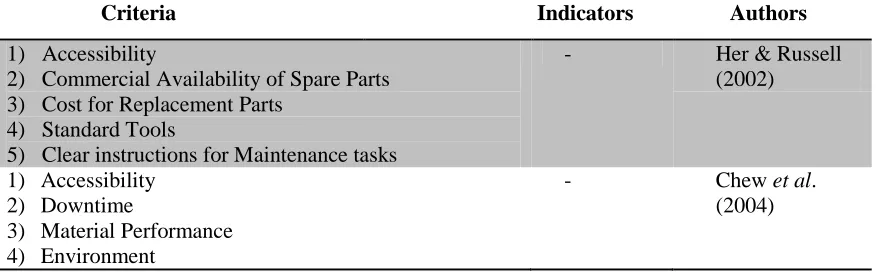
Although many maintainability related studied had been carried out by the academic research and comprehensively discussed the issue of maintainability in journals and conferences, yet, in the practical world, most organizations have no comprehensive and established criteria to induce towards the aim to achieve maintainable as well as CEBM. It is undeniable, that various scholars and professionals in the construction industry have brought forward some maintainability criteria to be considered. Adding to this, the emergence of recent maintainability studies has brought similar and some particularly related maintainability criteria into view (see Table 1.3). These limited maintainability criteria may lead to the inadequate maintainability decision to be considered during the design phase. Therefore, it is apparent to impose a comprehensive list of BDM criteria and indicators to be considered during the building design. The Table 1.3 lists down the BDM criteria identified by previous researches in different maintainability studies.
Table 1.3: The BDM criteria identified by previous researches in different maintainability studies.
Criteria Indicators Authors
1) Accessibility
2) Commercial Availability of Spare Parts 3) Cost for Replacement Parts
4) Standard Tools
5) Clear instructions for Maintenance tasks
- Her & Russell (2002)
1) Accessibility 2) Downtime
3) Material Performance 4) Environment
As can be seen in Table 1.3, there are only limited and comparatively similar maintainability criteria had been identified. Yet, if we think more broadly about enabling the whole building, it will be realized that, to make the whole building ‘maintainable’, it
is vital to include many more dimensions associated with appropriate supports from the built environment professionals (Duggan and Blayden, 2001). The availability of inadequate maintainability criteria blur the clarity on what the factors need to be considered in order to achieve better maintenance. Additionally there are only countable research was conducted to identify more specifically the indicators of each maintainability criteria and thus it leads to the inability of comprehensive information to be applied during the building design phase. The unavailability of indicators for each maintainability criteria had result the identification of maintainability criteria to be incomplete. This is because, having maintainability criteria independently had vague the ability of maintainability decision to be considered during the design phase. Therefore, the identification of indicators for each of the BDM criteria is apparent to form more comprehensive and clearly delineated decisive maintainability criteria.
Criteria Indicators Authors
1) Construction Quality 2) Environment
3) Material Durability, Sustainability & Maintainability 6) Maintenance Quality
- Chew et al. (2006)
1) Efficient Access 2) Adequate Safety 3) Maintenance needs 4) Plan for Easy maintenance 5) Environment Consideration
- Silva &
Ranasinghe (2010)
1) Accessibility 2) Clean ability 3) Functionality 4) Compatibility 5) Complexity
- Saghatforoush
et al. (2012)
1) Accessibility
2) Material Selection 3) Communication 4) Environment
5) Standardization
6) Maintenance Cost 7) Easy Assembly
8) Diagnose ability
13 As the main objective of identifying comprehensive BDM criteria and indicators are to reduce the overwhelming cost of maintenance through mitigation of defects, it is vital to discover the relationship among both of it. This aspect is vital in providing the building practitioners a clear picture of structured way or commonly described as “structural relationship” of BDM criteria and CEBM. The term CEBM is defined as a
building which deemed design to be lowest maintenance costs and with greatest return on investment (Whole Building Design Guide (WBDG), 2012; Krstic and Marenjak, 2012; File, 1991). Further, the word “structural” is defined as relating to the arrangement of and relations between the parts or elements of a complex whole (Pearsall & Hanks, 1998). Structural relationship or “what factor lead to what factor” will eventually help the building professionals determine the relevant BDM criteria and indicators to achieve CEBM. Hence, it is strongly assumed that providing the structural relationship among BDM criteria and indicators with CEBM will help the findings be more comprehensive and clear.
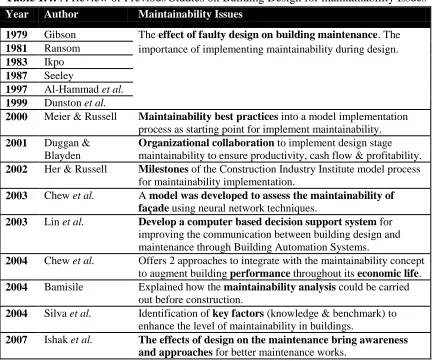
Despite of all these facts, the question is, did the previous researches on maintainability consider the BDM criteria and indicators to reduce the spiralling building maintenance cost burdens? Unfortunately, the identification of comprehensive BDM criteria to be applied during the design phase of building in particular to achieve CEBM is still known as unsolved riddle. This is based upon a review of former researches that focus on the BDM issues. The Table 1.4 below shows the summarize version of researches carried out by various researchers related to maintainability issues from the year of 1970’s till lately. Although the consideration of maintainability has been studied by various research since 70’s, the tables shows that, the studies carried out
initiatives to develop drivers such as organizational success factors, best practices and guidelines to be followed by built environment professionals to implement maintainability input during the design, construction and maintenance (Ismail and Mohammad, 2014; Silva et al., 2004; Duggan and Blayden, 2001; Meier and Russell, 2000 and Mills, 1994), some studied on significant design, construction and maintenance risk factors for better maintainability (Das and Chew, 2011; Chew and Das, 2007 and Silva and Ranasinghe, 2010). Few more researches seems to extreme and possible to develop maintainability framework, index, scoring device and even assessment model to evaluate the maintainability level of building (Das and Chew, 2010; Chew et al., 2008(a), (b); Chew and Tan, 2004 and Nicolella, 2014).
Table 1.4: A Review of Previous Studies on Building Design for maintainability Issues
Year Author Maintainability Issues
1979 Gibson The effect of faulty design on building maintenance. The importance of implementing maintainability during design. 1981 Ransom
1983 Ikpo 1987 Seeley
1997 Al-Hammad et al.
1999 Dunston et al.
2000 Meier & Russell Maintainability best practices into a model implementation process as starting point for implement maintainability. 2001 Duggan &
Blayden
Organizational collaboration to implement design stage maintainability to ensure productivity, cash flow & profitability. 2002 Her & Russell Milestones of the Construction Industry Institute model process
for maintainability implementation.
2003 Chew et al. A model was developed to assess the maintainability of façade using neural network techniques.
2003 Lin et al. Develop a computer based decision support system for improving the communication between building design and maintenance through Building Automation Systems.
2004 Chew et al. Offers 2 approaches to integrate with the maintainability concept to augment building performance throughout its economic life. 2004 Bamisile Explained how the maintainability analysis could be carried
out before construction.
2004 Silva et al. Identification of key factors (knowledge & benchmark) to enhance the level of maintainability in buildings.
15
Thus, it is obvious that there is a still a gap of what are the inclusive BDM criteria and indicators that need to be considered during the building design in order to achieve CEBM (Duggan and Blayden, 2001). The unavailability of comprehensive as well as clearly delineate BDM criteria and indicators result in uncountable building defects and impose high maintenance cost. In short, there is a need to identify the comprehensive (or important) building BDM criteria and indicators that provide maintainable building and subsequently influence CEBM. Consequently, this will lead to an improved future building designs, construction quality, maintenance management, and etc. Hence the author find, it is necessary to study more broadly on the term ‘maintainability’ and its associated criteria to open up a possible path for the practitioners, particularly Malaysia’s construction industry to apply those criteria during
the building design phase.
Author Maintainability Issues
2009 Che-Ani et al. Identification of design for maintainability factors that contributing to stabilize the sustainability and maintenance. 2010 Silva &
Ranasinghe
Maintainability Problems and strategies to solve those problems.
2010 Alhaji & Hassanain
Investigate the role of the facility manager in the architectural design process.
2010 Das et al. Decision-analysis framework for building maintainability management.
2011 Das & Chew Developed defect grading tool to improve building maintainability by preventing defects.
2012 Wood A Mind mapping developed as a framework for buildings that are economical and efficient to build and to run.
2012 Sivananthan et al. Overview Design Deficiencies on Ease of Maintenance. 2014 Ismail and
Mohamad
Incorporate building maintainability factors in building design to improve the building design life.
In summary, the issues that are addressed in this research are:
i) The comprehensive design for maintainability criteria and indicators to be applied during the design phase of a building to achieve cost effective building maintenance need to be identified and clearly explained.
ii) The structural relationship of the design for maintainability criteria and indicators to achieve cost effective building maintenance need to be identified.
1.4 Research Questions
This research attempts to answer the following questions;
1) What are the cost effective building maintenance indicators?
2) What are the building design for maintainability criteria and indicators to be considered during the building design phase to achieve cost effective
building maintenance?
17 1.5 Research Objectives
Addressing the issues mentioned in Section 1.3, this research aims to study the influence of building design for maintainability on achieving cost effective building maintenance. Subsequently, a structural model for establishing the relationship between building design for maintainability and cost effective building maintenance will be developed. In pursuance to achieve the aforesaid aim, the research will focus on the following objectives.
i) To identify the cost effective building maintenance indicators.
ii) To identify the building design for maintainability criteria and indicators to be considered during the design phase to achieve cost effective
building maintenance.
iii) To determine the structural relationship among the building design for maintainability criteria and among the indicators to achieve cost effective building maintenance.
1.6 Scope of the Research
have to be academic; it could be the knowledge of an experienced practitioner (Valerdi, 2013). The panel of experts will be selected based on a number of criteria including their research interest (knowledge) and experience with the issues under investigation (Jeffery et al., 2000; Hardy et al., 2000; Skulmoski et al., 2007; Valerdi, 2013), hierarchy or position (Mead and Moseley, 2001; Valerdi, 2013), publications (academicians) (Duncan et al., 2004; Valerdi, 2013) or involvement in projects (practitioners) (Powell, 2003; Cantrill et al., 1996; Haughey, 2010), and their willingness to participate (Powell, 2003; Skulmoski et al., 2007). Delbecq et al. (1975) further stated that the professional staff members together with their support team are well qualified to be subjects of a Delphi study.
A number of experts in the area closely related with building design, maintenance and its related field have been identified by the researcher using judgemental sampling as the potential population (see Appendix A, Table 1) of Delphi panel. The panels of experts who showed their willingness and interest to participate in the research from the potential population had been listed (see Appendix A, Table 2). Around 16 experts’ panels in the area of study have confirmed to participate in this
research. They are all experienced and well performed in building design and maintenance topics. The panel of experts served to validate the CEBM indicators and building BDM criteria and indicators identified from the literature. In addition, the panels of experts also will determine the BDM criteria and indicators that associated with particular building elements (basement, facade, floor, roof, lighting system, HVAC, lift, sanitary plumbing and fire-protection).
19 Third, as the research focuses on integrating maintainability during the building design and certain elements of a building from maintainability point of view, the structural model that was developed have been limited neither by complexity, size or type of building.
1.7 Significance of the Research
This research contributes to;
1.7.1 Filling in the gap that exists in the delineation of the building design for maintainability criteria and indicators and contribute to the knowledge.
Though numerous literatures and studies has been conducted on building maintainability, yet there is still a gap of what are the actual and significant building maintainability criteria and indicators that need to be considered during the building design, construction and maintenance phase. As for the time constraints and several other limitations, this research intended fill the gap of identifying building design related maintainability criteria and indicators to achieve CEBM especially in the context of Malaysia. Thus, by studying and identifying the BDM criteria and indicators, this research expands knowledge on the influence of BDM towards achieving CEBM.
1.7.2 Provide beneficial reference for local architects, design engineers, facility managers, engineers, construction manager and building owners.
during the design phase. In general, this research believed to be beneficial reference for local architects, design engineers, facility managers, engineers, construction manager and building owners to incorporate maintainability in the design stage to ensure a successful cost reduction during the building maintenance phase particularly for future projects in Malaysia. This is because the result of this research will assist the professionals in the building design phase to put extra care to attain better maintenance during the building maintenance phase. As a result, the maintainability related problems occur during occupancy stage that relatively increase cost burdens could be reduced.
1.7.3 Seeks to obtain useful knowledge and an in depth understanding as well as introduce new courses for postgraduate and undergraduate of built
environment students on incorporating maintainability aspects during the design stage.
21 1.8 Research Methodology
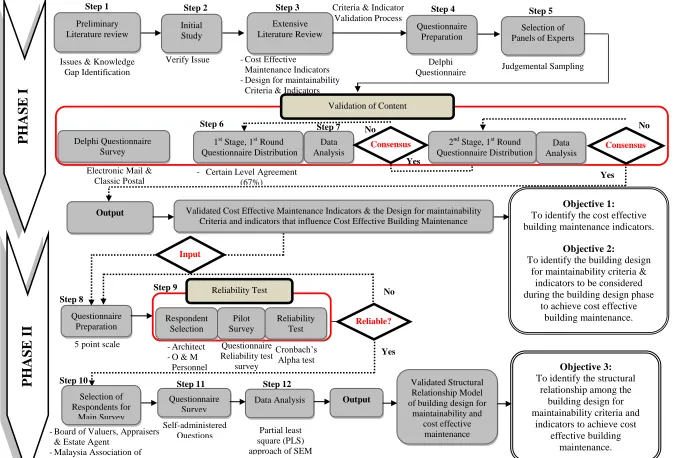
The research work is executed in two main phases as discussed below. The research methodology is illustrated in the flow chart shown in the Figure 1.1.
The first phase in the research methodology is aimed to obtain a holistic idea of the research problem and recognized the knowledge gap. A thorough review on various literatures was conducted to obtain the issues and problem associated with the study area. In order to investigate and verify the issues obtained through reviews with the Malaysia’s situation, a simple pilot survey was conducted in the early phase of the research. Three groups of respondents were selected for the pilot study, consisting of architect, maintenance personnel and engineer (civil, electrical and mechanical). The main aim of the research in the first phase is to identify, from the available literatures, the BDM criteria and indicators to achieve CEBM. Through critical review of the available literatures the indicators of CEBM were first identified. The CEBM indicators were used as a needle to form the theoretical BDM criteria and indicators.
Following the critical review on literature, next step is aimed to verify the CEBM indicators and BDM criteria and indicators obtained through literature review. Delphi Method (expert’s opinion) is the method that will be used to conduct the verification. In
In the second phase of the research methodology, the verified theoretical design for maintainability criteria and indicators were converted into questionnaire form and distributed to the respondents of the survey in order to examine and validate the proposed relationship between the constructs. Therefore, first questionnaire will be developed based on the output received from expert’s survey, to collect empirical data to
test the proposed theoretical model. As BDM deals with design and maintenance, the designers, architects, property or facility managers were considered the best respondent. Respondents will be selected from the membership list of professional bodies in Malaysia namely, The Board of Valuers, Appraisers and Estate Agent, Malaysia Association of Facility Management (MAFM), The Board of Architects Malaysia (LAM), Malaysian Institute of Architects (PAM) and The Construction Industry Development Board (CIDB). Before the main survey distribution is conducted, a pilot study will be conducted in order to test the reliability of the main questionnaire. Finally the questionnaire distribution will be conducted.
Figure 1.1: Research Methodology Diagram
P
HA
SE II
- Architect - O & M
Personnel Questionnaire Reliability test survey
P
HA
SE I
DelphiQuestionnaire Judgemental Sampling Preliminary
Literature review
Initial Study
Extensive
Literature Review Questionnaire Preparation
Step 1 Step 2 Step 3 Step 4
Selection of Panels of Experts
Step 5
Verify Issue - Cost Effective Maintenance Indicators - Design for maintainability
Criteria & Indicators Issues & Knowledge
Gap Identification
Criteria & Indicator Validation Process
Objective 1: To identify the cost effective building maintenance indicators.
Objective 2:
To identify the building design for maintainability criteria &
indicators to be considered during the building design phase
to achieve cost effective building maintenance. Validated Cost Effective Maintenance Indicators & the Design for maintainability
Criteria and indicators that influence Cost Effective Building Maintenance
Output
Yes
Electronic Mail & Classic Postal
- Certain Level Agreement (67%)
-
Validation of Content
Delphi Questionnaire Survey
1st Stage, 1st Round
Questionnaire Distribution
Data Analysis
2nd Stage, 1st Round
Questionnaire Distribution Data Analysis Consensus No No Yes Consensus Step 7 Step 6 Input Cronbach’s Alpha test
- Board of Valuers, Appraisers & Estate Agent
- Malaysia Association of Facility Management - Board of Architects Malaysia
Step 10 Step 12
Objective 3: To identify the structural
relationship among the building design for maintainability criteria and
indicators to achieve cost effective building maintenance. Selection of Respondents for Main Survey Questionnaire Survey
Data Analysis Output
Validated Structural Relationship Model of building design for
maintainability and cost effective
maintenance Self-administered
Questions Partial least square (PLS) approach of SEM Reliability Test Respondent Selection Pilot Survey Reliability Test Yes
5 point scale
Step 8
Step 9
Step 11
Questionnaire
Preparation Reliable?
No
1.9 Structure of the Research
This dissertation has been organised into 8 chapters according to the logical development that has taken place over the entire period of research. The overall 8 chapters are as organized as following;
Chapter 1. Introduction: In this chapter a general introduction, background and the justification of the research has been provided. A brief overview on the concepts of BDM and its importance were also explained. It further addressed the aim and objectives, scope and purpose, the significance, the methodology applied to conduct this research and a brief summary on the structure of this thesis.
Chapter 2. Integrated Maintenance in Building Design: To obtain a holistic idea of the research problem, and the rationale and concept of integrated maintenance during the building design phase. Therefore, the relevant topics reviewed are: the practice of maintenance in Malaysia, factors causing building maintenance problems, the effect of design deficiencies on building maintenance, design deficiencies related building maintenance cost, the role of Facility Management in building design and finally the rationale and concept on integration of maintenance during the building design phase. This helped to recognize the knowledge gap, issues and rationale of the study.
25 Chapter 4. Research Methodology: Discusses the methodology employed in this research. The chapter explains the design of the questionnaire developed to identify and verify the CEBM indicators and the BDM criteria and indicators established in Chapter 3 of the research. This chapter subsequently discusses the selection of respondents, data collection and analysis methods employed in this research. The final part of this chapter explicates about the validation process of structural relationship model of the building BDM criteria and CEBM.
Chapter 5. Data Analysis Phase I: It will explain the analyses that will be undertaken for achieving the first and second objectives of this research.
Chapter 6. Data Analysis Phase II: This chapter will discuss the analysis that carried out in order to achieve the third objective of the research. In the final part of this chapter the structural relationship model of building BDM criteria and CEBM will be verified.
Chapter 7. Results and Discussion: This chapter discusses the results obtained and the extent to which the results fulfil the objectives of this research.
REFERENCES
Abdulmohsen Al-Hammad and Sadi Assaf (1997). The Effect of Faulty Design on Building Maintenance. Journal of Quality in Maintenance. Vol. 3, pp. 29-39. Action Energy, (2001). New ways of cooling — Information for building designers
General Information Leaflet GIL 85. Available From: www.actionenergy.org.uk. [Accessed: 6 April 2013].
Adejimi, A. (2005), “Poor building maintenance in Nigeria: are architects free from blames?”, in ENHR International Conference on Housing: New Challenges and Innovations in Tomorrow’s Cities, Iceland, 29 June-3 July, Department of
Architecture, College of Engineering and Technology, Olabisi Onabanjo University, Ibogun Campus. Ogun State, Nigeria, pp. 1-15.
Addelson, L. (1996). Building Failure. Butterworth Architecture, UK.
Adler, M., et al (1996). Gazing into the Oracle: The Delphy Method and its Application to Social Policy and Public Health. London: Jessica Kigsley Publications.
Afranie, S and Osei Tutu, E. (1999). Analyzing of Problems, Practices and Policy. Afshari, A.R., Yusuff, R.M., & Derayatifar, A.R., (2012). An application of Delphi
method for eliciting criteria in personnel selection problem. Scientific Research and Essays. 7(33), pp. 2927-2935.
Ahmad R. H. (2006), Maintenance Management and Services (Case Study: PERKESO Building in Peninsular Malaysia. A project report submitted as a partial fulfillment of the requirements for the award of the degree of Master in
268 Ahmad, R, Nur Azhahani, A and Nur Haniza, I. (2006). The Effects Design on The Maintenance Of Public Housing Buildings In Malaysia-Part One. Journal of Buildings Engineer.
Aibinu A. A. and Al-Lawati A. M. (2010).Using PLS-SEM technique to model construction organizations’ willingness to participate in e-bidding. Automation in
Construction. Vol. 19, p. 714–724.
Alexander, K. (2009). Facilities management futures. Manchester, UK: A Euro FM Publication, Centre for Facilities Management.
Ali, A. S., Kamaruzzaman, S. N., Sulaiman, R. and Peng, Y. C. (2010). Factors Affecting Housing Maintenance cost in Malaysia. Journal of Facilities Management, Vol. 8 No. 4, pp. 285-298.
Ali, A.S. (2009). Cost decision making in building maintenance practice in Malaysia. Journal of Facilities Management. 7(4) p. 298-306.
Alexander, K. (1996). Facilities Management: Theory and Practice. London, UK: E & FN Spon.
Alexandrov, A. V., Pullicino, P. M., Meslin, E. M., & Norris, J. W. (1996). Agreement on disease-specific criteria for do-not-resuscitate orders in acute stroke. Stroke, 27, p. 232-237.
Alhaji, M. and Hassanain, M.A. (2010), “Towards Improvement in Facilities Operation and Maintenance through Feedback to the Design Team”, The Built & Human Environment Review, Vol. 3 No. 1, pp. 72-87.
Al-Hammad, A., Assaf, S. and Al-Shihah, M. (1997), “The Effect of Faulty Design on Building Maintenance”, Journal of Quality Maintenance Engineering, Vol. 3 No. 1, pp. 29–39.
Al-Khatam, J.A (2003). Buildings Maintenance Cost. Master of Engineering Report (CEM-600). College of Environmental Design. Construction Engineering and Management, King Fahd University of Petroleum & Minerals.
Al- Shiha, Mansoor Mohammad, M.S (1993), “The Effects of Faulty design and Construction on Maintenance”, Saudi Arabia, Master Dissertation.
Ammenwerth, E., Mansmann, U., Iller, C. and Eichstadter, R. (2003) Factors affecting and affected by user acceptance of computer-based nursing documentation: results of a two-year study. Journal of the American Medical Informatics Association;10:69-84.
Anderson J. C. and Gerbing D. W. (1988). Structural Equation Modeling in Practice: A Review and Recommended Two-Step Approach. Psychological Bulletin. Vol. 103, p. 411- 423.
Ankenbrandt, F.L., Lapole, R.E. and Margulies, G. (1963), Maintainability Design, Engineering Publishers, Elizabeth, New Jersey.
Arditi, D. and Nawakorawit, M. (1999a), “Designing Buildings for Maintenance: Designers’ Perspective”, Journal of Architecture Engineering, Vol. 5 No.4, pp.
107–116.
Arditi, D. and Nawakorawit, M. (1999b), “Issues in Building Maintenance Property Managers Perspective”, Journal of Archit Engineering, Vol. 5 No. 4, pp.
117-132.
Arditi, D. and Messiha, H. (1996). Life-cycle costing in Municipal Projects. Journal of Infrastructure System. 2(1) p.5–14.
Assaf, S., Al-Hammad, A. and Al-Shihah, M. (1996), “Effects of faulty design and construction on building maintenance”, Journal of Perform Constr Facilities, No. 10 Vol. 4, pp. 171–174.
Assaf, A.H. and Al-Shihah, M. (1995). The Effect of Faulty Construction on Building Maintenance. Journal ofBuilding Research and Information. 23(1) p.175–81. Assaf, S., Al-Hammad, A. and Al-Shihah, M. (1995). The Effect of Faulty Construction
on Building Maintenance. Journal of Building Research and Information. 23(3) p.175–181.
Ballast, D.K. (2010), Interior Design Reference Manual: Everything You Need to Know to Pass the NCIDQ Exam, 5th edition, Professional Publications Inc, United States of America, USA.
270 Barone, C., Pinto C., Normann, N., Capussotti, L., Cognetti, F., Falcone, A. and
Mantovani, L. (2014). KRAS Early Testing: Consensus Initiative and Cost Effectiveness Evaluation for Metastatic Colorectal Patients in an Italian Setting. PLoS ONE 9(1): e85897, 1 Vol (9), p. 1-13.
Barrett, P. S. and Stanley, C. A. (1999). Better Construction Briefing. Oxford, U.K: Blackwell.
BCA (2000). Enhancing Maintainability of Buildings – Pilot Study Report. Building Construction Authority, Singapore.
Becker, F. (1990). The Total Workplace. New York, USA: Van Nostrand Reinhold. Berg, Sven. (2006). "Snowball Sampling–I," pp. 7817–7821 in Encyclopedia of
Statistical Sciences, edited by Samuel Kotz, Campbell Read, N. Balakrishnan, and Brani Vidakovic. Hoboken, NJ: John Wiley and Sons, Inc.
Bernama (2009). Government Identifies Initiatives For National Asset
ManagementConcept. Available from:
http://www.kettha.gov.my/en/printpdf/node/882. [Accessed on 14th September
2013].
Biggs, S., et al (2011). Safety leaders’ perceptions of safety culture in a large Australian
construction organisation. Queensland University of Technology. Vol. NA, pp. 01-13.
Blanchard, B.S (1999). System Engineering Management. New York: John Wiley and Sons. pp.7.
Blanchard, B.S., Verma, D. and Peterson, E.L. (1995), Maintainability: A Key to Effective Serviceability and Maintenance Management, John Wiley & Sons, Inc, Canada.
Blanchard, B. S. and Lowery, E. E. (1969). Maintainability: Principles and Practices. New York: McGraw-Hill.
Boje, D. M., & Murnighan, J. K. (1982). Group confidence pressures in iterative decisions. Management Science. Vol. 28, pp.1187-1196.
Bourke, K. and Davies, H. (1997). Factors Affecting the Service Life Predictions of Buildings: A Discussion Paper. Laboratory Report, Prepared for Building Research Establishment. Garston, U.K.
Boussabaine, A.H. and Kirkham, R.J. (2004). Simulation of Maintenance Costs in UK Local Authority Sport Centres. Journal of Construction Management and Economics. Vol. 22 pp.1011-20.
Briffett, C. (1990). Balancing Design and Maintenance Issues : Building maintenance and Modernization Worldwide. Vol. 2, Singapore: Longman.
British Standards, BS3811:1984 (1984), “Glossary of Maintenance Management terms in Terotechnology”, London: BSI.
British Standards, EN 13306:2010 (2010), “Maintenance. Maintenance terminology” British adopted European Standard.
Brochner, J. (2003). Integrated Development of Facilities Design and Services. Journal of Performance of Constructed Facilities. Vol.17 (1), p. 19-23.
Brooks, K. W. (1979). Delphi technique: Expanding applications. North Central Association Quarterly. Vol. 53, 377-385.
Brockhoff, K. (1975). The performance of forecasting groups in computer dialogue and face to face discussions. In: Linstone, H., & Turoff, M. (Eds.), The Delphi method: techniques and applications, Addison-Wesley, London.
Buck, et al., (1993). Using the Delphi process to analyze social policy implementation: a post hoc case from vocational rehabilitation. Policy Sci. Vol. 26, p.271–288. Building Construction Authority, Singapore (2000) CONQUAS 21, 2000.
Building Research Establishment (BRE) (1983). Design and Site Procedures – Defects and Repairs. Building Research Establishment Digests. Vol. 4, Her Majesty's Stationery Office, London.
Building Research Establishment (BRE) (1991). Housing defects reference manual, The building research establishment defect action sheets. E&FN Spon, London. Burrell, G. and Morgan, G. (1979). Sociological Paradigms and Organizational
Analysis, Elelments of the Sociology of Corporate Life. London, Heinemann. Educational Books Ltd.