COMMUNICATION LINES MANAGEMENT SYSTEM
WONG KWAI YINN
A project report submitted in partial fulfillment of the requirements for the award of the degree of
Master of (Computer Science – Real Time Software Engineering)
Faculty of Computer Science and Information System
Universiti Teknologi Malaysia
ABSTRACT
The purpose of this project is to develop a RBDMS DSS with OLAP capabilities that will assist management in making decision concerning MAF communications assets. The DSS is to perform general database functions; generate assets and users reports and summaries. The ROLAP model was implemented to provide the DSS with OLAP functionality assisting the system in database queries and analysis. The methodology adopted for the project development is SDLC and model used is Waterfall. Analyzing and development of design requirements are done with the Unified Modeling Language 2.0; the industry standard graphical notation modeling language for object-oriented systems. The system is implemented as a 3 tier web application using an Apache Tomcat Server/JSP container implementing Java Servlet/JSP in a client-server environment running on the organization intranet. The RDBMS were implemented using MySQL 5.0 Community Server and OLAP functionality using Mondrian Server supported by JPivot and WCF. The system prototype were successfully implemented within the project timeframe by setting achievable objectives; adopting the right development methodology; using the appropriate software technologies and close cooperation with organization staff. It is found that the initial documentation of the SRS and SDD greatly assisted the software developed at the later stage. The implementation of the ROLAP model to support the DSS is found to be suitable for organization with existing database structures. It is also found that all the Open Source software’s utilized are capable of developing the required system besides freeing organization resource for other avenues as there are offered under the GNU GPL license. There are also freely available and their usages supported by the Malaysia Open Source IT initiatives.
vi
ABSTRAK
TABLES OF CONTENT
CHAPTER TITLE PAGE
DECLARATION ii
DEDICATION iii
ACKNOWLEDGEMENT iv
ABSTRACT v
ABSTRAK vi
TABLE OF CONTENTS vii
LIST OF TABLES xiii
LIST OF FIGURES xv
LIST OF ABBREVIATIONS xx
LIST OF APPENDICES xxiv
1 INTRODUCTION 1
1.1 Project Background 1
1.2 Sel Khidmat Telefon Organization 3
1.3 Sel Khidmat Talipon Responsibilities 4
1.4 Problem Statement 4
1.5 Project Objective 6
1.6 Project Assumption and Limitation 6
viii
2 LITERATURE STUDY 8
2.1 Information Systems 8
2.1.1 Introduction 8
2.1.2 Information Systems Environment 12
2.1.3 Information Systems Role 16
2.1.4 Information Systems Category 18
2.1.5 Summary 26
2.2 Database Management System 27
2.2.1 Introduction 27
2.2.2 Database Management System Component 30
2.2.3 Database Model 33
2.2.4 Database Application Architecture 39
2.2.5 Summary 49
2.3 On Line Analytical Processing 50
2.3.1 Introduction 50
2.3.2 OLAP Types 52
2.3.3 OLAP Cube 69
2.3.4 OLAP Schema 71
2.3.5 OLAP MDX 75
2.3.6 Summary 79
2.4 Data Warehouse 80
2.4.1 Introduction 80
2.4.2 Implementation Consideration 82
2.4.3 Data Warehouse Architecture 87
3 METHODOLOGY 93
3.1 Methodology 93
3.2 Design Standard 95
3.3 Coding Standard and Software 97
3.4 Testing and Evaluation 98
4 SOFTWARE DESIGN 100
4.1 CLIMS Software Design 100
4.2 Preliminary Design 101
4.2.1 CSC 01CLIMS System Login (SDD_REQ_100)
106
4.2.2 CSC 02CLIMS Update User (SDD_REQ_200)
108
4.2.3 CSC 03CLIMS View Log (SDD_REQ_300)
109
4.2.4 CSC 04CLIMS Update Record (SDD_REQ_400)
110
4.2.5 CSC 05CLIMS Data Report (SDD_REQ_500)
111
4.2.6 CSC 06CLIMS Data Analysis (SDD_REQ_600)
112
4.3 Detail Design 113
4.3.1 CSC 01CLIMS System Login (SDD_REQ_100)
114
4.3.1.1 CSU LoginPanel (SDD_REQ_101) 114
4.3.1.2 CSU LoginManager (SDD_REQ_102)
115
4.3.1.3 CSU UserDatabase (SDD_REQ_103)
115
4.3.1.4 CSU LogDatabase (SDD_REQ_104)
x
4.3.2 CSC 02CLIMS Update User (SDD_REQ_200)
116
4.3.2.1 CSU AdminPanel (SDD_REQ_201) 116
4.3.2.2 CSU UserRecPanel (SDD_REQ_202)
116
4.3.2.3 CSU UserManager (SDD_REQ_203)
117
4.3.2.4 CSU UserDatabase (SDD_REQ_204)
117
4.3.3 CSC 03CLIMS View Log (SDD_REQ_300)
118
4.3.3.1 CSU AdminPanel (SDD_REQ_301) 118
4.3.3.2 CSU UserLogPanel (SDD_REQ_302)
118
4.3.3.3 CSU LogManager (SDD_REQ_303) 119
4.3.3.4 CSU LogDatabase (SDD_REQ_304)
119
4.3.4 CSC 04CLIMS Update Record (SDD_REQ_400)
120
4.3.4.1 CSU OperatorPanel (SDD_REQ_401)
120
4.3.4.2 CSU DbTypeRecPanel (SDD_REQ_402)
120
4.3.4.3 CSU DbTypeManager (SDD_REQ_403)
121
4.3.4.4 CSU DbTypeDatabase (SDD_REQ_404)
121
4.3.5 CSC 05CLIMS Data Report (SDD_REQ_500)
122
4.3.5.1 CSU ManagerPanel (SDD_REQ_501)
4.3.5.2 CSU ReportPanel (SDD_REQ_502) 122
4.3.5.3 CSU ReportManager (SDD_REQ_503)
123
4.3.5.4 CSU DbTypeDatabase (SDD_REQ_504)
123
4.3.6 CSC 06CLIMS Data Analysis (SDD_REQ_600)
124
4.3.6.1 CSU ManagerPanel (SDD_REQ_601)
124
4.3.6.2 CSU AnalysisPanel (SDD_REQ_602)
124
4.3.6.3 CSU AnalysisManager (SDD_REQ_603)
125
4.3.6.4 CSU DbTypeDatabase (SDD_REQ_604)
125
5 IMPLEMENTATION 126
5.1 CLIMS 3-Tier Architecture 126
5.1.1 CLIMS Software Architecture 127
5.2 CLIMS Software Setup 130
5.2.1 Java Enterprise Edition and IDE 130
5.2.2 Apache Tomcat Server 134
5.2.3 MySQL Database Sever 139
5.2.4 Apache Ant 142
5.2.5 Mondrian OLAP Server 145
5.2.6 JPivot and WCF 150
5.2.7 JasperReports 153
5.3 CLIMS Requirement Traceability 156
1
CHAPTER 1
INTRODUCTION
1.1 Project Background
The ability to communicate is a vital factor in ensuring the success of the numerous daily functions performed by Malaysia Armed Forces (MAF) staffs. MAF bases and facilities exists in all the 11 states and 2 federal territory within the country. The basic facilities provided within these premises are telephone and facsimile communication lines which are used for MAF internal bases to bases communications besides communications with external governmental and private agencies. Additional communication facilities are internet access lines and satellite access link primarily making email and weather information retrieval abilities available. All these facilities are use daily through out the MAF and as in any other corporate office, their usage often seems routine and taken granted for. In reality there are not and for the record, there are actually very important and encompassing. Try imagining for a moment that your office phone and facsimile are out of order and there are also no internet access as well, and all you can do is to work from your cell phone.
regarding asset users and their where about; the asset billings by type and location; reports and analysis to inform managers and assists them in making decisions in the management and deployment of the assets.
The management of MAF communication lines is the responsibilities of Sel Khidmat Talipon which is a unit placed within Bahagian Komunikasi dan Elektronik (KOMLEK), MAF Headquarters, MINDEF. These include assets within the MAF Headquarters and the 3 major services which are Tentera Darat Malaysia (TDM); Tentera Laut DiRaja Malaysia (TLDM); and Tentera Udara DiRaja Malaysia (TUDM). Overall, the communication lines services under the jurisdiction of the unit are as follows:
1.1.1 Direct Line/Facsimile Line/PABX Extension.
International Direct Dialing (IDD). Category A – Out of State (STD).
Category B – Within State (STD).
1.1.2 Mobile Line. International. Regional. Local.
1.1.3 Internet.
Line access.
Wireless access.
1.1.4 Satellite Access.
Land based uplink.
3
1.2 Sel Khidmat Talipon Organization
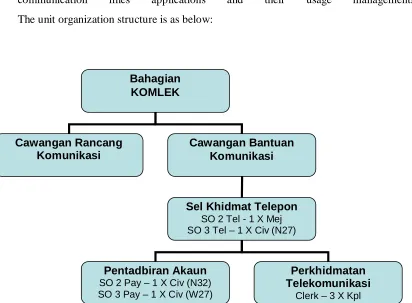
Within Bahagian KOMLEK, Sel Khidmat Talipon is placed under Cawangan Bantuan Komunikasi which is basically responsible for providing communication assistance to MAF Headquarters. Sel Khidmat Talipon is headed by a military officer with the rank of Major designated as Staff Officer Grade 2. He is assisted by a grade N27 civilian staff designated as his Staff Officer Grade 3. Together with them are 3 other service personnel and 2 other civilian staff. The unit is divided into the account administration and the telecommunication services section. The earlier is headed by a grade N32 civilian officer responsible for all communication services bill payment and the later consists of service personnel clerks assisting the unit in facilitating
communication lines applications and their usage managements. The unit organization structure is as below:
Figure 1.2 Sel Khidmat Telefon Organisation Bahagian
KOMLEK
Cawangan Rancang Komunikasi
Cawangan Bantuan Komunikasi
Sel Khidmat Telepon
SO 2 Tel - 1 X Mej SO 3 Tel – 1 X Civ (N27)
Pentadbiran Akaun
SO 2 Pay – 1 X Civ (N32) SO 3 Pay – 1 X Civ (W27)
Perkhidmatan Telekomunikasi
1.3 Sel Khidmat Talipon Responsibilities
Beside the main function of managing and administering all communication lines within MINDEF, the unit also has to undertake other responsibilities such as planning necessary budgetary functions for billings payment, controlling allocated communication lines budget, planning for required location line installation and maintenance of location lines exchanges. Its detail responsibilities are listed at Appendix A.
1.4 Problem Statement
The unit has 3 standalone computers which are used for daily office functions and 1 user terminal link up to eSPKB (Sistem Pengurusan Kewangan Bersepadu) which is a government online ordering and payment system. The unit currently practices the traditional manual file system in its record keeping in the course of performing its daily functions. Typically, necessary office files are divided according to organization internal and external information sources. There includes areas of communication assets, assets users, communication providers, assets billings, assets requisition and related managements activities. Records are kept in physical files format; labeled by topics and kept in cabinets where classified information is often under lock. The unit does not have a separate filing room and filing cabinets are placed within the same office premises. An index file assists in the location search for each file within the cabinets.
5
unit could not effectively represent the require organization data. Information provide by this files system could not effectively assists management in making decision as they contain error and are not reflective of the current state of affairs,
The unit does not have any information management system to assists in managing its responsibilities. The backup of the files systems are records kept in separate Microsoft Excel files but not representative of all office files. Among the problems identifies within the unit are as follows:
No asset users and billings database.
User application of communication lines are done manually.
Monthly inspection of various asset bills is done manually.
No information systems to record and monitor the current communication asset within the MAF premises.
No information systems to record and monitor current communication assets rentals and billings.
Difficulty in producing status report and summary report on billings and assets users required by higher management.
No information system tools to perform billings or assets queries and analysis.
1.5 Project Objective
The objective of this project is to design a relational database decision support system (DSS) that will assist Sel Khidmat Talipon in improving its current situation in the best possible means. The designated system should be able to enhance the unit daily operational tasks concentrating on its 2 major functions; which are to manage MAF communication assets and assisting the management in making decision concerning those assets. In order to achieve these, the designated relational database decision support system shall have the following capabilities:
Database function for keeping records of MAF communication users and assets.
Generation of reports and summaries as require by the management as to assists them in making assets management decision.
Online analytical processing (OLAP) capabilities to allow the management to perform records queries and analysis.
1.6 Project Assumption and Limitation
This project will involve the design and development of a database decision support system with OLAP capabilities that will meet the objectives as set forth above. It is a continual project from the current course Professional Attachment I module with the same name. The prototype system designated to be put forward at the end of the project duration will be a 3-tier web based system implemented within the unit and its headquarters intranet. The system will consist of the following modules:
Module to enable the system to verify users via a login panel. Module to enable system administrator to manage system users.
Module to enable system administrator to view users login. Module to enable data operators to input and update assets records.
174
REFERENCES
Alleman, G.D. (2008) What is System Architecture and Why Do We Care? Niwot Ridge Resources. http://www.niwotridge.com/Essays/WhatisSystemArchitecture.htm.
Ansary Ahmed et al. (2004) CBMS 4203 Sistem Maklumat Pengurusan. Universiti Terbuka Malaysia.
ARC (2008) The world’s first Retail HOLAP Data Model. Manthan Systems. http://www.arc-bi.com/products_architecture.htm
Ariyachandra, T. and Watson. H.J. (2006) Which Data Warehouse Architecture Is Most Successful? Business Intelligence Journal. http://www.tdwi.org/Publications /BIJournal /display.aspx?ID=7890.
Breitner, C.A. (1997) Data Warehousing and OLAP : Delivery Just-In-Time Information for Decision Support. Universität Karlsruhe, Germany. pp 9.
Boggs, W. and Boggs, M. (2002) Mastering UML with Rational Rose 2002. United States: SYBEX Incorporated.
Chapple, M. (2000) Two-Tier or n-Tier? About.com:Database. http://databases. about.com/od/specificproducts/a/architectures.htm.
Chartier, R (2008) Application Architecture: An N-Tier Approach - Part 1. 15seconds. http://www.15seconds.com/issue/011023.htm
_olap_analysis_iteva.pdf.
David, F. et al. (2006) Information System Environment. SBA Working Paper Series, Penn State Harrisburg, http://www.csab.org/pdf/ISEnvironment.pdf.
Data Warehousing (2008), MOLAP, ROLAP, And HOLAP. 1keydata.com. http://www.1keydata.com/datawarehousing/molap-rolap.html.
Dhar, V. and Stein, R. (1997) Seven Methods for Transforming Corporate Data Into Business Intelligence. Prentice-Hall.
Franconi, E. (2008) Data Warehouse Models and OLAP Operations. KRDB Research Centre. www.inf.unibz.it/~franconi/teaching/2001/CS636/CS636-olap.ppt
Greenfield, L. (1995) (a) The Case for Data Warehousing. The Data Warehousing Information Center. http://www.dwinfocenter.org/casefor.html
Greenfield, L. (1995) (b) The Case Against Data Warehousing. The Data Warehousing Information Center. http://www.dwinfocenter.org/against.html
Gunterloy, M. (2003) Add MDX to your SQL Server toolkit. Builder.com
http://www.builderau.com.au/program/mysql/soa/Add-MDX-to-your-SQL-Server- toolkit/0,339028784,320276459,00.htm
Laudon, J.P., and Laudon, K.C., (2000) Essentials of Management Information Systems: Organization and Technology in Networked Enterprise. Prentice-Hall.
Karl, E.K. (2008) The Making of Information Systems. Springer-Verlag Berlin Heidelberg.
Kambalyal, C. (2008) N-Tier Architecture. Tripod.com. http://channukambalyal. tripod.com/.
176
MicroStrategy (1995) (b) A Case for Relation OLAP. MicroStrategy Incorporated. http://www.strategy.com. pp 8.
Morabito, J and Stohr, E.A. (2001) (a) On-Line Analytical Processing And Applications
In E-Commerce. Stevens Institute of Technology. Wesley J. Howe School of Technology Management. United States. pp 9.
Morabito, J and Stohr, E.A. (2001) (b) On-Line Analytical Processing And Applications In E-Commerce. Stevens Institute of Technology. Wesley J. Howe School of
Technology Management. United States. pp 14 – 16..
Morabito, J and Stohr, E.A. (2001) (c) On-Line Analytical Processing And Applications
In E-Commerce. Stevens Institute of Technology. Wesley J. Howe School of Technology Management. United States. pp 19 - 21.
Pasumansky, M. (1998) MDX For Everyone. http://www.mosha.com/msolap/ articles/MDXForEveryone.htm
Pendse, N. (2005) (a) What is OLAP?. The OLAP Report www.olapreport.com. http://www.olapreport.com/ fasmi.htm
Pendse, N. (2005) (b) OLAP Applications. The OLAP Report www.olapreport.com. http://www.olapreport.com/Applications.htm
Pendse, N. (2005) (c) OLAP Architecture. The OLAP Report www.olapreport.com. http://www.olapreport.com Architectures.htm.
Pearson, W. (2002) MDX at First Glance: Introduction to SQL Server MDX Essentials. Database Journal. http://www.databasejournal.com/features/mssql/article.php /10894_1495511_3.
O’Brien, J.A., (2007) Introduction to Information Systems 13/e. Northern Arizona University, George M. Marakas, University of Kansas.
O’Donahue, J., (2002) Java Database Programming Bible. John Wiley & Sons.
Oracle 8i (2002), Schemas. Data Warehousing Guide. http://download.oracle.com /docs/cd/A87861_01/NT817EE/server.817/a76994/schemas.htm#1020.
Oracle 9i (2000), Data Ware housing Concepts. Data Warehousing Guide. http://www.lorentzcenter.nl/awcourse/oracle/server.920/a96520/concept.htm
Sadoski, D. (1997) Two Tier Software Architectures. Software Engieering Institute. http://www.sei.cmu.edu/str/descriptions/twotier.html
Schach (1999), The Waterfall Model. Online Interactive Modules for Teaching Computer Science. http://courses.cs.vt.edu/csonline/ SE/Lessons/ Waterfall/index.html.
SDD CLIMS (2008), Software Design Document for CSCI CLIMS. (Ref08-PT-01-034-A), CASE, Universiti Teknologi Malaysia.
SRS CLIMS (2008), Software Requirement Specifications for CSCI CLIMS. (Ref08-PT-01-045-A), CASE, Universiti Teknologi Malaysia.
Strum, Jake. (2000) Data Warehousing with Microsoft SQL Server 7.0 Technical Reference. Microsoft Press.
Wikipedia (2001) (a) Waterfall Model. The Free Encyclopedia. http://en.wikipedia.org /wiki/Waterfall_model.
Wikipedia (2001) (b) IEEE 12207. The Free Encyclopedia. http://en.wikipedia.org /wiki/ IEEE_12207.
Wikipedia (2001) (c) Unified Modeling Language. The Free Encyclopedia. http://en. wikipedia.org /wiki/Unified_Modeling_Language.
178
Wikipedia (2001) (e) Open Source License. The Free Encyclopedia. http://en. wikipedia.org /wiki/Open_source_license.
.
Wikipedia (2001) (f) Open Source License. The Free Encyclopedia. http://en. wikipedia.org /wiki/Database_management_system.
Wikipedia (2001) (g) Open Source License. The Free Encyclopedia. http://en. wikipedia.org /wiki/SQL.
Wikipedia (2001) (h) Open Source License. The Free Encyclopedia. http://en. wikipedia.org /wiki/Data_dictionary.
Wikipedia (2001) (i) Open Source License. The Free Encyclopedia. http://en. wikipedia.org /wiki/Information_Management_System.
Wikipedia (2001) (j) Open Source License. The Free Encyclopedia. http://en. wikipedia.org /wiki/Relational_model.
Wikipedia (2001) (k) Open Source License. The Free Encyclopedia. http://en. wikipedia.org /wiki/Relational_database.
Wikipedia (2001) (l) Open Source License. The Free Encyclopedia. http://en. wikipedia.org /wiki/Client-server.
Wikipedia (2001) (m) Open Source License. The Free Encyclopedia. http://en. wikipedia.org /wiki/Multitier_architecture.
Wikipedia (2001) (n) Open Source License. The Free Encyclopedia. http://en. wikipedia.org /wiki/OLAP_cube.
Wikipedia (2001) (o) Open Source License. The Free Encyclopedia. http://en. wikipedia.org /wiki/Star_schema.
Wikipedia (2001) (q) Open Source License. The Free Encyclopedia. http://en. wikipedia.org /wiki/Multidimensional_Expressions.