Key
UJords:
ANALYSIS OF MULTIPLE CAPTURE-RECAPTURE
DATA USING BAND-RECOVERY METHODS
CAVELL BROWNIE and KENNETH H. POLLOCK
Department of Statistics
North Carolina State University
Box 8203, Raleigh, NC 27695-8203 USA
Institute of Statistics
Mimeograph Series No. 1647
North Carolina State University
Raleigh, North Carolina
October, 1984
Capture-recapture models; band return models; fossil data;
SUMMARY
One simple approach to the analysis of multiple capture-recapture
data is to use only first and last captures and carry out the band-recovery
analyses of Brownie et
aZ.
(1978). In this paper, we present the loss inefficiency of this approach compared to the Jolly-Seber analysis and its
age-dependent extension. We also develop estimates of capture probabilities
and population sizes for the first and last capture data. Finally, we
present an example from the fossil record where only first and last capture
data are available, so that the Jolly-Seber model cannot be used.
1.
Introduction
Procedures for the statistical analysis of band or tag return data which
are described in a handbook by Brownie et
aZ.
(1978) are now being widelyused by wildlife and fisheries biologists. This is due in part to the
availability of supporting computer software from the U. S. Fish and
Wildlife Servi~e, Patuxent Wildlife Research Center, Laurel, Maryland.
Brownie et
aZ.
(1978) suggest that until analogous methodologyinvolving a comparable series of models is developed for live or multiple
recapture data, "there is always the possibility of analyzing live
recapture data by dead-recovery formulae." This is accomplished by
ignoring all but the first and last capture occasions for each animal
(Brownie et
aZ.,
1978, p. 175).One objective of this paper is to emphasize that this approach (e.g.,
Mardekian and McDonald, 1981) is now outdated. The appropriate methodology
for multiple capture-recapture data has now been developed by Pollock (1981),
computer programs are now available. Jolly-Seber analyses (Jolly, 1965;
Seber, 1965) can be performed using "POPAN" developed by Arnason and
Baniuk (1978) or a program available from J. E. Hines and J. D. Nichols,
U. S. Fish and Wildlife Service, Patuxent Wildlife Research Center, Laurel,
Maryland 20811. Hines and Nichols also have a program to carry out the
analysis for the age-dependent version of the Jolly-Seber model.
Biologists should be made aware that use of the band-recovery models with
live recapture data involves "throwing away" data, with consequent loss
of efficiency. We show that the loss in efficiency for survival estimators
can be substantial.
Recently, Nichols and Pollock (1983) and Conroy and Nichols (1984)
have shown that capture-recapture and band-recovery methodology can be
used in the analysis of fossil data. In that context, there are some data
sets where only first and last capture information is available. Therefore,
a second objective of this paper is to present new estimators and their
standard errors, of capture probabilities and population sizes which will
be useful to paleobiologists. We also show their loss in efficiency if
complete history information were available. An example using real fossil
data is presented, and finally, a general discussion is presented.
2.
Experimental Situation
The situation considered is a capture-recapture study, described for
example by Jolly (1965), Seber (1965), or Pollock (1981), involving
in efficiency incurred by discarding intervening capture records and
applying band-recovery analyses (e.g., Models 1 and H
l in Brownie et aZ.,
1978) to the first and last captures only. The single age class
situation (cf. Jolly, 1965; Seber, 1965) is considered first, and then
two age classes (cf. Pollock, 1981).
For simplicity, it is assumed that there are no losses on capture.
Otherwise, the usual assumptions are made that animals suffer independent
fates, and that the population is homogeneous, at least within an
age class, to time-specific survival and capture probabilities (see for
example, Seber, 1982, p. 196).
3.
One age Class
3.1 Notation
Notation used is, in general, consistent with that in Chapter 5 of Seber
(1982). However, comparison between the multiple capture-recapture and
band-recovery methods makes it necessary to extend this Dotation and
achieve some compromise with that in Brownie et aZ. (1978).
For the single age class Jolly-Seber model described by Seber (1982,
S is the number of sampling occasions.
N. is the total number in the population just before the ith
I
sample, i=l, ...,s.
M. is the number of marked animals in the population before the
I
ith sample, j=l, ...,s, M
1=O.
U.
I
<p.
I
Pi
=
1-q.I= N.-M. , i=l, .•. ,s. I I
is the survival rate from i to i+1, i=l, ... ,s-l.
is the probability an animal is captured in the ith sample
given that it is present, i=2, •..,s.
U. is the number first caught in the ith sample, i=1, ••.
,s-1-I
m. is the number of marked animals caught in the ith sample,
I
i=2, ...,s.
R. is the number of marked animals released after the ith sample,
I
i=l, ••.,s-l . (R.
=
u.+m. assuming no losses on capture).I I I
r. is the number of the R. that are captured at least once after
I I
the ith sample, i=l, ... ,s-l.
z. is the number captured before and after, but not in, the ith
I
sample, i=2, ..• ,s-1.
X. is the probability an animal present just after the ith sample
I
is not captured again, and is represented recursively by
i-X· =
I
Nichols, 1984).
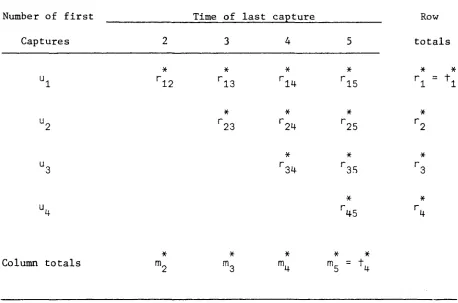
In order to apply the band-recovery Model 1 analysis to the multiple
recapture data, and obtain valid variance estimates, the recapture data
are used to construct a recovery matrix. The number of new releases after
sample i , u.
,
, and the number of this cohort last captured on each followingsampling occasion are recorded in the ith row and appropriate columns of
the recovery matrix (see, e.g., Mardekian and MacDonald, 1981; Conroy and
*
Entries in the recovery matrix are denoted r .. , where
IJ
*
r .. is the number of the u. first captured and released at the ith sample,
IJ I
that are recaptured for the last time in the jth sample, i=l, ... ,s-l,
j=i+l, ...,s (see Table 1).
[Table 1J
As indicated in Table 1, summary statistics based on the recovery
*
matrix {r .. } are
'J
i=l, ... ,s-l
*
m.
,
*
r.
I
*
and t.
I
the number of marked animals recaptured for the last time
in the ith sample, i=2, ...,s.
the number subsequently recaptured of the
u.
firstI
captured in the ith sample, i=l, ... ,s-l ,
the number first captured before or in the ith sample
and subsequently recaptured after the ith sample,
*
*
*
*
* *
(t1 = r
*
*
*
The relationship between these statistics, m.
,
r.,
t. andI I I
C.
,
R.
,
T.
in the usual band-recovery formulation (Brownieet aZ. ,
I I ' I
1978, p. 13) is not entirely straightforward, because release and
recovery (recapture) in the same period occurs in the typical band-recovery
study but cannot occur in the recapture studies considered here. Thus, the
*
diagonal elements of the usual recovery matrix are missing in {r .. } and
IJ
columns are shifted to the left.
3.2
Estimators and Large SampZe Variances
Estimating survival rates is the main objective in many recapture studies,
and is considered first. As noted by Seber (1982, p. 215), equivalent
results are obtained if survival rate estimators and their large-sample
variances are derived using a likelihood with the u. (new releases at i)
I
as random variables, or a likelihood conditional on fixed u. • This is
I
also true for estimators of capture probabilities. Thus, in comparing
estimators of ~. and p. , for the multiple recapture data results are
I I
drawn from Jolly (1965), Seber (1965) (where the u. are random) and from
I
Brownie and Robson (1983) (u. fixed); and for the first and last captures,
I
analogy is made to the band-recovery methods (Brownie
et aZ.,
1978, u.I
fixed) .
For the multiple recapture data, the Jolly-Seber estimators and
r.
1
[m.
+ Ri+
1Zi+
1]<p.
=
I i=1, ... ,s-2 (1)R.""
1 m
i+1+z i +1 1+1 rj+1 I
Var{$. ) = <p2 fE(Mi+l-mi+l)E(Mi+l+Ui+l)
[E(r~+ll
-
E{R~+l)J
I i
1
Mf+lE(M. -m. )
[E(~i)
-
E{~i
lJ}
<p. (l-<p. )
(2)
+ I I + I I
E(M.+u. ) E(M.+u.)
I I I I
COV(~i '~i+l)
= -<Pjif!i+1Qi+l{E(r~+ll
-
E(R~+1)
}
m. I
i=2, ... ,s-1 (3)
p. =
I m. +R. z.fr. I I I I
*
For the first and last capture data, the likelihood of the r ..
IJ
*
conditional on the u. is obtained by noting that the (r. '+1'.' .,r~ ) are
I I , I IS
mutually independent multinomial vectors characterized by
(4)
*
E( r. .) = u.<p • . . .if!. l P ·X.
IJ I I J- J J i=l, ... ,s-l, j=i+l, ... ,s.
INote that var<p.) in Brownie and Robson, 1983, p. 453, is incorrect.
I
By analogy to P[{R .. }] in Brownie and Robson (1976, p. 307), the
IJ
*
likelihood of {r .. } conditional on the u. is
IJ 1
where
*
P[{r .. } ] =
IJ
s-1 1T i=1
[
*
u.* ]
r.I , I.+1
~
... ,r.IS*
*
*
m.
t.+
1-r'+1f. I <p. 1 1
I I
*
u. -r.
I 1
X·1
f.I = ~
P X
'fi-1 i i i=1, ... ,s-1
*
*
*
*
A minimal sufficient statistic is (r
1,···,rS_1'
t
2, ...,t
s_1),*
*
*
where r. given u. is Binomial (u., 1-X.), and m. given
t.
1 is1 I I I 1
1-Binomial (t.
*
l ' <p. 1P.x. /
(1-X.») •1- 1- 1 1 I This leads to the maximum likelihood
~
*
estimators 1-X. = (r./u.)
I I 1
r----...;
<p. 1 P , X.
1- I I
* *
*
=
(m./t.
1)(r. 1/u .
1)I 1 - 1 - 1- Using
i=1, ... ,s-2 (5 )
p.
=
1*
r. I*
u. -r. I 1*
m. 1*
*
t.
1-m. 1- IThe large sample variances and relevant non-zero covariances are
Var(~.)
I
(7)
Var(p. )
I =
p?
i--4-
+1_*~
+I E(r. l ) u.-E(r.) I 1 1
*
*
E(t. l-m.) 1- I (8)The estimators based on first and last captures are denoted ~.
,p.
I I
to distinguish them from the Jolly-Seber estimators ~.
,p ..
I I
The estimator
p.
and its variance do not appear in earlier articles1
and are included here because of their importance in the context of the
example in Section 5. Also important in this context is estimation of
N. (the population size at i), and we present below the appropriate
I
estimator
N.
and its variance. In deriving N. and VarcN.) , it isI I 1
*
assumed that u. is Binomial (U.,p.) and t. 1 is Binomial CM. ,1-q.X.)
1 1 I 1- I 1 I
with U. and M. fixed and unknown. Thus, VarCN.) as presented below is
I I I
for fixed N. , and is comparable to Jolly's VCN.IN.) (equation (28),
1 I 1
Jolly, 1965).
*
*
*
u. t. 1 u. t. l-m.
* *
N.
= ~+ I - = -;rI 1- I (u. -r. +m. ) i=2, ... ,s-1 (9)*
1 p. l-q-:X. I I I
1 I 1 r. m.
I I
N2 { 1*
1 1 1 q.
x·
-<1-X· )}VarCN. ) = +
*
*
+*
+ 1 I I
(10)
I
I ECrj ) ECu. ) ECt. -m. ) ECmj ) ECu. - r . +m. )
* *
3.3
Lossin Efficiency
The loss in efficiency due to using only the first and last captures was
examined by comparing the appropriate asymptotic standard errors (se's),
obtained from the variances in the preceeding section. For ~. and ~.
I I
the variances used include the component of variation due to viewing the
number of marked animals surviving to i+l , of those present at i , as
the outcome of a chance process (cf. Jolly, 1965; Seber, 1965; Brownie
et al., 1978), rather than a fixed quantity (cf. Pollock, 1981). It
seems appropriate to include this component of variation because survival
estimates are often used to make comparisons across locations, times or
conditions, and given the same inherent chance of survival, actual survival
will vary from one occasion to another. For comparing
N.
andN. ,
I I
variances used were conditional on fixed N. , and therefore reflect
I
sampling variation, but not variation due to viewing N. as a random
I
variable (cf. Section 3.2, Jolly, 1982).
Percent loss in efficiency for ~. was calculated as
I
100[1-se($. )/se(~.)J , and analogously for
p.
andN. .
For simplicity,I I I I
the u. were assumed equal (u.=u, i=1, ... ,s-1), loss in efficiency being
I I
independent of u in this situation. Also, in each case considered, a
common value was used for the ¢. and for the p. (¢.=¢, i=1, ... ,s-1, and
1 I I
p.=p, i=2, ... ,s). The cases considered included values of
¢
andp likelyI
to obtain in practice. For example, values between 50 and 65% for annual
survival rates are typical for many banding studies, and the recapture
data in Mardekian and MacDonald (1981) yield estimates p. in the 30 to 40%
~
range, while the example in Pollock (1981) yields p. greater than 80%.
I
For a given set of values of ~ p and 5 , loss in efficiency is
not the same for each ~j' i=1, ...,5-2 (or for each
Pi ' N
j ) . Tosummarize results, loss in efficiency was calculated for each ~. and
1
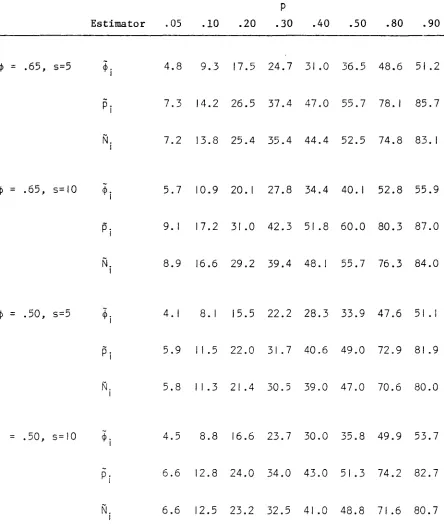
individual values averaged. These averages are presented in Table 2 for
the estimators of survival and capture probabilities and population size.
[Table 2J
Examination of Table 2 shows that average loss in efficiency is
considerably greater for
p.
andN.
than for ~.I 1 1 This seems reasonable,
as intermediate captures have a more direct effect on estimates of
corresponding p. (and hence of N.) than on estimates of survival in
1 1
preceding periods. Loss in efficiency is seen to increase as p increases,
and to a lesser degree, as ~ or the number of capture occasions (hence the
number of intermediate recaptures) increase. Note that for values of
p ~ .30 (corresponding to data in Mardekian and MacDonald, 1981 and
Pollock, 1981), the loss in efficiency is substantial.
In summarizing their results, biologists often report an average
survival rate (e.g.,
1 5-2
;P=-2
I ~.)5- I
i=l
and a standard error based on
5-3
1
2 I CoV(;P.'~.+l)
. 1 1 I
1=
.,.,.
, as compared to ~ , by
examined the loss in efficiency of ~
5-2
=
-2:-2 1:
~.
5- i=l I
calculating the appropriate standard errors using variance and covariance
formulae in (2) and (7) • For p ~ .3, results were essentially the same as
for cp. in Table 2. For p < .8 loss in efficiency tended to be less severe
r -
,
for the average, <P
,
than for the individual ~. (30 to 40% as compared toI
40 to 50%). This is because the negative correlation between survival
estimators for adjacent years is smaller in absolute magnitude for the <p. ,
I
-than for the <p.
,
for large pI
5-2
We also compared asymptotic standard errors for <PH = 1: w.~. and
i=l I I
~H
=
5-2 1:
i=l
v.~.
I I where the weights
w.
I andv.
I are chosen to minimize theasymptotic variances of <PH and <PH ' respectively (subject to 1:wj
=
1 and1:vj
=
1). Thus, ~H is the "Hanover estimator" described by Jolly (1982).This comparison provides information concerning the relative efficiency of
the two maximum likelihood estimators of a constant survival rate, <P ,
obtained assuming constant survival, and (i) applying the Model 2 analysis
of Brownie et al. (1978) to the first and last captures, or (ii) applying
Model B of Jolly (1982) to the complete recapture information (see Appendix
4, Jolly, 1982). Results for loss in efficiency for ~H (relative to ~H)
were very similar to those for ~ (relative to
$)
for all cases considered.4.
Two age Classes
In this section, we consider estimation of young and adult survival rates
(cp?
and<P~
respectively) given recapture information recorded separatelyI I
for individuals marked as young and as adults. Pollock (1981) provides the
appropriate estimators,
~?
and~~
, which utilize all the recaptureinformation. By omitting all but the first and last captures, Model HI
of Brownie
et at.
(1978) could also be used to obtain survival estimates,-0 -1
~. and ~. , and we are interested in the inefficiency of this latter
I I
procedure.
The relevant estimators and variances are not reproduced here.
~O ~1
However, var(~.) and var(~.) in Pollock (1981) do not allow for a variable
I I
number of survivors at i+1 of the marked animals of appropriate age present
just after sample i . Thus, var(~.)~O and var(~.)~1 of Pollock (1981) were
I I
adjusted (by adding the appropriate Binomial variance) in order to make
-0 -1
comparisons with var(~.) and var(~.) based on the band-recovery Model HI
I I
analysis of first and last captures.
-0 -1
Loss in efficiency for the estimators ~i and ~i is illustrated for
the example in Pollock (1981). For this 4-year study on neck-collared
young and adult giant Canada geese
(Branta canadensis maxima),
therecapture (i.e., resighting) rates were high (about 90 percent).
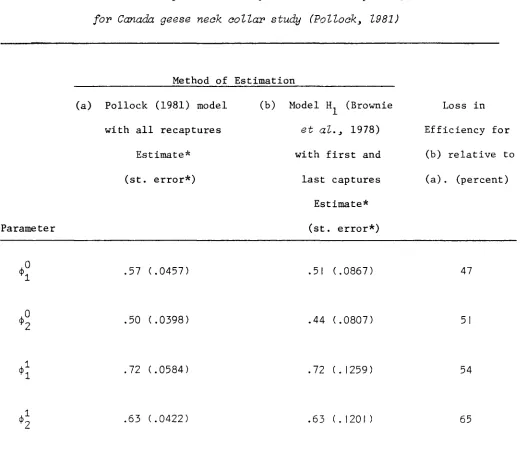
Survival rate estimates and estimated asymptotic standard errors obtained
using the method of Pollock (1981) on all recaptures, and using the
Model HI band-recovery analysis on first and last captures, are presented
in Table 3. No adjustment was made to correct for the neck-collar loss
problem (see Pollock, 1981). The standard errors of ~.~O and ~.~1 in Table 3
I I
are substantially larger than those in Pollock (1981) because here they
include the component of variation due to viewing the numbers of marked
survivors as variables, not fixed quantities.
Loss in efficiency in Table 3 was calculated as in Section 3.3, but
using the estimated standard errors. The roughly 50% loss in efficiency
shows the Model HI analysis to be clearly inferior in terms of precision
of estimates.
5.
Application to Fossil Data
Paleobiologists interested in examination of variation in extinction rates
have made use of compilations of fossil records consisting of the periods
of first and last encounters of the taxa of interest. This "stratigraphic
range data" is analogous to capture-recapture data where records of first
and last capture only are available.
In this setting, individuals correspond to species or taxa and a
sampling occasion corresponds to a geologic period. The first (last)
capture occasion is the earliest (latest) period in which the taxon is
*
encountered in the fossil record, and therefore, r .. is the number of taxa
IJ
first recorded in period i and last encountered in period j. Survival
from the midpoint of one period to the midpoint of the next (~.) is the
I
complement of the extinction rate, the capture probability (p.) is an
I
"encounter probability" or the probability that a taxon is observed in
a period given that it is extant during that period, and the population
size (N.) refers to the total number of taxa present.
I
Further discussion concerning the correspondence between this type
of paleontological data and capture-recapture methodology (including
validity of assumptions) is contained in Nichols and Pollock (1983) and
Conroy and Nichols (1984). The estimation of ¢. by applying the
band-recovery methods of Brownie et aZ. (1978) is also described by these
authors. In this context, inefficiency of the band-recovery analyses is
not an issue because the complete capture information is not available.
However, use of the estimators
p.
andN.
[equations (6) and (9)J addI I
substantially to the information resulting from the analyses described by
these authors.
The estimators
p.
can be used to examine the validity of the commonlyI
made assumption that the encounter probabilities are approximately one.
This assumption is the basis of many earlier analyses of similar data, and
reported trends in extinction rates, which are dependent on this assumption,
may be completely erroneous if the actual p. are less than one and not
I
constant.
An example for families in the phylum Mollusca follows. Numbers of
first and last encounters for periods ranging from the lower Ordovician
to the upper Permian, based on data in Sepko ski (1982), are presented in
Table 4.
[Table 4J
Using program ESTIMATE to perform the band-recovery analysis of
Brownie et aL (1978) produces estimates of <p. (but not of p. and N.),
I I I
and tests for the different models. The band-recovery Model 3 (constant
survival and recovery) is not expected to hold in this context, because
the
x. ,
and hence, f.=
<p. l P. X. , are not constant when <p and pareI I 1- I I
constant. Thus, it is not surprising that constant recovery is rejected
of fit to Model 3, and chi square
=
78.91 with 9 degrees of freedom forthe test of Model 3 versus Model 2). Constant survival was rejected in
favor of time-specific ~. 1 which was also expected, because the geologic
I
periods are known to vary in length (chi square = 24.43 with 8 degrees of
freedom for the test of Model 2 versus Modell). Fit to the model with
time-specific survival and recovery was acceptable (chi square
=
23.05with 25 degrees of freedom for the test of fit to Modell). Thus,
estimates of ~., p. and N.
I I I
equations (5), (6) and (9).
were obtained using the Model 1 output and
Extinction rates were calculated as 1-~. ,
I
with standard error given by se(~.) and were not adjusted for the
I
differences in lengths of the geologic periods. Estimates and estimated
standard errors are presented in Table 5.
[Table 5J
*
Due to the small sample sizes (small
u.
, r . andI I m.), estimates
*
Ihave poor precision, and are greater than 100 percent for one ~. and one
I
p. Nevertheless, it seems clear that results do not support the
I
assumption of p. constant and close to 100 percent. Further inferences
I
about the p. could be based on "contrasts" among the
p.
by means ofI I
approximate Z-tests using the estimated large sample variances; or on
tests concerning a model where constant p is built into the cell
expectations, these tests being beyond the capabilities of program
6.
Discussion
In examining the inefficiency of the practically expedient band-recovery
analysis on a subset (first and last captures only) of the recapture data,
we have ignored bias of the different estimators. This is because various
bias-reducing corrections can be employed which do not affect asymptotic
variances (cf. Seber, 1982, p. 204 and Brownie et aZ., 1978, p. 16).
Inefficiency associated with band-recovery analysis of multiple
recapture data was addressed in Brownie et aZ. (1978), but for a different
implementation of the analysis. The recovery matrix was assumed to contain
every recapture for an individual recorded in the same row of the matrix,
so that the multinomial structure of elements in a row was lost. Applying
the band-recovery analysis to such a recovery matrix will produce invalid
(negatively biased) variance estimates, and is not recommended (see the
last paragraph of Section 8.2, Brownie et aZ., 1978). The results for
loss in efficiency in Brownie et aZ. (1978) do not apply to the analysis of
first and last captures considered here.
Results in Table 2 may be used to assess the inefficiency of a
band-recovery analysis of first and last captures. In doing this, it is
important to note that recovery rates
f.
produced by the band-recoveryI
analysis underestimate capture probabilities p . .
I Inefficiency in
Table 2 is based on the value of p. and not f. = ¢. 1P. X.
I 1 1- I I In live
recapture studies, capture probabilities p. will often be substantially
I
larger than the 5 percent recovery rate of ~any band-recovery studies,
and the additional effort involved in implementing the appropriate
ACKNOWLEDGEMENTS
We thank K. P. Burnham, R. W. Morris, and J. D. Nichols for their
REFERENCES
Arnason, A. N. and Baniuk, L. (1978). Popan-2, a data maintenance and
analysis system for recapture data. Charles Babbage Research Centre,
Box 370, St. Pierre, Manitoba, Canada.
Brownie, C., Anderson, D. R., Burnham, K. P. and Robson, D. S. (1978).
Statistical Inference from Band Recovery Data--A Handbook.
ResourcePublication No. 131. Washington, D. C.: Fish and Wildlife Service,
United States Department of the Interior.
Brownie, C. and Robson, D. S. (1976). Models allowing for age-dependent
survival rates for band return data.
Biometrics
32, 305-323.Crosbie, S. F. and Manly, B. F. J. (1984). A new approach for parsimonius
modelling of capture-mark-recapture experiments. Submitted to
Biometrics.
Jolly, G. M. (1965). Explicit estimates from capture-recapture data with
both death and immigration--stochastic model.
Biometrika
52, 225-247.Jolly, G. M. (1982). Mark-recapture models with parameters constant in
time.
Biometrics
38, 301-321.Mardekian, S. Z. and McDonald, L. (1981). Simultaneous analysis of
band-recovery and live recapture data.
Journal of Wildlife
Management
45, 484-488.Nichols, J. D. and Pollock, K. H. (1983). Estimating taxonomic diversity,
extinction rates and speciation rates from fossil data using
Conroy, M. J. and Nichols, J. D. (1984). Testing for variation in
taxonomic extinction probabilities: A suggested methodology and
some results.
Paleobiology
(In press).Pollock, K. H. (1981). Capture-recapture models allowing for
age-dependent survival and capture rates.
Biometrics
37, 521-529.Seber, G. A. F. (1965). A note on the multiple-recapture census.
Biometrika
52, 249-259.Seber, G. A. F. (1982).
Estimation of Animal Abundance and Related
Parameters.
London: Griffin.Sepkoski, Jr., J. J. (1982). A compendium of fossil marine families.
Milwaukee Public Museum, Contributions in Biology and Geology.
Table 1
Recovery matrix for first and last captures~
with summary statistics~ for a atudy with s=5
Number of first Time of last capture Row
Captures 2 3 4 5 totals
*
*
*
*
*
*
u
1
r
12r
13r
14r
15r
1=
t1*
*
*
*
u
2
r
23r
24r
25r
2*
*
*
u
3
r
34r
3Sr
3*
*
u
4
r
45r
4Column totals m
*
=
t
*
Table 2
Average percent
lossin efficiency for estimators
~.• i=1 ... s-2.
p.•
i=2, .... s-1. andN.•
i=2 ... s-1I I I
p
Estimator .05 .10 .20 .30 .40 .50 .80 .90
<P = .65. s=5 ;Po 4.8 9.3 17.5 24.7 31.0 36.5 48.6 51.2
I
p.
7.3 14.2 26.5 37.4 47.0 55.7 78. I 85.7I
N.
7.2 13.8 25.4 35.4 44.4 52.5 74.8 83. II
<P = .65, s=IO <p. 5.7 10.9 20. I 27.8 34.4 40.1 52.8 55.9
I
p.
9. I 17.2 31.0 42.3 51.8 60.0 80.3 87.0 IN.
8.9 16.6 29.2 39.4 48.1 55.7 76.3 84.0I
<p = .50. s=5
;Pi
4.1 8. I 15.5 22.2 28.3 33.9 47.6 51. Ip.
5.9 11.5 22.0 31. 7 40.6 49.0 72.9 81.9 IN. 5.8 I1.3 21.4 30.5 39.0 47.0 70.6 80.0 I
<p = .50. s=IO ;Po
I 4.5 8.8 16.6 23.7 30.0 35.8 49.9 53.7
p.
6.6 12.8 24.0 34.0 43.0 51.3 74.2 82.7I
N.
6.612.523.232.541.048.871.680.7Table 3
Comparison of precision of sUY'Vival rate estimates based
on (aJ aU captures or (bJ first and last captUY'es~
for Canada geese neck colZar study (Pollock~ Z981J
Method of Estimation
(a) Pollock (1981) model (b) Model H
l (Brownie Loss in
with all recaptures et al.~ 1978) Efficiency for
Estimate* with first and (b) relative to
(st. error*) last captures (a) • (percent)
Estimate*
Parameter (st. error*)
cpO
.57 ( .0457) .51 ( .0867) 471
cpO
.50 ( .0398) .44 ( .0807) 512
cpl
.72 ( .0584).72
( • 1259) 541
cj>1 .63 ( .0422) .63 ( . 120 I ) 65
2
from Ordovician
toPermian (from Scpkoski, 1982)
Number
Period encountered Row
of first for first Period of Last Encounter
t
totalsencounter
t
time(u.)
e(m)
e(u)
S(9_-m)
S(u)
D(£)
D(m-u)
C(£)
c(u)
p(£)
P(u)
r.
*
"
"
e
(£) 62 18 10 4 1 1 6 2 0 2 4 48e(m)
38 9 4 2 1 6 1 0 1 2 26I
e
(u)
17 3 2 1 0 0 1 1 1 9 NV1I
S(£-m)
29 3 3 8 0 0 0 3 17S(u)
11 1 4 1 1 1 0 8D(£)
31 17 2 1 1 1 22D(m-u)
54 1 1 1 2 5C(£)
41 12 4 6 22C(u)
32 5 7 12P(£)
25 7 7*
Column totals
m.
18 19 11 8 7 41 7 16 16 33J
Table S
Estimates and standard errors for extinction probabilities
(1-~.)~ encounter probabilities (p.)~ and numbers of extant
I I .
families (Nj) for families in the phylum Mollusca
(for the data in Table 4)
Period 1-~. 5e(1-~. ) p. 5e
(p. )
N.
5e(N. )
I I I I I I
e
01,) 0.293 0.121e(m) 0.146 0.232 1.300 0.596 73.1 20.0
e
(u) 0.313 0.199 0.578 0.325 99.3 34.4S(2.-m) 0.318 0.170 0.445 0.228 124.8 44.7
S(u) 0.113 0.199 0.485 0.377 83.2 29.8
D( 2.) -1.974 1.389 0.380 0.216 144.9 55.2
D(m-u) 0.866 0.062 0.161 0.086 616.4 309.3
C(2.) 0.067 0.272 0.337 0.180 166.1 73.7
C(u) 0.171 0.341 0.320 0.153 180.0 69.6