A CONCEPTUAL MODEL OF TRUST IN LEARNING FOR GENERATION Z
NOOR ASSYIKIN BINTI ALIAS
A CONCEPTUAL MODEL OF TRUST IN LEARNING FOR GENERATION Z
NOOR ASSYIKIN BINTI ALIAS
A project report submitted in partial fulfillment of the requirements for the award of the degree of
Master of Science (Information Security)
Faculty of Computing Universiti Teknologi Malaysia
iii
This project report is dedicated to my family for their endless support and encouragement.
Abah Mama Angah Acik Abang
iv
ACKNOWLEDGEMENT
With the Name of Allah, the Most Gracious and the Most Merciful. Alhamdulillah, for granting me strength, health, inspiration, guidance and loves to complete this thesis.
First and foremost, thank you so much to abah, mama, angah, acik, abang and adik for their endless support and loves.
Great appreciation and thanks goes to my supportive supervisor, Dr. Mohd Fo’ad Bin Rohani, for his guidance, encouragement, patience and support throughout my study.
Also my utmost appreciation to lecturers and students who involve directly or indirectly helping me during this project been done.
Last but not least, thank you to my dearest friend, Nazatul for all the support, advices, transport and all the hardship we have been through together in our 6 years in UTM. Hope our friendship still remain unchanged. Thank you.
v
ABSTRACT
vi
ABSTRAK
vii
TABLE OF CONTENT
CHAPTER TITLE PAGE
DECLARATION ii
DEDICATION iii
ACKNOWLEDGEMENT iv
ABSTRACT v
ABSTRAK vi
TABLE OF CONTENTS vii
LIST OF TABLES xi
LIST OF FIGURES xiii
LIST OF ABBREVIATIONS xiv
LIST OF APPENDICES xv
1 INTRODUCTION
1.1 Introducing Gen Z 1
1.2 Background of Study 3
1.3 Problem Statement 5
1.4 Research Objectives 6
1.5 Scope of the Project 6
1.6 Important/Significant of Research 6
viii
2 LITERATURE REVIEW
2.1 Introduction 8
2.2 Generation Defined 9
2.3 List of generations 10
2.4 Introducing Generation Z 13
2.4.1 Characteristics of Generation Z 14
2.4.2 Gen Z Learning Style 17
2.4.2.1 Gen Z Engagement with Peers 20
2.5 Trust Defined 23
2.5.1 Factor in Trust 25
2.5.1.1 Benevolence Trust 25
2.5.1.2 Integrity Trust 26
2.5.1.3 Competence Trust 27
2.5.2 Trust for Gen Z 28
2.5.2.1 Trust in Learning Participation 29 2.5.2.2 Trust in Sharing Knowledge 31 2.5.2.3 Gain Trust from Gen Z 31
2.5.3 Evaluating Trust 33
2.5.3.1 Using Likert Scale 33
2.5.3.2 Pearson Bivariate Correlation 34
2.5.3.3 Cronbach’s Alpha 36
2.6 Conclusion 37
3 METHODOLOGY
3.1 Introduction 38
3.2 Research Strategy 39
3.2.1 Phase 1: Literature Review 41
3.2.2 Phase II: Conceptual Model of Trust
Development 42
ix
3.2.3.1 Questionnaire 44
3.2.3.2 Data Analysis 47
3.2.3.2.1 Reliability 48 3.2.3.2.2 Validity 48 3.2.3.3 Documenting Report 49
3.3 Conclusion 50
4 DEVELOPMENT OF CONCEPTUAL MODEL OF
TRUST
4.1 Introduction 51
4.2 Development of Conceptual Model of Trust 51 4.2.1 Selection of Criteria for Gen Z Learning Style 52
4.2.2 Selection for Trust in Gen Z 56
4.3 Conceptual Model of Trust in Learning for Gen Z 58
4.4 Conclusion 61
5 RESULTS AND FINDING
5.1 Introduction 62
5.2 Questionnaire Analysis 63
5.2.1 Section A: Demographic 64
5.2.2 Section B: Gen Z Learning Styles 66 5.2.2.1 Part A: Learning Method 66 5.2.2.2 Part B: Preferable Electronic Resources 68 5.2.2.3 Part C: Peer to Peer Learning Mode 69 5.2.3 Section C: Trust in Learning for Gen Z 72 5.2.3.1 Part A: Benevolence based trust 72 5.2.3.2 Part B: Integrity Based Trust 77 5.2.3.2 Part C: Competence Based Trust 82 5.2.3.3 Part D: Trust Factors 87
x
6 DISCUSSION AND CONCLUSION
6.1 Introduction 90
6.2 Achievements of the Overall Study 90
6.2.1 Objective 1 Achievement: Identify Gen Z
Characteristics and Learning Styles 91 6.2.2 Objective 2 Achievement: Develop Conceptual
Model of Trust in Learning for Gen Z 91 6.2.3 Objective 3 Achievement: Evaluate and Validate
Conceptual Model of Trust in Learning for Gen
Z 93
6.3 Limitations of Study 94
6.4 Recommendation for Future Research 94
6.5 Conclusion 95
REFERENCES 96
xi
LIST OF TABLES
TABLE NO. TITLE PAGE
1.1 Learning Style for Different Generations (IBM) 4
2.1 List of Generation 11
2.2 How to Participate with Gen Z 19
2.3 Summary of Gen Z Learning Styles 22
2.4 Rules of Thumb for Cronbach’s Alpha 36
3.1 Data Collection and Analysis Techniques Used 49
4.1 Gen Z Learning Style 53
4.2 Selection of Criteria in Learning Style for Gen Z 54
4.3 Gen Z Trust 56
4.4 Relationship between Trust and Gen Z Learning Styles 57
5.1 Gender 64
5.2 Age 65
5.3 Education Level 65
5.4 Percentage of Learning Method for Gen Z 67
5.5 Percentage of Preferable Electronic Resources 68
5.6 Percentage of Study with Peers 69
5.7 Share Learning Materials 70
xii
5.9 Characteristic of Peers 71
5.10 Benevolence Based Trust 73
5.11 Percentage of Likely to Participate in Class 74 5.12 Reliability Statistics for Benevolence Trust 75
5.13 Mean for Benevolence Trust 76
5.14 Correlations between BMean and Participation in Class 76
5.15 Percentage of Integrity Trust 78
5.16 Percentage of Doing Good in Assignment/Homework
by Relying to Friends 79
5.17 Reliability Statistics for Integrity Trust 80
5.18 Mean for Integrity Trust 81
5.19 Correlation between IMean and Rely in Friends in Class 81
5.20 Percentage of Competence Trust 83
5.21 Prefer referring to more competence person in certain
problem in subject 84
5.22 Reliability Statistics for Competence Trust 85
5.23 Mean for Competence Trust 85
5.24 Correlation between CMean and Refer to Expert 86 5.25 Percentage of the Essentiality of Benevolence, Integrity
and Competence in Learning Environment 87
xiii
LIST OF FIGURES
FIGURE NO. TITLE PAGE
1.1 Key Characteristics of Generation Z 2
2.1 Generational view: by 2015 12
2.2 Crisis During Time 13
2.3 Daily use of Electronic Devices 15
2.4 Five Factors of Trust 24
2.5 Gen Zers Trust Digital Channel More Than Other
Adults 28
2.6 Example of Likert Scale 33
2.7 Correlation Table 35
3.1 Research Flow 40
3.2 Distribution Through Social Media 47
xiv
LIST OF ABBREVIATIONS
GEN X Generation X
GEN Y Generation Y
xv
LIST OF APPENDICES
APPENDIX TITLE PAGE
A Sample of Questionnaire 101
B Percentage of Study Method Used by Generation 109
C Percentage of Electronic Resources Used 110
1
CHAPTER 1
INTRODUCTION
1.1 Introducing Gen Z
Generation Z (Gen Z) is referring to a cohort of generation who born after Generation Y (Gen Y). This generation born in mid of 1990s to early 2000s. Because of the changing in technology, culture and lifestyle, their characteristics is opposing compare to other generation. This generation also known as “tech savvy” or “digital native” because of their countless knowledge in using the technologies. They so immersed with technology and it is not just a tools anymore but it has been a part of their life. Since they were born in the world where people and places are related to digital technology, they prefer to see the all the digital “things” in what the found. They are also eager in doing something especially when it is impending to technologies.
Based on Grail Research Analysis, Gen Z is:
2 2. Constantly multitasking – most of the social media platform provide variable things in one device for example one social media got the function of text, photos, videos, links, audio, videos, slideshows and others.
3. They are always connected – they love to communicate through multiple types of social networking channels.
Members of Gen Z cannot live without the personal computer, mobile phones, gaming systems, MP3 players and Internet.They are comfortable with e-mail, texting and computer applications. They also can master the technologies faster than the previous generations. Gen Z also very familiar with the social networking. They are more expert than others. Since they grew up with this digital technology, they have little concern about the privacy, risk and threat. They also got no problem sharing their most secret details of their lives to virtual strangers. Moreover, Gen Z is very collaborative and creative. Gen Z is very scared with length. They don’t like taking too much time to read, do or say anything. That’s why abbreviations become more popular in texting. Youths texts an average of 2900 times a month. McCrindle Research, Sparxoo and Group MAD had concluded the several key characteristics of Gen Z in Figure 1.1.
Figure 1.1: Key characteristics of Generation Z
3 1.2 Background of Study
Generation Z are possibly the most informed, technologically advanced and socially aware kids of all time. They are the “Digital Native” generation who eager in doing something especially when it is comes to technologies. Being part of the most technologically advanced generation in history has provided them with some distinct advantages. They have a positive attitude towards technology and are not afraid to try new things. When they’re curious about a subject, they’ll often research it online. For them if you don’t know something, Google it (Kristin Gibson, 2013). Gen Z are always connected in a seamless cloud-based world of friends, data, and entertainment (Renfro, 2012). While according to Honey (2014) 75% of Generation Z visited a social network site daily and spent an average of 4.6 hours a day on social networks. Gen Z used social apps like Twitter to find information for research and buying products. They also only friends with their friends and like to do a lot of pictures and videos (Trosien, 2015). According to Trosein again, Gen Z trust more and rely on personal preferences. Which means they trust something that in personally come from people they know like family and friends.
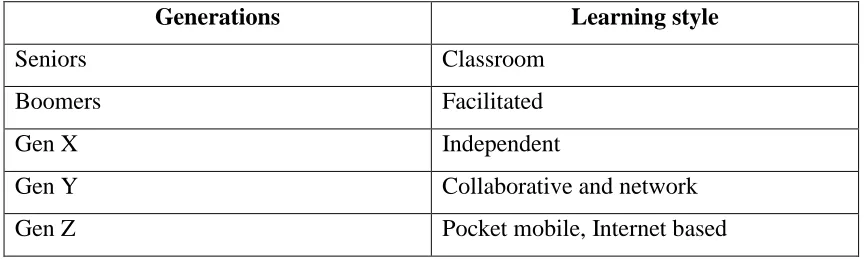
4 Table 1.1: Learning Style for Different Generations (IBM)
Generations Learning style
Seniors Classroom
Boomers Facilitated
Gen X Independent
Gen Y Collaborative and network
Gen Z Pocket mobile, Internet based
Other than that, beside of using technology as learning based, this generation also prefer spent their time communicating. They love working in project group or given team task. They like to run the ideas with family, friends and like-minded strangers on the Internet when they need some help. This generation prefer share their information with their friends. Sharing data is the ability to share the same data resources with multiple application or users (Encylopedia). But how this generation aware that the person that they want to share the learning materials can be trusted. Trust in human relation is subjective (Christian Bizer, 2005). The Trusted Computing Group defines trust as “an entity can be trusted if it always behaves in the expected manner for the intended purposes”. To establish the trust relation for peers in open system is malicious and risky. Trust also a social concept that is difficult to be measure by numerical values (Basha, 2014).
5 1.3 Problem Statement
Generation Z who born between 1995 to 2010 (Rothman) – the oldest now have turned 21, comprise of children who are true tech savvy. They don’t use technology as a tool but as their way of life. Gen Z is full of good kids, but they can be seeming hard to manage if teachers or educators don’t understand how this generation being function. Since Gen Z is now being conquering the education institutional, there is a need for us to know their learning styles. This way can help them to learn in more convenient learning environment. Gen Z like to participate in groups that share their interest and ideas (John C.Beck, 2006). To them by doing this, they can learn in more sideways, linear and lasting. By sharing interest, they can communicate well by themselves and merge with others (William, 2016). Gen Z also prefer to share their thoughts and experiences with others (Everett-Haynes, 2016).
6 1.4 Research Objectives
There are three objectives that need to be achieved:
i. To study Gen Z learning style and its characteristics.
ii. To develop a conceptual model of trust in learning for Gen Z. iii. To evaluate the conceptual model of trust in learning for Gen Z.
1.5 Scopes of the Project
i. Investigation of all objectives in this study are limited to Generation Z who age from 15 to 20. And all of the respondents are students from high school and university level (till degree) only.
ii. This study will focus on the learning styles of Generation Z.
1.6 Importance/ Significance of Research
All study should have the reason so that the study will give benefits to others. This significance study can be divided into two categories which are practical and research. Therefore, the significant of study is:
i. For research: developing the conceptual model of trust that can help Gen Z share information in trusted learning environment.
7 1.7 Thesis Organization
The remainder of this paper is organized as follows. This thesis contains of five chapters. Chapter 1 include the general overview of Generation Z, background of study, problem statement, research objectives, scopes and the importance of this research which is to develop a conceptual model of trust that suit with Gen Z learning styles.
Chapter 2 is Literature Review. This chapter presents the foundation for the study. The chapter begins with the general introduction of Gen Z, characteristics, Gen Z learning styles and brief how to participate with Gen Z. The next section will discuss on definition of trust, details on trust factors, trust for Gen Z, how to evaluate trsut using two techniques which are Pearson Bivariate Correlation and Cronbach’s Alpha and the related work
Chapter 3 is the Methodology. This chapter will briefly explain the research framework used in order to do this project. This chapter also include phase of research process. Chapter 4 is development of conceptual model of trust, Chapter 5 is results and findings. And lastly in Chapter 6, which is the last chapter in this report, will discuss about conclusion, limitation of study and future plan of it.
96
REFERENCES
Abrahams, F., 2015. Understanding Generation Z learning styles in order to deliver quality learning experiences. 2016, from http://www.precisionindustries.com.au/whats- hot-right-now-blog/understanding-generation-z-learning-styles-in-order-to-deliver-quality-learning-experiences
Anthony Vance , C. E.-D.-C. D. W. S., 2014. Examining Trust in Information Technology Artifacts: The Effects of System Quality and Culture. Journal of Management Information Systems, pp.73-100.
Auriat, M. T. S. a. N., 2005. Questionnaire design. UNESCO International Institute for Educational Planning.
Basha, S. U. S. a. D. M. S. S., 2014. An Exaustive Survey of Trust Models in P2P Network. International Journal on Web Service Computing (IJWSC), 5.
BQUService., 2016. 8 Tips to develop an interactive e-Learning strategy. Available at: https://www.bquservices.com/index.php?option=com_content&view=article&id =320&catid=7&Itemid=242
C., Kyle Cance, Julie Beck, Jennifer Santos., 2013. Generation Z: The next generation of college students. Paper presented at the NIRSA 2013 Inspiring Communities of WellBeing.
Christian Bizer, R. O., 2005. Using Context- and Content-Based Trust Policies on the Semantic Web.
97 Cook, D. V. S. (2015). Engaging Generation Z Students. Available at:
https://sites.google.com/a/uis.edu/colrs_cook/home/engaging-generation-z-students
Cultivate, C., 2016. The 10 Most Important Things You Need to Know About Gen Z. Available at: http://www.createcultivate.com/blog/2016/9/16/the-10-most-important-things-you-need-to-know-about-gen-z
2012. Meet Generation Z. 2016, Available at: http://gettingsmart.com/2012/12/meet-generation-z/
Daniel Z. Levin, R. C., Lisa C. Abrams and Eric L. Lesser., 2002. Trust and knowledge sharing: A critical combination. IBM Corporation.
Everett-Haynes, L. M., 2016. Generation Z: A New Class of Students Arrives. Available at: https://uanews.arizona.edu/story/generation-z-new-class-students-arrives Ford, T., 2015. 5 Tips for Teaching Generation Z In College. Available at:
https://blog.tophat.com/generation-z/
Gareis, M. T.-M. a. C. R., 2015. Principals, Trust, and Cultivating Vibrant Schools. Societies.
Glenn Mahoney, W. M., Gholamali C. Shoja. Generic Reliability Trust Model.
Gliem, J. A. G. a. R. R., 2003. Calculating, Interpreting, and Reporting Cronbach’s Alpha Reliability Coefficient for Likert-Type Scales.
Goddard, R. D., Tschannen-Moran, M., & Hoy, W. K., 2001. A multilevel examination of the distribution and effects of teacher trust in students and parents in urban elementary schools. The Elementary School Journal, 102(1), pp.3-17.
Grabinger, S. S. a. A., 2014. Gen Z The first generation of the 21st Century has arrived! Hart, J., 2008, (September). Understanding Today's Learner. Available at:
https://www.learningsolutionsmag.com/articles/80/
Hershey Harry Friedman, D. F., 2014. Learning About Leadership, Trust and Benevolence from Ethics of the Fathers (Avot). Journal of Religion and Business Ethics, 3(1). John C.Beck, M. W., 2006. The Kids are Alright: How the Gamer generation is Changing
98 John Drake, N. M., 2006. Benevolent Competence and Integrity-Based Trust in Knowledge Transfer: A Look at Software Reuse. Americas Conference on
Information Systems (AMCIS), America.
Jordahl, N. B. a. H., 2005. Free to Trust? Economic Freedom and Social Capital. pp.141-169.
Jovanovic, B. 2016. Building Trust Inside Your Team: Creating a Strong, Cohesive Group.
Kate McInnes, X. L., Huaxuan Li., 2007. Benevolence, Integrity and Competence: Dimensions of Trust in Internet Banking.
Keeter, P. T. a. S., 2010. Millennials: Confident. Connected. Open to Change. .
Kirschner, C., 2013. 7 signs we are too dependent on technology. Available at: http://www.mnn.com/green-tech/gadgets-electronics/stories/7-signs-we-are-too-dependent-on-technology
Kristin Gibson, T. C., Kyle Cance, Julie Beck, Jennifer Santos., 2013. Generation Z: The next generation of college students. Inspiring Communities of WellBeing.
L. Jean Camp, H. N., Cathleen McGrath., 2002. Trust: A Collision of Paradigms. 5th International Conference.
Lee, S. H., 2011. Does Trust Really Matter? A Quantitative Study of College Students' Trust and Use of News Media. College of Journalism and Mass Communications, 15.
Maitri, D. K. G. a. M., 2015. Gen Z - Children of Digital Revolution Transforming Social Landscape. American International Journal of Research in Humanities, Arts and Social Sciences, 10(3), pp.206-208.
McCrindle, M., 2011. The ABC of XYZ: Understanding the Global Generations UNSW Press.
Measom, C., 2016. The Importance of Trust Within a Team. 2016, Available at: http://work.chron.com/importance-trust-within-team-3940.html
Minitab., 2016. Interpret the key results for Correlation. Available at: http://support.minitab.com/en-us/minitab-express/1/help-and-how-to/modeling-statistics/regression/how-to/correlation/interpret-the-results/
99 Nillsen, R., 2004. The Concept of Integrity in Teaching and Learning.
Nicholas, A., 2008. Preferred Learning Methods of the Millennial Generation. Oh, T. C. R. a. E., 2008. Generational Differences.
Ostertag, V., 2007. An Investigation of the Value of Fictional Texts as a Tool for Enriching German Language and Culture Learning: A Kaleidoscopic View of
Outcomes and Possibilities.
Palley, W., 2012. Gen Z: Digital in Their DNA.
Pilcher, J., 1994. Mannheim's Sociology of Generations: An undervalued legacy. British Journal of Sociology, 45(3), pp.481–495.
Quill., 2016. Ten Things You Should Know About Generation Z Available at: Quill.com/eduresources
Roger C. Mayer, J. H. D., 1995. An integrative model of organizational trust. Academy of Management Review, 20(3), pp.709-734.
Rothman, D. A Tsunami of Learners Called Generation Z.
Shawbel, D., 2014. 66 Of The Most Interesting Facts About Generation Z. Available at: http://danschawbel.com/blog/39-of-the-most-interesting-facts-about-generation-z/
Smith, H. H. R., 2014. Development of Trust and Collaboration Between Teachers in PLC Teams: The Roles of Teachers, Principals and Different Facets of Trust. Brigham Young University BYU Scholars Archive.
Strauss, N. H. a. W., 2000. Millennials Rising: The Next Great Generation.
Trosien, L., 2015. 4 Things to Know About Generation Z. Available at: http://www.naahq.org/read/marketing-buzz/things-to-know-about-gen-z
Tulgan, B., 2013. Meet Generation Z: The second generation within the giant "Millennial" cohort: RainmakerThinking, Inc.
Woraluck Wongse-ek, G. B. W. a. L. G., 2013. Towards A Trust Model in E-Learning: Antecedents of A Student’s Trust. Paper presented at the IADIS International