NEW DESCRIPTOR FOR OBJECT DETECTION USING AN IMPROVED ENSEMBLE-BASED TECHNIQUE
AMIN MOHAMED AHSAN
i
NEW DESCRIPTOR FOR OBJECT DETECTION USING AN IMPROVED ENSEMBLE-BASED TECHNIQUE
AMIN MOHAMED AHSAN
A thesis submitted in fulfilment of the requirements for the award of the degree of
Doctor of Philosophy (Computer Science)
Faculty of Computing Universiti Teknologi Malaysia
DEDICATION
iv
ACKNOWLEDGMENTS
All praise and thanks are due to Allah who "Taught man that which he knew not," and peace and blessings of Allah be upon our prophet, Mohammad and upon all his family and companions. All thanks to Allah for graces and for giving me the strength and endurance to complete this research
During PhD journey, I was in contact with many people, scholars and academicians colleagues. They have contributed in different ways towards my understanding and thoughts. First, I would like to express my high appreciation to my supervisor, Prof. Dr. Dzulkifli Bin Mohamad, for encouragement, guidance, comments and his support which participated actively in the completion of this work.
ABSTRACT
TABLE OF CONTENTS
CHAPTER TITLE PAGE
DECLARATION ii
DEDICATION iii
ACKNOWLEDGMENTS iv
ABSTRACT v
ABSTRAK vi
TABLE OF CONTENTS vii
LIST OF TABLES xii
LIST OF FIGURES xvi
LIST OF ABBREVIATIONS xxiii
LIST OF APPENDICES xxv
1 INTRODUCTION 1
1.1 Introduction 1
1.2 Problem Background 2
1.3 Problem Statement 7
1.4 Research Questions 7
1.5 Research Aim 8
1.6 Research Objectives 8
1.7 Research Scope and Assumptions 9
1.8 Research Significance 10
1.9 Summary of Research Contributions 11
1.10 Terms Definitions 11
viii
2 LITERATURE REVIEW 14
2.1 Introduction 14
2.2 Object Detection 15
2.2.1 Features 18
2.2.1.1 Interest Points Detectors 21 2.2.1.2 Interest Points’ Descriptors 25 2.2.1.2.1 Floating-point-based
XXXXXXXXXXXXXXXX Descriptors 26 2.2.1.2.2 Binary-based Descriptors 28 2.2.1.3 Interest Point Detectors used and their
XXXXXXXXXXX Descriptors 29 2.2.1.3.1 SIFT Points’ Detector and
XXXXXXXXXXXXXXXXX Descriptor 29 2.2.1.3.2 SURF Points’ Detector and
XXXXXXXXXXXXXXXXX Descriptor 33
2.2.2 Object Recognition 37
2.2.2.1 Supervised Learning Algorithms 39 2.2.2.2 Technique Used 42 2.2.2.2.1 Back-propagation Neural
XXXXXXXXXXXXXXXXX Network 42 2.2.2.2.2 Related Issues 45 2.2.3 Object Localization 47
2.3 Ensemble-based Recognition 50
2.4 Data sets 54
2.5 Performance Evaluation 58
2.6 Related Works 62
2.6.1 Object Detection Frameworks 62
2.6.2 Features 64
2.6.3 Recognition 68
2.7 Discussion 72
3 RESEARCH METHODOLOGY 73
3.2 Study Framework 75
3.3 Object Detection Datasets 78
3.3.1 Faces Dataset 78
3.3.1.1 Training Data 78 3.3.1.2 Testing Data 81 3.3.1.2.1 Labeled Data 81 3.3.1.2.2 Unlabeled Data 83 3.3.2 Cars Dataset 84 3.3.2.1 Training Data 84 3.3.2.2 Testing Data 86 3.3.2.2.1 Labeled Data 86 3.3.2.2.2 Unlabeled Data 88
3.4 Proposed Methods 89
3.5 Experimental Design 91
3.6 Performance Evaluation 92
3.7 Summary 94
4 NESTED-WINDOWS OF HISTOGRAM OF
ORIENTED GRADIENTS DESCRIPTOR 95
4.1 Introduction 95
4.2 Methods 96
4.2.1 Motivation 96
4.2.2 SIFT and SURF Descriptors 97 4.2.2.1 SIFT Descriptor 97 4.2.2.2 SURF Descriptor 98
4.2.3 The Proposed Descriptor 99
4.2.4 Single-based Learning Technique 106 4.2.4.1 Learning Phase 106 4.2.4.2 Testing Phase 109
4.3 Experimental Design 110
4.4 Experimental Results 111
x
4.4.1.2 Cars Classification 116 4.4.2 Localization Performance 118 4.4.2.1 Faces Localization 119 4.4.2.2 Cars Localization 120
4.4.3 Invariance 121
4.4.3.1 Invariance to Rotation 121 4.4.3.2 Invariance to Scale 124
4.5 Time Consumption 128
4.6 Discussion 130
4.6 Summary 135
5 AN IMPROVED ENSEMBLE-BASED TECHNIQUE
FOR OBJECT CLASSIFICATION 136
5.1 Introduction 136
5.2 Methods 137
5.2.1 Motivation 137
5.2.2 An Ensemble-based Developed Technique 138 5.2.2.1 Learning Phase 140 5.2.2.2 Testing Phase 142
5.3 Experimental Design 144
5.4 Experimental Results 144
5.4.1 Classification Performance 145 5.4.1.1 Faces Classification Performance 145 5.4.1.2 Cars Classification Performance 150 5.4.2 Localization Performance 155 5.4.2.1 Faces Localization Performance 155 5.4.2.2 Cars Localization Performance 156
5.4.3 Time Consumption 157
5.5 Discussion 163
6 AN IMPROVED SCHEME OF AN INTEREST POINT
DETECTOR 171
6.1 Introduction 171
6.2 Motivation 172
6.2.1 Methods 172
6.2.2 A Developed Scheme for Speeding up The
XXXXXX Object Detection System 172
6.3 Experimental Results 179
6.4 Discussion 185
6.5 Summary 188
7 CONCLUSIONS 189
7.1 Introduction 189
7.2 Summary of Research Achievements 190
7.3 Research Contributions 191
7.4 Future Works 194
7.5 Research Challenges 195
REFERENCES 196
xii
LIST OF TABLES
TABLE NO. TITLE PAGE
2.1 Comparison between the global and local features 21 2.2 Comparison among some existing points’ detector
regarding some important criterion 25
2.3 Comparison among the most common algorithms (Kotsiantis,
et al., 2007)
40
2.4 Summary of some existing studies in regard to localization performance and time consuming
48
2.5 Notes on existing solutions of imbalanced data 53
2.6 INRIA person dataset 56
2.7 Summary of some common datasets used in object detection
field
57
2.8 The measurements used in some existing studies 61
2.9 Some proposed frameworks in literature 63
3.1 The relations among phases, study questions, study
objectives, methods, chapters, and the evaluation
90
4.1 Comparison among SIFT, SURF, and NHOG regarding some
criterion
105
4.2 Summary of Datasets used 112
4.3 Number of nodes of hidden layer for each descriptor 113
4.4 Comparison between SURF and NHOG in terms of
classification performance on Faces dataset
114
4.5 Comparison between SIFT and NHOG in terms of
classification performance on Faces dataset
114
4.6 Comparison between SURF and NHOG in terms of
classification performance on Cars dataset
116
classification performance on Cars dataset 116
4.8 Comparison between SURF and NHOG in terms of point
localization on faces dataset evaluated by Precision measurement
119
4.9 Comparison between SIFT and NHOG in terms of point
localization on faces dataset evaluated by Precision measurement
119
4.10 Comparison between SURF and NHOG in terms of point
localization on cars dataset evaluated by Precision measurement
120
4.11 Comparison between SIFT and NHOG in terms of point
localization on cars dataset evaluated by Precision measurement
120
4.12 Comparison between SURF and NHOG regarding to rotation
changes
122
4.13 Comparison between SIFT and NHOG regarding to rotation changes
122
4.14 Comparison between SURF and NHOG regarding to Scale changes
125
4.15 Comparison between SIFT and NHOG regarding to Scale changes
126
4.16 Time consumption comparison among SURF, SIFT, and
NHOG descriptor based on single classifier
128
4.17 Paired Samples Test on faces dataset, single-based classifier 132
4.18 Paired Samples Statistics on faces dataset, single-based classifier
132
4.19 Paired Samples Test on cars dataset, single-based classifier 133
4.20 Paired Samples Statistics on cars dataset, single-based classifier
133
5.1 Comparison between SURF and NHOG in terms of
classification performance on Faces dataset for E1 and E2 environments
145
5.2 Comparison between SIFT and NHOG in terms of
classification performance on Faces dataset for E1 and E2 environments
146
5.3 Comparison between SURF and NHOG in terms of
xiv
ensemble learning technique
148
5.4 Comparison between SIFT and NHOG in terms of
classification performance on faces dataset based on ensemble learning technique
148
5.5 Comparison between SURF and NHOG in terms of
classification performance on cars dataset for E1 and E2 environments
150
5.6 Comparison between SIFT and NHOG in terms of
classification performance on cars dataset for E1 and E2 environments
150
5.7 Comparison between SURF and NHOG in terms of
classification performance on cars dataset based on ensemble learning technique
153
5.8 Comparison between SIFT and NHOG in terms of
classification performance on cars dataset based on ensemble learning technique
153
5.9 Comparison between SURF and NHOG in terms of point
localization on faces dataset evaluated by Precision measurement based on ensemble classifiers
155
5.10 Comparison between SIFT and NHOG in terms of point
localization on faces dataset evaluated by Precision measurement based on ensemble classifiers
155
5.11 Comparison between SURF and NHOG in terms of point
localization on cars dataset evaluated by Precision measurement based on ensemble classifiers
156
5.12 Comparison between SIFT and NHOG in terms of point
localization on cars dataset evaluated by Precision measurement based on ensemble classifiers
156
5.13 Time consuming, SURF vs. NHOG and SIFT vs. NHOG
applied on faces dataset
157
5.14 Time consuming, SURF vs. NHOG and SIFT vs. NHOG
applied on cars dataset
160
5.15 Paired Samples Test on faces dataset, Single-based vs.
Ensemble-based techniques
168
5.16 Paired Samples Statistics on faces dataset for Single-based and Ensemble-based techniques
5.17 Paired Samples Test on cars dataset, Single-based vs. Ensemble-based techniques
169
5.18 Paired Samples Statistics on cars dataset for Single-based and Ensemble-based techniques
169
6.1 TPP, FP, TP, and Time consuming regarding the octave and
hidden layer settings
176
6.2 TPP, FP, TP, and Time consuming using NHOG+ with
different hidden layer settings
177
6.3 The average of time (in seconds) and the improvement
percentage for NHOG+ over NHOG applied on faces and cars datasets
179
6.4 TPP, FP,TP, and Precision of NHOG+ applied on faces and
cars datasets
182
6.5 Paired Samples Test regarding time consuming, NHOG vs.
NHOG +
185
6.6 Paired Samples Statistics regarding time consuming, NHOG
vs. NHOG +
186
6.7 Paired Samples Test regarding Precision metric, NHOG vs.
NHOG +
187
6.8 Paired Samples Statistics regarding Precision metric, NHOG
vs. NHOG +
xvi
LIST OF FIGURES
FIGURE NO. TITLE PAGE
1.1 Scenario leading to the study problem 6
2.1 The most common object detection challenges 16
2.2 Taxonomy of the main steps and elements of object
detection system 18
2.3 Taxonomy of features in object detection 19
2.4 Most common points’ detectors methods 22
2.5 Convolved Gaussian (left), DOG (right) proposed by Lowe
(2004) 30
2.6 Maxima and minima of DOG, Lowe (2004) 31
2.7 Interest point descriptor, Lowe (2004) 32
2.8 Computing the upright rectangle area using integral Image
Bay et al. (2008) 34
2.9 LOG Approximation (top row), Bay formula (2.13) (bottom
row )
35
2.10 Scale-Space: SIFT (left), SURF (right) 35
2.11 Assigning the Orientation, Bay et al. (2008) 36
2.13 Taxonomy of machine learning techniques 39
2.14 Standard architecture of Back-propagation Neural Network 43
2.15 Steps of BP neural network 45
2.16 Taxonomy of imbalanced data solutions 51
2.17 Bi-level filters for Center-Surround (Agrawal, et al., 2008) 65
2.18 Proposed approach for face detection (D. Kim and Dahyot,
2008) 68
2.19 Fusion schemes proposed by (Ludwig, et al., 2009). (a)
scheme1, (b) scheme2, (c) scheme3 70
2.20 Cascade classifiers structure (Wang, et al., 2012) 71
3.1 The Study Framework 76
3.2 Some examples of Caltech 101 “faces” dataset, the original
images 79
3.3 Some examples of an isolated faces clipped from Caltech
101 “faces” dataset, for training 79
3.4 Indoor examples from SUN397 dataset, for training 80
3.5 Outdoor examples from SUN397 dataset, for training 80
3.6 Some examples of an isolated faces clipped from Caltech
101 “faces” dataset, for classification test 82
3.7 Some examples of non-object from SUN397, for
classification test 82
3.8 Some unlabelled images from Caltech 101 “faces”, for
localization test 83
xviii
3.10 Some examples of non-object (street) used for cars training 85
3.11 Some examples of non-object (open space) used for cars
training 86
3.12 Some examples of car object used for classification test 87
3.13 Some examples of non-object used for classification test 87
3.14 Some unlabelled images from VOC2009, for localization
test 88
4.1 SIFT descriptor, Lowe (2004) 97
4.2 Orientation assigning, Bay et al. (2008) 98
4.3 SURF Descriptor Components 99
4.4 Points’ detection. (a) original image, (b) detected points 100
4.5 Building up the window around interest point 100
4.6 NHOG features extraction elements: (a) window gradients,
(b) nested-windows of gradients, (c) the considered
gradients, (d) pyramid representation 103
4.7 The involved process in NHOG 104
4.8 General framework for object detection based on interest
points 106
4.9 Training Procedure 108
4.10 Testing Procedure 110
4.11 ROC curve for SURF and NHOG according to hidden layer
settings on Faces dataset. (left) H1, (right) H2 115
4.12 ROC curve for SIFT and NHOG according to hidden layer
settings on Faces dataset. (left) H1, (right) H2 115
settings on Cars dataset. (left) H1, (right) H2
4.14 ROC curve for SIFT and NHOG according to hidden layer
settings on Cars dataset. (left) H1, (right) H2 118
4.15 Comparison between SURF and NHOG in regards to
average of FP along all images at θ 123
4.16 Comparison between SIFT and NHOG in regards to average
of FP along all images at θ 124
4.17 Comparison between SURF and NHOG in regards to
average of FP along all images at different scale value 127
4.18 Comparison between SIFT and NHOG in regards to average
of FP along all images at different scale value 127
4.19 Time consumption for each image using SURF and NHOG
descriptor based on single classifier 129
4.20 Time consumption for each image using SURF and NHOG
descriptor based on single classifier 129
5.1 Learning and testing phase of the developed technique. (a)
learning, (b) testing 139
5.2 ROC curve for SURF and NHOG according to E1 and E2
environments on Faces dataset with H1 and H2 setting. (top)
H1, (bottom) H2
147
5.3 ROC curve for SIFT and NHOG according to E1 and E2
environments on Faces dataset with H1 and H2 setting. (top)
H1, (bottom) H2 147
5.4 ROC curve for SURF and NHOG according to H1 and H2
applied on Faces dataset based on ensemble classifiers. (left)
H1, (right) H2 149
5.5 ROC curve for SIFT and NHOG according to H1 and H2
xx
H1, (right) H2
5.6 ROC curve for SURF and NHOG according to E1 and E2
environments on cars dataset with H1 and H2 setting. (top)
H1, (bottom) H2 151
5.7 ROC curve for SIFT and NHOG according to E1 and E2
environments on cars dataset with H1 and H2 setting. (top)
H1, (bottom) H2 152
5.8 ROC curve for SURF and NHOG according to H1 and H2
applied on cars dataset based on ensemble classifiers. (left)
H1, (right) H2 154
5.9 ROC curve for SIFT and NHOG according to H1 and H2
applied on cars dataset based on ensemble classifiers. (left)
H1, (right) H2 154
5.10 Comparison between SURF and NHOG in terms of time
consuming for each image using ensemble-based technique
applied on faces dataset. (a) H1, (b) H2 158
5.11 Comparison between SIFT and NHOG in terms of time
consuming for each image using ensemble-based technique
applied on faces dataset. (a) H1, (b) H2 159
5.12 Comparison between SURF and NHOG in terms of time
consuming for each image using ensemble-based technique
applied on cars dataset.( a) H1, (b) H2 161
5.13 Comparison between SIFT and NHOG in terms of time
consuming for each image using ensemble-based technique
applied on cars dataset. (a) H1, (b) H2 162
5.14 Comparison between single-based and ensemble-based
techniques for SURF and NHOG descriptors on faces
dataset in regard to H1 and H2 setting. (top) H1, (bottom)
H2
5.15 Comparison between single-based and ensemble-based
techniques for SIFT and NHOG descriptors on faces dataset
in regards to H1 and H2 setting. (top) H1, (bottom) H2 164
5.16 Comparison between single-based and ensemble-based
techniques for SURF and NHOG descriptors on cars dataset
in regards to H1 and H2 setting. (top) H1, (bottom) H2 165
5.17 Comparison between single-based and ensemble-based
techniques for SIFT and NHOG descriptors on cars dataset
in regards to H1 and H2 setting. (top) H1, (bottom) H2 166
6.1 Filters sizes for each octave used in SURF 174
6.2 SURF point detector, the relation between scale and the
detected interest points 174
6.3 Initial proposed schemes to speed up point’s detector, a) 4
octaves, b) 3 octaves 175
6.4 Proposed scheme to speed up point’s detector, NHOG+ 177
6.5 Some examples of object localization regarding the octave
settings and hidden layer settings, left half H1, right half H2.
(a) 4 octaves, (b) 3 octaves, (c) odd octaves. 178
6.6 Comparison between NHOG and NHOG+ in terms of time
consumption regarding hidden layer setting applied on faces
dataset. (a) H1, (b) H2 180
6.7 Comparison between NHOG and NHOG+ in terms of time
consumption regarding hidden layer setting applied on cars
dataset. (a) H1, (b) H2 181
6.8 Comparison between NHOG and NHOG+ in terms of FP
error regarding hidden layer setting applied on faces dataset.
xxii
6.9 Comparison between NHOG and NHOG+ in terms of FP
error regarding hidden layer setting applied on cars dataset.
LIST OF ABBREVIATIONS
ANN - Artificial Neural Network
B-SIFT - Binary SIFT
BRIEF - Binary Robust Independent Elementary Features
BRISK - Binary Robust Invariant Scalable Key-points
CCR - Correct Classification Rate
CenSurE - Center Surround Extermas
CV - Computer Vision
DOC - Difference of Gaussian
DR - Detection Rate
FAST - Features from Accelerated Segment Test
FLDA - Fishier Linear Discriminated Analysis
FN - False Negative
FNR - False Negative Rate
FP - False Positive
FPR - False Positive Rate
GLOH - gradient location-orientation histogram
HOG - Histogram of Oriented Gradient
IM-SURF - Improved SURF
LOG - Laplacian of Gaussian
xxiv
NHOG+ - Nested-windows of Histogram of Oriented Gradients plus
ORD - Oriented FAST and Rotated BRIEF
PCA-SIFT - Principal Component Analysis SIFT
ROC - Receiver Operating Characteristic
SIFT - Scale Invariant Feature Transform
SURF - Speeded Up Robust Feature
SVM - Support Vector Machine
TCB - Totally Corrective Boosting
TN - True Negative
TNR - True Negative Rate
TP - True Positive
LIST OF APPENDICES
APPENDIX TITLE PAGE
A False Positive and True Positive over all images applied on faces and cars datasets using single-based classifier
210
B False Positive and True Positive over all images applied on faces and cars datasets using ensemble-based classifier
226
C False Positive and True Positive over all images applied on faces and cars datasets using ensemble-based classifier and
CHAPTER 1
INTRODUCTION
1.1 Introduction
Computer vision (CV) is an area that includes approaches and techniques to acquire, process, analyze, and understand an image. Moreover, it produces a new form of symbols information as high-dimensional data from the natural world for further decisions (Morris, 2004). The idea of developing this field is to inspire the abilities of human vision to understand an image by machine (Sonka, 2007). Therefore, an image can be understood by seeing it in another form (i.e. numerical or symbolic information), this information can be extracted by using specific models such as geometry, statistic, learning technique or by combining two or more methods (Forsyth and Ponce, 2002). Additionally, CV is a relatively new area and has great relationship with many other fields such as Machine Learning, Physics, Control Systems, and Medical Imaging. Therefore, it is reasonable that CV has been rapidly developed into many kinds of sub-fields (Calonder, 2010a). Sub-fields of computer vision include, but not limited to, reconstruction of scene, object and events detection, object tracking, recognition of an object, video indexing, motion estimation, and image restoration.
sequence of images or video. In addition, detecting and finding a specific object in sequence images or video has become an increasingly important problem with numerous applications, especially with the popularity of smart phones and other devices. That includes searching for people, buildings, landmarks and other interest objects for further analyzing and decisions (Aly, 2011).
1.2 Problem Background
Visual object detection is an extremely troublesome computational issue. The main problem is that each object in the world can cast an unbound number of diverse 2-D images onto the retina as the object's position, pose, lighting, and background changes in respect to the viewer (DiCarlo and Cox, 2007). The variations occurs due to the deformations of non-rigid, and intra-class variability because of shape and other visual properties, also increase the difficulty of tackling this problem (Felzenszwalb et al., 2010). Furthermore, the quality of object detection (detection rate, precision, error) and time consumption add more difficulties to object detection system in which they are trade-off problems.
Full object detection system normally consists of three main elements; features, recognition, and localization. Features can be divided into two types, according to the area (spatial) that they are taken from, and the methods of feature’s
acquisition. Features based on spatiality can be global or local (Aly, 2011; Li B. et al., 2011; Pang et al., 2012); while the ways of getting features can be categorized into three types; extraction, selection, composition features (Lillywhite et al., 2012b).
3
technique is a way to build a system that mimic the human ability of learning from examples and it can recognize unknown instance based on prior knowledge and experience. Machine learning techniques can be classified into two types; single-based and ensemble-single-based techniques (Xu et al., 2011; Zhang X. and Cheng, 2012). In single-based method, only one algorithm is used to learn and classify the instance (Xu et al., 2011). On the other hand, the ensemble-based approach uses a several algorithms in a certain arrangement to get the final decision of instance recognition (Ceamanos et al., 2010; Galar et al., 2012; Liu and Wang, 2010; Rahman and Verma, 2011; Verikas et al., 2010; Xu et al., 2011).
Features play an important role in object detection and affect directly on the quality of detection (Yilmaz et al., 2006). For any object detection within an image based on features, object needs to be represented by features as a first process by which can be used later in the classification phase (Aly, 2011). Features can be divided into two types; global and local.
Global features: where an image can be represented by extracting features as one dimension which describe the whole image. Information extracted might be histogram of color (Forsyth and Ponce, 2002), or histogram of orientation as in (Dalal and Triggs, 2005). global features are fast and easy in computation which is considered advantage over local features, but they perform worse than local features in term of accuracy (Douze et al., 2009).
presented by Lowe (2004), Hessian-Affine and Harris-Affine which were introduced by Mikolajczyk and Schmid (2004), and SURF which brought by Bay et al. (2008) and it is relatively new. Similarly, there are many feature descriptors, SIFT and SURF are the most widely used because of their performance. The local features have superior performance over the global ones; but with large memory usage (Douze et al., 2009).
Among all local features, SIFT and SURF are the dominant features over all others in this field in terms of robustness and invariance (Li H. et al., 2013; Pang et al., 2012). However, the high dimensionality and computation complexity of such features consume a large amount of space (memory) and take longer time in recognition, especially against large-scale dataset e.g. SIFT. Besides, SURF descriptor might not make use the full information about the interest point ( Li H. et al., 2013); further, SURF has limitation regarding scale changes in case of zoom-out variant (Bay et al., 2008). So, these factors are challenges in some applications especially in real-time and mobile-based applications (Heinly et al., 2012; Li H. et al., 2013; Rister et al., 2013). These challenges give a motivation to introduce new features by converting the original features of SIFT or SURF into a new binary form. Examples of such binary-based features include, Binary Robust Independent Elementary Features (BRIEF) (Calonder et al., 2010b), Oriented FAST and Rotated BRIEF (ORD) (Rublee et al., 2011), and Binary Robust Invariant Scalable Key-points (BRISK) (Leutenegger et al., 2011). Binary-based methods introduced features that are faster and easy to be computed, however, they still inaccurate, instable, and less descriptive than the original ones (Heinly et al., 2012; Ni, 2012).
5
to recognize the part-based object. Moreover, it is not proper for some applications such as searching for an isolated object (Gauglitz et al., 2011).
As alternative to the matching technique, the learning-based technique, it has proven to be an effective method in object detection (Qiu et al., 2012). It is used successfully in category classification especially discriminative-based learning (Gu and Ren, 2010b), also researchers are paid more attention to design method that learn the interest point features (Li B. et al., 2011). Examples of such techniques are, Artificial Neural Network (ANN), boosting, decision trees, and Support Vector Machines (SVM) (Porikli and Yilmaz, 2012).
Since the data in object detection is an imbalance, this is a big challenge facing the learning-based methods as a single learning because the single-based method expect that all classes have the same distribution (He and Garcia, 2009; Sun et al., 2009), which leads to poorly accuracy of classification (Ceamanos et al., 2010; Galar et al., 2012; He and Garcia, 2009; Sun et al., 2009). Therefore, most conventional (standard or single-based) methods fail to be an effective to fix such problem (Ceamanos et al., 2010; Galar et al., 2012; He and Garcia, 2009).
To tackle this challenge, ensemble-based techniques are proposed to improve the accuracy of the classification (Ceamanos et al., 2010; Galar et al., 2012), and to reduce the effects of imbalanced data on the classification quality (Galar et al., 2012; Zhang X. and Cheng, 2012; Zhang Y. et al., 2012). however, this type of learning has structure complexity and need longer time than single-based learner (Xu et al., 2011).
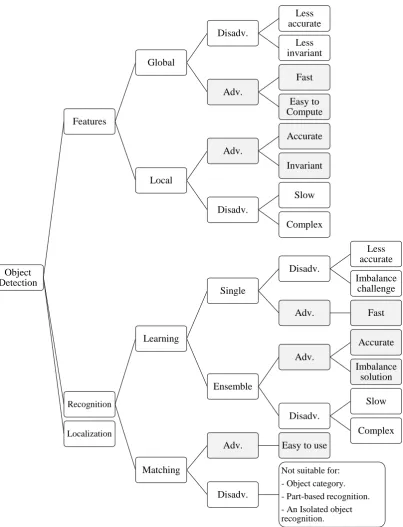
Adv.=Advantages, Disadv.=Disadvantages
Figure 1.1 : Scenario that led to the study problem
From Figure 1.1, the required solutions of object detection for both features and recognition can be concluded. Regarding the features; Features should be: Accurate, Fast, Invariant, and Easy to be computed. On the other hand; recognition
Object Detection Features Global Disadv. Less accurate Less invariant Adv. Fast Easy to Compute Local Adv. Accurate Invariant Disadv. Slow Complex Recognition Learning Single Disadv. Less accurate Imbalance challenge
Adv. Fast
Ensemble Adv. Accurate Imbalance solution Disadv. Slow Complex Matching
Adv. Easy to use
Disadv.
7
technique should be: Accurate, Fast, and Manage and reduce the effect of imbalance data on recognition quality.
1.3 Problem Statement
Full object detection system consists of three parts, features extraction, object recognition, and object localization. Most researches in literature focus only on one part of the whole system; each part affects the performance of the object detection system to some degree. Moreover, other challenges such as changes in rotation, scale, and imbalanced data effect are also affecting and complicating the system structure. Therefore, the performance of object detection system could be improved by introducing a new descriptor that produces fast, distinctive and invariant features, reducing the effect of imbalanced data by improving ensemble-based learning technique, and modifying the original interest points’ detector by which the system
can be carried out faster.
1.4 Research Questions
Research questions are:
(i) How to overcome the shortages of existing descriptors in terms of accuracy and time consumption.
(iii) How to further reduce the detection errors; False Positive Rate (FPR) and False Positive (FP), and keep enough interest points for object localization.
(iv) How to speed up the whole system of object detection without impact on precision of detection.
1.5 Research Aim
The aim of this research is to introduce a general model for object detection in which it can overcome the limitation of existing methods regarding the descriptor, classification, and speed. The proposed model consists of three parts; first, new descriptor based on interest point detectors which is fast and accurate in the same time; second, an ensemble-based improved learner based on ANN technique applied on different environments; third, an improved scheme to speed up the object detection system; all are integrated in one model.
1.6 Research Objectives
The objectives of this research can be summarized as follows:
9
(ii) To develop an effective supervised learning technique to learn the features of the proposed descriptor in (i) based on an ensemble learning in which it can increase the accuracy, reduce the error, and tackle the imbalance data challenge.
(iii) To propose a developed scheme that speed up the whole system resulting of the complexity in (ii) with no cost in quality of recognition.
1.7 Research Scope and Assumptions
Study scope and assumptions are as follows:
(i) Objects used in this study are; human faces and cars.
(ii) Scenes and environments in which the object is detected are:
a. Indoor and outdoor for faces detection.
b. Street and open space for cars detection.
(iii) Datasets used are:
a. Caltech 101 “faces”; for learning and testing.
b. PASCAL VOC 2009 “cars”; for testing.
c. SUN397; for learning.
d. Data for cars learning was collected by the researcher.
(v) Comparisons done as follows:
a. Comparing the proposed descriptor against SIFT and SURF descriptors based on measurements mentioned in (iv); besides, comparing the invariance to rotation and scale changes.
b. Comparing the ensemble-based classifiers against single-based classifier.
c. Time consumption comparisons; the proposed descriptor against SIFT and SURF descriptor, and the proposed scheme (that speed up the object detection system) against ensemble-based classifiers.
(vi) T-test was used to validate the obtained results regarding the FP error.
1.8 Research Significance
Object detection and its application play an important role in different fields as mentioned earlier; thus, this research takes the same importance beside the additional characteristics as follows:
(i) Usability: system can be used to detect any object by only providing positive and negative examples into the system; no extra changes are needed.
11
1.9 Summary of Research Contributions
Contributions of this study can be summarized as follows:
(i) A new local descriptor that is fast, accurate and overcome the existing descriptors in terms of speed, accuracy, and invariance.
(ii) A developed learning technique based on ensemble learning that produced higher accuracy than single-based learning technique and fixed the imbalance data problem.
(iii) A developed scheme that speeded up the object detection system by modifying the original SURF point’s detector.
(iv) Tow labelled datasets prepared from datasets mentioned in section 1.7 for training and testing phases.
1.10 Terms Definition
Due to using some terms in different domains, misconception or confusion may occurs; thus, this section provides the definition of terms used along this study, these definitions were taken from literature detailed in chapter 2.
(i) Interest Point
The most important point that can repeatable over scale-spaces, it can be edge or corner; sometimes it called key-point.
It is the method that detects the interest point.
(iii) Descriptor
Descriptor is the method that describe the detected interest point; describing the interest point means extract the substantial information about that point. Sometimes the method called extractor and the extracted information called feature.
(iv) Object Recognition
Object recognition is this study means, distinguishing the patterns that belonging to the object class from that they are not; it answer the question “Is there object within scene or not?” This includes the matching
technique and learning methods.
(v) Object Localization
Objection localization means if there an object exist within scene, determine the location of that object; so, it answer the question “Where the object location within scene?”
(vi) Object detection
The meaning of object detection embodies both object recognition and localization altogether.
(vii) Single-based classifier
Normally, single-based classifier means only one classifier used for learning and classification of patterns; sometimes it called traditional or conventional method.
(viii) Ensemble-based classifiers
13
(ix) An imbalanced data
Data that has minority and majority among its classes is called imbalanced data; that’s mean the distribution of instances for classes is not equal.
1.11 Thesis Outline
Aanæs, H., Dahl, A. L., and Pedersen, K. S. (2012). Interesting Interest Points. Int J Comput Vis. 97, 18-35.
Agrawal, M., Konolige, K., and Blas, M. (2008). Censure: Center surround extremas for realtime feature detection and matching. Computer Vision–ECCV 2008, 102-115.
Alwaili, S. (2007). Image-based object detection and identification. Doctor Philosophy, Universiti Teknologi Malaysia, Faculty Geoinformation Science and Engineering.
Aly, M. A.-E.-D. (2011). Searching Large-Scale Image Collections. Doctor Philosophy, California Institute of Technology, Pasadena, California.
Barczak, A. L. (2007). Feature Based Rapid Object Detection: From Feature Extraction to Parallelisation. Doctor of Philosophy. Massey University, Auckland, New Zealand.
Batista, G. E., Prati, R. C., and Monard, M. C. (2004). A study of the behavior of several methods for balancing machine learning training data. ACM Sigkdd Explorations Newsletter, 6(1), 20-29.
Bay, H., Ess, A., Tuytelaars, T., and Van Gool, L. (2008). Speeded-up robust features (SURF). Computer Vision and Image Understanding. 110(3), 346-359.
197
Calonder, M. (2010a). Robust, High-Speed Interest Point Matching for Real-Time Applications. Doctor Philosophy, Swiss Federal Institute of Technology, Lausanne, Switzerland.
Calonder, M., Lepetit, V., Strecha, C., and Fua, P. (2010b). Brief: Binary robust independent elementary features Computer Vision–ECCV 2010. 778-792: Springer.
Calonder, M., Lepetit, V., Ozuysal, M., Trzcinski, T., Strecha, C., and Fua, P. (2012c). BRIEF: Computing a local binary descriptor very fast. IEEE Transactions on Pattern Analysis and Machine Intelligence. 34(7), 1281-1298.
Caruana, R., and Niculescu-Mizil, A. (2006a). An empirical comparison of supervised learning algorithms. Proceedings of the 23rd international conference on Machine learning: ACM, New York, NY, USA, 96-103.
Caruana, R., Karampatziakis, N., and Yessenalina, A. (2008b). An empirical evaluation of supervised learning in high dimensions. Proceedings of the 25th international conference on Machine learning: ACM, New York, NY, USA, 161-168.
Ceamanos, X., Waske, B., Benediktsson, J. A., Chanussot, J., Fauvel, M., and Sveinsson, J. R. (2010). A classifier ensemble based on fusion of support vector machines for classifying hyperspectral data. International Journal of Image and Data Fusion, 1(4), 293-307.
Chapelle, O., Schölkopf, B., and Zien, A. (2006). Semi-supervised learning. Vol. 2: MIT press Cambridge.
Chawla, N. V., Japkowicz, N., and Kotcz, A. (2004a). Editorial: special issue on learning from imbalanced data sets. ACM Sigkdd Explorations Newsletter, 6(1), 1-6.
Cigizoglu, H. K., and Alp, M. (2006). Generalized regression neural network in modelling river sediment yield. Advances in Engineering Software, 37(2), 63-68.
Dai, Q., and Hoiem, D. (2012). Learning to localize detected objects. Proceedings
of the IEEE Conference on Computer Vision and Pattern Recognition CVPR, Providence, RI: IEE, 3322-3329.
Dalal, N., and Triggs, B. (2005). Histograms of oriented gradients for human detection. Proceedings of the IEEE Conference on Computer Vision and Pattern Recognition CVPR, San Diego, CA, USA: IEE, 886-893.
De Bock, K. W., Coussement, K., and Van den Poel, D. (2010). Ensemble classification based on generalized additive models. Computational Statistics and Data Analysis, 54(6), 1535-1546.
DiCarlo, J. J., and Cox, D. D. (2007). Untangling invariant object recognition. Trends in cognitive sciences, 11(8), 333-341.
Dogan, E., Sengorur, B., and Koklu, R. (2009). Modeling biological oxygen demand of the Melen River in Turkey using an artificial neural network technique. Journal of Environmental Management, 90(2), 1229-1235.
Douze, M., Jégou, H., Sandhawalia, H., Amsaleg, L., and Schmid, C. (2009). Evaluation of gist descriptors for web-scale image search. Proceedings of the ACM International Conference on Image and Video Retrieval CIVR. New York, NY, USA: ACM,19
Ebrahimi, M., and Mayol-Cuevas, W. W. (2009). SUSurE: Speeded up surround extrema feature detector and descriptor for realtime applications. Proceedings of the IEEE Conference on Computer Vision and Pattern Recognition CVPR, Miami, FL:IEEE, 9-14.
199
Everingham, M., Van Gool, L., Williams, C. K., Winn, J., and Zisserman, A. (2010). The pascal visual object classes (voc) challenge. International journal of computer vision. 88(2), 303-338.
Favelle, S. K., Palmisano, S., and Avery, G. (2011). Face viewpoint effects about three axes: The role of configural and featural processing. Perception-London. 40(7), 761.
Fawcett, T. (2006). An introduction to ROC analysis. Pattern Recognition Letters. 27(8), 861-874.
Fei-Fei, L., Fergus, R., and Perona, P. (2006a). One-shot learning of object categories. IEEE Transactions on Pattern Analysis and Machine Intelligence, 28(4), 594-611.
Fei-Fei, L., Fergus, R., and Perona, P. (2007b). Learning generative visual models from few training examples: An incremental bayesian approach tested on 101 object categories. Computer Vision and Image Understanding. 106(1), 59-70.
Felzenszwalb, P. F., Girshick, R. B., McAllester, D., and Ramanan, D. (2010). Object Detection with Discriminatively Trained Part-Based Models. IEEE Transactions on Pattern Analysis and Machine Intelligence, 32(9), 1627-1645.
Forsyth, D. A., and Ponce, J. (2002). Computer Vision: A modern approach. (Frist ed.): Prentice Hall.
Freitas, A., Costa-Pereira, A., and Brazdil, P. (2007). Cost-sensitive decision trees applied to medical data. Data Warehousing and Knowledge Discovery. Springer, 303-312.
Galleguillos, C., Babenko, B., Rabinovich, A., and Belongie, S. (2008). Weakly supervised object localization with stable segmentations Computer Vision– ECCV 2008: Springer,193-207
Ganganwar, V. (2012). An overview of classification algorithms for imbalanced datasets. International Journal of Emerging Technology and Advanced Engineering. 2(4), 42-47.
Gauglitz, S., Höllerer, T., and Turk, M. (2011). Evaluation of interest point detectors and feature descriptors for visual tracking. International journal of computer vision. 94(3), 335-360.
Gil, A., Mozos, O. M., Ballesta, M., and Reinoso, O. (2010). A comparative evaluation of interest point detectors and local descriptors for visual SLAM. Machine Vision and Applications. 21(6), 905-920.
Griffin, G., Holub, A., and Perona, P. (2007). Caltech-256 object category dataset.
Gu, C., Lim, J. J., Arbeláez, P., and Malik, J. (2009a). Recognition using regions. Proceeding of the IEEE Conference on Computer Vision and Pattern Recognition CVPR, Miami, FL:IEEE, 1030-1037.
Gu, C., and Ren, X. (2010b). Discriminative mixture-of-templates for viewpoint classification. Computer Vision–ECCV 2010, 408-421.
Harris, C., and Stephens, M. (1988). A combined corner and edge detector.
Harzallah, H., Jurie, F., and Schmid, C. (2009). Combining efficient object localization and image classification. ICCV, Kyoto, 237-244.
He, H., and Garcia, E. A. (2009). Learning from imbalanced data. IEEE Transactions on Knowledge and Data Engineering, 21(9), 1263-1284.
Heinly, J., Dunn, E., and Frahm, J.-M. (2012). Comparative evaluation of binary features Computer Vision–ECCV 2012: Springer, 759-773.
201
Hu, X., and Weng, Q. (2009). Estimating impervious surfaces from medium spatial resolution imagery using the self-organizing map and multi-layer perceptron neural networks. Remote Sensing of Environment. 113(10), 2089-2102.
Huang, G.-B., Zhu, Q.-Y., and Siew, C.-K. (2006a). Extreme learning machine: theory and applications. Neurocomputing. 70(1), 489-501.
Huang, G.-B., Wang, D. H., and Lan, Y. (2011b). Extreme learning machines: a survey. International Journal of Machine Learning and Cybernetics. 2(2), 107-122.
Juan, L., and Gwun, O. (2009). A comparison of sift, pca-sift and surf. International Journal of Image Processing. 3(4), 143-152.
Ke, Y., and Sukthankar, R. (2004). PCA-SIFT: A more distinctive representation for local image descriptors. Proceeding of IEEE Conference on Computer Vision and Pattern Recognition CVPR, 506-513.
Khan, N. Y., McCane, B., and Wyvill, G. (2011). Sift and surf performance evaluation against various image deformations on benchmark dataset. International Conference on Digital Image Computing Techniques and Applications DICTA, Noosa, QLD:IEEE, 501-506.
Kim, D., and Dahyot, R. (2008). Face components detection using SURF descriptors and SVMs. International Conference on Machine Vision and Image IMVIP, Portrush, 51-56.
Kim, S., and Lee, J. (2012). Scale Invariant Small Target Detection by Optimizing Signal to Clutter Ratio in Heterogeneous Bacground for Infrared Search and Track. Pattern Recognition. 45, 393.
KISHORE, G. N. (2011). STUDY OF OBJECT DETECTION AND READING. Doctor Philosophy, National Institute of Technology Rourkela.
Kotsiantis, S. B., Zaharakis, I., and Pintelas, P. (2007). Supervised machine learning: A review of classification techniques.
Lampert, C. H., Blaschko, M. B., and Hofmann, T. (2008). Beyond sliding windows: Object localization by efficient subwindow search. Proceeding of IEEE Conference on Computer Vision and Pattern Recognition CVPR, Anchorage, AK:IEEE, 1-8.
Laptev, I. (2009). Improving object detection with boosted histograms. Image and Vision Computing. 27(5), 535-544.
Lei, Z., Fang, T., and Li, D. (2010). Histogram of oriented gradient detector with color-invariant gradients in Gaussian color space. Optical Engineering. 49(10), 1-7.
Leutenegger, S., Chli, M., and Siegwart, R. Y. (2011). BRISK: Binary robust invariant scalable keypoints. IEEE International Conference on Computer Vision ICCV, Barcelona:IEEE, 2548-2555.
Li, B., Xiao, R., Li, Z., Cai, R., Lu, B.-L., and Zhang, L. (2011). Rank-SIFT: Learning to rank repeatable local interest points. IEEE Conference on Computer Vision and Pattern Recognition (CVPR), Providence, RI:IEEE, 1737-1744.
Li, C. (2007). Classifying imbalanced data using a bagging ensemble variation (BEV). Proceedings of the 45th annual southeast regional conference: ACM, New York, NY, USA,203-208.
Li, H., Xu, T., Li, J., and Zhang, L. (2013). Face Recognition based on Improved SURF. Third International Conference on Intelligent System Design and Engineering Applications (ISDEA), Hong Kong, 755-758.
Liang, Z., Wang, M., Zhou, X., Lin, L., and Li, W. (2012). Salient object detection based on regions. Multimedia Tools and Applications. 1-28.
203
Lillywhite, K., Tippetts, B., and Lee, D. J. (2012b). Self-tuned Evolution-COnstructed features for general object recognition. Pattern Recognition. 45(1), 241-251.
Lindeberg, T. (1994a). Scale-space theory: A basic tool for analyzing structures at different scales. Journal of applied statistics. 21(1-2), 225-270.
Lindeberg, T. (1998b). Feature detection with automatic scale selection. International journal of computer vision. 30(2), 79-116.
Liu, N., and Wang, H. (2010). Ensemble based extreme learning machine. Signal Processing Letters, IEEE. 17(8), 754-757.
Lowe, D. G. (2004). Distinctive image features from scale-invariant keypoints. International journal of computer vision. 60(2), 91-110.
Ludwig, O., Delgado, D., Gonçalves, V., and Nunes, U. (2009). Trainable classifier-fusion schemes: an application to pedestrian detection. 12th International IEEE Conference on Intelligent Transportation Systems ITSC, St. Louis, MO:IEEE, 1-6.
Mahiddine, A., Seinturier, J., Boï, J.-M., and Merad, P. D. D. (2012). Performances Analysis of Underwater Image Preprocessing Techniques on the Repeatability of SIFT and SURF Descriptors. 20th International Conference on Computer Graphics, Visualization and Computer Vision WSCG, 275-282.
Mair, E., Hager, G. D., Burschka, D., Suppa, M., and Hirzinger, G. (2010). Adaptive and generic corner detection based on the accelerated segment test Computer Vision–ECCV : Springer, 183-196.
McAuley, J. J., and Caetano, T. S. (2012). Fast matching of large point sets under occlusions. Pattern Recognition. 45(1), 563-569.
Mikolajczyk, K., and Schmid, C. (2004a). Scale and affine invariant interest point detectors. International journal of computer vision. 60(1), 63-86.
Miller, I., Campbell, M., Huttenlocher, D., Kline, F. R., Nathan, A., Lupashin, S., et al. (2008). Team Cornell's Skynet: Robust perception and planning in an urban environment. Journal of Field Robotics. 25(8), 493-527.
Mohan, A., Papageorgiou, C., and Poggio, T. (2001). Example-based object detection in images by components. IEEE Transactions on Pattern Analysis and Machine Intelligence, 23(4), 349-361.
Morel, J.-M., and Yu, G. (2009). ASIFT: A new framework for fully affine invariant image comparison. SIAM Journal on Imaging Sciences. 2(2), 438-469.
Morris, T. (2004). Computer Vision and Image Processing: Palgrave Macmillan.
Nagarajan, B., and Balasubramanie, P. (2008). Object classification in static images with cluttered background using statistical feature based neural classifier. Asian J. Inform. Technol. 7, 162-167.
Neubeck, A., and Van Gool, L. (2006). Efficient non-maximum suppression. IEEE International Cnoference on Pattern Recognition ICPR, Hong Kong, 850-855.
Ni, Z.-S. (2012). B-SIFT: A Binary SIFT Based Local Image Feature Descriptor. Fourth International Conference on Digital Home (ICDH), Guangzhou, China,117-121.
Opelt, A., Fussenegger, M., Pinz, A., and Auer, P. (2004). Weak hypotheses and boosting for generic object detection and recognition. Computer Vision-ECCV 2004. 71-84.
Osadchy, M., and Keren, D. (2004). Efficient detection under varying illumination conditions and image plane rotations. Computer Vision and Image Understanding. 93(3), 245-259.
Paliwal, M., and Kumar, U. A. (2009). Neural networks and statistical techniques: A review of applications. Expert Systems with Applications. 36(1), 2-17.
205
Papageorgiou, C. P., Oren, M., and Poggio, T. (1998a). A general framework for object detection. Sixth International Conference on Computer Vision, Bombay,555-562.
Papageorgiou, C. P. (2000b). A trainable system for object detection in images and video sequences. Doctor Philosophy, MIT.
Parks, D. H. (2006). Object detection and analysis using coherency filtering. Doctor Philosophy, McGill University.
Pedersoli, M., Gonzàlez, J., Bagdanov, A. D., and Villanueva, J. J. (2010). Recursive coarse-to-fine localization for fast object detection Computer Vision–ECCV: Springer, 280-293.
Pinto, N., Cox, D. D., and DiCarlo, J. J. (2008). Why is real-world visual object recognition hard? PLoS computational biology. 4(1), e27.
Ponce, J., Berg, T. L., Everingham, M., Forsyth, D. A., Hebert, M., Lazebnik, S., et al. (2006). Dataset issues in object recognition Toward category-level object recognition : Springer, 29-48.
Porikli, F., and Yilmaz, A. (2012). Object Detection and Tracking. Video Analytics for Business Intelligence. 3-41.
Qiu, X. N., Liu, S. R., and Song, J. T. (2012). Generic Object Detection Based on Boosting Embedded with Bag-of-Words. Applied Mechanics and Materials. 109, 285-289.
Rahman, A., and Verma, B. (2011). Novel layered clustering-based approach for generating ensemble of classifiers. IEEE Transactions on Neural Networks, 22(5), 781-792.
Rister, B., Wang, G., Wu, M., and Cavallaro, J. R. (2013). A fast and efficient SIFT detector using the mobile GPU. IEEE International Conference on Acoustics, Speech and Signal Processing (ICASSP), Vancouver, BC, 2674-2678.
Rosten, E., and Drummond, T. (2006). Machine learning for high-speed corner detection. Computer Vision–ECCV: Springer, 430-443.
Rublee, E., Rabaud, V., Konolige, K., and Bradski, G. (2011). ORB: an efficient alternative to SIFT or SURF. IEEE International Conference on Computer Vision (ICCV), Barcelona, 2564-2571.
Sahbi, H., and Geman, D. (2006). A hierarchy of support vector machines for pattern detection. The Journal of Machine Learning Research. 7, 2087-2123.
Scherer, M., Walter, M., and Schreck, T. (2010). Histograms of oriented gradients for 3d object retrieval. 18th International Conference in Central Europe on Computer Graphics, Visualization and Computer Vision WSCG, 41-48.
Schmid, C., and Mohr, R. (1997). Local grayvalue invariants for image retrieval. IEEE Transactions on Pattern Analysis and Machine Intelligence, 19(5), 530-535.
Singh, K. P., Basant, A., Malik, A., and Jain, G. (2009). Artificial neural network modeling of the river water quality—a case study. Ecological Modelling. 220(6), 888-895.
Singh, Y., Bhatia, P. K., and Sangwan, O. (2007). A review of studies on machine learning techniques. International Journal of Computer Science and Security. 1(1), 70-84.
Smith, S. M., and Brady, J. M. (1997). SUSAN—A new approach to low level image processing. International journal of computer vision. 23(1), 45-78.
Sonka, M., Hlavac, V., and Boyle, R. (2007). Image processing, analysis, and machine vision. Cengage Learning.
Su, H., and Chong, K. T. (2007). Induction machine condition monitoring using neural network modeling. IEEE Transactions onIndustrial Electronics, 54(1), 241-249.
207
Szeliski, R. (2010). Computer vision: algorithms and applications: Springer.
Tamminen, T., and Lampinen, J. (2004). A Bayesian occlusion model for sequential object matching. Proceeding of the British Conference on Machine Vision Conference, 547-556.
Taylor, M. E., and Stone, P. (2009). Transfer learning for reinforcement learning domains: A survey. The Journal of Machine Learning Research. 10, 1633-1685.
Trung, Q. N., Phan, D., Kim, S. H., Na, I. S., and Yang, H. J. (2014). Recursive Coarse-to-Fine Localization for Fast Object Detection. International Journal of Control and Automation. 7(1), 235-242.
Tuytelaars, T., and Mikolajczyk, K. (2008). Local invariant feature detectors: a survey. Foundations and Trends® in Computer Graphics and Vision. 3(3), 177-280.
Verikas, A., Kalsyte, Z., Bacauskiene, M., and Gelzinis, A. (2010). Hybrid and ensemble-based soft computing techniques in bankruptcy prediction: a survey. Soft Computing. 14(9), 995-1010.
Viola, P., and Jones, M. (2001). Rapid object detection using a boosted cascade of simple features. IEEE conference on Computer Vision and Pattern Recognition CVPR, 511-518.
Wang, P., Shen, C., Barnes, N., and Zheng, H. (2012). Fast and Robust Object Detection Using Asymmetric Totally Corrective Boosting. IEEE Transactions on Neural Networks and Learning Systems, 23(1), 33-46.
Wu, G., and Chang, E. Y. (2005). KBA: Kernel boundary alignment considering imbalanced data distribution. IEEE Transactions on Knowledge and Data Engineering, 17(6), 786-795.
Xiao, J., Hays, J., Ehinger, K. A., Oliva, A., and Torralba, A. (2010). Sun database: Large-scale scene recognition from abbey to zoo. IEEE conference on Computer vision and pattern recognition (CVPR), San Francisco, CA, 3485-3492.
Xu, Y., Cao, X., and Qiao, H. (2011). An efficient tree classifier ensemble-based approach for pedestrian detection. IEEE Transactions on Systems, Man, and Cybernetics, Part B: Cybernetics, 41(1), 107-117.
Yang, Y., and Newsam, S. (2011). Spatial pyramid co-occurrence for image classification. IEEE International Conference on Computer Vision (ICCV), Barcelona, 1465-1472.
Yeh, T., Lee, J. J., and Darrell, T. (2009). Fast concurrent object localization and recognition. IEEE Conference on Computer Vision and Pattern Recognition, 2009. CVPR. Miami, FL, 280-287.
Yilmaz, A., Javed, O., and Shah, M. (2006). Object tracking: A survey. Acm Computing Surveys (CSUR). 38(4), 13.
Yu, T.-H., Woodford, O. J., and Cipolla, R. (2011). An evaluation of volumetric interest points. International Conference on 3D Imaging, Modeling, Processing, Visualization and Transmission (3DIMPVT), Hangzhou, 282-289.
Zhang, X., and Cheng, C. (2012). Imbalanced data classification algorithm based on boosting and cascade model. IEEE International Conference on Systems, Man, and Cybernetics (SMC), Seoul, 2861-2866.
Zhang, Y., Zhang, D., Mi, G., Ma, D., Li, G., Guo, Y., et al. (2012). Using ensemble methods to deal with imbalanced data in predicting protein–protein interactions. Computational biology and chemistry. 36, 36-41.
209