ABSTRACT
FABRIZIO, LOUIS MICHAEL. The Creation and Evolution of North Carolina’s ABCs Accountability Program and the Impact of No Child Left Behind – A Case Study. (Under the direction of Robert C. Serow.)
The purpose of this study is to investigate in depth, through a case study design, the creation and evolution of North Carolina’s ABCs Accountability Program and how it has been impacted by the No Child Left Behind (NCLB) legislation. There were four research questions: (1) What political and educational factors influenced the creation of the ABCs Accountability Program? (2) How has the ABCs Accountability Program changed over time? (3) What impact has NCLB had on the ABCs? and (4) How have the interrelationships of federal, state and local policymakers in education changed from the inception of the ABCs Program?
Dr. James Causby, president of the North Carolina Association of School Administrators; and several high-ranking administrators of the North Carolina Department of Public Instruction including Dr. Richard Thompson, former Deputy State Superintendent of Public Instruction, and Dr. Henry Johnson, former Associate State Superintendent of Public Instruction.
Interview transcripts were analyzed for common themes and the findings of the study include descriptions of several aspects of the accountability program. These include: the inception of the ABCs Accountability Program during a period of high tension among the state-elected Superintendent of Public Instruction, the SBE, and the General Assembly; education governance issues in the state; examples of changes in the program resulting from attempts to game the system; examples of changes in the program resulting from SBE and legislative decisions regarding identification of low-performing schools, labels to classify schools, changes in financial incentive structures and who can receive the financial awards, and volatile issues related to teacher testing and automatic removal of certain principals based on schools being identified as low-performing schools. The findings also describe issues related to the negotiated rulemaking process used by the United States Department of Education (USED) for establishing proposed regulations for standards and accountability under NCLB; additional changes in the ABCs Accountability Program resulting from policy directives of USED; and potential effects of the Leandro court case.
ii
DEDICATION
This dissertation is dedicated in memory of my father, Florentino (Fiore) Fabrizio. He was born in Itri, a small town in Italy between Naples and Rome, in 1919. He
emigrated to the United States at the age of 11 and remained in school through the ninth grade. He then dropped out of school, worked several different jobs and eventually entered the Army during World War II. In 1946, he married my mother, Concetta, and together they raised four children; three girls and a boy. After marriage, my father worked two jobs for 20 years, one as a motorman for the New York City Transit
Authority, and the other as a jewelry maker and repairman for a jewelry company in New York City.
He then “retired” from both of these jobs and started working for the United States Postal Service until he really retired in 1985. He finally got to play golf several times a week and work in his garden more frequently – two things he thoroughly enjoyed doing. He and my mother also did some extensive traveling in the United States and abroad during his retirement.
On March 29, 2003, he died of acute myelogenous leukemia (AML), nine days after diagnosis. He taught me the values of hard work, doing one’s best, honesty, perseverance and always stressed the importance of a good education.
iii
BIOGRAPHY
I was born in the Manhattan Borough of New York City in 1952 and my parents and two older sisters and I moved up to the Bronx when I was two months old. I attended Blessed Sacrament School for first grade through eighth grade and then Cardinal
Spellman High School. In 1974, I graduated with a Bachelor of Science degree in physics from Georgetown University in Washington, DC. During my last semester at Georgetown University, I taught mathematics and science full-time for children ages 8-12 years old at an experimental “free school” called the Kalorama Children’s Program in the Adams Morgan neighborhood of Washington, DC. In August 1974, I moved to Durham, North Carolina and was hired in October as the education director for the Head Start program in Wake County, supervising the thirty education staff in six centers serving 300 students throughout Wake County. In August 1975, I was promoted to the director's position and also accepted into the Master of Science program (part-time) in educational administration and supervision at North Carolina State University (NCSU) in Raleigh. During my tenure as Head Start director, I was elected president of the North Carolina Head Start Association for two terms. I also served on the legislative committee of the National Head Start Association and made several trips to Washington, DC to meet with members of the North Carolina Congressional delegation to keep them better informed of the Head Start programs in the state.
iv
Carolina Department of Public Instruction (NCDPI). Several weeks after completing my internship, I was hired in the Division of Research as an education consultant to monitor the development of two new editions of the North Carolina High School Competency Tests. Within the next ten months, I completed my Master’s program and was promoted to a new position at NCDPI as the state’s Title I Evaluation Consultant. In this position, I was responsible for training Title I school personnel across the state on the requirements for evaluating the ESEA Title I program as well as conducting the state’s evaluation, writing the report, and submitting it to the U.S. Department of Education (USED).
In 1982, CTB/McGraw-Hill, the test publishing division of McGraw-Hill publishing company, hired me as their evaluation consultant for the State of North
Carolina. Over the next 14½ years, I served in various positions within CTB with my last six years as a national assessment consultant, working directly with 13 states in the southern region. As a national consultant, I was responsible for understanding the testing and accountability programs of the states in the region and assisting the state staff in selecting CTB’s tests and services as a means of meeting their assessment needs. While working for CTB, I also was elected the president of the North Carolina Association for Research in Education (NCARE) in 1988.
In 1996, I returned to the NCDPI as the director of the Division of Accountability Services where I oversee the statewide testing and accountability programs, including the assessment and reporting requirements of No Child Left Behind (NCLB). In my
v
Carolina’s Joint Legislative Education Oversight Committee (JLEOC) on numerous occasions. I also served as one of 22 individuals on the USED Negotiated Rulemaking Committee for standards and assessments for NCLB and have served on other national committees including the Technical Advisory Committee for the Voluntary National Test and the 2004 National Assessment of Educational Progress (NAEP) Mathematics
Steering Committee. I currently serve as the Chair of the national Standing Task Force on Assessment for the Education Information Management Advisory Consortium
(EIMAC) that is supported by the National Center for Education Statistics (NCES) of the USED.
In summary, I have been involved in testing and accountability for a total of over 26 years, including experiences in public education as well as private industry at local, state, and national levels. Conducting this study is a natural extension of my life’s major work.
Additionally, I am happily married to Katherine Kilburn Fabrizio, a
vi
ACKNOWLEDGEMENTS
This dissertation would not have been possible except for the support of many individuals. These include all of the professors whose classes I participated in and the members of my advisory committee: Dr. Bob Serow as Chair, and Drs. Duane Akroyd, Kevin Brady and Michael Vasu. Thank you all for working with me. I also thank the many individuals who were willing to take time out of their busy schedules to be
interviewed by me for this study. Your insights and contributions to this study and to the efforts for school accountability are greatly appreciated. A big thanks goes to Henry Johnson and Brad Sneeden for “convincing” me to enter the doctoral program! Thank you, guys. My appreciation also goes to the many staff members at NCDPI including Lois Rogers-Sims, Susan Auton, and Lucy Medlin for their assistance and kindly expressions of support when work and school were tough. My mother, Concetta; three sisters, Joanne, Frances, and Susanne; and oldest daughter, Erin, were always
encouraging me, without a lot a pressure, as I worked on the dissertation. It was much appreciated.
vii
TABLE OF CONTENTS
Page
LIST OF TABLES...x
LIST OF FIGURES ...xi
LIST OF ACRONYMS ... xii
CHAPTER I. INTRODUCTION ...1
Purpose of the Study ...2
Research Questions ...6
Sampling Procedures and Justification ...6
CHAPTER II. LITERATURE REVIEW ...8
History of Student Testing and Accountability Systems ...9
Components of Accountability Systems: Some Selected State
Samples ...15
Opposition to Large Scale Assessments and Accountability
Programs...21
Research on the ABCs of Public Education...24
Implications of NCLB ...28
Opinion Polls ...31
Negotiated Rulemaking...32
Theoretical Framework: Policy Formation, Policy Implementation
and Policy Evaluation...34
Policy
Process
Environments...34
CHAPTER III. METHODOLOGY...40
Problem Statement and Purpose of the Study ...40
Research Questions ...40
Research Design ...41
Data Collection...42
Data Analysis ...43
Validity ...43
viii
Interviews ...46
CHAPTER IV. FINDINGS ...49
1.
Political and Educational Factors That Influenced the Creation of
the ABCs Accountability Program ...49
Continual Changing of State Education Initiatives:
“Flavor of the Year”...50
Leadership During a Time of High Tension...51
Governance
of
Education...55
Some Skepticism and Concerns: “Smoke and Mirrors”...58
2. How the ABCs Changed Over Time...60
Gaming
the
System ...60
10/20
Day
Rule ...61
Including Dropouts ...62
Alternative Schools...63
Other Significant Policy Changes in the ABCs ...64
Use of a Confidence Interval for Low-Performing
Schools...65
Importance of Labels or Terms Used to Classify
Schools...66
Changes
in
Financial Incentive Structure...67
Should
The
Bonus
Awards Be Shared?...70
Removal of Principals – “It Was Pretty Dirty!”...73
The Excellent Schools Act and “Teacher Testing” ...76
3. The Impact of NCLB on the ABCs...79
Gaming
the
System ...82
Confusion ...82
Examples of Some Substantive Changes...83
4.
The Interrelationships of Federal, State and Local
Policymakers ...85
“[Locals]
Still
Blame the State”...87
Negotiated
Rulemaking ...88
Peer
Review ...89
ix
CHAPTER V. DISCUSSION...101
1.
Political and Educational Factors That Influenced the Creation of
the ABCs Accountability Program ...102
2. How the ABCs Changed Over Time...104
3. The Impact of NCLB on the ABCs...105
4.
The Interrelationships of Federal, State and Local
Policymakers ...106
Limitations
of the Study ...109
Further
Research...111
The Future of the ABCs and NCLB...112
REFERENCES ...119
APPENDICES ...136
A.
Evolution
of the ABCs ...137
B.
Interview Questions ...143
C. Informed Consent Form for Research ...148
x
LIST OF TABLES
Page
xi
LIST OF FIGURES
Page
xii
LIST OF ACRONYMS
Acronym Description
ABCs ABCs Accountability Program
AYP Adequate Yearly Progress
CEP Center on Education Policy
CRTs Criterion Referenced Tests
CTB formerly the California Testing Bureau
EIMAC Education Information Management Advisory Consortium
ELL English Language Learners
EOC End-of-Course EOG End-of-Grade
ESEA Elementary and Secondary Education Act FERPA Family Educational Rights Privacy Act
HLM Hierarchical Linear Modeling
IDEA Individuals with Disabilities Education Act IEP Individualized Education Program
IRB Institutional Research Board
JLEOC Joint Legislative Education Oversight Committee
KERA Kentucky Education Reform Act
KIRIS Kentucky Instructional Record Information System
LEP Limited English Proficient
MCT Minimum Competency Test
MDI Measurement Driven Instruction
MDR Measurement Driven Reform
NCES National Center for Education Statistics NCSL National Conference of State Legislators
NCAAAI North Carolina Alternate Assessment Academic Inventory NCAAP North Carolina Alternate Assessment Portfolio
NCAE North Carolina Association of Educators
NCARE North Carolina Association for Research in Education NCDPI North Carolina Department of Public Instruction NCGA North Carolina General Assembly
NCLB No Child Left Behind
NCSU North Carolina State University
NRC Negotiated Rulemaking Committee
NRTs Norm referenced tests
OESE Office of Elementary and Secondary Education, USED OSEP Office of Special Education Programs, USED
xiii
LIST OF ACRONYMS (Continued)
S. L. Session Law
CHAPTER I. INTRODUCTION
Like it or not, school accountability is here to stay in public education. In fact, the mention of “school accountability” and its concomitant reliance on the use of standardized achievement tests causes different reactions from people. The general public and policymakers expect accountability from the schools due to the large amount of public money invested in K-12 education (Hartle & Battaglia, 1993; McDonnell, 2002; Phelps, 2003; Resnick, 1982). Yet, for many educators and parents of students in the schools, the words “school accountability” invoke feelings of unnecessary pressure and intrusion into what occurs in classrooms and schools (Kohn, 2000). Linn (2001) comments that there are differences of opinion in the “prevalence and severity of unintended negative consequences of high-stakes assessments…[but that] it is clear, however, that high-stakes accountability systems are a prominent part of the educational agendas in states and districts throughout the nation” (p. 4).
North Carolina’s accountability system, referred to as the ABCs of Public Education, or the ABCs, has been in existence since June 1996. The “A” stands for
2
accountability programs. This particular study looks at various aspects of both the ABCs and NCLB, including insights into policy making and policy implementation differences between the ABCs and NCLB. [Please note a list of acronyms and their meanings used in this report is on page xii to provide a quick reference source.]
Purpose of the Study
The purpose of this study is to investigate in depth, through a case study design, the creation and evolution of North Carolina’s ABCs Accountability Program and how it has been impacted by the NCLB legislation. Included in this study is information on the federal-level negotiated rulemaking process and the political interrelationships of federal, state, and local education policymakers. In 2002, the United States Department of Education (USED), as mandated by the United States Congress through the NCLB legislation, used the negotiated rulemaking process as a means of developing
regulations for standards and assessments ("Fleshing out the ESEA," 2002), and through this study one can see how these regulations impacted North Carolina’s accountability program. Essentially, the overriding question of the study is what can be learned about the public policy process by investigating the creation and evolution of the ABCs Accountability Program and the impact of No Child Left Behind?
3
public to grapple with issues of policy development, implementation and evaluation. Under NCLB, each state now is required to have an accountability system that must have certain mandated components (a specific example is testing all students in grades 3-8 in both reading and mathematics beginning with the 2005-06 school year) and its plan must be approved by the United States Department of Education (USED). Hanushek and Raymond (2005) make the observation that NCLB “codified a developing policy view that standards, testing, and accountability were the path to improved performance” (p. 297). This policy view was shared by policymakers in North Carolina several years prior to the passage of the NCLB legislation.
The creation of the ABCs Accountability Program occurred during a period of political tension among the North Carolina Department of Public Instruction (NCDPI), the State Superintendent of Public Instruction, the North Carolina State Board of Education (SBE) and the North Carolina General Assembly (NCGA). During the final years of North Carolina State Superintendent Bob Etheridge’s term of office, the SBE removed many of his duties and assigned them to a new Deputy Superintendent, Dr. Richard Thompson, who was to report directly to the SBE, not the State Superintendent.
The ABCs Accountability Program has changed over time and the document entitled “The Evolution of the ABCs” (see Appendix A) was created and placed on the NCDPI Web site:
http://www.ncpublicschools.org/docs/accountability/reporting/abc/2004-4
05/abcevolution.pdf) as a reminder to school personnel and the public of what changes have occurred. This document is updated at least annually.
Some of the changes to the ABCs Accountability Program have increased pressure on both schools and students. The passage of two pieces of federal legislation, the Individuals with Disabilities Education Act (IDEA) amendments in 1997, and the 2001 reauthorization of the Elementary and Secondary Education Act (ESEA) of 1965, referred to as No Child Left Behind (NCLB), collectively have had a significant impact on schools and students. Wedged between these two major federal initiatives was the passage of the student accountability standards policy in April, 1999 by the North Carolina SBE. This policy established gateways for student promotion at grades 3, 5, and 8 and was intended to ensure that students who needed academic assistance would be identified and provided assistance before the principal made student promotion decisions.
5
NCLB has caused additional concerns for schools with its focus on the
disaggregation of test scores among various ethnic and racial groups as well as students with limited English proficiency, students with disabilities, and economically
disadvantaged students. Under the NCLB mandate, school performance is determined by analyzing each student subgroup’s performance against a standard established by the State based on federal guidelines. If any one subgroup does not meet the standard, the entire school is deemed to have not made adequate yearly progress (AYP). The NCLB requirements have been considered so severe that “lawmakers in Virginia, Utah and seven other states are taking steps to opt out or block using state funds for No Child Left Behind, calling the law an intrusion on local control” (Toppo, 2004). More recently, Utah legislators in April, 2005 “voted overwhelmingly in support of the legislation challenging NCLB’s preeminence over the state’s own accountability,” whereas Connecticut on August 22, 2005, became the first state in the nation to file a lawsuit against NCLB (Ascione, 2005). Connecticut’s Attorney General, Richard Blumenthal, claimed months earlier that the “federal government’s approach with this law is illegal and unconstitutional” (National Center for Fair and Open Testing, 2005, pp. 1, 13). Connecticut Commissioner of Education, Betty J. Sternberg, stated, “A lawsuit is an avenue of last resort. It is a sad testimony that we have been pushed to this extreme” (Connecticut Department of Education, 2005). Ascione (2005) also quotes from a statement from Susan Aspey, a spokeswoman from the USED, that:
6
students. NCLB is designed to close these gaps and raise achievement for all students, regardless of race, income, or background. But unfortunately, today's action doesn't bring the state any closer to closing its achievement gap.
These myriad state and federal laws, policies, and regulations illustrate the interrelationships of the various levels of government and how they can affect schools and students. Looking at North Carolina’s accountability program in more depth can help the public, school personnel, and other researchers better understand the
circumstances, and why some education accountability decisions were made. Research Questions
With the backdrop of this focus on accountability, and the fact that the state’s program had evolved over time, the introduction of NCLB added another set of
dynamics to the evolution of the program. Based on these circumstances, the following research questions were investigated:
1. What political and educational factors influenced the creation of the ABCs Accountability Program?
2. How has the ABCs Accountability Program changed over time? 3. What impact has NCLB had on the ABCs?
4. How have the interrelationships of federal, state and local policymakers in education changed from the inception of the ABCs Program?
Sampling Procedure and Justification
7
explore the topic are congruent and have an organic relation to one another” (p.10). Because this study delves in great detail into the ABCs Accountability Program, it is appropriate that the research method be qualitative in nature using a case study design where individuals with explicit knowledge about the program, its beginning, and its evolution are interviewed. Merriam (1998) indicates that a case study design is “employed to gain an in-depth understanding of the situation and meaning for those involved” (p. 19).
This study meets Merriam’s (1998, p. 35) definition of a historical case study since it involves a “description and analysis of a school, program, intervention, or practice as it has evolved over time [emphasis added].” The fact that NCLB adds additional requirements to the ABCs Accountability Program complicates the telling of the history because there are instances where the two programs have been at odds with each other. More specifically, it is possible for a school in North Carolina to receive recognition for doing well under the ABCs but simultaneously be placed into “Title I School Improvement” status because of inadequate performance under NCLB.
Undertaking a study to address the aforementioned research questions involves having detailed information and understanding of student assessments, the ABCs
8
CHAPTER II.
LITERATURE REVIEW
Accountability has several definitions and can include many different features. Reeves (2000) starts with two dictionary definitions of accountability and makes comments that are worth noting:
The Oxford English Dictionary defines “accountability” as follows: “liability to give account of, and answer for, discharge of duties or conduct; responsibility." Webster's Tenth Edition hits the mark: “an obligation or willingness to accept responsibility or to account for one's actions." With respect to schools, therefore, accountability must mean far more than a recitation of data. Accountability must also include the elements of “conduct” and “action.” Moreover, accountability must involve the acceptance of responsibility. Educational accountability systems that merely describe test scores are not worthy of the term. Instead, comprehensive accountability systems contain multiple measures of student achievement. Ultimately, only systems that include effects, causes, conduct, actions, and yes, responsibility, can earn the label of accountability. (p. 1)
This chapter explains why a study of North Carolina’s accountability program is valuable to the educational community at large and the public. The literature reviewed here includes the following sections: a brief history of how testing and accountability systems have changed during the last century; components of accountability systems and some selected state examples; opposition to large scale assessment and
9
History of Student Testing and Accountability Systems
While the main focus of this particular study is based on school accountability systems, it is appropriate to spend time discussing the history of student testing because the tests play a major role in the accountability systems. Student testing has a long history in America’s schools. Over a century ago, Alfred Binet was working in France on the identification of mentally retarded children and he developed his Binet scale of thirty items, published in 1905. Henry Goddard published the first American revision of the Binet scale several years later but it was not until 1914 that Lewis Terman
published the well known Stanford-Binet test specifically for use with American school children. Due to a markedly increasing immigrant population of school-aged children in the United States following the turn of the century, there was an interest in
identifying students not able to function in the classroom (Resnick, 1982). Resnick also describes additional developments in the history of testing including the use of
intelligence tests and achievement tests around the time of World War I.
10
necessary to ensure students would be successful in society after graduation from high school. These tests primarily contained multiple-choice items. This trend in student testing continued throughout the 1980s with increased concerns about education largely due to the release of the National Commission on Excellence in Education (1983) report called ANation At Risk: The Imperatives for Education Reform. Although this report claims that the nation’s schools were getting worse and declining in comparison with other nations, education researchers Berliner and Biddle (1995) claim the report’s concerns were not based on facts or valid research. Based on Berliner and Biddle’s research of available data, they concluded that “today’s students are at least as well informed as students were in previous generations, and that education in America compares favorably with education elsewhere” (p. 13).
11
“questions about the scaling, reliability, representativeness, economy, and potential biases of constructed-response tests, relative to multiple-choice tests of the same length” (p. 58), while Gitomer (1993) describes other concerns of generalizability, standard setting and equity issues related to performance tasks.
Noble and Smith (1994) report on Arizona’s implementation of a new performance-based testing program and discuss the phenomenon of “measurement driven reform” (MDR) and how the tests are used as a vehicle for reforming education. They distinguish between the old view and new view of MDR and claim that the old view is based on behaviorist psychology and pedagogy where “the student is a passive recipient of knowledge” (p. 2), while the new view is labeled cognitive-constructivism and “teaching that fits this …view of learning is likely to be holistic, integrated, project-oriented, long-term, discovery-based and social” (p. 9). Their research of the Arizona program implementation involved a multiple case study design with interviews with key policymakers and stakeholders, analysis of documents, yearlong classroom
12
13
14
From Figure 2.1, one sees the evolution of changes that include the impact from the federal level starting in the 1960s with the National Assessment of Educational Progress (NAEP) and the ESEA legislation. Also included is the era of minimum skills competency testing that started in the 1970s with the increased use of statewide tests followed by the idea of including sanctions and rewards as a part of the systems. The timeline concludes with the box of the NCLB legislation, although it also should have referenced the federal IDEA and Title I legislation in the box where it notes inclusion of special needs children (students with disabilities [SWD] and limited English proficient [LEP] students).
Linn (2000) also presents a history of assessments and accountability from a historical perspective, although he confines his history to the past five decades as he reviews five “waves” (p. 4) of educational reform. He begins by first describing the reasons that assessments are viewed with such great favor by policymakers in reform efforts. These reasons include the relatively low costs of the assessments, the relative ease of mandating these assessments at the state and federal level compared to making changes occur in classrooms, the relatively quick implementation of tests and
15
several types of accountability systems, he incorrectly states that North Carolina uses hierarchical linear modeling (HLM) and that the State’s model includes adjustments for the SES (socioeconomic status) of students. Neither of these two assertions is correct; moreover, these assertions lead to misunderstandings within the educational community and the public at-large.
Components of Accountability Systems: Some Selected State Samples For purposes of this study, a detailed listing of each state’s current
accountability system will not be provided since the main focus of the study is North Carolina’s accountability system. However, examples of some states’ systems are reviewed to describe various approaches to accountability during the past decade and to place North Carolina’s history of the ABCs within a historical and national context. [For those interested in descriptions of the various state accountability plans approved by the USED, see http://www.ed.gov/admins/lead/account/stateplans03/index.html.]
Elmore et al. (Elmore, Abelmann, & Fuhrman, 1996) coined the phrase “the new educational accountability” and stated:
it has three major components: a primary emphasis on measured student performance as the basis for school accountability, sometimes accompanied by other indicators of success; the creation of relatively complex systems of
standards by which data on student performance are compared by school and by locality; and the creation of systems of rewards and penalties and intervention strategies to introduce incentives for improvement. (p. 65)
16
Kentucky’s program made use of portfolios and performance assessment tasks. Both programs, however, used an indexing system to classify schools (in Kentucky) and school districts (in Mississippi and Kentucky) based on student performance. In terms of the complexity of the two index systems, Elmore, et al. make the observation that “statisticians and psychometricians may be in the driver's seat with the policy makers and educators unable to understand or explain the rationale behind the formulas and assessment approaches" (p. 77). The political, implementation, and design issues in Mississippi and Kentucky mirror many of the issues described in this study of North Carolina’s experiences. North Carolina State Senator Robert Rucho acknowledged the issue of complexity of accountability systems with the question, “Can you make this any more complicated?”1
Cohen (1996, p. 117) states “the idea of accountability for performance has broad appeal, but designing and implementing such schemes turns out to be a rich stew of politics, technical and ethical problems, and ideological conflict.” Similar statements have been made by educational researchers Ladd (1996), McDonnell (1994; 1997), and Stecher (2002).
Kentucky was one of the first states to move away from norm-referenced tests when it comes to a statewide accountability system at the school-building level. According to Whitford and Jones (2000), the Kentucky Supreme Court “struck down
1
17
over 700 laws governing elementary and secondary education” in 1989 (p. 1); in 1990 the legislature passed “a massive reform package” (p. 1) known as KERA – the Kentucky Education Reform Act. KIRIS – the Kentucky Instructional Record Information System was the system developed because of KERA. A “hallmark of KERA was a new vision of teaching and learning: they were to be performance based” (p. 4). The same was true of the assessments as well. However, Whitford and Jones argue that the linking of performance assessments with high-stakes accountability has “undermined the value of performance assessments as a strategy for improving teaching and learning” (p. 2). They claim that the continued demand by teachers for more
information concerning what is going to be on the test is prohibiting better student-teacher relationships because it is reducing the student-teachers’ professional status as they become increasingly interested in teaching what is on the test instead of what is best suited for individual students.
Ladd (1996) presents a collection of articles from several authors on the topics of performance-based incentive programs, school choice and vouchers, state allocation of education funds, and the costs of achieving high performance. The articles serve as a good source of information that lay the groundwork of school accountability nationally prior to the implementation of the ABCs Accountability Program in North Carolina.
18
with the schools identified as needing improvement, and the second is politics. He explains how, in terms of capacity, educators need “more incentives and opportunities to learn” (p. 124) and that as far as politics is concerned:
America displays few signs of the political patience, trust of professionals, and willingness to learn that standards based reform would require from politics, politicians, and the public… [and] it seems likely that no movement for
fundamental change can make dramatic progress unless reformers find ways to depoliticize education while building a broader constituency for their ideas. That would take sustained and sophisticated work, which is unfortunately rare in public education. (p. 125)
McDonnell (1997) also discusses the political implications associated with testing and accountability systems. She reviews the politics of enacting and
19
these new assessments “should influence classroom instruction” (p. 66). However, the changes in the assessments, from earlier versions, were more dramatic in Kentucky and California compared to North Carolina. Kentucky and California went beyond
multiple-choice test items and this introduced “the perception of greater scorer judgment, and hence variability” (p. 66). She also discovered that there was more opposition to the new assessment systems in Kentucky and California compared to North Carolina. McDonnell describes three lessons instrumental for other states interested in making changes to their assessment systems. These changes include: deciding whether the state is “ready for new forms of assessments,” acknowledging that “strong political leadership is needed,” and that “new standards and assessments cannot be solely a technical process limited to experts” (pp. 68-69). McDonnell concludes the study with the following closing statement:
Above all, those responsible for implementing new state assessments need to recognize that the process is inherently political in the best sense of that word because it involves public deliberation about what skills and knowledge are most important for a productive life and active citizenship. (p. 70)
McDonnell’s lessons will be reviewed later in conjunction with an introduction of North Carolina’s ABCs Accountability Program and the subsequent NCLB
legislation.
Millman (1997) was the editor of Grading Teachers, Grading Schools: Is
20
Tennessee, and Kentucky, and the Dallas, Texas school district. For each accountability system, there is an introductory article written from the perspective of a stakeholder (or “warrior”) who was involved in the “birth” of the system describing how it has been “refined over its history” (p. 5). This study on the creation and evolution of the state’s ABCs can serve as a similar reference document for North Carolina.
Linn (2001) discusses different purposes of testing and accountability systems and reviews some of the more difficult challenges associated with implementing such systems. Some of these challenges include having to answer, or address, the following questions: is the school-based system to focus on current performance, improvement or both?; should expectations for schools be adjusted for the effects of the socioeconomic background of students?; how should past school performance be used to measure growth – is it based on matching students from one year to the next, comparing the total group of students in one grade one year (say fourth graders) with the total group of the next higher grade level (fifth graders) the following year?, or comparing one grade level one year (say seventh graders) with the same grade level of students next year (seventh graders)?
21
in other states at the state level. This may be due to several factors, including the need for yearly testing with a test series having vertically aligned test scales, ability to track students from one year to the next, and use of proprietary software, owned by the SAS Institute, Inc. located in Cary, North Carolina (Dr. William Sanders is currently
employed at SAS Institute, Inc.). Bracey (2004) provides a short essay on issues related to the TVAAS system while McCaffrey et al. (2003) provide a more comprehensive review. Another reason occasionally mentioned as to why some states do not use the Sanders Model is due to the complexity of this model and its lack of transparency, meaning school staff and the public do not have access to the specific software calculations that are used in the model. TVAAS also has come under fire within the state of Tennessee with proposed legislation that would have eliminated the program (Olson, 2004b). However, this particular legislation did not pass (Olson, 2004a).
22
to the instructional process. Popham chaired the Commission on Instructionally Supportive Assessments that reported, in October 2001, nine requirements for building tests that support instruction and accountability. These requirements include: (1) taking the state’s content standards and setting priorities to support instruction and
assessments; (2) ensuring that the high-priority standards are evident and easy to understand; (3) reporting student, school and district results from the assessments by standard; (4) providing optional classroom assessments so schools can assess content not contained on the state assessments; (5) ensuring that attention is given to all content areas; (6) providing students with needed accommodations and alternate assessments; (7) following professional standards for test development; (8) providing appropriate professional development to increase student achievement based on the new
assessments; and (9) seeking evidence that the assessments are appropriate for use in accountability, appropriate for making decisions about students attaining proficiency on state standards, appropriate for improving instruction and finally, not the cause
unintended negative consequences. (See Popham (2001a), and McColskey and McMunn (2002) for more details and explanations of the nine requirements.)
23
Atkinson (1998), Williams (2003), and Amrein and Berliner (2002) report on negative unintended consequences of high-stakes testing and accountability programs while Rhoades and Madaus (2003) report on the problems that result from errors on state assessments and the impacts they have on students and schools. Kane et al. (Kane, Staiger, & Geppert, 2002) describe some of the problems with the initial Congressional House and Senate bills that led to the final NCLB legislation. Although some of the problems were corrected in the final bill, the authors argue that the consequences of the high-stakes accountability systems “place too much weight on single-year changes in test scores at the local level” due to volatility in test scores from two sources, “variance due to differences in the groups of students being tested each year” and “one-time factors that lead to temporary fluctuations in test performance” (p. 58). This concern is compounded by the work of Rogosa (1999) who reports on the need for tests with very high reliability to be able to accurately measure true changes in performance from one year to the next.
24
Vasu et al. (Vasu, Stewart, & Garson, 1998, p. 294) use the term “goal displacement” to describe what occurs when “employees in an organization seek to deliver output that is measured and ignore outputs that are not measured.” This is what some schools are doing with respect to the curriculum they teach, and is an apt concept for the narrowing of the curriculum behavior that occurs in some schools.
Research on the ABCs of Public Education
Since the inception of the ABCs Accountability Program, research studies on different aspects of the program have been conducted. They include several doctoral dissertations from which a few samples are presented. Polk (1997) investigated teachers’ levels of concern using a questionnaire to discover whether the teachers were “ready” for the ABCs Accountability Program. She also put forth several
recommendations for staff development that could be used for teachers exhibiting the various levels of concern. Howard (1998) conducted a qualitative study at a middle school in North Carolina of teachers’ perceptions of the ABCs Accountability Program. She concluded that the teachers were not motivated to change their instructional
25
each of these groups, she sampled 50 schools to study perceptions of the principals’ leadership through questionnaires completed by the teachers and the principals of the schools. Among the more interesting findings, was an inverse and opposite relationship between the principals’ perception of leadership behavior and that expressed by the teachers when viewed from the various school groupings. That is, principals in the low performing schools rated themselves the highest while the teachers rated them the lowest, and in the high performing schools the perceptions of the principals and teachers were opposite, principals rating themselves low and teachers rating them high. Boone (2000) took a different approach from looking at the ABCs Accountability Program, and conducted a case study of one school identified as one of the Top 25 Most
Improved Schools. Her research, over a seven month period of observations in a high poverty school, confirmed the correlates of effective schools research (commonly noted as instructional leadership, clear and focused mission, high expectations for students, opportunity to learn and student time on task, frequent monitoring of student progress, home-school relations, and safe and orderly environment) and generated several areas for future research, including teacher flight from low-performing schools, principal assignment, block scheduling, and critical theory.
26
district in North Carolina. Atkinson claims that there was agreement across all groups of interviewees on only two issues: “the inadequacy of the end-of-grade test’s multiple-choice format to assess the problem-solving ability and higher order thinking, and the probable short longevity of the ABCs Plan” (p. 116). She also makes the statement that, “The long term nature of continued research could possibly reveal greater
understandings of the reform process” (p. 130). Therefore, this study builds upon these statements from Atkinson’s work and offers additional insights into the process from an insider’s prospective.
Other studies of the ABCs have been conducted over the years. Jones, Jones, Hardin, Chapman, Yarbrough and Davis (1999) reported survey results from 236 teachers in 16 elementary schools (five school districts) in North Carolina. This represented a 50.2% response rate to their inquiry. In general, the responses were not supportive of the program. They indicated a narrowing of the curriculum, more time spent on preparing students for the tests, a negative impact on students “love of learning,” and lower morale of teachers (pp. 200-202).
27
original 74 schools participated in the later study and of the 64 schools only 49 had the same principals. It is unclear why they didn’t attempt to find the 25 missing principals regardless of whether they were in the same school as in 1997. While the results of the survey did indicate “that the incentives within the ABCs program are sufficiently powerful to alter the behavior of all principals regardless of their general views toward the program” (p. 516), the authors did express concern that “only 50% of the North Carolina school principals viewed the EOG tests as a good measure of a child’s mastery of the curriculum” (p. 523). According to the authors, this could be a problem for policymakers at the time since the state was in the process of developing a policy to use the EOG test results for student promotion decisions.
The Common Sense Foundation (McMillan, 1999) reports on its evaluation of the ABCs program and basically argues that while test scores may have risen due to the accountability program, there are negative consequences to the program. The
Foundation’s study was based on anonymous interviews with state officials,
28
Implications of NCLB
Much of the literature that involves testing and accountability makes references to “politics” and issues being “political” (Cohen, 1996; Hess, 2003; Heubert & Hauser, 1999; McDonnell, 1997, 2004). Very few of the articles though contain definitions of these words. However, Nakamura and Smallwood (1980) claim “Politics is normally thought of as a way of resolving conflicts that cannot be resolved by other means” (p. 38). It is with this description that the literature review on the implications of NCLB is presented.
Hamilton, Stecher and Klein (2002) present a comprehensive collection of articles on test-based accountability systems that includes mention of the impact of NCLB on states’ accountability systems. McDonnell’s (2002) chapter on
“Accountability as Seen Through a Political Lens” describes how
not only has the impetus for the movement toward large-scale achievement testing and test-based accountability systems come from politicians, the business community, and others outside of the education establishment, but the definition of the problem to which they are the solution has a decidedly political cast to it. (p. 101)
McDonnell later describes some of the limitations of testing and argues that
just as it will be difficult for policymakers to accept the limits of testing, it will be difficult for many members of the testing and measurement community to move from the role of critic to the role of system builder. (p. 119)
29
The Brookings Institution conducted a “Brookings Briefing” on December 11, 2003, to allow the two editors, Peterson and West, to describe their book, No Child Left Behind? The Politics and Practice of School Accountability, and some of their findings on accountability systems. Hess, who wrote one of the chapters in the book, describes the distinction between what he calls “tough-minded or coercive accountability and nice, or soft, accountability” and “why tough-minded accountability almost always winds up being softened” (Brookings Institution, 2003, p. 11). This distinction is useful in describing some of the history of the ABCs Accountability Program as well as the NCLB legislation.
30
that are supportive can be found in the following citations: Chubb (2005) and Rotherham (2005).
The Center on Education Policy [CEP] (2005) conducted a comprehensive national study on NCLB where 49 states and 314 nationally representative school districts completed surveys, and 36 school districts were included for in-depth case studies. While cautioning that it is too early to tell if student achievement gains over the last several years can be solely attributed to NCLB, the report indicates that there has been an increase in data-driven decision making. However, sanctions under NCLB, namely school choice and supplemental educational services, are experiencing mixed reviews as is the reallocation of more time for teaching reading and mathematics at the expense of other subjects.
31
United States Secretary of Education, Margaret Spellings, announced additional flexibility for how students with disabilities could be included in the accountability results for determining AYP (Spellings, 2005). These are two prime examples of the softening of accountability systems that Hess (2003) describes.
Opinion Polls
Many of the rules and regulations surrounding NCLB have been confusing to educators and the public. The changes in some of these rules and regulations have added to the confusion. Regardless, it is appropriate to have some perspective of the public’s opinions regarding some of the aspects of NCLB through results of opinion polls. The recent Phi Delta Kappa/Gallup poll (Rose & Gallup, 2005) indicates that support for the public schools remains at a high level. However, the authors point out a consistent pattern of strong support for the schools in the community while
32
the percentage of respondents indicating a very favorable, or somewhat favorable, opinion of NCLB has increased from 18% in 2003 to 28% in 2005. Unfortunately, respondents who “don’t know enough to say” comprise 45% of the respondents surveyed.
Negotiated Rulemaking
Pritzker and Dalton (1995) authored a sourcebook for individuals interested in the negotiated rulemaking process, commonly referred to as “reg-neg” for “regulatory negotiation” (p.1). To fully understand this process, one must go back to the
Administrative Procedure Act (APA) of 1946 [See 5 U.S.C. § 551 et seq.] which requires certain procedural requirements for federal agency decision making, one of which is rulemaking. Pritzker and Dalton define rulemaking as an “agency action that regulates the future conduct of persons, through formulation and issuance of an agency statement (a ‘rule’ or ‘regulation’) designed to implement, interpret, or prescribe law or policy” (p. 67). In 1990, the Congress passed the Negotiated Rulemaking Act [See 5 U.S.C. § 561 et seq.] which provided authority for federal agencies to use negotiated rulemaking. Pritzker and Dalton list the following four benefits of negotiated
rulemaking: “reduced time, money and effort expended on developing and enforcing rules; earlier implementation; higher compliance rates; and more cooperative
relationships between the [federal] agency and other parties” (p. 3).
33
Environmental Protection Agency in the 1980s. Subsequent Presidential Executive Orders have encouraged the use of “reg-neg” and Congress will sometimes mandate the use of the process, as was done with NCLB.
A 2005 review of Dissertation Abstracts revealed six studies including some aspect of the negotiated rulemaking process. As one might have expected, the studies revolved around issues of conflict resolution and public participation with only one study specifically related to education. The study involved First Amendment religious issues in public education (Doty, 1999). However, Furlong and Kerwin (2005) report in a follow-up survey from a previous survey conducted ten years earlier on the issue of interest group participation in the rulemaking process. They claim their research “contributes to an empirical literature on rule making that is far less developed or extensive than its subject warrants” (p. 355). In their survey, there were 149 survey respondents to a systematic random sample of 563 government affairs officials with a 25% response rate. The respondents rated their participation in different methods of influencing policy and the effectiveness of the methods. The results indicate four areas of statistical significance (at the .001 level) for the correlations between the
participation means and the effectiveness means. These four areas include: (1)
membership on agency boards; (2) informal contacts with agency staff before the notice of proposed rule makings; (3) filing petitions to initiate rule making; and (4)
34
supports the importance of including it in this study because of its role in establishing rules and regulations that have impacted the ABCs due to NCLB.
Theoretical Framework:
Policy Formation, Policy Implementation and Policy Evaluation Because this study investigates the creation and evolution of the ABCs Accountability Program, it is natural that issues related to policy formation, implementation, and evaluation are explored. This section on the review of the literature will trace briefly the history of research related to the policy process. Policy Process Environments
Nakamura and Smallwood (1980) describe the policy process as a system with “three interrelated functional environments” (p. 22). These include Environment I (policy formation), Environment II (policy implementation) and Environment III (policy evaluation). Each environment has its own set of actors and they interact with each other during the various phases of the public policy process using communication and compliance linkages. Before they discuss the three environments, the authors review the classical model of administration, starting with the work of Max Weber and the ideal bureaucracy, then Woodrow Wilson and his clear distinction between politics and administration, and the eventual impact of Frederick W. Taylor and his emphasis on efficiency during the era of scientific management. These coalesced into a process that was “machine-like” (p. 8) assumed that once a policy was made it would be
35
“pitfalls” that include: “(1) garbled messages from the senders; (2) misinterpretations from the receivers; or (3) system failure in terms of transmission breakdowns,
overloads, ‘noise,’ and inadequate follow-through or compliance mechanisms” (p. 24) that sometimes prevent policies from being implemented according to the desires of the policymakers.
Elmore (1980) introduces two conceptual frameworks for conducting implementation analysis since implementation is an important part of the policy process. These are “forward mapping and backward mapping” (p. 602). Elmore describes forward mapping as the more typical way that people think policymakers affect the implementation process: begins at the top, includes the intent of the policymakers, delineates the roles of the various levels of government, and states an outcome that is observable and in line with the purposes of the policymakers. However, Elmore states, “the most serious problem with forward mapping is its implicit and unquestioned assumption that policymakers control the organization, political, and technological processes that affect implementation” (p. 603). Backward mapping, on the other hand, assumes the opposite. Elmore claims
the closer one is to the source of the problem, the greater is one’s ability to influence it; and the problem-solving ability of complex systems depends not on hierarchical control but on maximizing discretion at the point where the problem is most immediate. (p. 605)
36
a mismatch between means and ends calls into question the adequacy of the original policy design” (Pressman & Wildavsky, 1984, p. xxv). Their case study research of the problems encountered in Oakland, California in implementing the employment program under the federal government’s Public Works and Economic Development Act of 1965 was based on interviews and a review of documents.
The mismatch between what policymakers intend, and what gets done in the field, is at the heart of Lipsky’s (1980) book on street-level bureaucrats, Street-Level Bureaucracy: Dilemmas of the Individual in Public Services. Lipsky contends that the street-level bureaucrats face a fundamental dilemma, namely, “how to provide
individual responses or treatment on a mass basis” (p. 44). Using teachers as an
example, he explains that they know that classroom instruction should be tailored to the needs of the individual students but that it is almost impossible for teachers to do it. He later notes that teachers also impart expectations of achievement on students and that “through informal tracking, teachers indicate to students who is expected to achieve and who is not” (p. 67).
One of the ways that implementation research has been categorized is through the labels of “top-down” and “bottom-up” approaches. Sabatier (1986) conducted an analysis of 15 years worth of research literature with the intent of providing a
37
O’Toole, Jr. (1986) conducted an extensive review of the research literature related to multi-actor implementation studies (numbering more than 300) as well as reviewing 40 research journals over a ten year period specifically looking for “policy recommendations and their utilization” (p. 183). His analyses indicated little detail about recommendations, little empirical support for the advice offered (probably due to the preponderance of case study methodology) and the advice offered was
contradictory.
38
Lester, & O'Toole Jr., 1990) she describes how the model incorporates interactions among legislative and administrative levels of government and utilizes concepts of inducements and constraints. It also goes beyond the simple one case study design, involves more longitudinal studies and involves multiple sites and observations.
Schofield’s synthesis of the top-down and bottom-up approaches draw upon the work of some of the researchers already mentioned; namely, Sabatier, Lipsky and Elmore. The top-down approach is seen as more rational, focusing on the role of the central government and use of control and boundaries for the use of discretion. The bottom-up approach tends to focus on the actual problems being addressed by the policymakers by looking at the actions of the local implementers. Schofield states, however, that “bottom-uppers deal directly with complexity and confusion, and this in itself is antithetical to those researchers who are trying to establish analytical
simplicity” (p. 251). Regardless of the differences between top-downers and bottom-uppers, the issue of researchers having access to elected officials is a problem with conducting the research according to Schofield.
Based on the literature review, it is clear that studying the public policy process is complicated. This is especially true when the initiative of interest is one that
39
40
CHAPTER III. METHODOLOGY
This chapter of the dissertation describes the problem statement and purpose of the study, the research questions and the specific methodology used in the study to investigate the ABCs Accountability Program and the NCLB legislation.
Problem Statement and Purpose of the Study
What can be learned about the public policy process by investigating in depth the creation and evolution of the ABCs Accountability Program and the impact of No Child Left Behind? North Carolina’s ABCs Accountability Program began in the 1996-97 school year for all schools that had any of the grades K-8. The following year, high schools entered the program. This program was initiated during a period of high tension among different state-level policymakers in education. Additionally, the ABCs has put lots of pressure on students and school personnel to show evidence of increased student performance. The passage of two pieces of federal legislation, the Individuals with Disabilities Education Act (IDEA) amendments in 1997, and the reauthorization in 2001 of the Elementary and Secondary Education Act (ESEA) of 1965, called No Child Left Behind (NCLB), have had a significant impact on both schools and students as well. All these federally legislated programs have caused changes in the North Carolina Accountability Program. This study will investigate some of these changes.
Research Questions
With the ABCs Accountability Program entering its tenth year of
41
especially in light of the NCLB legislation. With these thoughts in mind, the following research questions were investigated:
1. What political and educational factors influenced the creation of the ABCs Accountability Program?
2. How has the ABCs Accountability Program changed over time? 3. What impact has NCLB had on the ABCs?
4. How have the interrelationships of federal, state and local policymakers in education changed from the inception of the ABCs Program?
Research Design
Consistent with the numerous studies cited in the literature review, conducting a case study is one way to seek answers to the aforementioned research questions. I ruled out a mail or Internet-based survey as other means of answering the research questions because of concerns of a potentially low survey response rate that could potentially jeopardize the validity of the findings. I also believed there would be a greater
probability of gathering an in-depth understanding of the beginning and evolution of the ABCs Accountability Program through direct interviews with some of the major
contributors and participants of this program at the state level because that would allow additional follow-up questions to be asked based on the initial responses of the
42
Data Collection
The primary data collection method for this study was interviews. A tentative list of interviewees was generated based on my knowledge of the individuals playing a significant role in the creation of the ABCs Accountability Program. Bogdan and Biklen call this “purposeful sampling” (Bogdan & Biklen, 1998, p. 65). In addition, the interviewees were asked for names of other individuals that I should interview or contact. This technique for generating the additional names is called “snowball sampling” (Bogdan & Biklen, 1998, p. 64). Due to the status of many of the
interviewees in this study (former governor, former or current state legislators, former and current chairs of the State Board of Education, former state superintendent, and presidents of different organizations), this type of interviewing is called “elite interviewing” (Marshall & Rossman, 1999, p. 113).
The interviews were semi-structured in that although a list of potential questions were generated for the various individuals (see Appendix B for the lists of interview questions), I used information gathered during the interviews to pose additional questions that could not have been anticipated ahead of time. Bogdan and Bicklen (1998, p. 96) mention “the need to listen carefully” and that “good interviewing involves deep listening.” Through this process of deep listening, I planned to be flexible and willing to let the interviewees reveal other thoughts they had that might be helpful in providing a greater understanding of the events that transpired at the
43
interviews were audio taped, notes were taken in the event that the tape recorder malfunctioned, a drawback of audio taping identified by Merriam (1998, p. 87).
Additionally, information was gathered from other sources by reviewing public documents (minutes of SBE meetings, newspaper articles and NCDPI publications). In many instances, the information from the public documents, newspaper articles and NCDPI publications verified and confirmed issues that were being discussed during the interviews and also served as sources of information on changes to the ABCs program.
Data Analysis
All audio recordings from the interviews were transcribed by a professional transcriber and the 439 pages of transcripts were reviewed for themes and insights. The constant comparative method was used for data analysis purposes. This method is mostly used in grounded theory qualitative research although Merriam suggests that it is useful whether or not the researcher is building grounded theory. “The constant
comparative method involves comparing one segment of data with another to determine similarities and differences…the overall object of this analysis is to seek patterns in the data” (Merriam, 1998, p. 18).
Validity
Validity is typically thought of as answering the question, “Are you measuring what you think you are measuring?” Merriam (1998) poses six strategies for
44
research, and (6) researcher’s bias (pp. 204-205). This study used triangulation and researcher’s bias to enhance validity. The triangulation of data was accomplished through the review of public documents and various interviews with individuals from different orientations and affiliations. Although Bogdan and Biklen (1998) advise against the use of the term “triangulation” because “it confuses more than it clarifies, intimidates more than enlightens” (p. 104), I side with Merriam and Yin (2003) and agree with their use of the term.
Based on prior knowledge of the ABCs Accountability Program, I identified individuals to interview whom I anticipated would add insights into this state’s
45
attributed to them. By using the transcripts of the audio recordings, I did not need to use “member checking” which Stake (1995) describes as a way for the person being interviewed to have a chance to “examine rough drafts of writing…for accuracy and palatability” (p. 115). However, while using the transcripts can assure accuracy, it cannot assure palatability on the part of the interviewees. This was not viewed as a concern by me since the interviewees knew they were being audio taped and they had agreed that they could be quoted unless they specifically asked for a comment to be off the record.
Role of the Researcher
This study presented a dilemma for me due to my direct involvement with the ABCs Accountability Program since its inception in 1996. My concern was whether my involvement as an “insider” would potentially bias my interpretations and opinions of the comments made by the interviewees. However, it is because of this “insider” involvement in the ABCs that I have detailed knowledge about the program and access to the numerous individuals whom were interviewed.
A situation that I anticipated that might occur is that some of the interviewees might indicate that part of the success (or failure) of the ABCs was due to my
involvement with the accountability program. Yin (1994) uses the term “reflexivity” to describe one of the weaknesses of using interviews as a source of evidence. Reflexivity occurs when the “interviewee gives what the interviewer wants to hear” (p. 80).
46
Interviews
The original timetable for conducting interviews was extended due to the
difficulty in scheduling the interviews. Because the individuals being interviewed were primarily high-level policymakers or administrators, it was not unusual for some
appointments to be cancelled and rescheduled, some more than once. Because of some scheduling problems, some interviews were conducted by telephone, rather than in person. While initially concerned about conducting telephone interviews, I did find Goggin, Bowman, Lester and O’ Toole’s (1990) statement that “elite interviews can be either face-to-face or conducted by phone” (p. 192) which alleviated my concern. While their comment was made in reference to the high costs of conducting interviews with individuals from all 50 states, it is still appropriate since all of the telephone interviews that were conducted by me were with individuals who were out of state, out of their home county, or specifically preferred a telephone interview.
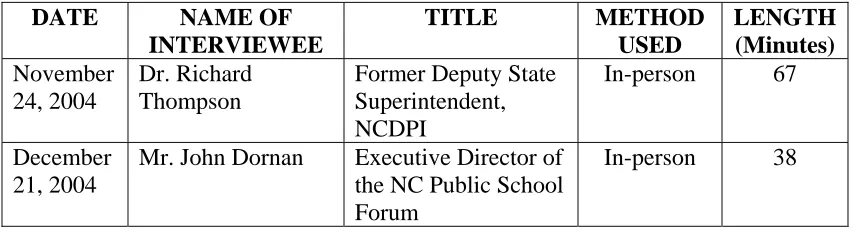
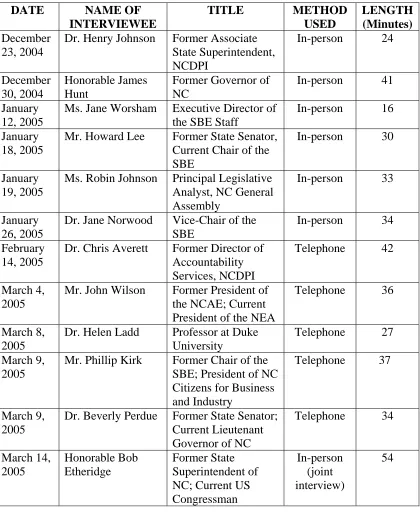
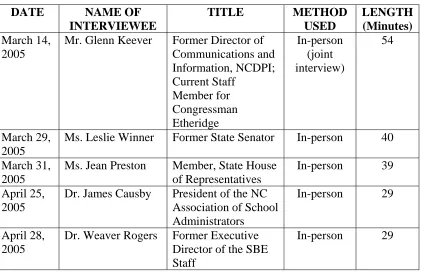
Table 1 below indicates the individuals who were interviewed, their current and/or former job titles, the dates and lengths of the interviews, and whether the interviews were in-person or by telephone.
Table 1: Interview Information
DATE NAME OF
INTERVIEWEE TITLE METHOD USED LENGTH (Minutes) November 24, 2004 Dr. Richard Thompson
Former Deputy State Superintendent, NCDPI
In-person 67
December 21, 2004
Mr. John Dornan Executive Director of the NC Public School Forum