ABSTRACT
BRAUER, JONATHAN RICHARD. Autonomy-supportive Parenting and Adolescent Delinquency. (Under the direction of Charles R. Tittle).
Autonomy-supportive Parenting and Adolescent Delinquency
by
Jonathan R. Brauer
A dissertation submitted to the Graduate Faculty of North Carolina State University
in partial fulfillment of the requirements for the degree of
Doctor of Philosophy
Sociology
Raleigh, North Carolina 2011
APPROVED BY:
_______________________________ ______________________________
Charles R. Tittle Patricia L. McCall
Committee Chair
________________________________ ________________________________
DEDICATION
BIOGRAPHY
ACKNOWLEDGMENTS
I am grateful to taxpayers of North Carolina for their fiscal support of NC State University, and to U.S. taxpayers for subsidizing the federal student loan program. My graduate education would not have been possible without these sources of financial support.
Jerry Crane of Rock Valley College introduced me to a variety of sociological concepts and inspired me to pursue a bachelor’s degree in sociology. The Rockford College faculty, notably Peter Tobias, Lynn Newhart, and Stephen Hicks, challenged me to pursue a graduate education. I am extremely grateful to each for encouraging me to start this journey.
I received excellent mentorship at NC State University. Charles Tittle, my advisor and the chair of my committee, provided me with exceptional training to match his rigorous expectations for excellence. He has also been a steady source of advice and encouragement. I am grateful for his influence on my work and professional identity, and for his friendship. Patty McCall, a member of my committee and an informal advisor, also provided personal friendship and professional mentoring to go along with her useful feedback on this work. I am fortunate that I have been able to learn from, work with, and know both Charles and Patty, and I look forward to many more years of friendship and professional collaboration.
Mock, Neko Everett, Shawnta White, Bruce Cheek, CHASS IT (especially Garrett Hobbs), and the housekeeping staff (especially Lucy) also deserve thanks – all of you are integral to the functioning of this department, and I appreciate the support that each of you has provided for me over the years.
I am grateful to my officemates (there have been too many list) for the countless hours of insightful conversations, practical help, and encouragement over the past several years. A few current and former fellow graduate students deserve special mention. Thanks to Jake Day for your scholarly help and your friendship from the beginning. I’ll be there when you finish, and I can’t wait to tell Don he was wrong! Zach Brewster and Jay Wills have been great mentors and even better friends – I could not have done this without the support of the Institute. Christine Mair and Brad Ray frequently provided dissertation advice, and their friendship, along with that of Earl Kennedy and Mark Bodkin, provided a welcome reprieve from stress at our morning coffee or yerba mate breaks. Thanks to all mentioned and to countless others – just knowing that you were sharing similar experiences provided me with a constant source of encouragement.
I am forever indebted to my family for their sacrifices, support, and belief in me; my research agenda has also been shaped by my experiences with them. My wife, Sara, has been an unwavering source of inspiration, happiness, and financial and emotional stability. I owe my family for making this journey possible; I owe Sara for making this journey worthwhile.
TABLE OF CONTENTS
LIST OF TABLES ..………ix
LIST OF FIGURES ..………x
LIST OF APPENDICES ..………xi
1. INTRODUCTION ………1
1.1 Prologue ..………1
1.2 Parenting and Delinquency .………2
1.3 Parenting and Child Development ..………3
1.4 Self-determination Theory ..………5
Autonomy-supportive contexts .…….……….………6
Self-regulation ..……….………7
Applying self-determination theory to explain adolescent delinquency ..………9
1.5 Criminological Research on Autonomy-supportive Parenting ..………10
2. AUTONOMY-SUPPORTIVE PARENTING AND THEORETICAL PATHWAYS TO DELINQUENCY ..………..………14
2.1 Introduction ..………14
2.2 Self-control ………14
Empirical status of self-control theory ..………15
Expanding upon self-control theory’s conceptualization of ‘self-control’ .……16
2.3 Peer Influence ..……… 20
2.5 Alternative Pathways ………25
2.6 Summary and Hypotheses .………26
3. DATA AND METHODS ………30
3.1 Data ………..………30
3.2 Measurement .………33
General measurement strategies ………33
Delinquency .………...………35
Autonomy-supportive parenting ………36
Theoretical mechanisms ………38
Control variables .………...………39
3.3 Analytic Strategy ………...………42
Multilevel modeling ………..………42
Testing mediation and moderation hypotheses .………43
4. RESULTS ……….………..………46
4.1 Bivariate Associations ..………46
4.2 Autonomy-supportive Parenting and Trajectories of Delinquency ..….………47
4.3 Theoretical mechanisms ………...…….………49
Theoretical mechanisms and adolescent delinquency ..………50
Linking autonomy-supportive parenting to adolescent delinquency .…………52
5. CONCLUSIONS ………57
5.1 General Conclusions ……….………57
Communicative autonomy ………61
Psychological autonomy ..………62
5.2 Limitations and Future Research Directions .………65
REFERENCES ..………77
LIST OF TABLES
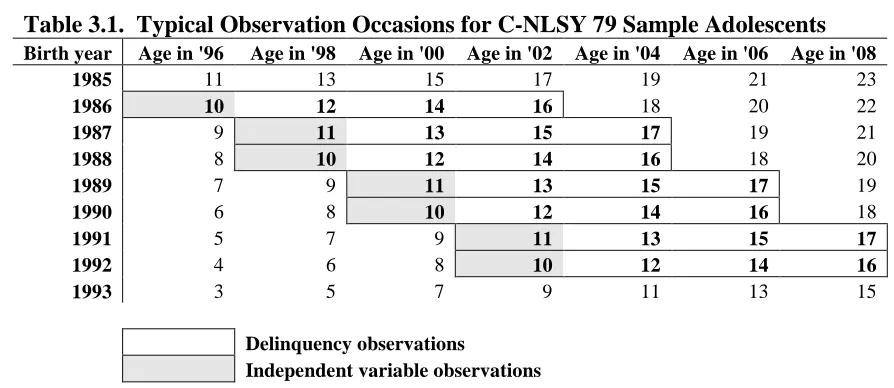
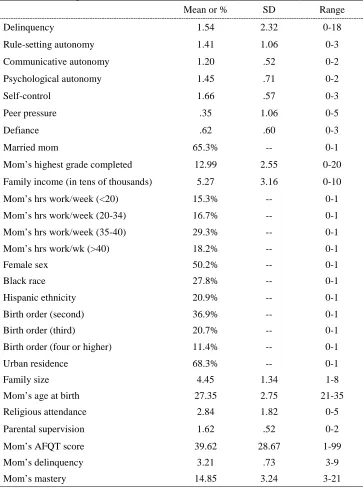
TABLE 2.1: Hypotheses ………..………99 TABLE 3.1: Typical Observation Occasions for C-NLSY 79 Sample Adolescents ..…..100 TABLE 3.2: NLSY Survey Items Used to Measure Theoretical Constructs .………102 TABLE 3.3: Descriptive Statistics for Variables at Respondent’s First Observation
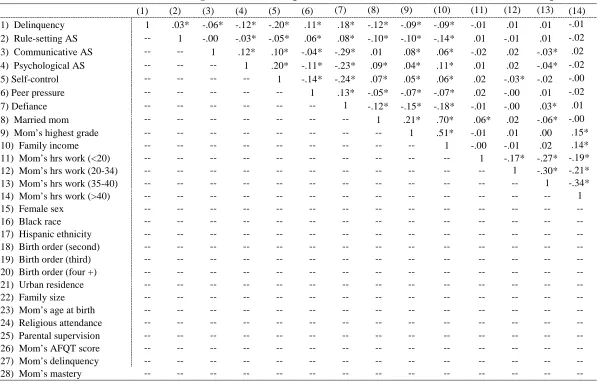
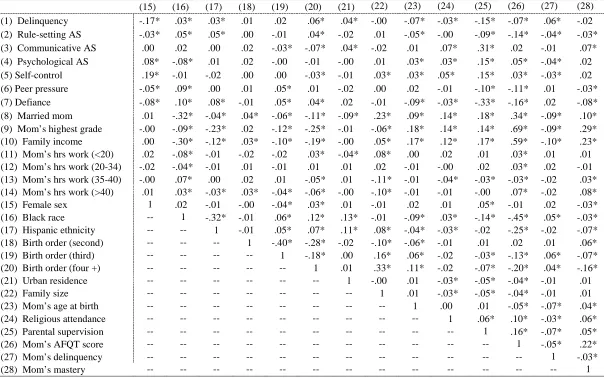
(Age 10-12; N=1,919) ..……… 104 TABLE 4.1: Bivariate Correlations among Variables at Respondent’s First
Observation (N=1,919; indicates p < .05) .………105 TABLE 4.2: Multilevel Poisson Regressions Predicting Links between Autonomy-
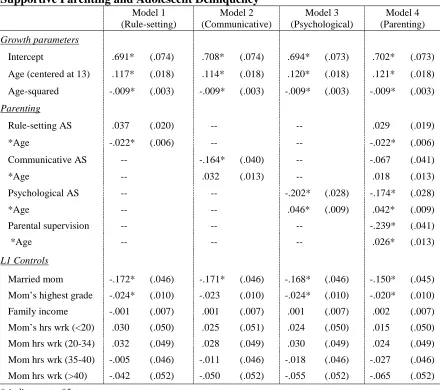
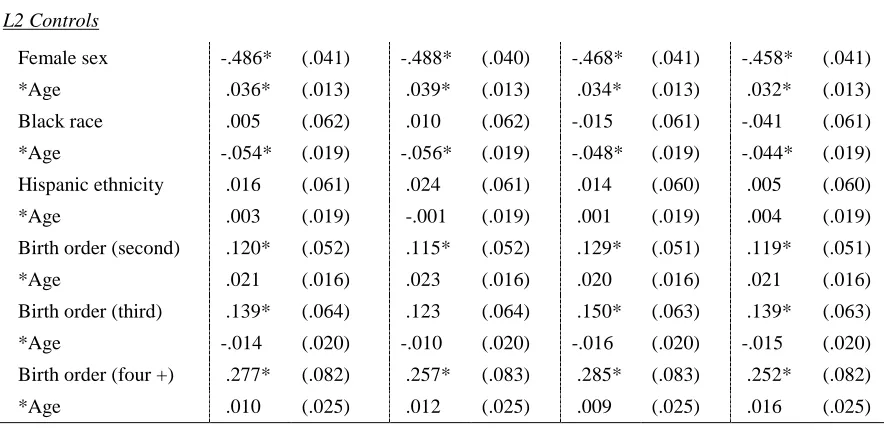
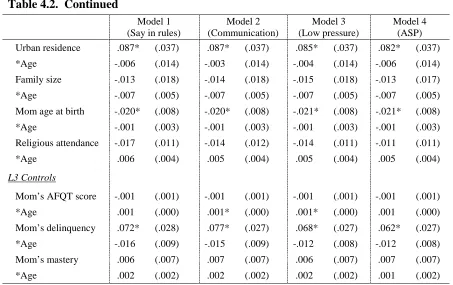
supportive Parenting and Adolescent Delinquency ..……… 107 TABLE 4.3: Multilevel Poisson Models Regressing Delinquency on Autonomy-supportive
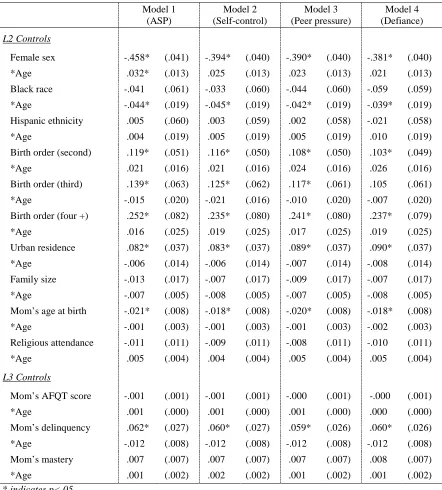
Parenting, Self-control, Peer Pressure, Defiance, and Controls ………110 TABLE 4.4: Clustered Survey Regressions Predicting Self-Control, Delinquent
Peer Pressure, and Indicators of Defiance at Respondent’s First
LIST OF FIGURES
FIGURE 3.1: Graphical Display of the C-NLSY’s Hierarchical Data Structure ..………114 FIGURE 4.1: Graphical Display of Links between Autonomy-supportive Parenting
and Adolescent Delinquency ..……… 115 FIGURE 4.2: Graphical Display of Links between Autonomy-supportive Parenting
LIST OF APPENDICES
APPENDIX 4.1: Comparison of Clustered Survey Regression Coefficients from Models Predicting Concurrent and Lagged Measures of Self-
control, Delinquent Peer Pressure, and Indicators of Defiance .…...…..113 APPENDIX 4.2: Comparison of Multilevel Poisson Regression Coefficients from
Final Models Predicting Alternative Measures of Delinquency ...…..114 APPENDIX 4.3: Comparison of Poisson Regression Coefficients from Cross-
sectional Models Predicting Concurrent and Lagged Measures
CHAPTER 1 INTRODUCTION 1.1 Prologue
Criminologists frequently identify “parenting” as a significant influence on
adolescents’ decisions to conform to or deviate from normative expectations. Often, these scholars examine the processes by which parental attachment, supervision, and coercion either inhibit or encourage adolescent delinquency (e.g., Agnew, Rebellon, and Thaxon 2000; Hirschi 1969; Gottfredson and Hirschi 1990; Patterson and Dishion 1985; Rankin and Kern 1994; Sampson and Laub 1993; Snyder and Patterson 1995; Straus and Kantor 1994; Unnever, Colvin, and Cullen 2004; Unnever, Cullen, and Agnew 2006; Warr 1993; Wilson 1987; Wong 2005). However, despite its prominence in scholarship on child development and its potential applicability to criminological theory, few criminologists have considered the part that autonomy-supportive parenting, or parenting practices that foster an adolescent’s capacity for independent decision-making, might play in encouraging or inhibiting
delinquent behavior.
Thus, the primary purpose of the research to be reported is to examine the
relationship between autonomy-supportive parenting and adolescent delinquency. I begin with a brief review of criminological literature on parenting and delinquency, and follow by discussing how this literature can be enriched by integrating the concept of parental
Youth 1979 (C-NLSY79). Specifically, these analyses will examine (1) the extent to which autonomy-supportive parenting influences adolescent delinquency, and (2) the processes by which this might occur.
1.2 Parenting and Delinquency
Criminologists consistently find that youths’ crime or delinquency is negatively related to parental attachment and to parental supervision, and positively related to parental coercion (e.g., Patterson and Dishion 1985; Rankin and Kern 1994; Sampson and Laub 1993; Snyder and Patterson 1995; Straus and Kantor 1994; Unnever, Colvin, and Cullen 2004; Unnever, Cullen, and Agnew 2006; Warr 1993; Wilson 1987). In addition, the criminological literature is rife with explanations for how and why parental attachment, supervision, or coercion might foster or inhibit adolescent delinquency. For example, theorists have posited that youths who share strong attachments with their parents are less likely to engage in delinquent activity because they fear that delinquency will damage these important relationships (Hirschi 1969; 2004). Alternatively, highly attached youths may weigh the typically conventional normative expectations of their parents more heavily than they do the expectations of other less salient, and perhaps less conventional, reference groups when considering whether or not to offend (Akers 1998; Sutherland and Cressey 1966).
Parental supervision is theorized to constrain adolescent delinquency through several different mechanisms. Some hypothesize that parental supervision indirectly reduces youths’ tendencies to deviate by playing a crucial role in the development of self-control
parental supervision reduces an adolescent’s opportunities for deviance by minimizing the youth's time spent in unstructured socializing with peers (Agnew and Petersen 1989; Osgood and Anderson 2004).
Finally, several theorists have suggested that coercive parenting practices can produce socio-emotional or social-psychological deficits (e.g., anger; low self-control) that cause youths to commit delinquency under some conditions (Agnew, Rebellon, and Thaxton 2000; Colvin 2000; Crosswhite and Kerpelman 2009). Coercive parenting has also been posited to reinforce aggressive or otherwise criminogenic interaction patterns that can foster youths’ later delinquency (Patterson, Dishion, and Bank 1984).
1.3 Parenting and Child Development
desirable child outcomes, while coercive parenting practices, or psychologically controlling techniques, are associated with undesirable child outcomes (e.g., Aquilino and Supple 2001; Barber, Olsen, and Shagle 1994; Bean, Barber, and Crane 2006; Beveridge and Berg 2007; Coley, Votruba-Drzal, and Schindler 2008; Conger, Ge, Elder, Lorenz, Simons. 1994; Gray and Steinberg 1999; Grolnick 2003; Simons, Chen, Simons, Brody, and Cutrona 2006; Simons, Lin, and Gordon 1998).
In addition to affirming the importance of parental attachment, supervision, and coercion, developmental research also has identified another parenting factor – parental autonomy support – that is associated with child development and that may be relevant to adolescent delinquency as well. Autonomy-supportive parenting refers to practices that foster a child’s capacity for autonomous decision-making. Researchers typically measure
While multiple theoretical perspectives have touted the importance of autonomy-supportive parenting for child development (c.f., Arnett 2000; Baumrind 1966, 1978; Blos 1979; Grolnick, Deci, and Ryan 1997; Maccoby and Martin 1983), one particularly
intriguing perspective is self-determination theory (see Deci and Ryan 1985; 2000). Self-determination theory (SDT) has garnered much empirical support, and likewise it is relied upon frequently to predict and interpret the effects of parental autonomy support on child developmental outcomes (e.g., Deci and Ryan 1987; Grolnick 2003; Grolnick, Gurland, DeCourcey, and Jacob 2002; Soenens and Vansteenkiste 2005). Further, as I will discuss later, some of SDT’s hypothesized causal mechanisms connecting parental autonomy support to adolescent delinquency are readily compatible with mechanisms found in existing theories of crime and delinquency.
1.4 Self-determination Theory
Self-determination theory focuses on human motivation and development. It assumes that people have intrinsic needs, including the need for autonomy, and that behaving in a self-determined or autonomous manner is critical to one’s optimal functioning (Deci and Ryan 1987, 2000; Ryan and Deci 2006; for a summary, see Soenens and Vansteenkiste 2005). In SDT, autonomy refers to the “experience of integration and freedom,” or to the “desire to self-organize experience and behavior and to have activity be concordant with one’s integrated sense of self” (Deci and Ryan 2000: 231). According to the theory,
Self-determined, or autonomous, behaviors are those that “are initiated and regulated through choice as an expression of oneself” (Deci and Ryan 1987: 1024), or that are “endorsed by the whole self and experienced as action for which one is responsible” (1025). At the other end of the continuum are controlled behaviors, which are described as being “pressured and coerced by intrapsychic and environmental forces,” and that likewise fail to leave the actor with an experience of autonomy or with a sense that the action was the result of true choice (1024).
Autonomy-supportive contexts
SDT argues that events and contexts can be more or less supportive of
self-determined or autonomous action. Deci and Ryan define “autonomy-supportive” events or contexts as those that “encourage the process of choice and the experience of autonomy” (1987: 1027). Likewise, the theory claims that people who are exposed to
autonomy-supportive contexts will “experience a greater sense of choice about their actions, and these actions are characterized by integration [with one’s own value system] and an absence of conflict and pressure” (Deci and Ryan 1987: 1033). In contrast, those who are least exposed to autonomy-supportive contexts (or are more exposed to controlling contexts) presumably are less likely to feel autonomous, and more likely to feel pressured to act in particular ways.
upon their own interests and values. Rather, parents may rely primarily on the threat of punishment or the promise of reward to pressure children to behave in particular ways. In contrast, Ryan and colleagues describe autonomy-supportive parents as those who attempt “to grasp and acknowledge the child’s perspective, use minimal controls to foster behavior, and provide choice when possible” (Ryan, Deci, Grolnick, and LaGuardia 2006: 815). As mentioned previously, autonomy-supportive parenting is theoretically expected to result in, and has been linked empirically to, a host of desirable child outcomes, including greater levels of creativity, better academic performance, stronger relational attachments, and fewer internalized and externalized problem symptoms (e.g., Grolnick et al. 1991; Grolnick,
Gorland, DeCourcey, and Jacob 2002; LaGuardia, Ryan, Couchman, and Deci 2000; Soenens and Vansteenkist 2005; for reviews, see Deci and Ryan 1987; Grolnick 2003; Ryan et al. 2006).
Self-regulation
Consistent with operant and cognitive learning theories (e.g., Skinner 1953; Bandura 1977; Akers 1998), SDT recognizes that external reinforcement or punishment contingencies, which are frequently used in controlling parenting contexts, often operate as effective
behavioral control mechanisms in the short term. However, the theory claims that this type of behavioral control strategy produces a form of contingency-dependent, controlled
that such behavioral control attempts may be perceived by the child as a challenge to the youth's autonomy, and as such are likely to be met with a defiant response. Finally, SDT asserts that reliance on coercive pressures to generate compliance from a child ultimately may undermine that child’s inner motivation or capacity for autonomous self-regulation (see Deci and Ryan 1987; 2000).
In contrast, SDT posits that autonomy-supportive practices should foster autonomous self-regulation, or action that reflects inner motivations and that is fully endorsed by one’s self. Autonomy-supportive parenting practices, then, should be more likely than controlling methods of parenting to result in a form of volitional or self-determined conformity among children that reflects the child’s acceptance of norms or behavioral expectations as one’s own. Further, this self-determined behavioral conformity should be more resistant to long-term extinction than the behavioral compliance produced by controlled self-regulation because, unlike the latter, the former does not require the continued presence of salient external reinforcement or punishment contingencies for maintenance. That is, this self-determined behavioral conformity is not “controlled” by, or contingent upon, anticipated external consequences of behavior; rather, it is motivated by an internalized desire to conform that should continue to be present even in contexts where parental sanctions are no longer salient or anticipated.1
1
Applying SDT to explain adolescent delinquency
SDT’s arguments regarding the effects of autonomy-supportive parenting on child development also may be relevant to adolescent’s decisions to participate in or refrain from delinquent behaviors. Recall that autonomy-supportive parenting practices are thought to foster willful, autonomous, or self-determined behavior among children. SDT also assumes that a person’s behavioral conformity to conventional expectations, at least in autonomy-supportive contexts, is a reflection of that individual's own internalized conventional motivations, values, or goals. This is because internalized motivations are posited as the product of exposure to autonomy-supportive contexts, and because in these contexts people presumably feel minimal pressure to act in ways that are inconsistent with their own values. Thus, adolescents who are exposed to autonomy-supportive parenting practices are expected to internalize motivations to conform to normative behavioral expectations and, assuming parents hold conventional normative values, therefore should choose to resist temptations to deviate.
1.5 Criminological Research on Autonomy-supportive Parenting
Despite these theoretical expectations and the consistent findings regarding supportive parenting’s relationship with other child outcomes, autonomy-supportive parenting has received relatively little attention in the criminological literature. Furthermore, the few studies in criminology that have explored the link between parental autonomy support and adolescent delinquency have not provided consistent support for the notion that such parenting practices inhibit delinquency (c.f., Goldstein, Davis-Kean, and Eccles 2005; Petts 2009; Turner, Irwin, Tschann, and Millstein 1993). For example, Turner and colleagues (1993) examined the link between parental autonomy support and youths’ risky behaviors using a sample of 189 sixth and seventh graders from a public middle school in the San Francisco Bay area. These authors did not find an association in early adolescence between parental autonomy support, measured using a scale that captured the degree to which parents accept and encourage a child’s independence and self-reliance, and problem behaviors such as fighting or substance use. However, they did find that those sixth and seventh graders who were exposed to greater levels of parental autonomy support exhibited lower levels of sexual intercourse relative to their less autonomy-supported counterparts.
Goldstein, Davis-Kean, and Eccles (2005) used longitudinal data from the Maryland Adolescent Development in Context Study to examine the relationship between autonomy-supportive parenting, measured using a scale that captured the extent to which a child had a say in decisions affecting his/her day-to-day life, risky peer contexts, and adolescent
Further, although they failed to find a bivariate correlation or a direct net effect of early autonomy-supportive parenting on later delinquency (i.e., as reported in the 11th grade), Goldstein and colleagues did find an indirect, positive effect of early autonomy-supportive parenting on later adolescent delinquency. Specifically, their results showed that early autonomy-supportive parenting was associated with more time spent in unstructured socializing with peers in the following year, which in turn predicted higher levels of later delinquency.
Petts (2009) used longitudinal data from a subsample of 2,472 youths born before 1984 in the C-NLSY to explore the influence of family and religious characteristics on delinquency during adolescence and young adulthood. Petts began by identifying three distinct delinquency-related trajectories across the ages of 10 to 25 using group-based
trajectory modeling: a low-level delinquent trajectory; an early adolescent-limited delinquent trajectory; and late adolescent-limited delinquent trajectory. After identifying these
trajectories, he employed multinomial logistic regression to examine whether family and religious characteristics predicted the likelihood of entering into each of these delinquency trajectory groups. In these regressions, Petts included a measure of child involvement in decision-making processes as a family process variable; as noted earlier, this measure may be conceptualized as an indicator of parental autonomy-support. Petts interpreted his findings as providing limited support for the idea that autonomy-supportive parenting reduces the
likelihood of following an early adolescent-limited trajectory of delinquency (as compared to a low-level delinquent trajectory; see 2009: 475). However, the multinomial logistic
further, his child decision-making measure failed to distinguish between the likelihood of entering a late adolescent-limited delinquent trajectory versus a low-level offending trajectory.
Finally, some scholars have examined the relationship between parenting and delinquency using parenting measures that incorporate elements of parental autonomy
support within conceptually broader parenting scales, such as democratic discipline, parental efficacy, authoritative parenting, or effective parenting (e.g., Aquilino and Supple 2001; Hoeve, Blokland, Dubas, Loeber, Gerris, and van der Laan 2008; Perrone, Sullivan, Pratt, and Margaryan 2004; Simons, Simons, Burt, Brody, and Cutrona 2005; Simons, Wu, Conger, and Lorenz 1994; see also Hoeve et al. 2009). Although these parenting scales frequently are found to be negatively correlated with adolescent delinquency, it is often unclear whether these parenting effects primarily reflect the association between delinquency and any particular element in the scale, such as autonomy support, or some combination of the incorporated elements. Further, it is possible that separate parenting elements used in such scales, such as autonomy support, supervision, or attachment, operate through different causal mechanisms to influence delinquency, and likewise may have distinct effects on adolescent delinquency (for a related argument, see Gray and Steinberg 1999).
Thus, from the existing research on this topic, it is unclear exactly what relationship, if any, autonomy-supportive parenting shares with adolescent delinquency. While it remains possible that parental autonomy support and adolescent delinquency are unrelated, this seems unlikely given the consistent associations reported in developmental research between
may suggest that the relationship between these two constructs is more complex than straightforward. That is, autonomy-supportive parenting may have an indirect influence on adolescent delinquency, and may even operate through countervailing mechanisms.
Additionally, adolescents’ decisions to engage in or refrain from delinquency may be
affected by the timing as well as the amount of exposure to parental autonomy support. If so, then explicit theoretical specification aimed at delineating precisely how and why autonomy-supportive parenting might influence adolescent delinquency would be necessary before such an association can be modeled adequately.
Therefore, in the following section, I will draw from the logic of SDT and from theoretical ideas found in the criminological literature to posit specific pathways by which parental autonomy support might be expected to influence adolescent delinquency.
Specifically, drawing from SDT’s arguments, I will hypothesize that exposure to autonomy-supportive parenting generally should inhibit delinquency by increasing an adolescent’s capacity for self-regulation (or self-control), by reducing the potential influence of peer pressures to deviate, and by reducing an adolescent’s defiance (or reactance) motives. However, drawing from extant criminological research, I will also hypothesize that
CHAPTER 2
AUTONOMY-SUPPORTIVE PARENTING AND THEORETICAL PATHWAYS TO DELINQUENCY
2.1 Introduction
Although parental autonomy support has received relatively little attention in the criminological literature, SDT’s arguments regarding autonomy-supportive parenting and child well-being can be readily integrated with causal processes found in existing
criminological theories to help explain adolescent delinquency. In fact, the theoretical mechanisms outlined in SDT by which autonomy-supportive parenting is expected to influence adolescent delinquency, such as self-regulation, defiance, and pressures to conform, are well-known to criminologists.
2.2 Self-control
First, the concept of regulation” in SDT is similar to the concept of
“self-control” as found in Gottfredson and Hirschi’s (1990) self-control theory of deviance (Logue 1996; Vohs and Baumeister 2004; see also Hay 2001). Both regulation” and “self-control” refer generally to relatively stable individual differences in one’s capacity to resist impulses to deviate from normative behavioral standards. In addition, both theories
Self-control theory (SCT – not to be confused with SDT) conceptualizes “self-control” as an individual’s ability or tendency to calculate the consequences of his or her actions (see Gottfredson and Hirschi 1990: 89-91; see also Dodson 2009; Hirschi 2004). Thus, individuals with low self-control are characterized as having a tendency to act on impulse, presumably due to their failure to consider fully the consequences of engaging in immediately gratifying behaviors such as delinquency. In contrast, those with high self-control presumably can and do resist the temptation to act impulsively, out of fear of undesirable consequences that are likely to follow such actions. Further, SCT theorizes that children develop high self-control early in life primarily through specific parental
socialization processes involving love, monitoring, recognition of misbehavior, and
punishment of wrongdoing. According to the theory, a child will develop high self-control if she has parents (or caregivers) who care enough about her to monitor her behavior closely, and who correct her wrongdoing in a consistent manner, assuming the parents themselves can recognize misbehavior (Gottfredson and Hirschi 1990: 97-100; see also Hirschi 1994;
Latimore, Tittle, and Grasmick 2006). In other words, SCT argues that children who are consistently supervised and punished for wrongdoing will tend to choose to conform when opportunities to deviate arise because they have learned that the costs of nonconformity are high.
Empirical status of SCT
the theory’s assertions regarding the sources of self-control have received relatively less attention (Cullen, Unnever, Wright, and Beaver 2008). In addition, while research on this topic often shows that some parenting measures are related to levels of self-control, this body of research also suggests that the sources of self-control may be more complex or more numerous than the theory predicts (Cullen et al. 2008). For example, in his test of SCT, Hay also examined the empirical relevance of Baumrind’s (1966) concept of authoritative parenting to self-control, and found that psychological autonomy-granting (among other parenting factors) was associated with higher levels of self-control (Hay 2001: 722). Thus, Hay concluded that SCT’s “exclusive focus on the extent of control ignores the vast parenting literature that suggests that the context and manner in which parental control is delivered significantly affects social-psychological and behavioral outcomes, including self-control” (2001: 725), and that SCT therefore would benefit from a broader conceptualization of parenting. Accordingly, SCT’s arguments about the parental sources of self-control may be improved by integrating some of SDT’s insights regarding the nature of self-control and its sources.
Expanding upon SCT’s conceptualization of ‘self-control’
thought of as capturing whether one is likely to refrain, or as capturing the probability that one refrains, from impulsive behavior. SDT’s types of self-regulation (i.e., autonomous or controlled), then, may be thought of as additionally capturing why one might refrain, or as capturing two different mechanisms responsible for causing one to refrain, from impulsive behavior – that is, as a result of anticipated consequences (as in controlled self-regulation), or due to an internalized desire to act accordingly (as in autonomous self-regulation). Further, recall SDT also asserts that whether a person develops controlled or autonomous self-regulation primarily depends upon differences in the contexts in which behavioral
expectations are presumably generated (Deci and Ryan 1987; 2000; Ryan and Deci 2002). For instance, people are posited to develop controlled self-regulation through consistent exposure to controlling contexts, and autonomous self-regulation through exposure to autonomy-supportive contexts.
bolster one’s capacity for self-regulation in general (i.e., regardless of type), because such practices explicitly encourage youth to think about the consequences of their potential actions.
Although SCT’s current formulation neither recognizes differences in types of self-control nor identifies autonomy-supportive parenting as a key source of self-self-control, the theory would not require substantial modification to incorporate each of these possibilities into its causal arguments. After all, SCT’s logical structure does not forbid the possibility that individuals with high self-control conform not only because they perceive the costs of crime to be high, but also because they have internalized a desire to conform.2 In other words, a person who perceives the costs of nonconformity to be high might also assent to rather than comply with pressures to conform, or might willfully choose to conform, because that person has integrated conventional standards into her sense of self (Ryan and Deci 2006).3
2 In fact, SCT does imply that individuals with high self-control are those who have internalized the
conventional value system (or the social bond) to the greatest extent (Hirschi 2004; see also Dodson 2009: 70-74). Although SCT does not make an explicit distinction between internal (autonomous) and external (controlled) sources of self-regulation, similar distinctions were made in early theorizing on the sources of behavioral control in criminology (e.g., Reckless, Dinitz, and Murry 1956; Reiss 1951; Nye 1958; for a similar discussion, see Akers 1991: 205-6). Furthermore, this idea that some people willfully conform because each has integrated normative behavioral expectations into one’s sense of self can be found in several criminological theories (c.f., normative self-concepts or internalized moral beliefs; e.g., Akers 1998; Etzioni 1988; Grasmick and Bursik 1990; Grasmick and Green 1980).
3
Furthermore, although SCT’s current formulation places a great deal of emphasis on parental supervision and punishment, the theory’s socialization arguments are not at odds with the possibility that autonomy-supportive parenting practices also might be important to the development of self-control in general, or to the development of autonomous self-regulation specifically.4
Thus, drawing upon SDT and expanding upon SCT, autonomy-supportive parenting practices are expected to produce higher levels of self-control in youth, as such practices may encourage youth to consider the consequences of their potential actions. In addition, youth exposed to autonomy-supportive parenting practices should be less likely than their
behaviors can be aligned simultaneously with external pressures and with internal desires, and that external regulation often forms the basis of internalized values and subsequent autonomous self-regulation. SDT’s main assertion, then, is that some intentional or self-regulated behaviors are more autonomous than are others; a person’s behavior is considered more autonomously self-regulated when that behavior is experienced as more willful or as more in line with one’s internalized value system. Thus, autonomousor self-determined
conformity, which is posited as a product of exposure to autonomy-supportive contexts, is thought to reflect more than a hedonic calculus in which each individual weighs that which he or she stands to lose or to gain – it also presumably reflects one’s identityorone’s sense of self.
counterparts to engage in delinquency throughout adolescence, because autonomy-supportive parenting theoretically encourages youth to integrate normative expectations into their sense of self, thereby producing an autonomous form of self-control that fosters conformity even in the absence of reinforcement or punishment contingencies.
2.3 Peer Influence
Thus far, parental autonomy support has been posited to inhibit adolescent
delinquency by fostering the development of self-control. In discussing this connection, it was posited that autonomy-supportive parenting practices inhibit delinquency by
encouraging the development of an autonomous form of self-regulation (or self-control) that fosters self-determined conformity among youth. That is, youth exposed to
autonomy-supportive parenting are theorized to conform because they want to conform, or because each has integrated conventional behavioral expectations into his or her sense of self (i.e., each has developed a normative self-concept). In addition to providing a person with an inner
motivation to conform, this normative self-concept supposedly fostered by autonomy-supportive parenting also may inhibit delinquency by reducing a person’s exposure and susceptibility to external motivations to deviate.
conform to the normative expectations of their peer groups (for a detailed discussion and review, see Akers 1998: 114-26). Following this logic, adolescents who are exposed to autonomy-supportive parenting (and thus develop normative self-concepts) may be less likely to socialize with delinquent peers than their counterparts, and therefore may experience fewer peer pressures to deviate.
Second, recall that the normative self-concept presumably fostered by exposure to autonomy supportive parenting should be present and should provide inner motivation to conform irrespective ofwhether one faces external pressures to conform or to deviate in a given situation (i.e., as mentioned previously, autonomous self-regulation is not contingency-dependent). Therefore, when faced with peer pressures to deviate, adolescents exposed to autonomy-supportive parenting may be better able to resist these pressures because they will be motivated to act in a manner consistent with their normative self-concept.
2.4 Reactance
These ideas are reminiscent of scholarship on “reactance” processes found in the criminological literature. The concept of reactance originates from Brehm’s (1966) reactance theory, which argues that people believe they have specific freedoms, and if a person
perceives that a freedom is threatened, then he or she experiences psychological reactance, or the motivation to restore that freedom or to regain a sense of control (for a summary, see Brehm 1993). Following a similar logic, some criminological theories argue that delinquent behaviors represent defiant or “reactive” behavioral attempts to assert autonomy, achieve control, or vent frustrations in response to denials of individual autonomy or losses of control (Agnew 1997; Greenberg 1977; Katz 1988; Moffitt 1993; Tittle 1995; see also Brezina 2000; 2008). Also, consistent with these arguments, a growing body of research findings seem to indicate that at least some criminal or delinquent behaviors stem from individuals’ perceived needs for autonomy or control (e.g., Agnew 1984; Brezina 2000, 2008; Curry and Piquero 2003; Jacobs and Wright 2006; Piquero and Hickman 1999; Van Gundy 2002).
Tittle’s control balance theory (Tittle 1995; 2004) is perhaps the most explicit
According to the theory, a provoked individual will balance cognitively the potential controlgained by any behavior with the potential counter-control likely to result from that action, and choose, perhaps subconsciously, the action that will result in the most favorable outcome in control gained. Further, CBT posits that one’s ultimate choice of behavioral response to provocation depends largely upon that person’s overall control ratio, or the average amount of control the individual can apply relative to the amount of control she experiences. People with balanced control ratios (i.e., those who can exert about as much control as they experience) usually are expected to find that acts of conformity provide the most favorable outcomes; conversely, those with imbalanced control ratios (i.e., relative deficits or surpluses of control) are anticipated to perceive deviance as providing the most desirable option for gaining or maintaining control.
The original formulation also described specific types of deviance (e.g., defiance; predation; exploitation) that an individual is most likely to commit depending upon her relative level of control (see Tittle 1995: 188-92). For example, the theory posits that people with moderate control deficits will be motivated to commit some form of deviance in an effort to gain control and rectify the imbalance; however, these people also have limited ability to exert control or to escape the counter-controls associated with serious forms of deviance. Thus, CBT predicts that those with moderate control deficits are most likely to respond to provocations with “defiant” forms of deviance. Defiant acts include a wide range of behaviors, such as disobedience, status offenses, vandalism, sullenness, protests,
system (Tittle 1995: 138-9). These acts presumably allow individuals “to escape unfavorable control without running the risk that the full force of counter-control will be brought down upon them” (1995: 190).
In addition, Tittle suggests that adolescents, especially, are prone to react with defiant acts of deviance when facing challenges to their autonomy or control (1995: 241-9). He argues that although people “typically gain more ability to control as well as to escape
control as they move from childhood to adulthood” (1995: 196), adolescence nonetheless is a transitional stage in which youth still are subjected to a great deal of control. As a result, adolescence may be a stage in the life-course that is typified by moderate overall control deficits (and likewise defiance).
Thus, both CBT and SDT postulate that some adolescents will react to a perceived lack of autonomy or control by committing defiant behaviors. SDT adds to this by asserting that autonomy-supportive parenting may reduce a youth’s perceived need for autonomy (or desire for control). Additionally, CBT offers a more complete explanation for why
be less likely to perceive parental control attempts as challenges to their autonomy or control, and also should be less likely to perceive defiant deviance (and its associated
counter-control) as a desirable response to provocation.
2.5 Alternative Pathways
In contrast to the arguments presented above, which are drawn from the logic of SDT, the criminological research literature seems to provide some reasons to expect a positive
association between autonomy-supportive parenting and adolescent delinquency. First, recall that parental supervision has been consistently linked to lower levels adolescent delinquency (e.g., Patterson and Dishion 1985; Wells and Rankin 1988). Though it is not traditionally considered an indicator of autonomy-supportive parenting, parental supervision typically is viewed as form of parental control; as such, a lack of such control may be conceptualized as a form of autonomy-supportive parenting. That is, children exposed to low levels of parental supervision are essentially granted the autonomy to act as they desire, without the constant pressure or fear of sanctions that can result from parental monitoring.
colleagues (2005) found that autonomy-supportive parenting in early adolescence actually exacerbates delinquency, by increasing time spent in unstructured socializing with peers (see also Beveridge and Berg 2007). Thus, it follows from this literature that
autonomy-supportive parenting, the opposite of controlling parenting, might actually increase adolescent delinquency, by reducing self-control, or by increasing a youth’s exposure to delinquent peers.
2.6 Summary and Hypotheses
In this section, I described specific theoretical pathways by which
autonomy-supportive parenting is expected to inhibit adolescent delinquency. Several of these pathways are reworded below as testable hypotheses; each hypothesis is also relisted in Table 2.1.
On a general level, autonomy support is thought to promote child well-being and inhibit adolescent delinquency, and therefore may be conceptualized as one form of social support that parents provide for their children. In other words, like parental provisions of emotional and instrumental support (see Wright and Cullen 2001), autonomy-supportive parenting may be expected to act in most cases as a “protective factor” that restricts youths’ participation in delinquency. Likewise, the first hypothesis states this posited general relationship between parental autonomy support and adolescent delinquency.
H1: Autonomy-supportive parenting will be negatively associated with adolescent
delinquency.
With regard to specific theoretical pathways, self-control is first identified as a
delinquency. Recall, since autonomy-supportive parenting practices presumably encourage a youth to consider the consequences of her potential actions and to integrate normative expectations into her sense of self, these practices are predicted to inhibit adolescent delinquency by producing higher levels of self-control. As a result, the second, third, and fourth hypotheses address this mediating relationship.
H2: Autonomy-supportive parenting will be positively associated with adolescent
self-control.
H3: Adolescent self-control will be negatively associated with adolescent
delinquency.
H4: Adolescent self-control will partially mediate the relationship between
autonomy-supportive parenting and adolescent delinquency
The second pathway involves potential linkages between autonomy-supportive parenting, adolescent delinquency, and peer pressures to deviate. First, autonomy-supportive parenting is expected to inhibit delinquency by fostering the development of a normative self-concept; this, in turn, is expected to encourage a youth’s selection into conventional peer groups and likewise reduce a youth’s exposure to delinquent peer pressures. Given the lack of specific measures of youths’ normative self-concepts, the fifth, sixth, and seventh
hypotheses explore the possibility that autonomy-supportive parenting inhibits delinquency by reducing youths’ exposures to delinquent peer pressures.
H5: Autonomy-supportive parenting will be negatively associated with delinquent
H6: Delinquent peer pressures will be positively associated with adolescent
delinquency.
H7: Delinquent peer pressures will partially mediate the relationship between
autonomy-supportive parenting and adolescent delinquency.
By fostering the development of a normative self-concept, autonomy-supportive parenting is also expected to bolster a youth’s ability to resist temptation when faced with peer pressures to deviate. Thus, the eighth hypothesis explores the possibility that autonomy-supportive parenting moderates the relationship between delinquent peer pressures and adolescent delinquency.
H8: Delinquent peer pressures will interact with autonomy-supportive parenting
in predicting adolescent delinquency, such that delinquent peer pressures will
share a weaker positive association with delinquency among adolescents
exposed to greater levels of autonomy support.
In a third theoretical pathway, adolescent delinquency is conceptualized as one specific manifestation of general defiant behavior resulting from an adolescent’s perceived lack of autonomy or control. Further, autonomy-supportive parenting is theorized to reduce the likelihood of adolescent delinquency by reducing a youth’s perceived need for autonomy or desire for control. Given the lack of specific measures of control ratios or reactance motives in the current study, the ninth, tenth, and eleventh hypothesis explore the possibility that autonomy-supportive parenting inhibits delinquency by reducing youths’ general
H9: Autonomy-supportive parenting will be negatively associated with defiance.
H10: Defiance will be positively associated with adolescent delinquency.
H11: Defiance will partially mediate the relationship between autonomy-supportive
parenting and adolescent delinquency.
Finally, in contrast to the above hypotheses, some criminological literature provides a basis for expecting autonomy-supportive parenting to increase adolescent delinquency.
Specifically, drawing from research on parental supervision and from Goldstein and colleagues’ (2005) research, autonomy-supportive parenting may provide youth with the
autonomy required to commit delinquency, perhaps by freeing them from the internalized inhibitions that are typically produced by parental control (i.e., by impeding the development of self-control), or by granting youth the freedom to socialize with delinquent peers.
HA1: Autonomy-supportive parenting will be positively associated with adolescent
delinquency.
HA2: Autonomy-supportive parenting will be negatively associated with
self-control.
HA3: Autonomy-supportive parenting will be positively associated with delinquent
peer pressures.
HA4: Self-control and delinquent peer pressures will partially mediate the positive
CHAPTER 3 DATA AND METHODS
3.1 Data
An adequate assessment of the hypotheses described above requires data with certain features. First, the data must include measures of key theoretical constructs, such as
autonomy-supportive parenting, self-control, defiance, peer pressures to deviate, and adolescent delinquency. Second, longitudinal data are preferred to permit examination of autonomy-supportive parenting’s potential long-term effects on adolescent delinquency. The Children of the National Longitudinal Survey of Youth 1979 (C-NLSY79) is a data source well suited for these purposes. The original National Longitudinal Survey of Youth 1979 (NLSY79) is a panel study administered to 12,686 individuals between the ages of 14 to 21 years old in 1979 and included an oversample of Black and Hispanic respondents. The C-NLSY79, which is sponsored by the US Bureau of Labor Statistics and the National Institute for Child Health and Human Development, started in 1986 and continues on a biennial schedule. It is comprised of all children born to the 6,283 original women of the NLSY79; at the 2006 wave, the subjects of the C-NLSY79 were estimated to represent more than 90% of all children ever to be born to these women (Bureau of Labor Statistics 2009).
Adult Survey that were consistent with those responded to in earlier waves (i.e., in the Child Self-Administered Supplement). Due to the nature of these data collection procedures, children born between 1986 and 1992 have between three and five potential observation occasions between the ages of 10 and 17 (collected from 1996-2008). Table 3.1 displays the typical data observation occasions for this subsample by child’s year of birth.5
Respondents were retained in the analytic sample if: (1) their first delinquency observation occurs between ages 10 to 12, and (2) they have a corresponding observation for each of the key independent variables in this study (i.e., autonomy supportive parenting and the theoretical mechanisms) at the first measurement occasion. These data are exceptionally complete on the key variables in this study – of the 2,158 respondents whose first
delinquency observation occurs between ages 10 and 12, 89% (n=1,919) also have corresponding data on the key independent variables at the first measurement occasion. Furthermore, the average respondent has 3.3 delinquency observations between 10 and 17. Specifically, of the 1,919 respondents with complete data on the delinquency, autonomy-supportive parenting, and theoretical mechanism measures, 1,837 have a second delinquency observation; 1,611 have a third delinquency observation; 840 have a fourth delinquency
observation; and 46 have a fifth delinquency observation. This sampling procedure yields an analytic sample of 6,253 observation occasions for 1,919 children born to 1,477 mothers.
In this study, all models are estimated using a multilevel modeling approach that uses available time points from any participant who has been observed at least once (see
Raudenbush and Bryk 2002; Singer and Willett 2003). An advantage of this approach is that it ensures unbiased estimation, even when using an unbalanced longitudinal dataset (i.e., where individuals have different numbers of observations), as long as data are missing at random (for a discussion, see Raudenbush & Bryk, 2002: 199-200). Further, listwise deletion of missing data produces reliable estimates in these designs when the sample size is large and the proportion of missing data is relatively low (Gibson and Olejnik, 2003).
Although the proportion of missing data is low across the key independent variables, multivariate listwise deletion across these variables and all control variables would result in substantial data loss – about 24% of subjects and 33% of total person-time observations are missing on at least one covariate in this study.6
6 In addition to arbitrary missingness due to attrition and item non-response, some observations are missing because a random subset of children of mothers from the original NLSY79 oversample of Blacks and Hispanics were not surveyed in 2000 due to budgetary restrictions.
with a set of plausible values that account for the uncertainty of missing values, while simultaneously preserving the intercorrelations between variables (for a detailed discussion of multiple imputation, see Schafer and Graham 2002). Specifically, the Markov Chain Monte Carlo (MCMC) method in SAS PROC MI was used to construct five imputed
datasets; for the few cases with imputed values that fell outside the range of observed values, the imputed values were truncated to fit the observed range of plausible values (e.g., imputed values for binary variables below 0 or above 1 were rounded 0 or 1, respectively). SAS procedures (e.g., PROC MEANS for descriptive statistics, PROC CORR for bivariate correlations, PROC GLIMMIX for multilevel models, and PROC SURVEYREG for cross-sectional models) were then performed across all five datasets, and parameters were
subsequently combined using PROC MIANALYZE (for a description of this procedure, see Yuan 2010).7
3.2 Measurement
General measurement strategies
Table 3.2 displays the survey items used to measure theoretical constructs and exogenous control variables.
In constructing scales and indices, factor analysis with oblique (promax) rotation was performed to assess whether constituent items form a single underlying dimension. Given the pooled longitudinal nature of the data, these analyses were limited to the response values for
each item at a subject’s initial observation occasion (i.e., at age 10 to 12). Unless otherwise noted, items that are included in the final scales or indices all loaded satisfactorily on only one dimension, using a cutoff of .400, and each improved the reliability of the scale, as demonstrated by an increase in Cronbach’s alpha. Cronbach’s standardized alpha reliability coefficients for multi-item scales and indices are reported in table 3.2.
For scales or indices comprised of three or more items, scores were computed as the person-mean of available items if 60% or more of the items were answered. Although mean substitution is often discouraged at the variable level because it can lead to biased estimates, person-mean imputation at the item level preserves a great deal of information while yielding efficient and unbiased results when a multi-item scale is unidimensional and has a relatively high reliability (e.g., alpha = .50; see Graham 2009; Jeličić, Phelps, and Lerner 2010; Roth,
Switzer, and Switzer 1999).
Table 3.3 presents descriptive statistics for all primary variables in their original metrics (i.e., before centering).8
8 Other researchers analyzing these data have used weights to correct for bias resulting from oversampling in the NLSY’s survey design (e.g., Parcel and Menaghan 1994). However, using weighted data in longitudinal regression analyses may result in substantial miscalculations of standard errors (Vander Ven et al. 2001). Instead, bias is reduced in this study by introducing controls for overrepresented characteristics in each analytic model (e.g., race/ethnicity, SES, maternal education, mother’s cognitive ability; see Guo 1998; Vander Ven et al. 2001; Winship and Radbill 1994).
nonessential multicollinearity associated with the introduction of cross-product interaction terms (Jaccard et al. 1990; Aiken and West 1991; Cohen et al. 2003).
Delinquency
The primary dependent variable – adolescent’s self-reported delinquency – is a scale constructed as a sum of the counts of the number of times a youth committed each of six different acts of delinquency in the past year. Each original item ranges from 0 = none, to 3 = more than two times. These acts include a range of violent, property, and status offenses that are commonly studied in criminological research, including staying out past a parental curfew, seriously hurting someone, shoplifting, vandalizing school property, getting drunk, and staying out all night without permission.9
Additional analyses were performed to check for robustness of findings across alternate measurement specifications for the dependent variable. First, since the primary measurement strategy essentially grants greater weight to higher frequency items, models were re-estimated using an alternative “variety” delinquency index created as a sum of dichotomous versions of the original six items, thereby representing the number of delinquent acts that a youth reported committing at least once in the past year. Second, a delinquency measure comprised only of the four items pertaining to vandalism and status offenses (staying out past a parental curfew, vandalizing school property, getting drunk, and
staying out all night without permission) was also used because these items most closely resemble Tittle’s (1995) definition of defiant acts of deviance.
Autonomy-supportive parenting
Autonomy-supportive parenting is measured by three variables that tap the extent to which (1) a youth perceives parents as treating him/her as capable of making important decisions by granting him/her a say in family rules; (2) a youth perceives parents as communicating with him/her as an individual capable of independent and meaningful thought by talking to him/her about important issues and by listening to his/her side in an argument; and (3) a youth feels parents allow him/her to act according to his/her own desires as opposed to feeling pressured by his/her parents to act in particular ways. The items used to construct these three variables are similar to those found in the Autonomy Support portion of Grolnick, Ryan, and Deci’s (1991) Perceptions of Parents Scale (see also Soenens,
Vansteenkiste, Lens, Luyckx, Goossens, Beyers, and Ryan 2007).
The first variable, autonomy-supportive rule-setting, is created as the mean of two items that ask how much say a youth has in family rules regarding doing homework and hanging out with friends.10
10 An additional item, representing how much say a youth has in rules about watching television, was not included because it failed to load above the .4 cutoff in factor analysis and because it lowered the reliability of the overall scale and of the rule-setting subscale.
Following Soenens and colleagues (Soenens et al. 2007; Soenens, Vansteenkiste, and Sierens 2009), in cases where a father or stepfather is in the household and responses on these items are also available for the father figure, each measure is constructed as the mean of responses regarding mom’s and dad’s (or stepdad’s) parenting practices. The third variable,
psychological autonomy support, is measured using one global indicator of the extent to which a youth feels pressured by his/her parents (reversed so that higher scores indicate more autonomy-supportive parenting).
Theoretical mechanisms
Self-control is measured as an additive scale comprised of five items that assess a youth’s impulsivity and risk-seeking behavior (see table 3.2).11 While the Cronbach’s alpha coefficient is relatively low for this scale (.60), factor analysis indicated the existence of only one factor, with the lowest factor loading at 0.4, and alpha reliability would not have been improved by eliminating any of the items. Delinquent peer pressure is constructed as an additive index consisting of five items that assess the extent to which a youth feels pressure from peers to engage in various deviant behaviors (see table 3.2). The third process measure,
defiance, is tapped using an indirect indicator that assesses the extent to which a youth lies to or withholds information from his/her parents, created as the mean of five separate items (see table 3.2).
Control variables
Numerous exogenous sources of potential influence over adolescent behavior are also explicitly controlled for in all models (see Table 3.2). Since each of these control variables either represents a known correlate of crime and delinquency (Ellis, Beaver, and Wright 2009), or has been previously associated with youths’ behavioral development (Parcel and Menaghan 1994), the inclusion of these control variables should minimize bias caused by unmeasured characteristics at each level of analysis.
First, prior research has consistently shown higher rates of delinquency among male youth (Cernkovich and Giordano 1987; Heimer and De Coster 1999), as well as among those who are less religious (Baier and Wright 2001; Evans et al. 1995), those living in urban areas (Elliott et al. 1989; Heimer 1997), and those whose parents previously engaged in
delinquency (McCord 1979). Sex is included as a time-invariant youth (level-2, or L2) characteristic, and is represented by a dummy variable indicating the youth is male or female (baseline). Religiosity is a L2 variable indicating how frequently the youth attends religious services (ranging from 0 = not at all to 5 =more than once a week). Urban residence is a L2 dummy variable indicating the youth lives in an urban area or a rural area (baseline). Mom’s crime/delinquency is included as a time-invariant family (level-3, or L3) characteristic in 1980, and is measured by an index comprised of twelve items representing various violent, property, and drug offenses that the child’s mother engaged in during 1979.12
12
Research has also documented lower rates of delinquency among youth with married parents (Demuth and Brown 2004), those with older parents (Morash and Rucker 1989), youth from smaller families (Tygart 1991), and those born earlier than their siblings (e.g., firstborn versus second-born, etc.; LeFlore 1988). Parents’ marital status is measured as a time-varying (level-1, or L1) dummy variable indicating the youth’s mother is married or unmarried (baseline) in the current wave. Mother’s age at child’s birth and family size are L2 variables that are measured at the child’s first observation. Birth order is measured using L2 dummy variables indicating that the youth is either the firstborn child (baseline), or the second-born, third-born, or fourth-born or later child.
In addition, race/ethnicity, socioeconomic status, and maternal employment are controlled for in this study, although past research has found these to be inconsistent
predictors of self-reported general delinquency (c.f., race/ethnicity: Elliott et al. 1989; Felson and Staff 2006; Heimer 1997; Vazsonyi and Flannery 1997; Weber et al. 1995;
socio-economic status: Cernkovich and Giordano 1992; Tittle, Villemez, and Smith 1978; Wright et al. 1999; maternal employment: Broidy 1995; Hirschi 1969; Nye 1958; Vander Ven et al. 2001). Race/ethnicity is measured using dummy variables indicating the youth is black, Hispanic, or white, non-Hispanic (baseline). Socioeconomic status is tapped by entering two separate L1 indicators into each model: mother’s highest grade completed and total family income (in constant 2008 dollars). Following Parcel and Menaghan (1994), maternal
schedule in the previous year.
Mother’s cognitive skills and mother’s perceived mastery are also controlled for in this study. Prior research has conceptualized mother’s cognitive skills and mother’s
perceived mastery as individual resources that can affect parenting and child well-being, and each has been linked to child antisocial behavior or delinquency (Parcel and Menaghan 1994; Vander Ven et al. 2001). Mother’ cognitive skills are measured with a percentile score from the Armed Forces Qualification Test (AFQT), an aptitude test given to all NLSY79 subjects in 1980. Maternal mastery is measured using the Pearlin Mastery scale (Pearlin et al. 1981), which was administered to all respondents in 1992, and is scored so that higher values indicate the respondent perceives having greater control over his or her life.13
Finally, parental supervision is also treated as a control variable in this study. However, while all other controls are treated as exogenous and entered into models prior to the inclusion of autonomy-supportive parenting, parental supervision is entered afterwards. This is because the lack of parental supervision, as discussed earlier, logically may be conceptualized as a behavioral form of autonomy-supportive parenting. As a result, treating parental supervision as an exogenous control may result in attenuation bias (i.e., due to conceptual and empirical overlap, its prior inclusion may attenuate the effects of the autonomy-supportive parenting variables). Parental supervision is a L2 variable indicating
how often the youth’s mother (and father/stepfather where applicable) knows who he or she is with when away from home (ranging from 0 =hardly ever to 2 =often).
3.3 Analytic Strategy
Multi-level modeling
The hypotheses pertaining to delinquency are tested using a multi-level modeling (MLM) approach that assesses all available data across individuals and at multiple points in time using a person-period data format. Specifically, the MLM procedure used in this research employs maximum likelihood estimation to model fixed effects coefficients and variance/covariance structures of random effects simultaneously (see Raudenbush and Bryk 2002; Singer and Willet 2003). While the fixed effects coefficients produced by these models are similar to the coefficients produced by OLS regression, the random effects estimation allows a researcher to account for the nested structure of longitudinal data by nesting observations hierarchically in conceptually meaningful clusters, or levels. In this study, youth-wave observations are nested within youth, and youth are nested within families (or mothers); thus, data observations from a given adolescent at a given wave of data are at the first level (L1), adolescents are at the second level (L2), and families (or mothers) are at the third level (L3). Figure 3.1 provides a graphical display of the hierarchical data structure of these C-NLSY data.
distribution and log-link function to normalize the distribution of residuals; these models were estimated using PROC GLIMMIX in SAS 9.2. Unconditional growth models of adolescent delinquency were estimated by including a linear slope term for age, centered at age 13, as the measure of time and by including a quadratic term for age. A series of
preliminary models were then estimated to determine whether coefficients should be treated as random or fixed. Based on the significance of random variance components in these models, the L3 intercept, L2 intercept, and linear age coefficient are specified with random variance components (see procedure described in Raudenbush and Bryk 2002). In addition, a random residual variance component is included in models predicting delinquency to adjust for over-dispersion.
Testing mediation and moderation hypotheses
examine mediation hypotheses (see MacKinnon, Lockwood, Hoffman, West, and Sheets 2002; Wu and Zumbo 2008).14
14
It is important to note that the approach used here is not intended to provide a direct test of the statistical significance of a mediation effect; rather, it uses data analysis to provide statistical evidence for whether a theoretically specified mediation effect is in place (for a detailed discussion, see Wu and Zumbo 2008). Alternative tests for mediation are inhibited by the multilevel nature of these data, the distributional differences across delinquency and its predictors, and the complex nature of the “total effects” examined in this study (which include effects on both intercepts and slopes of growth curves). However, if a precise test of the statistical significance of mediation effects were the primary goal, then the procedure used here should provide a reasonably accurate and relatively conservative test compared to alternative procedures, especially given the large sample sizes that will be used in this research. For instance, in their comparison of 14 methods to test the statistical significance of mediating effects, MacKinnon and colleagues note that, relative to other procedures, “the causal steps methods described by Kenny and colleagues are the most likely to miss real effects but are very unlikely to commit a Type I error” (2002: 13). They also note that the estimates produced by nearly all procedures examined (including the “causal steps” approach) had minimal bias, and that “relative bias decreased as sample size and effect size increased for all estimates” (2002: 11).
Note that another requirement for establishing mediation is proper temporal ordering among variables (Wu and Zumbo 2008). Items comprising the measures of autonomy-supportive parenting and its potential mediators are taken from the same waves of data, leaving doubts about the true causal ordering of these variables. Thus, lagged cross-sectional mediation models are re-estimated for all respondents who have a second observation on self-control, peer pressure, and defiance to examine whether autonomy-supportive parenting predicts lagged versions of these potential mediating variables. Furthermore, since
delinquency is comprised of one-year retrospective items and the predictor variables are current measures, temporal ordering is unclear at the first observation occasion in growth curve models. Therefore, to minimize concerns regarding reverse causation or spurious correlation due to simultaneous measurement at the first dependent variable observation, additional lagged cross-sectional models are estimated with PROC GLIMMIX using delinquency measures at different lag specifications (i.e., concurrent, one-wave lag, two-wave lag; three-two-wave lag, and four-two-wave lag).
In examining the hypothesized moderating effect of autonomy-supportive parenting, product term variables are used to identify whether statistically significant interactions exist net of the conditional effects of constituent variables (see Jaccard, Wan, and Turisi 1990; Cohen, Cohen, West, and Aiken 2003). Specifically, the separate (additive) effects of autonomy-supportive parentingand deviant peer influence are first included in models predicting delinquency; these additive models are then followed by the inclusion of