ABSTRACT
SPEIGHT, KATHERINE CARLETTE. Consumer Insights on Pre-packaged Cheddar Cheese Shreds Using Focus Groups, Conjoint, and Qualitative Multivariate Analysis. (Under the direction of Dr. Mary Drake).
This study established attractive attributes and drivers of liking for pre-packaged Cheddar cheese shreds. Seven focus groups with Cheddar cheese shred consumers (n = 61) were
conducted to probe consumer beliefs regarding packaging, ingredients, label claims, and
applications. Subsequently, an online survey was developed utilizing the key attributes from the focus groups. The survey (n = 1,288) included Maximum Difference scaling (MaxDiff), Kano questions, and adaptive choice based conjoint analysis (ACBC). Nine different commercial Cheddar cheese shreds varying in color, shred thickness, brand, and price were selected for a follow-up qualitative multivariate analysis (QMA) to gain further insight on attribute importance. Consumers (n = 13) were provided with commercial packages of shreds to evaluate over a four week period. Consumers journaled likes and dislikes. At the end of the four-week period, consumers participated in a 2.5 h downloading session and projective mapping (PM) exercise. Consumers placed highest importance on price, followed by nutrition claims, color, sharpness, thickness, and label claims. Four consumer clusters were identified from conjoint utility scores. One of the clusters identified was a potential value-added group that placed more importance on nutrition claims and brand over price while the other two groups were driven primarily by price. QMA results confirmed focus group and survey results: meltability, orange color, lack of
Consumer Insights on Pre-packaged Cheddar Cheese Shreds Using Focus Groups, Conjoint, and Qualitative Multivariate Analysis
by
Katherine Carlette Speight
A thesis submitted to the Graduate Faculty of North Carolina State University
in partial fulfillment of the requirements for the degree of
Master of Science
Food Science
Raleigh, North Carolina 2018
APPROVED BY:
__________________________ __________________________
Dr. Mary Drake Dr. April Fogleman
Committee Chair
DEDICATION
To my mother, Elizabeth Speight, the toughest fighter I know, and my father, Kevin Speight, the wisest man I know. Thank you for preserving with me through this long 25 year journey. I am blessed to have parents who are so supportive. Mom, you taught me how to stand up for what I believe in without backing down. I know I have you to thank for a big part of my perseverance through graduate school. I also have my siblings, Morgan and Thomas, to thank for some of my perseverance as I would not be nearly as tough without all the wrestling and
debating we had growing up. Dad, thank you for your willingness to council me through every aspect of life (from water bills to job interviews) on top of your busy schedule. Thank you also for being a shining example of hard work and open mindedness in my life. To my Auntie Dianne (AD), thank you for your constant text reminders/encouragements, tea/coffee/food, hugs, for opening your home to me when I needed a retreat, and for helping me get through this journey of graduate school. Thank you for helping me look at the positive, smell the arboretum roses, and celebrate every little accomplishment. To my Auntie Gayle and Uncle Ted, for always leaving a door open for me to escape to the beach. You will never understand the impact those retreats and your support have had on me. To my Grandma Winnie, Aunt Sally, Uncle Carey, Aunt Barbie, and (honorary uncle) Phil, thank you guys so much for the love and support you have shown me through undergraduate and graduate school. You guys are my long distance cheerleaders and I am happy to make you proud. Last, but not least, I’d like to thank my cousins for being my peer
BIOGRAPHY
Katherine Speight was born in Winston Salem, North Carolina to Dr. Kevin and Mrs. Elizabeth Speight, and is the second of three children. Growing up, she was an active member of student leadership, student outreach/community service teams, choir, and swim team. She was first introduced to the discipline of Food Science during a 2009 summer camp (S.C.I.B.L.S.) for applied bioprocessing at North Carolina State University. Her mother’s background in dairy and her father’s experience at NC State are what helped her decide on studying Food Science at
ACKNOWLEDGMENTS
This research and thesis would not have been possible without the support of multiple individuals. First and foremost, I would like to thank my advisor, Dr. MaryAnne Drake, for all of the direction, advice and prayers you provided me during my time in your lab. I am amazed at all that you have accomplish while also dedicating so much time to your graduate students. Thank you for churning out round after round of thesis edits, and for believing in me and providing me with countless learning opportunities during my time in your lab.
I would also like to thank my friends near and far for all of the love and support you have shown me during this time. I wish I could write more about you all individually, but just know that you each impact my life in critical ways and I’m so thankful for you. Thank you, Matthew Sharp, Andrew Fried, Andrew Fellner, Kenan Hawkins, Bobbie Ernst, Ashlyn McGuire, Tamara (Cleatus) Rook, Sidhant Dewan, Christa Eussen, Jake Crenshaw, David Hurrelbrink, and Dylan Page. Spencer Rhodes, I owe so much (probably my mental health) to you for the caring support you have provided me over the past 5 months, and I look forward to returning the kindness when you are in the thesis writing stage of your masters!
Finally, I would like to thank all of the MAD lab members and workers (past and present) who helped me with my panels and research during my time in the lab. Thank you Kara
TABLE OF CONTENTS
LIST OF TABLES... viii
LIST OF FIGURES... ix
CHAPTER 1. LITERATURE REVIEW. CONSUMER DESIRES AND PERCEPTIONS OF CHEDDAR CHEESE SHREDS... 1
INTRODUCTION... 2
Overview... 3
CHEDDAR CHEESE SHREDS... 3
Cheese Production in the U.S.... 3
History of Cheddar Cheese... 4
History of Cheese Shreds ... 4
Consumer Trends... 4
Compositions and Characteristics of Cheddar... 5
Shredding Process... 8
Sensory Properties... 10
Industry Concerns... 18
FOCUS GROUPS... 20
SURVEYS... 22
Overview of Online Survey Usage... 22
Demographics.... 22
Maximum Difference Scaling (MaxDiff)... 23
Kano Questioning... 25
ACBC... 26
QMA... 28
Part 1 – HUT... 29
Part 2 – Downloading Session and Projective Mapping Exercise... 30
CONCLUSIONS... 32
REFERENCES... 33
CHAPTER 2. CONSUMER INSIGHTS ON PRE-PACKAGED CHEDDAR CHEESE SHREDS USING FOCUS GROUPS, CONJOINT, AND QUALITATIVE MULTIVARIATE ANALYSIS... 44
ABSTRACT... 46
INTERPRETIVE SUMARY... 47
INTRODUCTION... 48
MATERIALS AND METHODS... 51
Experimental Overview... 51
Focus Groups... 51
Online Survey... 52
QMA... 53
Downloading Session and Projective Mapping Exercise... 54
Statistical Analysis... 55
RESULTS... 56
Focus Groups... 56
Survey Demographics... 58
Maximum Difference Scaling (MaxDiff) ... 59
Kano Questions... 59
Conjoint Analysis (ACBC)... 60
Qualitative Multivariate Analysis (QMA) ... 62
DISCUSSION... 64
CONCLUSION... 67
ACKNOWLEDGMENTS... 68
REFERENCES... 69
LIST OF TABLES
CHAPTER 1
Table 1.1 Flavor compounds generated from the 3 principal milk constituents
during ripening of cheese (taken from Singh et al. 2003)... 7 Table 1.2 Definition of the sensory attributes for shredded Cheddar cheese (taken
from Serrano et al., 2004)... 9 Table 1.3 Cheddar lexicon following the fine-tuning and identification of
references (Taken from Drake et al. 2001)... 13 Table 1.4 Language used to evaluate cheese texture perception; evaluation
techniques, term definitions, and references are given. (taken from
Brown et al., 2003)... 15
CHAPTER 2
Table 2.1 MaxDiff attributes for pre-packaged Cheddar cheese shreds... 75 Table 2.2 Kano attribute and questions for pre-packaged Cheddar cheese shreds... 76 Table 2.3 Attributes and levels used for ACBC conjoint analysis... 78 Table 2.4 Demographic, agreement, and check all that apply data of surveyed
participants (total pop. and clustered by utility)... 79 Table 2.5 Mean MaxDiff scores for purchase of pre-packaged Cheddar cheese
shreds (n = 1,288)... 84 Table 2.6 Total pop. and clustered Kano results... 85 Table 2.7 Mean importance scores for attributes evaluated in conjoint survey
(ACBC) clustered by utility... 86 Table 2.8 Mean utility scores for attributes evaluated in the conjoint survey
(ACBC) clustered by utility... 87 Table 2.9 Comments from QMA home usage diaries (n = 13) with overall liking
LIST OF FIGURES
CHAPTER 1
Figure 1.1 Example of anchored dual-response MaxDiff question used in a
consumer survey (Taken from Lagerkvist et al., 2012)... 14 Figure 1.2 National Cheese Institute (NCI) Cheese Color Standards... 18 Figure 1.3 Example of anchored dual-response MaxDiff question used in a
consumer survey (Taken from Lagerkvist et al., 2012)... 24 Figure 1.4 Kano’s two-dimensional quality model for consumer satisfaction
(Adapted from Kano et al., 1984)... 25
CHAPTER 2
Figure 2.1 Moderator guide for Cheddar cheese shred focus groups... 93 Figure 2.2 Wordcloud from focus group discussion (text size based on frequency of
mention – larger is more frequent)... 95 Figure 2.3 Multiple correspondence analysis (MCA) of demographic data of survey
participant clusters... 96 Figure 2.4 Wordcloud from QMA home usage diaries (text size based on frequency
of mention – larger is more frequent)... 97 Figure 2.5 Images from QMA HUT diaries... 98 Figure 2.6 Wordcloud from QMA downloading session(text size based on frequency
of mention – larger is more frequent)... 99 Figure 2.7 Value diagram based on consumer responses from QMA downloading
session... 100 Figure 2.8 Average projective map from QMA consumers (n = 13) for Cheddar cheese
shreds using multiple factor analysis (MFA)... 101 Figure 2.9 Correlated product descriptors from projective mapping tags from QMA
consumers (n = 13) for Cheddar cheese shreds using multiple factor
CHAPTER 1:
LITERATURE REVIEW
LITERATURE REVIEW
INTRODUCTION
The U.S. has never consumed as much cheese as it does today, and cheese consumption continues to grow (Gorski, 1998). Between 2010 and 2015 alone, retail cheese sales in the U.S. increased by 34%, reaching over $23 billion in 2015 (Weber, 2016). At this rate, retail sales of cheese in the U.S. are expected to reach approximately $28 billion by 2020 (Weber, 2016). Among the top varieties of cheese sold in the U.S. are Cheddar, American, cream cheese, Mozzarella, and Colby/Jack blends (Weber, 2016). Of the formats available, shredded and chunk/block are the best-selling forms of natural cheese in the U.S. (Anonymous, 2016a). Shredded natural cheese generated $4.7 billion in sales (up 5.3% from the previous year) during the 52-week period ending Dec 25th 2016, according to Information Resources Inc. (IRI) (Kennedy, 2017). Overall, “...the category [pre-shredded cheese] appears to be on a positive roll
that should provide new sales opportunities as consumers discover new varieties and uses for shredded cheese” (Felix, 2009). Convenience products such as pre-packaged Cheddar cheese
shreds represent the highest sales volume for U.S. Cheddar cheese (Weber, 2016).
Identification of the key drivers of consumer liking for pre-packaged Cheddar cheese is essential for future product development success and continued growth for the industry. Several sensory methods exist for gathering consumer insights, both qualitative and quantitative. Focus groups, conjoint surveys, and qualitative multivariate analysis (QMA) are the methods discussed
“…the category [pre-shredded cheese] appears to be on a positive roll that should provide new sales opportunities as consumers
in this review. By combining these methods, researchers are able to pinpoint consistent trends in drivers of liking for pre-packaged Cheddar cheese shred consumers.
Overview: This review will examine Cheddar cheese shreds and quantitative and
qualitative research methods that can be used to better understand how consumers make decisions about cheese purchases. To gather useful data, it is important to understand both the product being examined, in this case Cheddar cheese shreds, and the methods for evaluating consumer behaviors. While many sensory methods exist to collect consumer data, this review will specifically cover focus groups, online surveys (conjoint, MaxDiff, and Kano), and qualitative multivariate analysis (QMA) with a projective mapping (PM) exercise.
CHEDDAR CHEESE SHREDS
Cheese Production in the U.S.: Total U.S. cheese production, excluding cottage cheese,
in 2015 was 11.8 billion pounds, which was up 2.8% from 2014 (Dairy Products: 2015 summary, 2016). Cheese production in the U.S. is primarily lead by the Western region of the US with Wisconsin ranked number one in production (accounting for 25.9% of cheese production, excluding cottage cheese, in 2015) followed by California (20.5%), Idaho (8.0%), New York (6.8%), and New Mexico (6.5%) (Dairy Products: 2015 summary, 2016). Of the total U.S. cheese sales for 2015, excluding cottage cheese, Cheddar cheese accounted for 28.6% of cheese sales (Anonymous, 2016b).
“Shredding is often associated with hiding evidence, but not when it comes to cheese. Rather, by putting cheese through the shredder, manufacturers have created a spotlight worthy category that’s
History of Cheddar Cheese: The name “Cheddar” originated in Somerset County,
England and was given to American cheeses during the 19th century to increase its
competitiveness in the English market (Kindstedt, 2005). Cheddar cheese production in the U.S. took off during the mid-19th century when demand for hard English cheeses exploded due to an increase in American population, increase in European immigration, and relaxation of England’s
tariffs. Almost all farms in America started producing cheese because of the demand and its lucrative nature (Kindstedt, 2005).
History of Cheese Shreds: In 1996, cheese shred sales were jumpstarted by a boom in
food service sales (+4.4%) and cheese usage as an ingredient (+4.3%) (Gorski, 1998). “Cheese is
now a critical ingredient in packaged/prepared foods including breads, crackers, enchiladas, frozen and refrigerated entrees, pasta, pocket sandwiches, ravioli, etc.” (Gorski, 1998). As
demand for convenience increased, shreds started showing up more in the home-meal
replacement section of grocery stores, where labor and portion control are extremely important, according to Mike Sobol, director, marketing (deli, foodservice, cheese), Parmalat Canada (Felix, 2009). While the shreds movement started with Mozzarella and Cheddar, it has continued to expand to include specialty cheeses like Asiago, feta, blue, and goat cheese (Felix, 2009).
Consumer Trends: Consumers, especially millennials, have a growing in interest in
premium products, and this premium trend is expected to continue (Pullin, 2014). They are also becoming more accepting of using cheese in different applications, i.e. as a dessert item, partially due to the global marketplace becoming more accessible (Gorski, 1998). Fat is also currently trending. According to the “What’s in Store 2017” report published by the International Dairy-
the dairy case. Convenience, nutrition, natural claims, appeal to kids, and added flavors that provide gourmet flair to ordinary dishes are also important (Gorski, 1998; Anonymous, 2015).
Compositions and Characteristics of Cheddar: The legal definitions for Cheddar are
located under the Code of Federal Regulations (CFR), Title 21, Part 133 (2017) and outline a minimum milkfat content of 50% by weight of solids and maximum moisture content of 39% as requirements for consideration as a Cheddar or Cheddar-Type cheese. Furthermore, Cheddars must go through the Cheddar cheese making process or another similar process yielding the same results as the Cheddar making process.
All Cheddars start with the same basic formula of pasteurized milk, salt, annatto coloring (optional), enzymes, and cultures. The processing of Cheddar involves nine main steps: milk preparation, milk ripening, curd setting and cutting, curd cooking, Cheddaring, milling, salting, molding, and curing (Partridge, 2009). During processing, changes in moisture content, pH, production of antimicrobial factors, anaerobic conditions, and addition of NaCl can alter the quality of flavor, texture, and color of the cheese (Singh et al., 2003).
Cheddars fall under the classification of a hard, internally ripened cheese and must undergo a ripening process to develop flavors after initial processing (Partridge, 2009). There are no legal definitions or age parameters for Cheddar sharpness labels (mild, medium, sharp, or extra sharp), and Cheddar cheese labels are not indicative of aging time unless there is a specific aging time on the label (eg. Aged for at least 1 y). There are suggested time periods for ripening of Cheddar cheese (Partrige, 2009). Prior to ripening, Cheddar is often referred to as “green,” “current,” or “fresh” cheese. At this stage, the Cheddar cheese is generally weak/mild in flavor
flavors are considered “semi-” or “medium-aged” and are characterized by a noticeable change in aromatics. “Aged,” “sharp,” or “matured” Cheddar cheese flavors develop around 12 months into the curing process and are more robust and aromatic in nature. Lastly, “extra-sharp”
Cheddar can be cured for up to a year and a half to two years. While these are the typical aging times of flavor development, the process can be accelerated with the addition of enzymes to allow for “accelerated” ripening. With enzymatic ripening, Cheddar cheese can develop “sharp”
flavors in as little as six months.
Ripening of cheese is responsible for developing the various characteristic flavors,
aromas, and textures of Cheddar and involves a concerted series of microbiological, biochemical, and chemical reactions (Singh et al., 2003). The three primary biochemical processes that occur during ripening are glycolysis, lipolysis, and proteolysis. These primary biochemical processes account for the basic textural changes and flavor development of cheese during ripening (Fox et al., 1994). Finer aspects of cheese flavor and texture are developed through secondary
transformations that occur during cheese curd ripening. These secondary catabolic changes include deamination, decarboxylation, and desulfurylation of amino acids, β-oxidation of fatty
acids, and esterification (Fox, 1993). Several compounds are generated from milk’s three principal constituents (casein, milk fat, and lactose and citrate) during ripening and are
Table 1.1. Flavor compounds generated from the 3 principal milk constituents during ripening of cheese (taken from Singh et al. 2003)
Enzymes used in the cheese making process play an important role in texture and flavor development of Cheddar (Kindstedt, 2005). Cheddar cheese is a rennet-coagulated cheese, which means that the initial coagulation of the cheese milk occurs due to rennet activity (Singh et al., 2003). Rennet coagulation of milk occurs in two steps: 1.) enzymatic hydrolysis of к-casein and 2.) coagulation of casein by Ca2+ at > 20 ̊C (Singh et al., 2003). The process is also assisted by a small decrease in pH due to starter culture activity. Chymosin in rennet cleaves к-casein, which leads to the release of the hydrophilic casein glycomacropeptide part of к-casein, located on the casein micelle’s surface. Removing these hydrophilic peptides destabilizes the micelles. This destabilization in combination with the influence of Ca2+ at the appropriate temperature (> 20 ̊C) causes coagulation (Singh et al., 2003). About 5-10 percent of the rennet used during cheese making remains in an active form in the Cheddar after the cooking process and can impact flavor and texture development during ripening (Kindstedt, 2005). Rennet was traditionally extracted from calf stomach, but today, the gene has been cloned and most commercial chymosin (rennet) is harvested from fungal fermentation.
Cheddar. The protein (casein) matrix in Cheddar above a 5.0 pH is held together through calcium phosphate crosslinking, which allows for casein-water interactions. This creates a springy, elastic structure in the young cheese that is desired by many Cheddar consumers. Once pH decreases below 5.0, the protein-protein interactions in the matrix are modified, and casein-water interactions are reduced causing the texture of the cheese to become more brittle. As cheese ripens, proteolysis occurs and also contributes to a change in cheese texture.
Shredding Process: Cheddar requires at least 30 days of ripening prior to shredding to
reduce crumbs and improve surface smoothness, shred size uniformity, shred-to-shred piece adhesiveness, visual perception of oiliness, and tactile oiliness after shred handling (Serrano et al., 2004). Of the two manufacturing technologies used in Cheddar cheese production,
(traditional/milled-curd technology and stirred-curd technology) stirred-curd is simpler to
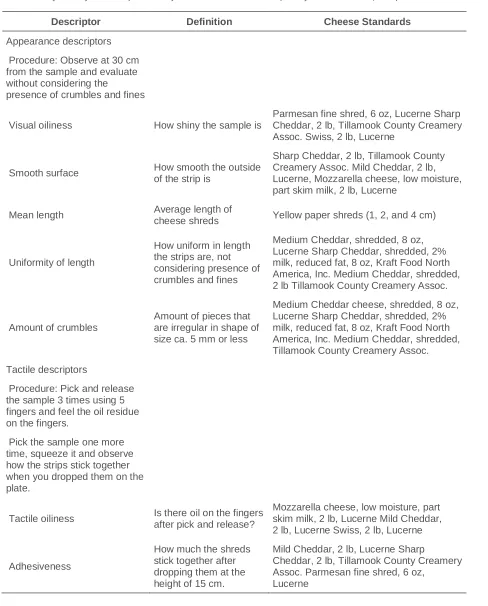
Table 1.2. Definition of the sensory attributes for shredded Cheddar cheese (taken from Serrano et al., 2004)
Descriptor Definition Cheese Standards
Appearance descriptors
Procedure: Observe at 30 cm from the sample and evaluate without considering the
presence of crumbles and fines
Visual oiliness How shiny the sample is
Parmesan fine shred, 6 oz, Lucerne Sharp Cheddar, 2 lb, Tillamook County Creamery Assoc. Swiss, 2 lb, Lucerne
Smooth surface How smooth the outside
of the strip is
Sharp Cheddar, 2 lb, Tillamook County Creamery Assoc. Mild Cheddar, 2 lb, Lucerne, Mozzarella cheese, low moisture, part skim milk, 2 lb, Lucerne
Mean length Average length of
cheese shreds Yellow paper shreds (1, 2, and 4 cm)
Uniformity of length
How uniform in length the strips are, not considering presence of crumbles and fines
Medium Cheddar, shredded, 8 oz, Lucerne Sharp Cheddar, shredded, 2% milk, reduced fat, 8 oz, Kraft Food North America, Inc. Medium Cheddar, shredded, 2 lb Tillamook County Creamery Assoc.
Amount of crumbles
Amount of pieces that are irregular in shape of size ca. 5 mm or less
Medium Cheddar cheese, shredded, 8 oz, Lucerne Sharp Cheddar, shredded, 2% milk, reduced fat, 8 oz, Kraft Food North America, Inc. Medium Cheddar, shredded, Tillamook County Creamery Assoc.
Tactile descriptors
Procedure: Pick and release the sample 3 times using 5 fingers and feel the oil residue on the fingers.
Pick the sample one more time, squeeze it and observe how the strips stick together when you dropped them on the plate.
Tactile oiliness Is there oil on the fingers
after pick and release?
Mozzarella cheese, low moisture, part skim milk, 2 lb, Lucerne Mild Cheddar, 2 lb, Lucerne Swiss, 2 lb, Lucerne
Adhesiveness
How much the shreds stick together after dropping them at the height of 15 cm.
Mild Cheddar, 2 lb, Lucerne Sharp
Cheddar, 2 lb, Tillamook County Creamery Assoc. Parmesan fine shred, 6 oz,
The only change in ingredients for shredded and block Cheddar is the addition of an anticaking agent (potato starch, corn starch, calcium sulfate, powdered cellulose, and blends of these agents) and a mold inhibitor (typically natamycin). Shredded cheese is coated with an anticaking agent to prevent shreds from sticking and caking and a mold inhibitor is added to inhibit mold growth on the shred surfaces (Elayedath and Barringer, 2002). After block Cheddar goes through a shredding process, the shreds are either dipped in a liquid containing
approximately 0.05% natamycin or in a mixture with powdered cellulose that is applied electrostatically and non-electrostatically with the use of a tumble drum or belt conveyer
(Elayedath and Barringer, 2002). Nutrient supplemention may be implemented in the coating of shreds as well (Isom et al., 2002). After the shreds are coated in the desired nutritional
supplements, anti-caking agents, and mold inhibitor, they are tumbled to make a consistent mix and are sent to a packaging station for packaging (Isom et al., 2002).
Sensory Properties: There are many sensory properties to evaluate for both block and
shredded Cheddar cheeses including visual appearance, aroma, texture, and taste. Several
methods exist to evaluate these attributes including traditional tools such as judging and grading, trained panels (descriptive analysis, DA), and affective or consumer tests.
2007, 2009). A cheese that receives a high score during a professional judging competition may not win favor among consumers and vice versa because trained judges are looking for complex profiles that may not be what consumers are accustomed to or typically encounter. Furthermore, two cheese products that receive the same high grade (such as AA) and score through defect-based judging, may have completely different flavor and texture profile differences that are not taken into account (Drake, 2004, 2007), which is why objective analytical sensory tools, such as descriptive analysis, are important.
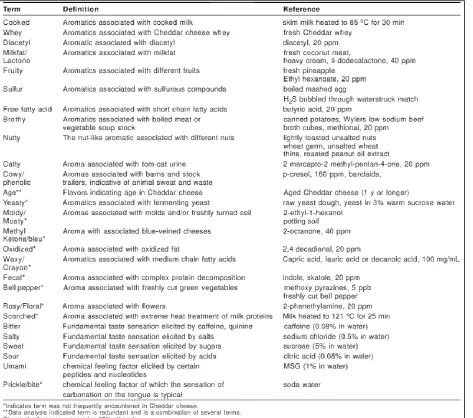
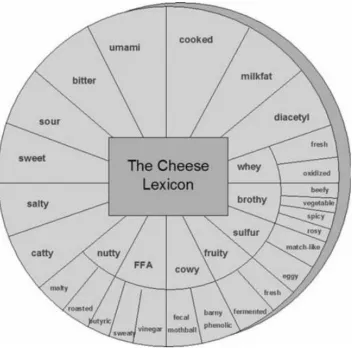
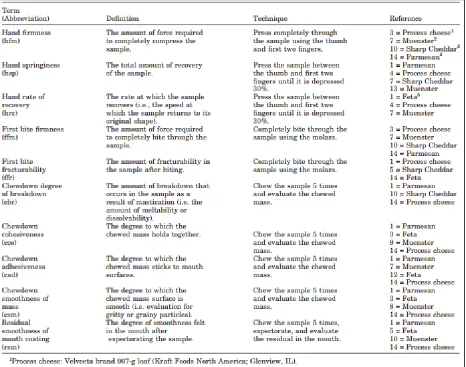
In descriptive analysis, trained panelists (n = 6-12) are trained to act as instruments, evaluating specific aroma, flavor, and textural sensory properties analytically. The process requires hours of training (anywhere between a few to several hundred depending on the number of attributes) and a specific language or lexicon (Drake, 2004, 2009). Defined sensory standards are essential for processors to maintain competitiveness in the market with consistent high quality products as consumers will not purchase a product that does not meet flavor expectations (Drake, 2004). In order to assist training and communication between different research groups, a standard sensory language for Cheddar cheese flavor and texture was developed and validated by highly trained panelists (Table 1.3 and Table 1.4) (Drake et al., 2001, 2002). This descriptive language has been used in combination with instrumental volatile analysis to appropriately interpret instrument results in flavor chemistry (Drake, 2009). Similarly, DA results can be used in combination with instrumental measurements of physical properties to determine sensory perception of texture (Drake, 2009).
Method uses a consensus procedure where 8-12 trained panelists evaluate samples individually at first then discuss and decide on intensity scores (on a 7-point scale) for various flavor, aroma, and aftertaste attributes chosen by the group (Caul, 1957; Lawless, 2013). There is no statistical analysis for Flavor Profile Method. The same principles of the Flavor Profile Method apply to the Texture Profile Method, in which measurements are made for mechanical, geometric, fat and moisture characteristics (Brandt et al., 1963; Lawless and Civille, 2013). The Spectrum
Descriptive Analysis builds on the Flavor and Texture Descriptive Analysis methods with additional points of discrimination and contains universal absolute intensity references and precise terminology (Meilgaard et al., 2007; Lawless and Civille, 2013). The addition of
universal scaling and precise terminology aids with consistency across products and DA panels. Tragon Quantitative Descriptive Analysis (Tragon QDA) does not use standardized terminology across all panels and, instead, uses consumer-based language created by trained panelists
Table 1.4. Language used to evaluate cheese texture perception; evaluation techniques, term definitions, and references are given. (taken from Brown et al., 2003)
Previous descriptive analysis of Cheddar characterized “young/undeveloped” Cheddars with the attributes “cooked/milky,” “whey,” “diacetyl,” and “milkfat/lactone” (Drake et al.
2001). Cheddars older than a year were characterized by “sulfur,” “brothy,” “nutty,” “free fatty acid,” and “catty” (Drake et al., 2001). In addition to the flavor attributes established by Drake et
rancid, bitter, cowy, and salt, and profiled aroma for intensity, creamy, sulfur, fruity, nutty, and rancid notes (1991). Another study by Caspia (2006) evaluated Cheddar for “cooked,” “whey,” “buttery,” “creamy,” “fruity,” “sulfur,” “free fatty acid,” “pungent” aromas. Texture and
performance attributes for Cheddar cheese as well as Cheddar cheese shreds have also been established and include stretchability, meltability, fracture, amount of crumbles, surface smoothness, shred length, uniformity of shreds, shred-to-shred piece adhesiveness, visual
perception of oiliness, and residual oiliness during shred handling (Brown et al., 2003; Serrano et al., 2004, 2005).
Since consumer perception (likes and dislikes) are not established through descriptive analysis, consumer or affective tests must be conducted. Perception of flavor often varies among trained panelists and consumers, as trained panelists differentiate between sensory attributes and hedonic impact while consumers are primarily focused on pleasant vs. unpleasant (hedonics) (McBride and Hall, 1979). Results from descriptive analysis and consumer tests can be
and salt content (Delahunty and Drake, 2004; Singh, 2006). A study by Caspia et al. (2006) showed that a 9-month Cheddar cheese received the highest liking among consumers compared to 7- and 9-month old cheeses, and contained strong “cooked,” “creamy,” and “buttery” flavors. Since consumers are highly variable and are constantly changing their opinions due to age, advertising, experiences, new products, etc., several companies have large sensory and/or market research departments that conduct affective (consumer) testing on a regular basis with
representative consumers (Drake, 2007).
Consumer expectation of color for Cheddar cheese shreds is important as it affects both liking and perception of flavor (Roth et al., 1988). Cheddars can be evaluated visually for shade of color and color uniformity. Cheddar cheese shreds in the U.S. are expected to be a “bright,
uniform, medium yellow-orange color with an attractive sheen” (USDA, 2001). Annatto extract, an orange-red natural carotenoid food coloring derived from the seeds of the achiote tree (Bixa orellana), is the permitted colorant for cheese in the U.S. and is considered exempt from certification and is informally considered to be a natural color (FDA, 2017). The yellowish- orange color imparted by annatto comes from its carotenoid components, bixin and norbixin (Wadhwani and McMahon, 2012).
by the National Cheese Institute (NCI) National Cheese Color Standards (Nelson-Jameson Company, Marshfield, WI), which is made up of 12 Munsel color chips (Figure 1.1). The shade of natural (no color added) Cheddar cheese is supposed to fall between 6 and 9 on the NCI color chart (see Figure 1.1). Addition of annatto can increase color intensity on the scale.
Figure 1.2. National Cheese Institute (NCI) Cheese Color Standards.
Prior to shredding, a single plug from a block of Cheddar can be visually evaluated for gassy openings, sheen of inner surfaces, and moisture (Partridge, 2009). After shredding and before cooking, Cheddar cheese can be visually inspected for uniformity of length, amount of cheese clumping, and visible moisture (Olson, 2008). Post-cooking visual inspection of shreds may include evaluating surface characteristics such as color of blisters, free oil, free moisture, blister coverage, shred fusion, shred melt, flow-off, surface consistency, and shape (Olson, 2008; Chen et al., 2009).
Industry Concerns: “You can’t think a shred is just a shred, because if it doesn’t taste
good or melt well, consumers will be turned off” (Felix, 2009). While convenience is absolutely
a major driving force behind shred sales, it is not the only factor that matters. A few areas of particular interest to the dairy industry are consumer feelings towards color additives, anti-caking agents, and label claims due to the recent clean label movement. While the “clean label”
consumer shift towards labels containing only “natural” ingredients or lacking the presence of “artificial” or “chemical” sounding ingredients (Saltmarsh, 2014). This trend is affecting the
cheese industry too, according to a report on consumer trends for cheese (Anonymous, 2015) which concluded that cheese consumers are looking for cheeses made with no additional additives or preservatives. The clean label trend is moving away from the addition of coloring (such as annatto), although annatto is considered a natural colorant and previous studies suggest that consumers expect a certain degree of orange color for Cheddar cheese (Partridge, 2009; Foegeding, 2015; Colantuono and Mikkola, 2017). Cheeses containing annatto cannot be labeled all natural since annatto is not present in milk.
Flavor is another big area of concern for the industry. Savory flavors are growing in popularity in the food and cheese industry as well. Mintel’s Cheese: Spotlight on Natural - US - November 2015 report mentions that cheese consumers are interested in cheeses made with savory (full-fat) cow’s milk (Anonymous, 2015). Studies suggest that consumers are not willing to sacrifice flavor for claims such as reduced sodium (Ganesan et al., 2014) or lower fat (Bryant et al., 1995; Childs and Drake, 2009). Nancy Strauss, trade-marketing manager for Aria Foods Canada Inc., predicted that future growth of the Cheese shred market would come from the idea of flavor, and suggested innovating unique blends or different types of cheeses as one approach (Felix, 2009). Blends that combine several types of cheeses for specific meals (Mexican and Italian) and that include non-cheese ingredients (such as sun dried tomatoes) have been shown to add an extra level of convenience and value to consumers (Felix, 2009). Black Diamond’s
Packaging can also increase sales – for example: adding recipes and serving suggestions to the packages, which encourage consumers to go beyond traditional usage of shredded cheese (Felix, 2009). Size/weight of the package is also a possible contributor to consumer liking. In 2009, the sales of medium-size bags (230-454g) far outsold the larger (455-999g) and smaller (<229g) bags (Felix, 2009). Furthermore, attractive visual imagery has been shown to influence consumer purchasing habits in the food industry in several studies, suggesting that packaging may be a key area of concern for product success (O’ Callaghan and Kerry, 2016; Simmonds and
Spence, 2016; Patel et al., 2015).
FOCUS GROUPS
Focus groups, a qualitative research technique established in the mid 1940s by Robert Merton and colleagues (Merton et al., 1956), are a helpful tool in understanding consumer behavior/language and to identify possible areas of focus for product development (Jervis and Drake, 2014). Focus groups are a qualitative research technique in which a group (n ~ 10 consumers) participates in a semi-structured interview covering a range of issues that is conducted by a nondirective moderator (Lawless and Heymann, 1998). Focus groups provide useful information for identifying attributes or descriptors that researchers might overlook when developing a quantitative research technique. Furthermore, focus groups allow the researcher to probe panelists for information in ways that are not possible through quantitative research and that allow for authentic personal consumer responses rather than requiring participants to
“Cross-merchandising is always a winner in increasing sales… Displays with pasta, salads, or pizza ingredients are a good starting point,” Nancy Strauss
respond with pre-established language responses (Jervis and Drake, 2014). Conducting focus groups before developing a ballot or survey for a product that has minimal information about it can help researchers obtain the most valuable consumer feedback from their future studies. Focus groups have been used to develop attributes and levels for surveys across all industries. Studies utilizing focus groups in the past include consumer research on Chinese food (Ding et al., 2005), fresh tomatoes (Oltman et al., 2014), yams (Barlagne et al., 2017), medical purposes (Houseman et al., 1997), and special populations (allergies) (Sommer et al., 2012).
A typical focus group can have anywhere between 3 and 12 panelists (depending on the researcher, the subject matter, and the age of the participants) (Stewart et al., 1994; Barbour and Kitzinger, 1999) and last between 90 to 120 minutes. It is recommended to run at least 2-4 focus groups, or until results become redundant, to ensure that representative data has been gathered (Jervis and Drake, 2014). When recruiting participants, demographics such as age, gender, shopping habits, and frequency of consumption [of the product being tested] should also be considered. In addition to panelists, focus groups consist of a moderator, discussion guide, note taker (possibly in a remote room), name tags (to be more personal), recording equipment, and a white board to write ideas (Resurreccion, 1998; Cardinal et al., 2003; Lawless and Civille, 2013).
To help facilitate free-flow discussion among panelists, there may be an icebreaker at the beginning of the focus group. The moderator can also help facilitate free-flow discussion
between panelists by guiding discussion. The moderator should encourage equal participation from all group members and free-flow discussion while also keeping discussion relevant (Kitzinger, 1995). Part way through the focus group there may be an activity such as a
After the focus group, the moderator and note taker discuss key phrases or ideas mentioned most frequently in the focus group and summarize major points for each topic covered. It is important to keep context in mind when analyzing data (Carey and Smith, 1994). While few explicit guidelines on how to analyze focus group data in social science research exist (Onwuegbuzie et al., 2009), suggested methods include the constant comparison analysis,
classical content analysis, keywords-in-context, discourse analysis, and micro-interlocutor analysis.
SURVEYS
Overview of Online Survey Usage: There are several different quantitative approaches
for gathering data from consumers online. The three areas that this review will cover are adaptive choice based conjoint (ACBC), MaxDiff scaling, and Kano questioning. While quantitative research, such as surveys, provides valuable quantifiable data on consumer preferences, qualitative research, such as focus groups and QMA, allows for further insights as to why consumers value the things they do. Qualitative methods uncover the motivations behind
consumer choices, such as purchasing habits (Berkwits and Iniu, 1998). Using multiple methods allows for cross-examination of results in order to draw conclusions about common trends in consumer preferences.
Demographics: An appropriate target audience of consumers must be defined for a
habits (frequency of purchase, primary shopper, types/brands purchased), household size (single or family), and income of the target consumers.
Maximum Difference Scaling (MaxDiff): MaxDiff scaling, also known as best-worst
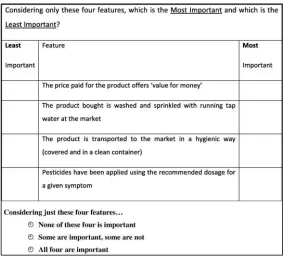
(BW) scaling, is growing in use for investigating preferences for products in consumer research (Lagerkvist et al., 2012). It was originally designed to allow respondents to make trade-offs in their choices between relevant food safety issues (Finn and Louviere, 1992). The design of MaxDiff scaling was based on the theory of paired comparisons (Roeckelein, 2006), a generally accepted theory of human decision-making, which allows it to overcome potential response biases typical of rating scales (Paulhus, 1991). During MaxDiff Scaling, consumers are provided with a set of attributes (typically 4-6) and are asked to pick the one that is the most important and the one that is the least important to them (Lagerkvist et al., 2012). From this information,
researchers are able to better rank the importance of attributes to consumers by removing the option for consumers to rank every attribute as important or not important. This method forces consumers to make a preference choice. Unlike additive conjoint models, MaxDiff scaling allows for single attribute comparisons, instead of being limited to multiple intra-attribute comparisons (Lynch, 1985).
Two main types of MaxDiff scaling exist: anchored (dual-response) and relative
(Lagerkvist et al., 2012). One finding from a comparison study on anchored vs. relative MaxDiff scaling (Lagerkvist et al., 2012) suggested that anchored models improve individual choice predictions and are more reliable in measuring preferences compared with conventional relativistic MaxDiff scaling. In a standard (relative) MaxDiff scaling approach, multiple
important (Lagerkvist et al., 2012). Dual-response anchored MaxDiff format ask panelists an additional no-choice question to the choices presented in the relative MaxDiff format. The additional no-choice question asks respondents to indicate one of three alternative relationships among attributes within sets: “None of these four is important,” “Some are important, some are not,” and “All four are important.” The addition of this no-choice question may cause
respondents to become more aware of the connections between attributes (Lagerkvist et al., 2012). MaxDiff allows for greater consumer discrimination in sensory testing, but it is also viewed as the most demanding method on panelists due to its length (Hein et al., 2008). Due to the nature of MaxDiff, consumers are presented with multiple combinations of attributes, which could lead to exhaustion from answering so many variations of the same type of question depending on how many attributes exist. As a result, it may be more convenient to choose relative MaxDiff over anchored dual-response in a longer survey as the dual-response can be even more taxing on respondents.
A previous study that utilized MaxDiff scaling evaluated health care preferences
(Mühlbacher et al., 2015) in order to develop better patient care in hospitals. Another study used MaxDiff to survey Canadian medical school students (Wang et al., 2011) to improve student retention rates. Other studies on food, including fair trade coffee (Darian et al., 2015), ground beef (Parker and Lusk, 2009), wine (Chrysochou et al., 2012) and others (Jaeger et al., 2008; Lagerkvist et al., 2012) provide useful data for the food industry.
Kano Questioning: Kano is another valuable survey technique that allows for better
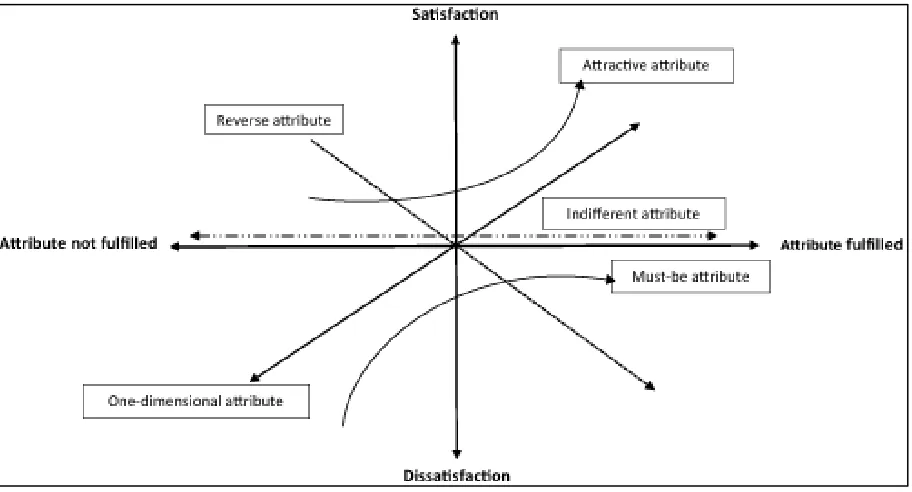
understanding of drivers of consumer satisfaction and dissatisfaction (Riviere et al., 2006). This method leads to classifications of product attributes to distinguish between those that contribute to satisfaction, dissatisfaction, and both: “performance” attributes, “must-be” attributes,
“attractive” attributes, “indifferent” attributes, and “reverse” (or “rejector”) attributes (Riviere et
al., 2006).
There are two parts to the Kano model: positive (functional) and negative (dysfunctional) questions. In the positive (functional) questions, participants are asked, “how do you feel if you had this feature” (Riviere et al., 2006). In the negative (dysfunctional) questions, participants are asked, “how do you feel if you did not have this feature” (Riviere et al., 2006). Possible
responses to these questions include: I like it, I expect it, I am neutral, I can tolerate it, and I dislike it (Riviere et al., 2006). Classifying attributes in Kano can be achieved through multiple approaches: Kano’s method, direct classification, qualitative data methods, penalty-reward contrast analysis, importance grid analysis and other regression methods (Mikulić and Prebežac, 2011; Chen, 2012; Wardy et al., 2014). Kano has been used in previous studies on consumer willingness to pay for smart phones (Kim, 2017) and several studies on food including black beans (Kuo et al., 2014), Indian fast food (Ponnam et al., 2011), sodium reduction labels (Kim et al., 2012), chocolate milk (Li et al., 2014), and cottage cheese (Hubbard et al., 2016).
ACBC: Conjoint analysis is a method that decomposes a product into different attributes,
which allow researchers to analyze how consumers value or like individual attributes of a product (Orme, 2010). Four main types of conjoint exist: full profile conjoint analysis, adaptive conjoint analysis (ACA), choice based conjoint (CBC), and adaptive choice based conjoint (ACBC) (Rao, 2010). In a conjoint analysis survey, a consumer is provided with a choice of products with different attributes and levels to choose from, much like a purchasing decision in the marketplace (Orme, 2010). In many respects, it can be compared to a multivariate form of MaxDiff. MaxDiff allows pairwise comparison of individual attributes. In conjoint, consumers choose from multiple combinations of attributes at one time.
(especially with more attributes). ACA was developed to handle large numbers of attributes in a more time effective method. This approach asks panelists to rank levels within each attribute based on preference and then assigns an importance value to each attribute (Orme, 2010; Rao, 2010). However, one disadvantage of ACA is that it cannot measure attribute interactions like CBC can (Orme, 2010). CBC, the most popular conjoint method used today, accounts for
attribute interactions by asking respondents questions that mimic a real market purchase situation (Orme, 2010; Rao, 2010), which gives researchers more insight on how respondents would make a choice in a real world setting. The limiting factor for CBC analysis is the number of attributes and levels that can be used. Previous research suggests that no more than 6 attributes and 9 levels per attribute should be used in a CBC study to avoid overwhelming participants (Cunningham et al., 2010; Green and Srinicasan, 1978; Orme, 2010).
asked to choose which attribute (if any) is totally unacceptable. The same format is used to ask the participant which attribute is a must have. Lastly, the choice task section generates multiple attribute combinations for the product being evaluated and panelists are asked to choose the one they would purchase out of the options presented to them. They are asked to consider different product concepts; then, they are given a choice between products based on their responses in the first section.
Studies that have used conjoint in the past have used it to measure preferences in a wide range of areas including preferences for cancer treatment (Weston and FitzGerald, 2004), locally produced foods (Darby et al., 2008), packaging (Silayoi and Speece, 2007), probiotics
(Annunziata and Vecchio, 2013), and a wide variety of foods including sour cream (Jervis et al., 2012), sandwich bread (Jervis et al., 2014), fresh tomatoes (Oltman et al., 2014), and protein beverages (Oltman et al., 2015). Conjoint can also be used to assess concepts such as risk taking (McMullen and Shepherd, 2006).
QMA
Qualitative multivariate analysis (QMA) is a composite qualitative approach with a small number of consumers (10-15) to identify and define sensory characteristics for consumer
preference (Beckley et al., 2012). QMA consists of a home usage test (HUT) and a follow up downloading session with a projective mapping (PM) exercise. QMA allows for a unique
in their daily lives rather than forcing them to answer questions about a product all at once. Additionally, the free-form style of QMA allows consumers to provide information that researchers may have overlooked.
Part 1 – HUT: The first part of the QMA method is a home usage experience. Generally,
Part 2 – Downloading Session and Projective Mapping Exercise: A downloading
session (basically an unstructured focus group) is conducted after the HUT part of a QMA to summarize and collect participant thoughts, perceptions, and insights from the HUT. Each sample is discussed individually and then expectations of the product as a whole are discussed. Consumers are each provided with a copy of their journal/online diary entries, including: pictures of the products, price, weight, any information that was given to participants with their samples, and consumers written responses/uploaded photos for each sample. Downloading session materials include a moderator guide, audio recorder, video recorder, and note taker. Data from downloading session are analyzed using similar techniques from focus group data analysis.
Following the downloading session, each panelist participates in a Projective Mapping (PM) exercise with the samples that were given to them during the HUT. During the PM
exercise, panelists are asked to consider the samples they evaluated during the HUT and to think about how similar and dissimilar they are from each other. They are then asked to place these samples on a map (a blank paper or iPad screen) in proximity to each other based on their own perceived similarities and differences – the more similar the samples, the closer they are in proximity and vice versa. Panelists are allowed to access to their journal/diary notes and all of the product information that was provided to them during their HUT evaluations (product price, picture, weight, etc) to complete the exercise.
CONCLUSIONS
REFERENCES
Anonymous. 2015. Cheese: Spotlight on natural - US - november 2015. Mintel Store. Anonymous. 2016a. Cheese - US - october 2016. Mintel Store.
Anonymous. 2016b. USDA Dairy products: 2015 summary.
Anonymous. 2017. What's in store for dairy this year? Dairy Foods. 118:104.
Albert, A., P. Varela, A. Salvador, G. Hough and S. Fiszman. 2011. Overcoming the issues in the sensory description of hot served food with a complex texture application of QDA®, flash profiling and projective mapping using panels with different degrees of training. Food Qual. Pref. 22:463-473.
Annunziata, A. and R. Vecchio. 2013. Consumer perception of functional foods: A conjoint analysis with probiotics. Food Qual. Pref. 28:348-355.
Barbour, R.S. and J. Kitzinger. 1999. Developing Focus Group Research. 1st publ. ed. Page 8. Sage Publications, Thousand Oaks, CA.
Barcenas, P., F.J.P. Elortondo, and M. Albisu. 2004. Projective mapping in sensory analysis of ewes milk cheeses: A study on consumers and trained panel performance. Food Res. Int. 37:723-729.
Barlagne, C., D. Cornet, J. Blazy, J. Diman, and H. Ozier‐Lafontaine. 2017. Consumers' preferences for fresh yam: A focus group study. Food Sci Nutr. 5:54-66.
Beckley, J.H., D. Paredes, and K. Lopetcharat. 2012. Qualitative multivariate analysis. Pages 100-121 in Product Innovation Toolbox: A Field Guide to Consumer Understanding and Research. Wiley-Blackwell, Ames, IA.
Berkwits, M. and T. Inui. 1998. Making use of qualitative research techniques. J. Gen. Intern Med. 13:195-199.
Brandt, M.A., E.Z. Skinner, and J.A. Coleman. 1963. Texture profile method. J. Food Sci. 28: 404-409.
Brown, J.A., E.A. Foegeding, C.R. Daubert, M.A. Drake, and M. Gumpertz. 2003. Relationships among rheological and sensorial properties of young cheeses. J. Dairy Sci. 86:3054-3067. Bryant, A., Z. Ustunol and J. Steffe. 1995. Texture of cheddar cheese as influenced by fat
reduction. J. Food Sci. 60:1216-1219.
Carey, M. A. and M. W. Smith. 1994. Capturing the group effect in focus groups: A special concern in analysis. Qual. Health Res. 4:123-127.
Olson, D. and K.J. Aryana. 2008. Ingredients in Dairy Products. Chapter 8. Pages 189-202 in Dairy processing & quality assurance. Blackwell Pub., Ames, IA.
Caul, J. 1957. The profile method of flavor analysis. Adv. Food Res. 7:1-40.
Chapman, C.N., J.L. Alford, C. Johnson, R. Weidemann, and M. Lahav. 2009. CBC vs. ACBC: Comparing results with real product selection. Proceedings of the 2009 Sawtooth
Software Conference, Del Ray Beach, FL, March 2009.
Chen, C., D. Wolle, and D. Sommer. 2009. Mozzarella: topics in sensory analysis for mozzarella. Chapter 15. Pages 459-487 in The Sensory Evaluation of Dairy Products. Springer. New York, NY.
Chen, L. 2012. A novel approach to regression analysis for the classification of quality attributes in the kano model: An empirical test in the food and beverage industry. Omega. 40:651-659.
Childs, J.L. and M. Drake. 2009. Consumer perception of fat reduction in cheese. J. Sens. Stud. 24:902-921.
Chrysochou, P., A. Krystallis, A. Mocanu and R. Lewis. 2012. Generation Y preferences for wine: An exploratory study of the US market applying the best-worst scaling. Br. Food J. 114:516-528.
Colantuono, F. and M. Mikkola. 2017. Consumer insight and approaches in new dairy products development. Pages 404-419 in Advances in Dairy Products. John Wiley & Sons Ltd, Chichester, UK.
Cunningham, C. E., K. Deal and Y. Chen. 2010. Adaptive choice-based conjoint analysis: A new patient-centered approach to the assessment of health service preferences. Pharmaceut Medicine. 24:324.
Dacre, J.C. 1955. A chemical investigation of the volatile flavor principle of Cheddar cheese. J. Dairy Res. 22:219-23.
Darby, K., M. T. Batte, S. Ernst and B. Roe. 2008. Decomposing local: A conjoint analysis of locally produced foods. Am. J. Agric Econ. 90:476-486.
Delahunty, C. M. and M. A. Drake. 2004. Sensory character of cheese and its evaluation. Chapter 19. Pages 455-487 in Cheese: Chemistry, Physics and Microbiology. Vol. 1. Elsevier Academic, Amsterdam.
Ding, M., R. Growl and J. Liechty. 2005. Incentive-aligned conjoint analysis. J. Mark. Res. 42:67-82.
Drake, M.A., S.C. Mcingvale, P.D. Gerard, K.R. Cadwallader, and G.V. Civille. 2001.
Development of a descriptive language for cheddar cheese. J. Food Sci. 66:1422-1427. Drake, M.A., Gerard, P.D., Wright, S., Cadwallader, K.R., Civille, G.V. 2002. Cross validation
of a sensory language for Cheddar cheese. Journal of Sensory Studies, 17:215-229. Drake, M. 2004. ADSA foundation scholar award: Defining dairy flavors. J. Dairy Sci. 87:777-
784.
Drake, M. A., M. D. Yates, and P. D. Gerard. 2005a. Impact of serving temperature on trained panel perception of cheddar cheese flavor attributes. J. Sens. Stud. 20:147-155.
Drake, M. A., M. D. Yates, P. D. Gerard, C. M. Delahunty, E. M. Sheehan, R. P. Turnbull and T. M. Dodds. 2005b. Comparison of differences between lexicons for descriptive analysis of cheddar cheese flavour in ireland, new zealand, and the united states of america. Int. Dairy J. 15:473-483.
Drake, M.A. 2007. Invited review: Sensory analysis of dairy foods. J. Dairy Sci. 90:4925-4937. Drake, M.A. 2009. Modern sensory practices. Pages 505-530 Chapter 17 In The Sensory
Evaluation of Dairy Products. Springer US, New York, NY.
Drake, S. L., K. Lopetcharat, S. Clark, H. S. Kwak, S. Y. Lee and M. A. Drake. 2009a. Mapping differences in consumer perception of sharp cheddar cheese in the united states. J. Food Sci. 74:S285.
Drake, S.L., K. Lopetcharat, and M.A. Drake. 2009b. Comparison of two methods to explore consumer preferences for cottage cheese. J. Dairy Sci. 92(12):5883-97.
Drake, S.L., P.D. Gerard, and M.A. Drake. 2008. Consumer preferences for mild cheddar cheese flavors. J. Food Sci. 73:S455.
Elayedath, S., and S.A. Barringer. 2002. Electrostatic powder coating of shredded cheese with antimycotic and anticaking agents. Innov. Food Sci. Emerg. Technol. 3:385-390. Food and Drug Administration Department of Health and Human Services. 2017. Cheese and
related cheese products. 21CFR part 133. Accessed Dec. 19, 2017.
Felix, S. 2009. Shred of truth. Canadian Grocer. 123:40-42.
Finn, A. and J. J. Louviere. 1992. Determining the appropriate response to evidence of public concern: The case of food safety. J. Public Policy & Marketing. 11:12-25.
Foegeding, E. A. 2015. A natural opportunity. J. Food Sci. 80:iv.
Fox, P.F. 1993. Cheese: An overview. Chapter 1. Pages 1-36 in Cheese: Chemistry, Physics and Microbiology. Vol. 1. 2nd ed. Chapman and Hall, London, U.K.
Fox, P. F., P. L. H. McSweeney and T. K. Singh. 1994. Proteolysis in cheese during ripening. Chapter 1. Pages 1-31 in Biochemistry of Milk Products. A. A. Varley J ed. Royal Society of Chemistry, Cambridge, U.K.
Ganesan, B., K. Brown, D. A. Irish, C. Brothersen and D. J. McMahon. 2014. Manufacture and sensory analysis of reduced- and low-sodium cheddar and mozzarella cheeses. J. Dairy Sci. 97:1970.
Gorski, D. 1998. Powerful cheese. Dairy Foods. 99(4):E-I.
Green, P. E. and V. Srinivasan. 1978. Conjoint analysis in consumer research: Issues and outlook. J. Cons. Res. 5:103-123.
Hein, K.A., S.R. Jaeger, B.T. Carr, and C.M. Delahunty. 2008. Comparison of five common acceptance and preference methods. Food Qual Pref. 19:651-61.
Heisserer, D.M., and E. Chambers IV. 1993. Determination of the sensory flavor attributes of aged natural cheese. J. Sens. Stud. 8:121-132.
Houseman, C., F.D. Butterfoss, A.L. Morrow, and J. Rosenthal. 1997. Focus groups among public, military, and private sector mothers: Insights to improve the immunization process. Public Health Nursing. 14:235-243.
Hubbard, E.M., S.M. Jervis, and M.A. Drake. 2016. The effect of extrinsic attributes on liking of cottage cheese. J. Dairy Sci. 99:183-193.
Isom, L., D.W. Mehnert, and N. Grabowski, inventors. 2002. Shredded cheese. Inc Kraft Foods Holdings, assignee. US Pat. No. 6426102B1.
Jervis, M. G. and M. A. Drake. 2014. The use of qualitative research methods in quantitative science: A review. J. Sens. Stud. 29:234-247.
Jervis, S.M., J.M. Ennis, and M.A. Drake. 2012. A comparison of adaptive choice‐based
conjoint and choice‐based conjoint to determine key choice attributes of sour cream with limited sample size. J. Sens. Stud. 27:451-462.
Kapoor, R., and L.E. Metzger. 2008. Process cheese: Scientific and technological Aspects—A review. Compr. Rev. Food Sci. Food Saf. 7:194-214.
Kennedy, J. and H. Heymann. 2009. Projective mapping and descriptive analysis of milk and dark chocolates. J. Sens. Stud. 24:220-233.
Kennedy, J. 2010. Evaluation of replicated projective mapping of granola bars. J. Sens. Stud. 25:672.
Kennedy, S. 2017. Sales of natural cheese shreds and slices top rest. Dairy Foods. 118:20.
Kim, M.K., K. Lopetcharat, P.D. Gerard, and M.A. Drake. 2012. Consumer awareness of salt and sodium reduction and sodium labeling. J. Food Sci. 77:S313.
Kim, J.S. 2017. Empirical analysis of consumer willingness to pay for smart phone attributes in multi-countries. Int. J. Innovation Management. 21:1.
Kindstedt, P. and Vermont Cheese Council. 2005. Pages 17-55, 123-138 in American Farmstead Cheese: The Complete Guide to Making and Selling Artisan Cheese. Chelsea Green Publishing.
King, M. C., M. A. Cliff and J. W. Hall. 1998. Comparison of projective mapping and sorting data collection and multivariate methodologies for identification of similarity-of-use of snack bars. J. Sens. Stud. 13:347-358.
Kitzinger, J. 1995. Qualitative research: Introducing focus groups. Br.Med. J. 311:299-302.
Kuo, C., S. You, and C. Lu. 2014. Integration of the kano and QFD model in health food development: Using black beans as examples. Qual Quant. 48:225-242.
Lawless, H.T. 2013. Flavor Profile Method. Page 79 in Laboratory Exercises for Sensory Evaluation. Vol 2. Springer, Boston, MA
Lawless, H.T., and M.R. Claassen. 1993. Validity of descriptive and defect-oriented terminology systems for sensory analysis of fluid milk. J. Food Sci. 58:108-112.
Lawless, H. T. and H. Heymann. 1998. Sensory Evaluation of Food: Principles and Practices. Pages 519-546. Chapman & Hall, New York, NY.
Lawless, L.J.R. and G.V. Civille. 2013. Developing lexicons: A review. J. Sens. Stud. 28:270- 281.
Li, X.E., K. Lopetcharat, and M.A. Drake. 2014. Extrinsic attributes that influence parents’ purchase of chocolate milk for their children. J. Food Sci. 79:S1415.
Lynch, JG. 1985. Uniqueness issues in the decompositional modeling of multi-attribute overall evaluations: An information integration perspective. J. Mark. Res. 22:1-19.
Manning, D.J. and H.M. Robinson. 1973. The analysis of volatile substances associated with Cheddar cheese aroma. J. Dairy Res. 40:63-75.
Marcano, J., G. Ares, and S. Fiszman. 2015. Comparison of partial and global projective mapping with consumers: A case study with satiating cheese pies. Food Res. Int. 67:323-330.
McBride, R.L. and C. Hall. 1979. Cheese grading versus consumer acceptability: An inevitable discrepancy. Aust. J. Dairy Technol. 34:66-68.
McMullen, J.S. and D.A. Shepherd. 2006. Encouraging Consensus‐Challenging research in universities. J. Management Stud. 43:1643-1669.
Merton, R.K., M. Fiske, and P.L. Kendall. 1956. The focused interview: a manual of problems and procedures. New York: Free Press. 12:153-62
Meilgaard, M., G.V. Civille, and B.T. Carr. 2007. Introduction to Sensory Techniques. Chapter 1. Pages 1-5 in Sensory Evaluation Techniques, 4th ed., CRC Press, Boca Raton, FL.
Mikulić, J. and D. Prebežac. 2011. A critical review of techniques for classifying quality attributes in the kano model. Managing Service Quality: An International Journal. 21:46-66.
Mühlbacher, A., P. Zweifel, A. Kaczynski and F. Johnson. 2015. Experimental measurement of preferences in health care using best-worst scaling (BWS): Theoretical and statistical issues. Health Econ Rev. 6:1-12.
Muir, D.D. and E.A. Hunter. 1991. Sensory evaluation of cheddar cheese: Order of tasting and carryover effects. Food Qual. Pref. 3:141-145.
Muir, D.D., E.A. Hunter, J.M. Banks and D.S. Horne. 1995. Sensory properties of hard cheese: Identification of key attributes. Int Dairy J. 5:157-177.
Murray, J.M. and C.M. Delahunty. 2000a. Mapping consumer preference for the sensory and packaging attributes of cheddar cheese. Food Qual. Pref. 11:419-435.
Murray, J. M. and C. M. Delahunty. 2000b. Selection of standards to reference terms in a cheddar‐type cheese flavor language. J. Sens. Stud. 15:179-199.
Murray, J., C. Delahunty, and I. Baxter. 2001. Descriptive sensory analysis: past, present and future. Food Res Int. 34:461–471.
Næs, T., P.B. Brockhoff, and O. Tomic. 2010. Preference Mapping for Understanding Relations between Sensory Product Attributes and Consumer Acceptance in Statistics for sensory and consumer science. John Wiley & Sons, Ltd, Chichester, UK. doi:
10.1002/9780470669181.ch9
Nestrud, M.A. and H.T. Lawless. 2008. Perceptual mapping of citrus juices using projective mapping and profiling data from culinary professionals and consumers. Food Qual. Pref. 19:431-438.
Nestrud, M. A. and H. T. Lawless. 2010. Perceptual mapping of apples and cheeses using projective mapping and sorting. J. Sens Stud. 25:390.
O’Callaghan, K. A. M. and J. P. Kerry. 2016. Consumer attitudes towards the application of smart packaging technologies to cheese products. Food Packaging and Shelf Life. 9:1-9.
Oltman, A.E., S.M. Jervis, and M.A. Drake. 2014. Consumer attitudes and preferences for fresh market tomatoes. J. Food Sci. 79:S2091-97.
Oltman, A.E., K. Lopetcharat, E. Bastian, and M.A. Drake. 2015. Identifying key attributes for protein beverages. J. Food Sci. 80:S1383-90.
Onwuegbuzie, A.J., W.B. Dickinson, N.L. Leech, and A.G. Zoran. 2009. A qualitative framework for collecting and analyzing data in focus group research. Int. J. Qual Methods. 8:1-21.
Orme, B. K. 2010. Getting Started with Conjoint Analysis strategies for product design and pricing research. Pages 39-50; 78-8. 2nd ed. Research Publ, Madison, WI.
Pagès, J. and F. Husson. 2001. Inter-laboratory comparison of sensory profiles: Methodology and results. Food Qual Pref. 12:297-308.
Pagès, J. 2003. Collection and analysis of perceived product inter-distances using multiple factor analysis: Application to the study of 10 white wines from the loire valley. Food Qual. Pref. 16:642-649.
Parker, N. and J.L. Lusk. 2009. Consumer preferences for amount and type of fat in ground beef. J. Agricultural and Applied Economics. 41:75-90.
Partridge, J. 2009. Cheddar and cheddar-type cheese. Chapter 9. Pages 225-270 in The Sensory Evaluation of Dairy Products. Springer. New York, NY.
Patel, R., J.P. Prajapati, and S. Balakrishnan. 2015. Recent trends in packaging of dairy and food products. Chapter 5. Pages 118-124 in National Seminar on “Indian Dairy Industry - Opportunities and Challenges.” Retrieved from:
www.dairyknowledge.in/sites/default/files/ch5_1.pdf
Paulhus, D.L. 1991. Measurement and Control of Response Bias. Pages 17-59 in Measures of Personality and Social Psychological Attitudes. Academic Press, San Diego, CA.
Ponnam, A., D. Sahoo and M. Balaji. 2011. Satisfaction-based segmentation: Application of kano model in indian fast food industry. J. Targeting, Measurement and Analysis for Marketing. 19:195-205.
Pullin, M. 2014. Consumer trends guide cheesemakers. Dairy Foods. 115:80.
Rao, V. R. 2010. Conjoint analysis. Wiley international encyclopedia of marketing. Accessed Oct. 20, 2017.
http://onlinelibrary.wiley.com/doi/10.1002/9781444316568.wiem02019/full
Resurreccion, A. 1998. The consumer panel. Pages 71-91 in Consumer sensory testing for product development. Aspen Publishers, Gaithersburg, MD.
Risvik, E., J. A. McEwan, J. S. Colwill, R. Rogers and D. H. Lyon. 1994. Projective mapping: A tool for sensory analysis and consumer research. Food Qual. Pref. 5:263-269.
Risvik, E., J. A. McEwan and M. Rødbotten. 1997. Evaluation of sensory profiling and projective mapping data. Food Qual. Pref. 8:63-71.
Riviere, P., R. Monrozier, M. Rogeaux, J. Pages and G. Saporta. 2006. Adaptive preference target: Contribution of kano's model of satisfaction for an optimized preference analysis using a sequential consumer test. Food Qual. Pref. 17:572-581.
Roth, H.A., L.J. Radle, S.R. Gifford, and F.M. Clydesdale. 1988. Psychophysical relationships between perceived sweetness and color in lemon- and lime-flavored drinks. J. Food Sci. 53:1116-1119.
Roeckelein, J.E. 2006. Thurstone’s Law of Comparitive Judgement. Pages 598-599 in Elsevier's Dictionary of Psychological Theories. 1st ed. Elsevier B.V., Amsterdam, The
Netherlands.
Saltmarsh, M. 2014. Recent trends in the use of food additives in the united kingdom. J. Sci. Food Agric. 95:649-652.
Serrano, J., G. Velazquez, K. Lopetcharat, J.A. Ramirez, and J.A. Torres. 2005. Moderately high hydrostatic pressure processing to reduce production costs of shredded cheese:
Microstructure, texture, and sensory properties of shredded milled curd cheddar. J. Food Sci. 70:S293.
Silayoi, P. and M. Speece. 2007. The importance of packaging attributes: A conjoint analysis approach. Eur. J. Mark. 41:1495-1517.
Simmonds, G. and C. Spence. 2016. Thinking inside the box: How seeing products on, or through, the packaging influences consumer perceptions and purchase behaviour. Food Qual. Pref. 62:340-351
Singh, T.K., M.A. Drake and K.R. Cadwallader. 2003. Flavor of cheddar cheese: A chemical and sensory perspective. Compr Rev Food Sci Food Saf. 2:166-189.
Singh, S. 2006. Impact of color on marketing. Management Decision. 44:783-789.
Sommer, I., H. MacKenzie, C. Venter and T. Dean. 2012. Factors influencing food choices of food‐allergic consumers: Findings from focus groups. Allergy. 67:1319-1322.
Stewart, B., D. Olson, C. Goody and A. Tinsley. 1994. Converting focus group data on food choices into a quantitative instrument. J. Nutr Educ. 26:34.
Stone, H. 1992. Quantitative Descriptive Analysis. Chapter 2. Pages 15-21 in Manual on descriptive analysis testing for sensory evaluation.
Toubia, O., J. R. Hauser and D. I. Simester. 2004. Polyhedral methods for adaptive choice-based conjoint analysis. J. Mark. Res. 41:116-131.
USDA. 2001. USDA Specifications for Shredded Cheddar Cheese. United States Department of Agriculture, Agricultural Marketing Service, Dairy Programs.
Varela, P. and G. Ares. 2012. Sensory profiling, the blurred line between sensory and consumer science. A review of novel methods for product characterization. Food Res. Int. 48:893-908.