DOI 10.1007/s10845-013-0753-y
Estimation of optimal machining control parameters using
artificial bee colony
Norfadzlan Yusup · Arezoo Sarkheyli · Azlan Mohd Zain · Siti Zaiton Mohd Hashim · Norafida Ithnin
Received: 24 November 2012 / Accepted: 23 February 2013 / Published online: 14 March 2013 © Springer Science+Business Media New York 2013
Abstract Modern machining processes such as abrasive waterjet (AWJ) are widely used in manufacturing industries nowadays. Optimizing the machining control parameters are essential in order to provide a better quality and economics machining. It was reported by previous researches that artifi-cial bee colony (ABC) algorithm has less computation time requirement and offered optimal solution due to its excellent global and local search capability compared to the other opti-mization soft computing techniques. This research employed ABC algorithm to optimize the machining control parame-ters that lead to a minimum surface roughness (Ra)value for AWJ machining. Five machining control parameters that are optimized using ABC algorithm include traverse speed (V), waterjet pressure (P), standoff distance (h), abrasive grit size (d) and abrasive flow rate (m). From the experimental results, the performance of ABC was much superior where the estimated minimum Ravalue was 28, 42, 45, 2 and 0.9 % lower compared to actual machining, regression, artificial neural network (ANN), genetic algorithm (GA) and simu-lated annealing (SA) respectively.
N. Yusup
Faculty of Computer Science and Information Technology, Universiti Malaysia Sarawak, 94300
Kota Samarahan, Sarawak, Malaysia e-mail: [email protected]
A. Sarkheyli·A. M. Zain (
B
)·S. Z. M. Hashim·N. Ithnin Soft Computing Research Group, Faculty of Computing, Universiti Teknologi Malaysia, 81310 Skudai, Johor, Malaysia e-mail: [email protected]; [email protected] A. Sarkheylie-mail: [email protected] S. Z. M. Hashim
e-mail: [email protected] N. Ithnin
e-mail: [email protected]
Keywords Machining·Abrasive waterjet·Optimization
Introduction
The manufacturing industries nowadays face many chal-lenges such as market competition, expensive machining cost, customer high request and complexity of the product. For manufacturers, the main objective is to produce high quality of product with less cost and time constraints. Today, modern machining processes are widely used in manufactur-ing industries because it has some advantages (for example in terms of cost) compared to traditional machining processes (Ridwan et al. 2012;Mokhtar and Xu 2011;Zain et al. 2012a). According toNagendra Parashar and Mittal 2007, traditional machining processes are costly and inefficient because it is incapable to machine the materials cost-effectively because of the tools is harder than the workpiece. The alteration or new traditional machining methods are also needed because in several cases, the methods might not be operated. Roy and Mehnen (2008) suggest that new method need to be developed in order to guarantee fast, safe and cost efficient production. The modern machining process can be catego-rized into four types which are (i) mechanical (e.g. abrasive waterjet (AWJ), ultrasonic machining (USM)), (ii) chem-ical (e.g. chemchem-ical machining (CHM)), (iii) electrochemi-cal (e.g. electrochemielectrochemi-cal machining (ECM), electrochemielectrochemi-cal grinding (ECG)) and (iv) thermoelectric (e.g. electrobeam machining (EBM), laserbeam machining (LBM)).
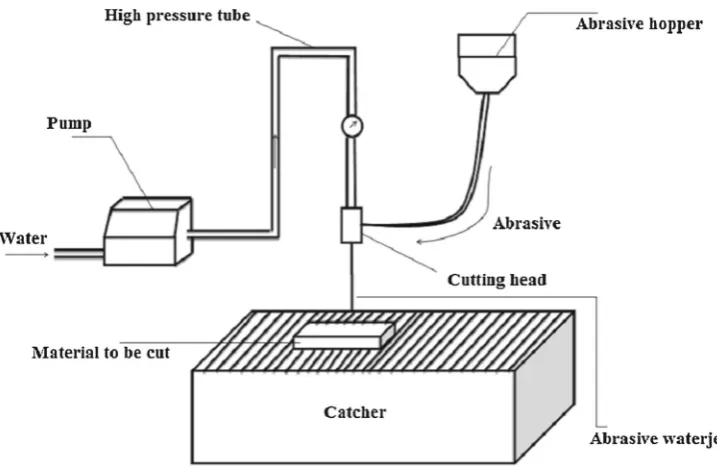
Fig. 1 Abrasive waterjet cutting process (Selvan and Raju 2011)
and overheat compared to other cutting machining. Today, the CNC AWJ is usually used to cut softer materials while the recent developed AWJ machining technology is used for cutting harder materials. In AWJ, abrasive particles such as silicon carbide and aluminium oxide were used to enhance the metal removal rate. The abrasive thoroughly mixed with water to increase the penetration power (Singh 2008). The diagram of abrasive waterjet cutting process is illustrated in Fig.1. According toCaydas and Hascalik(2008), the vari-ous advantages of AWJ are including no thermal distortion, high machining versatility and flexibility, also small cutting forces which means the machining has less pressured on the workpiece. AWJ downsides and restrictions include produc-ing deafenproduc-ing sound and untidy operational settproduc-ing. At a high traverse rates, the cutting of the material may build narrowed edges on the kerf (Azmir and Ahsan 2008).
The current trends of research show soft computing tech-niques have been used by many researchers to optimize the machining control parameters of traditional and modern machining (Pal et al. 2011;Topal and Ço˘gun 2011). Evolu-tionary optimization technique that was inspired by nature or animal behaviour such as genetic algorithm (GA), simulated annealing (SA), ant colony optimization (ACO), particle swarm optimization (PSO) and artificial bee colony (ABC) have been employed in place of conventional techniques such as sequential unconstrained minimization technique, non-linear programming and goal programming (Salehi and Bahreininejad 2011;Li et al. 2012;Zain et al. 2010a,b,c). From our literature review, there is a deficiency of research in optimizing machining control parameters of surface rough-ness (Ra)in modern machining areas particularly using ABC
optimization technique. Yusup et al. (2012) have summa-rized and compared the latest 5 year researches from 2007 to 2011 that used evolutionary optimization techniques such as GA, SA, PSO, ABC and ACO to optimize machining con-trol parameter of both traditional and modern machining. In paper overview byOduguwa et al.(2005), the authors stated that successful applications of evolutionary computing (EC) suggest that EC will have a good prospective in the future particularly in machining industry
this study are amplitude of ultrasonic vibration, frequency of ultrasonic vibration, mean diameter of abrasive particles, volumetric concentration of abrasive particles, and static feed force. The objective considered is maximization of MRR sub-jected to the constraint of Ra. The results show that ABC, HS and PSO outperformed the GA result. GA was consid-ered byMaji and Pratihar(2010) to optimize the machining control parameters of EDM. In the study, three machining control parameters of EDM such as peak current, pulse-on-time and pulse-duty-factor were employed. Regression analysis was developed and GA was used to determine opti-mal machining control parameters of EDM for ensuring the maximum MRR and minimum Ra. The results conclude that the regression models had performed well in predicting the results of some test cases. InPasam et al.(2010), optimiz-ing machinoptimiz-ing control parameters of WEDM titanium alloy (Ti6Al4V) was studied. The performance of eight machin-ing control parameters such as ignition pulse current, short pulse duration, time between two pulses, servo speed, servo reference voltage, injection pressure, wire speed and wire tension on surface finish was studied using Taguchi parame-ter design. A mathematical regression model was developed and the optimization of Ra was using GA. The minimum Ra obtained was 1.85μm with selected optimum machin-ing control parameters of WEDM. The study of Chen et al.(2010) analyzed WEDM control parameters during man-ufacture of pure tungsten profiles. The pulse on time, the pulse off time, arc off time, the servo voltage, the wire feed rate, the wire tension and the water pressure were selected as the WEDM control parameters. Three considered machin-ing performances are the cuttmachin-ing velocity, surface roughness and roughness maximum. Integrate back-propagation neural network (BPNN/SA) approach was proposed and SA tech-nique was used to find the most optimal machining control parameters. The estimated optimal machining control para-meters are: pulse on time of = 0.42 (μs), pulse off time of = 12.15 (μs), arc off time = 13.73 (μs), servo voltage = 45.17 (V), wire feed rate = 10.32 (m/mm), wire ten-sion = 1751.07(gf), and water pressure = 15.21 (kgf/cm2). The predicted machining performance cutting velocity = 7.8558 (m/min), surface roughness = 1.1786 (μm) and rough-ness maximum = 10.7873 (μm).
The non-dominated sorting GA (NSGA-II) was employed bySenthilkumar et al.(2010) to optimize machining con-trol parameters of ECM. The optimization of four machining control parameters which are electrolyte concentration, elec-trolyte flowrate, applied voltage and tool feed rate was con-sidered to maximize MRR and minimize Ra. The optimized value of Ra obtained through NSGA-II was 2.172μm and the corresponding MRR was 0.413 g/min. The optimal com-bination of machining control parameters achieved was elec-trolyte concentration = 17 g/L, elecelec-trolyte flow rate = 8 L/min, applied voltage = 16 V and tool feed rate = 0.9 mm/min. ABC
was considered by Rao and Pawar (2009) to find optimal combination machining control parameters of WEDM such as pulse-on time, pulse-off time, peak current, and servo feed setting with an objective of achieving maximum machin-ing speed for a desired value of surface finish. The optimal machining control parameters of AWJ machining of 6063-T6 aluminum alloy have been investigated byKolahan and Hamid(2009) using SA. Four machining control parameters considered in this work are water pressure, abrasive flow rate, jet traverse rate and diameter of focusing nozzle. It was found that SA was effective to estimate particular opti-mal machining control parameters. In Somashekhar et al.
(2009), the optimization machining control parameters of micro-WEDM (μ-WEDM) such as gap voltage, capacitance and feed rate were studied. A regression model was devel-oped for the experimental results of Ra and overcut of the micro slots produced on the aluminium. GA was employed to determine the desired output value ofμ-WEDM. The min-imum Raachieved was 4.557μm and the overcut value was 33.2μm. In the research ofSaha et al.(2008), BPNN tech-nique was considered to optimize four machining control parameters of WEDM such as pulse-on-time, pulse off-time, peak current and capacitance, and the 4-11-2 network archi-tecture has been found to be the optimal one for overall Ra mean prediction error.
Methodology
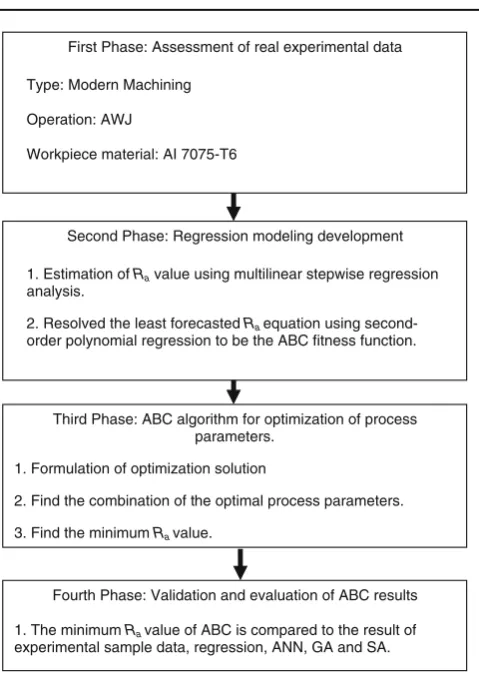
The summary of four phases that was implemented in this research is given as follows:
i. The first phase was the assessment of the experimental data by (Caydas and Hascalik 2008). In this phase, a set data of machining control parameters and machining performance were referred.
ii. In the second phase, a regression model was developed byZain et al.(2011) using the machining control para-meters from the case study in the experimental phase. A multilinear stepwise regression analysis was performed to predict the Ravalue. The predicted equation for Rawas based on the second-order polynomial regression devel-oped by (Caydas and Hascalik 2008).
iii. In the third phase, ABC was employed to optimize machining control parameters of AWJ that will lead to a minimum Ravalue. The objective function selected was based on the predicted equation of the regression model. iv. In the last phase, the minimum Ra value achieved was compared to the experimental, regression, ANN, GA and SA and the performance of ABC was evaluated.
First Phase: Assessment of real experimental data
Type: Modern Machining
Operation: AWJ
Workpiece material: AI 7075-T6
Second Phase: Regression modeling development
1. Estimation of Ra value using multilinear stepwise regression analysis.
2. Resolved the least forecasted Raequation using second-order polynomial regression to be the ABC fitness function.
Third Phase: ABC algorithm for optimization of process parameters.
1. Formulation of optimization solution
2. Find the combination of the optimal process parameters.
3. Find the minimum Ra value.
Fourth Phase: Validation and evaluation of ABC results
1. The minimum Ra value of ABC is compared to the result of experimental sample data, regression, ANN, GA and SA.
Fig. 2 The flows of research work
Table 1 Levels of process parameters and coding identification
Level in coded form
Independent variables Units 1 2 3
Traverse speed, V mm/min 50 100 150
Waterjet pressure, P MPa 125 175 250
Standoff distance, h Mm 1 2.5 4
Abrasive grit size, d lm 60 90 120
Abrasive flow rate, m g/s 0.5 2 3.5
Assessment of real experimental data
The experimental assessment is based on the work of
Caydas and Hascalik(2008). The material of machined work-piece was Al 7075-T6 wrought alloy (AlZnMgCu1.5). The chemical composition of Al 7075-T6 wrought alloy includes A1 91.02%, Cu 1.65%, Mg 2.0%, Cr 0.23%, Zn 5% and Mn 0.1%. The coded level form for the machining is based on DOE for the five control parameters as defined in Table1. During the experiments, a distance of 5mm from the top of the cutting surface was taken for the measurements. A handy device named SJ-201 was used to measure the average Ra. In order to examine the machined surface, another device
Table 2 Ravalues for real machining (Caydas and Hascalik 2008) No Setting values of experimental
process parameters
Ra(μm)
V P h d m
(m/min) (MPa) (mm) (μm) (g/s)
1 50 125 1 60 0.5 2.124
2 50 125 1 60 2 2.753
3 50 125 1 60 3.5 3.352
4 50 175 2.5 90 0.5 4.311
5 50 175 2.5 90 2 4.541
6 50 175 2.5 90 3.5 5.123
7 50 250 4 120 0.5 6.789
8 50 250 4 120 2 7.524
9 50 250 4 120 3.5 9.123
10 100 125 2.5 120 0.5 3.575
11 100 125 2.5 120 2 4.457
12 100 125 2.5 120 3.5 5.628
13 100 175 4 60 0.5 7.010
14 100 175 4 60 2 7.535
15 100 175 4 60 3.5 7.893
16 100 250 1 90 0.5 8.121
17 100 250 1 90 2 8.312
18 100 250 1 90 3.5 9.163
19 150 125 4 90 0.5 4.328
20 150 125 4 90 2 5.120
21 150 125 4 90 3.5 5.852
22 150 175 1 120 0.5 6.143
23 150 175 1 120 2 6.721
24 150 175 1 120 3.5 7.780
25 150 250 2.5 60 0.5 8.890
26 150 250 2.5 60 2 9.120
27 150 250 2.5 60 3.5 10.035
Ra(minimum) 2.124
named LEO 32 scanning electron microscope (SEM) was used.
A total of 27 experimental trials have been performed based on L27 Taguchi’s orthogonal array to find the minimum and average value of Rain AWJ machining. The lowest Ra values is 2.124μm which was obtained by the following con-trol parameters V =50, P=125,h=1,d =60,m=0.5. The values for each experimental AWJ control parameters and optimal Raare shown in Table2.
Regression modeling development
in abrasive waterjet machining is defined mathematically in Eq. (1):
Ra=cVqPrhsdtmuε (1)
where Ra is the experimental (measured) inμm, V is the traverse cutting speed in mm/min, P is the waterjet pressure in MPa, h is the standoff distance in mm, d is abrasive grit size inμm, m is the abrasive flow rate in g/s,εis experimental error, and c,q,r,s,t , and u are the model parameters to be estimated using the experimental data.
To develop the Regression model for estimating the Ra value, the mathematical model given in (1) is linearized by performing a logarithmic transformation as follows:
lnRa=lnc+qln V+r ln P+sln h+t ln d+uln m+lnε (2)
Subsequently, (2) can be written as:
y=b0x0+b1x1+b2x2+b3x3+b4x4+b5x5+ε (3)
where y is the logarithmic value of the experimental Ra, x0 = 1 is a dummy variable, x1, x2, x3, x4 and x5 are the control parameter values (logarithmic transformations) of V, P,h,d and m, respectively,ε is the logarithmic trans-formation of experimental errorεand b0, b1, b3, b4and b5are the model parameters to be estimated using the experimental data. Next, (3) can also be written as follows:
ˆ
y=y−ε=b0x0+b1x1+b2x2+b3x3+b4x4+b5x5(4)
where ˆy is the logarithmic value of the predictive (estimated) Ra. Equation (4) can be extended to form a second-order polynomial regression for surface roughness predicted equa-tion and given as follows:
ˆ
y=Ra=b0+b1V +b2P+b3h+b4d+b5m +b11V2+b22P2+b33h2+b44d2+b55m2 +b12VP+b13Vh+b14V d+b15V m+b23Ph
+b24Pd+b25Pm+b34hd+b35hm+b45dm (5)
As of the results ofCaydas and Hascalik (2008), the final regression model for surface roughness obtained is written as follows:
Ra= −5.07976+0.08169V +0.07912 P−0.34221h −0.08661d−0.34866m−0.00031V2
−0.00012 P2+0.10575h2+0.00041d2 +0.07590m2−0.00008V m−0.00009Pm
+0.03089hm+0.00513dm (6)
ABC optimization
ABC is a swarm-based algorithm that mimics the foraging behaviour of swarm honey bee. Similar to the concept of
ACO and PSO, this exploration algorithm is capable of trac-ing good quality of solutions. There are three types of bees in the colony which are employed, onlookers and scouts bees. Each type of bee bears a different task. Employed bees that are currently exploiting and searching are linked with the food sources. The unemployed bees or scouts bees are asso-ciated with establishing new food sources either by search-ing the environment surroundsearch-ing the hives or waitsearch-ing for the employed bees to share the best food source location in the hives. The onlookers bees that watched the waggle dance are positioned on the food sources by using a probability based selection process. The probability value which the food source is favoured by onlookers increases while the quantity of the nectar amount increases which is calculated in Eq. (7). There are three important control parameters in ABC which are colony size, limit and maximum cycle.
The detailed ABC pseudocode to solve the optimization is as follows, (Karaboga and Akay 2009):
1. Initialize the population of solutions xi,j 2. Evaluate the population
3. Cycle=1 4. Repeat
5. Produce new solutions (food source positions)υi,j in the neighbourhood of xi,j for the employed bees using the formulaυi,j = xi,j +ij(xi,j−xk,j) (k is a solution in the neighbourhood of i,is a random number in the range [−1,1]) and evaluate them
6. Apply the greedy selection process between xi andυi 7. Calculate the probability values Pi for the solutions xi
by means of their fitness values using the Eq. (7):
Pi= f i ti
S N
i=1 f i ti
(7)
In order to calculate the fitness values of solutions we employed the following Eq. (8).
f i ti =
1
1+fi, i f fi ≥0
1+abs f (i) , i f fi <0
(8)
8. Normalize Pi values into [0,1].
9. Produce the new solutions (new positions) υi for the onlookers from the solutions xi, selected depending on Pi, and evaluate them.
10. Apply the greedy selection process for the onlookers between xi andυi.
11. Determine the abandoned solution (source), if exists, and replace it with a new randomly produced solution xi for the scout using the Eq. (9).
12. Memorize the best food source position (solution) achieved so far
13. Cycle=cycle+1
14. Until cycle= Maximum Cycle Number (MCN)
The program to optimize machining control parameters of AWJ that will lead to a minimum Ra value was developed and run using MATLAB (R2010a) software. In the experiment, three control parameters of ABC have been employed which are colony size where it refers to the number of bees in the colony, limit where it controls the number of trials to improve certain food source. The colony size was set to 10; limit and maximum cycle was set to 50. The range of AWJ machining control parameters are given in the Eq. (10a–10e).
50mm/min <x1<150 mm/min (10a)
125Mpa <x2<250Mpa (10b)
1mm <x3<4mm (10c)
60μm<x4<120μm (10d)
0.5g/s<x5<3.5g/s (10e)
where x1is the traverse cutting speed (V)in mm/min, x2is the waterjet pressure (P)in MPa, x3is the standoff distance (h)in mm, x4is the abrasive grit size (d)inμm and lastly, x5the abrasive flow rate (m)in g/s. The objective function is defined in Eq. (11):
Ra= −5.07976+0.08169x1+0.07912x2−0.34221x3 −0.08661x4−0.34866x5−0.00031x12
−0.00012x2
2+0.10575x 2
3+0.00041x 2 4 +0.07590x2
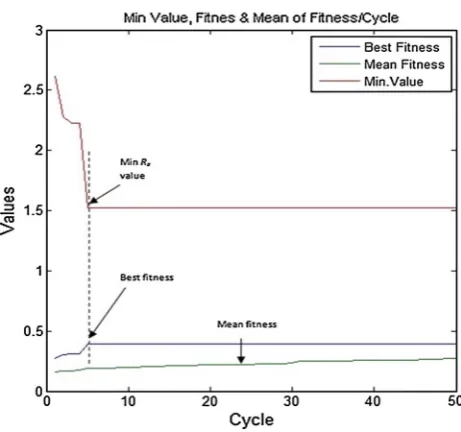
5−0.00008x1x5−0.00009x2x5 +0.03089x3x5+0.00513x4x5 (11) In optimizing control parameters of AWJ machining, the minimum Ravalue found was 1.5223μm. The optimal solu-tion of the ABC are 50 mm/min for cutting speed, 125 Mpa for waterjet pressure, 1.5504 mm for standoff distance, 102.5213μm for abrasive grit size and 0.5 g/s for abrasive flow rate. It was found out that a minimum Ra value is obtained with a smallest value of 10 colony size, 50 maxi-mum cycle and 10 runs are adequate. A maximaxi-mum cycle value of 10 and 20 did not give a good result in all bee colony sizes. The average minimum Ravalue of 1.5223μm is achieved on the sixth runs. Figure3 shows the experimental results of using 50 maximum cycles. Figure4 shows the comparison of the effect of colony size in AWJ.
Validation and evaluation of ABC results
To validate the results of ABC, a t-test two sample assuming equal variances was used and the results are shown in Table3. There was a statistically significant decrease from exper-imental (Mean = 6.3452, and variance = 4.7955) to ABC
Fig. 3 Experimental results using 50 max cycles
Fig. 4 Effect of colony sizes in optimizing Ravalue of AWJ
(Mean = 1.6220, variance = 0.0164, t(52) = 11.1882). Theα value is 0.05 and the one-tailed p value is less than 0.0001. If p<0.05, it shows that the observed different within two methods are significant. Then, eta squared statistic was cal-culated to show the magnitude of the intervention’s effect using Eq. (12). The results of eta squared statistic was (.71) indicated a large effect size.
Eta squared =t2/t2+N−1 (12)
Table 3 Results of t-test
Variable Mean Variance N Correlation Pooled variances df t Stat P(T ≤t)one-tail t Critical one-tail
Exp 6.3452 4.7955 27 0.0260 2.4059 52 11.1882 9.42126E-12 1.67469
ABC 1.6220 0.0164 27
Table 4 Conditions to define
the scale for optimal process parameters of AWJ
Decision Independent variables
V (mm/min) P (MPa) h (mm) d (μm) m (g/s)
Lowest 50≤xi<70 125≤xi<150 1.0≤xi<1.6 60≤xi<72 0.5≤xi<1.1 Low 70≤xi<90 150≤xi<175 1.6≤xi<2.2 72≤xi<84 1.1≤xi<1.7 Medium 90≤xi≤110 175≤xi≤200 2.2≤xi≤2.8 84≤xi≤96 1.7≤xi≤2.3 High 110<xi ≤130 200<xi ≤225 2.8<xi≤3.4 96<xi≤108 2.3<xi≤2.9 Highest 130<xi\ ≤150 225<xi ≤250 3.4<xi≤4.0 108<xi≤120 2.9<xi≤3.5
Ra= −5.07976+0.08169(50)+0.07912(125) −0.34221(1.5504)−0.08661(102.5213)
−0.34866(0.5)−0.00031(50)2−0.00012(125)2 +0.10575(1.5504)2
+0.00041(102.5213)2+0.07590(0.5)2 −0.00008(50) (0.5)
−0.00009(125) (0.5)+0.03089(1.5504) (0.5) +0.00513(102.5213) (0.5)
=1.52228≈1.5223μm
In order to evaluate the optimal control parameters of ABC for AWJ, the values of the cutting condition level noted as 1, 2 and 3 as given in Table1, are classified as the lowest, lower, medium, high, highest scales. With xi = optimal cut-ting conditions of AWJ, Table4shows the conditions used to define the scale of the levels for the five optimal control parameters.
The set values of optimal control parameters of ABC opti-mization that lead to the minimum Ravalue are 50 mm/min for traverse speed, 125 MPa for waterjet pressure, 1.5504 mm for standoff distance, 102.5213μm for abrasive grit size and 0.500 g/s for abrasive flow rate. This confirmed that the opti-mal control parameters are within the range of minimum and maximum value of experimental design as shown in Table1.
Effectiveness of ABC algorithm for improving machining process
In this paper, ABC algorithm was proposed for optimiza-tion of machining control parameters. By perusing the structure of ABC algorithm, it is clarified that ABC is a meta-heuristic optimization approach with different local
and general search strategies compared to other evolutionary approaches. As well, its exploration and evaluation results reported by researchers have verified that the popular effec-tiveness of ABC is related to flexibility, simplicity, conver-gence rate, diversity, and accuracy of the solutions. Although effectiveness of ABC algorithm has been reported by previ-ous researchers, but it has not been previprevi-ously considered for some problems such as optimization of modern machin-ing process. Consequently, in this research a machinmachin-ing case study on the AWJ, classified as one of modern machining processes, was considered to illustrate the robustness of ABC algorithm in optimization of machining control parameters. ABC algorithm was employed to optimize five machining parameters of AWJ which are cutting speed, waterjet pres-sure, standoff distance, abrasive grit size, and abrasive flow rate to estimate a minimum surface roughness value. In addi-tion, a dataset of 27 experimental machining data on AWJ is considered in this study. Then effectiveness of the proposed ABC on AWJ process is summarized.
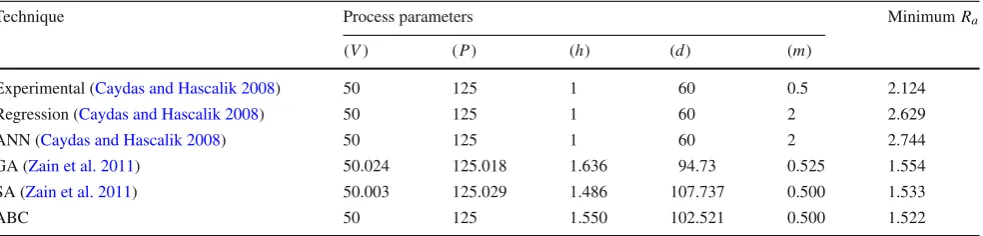
Table 5 Comparison of the optimal process parameters for minimum Ra
Technique Process parameters Minimum Ra
(V) (P) (h) (d) (m)
Experimental (Caydas and Hascalik 2008) 50 125 1 60 0.5 2.124
Regression (Caydas and Hascalik 2008) 50 125 1 60 2 2.629
ANN (Caydas and Hascalik 2008) 50 125 1 60 2 2.744
GA (Zain et al. 2011) 50.024 125.018 1.636 94.73 0.525 1.554
SA (Zain et al. 2011) 50.003 125.029 1.486 107.737 0.500 1.533
ABC 50 125 1.550 102.521 0.500 1.522
A question related to this issue is how to know specifically the potential values of the machining control parameters for giving a possible minimum value of machining performance when practiced through experimental trial? Conventionally, to estimate the possible minimum value of machining per-formance, the experimental trial process has been done many times at different combination of control parameter values. It is fully depend to mechanist experience who conducts the experiment. Therefore the optimization process based on computational approach is a way to guide the non-experience machinist to study the potential value of machining cutting conditions to gain the minimum value of machining per-formance. ABC is seen as a good strategy to estimate a combination of optimal control parameter values to gain the minimum value of machining performance. The main fac-tor to avoid of using experimental trial in finding the opti-mal solution of machining control parameters is the cost. Meanwhile, the mechanists have to use a large number of machining workpieces. Meanwhile, the cost for providing a large number of workpieces is also increased. Based on the intelligent scheme throughout this study, it was confirmed that ABC has effectively assisted the machinist to identify the possible optimal machining control parameters through computational estimation strategy. Trial and error process is done by an informal process by altering the ABC’s para-meters such as bee colony size and number of cycles. This study proposed several combinations of ABC’s parameters such as 10-10-50 represents the ABC’s parameters combi-nation of colony size-max cycles-limit that leads to a min-imum surface roughness value of 2.7090μm. The value of surface roughness is improved by 40 % when the max cycles per run value increased to 20. Next, when the max cycles per run are increased to 50 and 100, the minimum surface roughness value found is 1.5223μm. This minimum surface roughness value is enhanced by 44 % compared to the first control variables combinations. It was also confirmed that ABC has estimated the accurate predicted surface roughness value for AWJ machining process by using a smaller num-ber of bee colony size of 10, limit and maximum numnum-ber of cycles of 50 gave the best result.
It was proved that ABC is an effective optimization algo-rithm applied for probabilistic exploration includes local and global searches. This effectiveness was obviously clear by comparing the mean and variance values of machining experimental and ABC optimization results by using a t-test two sample. The reason for this result can be demonstrated from the theory of ABC algorithm enables to employ three exploration strategies simultaneously; they are probabilis-tic, greedy and stochastic. Probabilistic exploration includes local and global searches. A local search is performed by employed and onlooker bees to find food sources. Global search is carried out by onlooker bees to find the most prof-itable sources. Greedy exploration which is a local search is performed by onlooker and employed bees to replace a good next candidate solution instead of current one. Also, stochastic exploration which is a global search carried out by scout bees to find an abandoned solution and replaced it with a new random solution. Therefore, exploration ability of ABC algorithm is enhanced by considering these three strategies. Also, stochastic exploration is effective to control exploration process of the algorithm to avoid being trapped into local optimal for optimization of experimental machin-ing process parameters.
in Table5, it was found that traverse speed and waterjet pres-sure are the dominant factors and the most influence process parameters in giving a minimum surface roughness value. The level of the optimal machining control parameters that leads to a minimum predicted surface roughness value are lowest for traverse speed, waterjet pressure, standoff dis-tance, abrasive flow rate, and high for abrasive grit size. This result indicated the capability of ABC algorithm has reduced the machining experimental performance value effectively. It is based the theories that ABC algorithm could balance the local and global searches, enhance diversity of the solutions and avoid from premature convergence, and the most signifi-cant incident in the ABC algorithm is a dancing area between bees. This unique area could improve probability of finding the most global profitable sources by onlooker for improving the performances of machining experimental process.
Conclusion
The role of machining control parameters in AWJ is signifi-cant in order to produce a minimum value of surface rough-ness. The minimum surface roughness influences the quality of the product end results characteristic such as the appear-ance, functionality and dependability. It was demonstrated that the ABC technique is capable in estimating the lowest value of surface roughness compared to machining experi-mental.Therefore ABC could be labelled as a useful compu-tational technique to build process model on the basis of the expertise of human operators for producing desired product in shorter time and reduce operational cost. All in all, ABC algorithm which inspires from honeybee swarms behaviours is an effective algorithm in optimization of different complex problems as well as optimization of AWJ machining control parameters. Furthermore, the robustness of basic ABC algo-rithm compared to other evolutionary algoalgo-rithms is consid-erable to be enhanced in the feature works.
Acknowledgments Special appreciative to reviewers for useful advices and comments. The authors greatly acknowledge the Research Management Centre, UTM and Ministry of Higher Education Malaysia (MOHE) for financial support through the Exploratory Research Grant Scheme (ERGS) No.Q.J13000078284L003.
References
Azmir, M. A., & Ahsan, A. K. (2008). Investigation on glass/epoxy composite surfaces machined by abrasive water jet machining.
Jour-nal of Materials Processing Technology, 198(1–3), 122–128.
Caydas, U., & Hascalik, A. (2008). A study on surface roughness in abrasive waterjet machining process using artificial neural networks and regression analysis method. Journal of Materials Processing
Technology, 202, 574–582.
Chen, H., Lin, J., Yang, Y., & Tsai, C. (2010). Optimization of wire electrical discharge machining for pure tungsten using a neural
net-work integrated simulated annealing approach. Expert Systems with
Applications, 37(10), 7147–7153. doi:10.1016/j.eswa.2010.04. Karaboga, D., & Akay, B. (2009). A comparative study of Artificial
Bee Colony algorithm. Applied Mathematics and Computation, 214, 108–132.
Kolahan, F., & Hamid, K. (2009). Modeling and Optimization of Abra-sive Waterjet Parameters using Regression Analysis. World Academy
of Science, Engineering and Technology, 59(2009), 488–493.
Li, X., Yalaoui, F., Amodeo, L., & Chehade, H. (2012). Metaheuris-tics and exact methods to solve a multiobjective parallel machines scheduling problem. Journal of Intelligent Manufacturing, 23(4), 1179.
Maji, K. & Pratihar, D. K. (2010). Modeling of electrical dis-charge machining process using conventional regression analysis and genetic algorithms. Journal of Materials Engineering and
Per-formance, 20(7), 1–7.
Mokhtar, A., & Xu, X. (2011). Machining precedence of 21/2D inter-acting features in a feature-based data model. Journal of Intelligent
Manufacturing, 22(2), 145–161.
Nagendra Parashar, B. S., & Mittal, R. K. (2007). Elements of
Manufac-turing Processes. New Delhi: Prentice-Hall of India Private Limited.
Oduguwa, V., Tiwari, A., & Roy, R. (2005). Evolutionary computing in manufacturing industry: An overview of recent applications. Applied
Soft Computing, 5(3), 281–299.
Pal, S., Heyns, P. S., Freyer, B. H., Theron, N. J., & Pal, S. K. (2011). Tool wear monitoring and selection of optimum cutting conditions with progressive tool wear effect and input uncertainties. Journal of
Intelligent Manufacturing, 22(4), 491–504.
Pasam, V. K., Battula, S. B., Valli, P. M., & Swapna, M. (2010). Opti-mizing surface finish in WEDM using the taguchi parameter design method. Journal of the Brazilian Society of Mechanical Sciences and
Engineering, 32(2), 107–113.
Rao, R. V., & Pawar, P. J. (2009). Modelling and optimization of process parameters of wire electrical discharge machining. Proceedings of
the Institution of Mechanical Engineers, Part B: Journal of Engi-neering Manufacture, 223(11), 1431–1440.
Rao, R. V., Pawar, P. J., & Davim, J. P. (2010). Parameter optimization of ultrasonic machining process using nontraditional optimization algorithms. Materials and Manufacturing Processes, 25(10), 1120– 1130.
Ridwan, F., Xu, X., & Liu, G. (2012). A framework for machining opti-misation based on STEP-NC. Journal of Intelligent Manufacturing,
23(3), 423–441.
Roy, R., & Mehnen, J. (2008). Dynamic multi-objective optimisation for machining gradient materials. CIRP Annals Manufacturing
Tech-nology, 57(1), 429–432.
Saha, P., Singha, A., Pal, S. K., & Saha, P. (2008). Soft computing models based prediction of cutting speed and surface roughness in wire electro-discharge machining of tungsten carbide cobalt compos-ite. International Journal of Advanced Manufacturing Technology,
39(1–2), 74–84.
Salehi, M., & Bahreininejad, A. (2011). Optimization process plan-ning using hybrid genetic algorithm and intelligent search for job shop machining. Journal of Intelligent Manufacturing, 22(4), 643–652.
Samanta, S., & Chakraborty, S. (2011). Parametric optimization of some non-traditional machining processes using artificial bee colony algorithm. Engineering Applications of Artificial Intelligence, 24(6), 946–957.
Selvan, M. C. P., & Raju, N. M. S. (2011). Selection of process parame-ters in abrasive waterjet cutting of copper. International Journal of
Advanced Engineering Sciences and Technologies, 7(2), 254–257.
of the Institution of Mechanical Engineers, Part B: Journal of Engineering Manufacture, 224(9), 1399–1407.
Singh, D. K. (2008). Fundamentals of manufacturing engineering. Boca Raton: CRS Press, Taylor and Francis Group.
Somashekhar, K. P., Ramachandran, N., & Mathew, J. (2009). Modeling and optimization of process parameters in micro wire EDM by genetic algorithm Retrieved from www.scopus.com. Topal, E. S., & Ço˘gun, C. (2011). Computer-based estimation and
com-pensation of diametral errors in CNC turning of cantilever bars.
Jour-nal of Intelligent Manufacturing, 22(6), 853–865.
Yusup, N., & Zain, A. M. (2012). Evolutionary techniques in optimizing machining parameters: Review and recent applications (2007–2011).
Expert Systems with Applications, 39(10), 9909–9927.
Zain, A. M., Haron, H., & Sharif, S. (2010a). Application of GA to optimize cutting conditions for minimizing surface roughness in end milling machining process. Expert System with Applications, 37, 4650–4659.
Zain, A. M., Haron, H., & Sharif, S. (2010b). Prediction of surface roughness in the end milling machining using artificial neural net-work. Expert System with Applications, 37, 1755–1768.
Zain, A. M., Haron, H., & Sharif, S. (2010c). Simulated annealing to estimate the optimal cutting conditions for minimizing surface roughness in end milling Ti-6Al-4V. Machining Science and
Tech-nology, 14(1), 43–62.
Zain, A. M., Haron, H., & Sharif, S. (2011). Genetic Algorithm and Simulated Annealing to estimate optimal process parameters of the abrasive waterjet machining. Engineering with Computers, 27, 251– 259.
Zain, A. M., Haron, H., & Sharif, S. (2012a). Integrated ANN-GA for estimating the minimum value for machining performance.
Interna-tional Journal of Production Research, 50(1), 191–213.