ABSTRACT
LIAN, FEIER. Communication-Cost-Constrained Algorithms and Games for Multi-Agent Control Systems. (Under the direction of Alexandra Duel-Hallen and Aranya Chakrabortty).
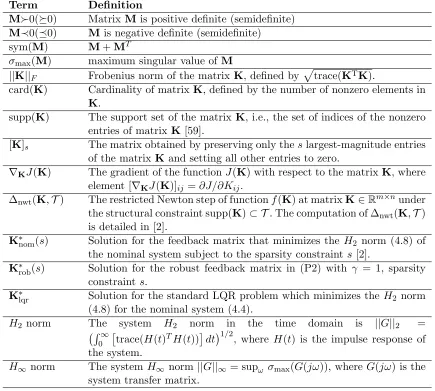
This dissertation work focuses on communication-cost-constrained optimization and games in multi-agent control systems. In large-scale wide-area control systems, due to the need to feed back large volume of real-time sensor data to local and remote controllers, a dedicated wide-area communication infrastructure is required to guarantee secure and robust data communication, and that the economic efficiency of the communication network must be guaranteed. Through-out the thesis we take the communication cost of the underlying network as a constraint in the controller design for the wide-area control system. The controller design in this thesis is cast as an optimization problem to optimize a certain control performance index, subject to communication-cost constraints. In the multi-agent control system, when all agents have a global control performance objective, we solve a centralized (or social) optimization. When the agents have different objectives, we model the control strategies of multiple agents as a noncooperative game, and also develop cost-allocation algorithms. We first assume a known model and later in the thesis investigate control designs for systems with model uncertainty.
In Chapter 2, we investigate the social optimization and noncooperative games under communication-cost constraint for the multi-agent systems when the underlying system pa-rameters are fixed and known to all agents. We model the communication cost as the number of communicating state/control input pairs across different nodes. Under the communication-cost constraint, we first investigate the scenario where the the agents cooperatively optimize a global performance objective. We develop a greedy algorithm for the sparsity-constrained cen-tralized linear-quadratic regulator (LQR) problem based on gradient support pursuit (GraSP) method. Then, we consider the scenario where the agents aim to satisfy their own selfish ob-jectives using a noncooperative differential game, and a distributed algorithm for solving the Nash equilibrium (NE) of the game is proposed. Moreover, we propose a cost allocation scheme, which fairly allocates costs of the communication infrastructure according to the agents’ diverse needs for feedback and cooperation. The proposed algorithms and the cost allocation method are validated using numerical experiments on the Australian power system.
sparsity-constrained mixedH2/H∞ controller, which is guaranteed to stabilize the closed-loop
uncertain system, equivalent to minimizing the H2 objective under the H∞-norm and
spar-sity constraints. We solve the proposed minimization problem by first improving a previously proposed descent algorithm for mixed H2/H∞ control using a modified Zoutendijk’s method.
Then, we impose a sparsity constraint on this design by combining it with a greedy gradient support pursuit (GraSP) method. We illustrate the effectiveness of the proposed algorithm via a system of unstable nodes, where the proposed design can guarantee a predetermined level of sparsity while maintaining acceptableH2 performance as well as H∞ robustness.
Finally in Chapter 4, we extend the centralized sparsity-constrained design for uncertain systems in Chapter 3 to noncooperative games in uncertain multi-agent systems. First, we re-visit the centralized mixedH2/H∞control problem under the sparsity constraint. We improve
on the GraSP-based method in Chapter 3 and propose a new algorithm based on the proximal alternating linearization method (PALM). Then we investigate a sparsity-constrained nonco-operative game based on PALM for the mixed H2/H∞ control of multi-agent systems under
©Copyright 2019 by Feier Lian
Communication-Cost-Constrained Algorithms and Games for Multi-Agent Control Systems
by Feier Lian
A dissertation submitted to the Graduate Faculty of North Carolina State University
in partial fulfillment of the requirements for the Degree of
Doctor of Philosophy
Electrical Engineering
Raleigh, North Carolina
2019
APPROVED BY:
Dror Baron Thayer Morrill
Alexandra Duel-Hallen Co-chair of Advisory Committee
DEDICATION
BIOGRAPHY
ACKNOWLEDGEMENTS
First and foremost, I would like to thank my co-advisors, Dr. Alexandra Duel-Hallen and Dr. Aranya Chakrabortty, for their guidance, support, patience, and insights. Thank you for sharing your expertise in communications, game theory, optimization, control theory and power systems with me, and I am grateful for your trust and encouragement during the difficult times of my research, your patience in helping me polish my writing and presentation. It is such an honor for me to work with you, I am so glad that we dived deep into the research problem together, it was a fulfilling journey.
I would also like to thank my committee members Dr. Dror Baron and Dr. Thayer Morrill for their encouragement, support, and insightful comments on my research work. Thanks for serving in my committee board. My extended thanks to all professors who have taught me in NC State University. Your excellent lectures have laid the foundations for me being able to explore new research problems.
I would like to thank my parents, without your continuous love and support I could not accomplish this much. Thank you for the encouraging words during my frustrated moments. I cherish the time we spent together during vacation, your homemade cooking and sense of humor can always cheer me up.
TABLE OF CONTENTS
LIST OF TABLES . . . vii
LIST OF FIGURES . . . .viii
Chapter 1 Introduction . . . 1
1.1 Motivation . . . 1
1.2 Preliminaries . . . 5
1.2.1 Strategic-form game and Nash Equilibrium . . . 5
1.2.2 Kurdyka- Lojasiewicz (KL) Property . . . 6
Chapter 2 Game-Theoretic Multi-Agent Control and Network Cost Alloca-tion under CommunicaAlloca-tion Constraints . . . 8
2.1 Introduction . . . 9
2.2 System Model and the Communication-Cost-Constrained Centralized Optimization 11 2.3 Multi-Agent System Model and Communication-Cost-Constrained Linear-Quadratic Games . . . 15
2.4 Network Cost Allocation . . . 18
2.5 Example: Sparsity-Constrained Wide-Area Control of Power Systems . . . 21
2.6 Numerical Results and Performance Analysis for the Australian Power System Model . . . 23
2.6.1 Global Energies . . . 25
2.6.2 Selfish Energies and Cost Allocation . . . 26
2.6.3 Algorithm Convergence and Implementation Issues . . . 28
2.7 Conclusion . . . 29
Chapter 3 Sparsity-Constrained Mixed H2/H∞ Control . . . 30
3.1 Introduction . . . 30
3.2 MixedH2/H∞ control . . . 31
3.3 Descent algorithm for mixed H2/H∞ control . . . 34
3.3.1 The gradient method for mixedH2/H∞ control . . . 34
3.3.2 Modified Zoutendijk’s feasible direction method . . . 34
3.4 Sparsity-constrainedH2/H∞ control . . . 37
3.5 Numerical Example . . . 40
3.6 Conclusions . . . 42
Chapter 4 Game-Theoretic Mixed H2/H∞ Control with Sparsity Constraint for Multi-agent Networked Control Systems . . . 44
4.1 Introduction . . . 44
4.2 PALM algorithm for centralized sparsity-constrained mixed H2/H∞control . . . 47
4.2.1 System model and mixedH2/H∞ control . . . 47
4.2.2 Sparsity-constrained mixedH2/H∞ control . . . 49
4.2.4 Algorithm description . . . 51
4.3 Sparsity-constrained noncooperative games for multi-agent control . . . 55
4.3.1 Multi-agent system model and generalized Nash equilibrium . . . 55
4.3.2 PALM algorithm for GNE . . . 57
4.4 Numerical results and convergence analysis . . . 61
4.4.1 Experiment setup . . . 61
4.4.2 Social optimization . . . 62
4.4.3 The noncooperative game . . . 65
4.4.4 Algorithm Convergence and Complexity . . . 66
4.5 Conclusion . . . 67
Chapter 5 Contributions and Future Directions. . . 68
BIBLIOGRAPHY . . . 70
Appendices . . . 81
Appendix A . . . 82
A.1 Definition of Nondecreasing Selfish Payoffs for Algorithm 2.3 . . . 82
A.2 Derivations ofQ and Qi matrices in Section 2.5, eq. (2.25, 2.28) . . . 83
A.2.1 Matrix Qin eq. (2.25) . . . 83
A.2.2 Matrix Qi in eq. (2.28) . . . 84
A.3 Efficiency of the grand coalition . . . 86
Appendix B . . . 88
B.1 Computation of (4.32) . . . 88
B.2 Overview of Zoutendijk’s method . . . 89
B.3 Definitions of Terms in Section 4.2.3 . . . 90
B.4 Notation used in Kurdyka- Lojasiewicz (KL) Property, employed in conver-gence analysis of Algorithm 4.6 . . . 90
LIST OF TABLES
Table 2.1 Notation used in the Algorithms 2.1 and 2.2 . . . 13
Table 3.1 Notation used in Chapter 3 . . . 32
LIST OF FIGURES
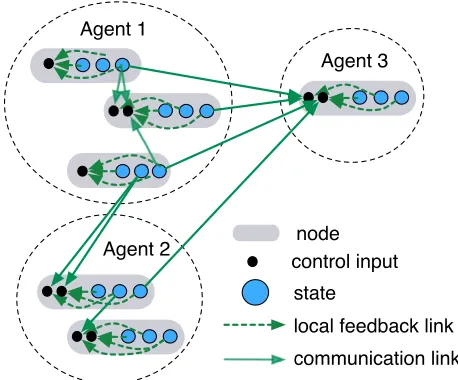
Figure 2.1 The communication structure of the multi-agent system. . . 9 Figure 2.2 A simplified 50-bus representation of the southeast Australian power system [1]. 24 Figure 2.3 Global energies of social optimization and noncooperative games vs.
commu-nication cost constraint. . . 25 Figure 2.4 Selfish energies (objectives), payoffs and cost allocation in Algorithm 2.3 vs.
communication cost constraints. (a) Selfish energies of noncooperative games for areas 1–4. (b) The energy savings (payoffs) vi(s) and vsoc(s) and payoff increase ξ(s). (c) Proportional cost allocation. . . 27 Figure 3.1 H2 norm increase relative to the H2 norm of standard LQR vs. sparsity
constraint sfor sparse LQR [2] and Algorithm 2. . . 41 Figure 3.2 H∞norm vs. sparsity constraint s for sparse LQR [2] and Algorithm 2. . . . 41
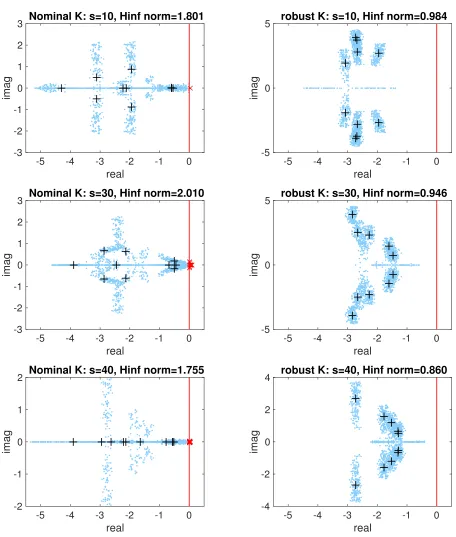
Figure 3.3 The closed-loop poles for the unstable nodes system using the nominal feed-back K∗nom(s) and the robust feedback K∗rob(s) for two sparsity constraint valuess. The blue circles and the red crossmarks represent the stable and un-stable closed-loop poles of the uncertain ˆAi’s, respectively. The black pluses represent the closed-loop poles of the nominal system without uncertainty. The imaginary axis is shown by the red vertical line. . . 43
Figure 4.1 The unstable node system. . . 62 Figure 4.2 The LQR cost J and H∞ norm vs. sparsity constraint s. . . 63
Figure 4.3 The error in K vs. iteration k in PALM Algorithm 4.6 Step 2 and 3 for different s-values. . . 63 Figure 4.4 The penalized cost function Φ(Kk,Fk) and the coupling function||Kk−Fk||2
F
vs iteration kin the end of Step 3 of Algorithm 4.6 for multiple s-values. . . 64 Figure 4.5 Errors in consecutive steps of Kl
i and Fli for players i = 1,2 vs. step l in
Algorithm 4.8 (the noncooperative game). . . 65 Figure 4.6 The individual LQR cost and globalH∞ norm of KGNE(s) vs sparsity
Chapter 1
Introduction
1.1
Motivation
Networked Control Systems (NCSs), such as power systems, sensor networks and autonomous vehicles, require real-time feedback of massive volumes of sensor data from one operating re-gion of the physical network to controllers located in other rere-gions [3]. One of the foremost requirements for NCS, is the need for a highly robust communication system that works in sync with the control functionalities. For example, the envisioned architecture of wide-area communication for the US power grid, often referred to as the North American Synchrophasor Initiative Network (NASPI-net) [4], involves sensors (Phasor Measurement Units (PMUs)) in-side the operating boundaries of utility companies that send real-time data to local controllers via a local-area network and to remote controllers over a secure wide-area network. Each area is equipped with its own dedicated phasor gateway, which routes the incoming sensor data-streams to the respective controllers. In other applications of NCS such as disease monitoring, vision-based control of robots and autonomous vehicles [5], it is also economically desirable to optimize for sparse sensors or reduce the communication between sensors and controllers, due to either the high costs of sensors, or the need to identify key communication links to guarantee fast control decisions. This thesis is motivated by the following question - how can one guaran-tee the economic viability of this communication architecture? Installation of communication links for transporting feedback data from sensors to controllers requires a significant financial investment by the utilities.
to minimize the LQR cost together with an `1-norm penalty for the feedback matrix. Other works solve a cardinality minimization or cardinality constrained problem, by relaxing it to a convex problem, such as converting the cardinality constraint to a rank constraint [13, 14], or `1-norm constraint [15–17]. Another line of research investigates the design and performance of distributed control given the predefined sparsity and delay pattern [10, 18]. The sparsity promoting algorithms have been widely used in various NCSs for system identification or optimal sensor placement problems such as fluid flow control [5, 19] and biological networks [20].
In real world large-scale control systems, model uncertainties are bound to arise due to changing network operating conditions and topologies, or the mismatch between designers’ knowledge and real network parameter values caused by idealistic assumptions or commu-nication delay. The robust design of commucommu-nication-cost-efficient controllers is investigated in [11, 15, 21–27]. The H∞ control is used in [21, 22] to guarantee stability for closed-loop
un-certain systems with parametric unun-certainty, where theH∞-norm constraint is translated into
a linear matrix inequality (LMI). In [15], controllers with minimum number of communication links are designed for systems with polytopic uncertainty, which is equivalent to minimizing the cardinality of the feedback matrix subject to anH∞constraint. In [15], the `1 norm
minimiza-tion problem is solved as a convex relaxaminimiza-tion for the cardinality minimizaminimiza-tion problem. In [23], a sparseH∞controller is designed by exploiting the symmetric and sparse structure of the system
state matrix. In [24], the robust stability analysis of sparsely interconnected uncertain systems is investigated using integral quadratic constraints, and it is shown that the sparse formulation of the stability analysis is equivalent to solving a set of sparse LMIs. In [11], a sparsity-promoting controller is designed for systems with norm-bounded uncertainty and delay, via minimizing the quadratic cost supplemented by the`1 norm of the feedback matrix under an LMI constraint. The work [26] introduces a notion of non-fragility for the state-feedback controller, which aims to provide stability guarantees for uncertain perturbations in the feedback matrix. Based on the non-fragility notion, a sparse state feedback controller is designed given the desired sparsity pattern. In [25], the robust non-fragility-based controller is designed with a row-column spar-sity constraint, where the non-convex sparspar-sity-constrained problem is reformulated as a convex rank-constrained problem.
networks [34]. Recently, significant research effort has been devoted to modeling decision making and analyzing interactions among agents using game theory [32, 33, 35–37]. In particular, the linear-quadratic differential game [38] is a family of games that is popular in control system applications where the system states evolve according to a differential equation, and each player chooses its own control strategy and has a quadratic cost function to minimize. The necessary conditions of Nash equilibrium (NE) for linear quadratic games and corresponding numerical algorithms are investigated in [39–41].
In multi-agent systems, robustness for control strategies has been investigated in [42–47]. In [42], the Nash-type differential game for known systems [38] was extended to systems with polytopic uncertainty, and the Nash equilibrium was found for guaranteed cost-control. In [43], the uncertain external disturbance is modeled as a fictitious player trying to maximize all players’ costs, and the robust Nash strategies for all players are found by solving a coupled Riccati differential equation. The works [42, 43] extend the Nash-type differential game in [38] by finding robust Nash strategies while either considering polytopic uncertainty or formulating uncertain external disturbances as a fictitious player. The works [44–47] model the uncertainty in the multi-agent system using stochastic differential equations, and Nash strategies are found by solving cross-coupled matrix equations, using necessary optimality conditions or Karush-Kuhn-Tucker (KKT) conditions. In [44], the guaranteed cost control problem for uncertain stochastic systems withN decision makers is investigated. A similar work [45] investigates both the Pareto optimality and Nash equilibrium for a mixedH2/H∞ control problem for stochastic
delay systems with multiple players. In [46], Stackelberg games for linear stochastic systems with multiple followers are studied, and the Nash strategies for noncooperative followers are developed. In [47], the Nash game and Pareto optimal optimization are studied for linear time-delay systems with Markovian jumping parameters. In [48], gain-scheduled Nash games withH∞
noncooperative game, we first investigate the NE solution when model parameters are known to all agents, and then study the Generalized Nash Equilibrium of the noncooperative game when the model uncertainty is translated into a sharedH∞-norm bound on all the agents.
This thesis is organized as follows. First, in Chapter 2, we investigate the social optimization and noncooperative games under communication-cost constraints for multi-agent systems when the underlying system parameters are fixed and known to all agents. We model the communi-cation cost as the number of communicating state/control input pairs across different nodes. Under the communication-cost constraint, we first investigate the scenario where the agents cooperatively optimize a global performance objective. We develop a greedy algorithm for the sparsity-constrained centralized LQR problem based on the gradient support pursuit (GraSP) method. Next, we consider the scenario where the agents aim to satisfy their own selfish objec-tives using a noncooperative differential game, and a distributed algorithm for solving the NE of the game is proposed. Moreover, we propose a cost allocation scheme, which allocates costs of the communication infrastructure fairly according to the agents’ diverse needs for feedback and cooperation. The proposed algorithms and the cost allocation method are validated using numerical experiments on the Australian power system.
While in Chapter 2 we employ an idealistic assumption that the parameters for the under-lying physical system are known to all agents, in real-world large-scale control networks, the system parameters might not be known exactly by the designer. To account for the model un-certainty, in Chapter 3 we investigate the centralized controller design problem with a sparsity constraint under parametric uncertainty. We assume that the model uncertainty can be cap-tured by the norm-bounded uncertainty in the system state and control matrices, and design a sparsity-constrained mixedH2/H∞ controller, which is guaranteed to stabilize the closed-loop
uncertain system, equivalent to minimizing theH2 objective under theH∞-norm and sparsity
constraints. We solve the proposed minimization problem by first improving a previously pro-posed descent algorithm for mixedH2/H∞control using a modified Zoutendijk’s method. Then,
we impose a sparsity constraint on this design by combining it with a greedy GraSP method. We illustrate the effectiveness of the proposed algorithm via a system of unstable nodes, where the proposed design can guarantee a predetermined level of sparsity while maintaining acceptable H2 performance as well asH∞ robustness.
Finally in Chapter 4 we extend the centralized sparsity-constrained design for uncertain systems of Chapter 3 to noncooperative games in uncertain multi-agent systems. First, we revisit the centralized mixed H2/H∞ control problem under the sparsity constraint. We
im-prove on the GraSP-based method of Chapter 3 and propose a new algorithm based on the proximal alternating linearization method (PALM). Then we investigate a sparsity-constrained noncooperative game based on PALM for mixedH2/H∞control of multi-agent systems under
algo-rithm, which converges to an approximate generalized Nash equilibrium (GNE). Moreover, we show that when all agents have the same H2 objective in this game, the algorithm for solving the approximate GNE serves as a partially distributed social optimization solution. Numeri-cal experiments are run on the example of a network of unstable nodes, and the results show the advantages of the PALM-based algorithm over the GraSP-based algorithm as well as the convergence of the game.
1.2
Preliminaries
1.2.1 Strategic-form game and Nash Equilibrium
In this subsection, we review some basic concepts for strategic-form games, which are used in Chapters 2 and 4 of this thesis. In both chapters, we consider two kinds of games. In one case, the players act noncooperatively, where each player tries to optimize its own objective, i.e., noncooperative game. In the other case, the players act cooperatively, and optimize one social objective, i.e., cooperative game. In Chapter 2, we investigate cost allocation among the players when they form the cooperation, thus we develop the bargaining game.
Next, we briefly review games in strategic form, which are employed in Chapters 2 and 4 when we consider noncooperative games. To define a game in strategic form, we need to specify the set of players in the game, the set of actions available to each player, and the way the players’ payoffs depend on the actions that they choose.
The strategic-form game has the following form,
Γ = (N,(Ai)i∈N,(ui)i∈N), (1.1)
where N is is the set of players in the game Γ, Ai is the set of strategies (or pure strategies) available to player i, and ui is the payoff function, ×j∈NAj → R. When the strategic-form
game Γ is played, each player imust choose one of the strategies in set Ai. A strategy profile
is a combination of strategies that the players inN might choose. Let A denote the set of all possible strategy profiles,
A=×i∈NAi. (1.2)
For any strategy profilea= (aj)j∈N, the value ui(a) represents the payoff that playeri would
obtain ifawere the combination of strategies implemented by the players. In all strategic-form games studied in this thesis, the players choose their strategies simultaneously. This kind of game is also called a one-shot simultaneous-move game [54].
belief about other players’ actions is correct [55], the NE can depict the steady state, where each player chooses the best strategy available based on other players’ strategies. Let a be a strategy profile, anda−i the combination of strategies inaof all players excepti, then (a0i, a−i)
denotes the strategy profile where playerichoose a0i, and all other players choosea−i. The NE
can be formally defined as follows [55]:
The strategy profile a∗ in a strategic game is a Nash Equilibrium if for every player i and
every strategy ai of player i, a∗ is at least as good according to player i’s preferences as the
strategy profile (ai, a∗−i), where player ichoosesai while every other player j choosesa∗j, i.e.,
ui(a∗)≥ui(ai, a∗−i) ∀ai ∈ Ai. (1.3)
1.2.2 Kurdyka- Lojasiewicz (KL) Property
The Kurdyka- Lojasiewicz (KL) property is used in Chapter 4 for convergence analysis. Here we present some basics of the KL property introduced in [56]. First we define some notation.
Definition 1.2.1. (Distance.) For any subset S ⊂Rd and any pointx∈Rd, the distance from
x toS is defined and denoted by
dist(x,S) := inf{||y−x||:y∈ S}. (1.4) When S=∅, we have dist(x,S) =∞ for all x.
Let η ∈ [0,∞]. We denote by Φη the class of all concave and continuous functions ϕ :
[0, η)→R+ that satisfy the following conditions: (i) ϕ(0) = 0;
(ii)ϕhas first order continuous derivative on (0, η) and continuous at 0; (iii) for all s∈(0, η) :ϕ0(s)>0.
We first review the definition of proper and lower semicontinuous functions:
Definition 1.2.2. (Proper) The function σ :S →Ris a proper function if σ(x)>−∞ for all x∈ S, and σ(x)<∞ for at least one pointx∈ S.
Definition 1.2.3. (Lower semicontinuous) The functionσ:S →Ris lower semicontinuous at ¯
x∈ S if for all >0 there exists aδ such thatx∈ S and ||x−xˆ||< δ implyσ(x)−σ(¯x)>−. For proper and lower semicontinous functions, the subdifferentials are defined below [56]:
Definition 1.2.4. (Subdifferentials) Let σ :Rd→ (−∞,∞] be a proper and lower
semiconti-nous function.
all vectorsu∈Rdthat satisfy
lim
y6=xyinf→x
σ(y)−σ(x)− hu,y−xi
||y−x|| ≥0. (1.5)
When x∈/ dom(σ), we set ˆ∂σ(x) =∅.
(ii) The limiting subdifferential, or subdifferential, of σ at x ∈ Rd, written ∂σ(x), is defined
through the following,
∂σ(x) :=nu∈Rd:∃xk→x, σ(xk)→σ(x) and uk ∈∂σ(xˆ k)→u ask→ ∞o (1.6)
Note that points whose subdifferentials contain 0 are called (limiting-)critical points.
The KL property is defined as follows.
Definition 1.2.5. (Kurdyka- Lojasiewicz (KL) Property) Let σ : Rd → (−∞,+∞] be proper
and lower semicontinuous.
(i) The functionσ is said to have the KL Property at ¯u∈dom(∂σ) :={u∈Rd:∂σ(u)6=∅}if
there existsη∈(0,∞], a neighborhoodU of ¯u and a functionϕ∈Φη, such that for all
u∈ U ∩[σ(¯u)< σ(u)< σ(¯u) +η], (1.7) the following inequality holds,
ϕ0(σ(u)−σ(¯u))dist(0, ∂σ(u))≥1. (1.8) (ii) If σ satisfies the KL property at each point of dom(∂σ), thenσ is called a KL function.
It is shown in [56] that KL functions arise in many applications of optimization, in particular, semi-algebraic functions are KL functions. The definitions for semi-algebraic functions are given as follows.
Definition 1.2.6. (Semi-algebraic sets and functions). (i) A subset S ∈ Rd is a real
semi-algebraic set if there exists a finite number of real polynomial functions, gij, hij :Rd→R, such
that
S =∪pj=1∩qi=1nu∈Rd:gij(u) = 0 andhij(u)<0
o
. (1.9)
(ii) A functionh:Rd→(−∞,+∞] is called semi-algebraic if its graph n
(u, t)∈Rd+1 :h(u) =t o
(1.10)
Chapter 2
Game-Theoretic Multi-Agent
Control and Network Cost
Allocation under Communication
Constraints
2.1
Introduction
Multi-agent networked dynamic systems arise in many practical scenarios where the commu-nicating entities are spatially separated or have different economic priorities, e.g., in cyber-physical power networks, multi-vehicle formation, intelligent transportation, industrial automa-tion, etc [57]. Social optimization can be performed when all agents aim to jointly optimize a system-wide objective while a noncooperative differential game is suitable when their objectives are different [38]. The linear-quadratic regulator (LQR) optimization objectives are frequently employed in the literature due to their tractability, feasibility of distributed implementation, and broad applicability of the quadratic utility function [38–40, 58].
A networked multi-agent dynamic system with multiple nodes is illustrated in Fig.2.1. Ev-ery agent owns a subset of nodes, where each node contains several states and control inputs. To achieve a desired performance objective, it is often necessary to employ state or output feedback. In this chapter, frequently used assumptions of LQR optimization and static state feedback are employed [58]. Without loss of generality, we define the feedback links from states to control inputs within one node as local feedback links, which incur negligible expense, and the feedback links across different nodes ascommunication links. The traditional state-feedback centralized LQR optimization [58] and the linear-quadratic games [38–40] require a dense feed-back matrix and, thus, communication links from every state to every control input, which necessitates significant information exchange among the system nodes, and, thus, large com-munication infrastructure investment to assure desired rate and delay constraints. Due to wide
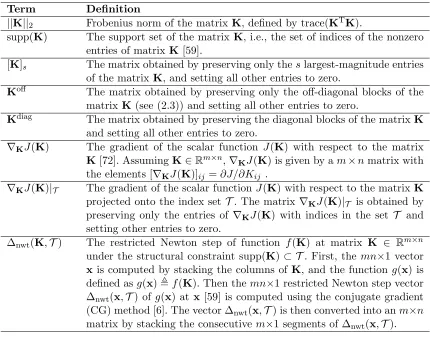
Agent 1
Agent 2
Agent 3
communication link local feedback link state
node control input
applicability of proposed methods, we do not assume specific communication medium or net-work topology. Instead, we address the following question: how to reduce the communication cost, given by the number of communication links (see Fig.2.1), while maintaining desired con-trol objectives? To answer this question, we develop a family ofsparsedesigns, which provide a trade-off between the communication cost and control performance, and reveal the most critical communication links. By limiting the number of communicating state/control input pairs, we reduce the overall bill for leasing bandwidth in an existing network or investment in a dedicated communication infrastructure. However, computation of the actual economic benefit depends on specific communication technology and application and is beyond the scope of this chapter. Sparsity-constrained optimization has been investigated in [59, 60], and the state-feedback optimal-control LQR algorithms for sparsity promotion were addressed in [6,7]. However, these methods employ global optimization objectives and centralized implementation, which limit their applicability to multi-agent systems. Moreover, distributed approaches in the literature [10,61] cannot accommodate specified sparsity constraints and different optimization objectives of the agents.
suppression of inter-area power oscillations, but potentially requires a substantial investment in the communication network needed to exchange state feedback information [4, 7, 67–71]. These results are shown vs. the sparsity constraint, from dense feedback [40] to the decentralized implementation [67], thus illustrating the trade-off between the communication cost and the control performance.
The main contributions of this chapter are:
• Development and analysis of centralized and distributed social optimization algorithms and a noncooperative linear-quadratic game for multi-agent LQR optimal control with static linear state feedback under the constraint on the number of communicating state-control input pairs;
• Development of fair network cost allocation algorithm under sparsity constraints;
• Enabling sparsity-constrained designs and network cost allocation for a multi-area power system that employs wide-area control.
This chapter is organized as follows. The system model and the communication-cost-con-strained social optimization is presented in Section 2.2. In Section 2.3, the multi-agent system model is developed, and the sparsity-constrained distributed differential games are discussed. Section 2.4 describes the proposed network cost allocation algorithm. In Section 2.5, we present an example of utilizing the proposed methods for WAC of power systems. Numerical results and discussion for the Australian power system example are contained in Section 2.6. Finally, some concluding remarks are made in Section 2.7.
2.2
System Model and the Communication-Cost-Constrained
Centralized Optimization
The linear dynamic system with n nodes illustrated in Fig.2.1 is described by the following state-space equation.
˙
x(t) =Ax(t) +Bu(t) +Dw(t), x0(t) =0. (2.1)
wherex(t)=(XT
1 (t), ...,XnT(t))T∈Rm×1 is the vector of states, Xj∈Rmj×1 is the vector of states
for nodej∈{1, ..., n},mj is the number of states in node j,m =Pnj=1mj, u(t) = (U1(t)T, ...,
Un(t)T)T ∈
Rq×1 is the vector of control inputs, Uj ∈ Rpj×1 is the the vector of control input
of node j,pj is the number of control inputs in node j,q =Pnj=1pj, w(t) is a scalar impulse
We assume linear static feedback is employed, and thus the control input satisfies
u(t) =−Kx(t) (2.2)
where K ∈ Rq×m is the feedback gain matrix, with u(t) = (u
1(t), ..., uq(t))T, and x(t) =
(x1(t), ..., xm(t))T. If the coefficient Kij 6= 0, the system (shown in Fig.2.1) contains a
com-munication link that delivers the data of state j to control input i. We will refer to the tuple (xj(t), ui(t)) where j = 1, ..., m, and i = 1, ..., q, as a state-control input link in the rest of
this chapter. Since the states x(t) and the control inputsu(t) are organized according to their physical locations, the matrix Kis in the form
K=
K11 K12 · · · K1n
K21 K22 · · · K2n
.. .
Kn1 Kn2 · · · Knn
(2.3)
where the blockKij ∈Rpi×mj represents feedback of the states of node j to the control inputs
of node i, with i = j corresponding to local feedback and i 6= j — to communication links (see Fig.2.1). Without loss of generality, we define the communication cost as the number of communication links associated with the off-diagonal blocks ofK, given by
cardoff(K) =
n
X
i,j=1,i6=j
nnz(Kij) (2.4)
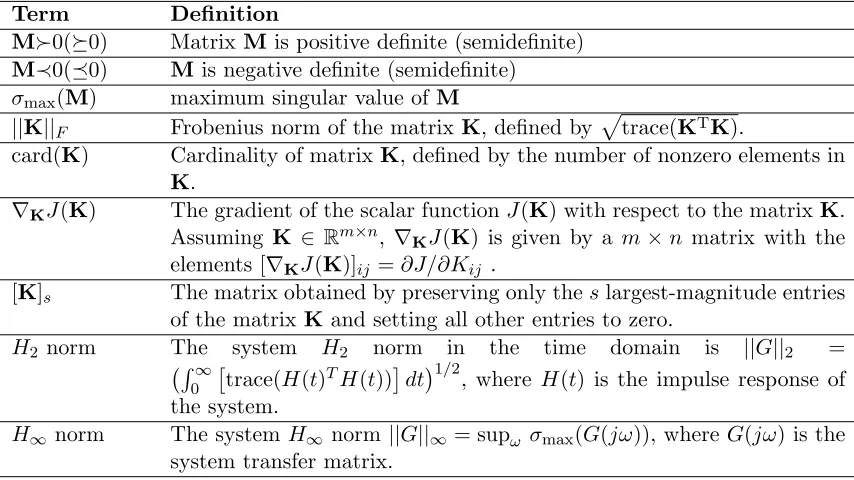
where nnz(·) operator counts the number of nonzero elements in a matrix. The proposed rithms can be easily adapted to other sparsity criteria. Additional notation used in the algo-rithms is described in Table I.
For the model (2.1, 2.2), the social global LQR objective function is given by [58]
J(K) =
Z ∞
t=0
[x(t)TQx(t) +u(t)TRu(t)]dt (2.5)
Table 2.1: Notation used in the Algorithms 2.1 and 2.2
Term Definition
||K||2 Frobenius norm of the matrixK, defined by trace(KTK).
supp(K) The support set of the matrix K, i.e., the set of indices of the nonzero entries of matrix K[59].
[K]s The matrix obtained by preserving only theslargest-magnitude entries
of the matrixK, and setting all other entries to zero.
Koff The matrix obtained by preserving only the off-diagonal blocks of the matrixK (see (2.3)) and setting all other entries to zero.
Kdiag The matrix obtained by preserving the diagonal blocks of the matrixK and setting all other entries to zero.
∇KJ(K) The gradient of the scalar function J(K) with respect to the matrix
K[72]. AssumingK∈Rm×n,∇
KJ(K) is given by am×nmatrix with
the elements [∇KJ(K)]ij =∂J/∂Kij .
∇KJ(K)|T The gradient of the scalar functionJ(K) with respect to the matrix K
projected onto the index set T. The matrix ∇KJ(K)|T is obtained by
preserving only the entries of ∇KJ(K) with indices in the set T and
setting other entries to zero.
∆nwt(K,T) The restricted Newton step of function f(K) at matrix K ∈ Rm×n
under the structural constraint supp(K) ⊂ T. First, the mn×1 vector x is computed by stacking the columns of K, and the function g(x) is defined asg(x),f(K). Then themn×1 restricted Newton step vector ∆nwt(x,T) of g(x) at x [59] is computed using the conjugate gradient (CG) method [6]. The vector ∆nwt(x,T) is then converted into anm×n matrix by stacking the consecutive m×1 segments of ∆nwt(x,T).
Next, we formulate the social optimization under the communication cost constraints: min
K J(K)
s.t. cardoff(K)≤s ˙
x(t) =Ax(t) +Bu(t) +Dw(t)
u(t) =−Kx(t) (2.6)
The optimization (2.6) produces a system with at mostsstate-control input links. Direct solu-tion of (2.6) can have combinatorial complexity [59], so we utilize a numerically efficientGraSP
Algorithm 2.1 Minimizing the centralized LQR objective under the global communication cost constraint s.
1 Initialization
K:=K0 2 Iteration
while stopping criterion are not metdo (0)Kprev :=K
(1) Compute gradient ofJ(K) w.r.t K:g=∇KJ(K)
(2) Identify up to 2soff-diagonal block directions:Z = supp([goff] 2s)
(3) Merge support:T =Z ∪supp(K).
(4) Descend using the Newton step of J restricted to T:K:=K+λ∆nwt(K,T). (5) Prune communication links:K:=Kdiag+ [Koff]
s
(6) Stopping criterion: ||K−Kprev||2 < abs
√
qm+rel||Kprev||2 end while
3 Polishing
I = supp(K)
while not||∇KJ|I||2/ √
qm < 2 do
Descend using the Newton step ofJ restricted to I: K:=K+λ∆nwt(K,I).
end while
gradient-descent directions. In Step 2(1), the gradient ofJ(K) over Kis computed as [62]
∇KJ(K) = 2(RK−BTP)L (2.7)
where the matricesPand L are the unique solutions of the following Lyaponuv equations
(A−BK)TP+P(A−BK) +Q+KTRK= 0
(A−BK)L+L(A−BK)T+DDT = 0 (2.8)
2.3
Multi-Agent System Model and
Communication-Cost-Constrained Linear-Quadratic Games
Suppose that there arer agents, where the agentiowns ni nodes in the system (2.1) as shown
in Fig.2.1. Without loss of generality, the nodes are partitioned as follows
S1 ={1,2, ..., n1} ⇒ belongs to agent 1. S2={n1+ 1, n1+ 2, ..., n1+n2} ⇒ belongs to agent 2.
. . . ⇒ . . .
Sr={n1+n2+...+nr−1+ 1, ..., n} ⇒ belongs to agentr. (2.9) We can rewrite the states and control inputs of each agentiin (2.1) as follows:
˙ xi(t) =
r
X
k=1
Aikxk(t) + r
X
k=1
Bikuk(t) +Diw(t) (2.10)
u1(t) .. . ur(t)
=− K1 .. . Kr
·x(t) (2.11)
where xi(t) = (XnT1+...+ni−1+1(t), ...,X T
n1+...+ni(t))
T ∈
RMi×1 is the vector of states for agent i,
with Mi = Pnj=1+n1...++...n+ini−1+1mj; ui(t) = [UnT1+...+ni−1+1(t), . . . ,U T
n1+...+ni(t)]
T ∈
RNi×1 is the
vector of control inputs for agent i, with Ni =Pjn=1+n...1++...n+ini−1+1pj, K
i is the submatrix ofK
associated with the control inputs of the agenti,Di is the control matrix for the disturbance
input that enters agenti, and D= col(D1, ...,Dr).
Next, we briefly summarize results on linear-quadratic games for this system [38, 40]. The agents in (2.9) are viewed as players that optimize their individual, or selfish, objectives Ji by
selecting their control inputsui(t), for i= 1, ..., r. Theselfish objective of the playeriis given
by
Ji(u1,u2, ...,ur)=
Z ∞
t=0
[x(t)TQix(t)+ui(t)TRiui(t)]dt (2.12)
where Ri∈RNi×Ni, and Qi∈Rm×m are positive semidefinite and positive definite matrices,
as [38]
Ji(u∗i(t),u
∗
−i(t))≤Ji(ui(t),u∗−i(t)),∀ui(t), t=[0,∞) (2.13)
for ∀i∈{1, ...r}, where u−i(t):=(u1(t), . . . ,ui−1(t),ui+1(t), . . . ,ur(t)) is the tuple of strategies
formed by all players except for the playeri. When state feedback is employed (2.11), the Nash strategies u∗i(t) in eq.(2.13) can be determined by solving the cross-coupled algebraic Riccati equations (CARE) (eq.(8) in [40]), where the solution to CARE exists and is unique when the system is weakly coupled. However, CARE produces a dense feedback matrix [40], and, thus, communication links from every state to every control input.
To limit the communication cost in a noncooperative scenario, we formulate a
linear-quadratic noncooperative NFG where the players can establish at most s state-control input
communication links (see Fig.2.1) while each player aims to minimize its selfish LQR objective (4.37). A Nash Equilibrium of this game results in a communication network with cost bounded by s. Thus, Nash strategies (u∗1(t),u∗2(t), ...,u∗r(t)) satisfy for∀i∈ {1, ..., r}
Ji(u∗i(t),u∗−i(t))≤Ji(ui(t),u∗−i(t)) ,∀ui(t)
s.t. cardoff(K)≤s (2.14)
Equivalently, since linear static feedback (2.11) is employed, the strategy of player i is given by the submatrixKi in (2.11), and Nash strategies are expressed as (K1∗,K2∗, ...,Kr∗), which
satisfy for eachi∈ {1, ..., r}
Ji(Ki
∗
,K−i∗)≤Ji(Ki,K−i
∗
) ,∀Ki
s.t. cardoff(K)≤s (2.15)
where the tupleK−i:= (K1, ...,Ki−1,Ki+1, ...,Kr) represents the strategies of all other players
except i. In this case, as s increases, the optimization (2.15) retains the most critical state-control input links needed for the noncooperative optimization, characterized by the set of selfish objectives (4.37).
The proposed game is described in Algorithm 2.2. It is inspired by the iterative gradient descent methods in [36,63], where each player takes a small step towards minimizing its own ob-jective while other players’ strategies are fixed. In each step associated with playeri, we use the GraSP algorithm [59] to update the strategic variableKi while maintaining the overall sparsity constraint. Thus, in the submatrix Ki in (2.11), the elements representing local feedback, i.e., those in the blocks Kjj ∈ Rpj×mj in (2.3) for j ∈ S
i, are free variables while the off-diagonal
w.r.t. playeri’s strategy Ki is similar to that in (2.7–2.8).
∇KiJi(Ki,K−i) = 2(RiKi−DTP¯i) ¯Li (2.16)
where ¯Pi and ¯Li are the unique solutions of the following Lyapunov equations
( ¯Ai−BiKi)TP¯i+ ¯Pi( ¯Ai−BiKi) +Qi+Ki
T
RiKi= 0
( ¯Ai−BiKi) ¯Li+ ¯Li( ¯Ai−BiKi)T+DDT = 0 (2.17)
and ¯Ai =A−Prj=1,j6=iBjKj,Bj = col(B1j, ...,Brj).
Algorithm 2.2 is distributed in the sense that player i individually updates its strategic variableKi. Each player has prior knowledge of the underlying physical system (i.e., the matrices A,B,D in (2.1)) and broadcasts its strategic move (the submatrix Ki) after its strategy is
Algorithm 2.2 Noncooperative game under the global communication cost constraints. 1 Initialization
K:=K0
Initialize the link constraint si for each playeri , i= 1, ..., r, Pri=1si=s.
2 Iteration
while stopping criterion are not metdo Kprev:=K
fori= 1. . . r do
(1) if i >1, si =s−cardoff(K−i).
(2) Compute gradient of Ji in (4.37) w.r.t Ki:
gi =∇KiJi(Ki,K−i)
(3) Identify up to 2si off-diagonal block directions:Z = supp([goffi ]2si)
(4) Merge support: T =Z ∪supp(Ki).
(5) Descend using the Newton step of Ji restricted to T:Ki :=Ki+λ∆nwt(Ki,T). (6) Prune among the off-diagonal block elements: Ki :=Ki,diag+ [Ki,off]
si
end for
Construct global feedback matrix:K= [K1;...;Kr].
Stopping criterion: ||K−Kprev||2 < abs
√
qm+rel||Kprev||2. end while
3 Polishing
Ii = supp(Ki), fori= 1, ..., r.
while not∇KiJi|Ii < 2 ∀i= 1, ..., r do
fori= 1, ..., rdo
Descend using the Newton step of Ji restricted to Ii:Ki:=Ki+λ∆nwt(Ki,Ii).
updated at the completion of Step 2(6) and each inner loop of Step 3.
Finally, note that the social optimization under the sparsity constraint (2.6) can also be implemented in a distributed fashion using a potential game [36], obtained from (2.15) by replacing the individual objectives in (2.15) with the common social objective (2.5) while the players’ strategies are still defined as their control vectors. We refer to this game as distributed social optimization, and its equilibria are defined as
J(Ki∗,K−i∗)≤J(Ki,K−i∗) ,∀Ki
s.t. cardoff(K)≤s (2.18)
To compute (2.18), we use Algorithm 2, where the social objective J() replaces Ji() in Step
2(2) and in the Polishing Step 3.
Finally, we discuss the NEs of the proposed games. Since the LQR objective (2.5) is not convex in the feedback matrix K in general [72], the noncooperative game (2.14, 2.15) is not guaranteed to admit a pure-strategy NE [74]. On the other hand, the distributed social op-timization (2.18) is an exact potential game, and, thus, a pure NE exists for this game [36]. Moreover, the optimal solution of the social optimization problem (2.6) constitutes a NE of (2.18) although the converse does not necessarily hold due to nonconvexity of the LQR objec-tive. Finally, while CARE has a unique NE under the weakly-coupled system assumption [40], the cost-constrained games (2.14), (2.18) can have multiple NEs.
2.4
Network Cost Allocation
First, we review relevant results for cooperative NFGs with transferable utility [75] where the utility of a coalition is viewed as monetary value, which is distributed among the players. Supposerplayers cooperatively form a network with the objective of maximizing their payoffs. Several approaches to fair payoff allocation have been proposed in the literature [65, 66, 76, 77]. We employ the Nash Bargaining Solution (NBS) due to its computational efficiency in NFGs [65, 66]. The NBS payoff allocation algorithm proceeds inthree stepsbased on [66]:
(1) The players cooperate to construct a network that maximizes the global social payoff
vsoc;
(2) Thedisagreement point is computed as
v= (v1, v2..., vr) (2.19)
where the selfish payoff vi is the minimum payoff that the ith player is willing to accept. For
satisfy its own selfish objective;
(3) The overall payoff vsoc is split among the players, with the allocated payoff of playeri given by [66]
αi =vi+
vsoc−Prk=1vk
r . (2.20)
Note that bargaining is successful when the payoff of the social network is at least as large as the sum of the selfish payoffs, i.e.,
vsoc≥
r
X
i=1
vi (2.21)
or equivalently, each player’s allocated payoff is at least as large as its selfish payoff:
ξ =αi−vi ≥0. (2.22)
From (2.22), all players benefit equally by forming the social network.
Next, we describe the proposed network cost allocation method for sparsity-constrained
multi-agent dynamic systems, which is summarized in Algorithm 2.3. Given the global
com-munication cost constraints, in steps 1–3, three different scenarios are analyzed, depending on
Algorithm 2.3 Network Cost Allocation under the Communication Cost Constraint s. 1 Find social optimized objective Jsoc(s)
Jsoc(s) is the optimized objective of (2.6) or (2.18) under constraint s; 2 Find decoupled optimized objectives at DNE.
(1) The NE (2.15) fors= 0 is the decoupled NE (DNE); (2)Optimized selfish objectiveatDNE:JD
i , i= 1, ..., r.
(3)Total objective at DNE: J˜D:=Pr i=1JiD.
3 Find coupled optimized objectives at CNE
(1) The NE (2.15) under constraint siscoupled NE (CNE(s)); (2)Optimized selfish objective at CNE:JC
i (s), i= 1, ..., r
(3)Total objective at CNE(s): ˜JC(s) =Pr
i=1JiC(s).
4 Compute and allocate payoffs and network costs
(1) Thesocial payoff:vsoc(s) = ˜JD−Jsoc(s) (2) Theselfish payoffs (the disagreement point):
vi(s) =JiD−JiC(s), i= 1, ..., r;
(3) Theallocated payoffs: αi(s) =vi(s) +vsoc(s)
−Prk=1vk(s)
r
whether the agents employ: (i) non-local feedback, i.e.,communication bounded by cost s; and
(ii) cooperation. In Step 1, both (i) and (ii) are assumed, resulting in the social optimization, implemented using Algorithm 2.1 or 2.2 under the constraints. In contrast, in Step 2 neither
(i) nor (ii) are employed, and thus the agents play the decoupled noncooperative game, i.e., (2.14) with s= 0, which results in a decentralized system using the Polishing Step 3 of Algo-rithm 2.2 (see [67]). Finally, in Step 3, only (i)is employed, resulting in the coupledgame, i.e., (2.14) with the global constraint s, implemented using Algorithm 2.2. Note that Steps 1 and 3 optimize systems with (at most) scommunication links (see Fig.2.1), while Step 2 restricts communication to local feedback links.
In Steps 4(1) and 4(2), the payoffs vsoc(s) and vi(s) represent the improvement in control
performance, or objective reduction, provided by communication bounded by cost s with (in Step 1) and without (in Step 3) cooperation, respectively, relative to the decentralized imple-mentation (Step 2). It is reasonable to model the minimum payoff an agent i expects from communication by its selfish objective reduction, or selfish payoff,vi(s), thus forming the
dis-agreement point. The allocated payoffs αi(s) are computed in Step 4(3). Note that the NBS
algorithm interprets the payoffs αi(s) and vi(s) as values (e.g., monetary payoffs) that agent
iderives from communication with and without cooperation, respectively (see (2.19, 2.20)). If cooperation does not degrade the minimum acceptable valuevi(s), i.e., if (2.21, 2.22) hold, then
bargaining is successful, and the agents agree to use the links formed by the social optimization found in Step 1, which provides them with the social payoff vsoc(s) and the individual payoffs αi(s), i = 1...r. The latter condition is satisfied for a practical scenario where, in (2.5) and
(4.37), the matrixR is block-diagonal with diagonal blocks given by Ri,i= 1, ..., r, and r
X
i=1
Qi =Q (2.23)
In this case, Pri=1Ji(K) =J(K)1, ∀K, and thus a NE of the noncooperative game (2.13) is a
feasible solution of the social optimization (2.6) for the same value of constraint s, resulting in Jsoc(s)≤J˜C(s) (see Step 1 and 3(3)), which is equivalent to (2.21).
We assume that the grand coalition forms in the proposed cooperative game among the agents. This assumption justifies Step 1 in Alg. 3, where all players cooperate. A sufficient condition for this assumption is efficiency of the grand coalition [78]. We show in appendix A.1 that a practical coalition-level identity similar to (2.23) guarantees efficiency of the grand coalition.
If cooperation is successful, the feedback data required for implementing the social control
1
strategy(as specified by the optimal feedback matrix in (2.6) or (2.18)) will be delivered by the communication network specific to the given medium and application, wherethe constraintsis chosen based on the desired performance/cost tradeoff. In the final Step 4(4), we compute each agent’s share of the cost of this network proportionally to the allocated payoffsαi(s). Note that
ifξ(s) in (2.22) is small relative to the average of the selfish payoffs vi(s) (orJsoc(s)≈J˜C(s)),
the benefit of cooperation (ii) is small relative to that of communication (i), and the agents’ costsCi(s) can vary significantly due to the agents’ diverse needs for feedback and cooperation
as is illustrated in Section 3.5 and in [67]. On the other hand, when ξ(s) is relatively large, i.e., αi(s) ≈ ξ(s) for all i, the payoffs equalize (2.22), resulting in equally split cost of the
communication network among the agents.
2.5
Example: Sparsity-Constrained Wide-Area Control of
Power Systems
We validate our algorithms using the example of wide-area control (WAC) of large-scale power system networks. In recent literature such as [7, 68], WAC has been shown to be very useful for suppressing low-frequency oscillations following small-signal disturbances in large power grids, at the cost of communicating real-time data from sensors at one operating region to controllers at others. The sensors are referred to as Phasor Measurement Units (PMUs), all of which are synchronized to each other via GPS. The envisioned architecture for PMU data exchange in the US power grid, also referred to as the North American Synchrophasor Initiative Network, or NASPInet [4], involves PMUs located at substations of different utility companies sending their measurements to controllers at remote generators through a wide-area communication network such as the Internet. To reduce the cost of this communication, sparsity promotion for WAC was studied in [6, 7]. However, these designs employed social centralized implementation. In contrast, our approach is to design distributed controllers for WAC that are efficient with respect to communication costs. Moreover, we address the question posed in [4] on financing the communication network among the power companies. While the envisioned NASPInet has many functions beyond WAC, fair allocation of network costs associated with delivery of feedback data is necessary to develop its overall pricing scheme.
reasonable amount of control effort [7], where the matrices Q and R in (2.5) are chosen to reduce the energies of the state and control vectors, respectively. Therefore, in the rest of this chapter we will refer to the objective (e.g., in (2.5), (4.37), Algorithm 2.3, etc.) as energy and to the payoffs vsoc(s) and vi(s) in Algorithm 2.3 (Step 4(1) and 4(2)) as energy savings.
Typically a 3rd-order model of synchronous generators, including two swing states and one excitation state (for details, please see [68]) suffices for solving most WAC problems since the goal is to influence the electro-mechanical dynamics of these generators. Note that the 3rd-order model indicates mj = 3 and pj = 1,∀j = 1, ..., n in the general state-space model (2.1). We
consider a power system withn synchronous generators, divided intor non-overlapping areas, and define the states of the jth generator accordingly as
XjT(t) = (∆δj(t),∆ωj(t),∆Ej(t)), (2.24)
where the elements represent small-signal changes in phase angle, frequency, and excitation voltage, respectively. If higher-order models are considered, then the last term can be simply replaced by a vector x−j that collects all states except for the phase and the frequency. We assume full state availability, which can be achieved by placing PMUs at every generator bus, or by running a prior state estimation loop. We assume the matrixDin (2.1) to be an indicator matrix with all elements zero except for the one corresponding to the acceleration equation of the generator at which the fault w(t) happens.
Next, we describe the choice of matrices in the social (2.5) and the selfish (4.37) energy optimization. We set R in (2.5) and Ri (4.37) as the identity matrix as to achieve the same
weight for the energy of every control input. The matrix Q in (2.5) is chosen so that all generators arrive at a consensus in their small-signal changes in phase angles and frequencies, as dictated by the physical topology of the network [7, 67]. Considering the small-signal-model in Kron-reduced form [68], for the 3rd order model,Qin (2.5) is determined from (2.25)
Estates=
∆δ ∆ω ∆E T ¯ L ¯ L I
| {z }
Q0 ∆δ ∆ω ∆E
=xT(PTQ0P)x=xTQx
= n X k=1 n X
j=k+1
[(∆δj−∆δk)2+ (∆ωj −∆ωk)2] + n
X
j=1 ∆E2
j, (2.25)
∆ET∆E term in (2.25) is replaced by (x−)Tx−, where the latter is obtained by stacking the
terms x−j. The matrix ¯L =nI−1n·1Tn (appendix A.2, where 1n∈Rn×1 is the column vector
of all ones, andI is the identity matrix.
To quantify the ith player’s selfish objective (4.37), we define two quantities, namely,
intra-area energy andinter-area energy, from the perspective of the ith player as follows: Eintra
i (x) :=
X
k∈si
X
j∈si
j>k
(∆δk−∆δj)2+ (∆ωk−∆ωj)2
+X
k∈si
∆E2
k (2.26)
Eiinter(x) := 1 2
X
k∈si
X
j=1,...,n, j /∈si
(∆δk−∆δj)2+ (∆ωk−∆ωj)2
(2.27)
It can be seen that the intra-area energy of area i is designed for the consensus in the phase angle and frequency states of the generators in area i. The inter-area energy is modeled by collecting the power transfer terms associated with a generator in area i and a generator in another area, and attributing 1/2 of this energy to area i. The total state energy associated with area i∈ {1, ..., r}is
xTQix=Eiintra(x) +Eiinter(x), (2.28)
where Qi ≥ 0, since (2.28) is the quadratic form of the states. Detailed derivations ofQ and
Qi can be found in [79]. It is easy to show that the resulting LQR objectives (2.5) and (4.37)
satisfy (2.23), thus assuring successful cooperation among the power companies. We illustrate this fact in the next section by numerical simulation of a 50-bus power system model.
2.6
Numerical Results and Performance Analysis for the
Aus-tralian Power System Model
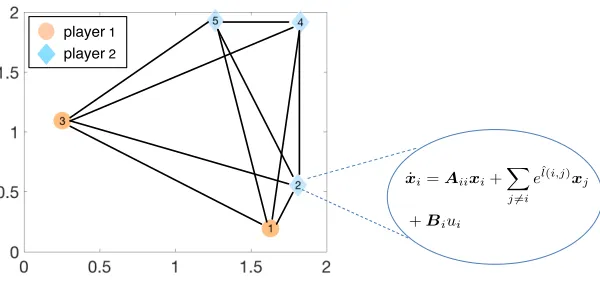
!"# !"$ !"! !"% !"& !"' !"( !") !"* !** !*" !*) !*& !*! !*$ !*# )"$ )"# )"* )"% )") )"' )*) )"& )"( )** )*" )*& )*! )*# )*% )*$ *") *"* &"' &*" &** &"$ &*! &"* &") &"& &*) &"! &*& &"% &"( $"' &*$ $"% $"# $"$ $"( $"! )"! $") $"& $"* +,-./* +,-./& +,-./! +,-.) &"#
(a) Line diagram of the Australian 50-bus system.
generator bus (node) load bus
communication link local feedback link
physical transmission line Area 1 (Agent 1) Area 3 (Agent 3) Area 4 (Agent 4) Area 2 (Agent 2)
(b) Simplified Australian power system with feedback links.
Figure 2.2: A simplified 50-bus representation of the southeast Australian power system [1].
0 1 10 100 1000 s
80 85 90 95 100
Global energy
Centralized (Alg.1) Social distributed (Alg.2) Sparsity-promotion [8] CNE (Alg.2)
DNE CARE [5]
Figure 2.3: Global energies of social optimization and noncooperative games vs. communication cost constraint.
2.6.1 Global Energies
Fig.2.3 shows the global closed-loop energies for the 50-bus system with respect to the com-munication cost constraints for the various centralized and distributed algorithms discussed in the previous sections. Global energies of the centralized optimization (2.6) using Algorithm 2.1, the coupled noncooperative game (CNE) in Step 3 of Algorithm 2.3, the social distributed optimization (2.18) using Algorithm 2, and of the decoupled game (DNE) in Step 2 of Algo-rithm 2.3 are included. We also show the global energy of the iterative dense-feedback method that solves CARE [40] (note that our system satisfies the weakly coupled condition in [40]) and of the centralized sparsity-promoting ADMM method [7], modified to satisfy the sparsity constraint. Since the energy of the method in [7] is nondecreasing with the sparsity parameter γ, a bisection search on γ yields the smallest value ofγ for which the off-diagonal cardinality of the feedback matrix produced by the ADMM algorithm satisfies the constraint. The choice of the l1-metric weights for this ADMM implementation is described in [67].
respectively. The former corresponds to the decentralized case [67] while the latter requires dense communication [40].
Moreover, the energyJsoc of the distributed social optimization (using Algorithm 2) closely approximates that of the centralized Algorithm 1 for most of thes-range. We also observe that the closed-loop energy of social optimization using Algorithms 2.1 or 2.2 is smaller than that using the sparsity-promoting algorithm in a moderately sparse region, thus providing better reduction of both intra- and inter-area oscillations when given an exact communication cost constraint.
While the global energies of all sparsity-constrained methods are theoretically nonincreas-ing with s, the social algorithms might occasionally produce a larger energy as s increases. This happens when an algorithm converges to a local minimum since the optimization objec-tive (2.5) is locally, but not necessarily globally, convex in K [72]. If the algorithm results in Jsoc(s2)>Jsoc(s1) fors2>s1, we choose a suboptimal solutionJsoc(s2),Jsoc(s1) (see Algorithm 2.3, Step 1), which produces a nonincreasing Jsoc(s). Finally, note that the global objectives (energies) of all algorithms saturate to the same asymptotic value whensexceeds 740, implying that the communication cost can be reduced by a factor of 3 relative to the cost of the dense LQR network without compromising the control performance. Thus, in the next figure, we show results only for small and moderate values ofs, where the energies vary significantly.
2.6.2 Selfish Energies and Cost Allocation
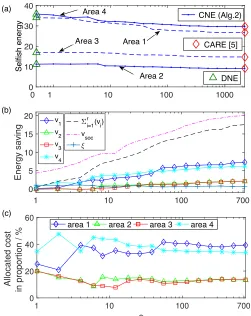
In Fig.2.4, we show performance of noncooperative games, as well as payoffs and costs in Al-gorithm 2.3. Fig.2.4(a) shows the individual energy objectives of the four areas at CNE (Step 3(2)). In Fig.2.4(b), the selfish energy savings vi(s) (Step 4(2)) for each company, their sum,
the social energy savingsvsoc(s) (Step 4(1)), and the payoff increaseξ(s) (2.22) are illustrated. We observe that bargaining is successful (see (2.21)), and there is modest payoff increase due to cooperation.
Note that while the overall global CNE objective ˜JC(s) (Step 3(3)) is theoretically nonin-creasing with s, this is not necessarily true for individual selfish energies JC
i (s) in Step 3(2),
which means that increasing the overall communication budget might degrade some areas’ en-ergies when they act noncooperatively. This phenomenon can result in decreasing and possibly negative payoffs vi(s) and αi(s) over some regions of the constraint s, which might dissatisfy
the affected players and would require a revision of the proposed cost allocation method in Step 4(4) of Algorithm 2.3. See, e.g., slightly increasing selfish objective JC
3(s) and negative selfish payoffv3(s) of area 3 in Fig.2.4 (a) and (b), respectively, for small values ofs. Nevertheless, the allocated payoffs αi(s) in Algorithm 2.3 (Step 4(3)) are nonnegative for all companies for the
0 1 10 100 1000 0 10 20 30 40 Selfish energy DNE CARE [5] CNE (Alg.2) Area 4 Area 1 Area 3 Area 2 (a)
1 10 100 700
s 0 20 40 60 Allocated cost
in proportion / %
area 1 area 2 area 3 area 4 (c)
(b)
1 10 100 700
0 5 10 15 20 Energy saving v 1 v 2 v 3 v 4
!i=1r (v
i)
v
soc
!
Figure 2.4: Selfish energies (objectives), payoffs and cost allocation in Algorithm 2.3 vs. com-munication cost constraint s. (a) Selfish energies of noncooperative games for areas 1–4. (b) The energy savings (payoffs) vi(s) and vsoc(s) and payoff increase ξ(s). (c) Proportional cost
allocation.
payoff computation method that guarantees nondecreasing payoffs is presented in Appendix A.1.
Fig.2.4 demonstrates significant disparity in the selfish energiesJC
i (s), thevi(s) values, and
the allocated proportional costs Ci(s) among the areas, which is due to the grid topology. For
example, large selfish energy and allocated cost of area 1 can be explained by its large number of generators. However, area size is not the only indicator, e.g., area 4 has fewer generators than area 3, but much larger selfish energy JC
are the most valuable for achieving energy reduction when using WAC [7].
2.6.3 Algorithm Convergence and Implementation Issues
First, we focus on the numerical properties of Algorithms 1 and 2. Since the LQR objective does not satisfy the Stable Restricted Hessian condition [59], convergence of these algorithms is not assured in general. However, if Step 2 of Algorithm 1 converges and yields a stabiliz-ing feedback matrix K, then Step 3 will also converge due to the local convexity ofJ(K). At convergence, Step 3 produces a feedback matrix ˆKthat satisfies the basic feasibility property ∇KJ(K)|supp( ˆK)(K= ˆK) = 0, which is a weak necessary condition for the optimality of
prob-lem (2.6) [60]. Similar arguments demonstrate that Algorithm 2 produces a feedback matrix that satisfies the basic feasibility property of each individual minimization in the CNE problem (2.15) (or (2.18) for social optimization). Note that the decoupled game in Step 2 of Algorithm 2.3 represents an unconstrained optimization with respect to each player’s strategy, which is given by its local feedback matrix [67]. This game is implemented using the polishing Step 3 of Algorithm 2.2. When this implementation converges, the resulting equilibrium point is a local NE [63] due to local convexity of the LQR objective [72], i.e., the strategy of each player is a local optimum given other players’ strategies. From these observations, we conclude that con-vergence properties of proposed algorithms resemble those of the ADMM-based methods [7]. In both cases, while theoretical guarantees are not always feasible, extensive numerical experience demonstrates that the algorithms converge and provide desirable minimization solutions over a range of sparsity parameters. We found that the proposed sparsity-constrained algorithms also converge and exhibit similar performance and complexity trends to those shown in this chapter for the New England power system model used in [7].
stabilizing feedback matrix (Similarly, stabilizing feedback might not exist for small values of the constraints). Moreover, Algorithm 2 had the best performance when the initial link settings si were chosen proportionally to the number of nodes ni in (2.9).
Finally, we found that the computational load of the polishing step dominates the overall runtime for both algorithms, and the Newton step using the CG method (see Table 2.1, last entry) is the most computation-intensive operation, which has polynomial complexity in sand the number of states [6]. In our experiments, all algorithms in Fig.2.3 converged in less than 103 seconds for any value of s although this did not include the bisection search time for the modified ADMM method [7], which is very computation-intensive. Moreover, the distributed social implementation using Algorithm 2 converged much faster than the centralized method (Algorithm 1)2.
2.7
Conclusion
LQR optimization under the communication-cost constraint was investigated for multi-agent dynamic systems with linear static state feedback. First, a communication-cost-constrained centralized social optimization algorithm was developed. Second, distributed game-theoretic al-gorithms were investigated for both selfish and social optimization under the sparsity constraint. Finally, cooperative NFG theory was employed to allocate the costs of the communication in-frastructure in a multi-agent dynamic system. Using a 50-bus power system model divided into 4 areas, we demonstrated convergence of proposed algorithms and desirable performance and complexity features of distributed methods over the range of the sparsity constraint, thus pro-viding a trade-off between the communication cost and the control performance. Furthermore, we discussed the relationship between the proportionally allocated costs and power companies’ needs for feedback and cooperation, and showed that the proposed cost allocation algorithm is rooted in the physical topology of the power grid. Our current research focuses on applying pro-posed algorithms to systems with uncertainty and communication delays. Moreover, we plan to extend the concepts of this chapter to diverse multi-agent dynamic system applications, robust optimization objectives, output feedback, and different communication network architectures.
2The experiments are run using MATLAB on a MacBook Pro with Yosemite operating system, 2.6 GHz Intel
Chapter 3
Sparsity-Constrained Mixed
H
2
/H
∞
Control
We propose an algorithm for designing sparsity-constrained controllers for linear time-invariant systems with model uncertainties using a mixedH2/H∞objective. We first improve a previously
proposed descent algorithm for mixed H2/H∞ control using a modified Zoutendijk’s method.
Thereafter, we impose a sparsity constraint on this design by combining it with a greedy gra-dient support pursuit (GraSP) method. The proposed algorithm guarantees a predetermined level of sparsity while maintaining acceptable H2 performance as well as H∞ robustness to
uncertainties in the open-loop model. The effectiveness of the proposed method is illustrated through simulations.
3.1
Introduction
Recent papers such as [2, 8, 81, 82] have proposed various sparse LQR optimal control designs for reducing communication costs for controlling large multi-agent LTI networks. However, this research ignores model uncertainties, which are bound to arise in all practical large-scale systems since the network operating conditions and the resulting network topology might change rapidly over time. Even if the system is static, the designer might not know all model parameters or have mismatched parameter values due to idealistic design assumptions in the underlying communication network. This problem is addressed in [23], where a sparse H∞ controller is
derived for a class of system with sparse input matrix by exploiting the symmetric structure of the state matrix. However, to provide robustness while optimizing the closed-loop performance, is it desirable to use the mixed H2/H∞ control objective [83, 84]. In [22], this objective was
combined with sparsity promotion by minimizing the weighted sum of H2-norm bound, H∞
![Figure 2.2:A simplified 50-bus representation of the southeast Australian power system [1].](https://thumb-us.123doks.com/thumbv2/123dok_us/1284519.1160958/35.612.205.427.75.214/figure-simplied-bus-representation-southeast-australian-power.webp)

![Figure 3.1: Hs2 norm increase relative to the H2 norm of standard LQR vs. sparsity constraint for sparse LQR [2] and Algorithm 2.](https://thumb-us.123doks.com/thumbv2/123dok_us/1284519.1160958/52.612.188.429.335.525/figure-increase-relative-standard-sparsity-constraint-sparse-algorithm.webp)