DYNAMIC TIMESLOT ALLOCATION TECHNIQUE FOR WIRELESS SENSOR NETWORK
OON ERIXNO
A thesis submitted in fulfillment of the requirements for the award of the degree of
Master of Science (Computer Science)
Faculty of Computing Universiti Teknologi Malaysia
iii
iv
ACKNOWLEDGEMENT
All praise unto Allah for everything I have. I would like to thank the following persons who accompanied me during the time I was working for this degree.
In preparing this thesis, I was in contact with many people, researchers, academicians, and practitioners. They have contributed towards my understanding and thoughts. In particular, I wish to express my sincere appreciation to my thesis supervisor, Assoc. Prof. Dr. Kamalrulnizam Abu Bakar, for encouragement, guidance, critics and advice till the end of glorious successful work.
My fellow postgraduate students should also be recognized for their support. My sincere appreciation also extends to all my colleagues, En. Herman, Edi Saputra, Yoanda Alim Syahbana, M. Gary Shaffer, Farah Ramadhani and others who have provided assistance at various occasions. Their views and tips are useful indeed. Unfortunately, it is not possible to list all of them in this limited space.
v
ABSTRACT
vi
ABSTRAK
vii
TABLE OF CONTENTS
CHAPTER TITLE PAGE
DECLARATION II
DEDICATION III
ACKNOWLEDGEMENT IV
ABSTRACT V
ABSTRAK VI
TABLE OF CONTENTS VII
LIST OF TABLES X
LIST OF FIGURES XI
1 INTRODUCTION 1
1.1 Overview 1
1.2 Background of the Problem 3
1.3 Statement of the Problem 6
1.4 Purpose of the Research 6
1.5 Objectives 7
1.6 Scope and Key Assumptions 7
1.7 Research Contributions 8
1.8 Organization of the Thesis 8
2 LITERATURE REVIEW 9
2.1 Introduction 9
2.2 Wireless Sensor Network 10
viii
2.3 Funnelling Effect 15
2.4 Some Approaches to Minimize the Funnelling Effect 18
2.4.1 Data Aggregation 18
2.4.2 Funnelling-Aware Medium Access Control (MAC) 21
2.4.3 Congestion Control 25
3 RESEARCH METHODOLOGY 30
3.1 Introduction 30
3.2 Research Phases and Investigation Procedure 31
3.2.1 Research Phases 31
3.2.2 Investigation Procedure 33
3.2.3 Overview of the Proposed DTsA 34
3.3 Experiment and Evaluation 40
3.3.1 Experiment Procedure 41
3.3.2 DTsA Evaluation 44
3.4 Summary 45
4 DESIGN OF DYNAMIC TIME SLOT ALLOCATION 46
4.1 Introduction 46
4.2 Dynamic Traffic Scheduling in DTsA 46 4.3 Communication Timing and Framing in DTsA 48
4.4 DTsA Operation 50
4.5 Network Setup Phase 54
4.5.1 Listening Neighbor’s Super-frame Beacon 55 4.5.2 Joining Parent Node’s Cluster 58 4.5.3 Creating New Cluster/ Personal Area Network 65
4.6 Steady State Phase 67
4.6.1 Updating Status of Child Nodes 71 4.6.2 Updating Time Slot Information 72 4.6.3 Transmitting Super-frame Beacon 74 4.6.4 Transmitting Time Slot Information 76 4.6.5 Receiving Join Request Packet 79
ix
4.6.7 Transmitting/ Forwarding Data Packet 86
4.6.8 Network Self-Healing 93
5 EXPERIMENT AND ANALYSIS 95
5.1 Introduction 95
5.2 Design of Experiment 95
5.2.1 Design of Timing and Framing 96
5.2.2 Procedure of Experiment 98
5.3 Result and Analysis 101
5.3.1 Low Level Funnelling Topology 102 5.3.2 High Level Funnelling Topology 104
6 DISCUSSIONS AND CONCLUSIONS 116
6.1 Introduction 116
6.2 Discussions 116
6.2.1 Advantage of DTsA 118
6.2.2 Challenge of DTsA 119
6.3 Future Works 120
6.4 Conclusions 120
PUBLICATIONS 122
REFERENCES 123
x
LIST OF TABLES
TABLE NO. TITLE PAGE
xi
LIST OF FIGURES
FIGURE NO. TITLE PAGE
1.1 Funnelling effect 2
1.2 Funnelling effect in WSN 3
2.1 Structure of literature review 10
2.2 Typical architecture of sensor node’s components 11
2.3 Funnelling issue 16
2.4 Funnelling effect (Hyeonsu et al., 2010) 17 2.5 LEACH topology for data aggregation (Abdulsalam and Kamel,
2010) 20
2.6 Funnelling-MAC in WSN (Ahn et al., 2006) 22 2.7 Dartmouth College Sensor Testbed (Ahn et al., 2007) 23
3.1 Research phases 32
3.3 Hierarchical clusters network topology 35
3.4 Illustration of DTsA 38
3.5 Illustration of MT-XLP 40
3.6 Experimental network topology 41
3.7 Prototype of sensor node 42
4.1 Mechanism of dynamic traffic scheduling in DTsA 47
4.2 DTsA round 49
4.3 Time frame of parent mode operation 49
4.4 Time frame of child mode operation 50
4.5 Flow chart: DTsA operation 51
4.6 Structure of configuration words 51
4.7 Flow chart: network setup phase 54
4.8 Flow chart: listen to neighbour’s SB 56 4.9 Flow chart: arranging priority of neighbor to become parent
xii
4.10 Flow chart: mechanism of join to parent node’s cluster 62
4.11 Format of Join Request (JR) packet 63
4.12 Flow chart: mechanism for creating new cluster network 66
4.13 Flow chart: steady state phase 68
4.14 Flow chart: updating status of child nodes 71 4.15 Flow chart: updating time slot information 73 4.16 Format of Super-frame Beacon (SB) Packet 74 4.17 Flow chart: Transmitting Super-frame Beacon (SB) packet 75 4.18 Format of Time Slot Information (TSI) packet 77 4.19 Flow chart: transmitting time slot information 77 4.20 Flow chart: receiving Join Request (JR) packet 80 4.21 Format of Acknowledgement (Ack) packet 83
4.22 Flow chart: receiving data packet 84
4.23 Flow chart: transmitting/ forwarding data packet 87
4.24 Format of UTS packet 88
4.25 Format of activation packet 89
4.26 Format of data packet 90
4.27 Flow chart: network self-healing 94
5.1 Timing and Framing DTsA 96
5.2 Timing and Framing of MT-XLP 98
5.3 (a) Low level funnelling topology 99
5.3 (b) High level funnelling topology 99
5.4 Throughput vs. packet rate in low level funnelling topology 103 5.5 Packet loss vs. packet rate in low level funnelling topology 104 5.6 Throughput vs. packet rate in high level funnelling topology 105
5.7 Throughput vs. packet rate in DTsA 106
xiii
CHAPTER 1
INTRODUCTION
1.1 Overview
In recent years, Wireless Sensor Network (WSN) technology has been explored and implemented by many researchers. Generally, this technology is a kind of data acquisition network, controlled and monitored by a Network Operation Centre (NOC) (Lewis, 2004). It has been implemented in various applications including machine to machine communication, environmental monitoring, or data collection. Research by Khakpour and Shenassa (2008) implemented WSN for industrial control system while Rhee et al. (2008) implemented WSN for building protection surveillance system. Yaghmaee and Adjeroh (2009) implemented WSN for environmental monitoring system.
2
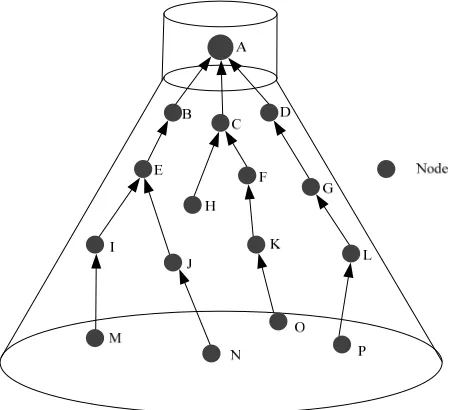
Figure 1.1 shows the funnelling issue that occurs in a network with multi-to-one uplink traffic. Suppose that A is a node that serves as data collector (also known as sink node) and nodes from B to P are sensor nodes that serve as data transmitter (also known as sensor nodes). Each of sensor nodes has different traffic intensity based on its distance from sink node. For example, a comparison between node B that is near to node A and node M that is far from node A. By assuming that every sensor node transmits a packet periodically, the node B has six packets that must be transmitted periodically. Among of them are one packet from its own packet and five packets from other nodes i.e. E, I, M, J, and N. Meanwhile, the node M only has one packet to transmit its own packet periodically.
Figure 1.1 Funnelling effect
3
1.2 Background of the Problem
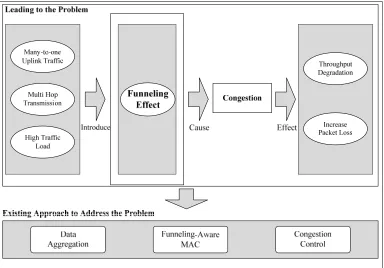
Figure 1.2 summarizes phenomenon of funnelling effect in WSN and existing approach to address the issue. The funnelling is usually occurred in WSN that characterized by many-to-one uplink traffic that transmits over multi hop transmission and in high traffic load. This condition causes congestion in nodes that are near to sink node. As a consequence, it may reduce throughput and increase packet loss. Many approaches have been proposed to overcome the funnelling effect. The approaches include data aggregation, funnelling-aware Medium Access Control (MAC), and congestion control.
Figure 1.2 Funnelling effect in WSN
4
et al., 2003). The data aggregation is performed by cluster head. Despite
transmitting large number of packet and processing the packets in Network Operation Centre (NOC), the cluster head pre-processes packets from its child nodes before transmitting them to sink node. The packet pre-processing summarizes information that received from child nodes. Then, only a few packets will be transmitted to sink node that represent information collected from child nodes. By this way, cluster head can reduce number of packets to be transmitted to sink node.
Other approach to address funnelling issue is by implementing funnelling-aware Medium Access Control (MAC) protocol. Z-MAC is one of funnelling funnelling-aware MAC proposed by Rhee et al. (2008). It is a hybrid (TDMA/CSMA) protocol that acts like a schedule-based protocol under high traffic intensity and a contention-based protocol under low traffic intensity. To schedule data transmission during high traffic intensity, Z-MAC offers scheduling mechanism using DRAND (Rhee et al., 2009). As drawback of Z-MAC, it cannot schedule packet transmission for high traffic intensity that is near to sink node. Therefore, it cannot fully mitigate the effects of funnelling.
The limitation of Z-MAC is addressed by Funnelling-MAC proposed by Ahn
et al. (2006). Funnelling-MAC defines an intensity region where is near to sink node
that is normally occupied by more nodes. It deploys TDMA scheduling within the intensity region, while keeping CSMA in the rest of the network to provide flexibility. The Funnelling-MAC can address the funnelling effect by scheduling more traffic in the intensity region, and enlarge the intensity region to allow more nodes to deploy TDMA scheduling.
5
transmission. For example, WSN application for monitoring landslide that employs large number of nodes with short range transmission cannot use this approach.
As congestion control approach, Multi-channel Time Division Multiple Access (TDMA) – based cross layer protocol (MT-XLP) proposed by Saputra (2012) uses local synchronization to eliminates the need of sink node with long transmission range. Using hierarchical cluster network topology, synchronization is performed locally within each cluster. To prevent inter-cluster collisions, this protocol uses Frequency Division Multiple Access (FDMA) scheme to assign different frequency channel to each cluster. Intra cluster collisions are avoided by applying Time Division Multiple Access (TDMA) scheme. Using TDMA scheme, MT-XLP controls congestion by scheduling the traffic. The scheduling distributes traffic over hierarchical cluster topology. Load balancing and hop-by-hop flow control are two main features of the traffic scheduling.
Although the MT-XLP offers congestion control and traffic scheduling, it cannot fully mitigate the funnelling effect. Fixed time slot allocation that used in MT-XLP cannot schedule the traffic while the network topology is dynamically changes. This condition influences amount of data packet that forwarded from node to node. MT-XLP is not flexible enough to adapt with condition and to schedule more traffic for sensor nodes that nearer to sink node.
6
1.3 Statement of the Problem
Based on review on the previous works, dynamic traffic scheduling has important role in addressing funnelling effect in WSN. To minimize the funnelling effect, more traffic should be scheduled by nodes that is nearer to sink node, because nodes that are nearer to sink node has to forward more data packets than nodes that are far away from sink node. Using dynamic traffic scheduling allows nodes to dynamically scheduling their packet transmission following their traffic intensity in various network topologies.
However, designing dynamic traffic scheduling in DTsA introduces some challenges. Design of dynamic traffic scheduling in DTsA should be able to adapt with the change of traffic intensity due to the change of network topology and packet rate transmitted by sensor nodes. In addition, the dynamic traffic scheduling requires mechanism of timing and framing to synchronize communication between nodes. Moreover, minimizing the packet loss and increasing the throughput are two challenges in solving the funnelling effect. To provide such design of the DTsA, this research has to answer the following research questions:
1. How dynamic traffic scheduling can adapt variation of traffic intensity and minimizing funnelling effect?
2. How to handle child-parent node synchronization when network topology is dynamically changed using dynamic traffic scheduling?
1.4 Purpose of the Research
7
loss. DTsA also allow network to adapt with the change of traffic intensity due to the change of network topology or packet rate transmitted by sensor nodes.
1.5 Objectives
The specific objectives of this research are:
1. To develop Dynamic Time slot Allocation (DTsA) technique that can adapt variation of traffic intensity in order to minimize funnelling effect.
2. To enhance synchronization in communication of child-parent node by optimizing timing and framing mechanism.
3. To evaluate performance of DTsA in various traffic intensities and dynamic change of topology.
1.6 Scope and Key Assumptions
This research is limited to the following:
1. DTsA is only designed for uplink data direction in which data comes from sensor nodes toward sink node.
2. DTsA is limited to applications with periodic data transmission.
8
1.7 Research Contributions
The main contributions of this research are summarized as follow:
1. A design of Dynamic Timeslot Allocation (DTsA) technique for minimizing funnelling effects that can adapt various traffic intensities.
2. Management of timing and framing that enables DTsA allocate time slot dynamically
1.8 Organization of the Thesis
123
REFERENCES
Abdulsalam, H. M., and Kamel, L. K. (2010, 13-13 Dec. 2010). W-LEACH: Weighted Low Energy Adaptive Clustering Hierarchy Aggregation Algorithm for Data Streams in Wireless Sensor Networks. IEEE
International Conference on Data Mining Workshops (ICDMW). 13
December. Sydney, Australia: IEEE, 1-8.
Ahn, G.-S., Hong, S., Miluzzo, E., Campbell, A., and Cuomo, F. (2006). Funnelling-MAC: a localized, sink-oriented MAC for boosting fidelity in sensor networks. SenSys '06: Proceedings of the 4th international conference on
Embedded networked sensor systems.31 October - 6 November. Boulder,
Colorado: ACM, 293-306.
Akyildiz, I. F., Su, W. L., Sankarasubramaniam, Y., and Cayirci, E. (2002). A survey on sensor networks. IEEE Communications Magazine, 40(8), 102-114.
Al-Karaki, J. N., and Kamal, A. E. (2004). Routing techniques in wireless sensor networks: A survey. IEEE Wireless Communications, 11(6), 6-28.
Bista, R., Yong-ki, K., and Jae-Woo, C. (2009). A New Approach for Energy-Balanced Data Aggregation in Wireless Sensor Networks. Ninth IEEE International Conference on Computer and Information Technology, CIT
'09. 11-14 October. Xiamen, China: IEEE, 9-15.
Chi, T., Chen, M., and Gao, Q. (2008). Implementation and Study of a Greenhouse Environment Surveillance System Based on Wireless Sensor Network. International Conference on Embedded Software and Systems Symposia,
Proceedings. 29-31 July. Chengdu, China: IEEE, 287-291.
124
on Embedded networked sensor systems. 3-5 November. Baltimore, USA:
ACM, 148-161.
Fan, G.-y., Chen, H.-f., Xie, L., and Wang, K. (2011). Funnelling media access control (MAC) protocol for underwater acoustic sensor networks. Journal of
Zhejiang University SCIENCE C, 12(11), 932-941.
Heinzelman, W. R., Chandrakasan, A., and Balakrishnan, H. (2000). Energy-efficient communication protocol for wireless microsensor networks. Proceedings of the 33rd Annual Hawaii International Conference on System
Sciences. 4-7 January. Maui, USA: IEEE, 1-10.
Hyeonsu, L., Seung Hyong, R., Yonghoon, C., Suwon, P., and Jeong, T. T. (2010,). An adaptive MAC protocol for ensuring throughput in wireless sensor networks. International Conference on the Information and Communication
Technology Convergence (ICTC). 17-19 November. Jeju, Korea: IEEE,
247-249.
Khakpour, K., and Shenassa, M. H. (2008). Industrial Control using Wireless Sensor Networks. 3rd International Conference on Information and Communication
Technologies: From Theory to Applications Vol 1-5. 7-15 April. Damascus,
Syria: IEEE, 1927-1931.
Khosrowshahi, A. C., Dehghan, M., Pedram, H., and Alizadeh, M. (2009). A Novel Multi Channel Sensor Network MAC Protocol. Fourth International
Conference on the Systems and Networks Communications. 20-25
September. Porto, Portugal: IEEE, 230-235.
Kohvakka, M., Kuorilehto, M., H, M. (2006). Performance analysis of IEEE 802.15.4 and ZigBee for large-scale wireless sensor network applications. Proceedings of the 3rd ACM international workshop on Performance
evaluation of wireless ad hoc, sensor and ubiquitous networks. 2-6 October.
Torremolinos, Spain: ACM, 48-57.
Lewis, F. L. (2004). Wireless Sensor Networks. In Smart Environments:
Technologies, Protocols, and Applications. New York, USA: John Wiley.
Mainwaring, A., Culler, D., Polastre, J., Szewczyk, R., and Anderson, J. (2002). Wireless sensor networks for habitat monitoring. Proceedings of the 1st
ACM international workshop on Wireless sensor networks and applications.
125
Murthy, C. S. R., and Manoj, B. S. (2004). Ad Hoc wireless networks: architectures
and protocols: Prentice Hall PTR.
Petrovic, D., Shah, R. C., Ramchandran, K., and Rabaey, J. (2003). Data funnelling: routing with aggregation and compression for wireless sensor networks. IEEE International Workshop on First Sensor Network Protocols and
Applications. 11 May. Anchorage, Alaska: IEEE, 156-162.
Rhee, I., Warrier, A., Aia, M., Min, J., and Sichitiu, M. L. (2008). Z-MAC: A hybrid MAC for wireless sensor networks. IEEE-Acm Transactions on Networking, 16(3), 511-524.
Rhee, I., Warrier, A., Min, J., and Xu, L. S. (2009). DRAND: Distributed Randomized TDMA Scheduling for Wireless Ad Hoc Networks. Ieee
Transactions on Mobile Computing, 8(10), 1384-1396.
Salajegheh, M., Soroush, H., and Kalis, A. (2007). HyMAC: Hybrid TDMA/FDMA medium access control protocol for wireless sensor networks. 18th International Symposium on Personal, Indoor and Mobile Radio
Communications, Vols 1-9. 3-7 September. Athens, Grece: IEEE, 4069-4073.
Saputra, E. (2012). Efficient Communication Through Multi-Channel Time Division
Multiple Access for Wireless Sensor Network. Masters Thesis, Universiti
Teknologi Malaysia.
Shafiullah, G. M., Thompson, A., Wolfs, P. J., and Ali, S. (2008). Energy-Efficient TDMA MAC Protocol for Wireless Sensor Networks Applications. 11th International Conference on Computer and Information Technology: Iccit
2008, Vols 1 and 2. 24-27 December. Khulna, Bangladesh: IEEE, 985-990.
Sokwoo, R., Seetharam, D., and Sheng, L. (2004). Techniques for minimizing power consumption in low data-rate wireless sensor networks. Wireless
Communications and Networking Conference. 21-25 March. Atlanta, USA:
IEEE, 1727-1731.
Stemm, M., and Katz, R. (1997). Measuring and reducing energy consumption of network interfaces in hand-held devices. IEICE Transactions on
Communications, 80(8), 1125-1131.
Tang, Z., Mei, Z., and Wang, H. (2010). Congestion Control for Industrial Wireless Communication Gateway. International Conference on the Intelligent
Computation Technology and Automation (ICICTA). 11-12 May. Changsa,
126
Wan, C.-Y., Eisenman, S. B., and Campbell, A. T. (2003). CODA: congestion detection and avoidance in sensor networks. Proceedings of the 1st
International Conference on Embedded Networked Sensor Systems. 5-7
November. Los Angles, USA: ACM, 266-279.
Wang, C., Li, B., Sohraby, K., Daneshmand, M., and Hu, Y. (2007). Upstream congestion control in wireless sensor networks through cross-layer optimization. IEEE Journal on Selected Areas in Communications, 25(4), 786-795.
Wang, G. X., and Liu, K. (2009). Upstream Hop-by-Hop Congestion Control in Wireless Sensor Networks. IEEE 20th International Symposium on Personal,
Indoor and Mobile Radio Communications. 13-16 September. Tokyo, Japan:
IEEE, 1406-1410.
Wei, Y., Heidemann, J., and Estrin, D. (2002). An energy-efficient MAC protocol for wireless sensor networks. 21st Annual Joint Conference of the IEEE
Computer and Communications Societies. 23-27 June. New York, USA:
IEEE, 1567-1576 .
Yaghmaee, M. H., and Adjeroh, D. A. (2009). Priority-based rate control for service differentiation and congestion control in wireless multimedia sensor networks. Computer Networks, 53(11), 1798-1811.
Zhou, B., Ngoh, L. H., Lee, B. S., and Fu, C. P. (2004). A hierarchical scheme for data aggregation in sensor network. 12th IEEE International Conference on
Networks, Vols 1 and 2. 5-8 October. Berlin, Germany: IEEE, 525-529.