ANALYSIS AND IMPROVEMENT OF S-BOX IN RIJNDAEL- AES ALGORITHM
JULIET NYOKABI GAITHURU
A dissertation submitted in partial fulfillment of the requirements for the award of the degree of Master of Computer Science (Information Security)
Faculty of Computing Universiti Teknologi Malaysia
This dissertation is dedicated to my father Samuel Gaithuru, mother Esther Njeru and brothers Robert Njeru and Robin Muigai for their fervent support and
encouragement.
ACKNOWLEDGEMENT
greatly to work on this project. His willingness to motivate me contributed tremendously to our project. I have learned a lot from him and I am fortunate to have
him as my mentor and supervisor
Besides, I would like to thank the authority of Universiti Teknologi Malaysia (UTM) for providing me with a good environment and facilities such as Computer laboratory
to complete this project with software which I needed during the process.
TABLE OF CONTENTS
CHAPTER TITLE PAGE
DECLARATION ii
DEDICATION iii
ACKNOWLEDGMENT iv
ABSTRACT v
ABSTRAK vi
TABLE OF CONTENTS vii
LIST OF TABLES xi
LIST OF FIGURES xii
LIST OF APPENDICES xii
1 INTRODUCTION ERROR! BOOKMARK NOT DEFINED. 1.0 Introduction Error! Bookmark not defined. 1.1 Problem background Error! Bookmark not defined. 1.2 Problem Statement Error! Bookmark not defined. 1.3 Purpose of the Study Error! Bookmark not defined.
1.3 Project Objectives 5
1.4 Project Scope Error! Bookmark not defined.
1.5 The Significance of the Study 6
1.6 Organization of Report 7
2.1 Introduction to Rijndael 8
2.2 Detailed Description of Rijndael 11
2.2.1 Substitution 14
2.2.2 Permutation 16
2.2.3 Mixing 17
2.2.4 Key Adding 18
2.2.5 The key schedule 19
2.3 S-Box 20
2.3.1 Design Principles of an S-Box 21 2.3.2 S-Box Construction Techniques 23
2.4 Implementation 26
2.5 Strengths of Rijndael 27
2.6 Weaknesses of Rijndael 29
2.6.1 Attacks that do not Exploit the Structural Properties of AESError! Bookmark not defined. 2.6.2 Attacks that Exploit the Structural Properties of AES 29
2.6.2.1 Differential and Linear Cryptanalysis 30
2.5.2.2 Saturation Attacks 30
2.6.2.3 Algebraic Attacks 31
2.6.3 Attacks that exploit implementation weaknesses of AES 32
2.7 Summary 33
3 RESEARCH FRAMEWORK 50
3.0 Introduction 50
3.1 Research Framework 51
3.1 Phase I- Study AES 53
3.1.1 Studying the History of AES 53
3.1.2 Operation of AES 53
3.1.3 Problem Finding 54
3.1.4 Problem Formulation 54
3.2 Phase II – S-Box Analysis 55
3.2.2 Develop Algorithm 58 3.2.3 Develop the custom-made analysis tools 58
3.2.4 S-Box Analysis 59
3.3 Phase III- Generation of a Secure S-Box 60 3.3.1 Review of Previous Works Error! Bookmark not defined. 3.3.2 Suggestion of an S-Box Generation Technique 60 3.3.3 Qualitative Analysis of the Suggested Solution 61
3.4 Summary 62
4 ANALYSIS AND TESTING 63
4.0 Introduction 63
4.1 Testing and Analysis 64
4.1.1 Monobit/Frequency Test 65
4.1.2 Serial Test 67
4.1.2.1 The 2-bit Serial test 68
4.1.2.2 The 3-bit Serial test 69
4.1.2.3 The 4-bit Serial test 71
4.1.3 Correlation Test 72
4.1.3.1 The 2-bit Correlation Test 74
4.1.3.2 The 3-bit Correlation Test 75
4.1.3.3 The 4-bit Correlation Test 76
4.1.4 Non-linearity Test 77
4.2 Summary 79
5 S-BOX GENERATION USING A NON-LINEAR PRNG 81
5.0 Introduction 81
5.1 Proposed S-Box 82
5.1.1 Non-linear Pseudo-Random Number Generator 82
5.1.2 S-Box Construction 84
5.1.2.1 Inversive Congruential Random Number Generator 84
5.2.3 Correlation test 89
5.3 Summary 90
6 CONCLUSION 92
6.1 Introduction 92
6.2 Research Objectives 93
6.3 Research Findings and Contribution 94
6.4 Limitations of the Study 96
6.5 Future Works 96
5.6 Final Remark 97
REFERENCES 86
LIST OF TABLES
TABLE NO. TITLE PAGE
1.1 Comparative performances of the 5 AES candidate algorithms 3
4.1 Monobit test results 53
4.2 2-bit serial test results 56
4.3 3-bit serial test results 57
4.4 4-bit serial test results 59
4.5 2-bit correlation test results 62
4.6 3-bit correlation test results 63
4.7 4-bit correlation test results 64
TABLE OF FIGURES
FIGURE NO. TITLE PAGE
2.1 General structure of Rijndael algorithm 14
2.2 SubBytes transformation 15
2.3 ShiftRows transformation 20
2.4 MixColumns transformation 21
2.5 AddRoundKey transformation 22
2.6 SubBytes transformation 24
3.1 Research Framework 34
4.1 Arrangement and conversion of S-Box output to decimal then binary 52
4.2 Results of Serial Test 55
4.3 Right-shift mechanisms in the correlation test 60
4.4 Correlation Test Result 60
LIST OF APPENDICES
APPENDIX TITLE PAGE
A sbox_output.txt 87
B Frequency Test Results 88
C Correlation Test Results 91
CHAPTER 1
INTRODUCTION
1.0 Introduction
The internet, which started off as a communications system for scientists and the military, has now become a gateway to a lot of knowledge and information, and is used in everyday life. It is used as a tool that enables communication among millions of people; a means of banking, shopping, investing, entertainment and education (Project, 2005).
As the importance and popularity of the internet has grown over the years, the number of threats from hackers has grown with it, thus necessitating the need for the encryption of confidential data. Presently, there are many hackers on the internet therefore rendering our data insecure without the use of encryption technology. It is very important to safeguard financial and business information from these hackers, and this is made possible through the use of encryption technology.
In this way, personal data is stored safely on the hard disk, when being transferred over the internet while at the same time hiding the owner’s identity as
well as personal information including details of the information processed over the internet.
Various methods of data encryption have been used over time, with developments being made to improve these techniques as hackers develop improved ways of attacking the algorithms used for encryption. This process of continued improvement of cryptographic security brought about the development and acceptance of the Advanced Encryption Standard (AES). AES is a National Institute of Standards and Technology (NIST) specification used for encrypting electronic data and has since been used to encrypt digital information ranging from telecommunication to financial and government data.
Today AES is applied in over 1700 NIST-validated products and has also been approved by NIST, International Standards Organization (ISO), IEEE and also come to be known as the US government standard. It is used by the U.S. National Security Agency (NSA) for providing security of top secret information. Due to its high level application, there is a need to ensure its security. In the past few years, there have been numerous attempts to attack the algorithm and show its vulnerabilities. This has therefore created a need to evaluate the algorithm and discover its weaknesses and therefore develop an improvement of the algorithm so as to safeguard top secret information.
1.1 Problem background
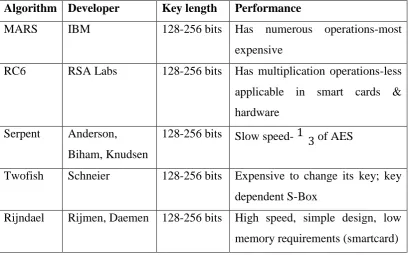
information. The selection of Rijndael was done following a selection process which began with 15 candidate algorithms which were then narrowed down to 5 finalists whose comparative performance is as shown in the Table 1.1.
Table 1.1: Comparative performances of the 5 AES candidate algorithms
Algorithm Developer Key length Performance
MARS IBM 128-256 bits Has numerous operations-most expensive
RC6 RSA Labs 128-256 bits Has multiplication operations-less applicable in smart cards & hardware
Serpent Anderson, Biham, Knudsen
128-256 bits Slow speed- of AES
Twofish Schneier 128-256 bits Expensive to change its key; key dependent S-Box
Rijndael Rijmen, Daemen 128-256 bits High speed, simple design, low memory requirements (smartcard)
As shown in the Table 1.1, Rijndael was designed on the basis of three criteria: resistance to attacks; high speed and code compactness suitable for a variety of platforms; and simplicity in design. Rijndael was chosen in favour of four other candidate algorithms; Serpent, MARS, Two-fish and RC6, This was due to its superior performance in comparison to candidates. Its performance during encryption and decryption was ranked as the highest for 64-bit and 8-bit (C and assembler), in the 32-bit smartcard as well as in Digital Signal Processors. It ranked second when implemented in 32-bit C or Java. Its performance in key scheduling was rated as the best on each platform. NIST proceeded to rank Rijndael as having the highest overall performance (Molloy, 2009).
In the last decade, there have been many researchers who have tried to unearth weaknesses in AES, but none have been found so far. Research has shown that attacks on the Rijndael AES algorithm are dependent upon the generation of 2119-2128 plaintext-ciphertext pairs (Răcuciu et al. 2008). It has been discovered that an attack is possible by exploiting weaknesses in its structure, non-structural properties as well as weaknesses present during implementation.
i. Weaknesses in the structure are prone to:
a) Saturation attacks- also referred to as the square attack. It is the most powerful cryptanalysis of AES and can break down a 7-round reduced version.
b) Algebraic attacks- which try to exploit the round transformation following the revelation by W.Millan and J.Fuller that the S-Box can be described by 8 Boolean functions (J. F. a. W. Millan, 2003).
c) Weaknesses in non-structural properties are prone to the exhaustive key search attack-which is possible for 56-bit key DES, but not for 128-bit AES due to the significant financial investment in hardware required (Daemen et al., 2002). However, if the cost of processing power is halved every six months according to the current trend, then this attack may be plausible at the end of the century.
ii. Implementation weaknesses which pave the way for side-channel attacks- which could be in the form of timing analysis, differential & simple power analysis. AES has shown resistance due to its binary XOR and table look-up process
there is no practical threat on the security of user data yet although this discovery may pave the way for further research which may lead to the discovery of new attack strategies on the AES algorithm. Therefore due to this revelation, it is necessary to develop a way to improve the security of the Rijndael-AES algorithm.
1.2 Problem Statement
Rijndeal was selected as the first AES algorithm by NIST in 2001, due to its security cost and implementation benefits and has since been used to encrypt sensitive information. However, many attempts have been made to uncover weaknesses in AES including possible susceptibility to the algebraic attack, side channel attack and saturation (square) attack (Atasu et al., 2004). These efforts have not produced a practical threat to the security of Rijndael AES algorithm, but have provided new insights which might mean there is a possibility of exploiting the security of Rijndael and thus expose sensitive top secret information. This research therefore explores the weaknesses in AES particularly focusing on the S-Box used in the sub-bytes transformation and improve these weaknesses.
1.3 Purpose of the Study
1.4 Project Objectives
This project aims at achieving three objectives:
i. To study the AES algorithm (Rijndael).
ii.To analyze the weaknesses of the main S-Box in Rijndael AES algorithm, by using customized tools and mathematical tests.
iii.To suggest a technique for generating a customized secure S-Box.
1.5 Project Scope
This research focused on analyzing and revealing the weaknesses of the Rijndael algorithm in AES and therefore use these findings to develop an improvement of the algorithm which ensures improved security of the algorithm. The scope of this research is as follows:
i. Initially, an analysis of the operation of the Rijndeal AES algorithm was carried out.
ii. The study was conducted on the 128-bit key length version of the Rijndael AES algorithm which implements 10 rounds and encrypts a plaintext data block of 128-bits at a time.
iii. The evaluation of the randomness of sequences of the S-Box output bits was carried out using the following tests: frequency test, serial test, correlation test and non-linearity test.
v. A technique for generating a more secure S-Box was proposed that satisfies three S-Box design principles: non-linearity, bit independence criterion (BIC) and the correlation analysis under the majority logic criterion.
vi. A qualitative analysis of the suggested solution was carried out.
1.6 The Significance of the Study
Today, the growing use of the internet for banking, communication and business purposes has necessitated the use of a secure encryption algorithm. The Rijndael algorithm in AES is implemented for this purpose and is even used to protect top secret government information. In the past decade, there have been numerous attempts by researchers to uncover the weaknesses of AES (Atasu et al., 2004). In this study, an evaluation of the weaknesses in the Rijndael algorithm in AES is done and for these weaknesses; a suggestion is given for the improvement of the security of the algorithm. This study helps to ensure more secure e-banking, communication and electronic transactions. Given the use of AES as the US government standard, the development of an improved AES algorithm provides assurance of the security of US government information. This study also provides significant contribution in the growing trend of cloud computing, by ensuring CIA (confidentiality, integrity and availability) when accessing data to and from data centres, in peer transactions as well as in providing secure user authentication (Ali, 2011)
REFERENCES
Ali, H. A., Firkhan Mohd Saman, Md Yazid. (2011). Rijndael encryption technique for user authentication in cloud computing.
Atasu, K., Breveglieri, L., & Macchetti, M. (2004). Efficient AES implementations for ARM based platforms. Paper presented at the Proceedings of the 2004
ACM symposium on Applied computing.
Bubicz, J. S., Janusz. Compound Inversive Congruential Generator Design Algorithm. parameters, 2(4), 6.
Chun, Y., & Yanxia, G. (2009). A Research and Improvement Based on Rijndael Algorithm. Paper presented at the Information Science and Engineering
(ICISE), 2009 1st International Conference on.
Cui, L., & Cao, Y. (2007). A new S-box structure named Affine-Power-Affine. International Journal of Innovative Computing, Information and Control,
3(3), 751-759.
Daemen, J., Rijmen, V., & Barreto, P. S. (2002). Rijndael: beyond the AES. Paper presented at the Mikulášská kryptobesídka 2002--3rd Czech and Slovak
cryptography workshop.
Desmedt, Y., Van Le, T., Marrotte, M., & Quisquater, J.-J. (2002). Algebraic Structures and Cycling Test of Rijndael.
Gentle, J. E., Härdle, W. K., & Mori, Y. (2012). Handbook of computational statistics: concepts and methods: Springer.
Gille-Genest, A. (2012). Pseudo-Random Numbers Generators. Premia 14. Retrieved from
Gregory Gordon Rose, D. D., CA, (US); Alexander Gantman, P., CA, & (US); Lu Xiao, S. D., CA (US). (2011). United States Patent No. 11/509,215: U. States.
Hellekalek, P. (1995a). Inversive pseudorandom number generators: concepts, results and links. Paper presented at the Proceedings of the 27th conference
on Winter simulation, Arlington, Virginia, USA.
Hellekalek, P. (1995b). Inversive pseudorandom number generators: concepts, results and links. Paper presented at the Proceedings of the 27th conference
on Winter simulation.
Hussain, I., Shah, T., Gondal, M., Khan, W., & Mahmood, H. (2012a). A group theoretic approach to construct cryptographically strong substitution boxes. Neural Computing and Applications, 23(1), 97-104. doi:
10.1007/s00521-012-0914-5
Hussain, I., Shah, T., Gondal, M. A., Khan, W. A., & Mahmood, H. (2012b). A group theoretic approach to construct cryptographically strong substitution boxes. Neural Computing and Applications, 1-8.
Hussain, I., Shah, T., Mahmood, H., & Gondal, M. A. (2012). A projective general linear group based algorithm for the construction of substitution box for block ciphers. Neural Computing and Applications, 1-9.
Hussain, I. S., Tariq Mahmood, Hasan Gondal, Muhammad Asif. (2012). A projective general linear group based algorithm for the construction of substitution box for block ciphers. Neural Computing and Applications, 1-9.
Inc, T. C. L. C. (1981- 2013). PCMAG Encyclopedia PCMAG Encyclopedia.
Joan Daemen, V. R. (2002). The Design of Rijndael: The Advanced Encryption Standard. Verlag Berlin, Germany: Springer.
Kinga Márton, A. S., Christian Săcărea, Octavian Creţ. (2011). Generation and
Testing of Random Numbers for Cryptographic Applications. international conference Romanian Cryptology Days, RCD-2011(Proceedings of the
Romanian Academy, Series A).
Krishnamurthy, G., & Ramaswamy, V. (2008). Making AES stronger: AES with key dependent S-box. IJCSNS International Journal of Computer Science and Network Security, 8(9), 388-398.
Li, L. (2011). Testing Several Types Of Random Number Generator. MS, Master of Science, The Florida State University. (Electronic Theses, Treatises and Dissertations. Paper 5393)
Li, X. C., Junli Liu, Weixiao Wan, Wanggen. (2009). An improved AES encryption algorithm. Paper presented at the Wireless Mobile and Computing (CCWMC
2009), IET International Communication Conference on.
Meidl, W., & Topuzoğlu, A. (2010). On the Inversive Pseudorandom Number
Generator. In L. Devroye, B. Karasözen, M. Kohler & R. Korn (Eds.), Recent Developments in Applied Probability and Statistics (pp. 103-125):
Physica-Verlag HD.
Millan, W. (1998). How to improve the nonlinearity of bijective S-boxes. In C. Boyd & E. Dawson (Eds.), Information Security and Privacy (Vol. 1438, pp. 181-192): Springer Berlin Heidelberg.
Molloy, P. (2009). Multiprocessing-ASMP vs SMP.
Niels Ferguson, B. S., Tadayoshi Kohno. (2010). Cryptography Engineering: Design Principles and Practical Applications. Indianapolis, United States of
America: Wiley Publishing, Inc.
NIST. (2001). A statistical test suite for random and pseudo-random number generators for cryptographic applications NIST Special Publication 800-22.
Pierre L’ecuyer, R. S. (2007). TestU01: A C Library for Empirical Testing of
Random Number Generators (Vol. ACM Transactions on Mathematical Software, Vol. 33, No. 4, Article 22): Universit ´e de Montr ´ea.
Project, T. L. I. (2005). PID.
Răcuciu, C. G., Dan Medeleanu, Florin Jula, Nicolae Raducanu, Dan. (2008).
Comparative analisys for the new generation of encryption algorithms
involved in NESSIE and CRYPTREC projects. Paper presented at the The
38th International Symposium of the Military Equipment & Technologies Research Agency, Bucureşti.
Rizwan Jameel Qureshi, M. H., SA. (2008). An adaptive software development process model. Advances in Engineering Software, 39(8), 654-658.
Rukhin, A. S., Juan Nechvatal, James Smid, Miles Barker, Elaine. (2001). A statistical test suite for random and pseudorandom number generators for cryptographic applications: DTIC Document.
Ph: 201-801-0233: Cognizant Academy.
Sulak, F. (2011). Statistical Analysis of Block Ciphers and Hash Algorithms. Philisophy of Doctorate in Cryptography, Middle East Technical University.
T Kean, M. M., JV McCanny, S McMillan, C Patterson. (2001). Field-Programmable Logic and Applications: 11th International Conference.
Verlag Berlin Hedelberg, Germany: Springer.
Tran, M.-T. B., Doan Khanh Duong, Anh Duc. (2008). Gray S-box for advanced encryption standard. Paper presented at the Computational Intelligence and