User Manual
61200663L1-1B May 2001
1200663L1 Single Mode SC 1200663L2 Multi-mode SC 1200663L4 Multi-mode ST
Spectrum is a registered trademark of Cabletron. Netview is a registered trademark of IBM.
901 Explorer Boulevard P.O. Box 140000 Huntsville, AL 35806
(256) 963-8000
© 2001 ADTRAN, Inc. All Rights Reserved.
Important Safety Instructions
When using your telephone equipment, please follow these basic safety precautions to reduce the risk of fire, electrical shock, or personal injury:
1. Do not use this product near water, such as near a bathtub, wash bowl, kitchen sink, laundry tub, in a wet basement, or near a swimming pool.
2. Avoid using a telephone (other than a cordless-type) during an electrical storm. There is a remote risk of shock from lightning.
3. Do not use the telephone to report a gas leak in the vicinity of the leak.
4. Use only the power cord, power supply, and/or batteries indicated in the manual. Do not dispose of batteries in a fire. They may explode. Check with local codes for special disposal instructions.
Save These Important Safety Instructions
Notes provide additional useful information.Cautions signify information that could prevent service interruption.
This equipment has been tested and found to comply with the limits for a Class A dig-ital device, pursuant to Part 15 of the FCC Rules. These limits are designed to provide reasonable protection against harmful interference when the equipment is operated in a commercial environment. This equipment generates, uses, and can radiate radio fre-quency energy and, if not installed and used in accordance with the instruction man-ual, may cause harmful interference to radio frequencies. Operation of this equipment in a residential area is likely to cause harmful interference in which case the user will be required to correct the interference at his own expense.
Shielded cables must be used with this unit to ensure compliance with Class A FCC limits.
ADTRAN warrants that for five (5) years from the date of shipment to Customer, all products manufactured by ADTRAN will be free from defects in materials and work-manship. ADTRAN also warrants that products will conform to the applicable speci-fications and drawings for such products, as contained in the Product Manual or in ADTRAN's internal specifications and drawings for such products (which may or may not be reflected in the Product Manual). This warranty only applies if Customer gives ADTRAN written notice of defects during the warranty period. Upon such notice, ADTRAN will, at its option, either repair or replace the defective item. If ADT-RAN is unable, in a reasonable time, to repair or replace any equipment to a condition as warranted, Customer is entitled to a full refund of the purchase price upon return of the equipment to ADTRAN. This warranty applies only to the original purchaser and is not transferable without ADTRAN's express written permission. This warranty becomes null and void if Customer modifies or alters the equipment in any way, other than as specifically authorized by ADTRAN.
EXCEPT FOR THE LIMITED WARRANTY DESCRIBED ABOVE, THE FOREGOING CONSTITUTES THE SOLE AND EXCLUSIVE REMEDY OF THE CUSTOMER AND THE EXCLUSIVE LIABILITY OF ADTRAN AND IS IN LIEU OF ANY AND ALL OTHER WARRANTIES (EXPRESSED OR IMPLIED). ADTRAN SPECIFICALLY DIS-CLAIMS ALL OTHER WARRANTIES, INCLUDING (WITHOUT LIMITATION), ALL WARRANTIES OF MERCHANTABILITY AND FITNESS FOR A PARTICULAR PURPOSE. SOME STATES DO NOT ALLOW THE EXCLUSION OF IMPLIED WAR-RANTIES, SO THIS EXCLUSION MAY NOT APPLY TO CUSTOMER.
ment if the product does not meet its published specification, or if it fails while in ser-vice.
A return material authorization (RMA) is required prior to returning equipment to ADTRAN. For service, RMA requests, training, or more information, see the toll-free contact numbers given below.
Presales Inquiries and Applications Support
Please contact your local distributor, ADTRAN Applications Engineering, or ADT-RAN Sales:
Post-Sale Support
Please contact your local distributor first. If your local distributor cannot help, please contact ADTRAN Technical Support and have the unit serial number available.
The Custom Extended Services (ACES) program offers multiple types and levels of ser-vice plans which allow you to choose the kind of assistance you need. For questions, call the ACES Help Desk.
Repair and Return
If ADTRAN Technical Support determines that a repair is needed, Technical Support will coordinate with the Custom and Product Service (CAPS) department to issue an RMA number. For information regarding equipment currently in house or possible fees associated with repair, contact CAPS directly at the following number:
Applications Engineering (800) 615-1176
Sales (800) 827-0807
Technical Support (888) 4ADTRAN
ACES Help Desk (888) 874-2237
ADTRAN Customer and Product Service 901 Explorer Blvd.
Huntsville, Alabama 35806
RMA # _____________
Training
The Enterprise Network (EN) Technical Training Department offers training on our most popular products. These courses include overviews on product features and func-tions while covering applicafunc-tions of ADTRAN's product lines. ADTRAN provides a va-riety of training options, including customized training and courses taught at our facilities or at your site. For more information about training, please contact your Terri-tory Manager or the Enterprise Training Coordinator.
Training - phone (800) 615-1176, ext. 7500 Training - fax (256) 963 7941
List of Figures ... xv
List of Tables ... xvii
Chapter 1. Introduction
Product Overview ... 1-1 Optical Interface Port ... 1-2 SNMP ... 1-3 Telnet ... 1-4 Interface Option Cards ... 1-4 HSSI Card... 1-4 V.35 Card... 1-5 Quad DSX-1 Card ... 1-5
Chapter 2. Installation and Operation
Powering the Unit ... 2-8 Reviewing the Front Panel ... 2-9 Control Port... 2-9 VT-100 Terminal Connection ... 2-9 Navigating Within the Menus ... 2-11 OSU 300 Main Menus ... 2-11 Status ... 2-11 Statistics ... 2-11 Configuration ... 2-11 Diagnostics ... 2-11 Remote Login ... 2-12 Logout ... 2-12 Remote Active LED... 2-12 Optical Interface LEDs... 2-12 In Service ... 2-12 In Test ... 2-12 Alarm ... 2-12 LOS ... 2-12 DTE Port LEDs... 2-13
Chapter 3. Configuration
Trap IP Addresses... 3-13 Trap Generation ... 3-13 Toggle All Traps ... 3-15 Password ... 3-16 Terminal Timeout ... 3-16 IP Security ... 3-16 IP Hosts... 3-16 Master Control Port ... 3-16 Slave Control Port ... 3-16 Circuit ID... 3-16 Date/Time... 3-17 Alarm Relay ... 3-17 Utilities ... 3-17 Save Configuration ... 3-18
Chapter 4. Status
Chapter 5. Statistics
Viewing Statistical information ... 5-1 Alarm History... 5-2 Performance Parameters ... 5-4
Chapter 6. Diagnostics
Reset All Tests ... 6-14
Chapter 7. Applications
Single Port Full T3 Bandwidth ... 7-1 Point-to-Point Multiport Application ... 7-2 Fractional T3 Carrier Application ... 7-4 Remote SNMP Management Application ... 7-6 Voice Application ... 7-7
Appendix A. Pinouts ... A-1
Appendix B. Specifications Summary ... B-1
Appendix C. Acronyms/Abbreviations... C-1
Appendix D. Glossary ... D-1
PRODUCT OVERVIEW
The OSU 300 is a multiport DSU/CSU (data service unit/channel service unit) that provides access to high-speed services over single-mode or multi-mode fiber. The unit provides a cost-effective, versatile approach for delivering high-speed frame relay and dedicated digital services at data rates from 75.18 kbps to
44.2 Mbps. The TDM (time division multiplexer) multiport design allows you to share the cost of the fiber link between multiple applications. This unit maximizes the use of high-speed services, providing up to four data ports capable of transmitting and receiving high-capacity, realtime data.
The OSU 300 contains a built-in HSSI (high speed serial interface) port and three expansion slots which accept additional HSSI, V.35, or Quad DSX-1 interface cards. The HSSI interfaces support rates between 75 kbps and 44.2 Mbps in 75-kbps increments. The high-speed V.35 interface option card supports rates up to 10 Mbps in increments of 75 kbps. The Quad DSX-1 interface card provides four DSX-1 lines. Each DSX-1 port supports rates up to 1.544 Mbps.
Complete configuration, diagnostics, and performance monitoring are available through SNMP, Telnet, or a VT-100 terminal interface. This connection can be made via Ethernet or a local EIA-232 link. The OSU 300 is designed for either desktop use or for installation in a 19-inch rack.
The major features of the OSU 300 are as follows:
• Full feature multiport optical DS3 DSU/CSU
• Maximum of four user data ports: one integrated HSSI port and three additional slots for optional HSSI, high-speed V.35, or Quad DSX-1 cards
• Automatic or manual remote configuration
• Embedded SNMP and Telnet management through 10BaseT Ethernet or SLIP/PPP
• Detailed performance monitoring for local and remote units • Simplified configuration through detailed VT-100 terminal
menu structure
OPTICAL INTERFACE PORT
• The optical interface of the OSU 300 consists of either a single-mode or a multi-single-mode transceiver module comprised of a transmitter, a receiver, and an SC or ST receptacle.
• The optical interface port supports angled SC type optical connectors (1200663L1 and L2 only).
• The optical interface port operates in the 1280 nm to 1335 nm wavelength range (1310 nm nominal).
• The total output power is 8 mW, as defined by IEC with a 50 mm aperture at 10 cm distance.
• The optical interface uses two fibers, one for each direction of transmission.
• The transceiver optical budgets for the optical transceivers are 28dB (single-mode) and 9 dB (multi-mode). See the Optical Interface Port section on page 2-7 for calculations.
• The IEC Class 1 laser is safety compliant under normal
operating conditions. The Class 1 rating is due to an integrated automatic shutdown circuit that disables the laser when it detects transmitter failures. The FITS rating of the internal shutdown circuit is less than 500 FITS.
• The FDA Class 1 laser is safety FDA compliant. • The product is shipped with a removable process plug
covering the optical interface.
• A mechanical cover engages when the fiber cable is removed from the optical interface. The cover provides dust protection in the event of the optical interface being disconnected, and additional protection to the human eye.
SNMP
The OSU 300's embedded SNMP feature allows unit access and control by a network manager through either the auxiliary (AUX) control port or the 10BaseT local area network (LAN) port. The OSU 300 supports the MIB-II standard, RFC 1213 and 1407, and the ADTRAN Enterprise Specific MIB.
The term SNMP broadly refers to the message protocols used to exchange information between the network management system (NMS) and the managed devices, as well as to the structure of device management databases. SNMP has three basic components: Network Manager, Agent, and MIB.
Network Manager
Control programs that collect, control, and present data pertinent to the operation of the network devices. These programs reside on a network management station.
Agent
MIB
Industry standard presentation of all status and configuration parameters supported by a network device.
TELNET
Telnet provides a password-protected, remote login facility to the OSU 300 that allows a remote user to control the OSU 300 through the terminal menus. Only one Telnet session may be active at a time.
INTERFACE OPTION CARDS
Optional HSSI, V.35, or Quad DSX-1 interface cards may be purchased to equip the OSU 300 with up to three additional ports.
HSSI Card
The optional HSSI card plugs into one of the three expansion slots on the rear of the OSU 300. With optional HSSI cards installed, the total 44.2 Mbps bandwidth of the DS3 can be divided among the total number of ports to provide multiple data channels over the DS3. The total bandwidth of the DS3 can be divided among the available ports in any fashion, as long as the divisions are on 75 kbps boundaries.
V.35 Card
The optional V.35 card plugs into an expansion slot on the rear of the OSU 300 to provide a V.35-type DTE interface. The V.35 card operates similarly to the HSSI card, except that the maximum bandwidth of the V.35 card is limited to 10 Mbps.
Like the HSSI card, the V.35 card can be hot inserted or swapped, and it installs just as the HSSI card does. However, instead of the standard HSSI connector, this card contains a standard 34-pin V.35 connector for DTE connections. See the section DTE Ports 2-4 (Expansion Slots) on page 2-5 for more information on installing option cards.
Quad DSX-1 Card
The optional Quad DSX-1 interface card plugs into the card slots on the rear of the OSU 300. This card allows you to transport up to four DSX-1 lines per card over the DS3 interface of the OSU 300 along with high-speed data from the other HSSI/V.35 ports. This configuration allows connectivity of both voice channels and high-speed data channels for two point-to-point sites using only one network interface. Up to three cards may be installed into the OSU 300 port card slots.
Like the other interface cards, the Quad DSX-1 card can be hot inserted or swapped. See the section DTE Ports 2-4 (Expansion Slots) on page 2-5 for more information on installing option cards.
RECEIVING INSPECTION
Carefully inspect the OSU 300 for any damage that may have occurred in shipment. If damage is suspected, file a claim immediately with the carrier and contact ADTRAN Technical Support (see the last page of this manual). Keep the original shipping container to use for future shipment or verification of damage during shipment.
SHIPPING CONTENTS
The OSU 300 shipment includes the following items:
• The OSU 300 unit
• The OSU 300 User Manual
• 8-position modular to 8-position modular cable (P/N 3127004) • 8-position modular to DB-25 female connector
(P/N 3196ADPT005)
• Mounting ears for 19-inch rack installation • Rubber feet for stand-alone use
CUSTOMER PROVIDES
INSTALLING THE UNIT
The OSU 300 can be used as a desktop stand-alone device or mounted into a standard 19-inch equipment rack. See the section VT-100 Terminal Connection on page 2-9 for information on terminal configuration.
Rackmount Installation
Follow these steps to mount your unit into a rack:
1. Install the 19-inch rackmount flanges on each side of the OSU 300 enclosure at one of the three available positions.
2. After the flanges have been installed, position the OSU 300 at the correct location within the rack and secure the mounting flanges to the mounting rails of the rack.
3. Make all network, DTE, and power connections to the rear of the unit. See the section Powering the Unit on page 2-8 for more information on making the DC power connection.
4. Using the 8-position modular to DB-25 female connector and the 8-position modular to 8-position modular cable, connect a VT-100 terminal device to the CONTROL interface jack on the front panel of the unit.
Desktop Installation
Follow these steps when using your OSU 300 as a desktop unit:
1. Affix the four adhesive-backed rubber feet to the bottom of the unit, one on each of the four corners. The feet should be placed approximately one inch from the front or back and one inch from the sides of the unit
2. Make all network, DTE, and power connections to the rear of the unit. See the section Powering the Unit on page 2-8 for more information on making the DC power connection.
3. Using the 8-position modular to DB-25 female connector and the 8-position modular to 8-position modular cable, connect a VT-100 terminal device to the CONTROL interface jack on the front panel of the unit.
REVIEWING THE REAR PANEL
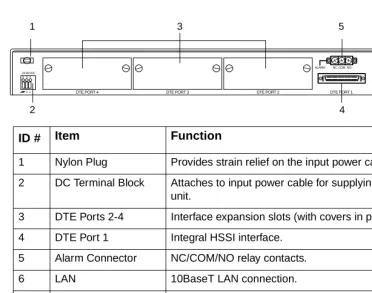
Figure 2-1. OSU 300 Rear Panel Description
Figure 2-2. Moving the Optical Interface Door DTE PORT 4 DTE PORT 3 DTE PORT 2 DTE PORT 1
NC COM NO ALARM LAN + -24-48 VDC RX IN TX OUT OPTICAL INTERFACE 1 2 3 4 5 6 7 8 9 Laser Radiation Avoid Exposure to Beam
Laser Class 1 Product Complies with 21 CFR
ID # Item Function
1 Nylon Plug Provides strain relief on the input power cable.
2 DC Terminal Block Attaches to input power cable for supplying power to the unit.
3 DTE Ports 2-4 Interface expansion slots (with covers in place).
4 DTE Port 1 Integral HSSI interface.
5 Alarm Connector NC/COM/NO relay contacts.
6 LAN 10BaseT LAN connection.
7 Optical Interface Door Provides protection from laser beam.
8 Optical Interface DS3 service connection.
9 Removable Dust
Cover
Protects unit from dust. Remove to use the Optical Interface.
RX IN TX OUT
OPTICAL INTERFACE
Slide this door up and down
to access the Optical Interface.
Dust cover in place.
Laser Radiation Avoid Exposure to Beam
Strain Relief
To relieve strain on the input power cable, the nylon plug ties off the power cable.
DC Terminal Block
The three-position DC terminal block accommodates 12 to 26 AWG wire. The positive (+) and negative (-) terminals connect to a 24 to 48 VDC, 0.4A power source. Figure 2-3 illustrates the terminal block power connector, along with definitions for the three connector symbols.
Figure 2-3. DC Power Connector
DTE Ports 2-4 (Expansion Slots)
The OSU 300 rear panel contains three expansion slots (DTE ports 2-4) for installing optional interface cards. Currently available cards include the HSSI card (P/N 1200218L1), the V.35 card
(P/N 1200219L1), and the Quad DSX-1 card (P/N 1200284L1). To insert the cards, follow these steps:
1. Remove the appropriate slot cover from the empty slot. 2. Slide the card into the empty slot until the card panel is flush
with the OSU 300 chassis.
3. Push in the thumbscrews and turn clockwise to secure the card and ensure proper connection to the main board of the OSU 300.
Symbol Definition
Frame ground.
+ Positive side of DC power source (usually ground).
DTE Port 1 (HSSI Interface)
DTE port 1 is a built-in HSSI port that resides on the main board of the OSU 300. Configure the bandwidth of this port in 75 kbps increments from 75 kbps to 44.2 Mbps. If a single application requires the full 44.2 Mbps of bandwidth, the OSU 300 does not have to be equipped with additional port cards. Appendix A contains the pinout for this port.
Alarm Connector
The alarm connector is a three-position, screw-type terminal block that connects to the three contacts of a Form C-type relay on the main board of the OSU 300. This relay activates any time the OSU 300 detects an alarm condition on the high-speed network
interface. Table 2-1 describes the alarm connector terminal block. Use the ALARM RELAY selection of the CONFIGURATION menu to disable the alarm function.
LAN Port
The LAN port is an 8-pin modular connector that provides a 10BaseT Ethernet LAN interface. This interface uses SNMP and Telnet to control the unit. Appendix A contains the pinout for this port.
Table 2-1. Alarm Connector Terminal Block Description
Position Name Description
Left NC (Normally Closed) Opens when a selected alarm condition is present.
Center COM (Common) Common connection between external circuitry and NC or NO terminal.
Optical Interface Port
The OSU 300 optical interface port consists of a single-mode or multi-mode transceiver module composed of a transmitter, a receiver, and an SC or ST receptacle. The optical interface port supports angled SC type optical connectors (61200663L1 and L2 only) and operates in the 1280 nm to 1335 nm wavelength range (1310 nm nominal). The total output power is 8 mW with a 50 mm aperture at 10 cm distance, as defined by IEC. The optical interface uses two fibers, one for each direction of transmission.
The transceiver optical power budgets for the optical transceivers are 28dB (single-mode) and 9dB (multi-mode). These budgets are calculated as follows:
Single-Mode
Worst case optical transmit power = -5dBm Worst case optical receiver sensitivity = -34dBm
Calculations:
(34 - 5) dB = 29 dB - 1dB (optical path penalty) = 28dB
Multi-Mode
Worst case optical transmit power = -20dBm Worst case optical receiver sensitivity = -30dBm
Calculations:
(30 - 20) dB = 10dB - 1dB (optical path penalty) = 9dB
The optical interface complies with the physical interface
The OSU 300 comes with a removable process plug that covers the optical interface. A mechanical door engages when the fiber cable is removed from the optical interface (see also, Figure 2-2 on page 2-4). This door protects the unit from dust in the event of the optical interface being disconnected, and it provides additional protection for the human eye from the laser beam.
POWERING THE UNIT
The OSU 300 can be powered from either a standard AC mains supply or a 48 VDC Supply. When mains powered, the unit receives power via an external power supply that converts the mains power to a usable 48 VDC source. When powered by the AC mains supply, the unit operates normally within specification when supplied with AC voltages from 190–264 VAC at 47–53 Hz. The 48 VDC source interfaces to the rear panel of the unit through a screw-down terminal block. A nylon plug allows strain relief on the power cabling to the system.
The following requirements must be met during installation of the DC version of the OSU 300:
1. The unit must be connected to a reliably grounded -24 or -48 VDC source which is electrically isolated from the AC source.
2. The branch circuit overcurrent protection should be a fuse or circuit breaker rated 48 VDC, 15 A.
3. The unit should be installed in accordance with the requirements of NEC NFPA 70.
4. A readily-accessible disconnect device that is suitably
REVIEWING THE FRONT PANEL
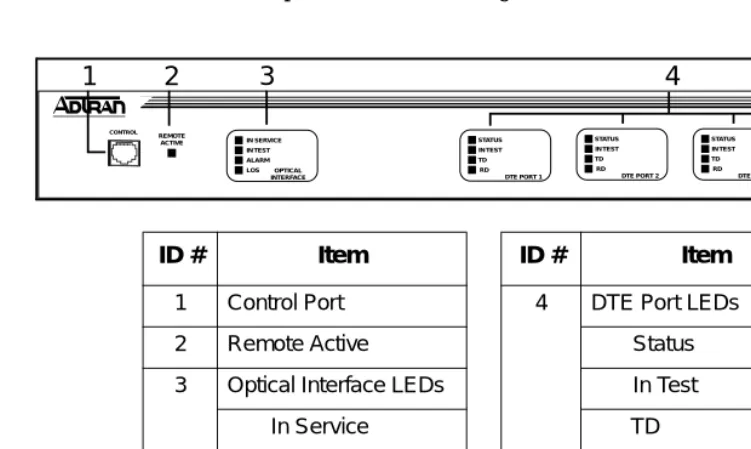
Figure 2-4 illustrates the OSU 300 front panel. Descriptions of each front panel item follow Figure 2-4.
Figure 2-4. OSU 300 Front Panel
Control Port
The OSU 300 front panel contains an 8-pin modular jack labeled
CONTROL. The control port provides connection to a VT-100
EIA-232 compatible interface. Appendix A gives the pinout.
VT-100 Terminal Connection
To control the OSU 300 using a VT-100 terminal, follow this procedure:
1. Configure the VT-100 terminal for 9600, 19200, 38400, or 57600 baud, 8-bit characters, no parity, and one stop bit (xxxx, 8N1).
STATUS IN TEST TD RD
DTE PORT 4 STATUS
IN TEST TD RD
DTE PORT 3 STATUS
IN TEST TD RD
DTE PORT 2 STATUS
IN TEST TD RD
DTE PORT 1 IN SERVICE IN TEST ALARM LOS OPTICAL INTERFACE CONTROL REMOTE ACTIVE
1
2
3
4
OSU 300
ID # Item ID # Item
1 Control Port 4 DTE Port LEDs
2 Remote Active Status
3 Optical Interface LEDs In Test
In Service TD
In Test RD
Alarm
2. Using the ADTRAN-provided terminal interface cable adapter, connect the DTE port of a terminal to the 8-pin modular jack labeled CONTROL on the front panel of the OSU 300.
3. Initialize the terminal session and allow approximately 20 seconds for initialization.
4. Press Enter repeatedly until the password prompt appears. 5. Enter the password. The factory default password is adtran (all
lower-case). The MAIN menu appears (see Figure 2-5).
6. Make selections by entering the number corresponding to the chosen parameter. Press Esc to return to the previous screen. End a terminal session by selecting LOGOUT from the MAIN
menu or by pressing Ctrl-C at any time.
Navigating Within the Menus
Navigate within the OSU 300 terminal menus using the following procedures:
OSU 300 Main Menus
Status
Provides status information on the network and DTE ports. See the chapter Status on page 4-1 for more information.
Statistics
Provides statistical information for the network and DTE ports. See the chapter Statistics on page 5-1 for more information.
Configuration
Sets network, DTE, and system management parameters. See the chapter Configuration on page 3-1 for more detailed information.
Diagnostics
Performs loopback and BERT tests. See the chapter Diagnostics on page 6-1 for more detailed information.
If you want to... Press...
select an item the number corresponding to your choice, and
then press the Enter key.
scroll between screens of the same selection the up and down arrow keys. Additional screens are available when the words Up or
Down display in the right-hand side of the
menu.
scroll left and right of the same screen the left and right arrow keys. Additional screens are available when < or > display in the top portion of the menu.
return to the previous menu the ESC key.
end the terminal session Ctl-C.
Remote Login
Allows configuration of certain items on the remote OSU 300. The remote unit’s password is required at login.
Logout
Ends the terminal session and logs out of the system. Password entry is required before a new session can begin.
Remote Active LED
A solid LED indicates a remote configuration session is taking place through a Telnet session or from the remote end OSU 300. The LED flashes when the unit is being accessed locally through the front panel CONTROL port.
Optical Interface LEDs
The following LEDs provide information on the optical interface.
In Service
Active when a valid signal is being received on the optical interface.
In Test
Active when the network interface has been put in loopback by the service provider.
Alarm
Active when the high-speed receive signal contains framing errors, when the yellow alarm is received from the far end unit, or when other alarm messages are received from the network.
LOS
DTE Port LEDs
The following LEDs provide information on DTE ports 1 through 4.
Status
This LED indicates the following conditions:
In Test
This LED indicates the DTE interface is performing a BERT test.
TD
This LED indicates the OSU 300 DTE port is transmitting data.
RD
This LED indicates the OSU 300 DTE port is receiving data.
LED Condition
Off No option card is installed.
Flashing green Interface is available but not configured.
On green Interface is available and configured.
On red DTE fault condition (for HSSI interface, no clock from DTE).
The OSU 300 can be configured locally and remotely. Local configuration is accomplished through a 10BaseT Ethernet connection, a SLIP/PPP port, or a VT-100 terminal. Remote configuration can take place through the T3 data link using a local OSU 300.
The CONFIGURATION menu consists of the following submenus
relating to specific interfaces or functions: DS3 NETWORK, DTE
PORTS, SYSTEM MANAGEMENT, UTILITIES, and SAVE CONFIGURATION.
Figure 3-1 shows the main CONFIGURATION terminal menu. Detailed
descriptions of each individual menu parameter are given in the following sections: DS3 NETWORK (page 3-2), DTE PORTS (page
3-3), SYSTEM MANAGEMENT (page 3-11), UTILITIES (page 3-17), and
SAVE CONFIGURATION (page 3-18).
DS3 NETWORK
To access the network configuration parameters, select 1- DS3
NETWORK. Configure the OSU 300 network settings to match the T3
signal received from the service provider. During remote configuration, this menu is read-only. The DS3 NETWORK
CONFIGURATION menu is shown in Figure 3-2. Descriptions of the
DS3 NETWORK fields follow the figure.
Figure 3-2. DS3 Network Configuration Menu
DS3 Timing
Set the timing to LOOP if the OSU 300 is to derive timing from the
network; set to LOCAL if the unit is to be the master timing source
for the circuit.
Remote Auto-Configuration
This feature allows one OSU 300 (set to MASTER) to automatically
relay its DTE port bandwidth configuration to a second unit (set to SLAVE). If desired, the feature can be disabled by either unit.
XCV Threshold
Sets the threshold for code violations. Options include 1)DISABLED,
Multiplexing Mode
The MULTIPLEXING MODE menu allows you to select the DTE port bandwidth increment size. The increment size of Nx75 kbps allows the user to divide 588 blocks among the four ports. The increment size of Nx3.16 Mbps has 14 blocks available, and ports 2, 3, and 4 are disabled. Only port 1, the built-in HSSI port, is available in this mode. The Nx3.16 Mbps mode provides compatibility with Juniper and Cisco routers at below full-bandwidth rates. When the user switches the multiplexing mode, the system will reboot causing service interruption. Loading default settings does not reset this option.
DTE PORTS
The DTE PORTS menu allows you to select a port to configure. If
REMOTE AUTO CONFIGURATION is set to MASTER (CONFIGURATION ->
DS3 NETWORK -> REMOTE AUTO CONFIGURATION -> MASTER), then a fifth option, TIMED PROFILES, is available (see Figure 3-3). This option allows you to set up timed profiles specifying bandwidth allocation for all four ports.
Configuration selections for the individual ports are described in the following section. A more in-depth description of TIMED
PROFILES is on page 3-10.
Port Selections 1-4
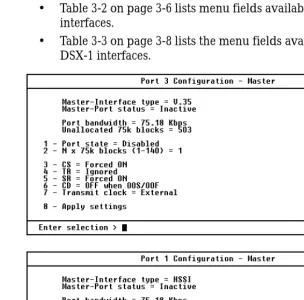
Select DTE PORT 1, 2, 3, or 4 to access the port configuration parameters. Configure each DTE port to be compatible with the DTE equipment attached to it. Figure 3-4 shows PORT
CONFIGURATION menu examples. Descriptions of the individual
fields follow the illustration. The descriptions are listed in tables based on the DTE port interface type (HSSI, V.35, or Quad DSX-1).
• Table 3-1 on page 3-5 lists the menu fields available for HSSI and V.35 interfaces.
• Table 3-2 on page 3-6 lists menu fields available only for V.35 interfaces.
Configuration Selections for HSSI and V.35 Interfaces
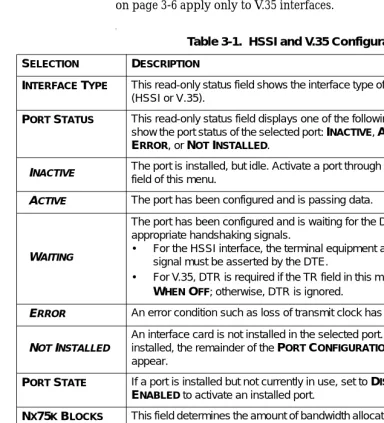
The configuration selections listed in Table 3-1 are available for HSSI and V.35 interfaces. Additional selections listed in Table 3-2 on page 3-6 apply only to V.35 interfaces.
s
Table 3-1. HSSI and V.35 Configuration Selections
SELECTION DESCRIPTION
INTERFACE TYPE This read-only status field shows the interface type of the selected port
(HSSI or V.35).
PORT STATUS This read-only status field displays one of the following messages to
show the port status of the selected port: INACTIVE, ACTIVE, WAITING,
ERROR, or NOT INSTALLED.
INACTIVE The port is installed, but idle. Activate a port through the PORT STATE
field of this menu.
ACTIVE The port has been configured and is passing data.
WAITING
The port has been configured and is waiting for the DTE to issue the appropriate handshaking signals.
• For the HSSI interface, the terminal equipment available (TA) signal must be asserted by the DTE.
• For V.35, DTR is required if the TR field in this menu is set to IDLE
WHEN OFF; otherwise, DTR is ignored.
ERROR An error condition such as loss of transmit clock has occurred.
NOT INSTALLED
An interface card is not installed in the selected port. If a port is not installed, the remainder of the PORT CONFIGURATIONmenu does not appear.
PORT STATE If a port is installed but not currently in use, set to DISABLED. Set to
ENABLED to activate an installed port.
NX75K BLOCKS This field determines the amount of bandwidth allocated to the selected
port. For a HSSI interface, the selections are from 1-588 (yielding a bandwidth of 75.2 kbps to 44.2 Mbps). For a V.35 interface, the selections are from 1-140 (yielding a bandwidth of 75.2 kbps to 10.5 Mbps). Changes to this field do not take effect until APPLY SETTINGS is selected.
PORT BANDWIDTH This read-only status field shows the amount of bandwidth that will be
UNALLOCATED
75KBLOCKS
This read-only status field shows the number of 75k blocks of bandwidth not already allocated to the four DTE ports.
APPLY SETTINGS Select this field after making all configuration changes for the selected
port. The changes are then applied to the unit immediately. Applying the settings briefly affects all ports of the OSU 300. You may cancel changes made to the current PORT CONFIGURATION menu by pressing the ESC key.
Table 3-1. HSSI and V.35 Configuration Selections (Continued)
SELECTION DESCRIPTION
Additional configuration selections are available for V.35 interfaces. These selections are listed in Table 3-2.
Table 3-2. Additional V.35 Interface Port Configuration Selections
SELECTION DESCRIPTION
CS Selects the control mode for the clear to send (CS) lead.
FORCED ON The CS lead remains on and request to send (RS) is ignored
as long as the unit is synchronized and able to pass data.
FOLLOW RS The CS state matches the RS state.
TR Selects the OSU 300’s response to the data terminal ready
(TR) lead.
IGNORED The OSU 300 ignores the state of the TR lead.
IDLE WHEN OFF The OSU 300 suspends traffic on the selected port if the TR
lead is off.
SR Selects the control mode for the data set ready (SR) lead.
FORCED ON The SR control lead remains on regardless of the state of the
network.
OFF WHEN OOS/OOF
Transmit Clock
Selects the source of the clock used to transfer data from the DTE to the OSU 300. Use the following chart to determine your selection: OFF WHEN TEST The SR lead remains on except when the OSU 300 is
executing a test.
OFF WHEN OOS/OOF OR TEST
The SR lead remains on except when the unit receives an OOS/OOF condition from the network or when the unit is executing a test.
CD Selects the control mode for the carrier detect (CD) lead.
FORCED ON The CD lead remains active at all times.
OFF WHEN OOS/OOF The CD control lead remains on unless the OSU 300 receives
an OOS/OOF condition from the network.
TRANSMIT CLOCK See the following section for a description of this item.
Table 3-2. Additional V.35 Interface Port Configuration Selections (Continued)
SELECTION DESCRIPTION
SELECT... IF...
NORMAL you want the transmit clock to be derived from the
OSU 300.
INVERT your DTE device cannot provide a transmit clock
signal and data errors are present between your DTE and the OSU 300.
EXTERNAL you are transmitting at high rates. This selection
eliminates data errors caused by excessive delays in the DTE transmit clock receiver, transmit data driver, and cable length.
Configuration Selections for DSX-1 Interfaces
The configuration selections listed in Table 3-3 are available for Quad DSX-1 interfaces. Separate selections can be made for each of the four DSX-1 ports of the card. The menu is shown in Figure 3-5.
Figure 3-5. Port Configuration Menu for Quad DSX-1 Interface Card
The Quad DSX-1 does not perform ESF to SF (D4) conversion through the network. Therefore, both ends of the circuit must be configured for the same framing type.
Table 3-3. DSX-1 Interface Port Configuration Selections
SELECTION DESCRIPTION
INTERFACE TYPE This read-only status field displays QUAD DSX-1, indicating that a
Quad DSX-1 interface card is installed in the DTE Port card slot.
PORT STATUS This read-only status field displays INACTIVE, ACTIVE, WAITING,
ERROR, or NOT INSTALLED, indicating the current status of the DSX-1 interface.
UNALLOCATED 75K
BLOCKS
Displays the amount of bandwidth (in 75k increments) not already allocated to any of the OSU 300 DTE ports.
FRAMING Select the framing format for each individual DSX-1 interface. The default setting is ESF. Select ESF if your DTE device is configured for Extended Superframe framing. Select D4 if your DTE device is configured for D4 framing. Select AUTO to allow the interface to detect the framing type (ESF or D4) automatically. When in AUTO mode, the selected interface toggles between ESF and D4
approximately every ten seconds until it detects valid framing. Note:
D4 is equivalent to superframe format (SF).
LINE CODING Set the line code for each individual DSX-1 interface to match the
connected DTE device. Three choices are available: B8ZS, AMI, and AMI W/STUFFING (AMI coding with bit stuffing).
LINE LENGTH Set the line length for each DSX-1 interface according to the distance
from the OSU 300 to your DTE device. Set to 7.5 dB if the attached DTE device only supports DS-1 levels.
DSX-1 TIMING
SOURCE
For each Quad DSX-1 card pair (the near-end and far-end Quad DSX-1 cards), there must be only one source of timing. The available timing sources are described below.
DS3 The timing for both the near-end and far-end Quad DSX-1 cards is derived from the DS3 interface. All DTE devices connected to the DSX-1 interfaces must be slave timed since both cards source the timing reference derived from the DS3. Both units must be set to DS3.
REMOTE The timing source for the Quad DSX-1 card is derived
from the far-end Quad DSX-1 card. Use this mode if the far-end card has a DSX-1 TIMING SOURCE
configuration of DSX-1 #1, DSX-1 #2, DSX-1 #3, or
DSX-1 #4.
DSX-1 #X The timing source for the Quad DSX-1 pair is derived from one of the four DSX-1 interfaces. When configured in this manner, one of the DSX-1 interfaces is slaved to the DSX-1 interface from your DTE. The remaining three DSX-1 interfaces, if enabled, source the timing as derived from the slaved port. The far-end DSX-1 interface must be configured for REMOTE. Note: If more
than one Quad DSX-1 card is installed, each card can have a different timing source configuration.
APPLY SETTINGS Select this field after making all configuration changes for the
selected port. The changes are then applied to the unit immediately.
Table 3-3. DSX-1 Interface Port Configuration Selections (Continued)
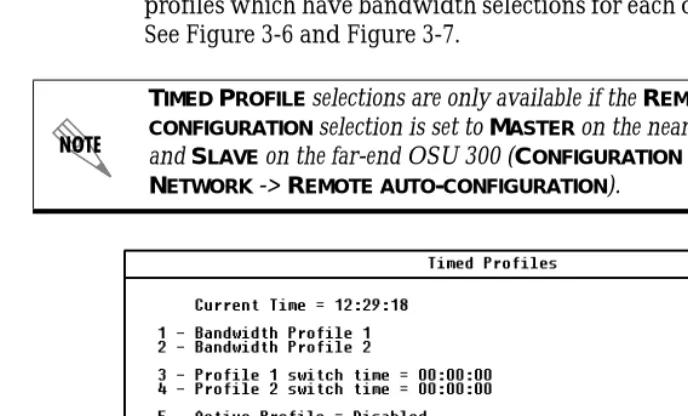
Timed Profiles
Using this option, you can allocate bandwidth based on the time of day. For example, you can assign more bandwidth to the corporate LAN during business hours and more bandwidth to a backup machine in the evenings. The OSU 300 can store two separate user profiles which have bandwidth selections for each of the four ports. See Figure 3-6 and Figure 3-7.
Figure 3-6. Timed Profiles Screen
Bandwidth Profiles 1 and 2
The PROFILE CONFIGURATION menus allow you to change the PORT
STATUS and NX75K BLOCKS options for HSSI and V.35 ports. See
page 3-5 for descriptions of these options. This screen also allows you to enable or disable each individual DSX-1 interface of a Quad DSX-1 card at the time of date specified in the given profile. Settings for all port types are assigned to the selected profile (1 or 2) and will apply whenever that profile is active (see Figure 3-7 on page 3-11).
TIMED PROFILE selections are only available if the REMOTEAUTO
-CONFIGURATIONselection is set to MASTER on the near-end OSU 300
and SLAVE on the far-end OSU 300 (CONFIGURATION -> DS3
Figure 3-7. Example of a Profile Configuration Menu
Profile Switch Time (1 and 2)
Enter the time that you want the profile to become active. Enter the time in military time (i.e., 00:00:00 = 12 AM). The profile remains active until one of the following occurs: (1) the other profile’s activation time comes about, or (2) the profile is disabled manually through the ACTIVE PROFILE selection.
Active Profile
Use this field to either manually force a profile to become active (regardless of the time of day) or to disable the profiles completely.
SYSTEM MANAGEMENT
The SYSTEM MANAGEMENT menus (see Figure 3-8 on page 3-12)
Figure 3-8. System Management Configuration Menu
Local IP Address
Enter the OSU 300 IP address. This IP address applies to the Ethernet or auxiliary port (when configured for PPP or SLIP). This address is available from the network administrator.
Gateway IP Address
Enter the gateway IP address of the OSU 300. This address is necessary only if the OSU 300 and the network manager are connected through a gateway node. If an IP packet is to be sent to a different network, the unit sends it to the gateway.
Subnet Mask
Enter the subnet mask of the OSU 300. This address is available from the network administrator.
Read Community Name
Write Community Name
Enter the authentication strings used for SNMP management. Match the OSU 300 to the SNMP manager for write privileges.
Trap Community Name
Enter the authentication strings used for SNMP management. Match the OSU 300 to the SNMP manager for trap privileges.
Trap IP Addresses
Enter up to five SNMP manager IP addresses to which the OSU 300 sends traps.
Trap Generation
This field determines which trap types (if any) are generated by the unit (see Figure 3-9). Use this menu to enable or disable NEAR END
ALARM, FAR END ALARM, MIB II STANDARD, NETWORK TEST, DTE PORT, and QDSX ALARM trap types. See Table 3-4 through Table 3-9 for trap descriptions.
Table 3-4. Near End Alarm Trap Descriptions
Trap Type If ENABLED, this trap is sent...
Red Alarm (LOS) when the unit detects a loss of signal.
Out of Frame (OOF)
when the unit detects an out of frame condition.
Yellow Alarm (RAI)
when the unit detects an incoming RAI signal.
Idle Signal when the unit detects an incoming idle signal (1100) over the entire DS3 bandwidth.
Excessive CV (XCV)
when the unit detects excessive code violations.
Table 3-5. Far End Alarm Trap Descriptions
TRAP TYPE IF ENABLED, THISTRAPISSENT...
Red Alarm (LOS) when the unit receives indication from the far end unit through the far end alarm and control (FEAC) channel that the far end unit has lost its receive signal.
Out of Frame (OOF)
when the unit receives indication from the far end unit through the FEAC channel that the far end unit has lost frame synchronization with the network.
Yellow Alarm (RAI)
when the unit receives indication from the far end unit through the FEAC channel that the far end unit is receiving an RAI indication from the network.
Idle Signal when the unit receives indication from the far end unit through the FEAC channel that the far end unit is receiving an idle signal (1100) over the entire DS3 payload.
Eqpt. Fail NSA when the unit receives indication from the network through the FEAC channel of a non-service-affecting failure in the network equipment.
Eqpt. Fail SA when the unit receives indication from the network through the FEAC channel of a service-affecting failure in the network equipment.
Com. Eqpt. Fail NSA
Toggle All Traps
When activated, this entry allows you to toggle ALL alarms (previously described) between their disabled and enabled states.
Table 3-6. MIB II Standard Trap Descriptions
TRAP TYPE IF ENABLED, THISTRAPISSENT...
Cold Start when the unit is first powered on.
Link Up when the network recovers from a Link Down condition and data transmission is restored.
Link Down when a network condition prevents data transmission. This could be either an alarm or a network test.
Auth. Failure when an SNMP request is made with the wrong read or write community names.
Table 3-7. Network Test Trap Descriptions
TRAP TYPE IF ENABLED, THISTRAPISSENT...
Network Test In when the unit goes into a DS3 network test, either commanded locally or remotely.
Network Test Out when the unit is in a DS3 network test and the test is terminated.
Table 3-8. DTE Port Trap Description
TRAP TYPE IF ENABLED, THISTRAPISSENT...
Port Status Change when the unit detects a change in any of the four DTE ports. These traps may be generated when a DTE interface card is plugged in, a cord is removed, a port is reconfigured, a port goes into an error condition due to cabling problems, or a port goes into a test mode.
Table 3-9. Quad DSX-1 Port Trap Description
TRAP TYPE IF ENABLED, THISTRAPISSENT...
Password
Set the password required at login (up to 32 characters). The default password is adtran (all lower case).
Terminal Timeout
Set the amount of time the terminal or Telnet session can remain inactive before requiring re-entry of the password for access. This option can be disabled or set for 1 MINUTE, 5 MINUTES, 15 MINUTES, 60 MINUTES, or ONEDAY.
IP Security
Enable or disable the IP Security option. If enabled, the unit accepts management commands and Telnet sessions from the IP addresses entered into the IP HOSTS fields.
IP Hosts
Enter up to sixteen management station IP addresses from which the unit should accept management commands. These addresses are only applicable if IP SECURITY is enabled.
Master Control Port
Enable or disable the MASTER CONTROL PORT option. If enabled, the unit may be accessed through the craft port.
Slave Control Port
Enable or disable the CONTROL PORT option. If enabled, the unit may be accessed through the craft port.
Circuit ID
Date/Time
Enter date and time information. Enter the time in military time (20:16:00 for 8:16 pm). Enter the month, date, and year (08/02/01). View this information in the STATISTICS menus.
Alarm Relay
Enable if the alarm terminal block (located on the rear of the unit) is connected to an audible alarm. If enabled, the alarm circuit is activated when a network alarm occurs.
UTILITIES
The UTILITIES menu allows you to view OSU 300 system information (including self-test results), revert to default
configuration settings, or flash load a new version of software. The
UPDATE FLASH SOFTWARE selection is only applicable when
.:
Figure 3-10. System Utilities Menu
SAVE CONFIGURATION
The SAVE CONFIGURATION selection commits the current
configuration changes to nonvolatile memory. If this option is not selected after making changes to the configuration, the unit reverts to its previous configuration when powered down.
IFTHESELF-TESTRESULTSARE... THEN...
PASS the self-test was successful and the unit is ready to
use.
BAD RAM DATA
BAD RAM ADDRESS
BAD CHECKSUM
BAD BOOT SECTOR
DS3F LOOPBACK FAILURE
ARTE TERMINAL LOOPBACK FAILURE
or
ARTE INTERNAL LOOPBACK FAILURE
contact ADTRAN Technical Support. See Customer
Service, Product Support Information, and Training in
the front section of this manual.
CONFIGURATION CORRUPT select SAVE CONFIGURATION from the main
View port status information by selecting 1-STATUS from the MAIN
menu. Information for the network port and the DTE ports is provided. Figure 4-1 shows the STATUS menu.
NETWORK: STATE
This field displays the current condition of the network. Possible conditions are listed in the following chart.
NETWORK: ALARM
This field displays the current alarm condition of the OSU 300. Possible conditions are given in the following chart.
Condition Description
Normal The OSU 300 is ready to pass data.
Alarm The unit is currently receiving an alarm indication. See the ALARM STATE field in this menu to determine the alarm type.
In Test The unit is currently in test mode. The DIAGNOSTICS menu provides information on test type.
Condition Description
Normal No alarms are currently being received.
Yellow The unit is transmitting a yellow alarm from the network. This alarm is a signal sent back toward the source of a failed transmit circuit. The X-bits (X1 and X2) are set to zero.
LOS (Red Alarm) The unit has lost the Rx signal.
OOF The unit detects an out of frame condition from the network.
REMOTE STATUS: ALARM
This field displays the current state of the remote link. Possible states are listed in the following chart.
REMOTE STATUS: DATA LINK
This field displays the current state of the data link between the remote and the local OSU 300s. Possible states are listed in the following chart.
Condition Description
Normal No alarms are currently being received.
RAI (Yellow Alarm) The unit is transmitting a yellow alarm from the network. This alarm is a signal sent back toward the source of a failed transmit circuit. The X-bits (X1 and X2) are set to zero.
LOS (Red Alarm) The unit has lost the Rx signal.
OOF The unit detects an out of frame condition from the network.
Idle The unit detects an idle sequence from the network. Service is immediately available for use.
Eqpt Fail (SA) The network has signaled a service affecting equipment failure condition.
Eqpt Fail (NSA) The network has signaled a non-service affecting equipment failure condition.
Com Eqpt Fail (NSA) The network has signaled a non-service affecting common equipment failure condition.
Unknown The OSU 300 is unable to determine the state of the network or the remote unit.
Condition Description
Normal The local unit’s data link is in sync with the remote unit.
Disabled The DATA LINK option in the DS3 NETWORK CONFIGURATIONmenu is set to DISABLED.
DTE PORTS
The following status information is available for DTE Ports 1-4.
Interface Type
The interface type of the port is shown in this field (HSSI, V.35, or Quad DSX-1).
Port Status
This field displays the current port status. Possible states are listed in the following chart.
Bandwidth
Displays the amount of bandwidth allocated to this port. This field does not apply to the Quad DSX-1 interface card.
DTE Leads
If a lead is active on the port, it displays in this field. The leads
Condition Description
Inactive The port is installed, but idle. Activate a port through the PORT STATE field of the DTE PORT CONFIGURATION menu.
Active The port has been configured and is passing data.
Error An error condition such as loss of transmit clock has occurred.
In Test The unit is currently in test mode.
Waiting for DTE The port has been configured and is waiting for the DTE to issue the appropriate handshaking signals. For the HSSI interface, the terminal equipment available (TA) signal must be asserted by the DTE. For V.35, DTR is required if the TR field is set to IDLE WHEN OFF; otherwise, DTR is ignored. The TR field is found in the DTE PORT
the Quad DSX-1 interface card. Lead descriptions for both the HSSI and the V.35 interfaces follow.
T1 Status
This field displays the current status of the Quad DSX-1 interface card. Some conditions are given for each of the four individual ports, while others apply to the entire card. Possible states are listed in the following charts.
Condition Description
Status conditions for an individual DSX-1 port
Off The DSX-1 port has been turned off by the user.
OK The DSX-1 port is on and is capable of passing data.
Red The DSX-1 port detects a loss of signal and is in red alarm.
OOF The DSX-1 port detects an out of frame condition from the network.
Yel The DSX-1 port detects a yellow alarm condition.
Blue The DSX-1 port detects a blue alarm condition (unframed all ones).
Tst The DSX-1 port is in test.
Condition Description
Status conditions for the entire Quad DSX-1 card
Initializing The Quad DSX-1 interface card has just been inserted and is initializing.
Comm Error The OSU 300 unit is unable to communicate with the Quad DSX-1 interface card. If displayed, call ADTRAN Technical Support (refer to the last page of this manual).
Frame Slip The Quad DSX-1 interface card has detected a frame slip.
t
HSSI Interface Leads
TA (terminal available)
Asserted by the DTE to indicate readiness to transmit data.
CA (communications equipment available)
Asserted by the OSU 300 to indicate readiness to transmit data.
LA (loopback circuit A)
The condition reflected by this lead is dependent upon the LB lead. See Table 4-1.
LB (loopback circuit B)
The condition reflected by this lead is dependent upon the LA lead. See Table 4-1.
LC (loopback circuit C)
Asserted by the unit to request a loopback from the DTE.
TM (test mode)
Asserted by the OSU 300 when either the network or the port is being tested.
When a DSX-1 port is enabled but is not attached to a DTE device, the OSU 300 will transmit an unframed all ones condition (blue alarm) to the remote site.
Both TA and CA must be on before data will flow.
Table 4-1. LA and LB Leads
LA LB Condition
Off Off No test (normal)
On Off Local line loopback
V.35 Interface Leads
RS
Request to send.
CS
Clear to send.
CD
Carrier detect.
TR
Data terminal ready.
SR
Data set ready.
LL
Local DTE port loopback.
RL
Remote port payload loopback.
TM
VIEWING STATISTICAL INFORMATION
To access LOCAL STATISTICS menus, select 2-STATISTICS from the
MAIN menu. Alarm information and performance parameters are
available for both the near and far ends of the network (see Figure 5-1). If a Quad DSX-1 card is installed, the menu item OTHER
STATISTICS appears on the main STATISTICS screen. This selection
provides access to alarm counts for the DSX-1 ports.
All statistical information is given in screens based on the following time periods: the current 15-minute interval, a 24-hour history (divided into 96 15-minute intervals), and the totals for the previous 24 hours. Also, a cumulative alarm count is given. This count continues indefinitely until reset by the user.
Alarm History
The OSU 300 keeps track of yellow and red alarms for the near end. View alarm history information in one of the three time period selections, or view a cumulative alarm count. Information in these fields is for the given time period (if any) since the last reset. The cumulative alarm count continues indefinitely until CLEAR ALL
DS3 ALARM COUNTS is selected. See Figures 5-2 through 5-4 for examples of alarm history screens.
An alarm history is also available for the individual ports of a Quad DSX-1 interface card (if installed). Select PORTX QUAD DSX-1
ALARM HISTORY (where X is the number of the card slot in which the
Quad DSX-1 card is installed). See Figure 5-5 on page 5-4 for an example of the 24-hour alarm history for the card.
If the DATA LINK option is disabled, remote statistics are not available
(CONFIGURATION -> F/ONETWORK -> DATALINK).
Figure 5-2. Current Alarm Count
Figure 5-3. 24-Hour Alarm History
Figure 5-4. 24-Hour Alarm Totals
Figure 5-5. Quad DSX-1 24 Hour Alarm History
Performance Parameters
of the performance parameter screens. Descriptions of each field on these screens follow the illustrations.
Figure 5-6. Network Statistics Menu for Current 15-Minute Interval
Figure 5-8. Network Port Statistics Menu (24-Hour Totals)
Interval starting at:
Time that the 15-minute interval began. This field is only displayed in the 24-hour history screen, which gives information for the previous 24 hours divided into 15-minute intervals (shown in Figure 5-7 on page 5-5).
Unavailable Seconds (UAS)
Time in seconds that the network port is unavailable for data delivery. This means that the T3 link is down or in test, or that the signaling state is down.
Severely Errored Framing Seconds (SEFS)
Number of seconds with one or more out of frame defects or a detected incoming AIS.
Line Coding Violations (LCV)
Number of BPVs (bipolar violations) and EXZs (excessive zeros) that have occurred.
Line Errored Seconds (LES)
Number of seconds in which one or more CVs or one or more LOS (loss of signal) defects occurred.
P-Bit Errored Seconds (PES)
incoming AIS (alarm indication signal). This count is not incremented when UASs (unavailable seconds) are counted.
P-Bit Severely Errored Seconds (PSES)
Number of seconds with 44 or more PCVs, one or more out of frame defects, or a detected incoming AIS. This count is not incremented when UASs are counted.
P-Bit Coding Violations (PCV)
Number of coding violation (CV) error events that have occurred.
C-Bit Coding Violations (CCV)
In C-bit parity mode, this is a count of coding violations reported via the C-bits or the number of C-bit parity errors that have occurred.
C-Bit Errored Seconds (CES)
Number of seconds with one or more CCVs, one or more out of frame defects, or a detected incoming AIS. This count is not incremented when UASs are counted.
C-Bit Severely Errored Seconds (CSES)
Number of seconds with 44 or more CCVs, one or more out of frame defects, or a detected incoming AIS. This count is not incremented when UASs are counted.
F-Bit Errors (FBE)
Number of times an F-bit framing error has occurred.
M-Bit Errors (MBE)
Number of times an M-bit framing error has occurred.
Far-End Block Errors (FEBE)
Number of times a block error has occurred on the far end.
Percent Availability
Time that the network port is available for data delivery.
The DIAGNOSTICS menu allows you to initiate loopback and BERT
tests from the OSU 300. Figure 6-1 on page 6-2 shows the main
DIAGNOSTICS menu. Perform tests for the entire DS3 or for an
individual DTE port. If a Quad DSX-1 card is installed, activate loopback tests for an entire card (all four DSX-1s) or for an individual DSX-1 port.
To choose a DTE port from the left column of the menu, select the port’s corresponding number and press Enter. The individual port menus provide loopback and BERT selections. BERT configuration options and results are given in the right column of the main
DIAGNOSTICS menu.
Diagnostic selections are described in the following portions of this chapter:
• DS3 on page 6-2
• DTE Ports 1-4 on page 6-3 (HSSI and V.35 Port Options) • Quad DSX-1 Diagnostic Options on page 6-7
• BERT Configuration on page 6-12
You can only perform a BERT test on one DTE port at a time. If a BERT test is already in progress and a second BERT test is selected for another port, the first test is discontinued.
Figure 6-1. Diagnostics Main Menu
DS3
When you access the DS3’s diagnostic options by selecting 1 from the main DIAGNOSTICS menu, the screen shown in Figure 6-2
displays.
Figure 6-2. DS3 Diagnostics Menu
Data Mode
DS3 Payload Loopback
During this test, all payload information is re-framed and looped back towards the network. See Figure 6-3 for a block diagram illustrating the loopback point and the signal paths for this test.
Figure 6-3. DS3 Payload Loopback Test
BERT
Select BERT to perform a bit error rate test over the entire payload bandwidth. Only one BERT test may be performed at a time.
Remote DS3 Loopback
This selection initiates a DS3 loopback test for the remote unit.
Remote DS3 Loopback with BERT
This selection initiates a DS3 loopback test for the remote unit and sends/checks the BERT pattern over the entire DS3 payload bandwidth.
DTE Ports 1-4
Access the DTE port diagnostic options by selecting the number corresponding with the desired port (options 2 through 5) from the
This test does not interrupt data flow from the network to the DTE, but it does block all DTE-to-network data.
DTE
main DIAGNOSTICS menu. These options differ depending on the
interface type of the selected port. See the following section for the testing options available for the HSSI and V.35 ports. See Quad DSX-1 Diagnostic Options on page 6-7 for testing options available for the DSX-1 ports.
HSSI and V.35 Diagnostic Options
Figure 6-4 shows the available menus when the selected DTE port is HSSI or V.35. Descriptions of the menus follow the figure.
Figure 6-4. HSSI or V.35 Port Diagnostics Menu
Data Mode
Ends a test already in progress.
Payload Loopback
This selection initiates a PAYLOAD LOOPBACK test for all data on the selected port rather than for the entire DS3. During this test, the data is looped back in the network direction. Perform this test to verify the integrity of the portion of the DS3 link connecting the selected port of the OSU 300 and the remote DTE. This test is non-intrusive to the three other ports (see Figure 6-5 on page 6-5).
Figure 6-5. Payload Loopback Test
Payload BERT
This selection performs a bit error rate test on the selected port. This test is non-intrusive to the other three ports. Only one BERT test may be performed at a time. This test is normally performed from the remote and local ends simultaneously to determine whether the errors are coming from the transmit or the receive direction (see Figure 6-6).
Figure 6-6. Payload BERT Test
DTE Loopback
This test is used to verify proper operation of the link between the OSU 300 and the terminal equipment. During this test, all data sent by the terminal equipment is looped back to the terminal
DTE
MUX OSU 300
BERT OUT
BERT IN DTE
equipment. Figure 6-7 shows a block diagram illustrating the loopback point and the signal path.
Figure 6-7. DTE Loopback Test
Payload and DTE Loopback
Select this test to perform payload and DTE loopbacks
simultaneously. The individual tests are described on page 6-3 and page 6-5, respectively. Figure 6-8 shows a block diagram illustrating this test.
Figure 6-8. Payload and DTE Loopback Test While in DTE loopback, data from the host is transmitted into the net-work.
DTE
MUX OSU 300
DTE
Remote Port Payload Loopback
This selection initiates a payload loopback on the remote OSU 300 for all data on the selected port. Perform this test to verify the integrity of the portion of the DS3 link connecting the local DTE and the selected port of the remote OSU 300. All other ports on both the local and remote units are unaffected.
Remote Payload Loopback with BERT
Perform this test to verify the integrity of the link between the selected port of the local OSU 300 and the corresponding remote OSU 300 port. During this test, the remote unit loops back all data for the selected port, while the local unit sends and checks the selected BERT pattern. The loopback point and the signal paths for the remote OSU 300 are the same as the payload loopback test for the local OSU 300 (shown in Figure 6-5 on page 6-5).
Quad DSX-1 Diagnostic Options
The menu shown in Figure 6-9 appears if the selected port is a Quad DSX-1. Descriptions of the menu selections follow the figure.
Figure 6-9. Quad DSX-1 Diagnostics Menu
Data Mode
#x Payload Loopback
During this test, all payload information on the selected DSX-1 interface is reframed and looped back towards the DTE. See Figure 6-10 for an illustration of this test.
Figure 6-10. T1 Payload Loopback Test
#x Framer Loopback
During this test, all information from the network side (DS3) for the selected DSX-1 interface is looped back towards the network. See Figure 6-11 for an illustration of this test.
Figure 6-11. Framer Loopback Test OSU 300
T3 DSX-1
Quad DSX-1
DS3 MUX
F
ramer/F
or
matter
Jitter Atten
uator
Elastic Store
OSU 300
T3 DSX-1
Quad DSX-1
DS3 MUX
F
ramer/F
or
matter
Jitter Atten
uator
#x Local Loopback
During this test, all information from the network side (DS3) for the selected DSX-1 interface is looped back towards the network. This test is similar to the framer loopback test (described in the previous paragraph), with the exception that this test penetrates the circuitry deeper into the Quad DSX-1 interface card. See Figure 6-12 for an illustration of this test.
Figure 6-12. T1 Local Loopback Test
#x Line Loopback
During this test, all information on the selected DSX-1 interface, including framing, is looped back towards the DTE. See Figure 6-13 for an illustration of this test.
Figure 6-13. Line Loopback Test
OSU 300
T3 DSX-1
Quad DSX-1
DS3 MUX
F
ramer/F
or
matter
Jitter Atten
uator
Elastic Store
OSU 300
T3 DSX-1
Quad DSX-1
DS3 MUX
F
ramer/F
or
matter