An Incremental Approach to
Reachability Analysis of Distributed
Programs with Synchronous
Communication
K. C. Too
Center for Communications and Signal Processing
Department of Computer Science
North Carolina State University
TR-92/20
An
Incremental Approach to Reachability Analysis of
Distributed Programs with Synchronous Communication
November 1, 1992
K. C. Tai
Department of Computer Science Box 8206
North Carolina State University Raleigh, NC 27695-8206, USA
Abstract
Each process in a distributed program with synchronous communication can be modeled as a communicating finite state machine (CFSM). For a set M of CFSMs, the reachability analysis of M is to derive a CFSM describing the external behavior of M and verify safety properties such as freedom from deadlocks or livelocks. The conventional approach to reachability analysis of M is to compose all CFSMs in M at the same time and derive all reachable states of M. This approach is impractical for analyzing large distributed programs.
In
this paper we apply the theory of CCS (calculus of communicating systems) to define an incremental strategy for reachability analysis. A set of CFSMs is organized into a hierarchy. We present an algorithm that, for a .given hierarchy of a set M of CFSMs, incrementally composes and reduces subsets of CFSMs in M and finally produces a minimum CFSM describing the external behavior of M. We also show that this incremental reachability anal~isguarantees the detection of deadlocks and may also detect livelocks.Our incremental strategy for reachability analysis is practical for analyzing large distributed programs and can be easily incorporated into an incremental development of distributed programs. Furthermore, if some components of a distributed program are modified or replaced, the effort for re-analysis can be significantly reduced by applying this incremental approach.
1. Introduction
In
this paper we consider distributed programs using synchronous message-passing constructs, including blocking send/receive, remote procedure calls, and rendezvous [And91]. Thereachability analysis
of a distributed programP
is to identify the external behavior ofP
and verify safety properties, such as freedom from deadlocks or livelocks, without having pISspecification. The external behavior of P can also be used to determine the satisfication of pIS
specifications [CES86].
Each process in a distributed program can be modeled as a communicating finite state machine (CFSM). For a set M of CFSMs, the conventional approach to reachability analysis, referred to as the
all-at-once approach,
is So compose all CFSMs inM
at the same time and construct thereachability graph (RG)
ofM,
which contains all reachable states of M. The number of states in the RG of M may be as high as the product of the numbers of states of ind~~idual CFSMs in M. Thisstate explosion
problem makes the all-at-once approach impractical for analyzing large distributed programs.Let M = {Ml,M2, ...,Mn}, nc-O, be a set of CFSMs, where Mi, O<i<=n, denotes a CFSM. The CFSMs in
M
can be organized into ahierarchy,
which defines a hierarical structure of Ml,M2,
In this paper we present an algorithm that, for a given hierarchy of a set M of CFSMs, incrementally composes and reduces subsets of CFSMs in M and finally produces a minimum CFSM describing the external behavior of M. We also show that this incremental reachability analysis guarantees the detection of deadlocks and may also detect livelocks. The organization of this paper is as follows. Section 2 gives basic definitions. Section 3 presents our incremental approach to reachability analysis. Section 4 shows how to detect deadlock and livelock during incremental reachability analysis. Section 5 provides empirical results. Section 6 concludes this paper with a comparison of different strategies for incremental reachability analysis.
2. Preliminaries
A send (receive) command references a communication channel for sending (receiving) messages. There are three basic types of channel naming:
- direct-naming: the destination (source) of a send (receive) command is a process. Thus a pair of sender and receiver defines a channel.
- port-naming: the destination (source) of a send (receive) operation is a port (or entry), which has a unique receiver. Each port defines a channel.
- mailbox-naming: the destination (source) of a send (receive) operation is a mailbox, which may have any process as a sender or receiver. Each mailbox defines a channel.
A remote procedure call or a rendezvous can be expressed in terms of blocking send and receive as follows:
- A call to procedure or port T of process P can be represented as
send ... to P.T;
- A procedure T (for remote procedure calls) or an accept for port T (for rendezvous) can be represented as
receive ... from T with Q; (Q is a variable with a process name as its value.) ... (details of the acceptance operation)
send ... to Q;
The above receive command is of type port-naming with receive-any, which is the same as port-naming except that the receive command has an additional variable, which is assigned to be the name of the sender when the command is executed. The above send command is of type direct-naming send with dynamic binding, which has a process variable for its destination.
For the sake of simplicity, we consider only blocking send and receive commands in the remainder of this paper.
Let (channel name, message) be denoted as an event. For an event u, a send ~Eerationfor u is denoted as "_u", a receive operation for u "+u", and a synchronization operation for u "*u". A CFSl\'I is a 5-tuple (L,V,O,S,t), where 2: consists of send, receive, and synchronization operations, V is a finite set of states,
o
is a nondeterministic state transition function and maps a state in (V -t) and a element in L into a subs.et of V, s is the initial state, and t is a set of finalFig. 1 shows three CFSMs using direct-naming only. A transition labeled by "-(i,j,m)" indicates a send operation with Mi as the sender, Mj the receiver, and m the message. Similarly, a transition labeled by "+(i,j,m)" indicates a receive operation with Mi as the sender, Mj the receiver, and m the message. Also, a transition labeled by "*(i,j,m)" indicates a synchronization between Mi and Mj with delivery of message m from Mi to Mj.
Let M be a set of CFSMs. A channel in M is referred to as an internal channel in M if it involves CFSMs in M, but not CFSMs outside M. Let L a set of channels.
RG(M,L)
denotes the reachability graph of M with each channel in L that involves some CFSMs in M as an internal channel. (L may contain channels not involving any CFSM in M.) More precisely, RG(M,L) is the minimum CFSM that defines the set of sequences of (1) synchronization operations among~
CFSMs in M and (2) send and receive operations of CFSMs in M that involve channels not in L. Thus, RG(M,{}) is the minimum CFSM that defines the set of sequenc~~of send, receive, and synchronization operations of CFSMs in M. RG(M,L) can be viewed as RG(M,{}) modified by deleting send and receiver transitions involving channels in L and then reducing it to a minimum CFSM. Let RG~I) denote the reachability graph of M with each channel in M as an internal channel. Thus, every transition in RG(M) is a synchronization transition.
and thus the set of internal channels of M can be determined from M only if the set of channels communicating with CFSMs outside M is specified.
~~tEXT_RG(M,L) be the minimum CFSM that isobservational equivalent to RG(M,L). Since the definition of observational equivalence between two CFSMs is very complicated [Mil89], it is not given here. An alternative definition is that EXT_RG(M,L) is RG(M,L) modified by deleting synchronization transitions and then reducing it to a minimum, observational equivalent CFSM. Informally, EXT_RG(M,L) is RG(M,L) modified by deleting synchronization transitions and then reducing it to a minimum CFSM. Thus, EXT_RG(M,L) is the minimum CFSM that has the same external behavioras RG(M,L). If RG(M,L) contains only synchronization transitions, then RG(M,L) has empty external behavior and EXT_RG(M,L) contains only one state and no transitions. Since RG(M) contains "only synchronization transitions, EXT_RG(l\'I) contains only one state and no transitions. In this paper, "::" denotes observational equivalence between two CFSMs.
A hierarchy of CFSMs denotes a set of CFSMs with a hierarchical structure. Formally, a
hierarchy H of CFSMs M1, M2, ... and Mn, n> 1, is denoted as
(Hl,H2, ...,Hm)
through M4. «(Ml,M3),M4),M2) has (M1,M3), «M1,M3),M4), and «(Ml,M3),M4),M2) as its sub-hierarchies.
The level of a hierarchy H of CFSMs with respect to itself is one. For each sub-hierarchy of H, its level with respect to H is one plus the level of its parent-hierarchy with respect to H. Thus, the levels of (Ml,M3) and «Ml,M3),M4) with respect to «(Ml,M3),M4),M2) are 3 and 2, respectively. The depth of a hierarchy H of CFSMs, or D(H), is defined as the maximum level of sub-hierarchies of H. A top-down traversal of a hierarchy H of CFSMs is to visit H first, then the level 2 hierarchies of H, and so on. A bottom-up traversal of a hierarchy H is to visit the level D(H) sub-hierarchies of H, then the level (D(H)-1) sub-hierarchies of H, and so on.
3. An Incremental Approa~hto Reachability Analysis
For a set M of CFSMs with a given set of internal channels, a CFSM describing the external behavior of M can be obtained by applying the all-at-once approach to construct RG(M,INT_C(M)) and then reduce it to a minimum CFSM. This approach is very time- and space-consuming. An alternative is to define a hierarchy of M and incrementally compose and reduce the CFSMs in M according to this hierarchy. In this section, we present an algorithm for this incremental approach.
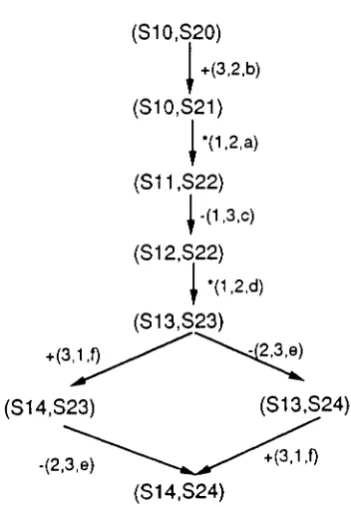
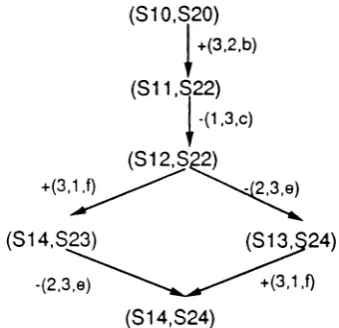
which is shown in Fig. 2. Then we derive the minimum CFSM that has the same external behavior as RG«Ml,M2),{(1,2),(2,1)}). This minimum CFSM, shown in Fig. 3, is EXT_RG«Ml,M2),{(1,2),(2,1)}). The next step is to compose the CFSM in Fig. 3 and M3 with {(1,3),(2,3),(3,1),(3,2)} as the set of internal channels. The resulting CFSM of this composition is given in Fig. 4. Since the CFSM in Fig. 4 has synchronization transitions only, its minimum, observational equivalent CFSM is
O.
Algorithm
INC_RAfor
Incremental Reachability AnalysisLet H be a hierarchy of a set M of CFSMs Ml, M2, ..., and Mn, n>l. Assume that if Muses port- or mailbox-naming, then INT_C(M), the set of internal channels of M, is given. For the sake of simplicity, in steg (1) it is assumed that M uses either direct-naming only or port/mailbox-naming only. If M uses both direct-naming and port/mailbox-naming, then step (1) of this algorithm needs to be modified slightly.
(1)For each sub-hierarchy B of H, let INT_C(B) be defined as { channels involving two or more components of B, but not any CFSM outside B }, which is constructed as follows:
Case (a): M uses direct-naming only.
(a.1) For each Mi, ),i<=n, let USE_C(Mi)
={
(sender,receiver) : the sender or receiver is in Mi }. Let INT_C(M) be the empty set.(a.Z) Perform a bottom-up traversal of H to visit hierarchies of H. For a sub-hierarchy B, let
INT_C(M) = INT_C(M) U INT_C(B).
Case (b): Muses port- or mailbox-naming only.
(b.I) Perform a bottom-up traversal of H to visit hierarchies of H. For each sub-hierarchy B that is not H, let USE_C(B)
={
ports or mailboxes used in B } (b.2) Let INT_C(H)=
INT_C(M)n
{ ports or mailboxes in at least two USE_C sets of components of H } and LEFT_ C(H) = INT_C(M) - INT _C(H).
(b.3) Perform a top-down traversal of H to visit sub-hierarchies of H that are not H. For each B of these sub-hierarchies, let B* denote the parent-hierarchy of B. Define INT_C(B) = LEFT_C(B*)
n
{ ports or mailboxes in at least two USE_C sets of components of B } and LEFT_C(B) c: LEFT_C(B*) - INT_C(B).
(2)For each CFSM Mi, ic-O, in M, let INT_C(Mi) be the empty set and let EXT_RG(Mi,INT_C(Mi) be Mi.
(3)Perform a bottom-up traversal of H to visit sub-hierarchies of H. For a sub-hierarchy B, where B=(Bl,B2, ...,Bm), m > 1,
let RG(B,INT_C(B» = RG( ( EXT_RG(Bl,INT_C(Bl», EXT_RG(B2,INT_C(B2)), ..., EXT_RG(Bm,INT_C(Bm)) ), INT_C(B) ).
Let EXT_RG(B,INT_C(B» be the minimum CFSM that is observational equivalent to RG(B,INT_C(B)).
When algorithm INC_RG terminates, RG(H,INT_C(H» and EXT_RG(H,INT_C(H) have been constructed. Since INT_ C(M) denotes the set of internal channels for all of CFSMs in H,
EXT_IRG(H,INT_C(M)),
respectively, where"IRG"stands for "incremental reachability graph". Below we show that EXT_IRG(H,INT_C(M)) is the minimum CFSM describing the external behavior of M. Thus, algorithm INC_RG is more efficient than the all-at-once approach for identifying the external behavior of a set of CFSMs. The following lemma is derived from the restriction laws of CCS (on page 80 of [MiI89]) and is needed for the proof of theorem 2.Lemma
1.
Let M and M" be sets of CFSMs and L a set of channels.(a)RG(M,L) = RG(M,(L U L")), where L" is a set of channels not involving any CFSMs in M. (b)RG(RG(M,L),RG(M",L)),L*) = RG«M,M"),(L U L*)), where Land L* are disjoint and no
channel in L involves CFSMs in both M and M".
Theorem 2.
Let H be a hierarchy of a set M of CFSMsMl ,
M2, ..., and Mil, n>1. Assume that if Muses port- or mailbox naming, then INT_ C(M), the set of internal channels of M, is given. Assume that algorithm INC_RG has been applied to H.(l)IRG(H,INT_C(M)) is the minimum CFSM that defines the set of sequences of (1) synchronization operations involving components of Hand (2) send and receive operations of CFSMs in M that involve channels not in INT_C(M).
(2) IRG(H,INT_C(M)) == RG(M,INT_C(M)) and EXT_IRG(H,INC_(M)) = EXT_RG(M,INT_C(M)).
of Nl, N2, ... and Nm, and (b) INT_C(Nl), INT_C(N2), ..., INT_C(Nm), and INT_C(H) are
mutually exclusive and the union of them is INT_C(M). (1) is true becasue INT_C(H) is disjoint
from any of INT_C(Nl), INT_C(N2), ..., and INT_C(Nm). Note that if an element was also an
element of INT_C(Mi) for some i, O<i<=m, then some synchronization operations involving
components of H could be missing in IRG(H,INT_C(M». The proof for (2) is as follows. By
definition, IRG(H,INT_C(M)) = RG(H,INT_C(H)). According to step (3) of algorithm INC_RG,
IRG(H,INT_C(M)) = RG( ( EXT_RG(Hl,INT_C(H1», EXT_RG(H2,INT_C(H2), ...,
EXT_RG(Hm,INT_C(Hm) ) ),INT_C(H)).
For l<=i<= m, EXT_RG(Hi,INT_C(Hi)) = EXT_IRG(Hi,INT_C(Ni)) == IRG(Hi,INT_C(Ni)) ==
RG(Ni,INT_C(Ni)). Thus,
IRG(H,INT_C(M)) == RG( ( RG(Nl,INT_C(Nl)), RG(N2,INT_C(N2)), ...,
RG(Nm,INT_C(Nm) ) ),INT_C(H».
Let INT_C" be the union of INT_C(Nl), INT_C(N2), ... and INT_C(Nm). Following lemma l(a),
we can replace each INT_C(Ni), Oci<=m, in the right- hand side of the above equation with
INT_C". Hence,
IRG(H,INT_C(M)) == RG«RG(Nl,INT_C"),RG(N2,INT_C"), ...,RG(Nm,INT_ C")),INT_C(H)).
Note that INT_C" and INT_C(H) are disjoint and no channel in INT_C" involves CFSMs in two
or more of Nl, N2, ..., and Nm. Following lemma l(b), we have
IRG(H,INT_C(M)) RG«(Nl,N2, ...,Nm),INT_C(M)) = RG(M,INT_C(M»). Since
IRG(H,INT_C(M)) and RG(M,INC_(M) are observational equivalent, their minimum,
observational equivalent CFSMs are equal and therefore EXT_IRG(H,INT_C(M))=
4. Deadlock and Livelock Detection in Incremental Reachability Analysis
In this section, we show that incremental reachability analysis using algorithm INC RG guarantees the detection of deadlocks and may also detect livelocks. Let M be a set of CFSMs and L a set of channels. A state in RG(M,L) is called a deadlock state if (1) S has no successor state, (2) S is not a final state (i.e., at least one CFSM in M is not in a final state when M is in state S), and (3) at least one path from the initial state of RG(M,L) to S contains only synchronization transitions. Condition (3) is required because if every path from the initial state to S contains some send or receive transitions involving channels not in L, then whether Swill be entered depends upon the interaction between M and other CFSMs. A deadlock state of M is said to involve a CFSM in M if this CFSM is not in a final state when M is in this deadlock state. Since RG(M) contains synchronization transitions only, a deadlock state in RG(M) is a state that has no transitions and is not a final state. Assume that in Fig. 1, the label associated with the transition from state S33 to state S34 is changed from "+(2,3,e)" to "+(2,3,g)". Then the state (S14,S23,S33) in Fig. 4 becomes a deadlock state.
of a deadlock state, although RG(M,L) does not necessarily contain a deadlock state. Thus, two observational equivalent CFSMs have the same result on deadlock only if they have non-empty external behavior. From theorem 2 and the above discussion, we have the following theorem.
Theorem 3. Let H be a hierarchy of a set M of CFSMs Ml, M2, ..., and Mn, n> 1. Assume that if Muses port- or mailbox naming, then INT_C(M), the set of internal channels of M, is given. (a)IRG(H,INT_C(M)) contains a deadlock state if and only if RG(M,INT_C(M)) contains a
deadlock state.
(b)If EXT_IRG(M,INT_C(M)) has non-empty external behavior, EXT_IRG(H,INT_C(M)) contains a deadlock state if and only if RG(M,INT_C(M)) contains a deadlock state.
Let M be a set of CFSMs Ml, M2, ..., and
Mn,
n> 1, and L a set of channels. A state in RG(M,L) "is said to be a livelock state if (1) S has at least one successor state, (2) at least one path from the initial state of RG(M,L) to S contains only synchronization transitions, and (3) there exists at least one CFSM Mi, O<i<=n, such that (a) Mi has not entered its final state and (b) each of S and its reachable states has no transitions involving Mi (i.e., Mi cannot make any progress after entering state S). A livelock state S of M is said to involve a CFSM if each of S and its reachable states has no transitions involving this CFSM. Following the definitions of deadlock and livelock states, we have the following theorem.
RG(M,INT_C(M» contains a livelock or deadlock state involving all CFSMs in Mil.
Consider the deadlock example used earlier. If the modified CFSM in Fig. 4 is combined with
other CFSMs, the resulting CFSM contains a livelock or deadlock state involving M1, M2, and
M3 and this state is entered from the initial state via the sequence of transitions labeled
"*(" 3 b)" "*(1 3. - " ,
'"
c)" and "*(1 3" .f)"5. Empirical Studies of Incremental Reachability Analysis and Deadlock Detection
We have compared algorithm INC_RG and the all-at-once approach by applying them to the
following six concurrent programs written in CCS:
name
ABP
CSMA
GS
DME
PME
description
Alternating Bit Protocol (two versions)
.-Carrier SenselMultiple Access
Gas Station Problem (with one operator, one pump, and three customers) [HeI85]
Dekker's Mutual Exclusion Algorithm
Peterson's Mutual Exclusion Algorithm
For each of these CCS programs, say M, we performed the following tasks:
(a)defined a hierarchy, let INT_C(M) ={direct-naming channels involving only CFSMs in M and
ports or mailboxes used in M}, and applied algorithm INC_RG.
(a.Z) determined the maximum of total number of states at any time during the execution of algorithm INC_RG. This number is referred to as #IRG_max.
Since the value of #IRG_max depends upon the hierarchy chosen, we considered several possible hierarchies and selected the one with the smallest value of #IRG_max.
(b)let INT_C(M) = {direct-naming channels involving only CFSMs in M and ports or mailboxes used in M}, and applied the all-at-once approach to determine the number of states in RG(M\INT_C(M)). This number is referred to as #RG_closed.
(c) let INT_C(M)
= {},
and applied the all-at-once approach to determine the number of states in RG(M,{}). This number is referred to as #RG_open.These CCS program were analyzed by using Concurrency Workbench [CPS91] to determine the values of #EXT, #IRG_max, #RG_~losed,and #RG_open, as well as the existence of deadlocks. The results of this analysis are shown in the following table. The "n/r" entry in the table indicates "no result" because the analysis for the entry did not terminate after two days of e~~cution.
Program #EXT #IRG max #RG closed #RG open- Deadlock?
~
-ABP-I 9 40 41 180 Yes
ABP-II 2 12 12 180 No
CSMA 12 31 36 560 No
GS 1 14 14 n/r Yes
DME 2 114 126 800 No
PME 2 31 31 288 No
The above six programs are too small to show a significant difference between the value of #IRG_max and that of #RG_closed. We are currently using larger programs for empirical studies and studying how to define a hierarchy for a set of CFSMs in order to produce a "minimum" or "near minimum" values of #IRG_max.
Note that if a CCS program uses direct- or port-naming, the value of #RG_open in the above table is larger than necessary. The reason is that each action name in a CCS program is viewed as a mailbox and the Concurrency Workbench does not attempt to determine whether each action name in a CCS program can be viewed as a direct-naming channel or a port. Consider the set M of CFSMs Ml and M2 using direct-naming. RG(M,{}) contains send and receive transitions involving channels (1,2) and (2,1). Such transitions (and possibly some states) should be deleted since they are redundant. After the deletion of redundant transitions and states in RG(M,{}), the value of #RG_open is reduced to that of #RG_closed. Similarly, consider a set M" of CFSMs using port-naming with port R associated with a CFSM in M". RG(M",{}) contains#~~ndtransitions involving port R and such transitions (and possibly some states) are redundant.
6. Conclusion
Assume that a module M of a distributed program P is modified or replaced. If module M has the same EXT_IRG as its original version, then there is no need to re-analyze P for verification of properties such as freedom from deadlock or livelock. If module M has a different EXT_IRG, then portions of P that are affected by module M can be incrementally re-analyzed in bottom-to-top order. The re-analysis of P stops at a sub-hierarchy of P if the EXT_IRG of this sub-hierarchy is not changed due to the changes in module M. Thus, incremental analysis can significantly reduce the effort for re-analysis of a large distributed program due to correction or enhancement of this program.
Incremental reachability analysis of a set of CFSMs with synchronous communication has been studied by some researchers. In [LSU89] algorithms for incremental composition and reduction of CFSMs with direct-namingweregiven. At each composition step, a pair of CFSMs were combined. No quantitative way of ranking CFSMs for incremental composition was used. The paper presented three heuristic rules for reducing a CFSM to a smaller, observational equivalent one. However, the three rules do not necessarily produce a minimum, observational equivalent CFSM. The paper claimed that incremental analysis of the 0.931 protocol produced less than 1,000 states, while the all-at-once approach produced over 60,000 states. It is not clear, however, that the reachability graph produced by the all-at-once approach contains redundant transitions and states as mentioned in section 5.
input of the other transition, and (2) keeping transitions that neither take input from nor produce output to the other CFSM. There was no discussion of whether the resulting CFSM is observational equivalent to the original set of CFSMs.
In [YeY91] a prototype tool for incremental analysis of programs written in an Ada-like design language called PAL was described. For 3 PAL program, the tool transforms it into a set of process
graphs, one for each task, and performs composition and simplification of these process graphs. The tool can also determine the equivalence of process graphs. The axioms of composition, simplification, and equivalence used in this tool are based on ACP [BeK84], which is a different theory of process algebra from CCS and CSP [Hoa8S].
Our paper is different from the above mentioned papers in several aspects. First, we define the CFSM model to include message passing constructs using direct-naming, port-naming and mailbox-naming. Second, we show how to perform incremental analysis of a given hierar..chy of CFSMs with a given set of internal channels. At each step of this incremental analysis, a minimum CFSM describing the external behavior of CFSMs analyzed so far is produced. Third, we apply the theory of CCS to provide a formal proof that OUf incremental analysis guarantees the detection of
Acknowledgment
I would like to express my gratitude to Pramod Koppol for carrying out the empirical studies reported in section
5
and for his helpful comments on this paper. Also,I
would like to thank Dr. Rance Cleaveland for helpful discussion on CCS and Concurrency Workbench and for providing several CCS programs used in our empirical studies. The CCS program for the gas station problem was provided by U fuk Celikkan.References
[And91] G. R. Andrews, Concurrent Programming, Benjamin/Cummings, 1991.
[BeK84] J. A. Bergstra, and J. W. Klop, "Process Algebra for Synchronous Communication", Information and Control, 1984, 109-137.
[CES86] E. M. Clarke, E. A., Emerson, and A. P. Sistla, Automatic verification of finite-state systems using temporal logic", ACM TOPLAS, Vol. 8, No.2, April 1986, 244-263.
[CPS91] R. Cleaveland, J. Parrow and B.Steffen, "The Concurrency Workbench: A Semantics Tool for the Verification of Concurrent Systems", Computer Science Technical Report TR-91-26, North Carolina State University, 1991, to appear in ACM TOPLAS, Jan. 1993.
[LSU89] A. M. Lapone, K. K. Sabnani and M. U. Uyar. An Algorithmic Procedure for Checking Safety Properties of Communication protocols. IEEE Transactions on Communications, Sept. 1989, 940-948.
[HeI8S] D. Hclrnbold, and D. Luckham, "Debugging Ada tasking programs," IEEE Software, Vol. 2, No.2, March 1985, 47-57.
[Hoa8S] C. A. R. Hoare, Communicating Sequential Processes, Prentice-Hall, 1985. [Mi189] R. Milner, Communication and Concurrency, Prentice-Hall, 1989.
[SKB90] B. Sarikaya, V. Koukoulidis and G. V. Bochmann, "Method of Analyzing Extended Finite-State Machine Specifications", Computer Communications, Vol 13, No.2, March 1990, 83-92.
M1 810
!
-(1,2,a) 811!
-(1,3,c) 812 ~ +(2.1,d) 813!
+(3.1,f) 814 M2 820!
+(3.2,b) 821!
+(1,2.a) 822~
-(2,1 ,d) 823!
-(2.3.8)824
Figure 1: CFSMs M1, M2 and M3
(810,820)
!
+(3.2.b) (810,821 )~
*(1.2.a) (811 ,822)~
-(1.3,c) (812,822)~
*(1,2.d) (813,823)+(3~~
(814,823) (813,824) (814,824)Figure 2: RG((Ml,M2),{(1,2),(2,1)})
(810,820)
~
+(3,2.b)(811,822)
~
-(1,3,c)(S12,S~
"'''_,+(3,~ ~
(814,823) (813, 24)
-(2,3,8)
(814,824)
Figure 3: EXT.RG((Ml,M2),{(1,2),(2,1)})
(810,820,830)
~
*(3,2,b)(811,822,831 )
~
*(1,3,c)(812,822,832)
~
*(3.1,f)(814,823,833)
~
*(2,3,9)(814,824,834)