TABU SEARCH METHOD FOR SOLVING MULTIOBJECTIVE JOB SHOP SCHEDULING PROBLEM
NOR FAUZANA BINTI AWANG
A dissertation submitted in fulfilment of the requirement for the award of the degree of
Master of Science (Mathematics)
Faculty of Science Universiti Teknologi Malaysia
To my beloved parents
Hj. Awang Bebakar and Hjh. Rohani Mahmud siblings
Mohd Ruzman Awang & Afeefa Nawfa Amran Nor Farahiyah Awang & Nasrullah Yahaya
Muhd Hazimin Awang & Norasiah Dahalil Nor Hidayah Awang
Nor Hafilah Awang little supporters Hasya Barizah Nasrullah Dhia Arissa Sofea Muhd Hazimin
and friends
Syazwani, Izzah, Zahidatul, Farah,
Arif and Mazlan
iv
ACKNOWLEDGEMENT
ABSTRACT
vi
ABSTRAK
TABLE OF CONTENTS
CHAPTER TITLE PAGE
DECLARATION ii
DEDICATION iii
ACKNOWLEDGEMENTS iv
ABSTRACT v
ABSTRAK vi
TABLE OF CONTENTS vii
LIST OF TABLES x
LIST OF FIGURES xiv
LIST OF SYMBOLS AND ABBREVIATIONS xv
1 INTRODUCTION
1.1 Introduction 1
1.2 Background of the Problem 2
1.3 Statement of the Problem 5
1.4 Objectives of the Study 6
1.5 Scope of the Study 6
1.6 Significant of the Study 7
1.7 Layout of the Dissertation 7
2 LITERATURE REVIEW
2.1 Introduction 8
viii
2.2.1 Classes of Schedule 10
2.2.2 Assumptions in Job Shop Scheduling Problem
13
2.3 Objectives for Job Shop Scheduling Problem 14 2.3.1 Single Objective Optimization 15 2.3.2 Multiobjective Optimization 16
2.4 Solution Methods 17
2.4.1 Exact Method 19
2.4.2 Heuristic Method 19
2.4.3 Metaheuristic Method 21
2.5 Tabu Search method 22
2.5.1 Initial Solution 25
2.5.2 Critical Path 26
2.5.3 Neighbourhood Structure 26
2.5.4 Move 32
2.5.5 Tabu List 32
2.5.6 Aspiration Criterion 33
2.5.7 Termination Criterion 34
2.6 Summary 34
3 RESEARCH METHODOLOGY
3.1 Introduction 35
3.2 Research Design and Procedure 36
3.3 Tabu Search 38
3.3.1 Basic Tabu Search Algorithm 39
3.3.2 Initial Solution 42
3.3.3 Critical Path 43
3.3.4 Neighbourhood Structure 44
3.3.5 Move 44
3.3.6 Tabu List 44
3.3.7 Aspiration Criterion 45
3.3.8 Termination Criterion 45
3.4.1 Formulation of Makespan 46 3.4.2 Formulation of Total Weighted Tardiness 47
3.5 Summary 49
4 RESULTS AND DISCUSSIONS
4.1 Introduction 50
4.2 Examples of 3x3 JSSP 51
4.2.1 Initial Solution 52
4.2.2 Tabu search 55
4.3 Example of 4x4 JSSP 62
4.3.1 Initial Solution 63
4.3.2 Tabu Search 68
4.4 Example of 6x6 JSSP 98
4.4.1 Initial Solution 99
4.4.2 Tabu Search 102
4.5 Discussion 106
4.5.1 Result of 3x3 JSSP 107
4.5.2 Result of 4x4 JSSP 108
4.5.3 Result of 6x6 JSSP 112
4.6 Benchmark Problem 116
4.6.1 Benchmark Problem for 3x3 JSSP 117 4.6.2 Benchmark Problem for 4x4 JSSP 119 4.6.3 Benchmark Problem for 6x6 JSSP 122
4.7 Summary 125
5 CONCLUSIONS AND RECOMMENDATIONS
5.1 Conclusion 126
5.2 Recommendations 130
REFERENCES 131
x
LIST OF TABLES
TABLE NO. TITLE PAGE
2.1 Example of Priority Dispatching Rules 20
2.2 Some Application of Tabu Search 24
4.16 Gantt Diagram for 4x4 JSSP at iteration 3 75 4.17 and TWT for 4x4 JSSP at iteration 3 76 4.18 Gantt Diagram for 4x4 JSSP at iteration 4 78 4.19 and TWT for 4x4 JSSP at iteration 4 79 4.20 Gantt Diagram for 4x4 JSSP at iteration 5 81 4.21 and TWT for 4x4 JSSP at iteration 5 83 4.22 Gantt Diagram for 4x4 JSSP at iteration 6 85 4.23 and TWT for 4x4 JSSP at iteration 6 85 4.24 Gantt Diagram for 4x4 JSSP at iteration 7 87 4.25 and TWT for 4x4 JSSP at iteration 7 88 4.26 Gantt Diagram for 4x4 JSSP at iteration 8 90 4.27 and TWT for 4x4 JSSP at iteration 8 91 4.28 Gantt Diagram for 4x4 JSSP at iteration 9 93 4.29 and TWT for 4x4 JSSP at iteration 9 94 4.30 Gantt Diagram for 4x4 JSSP at iteration 10 96 4.31 and TWT for 4x4 JSSP at iteration 10 97 4.32 Example of 6x6 Job Shop Scheduling Problem 99 4.33 and TWT for 6x6 JSSP at iteration 0 101 4.34 Gantt Diagram for 6x6 JSSP at iteration 1 104 4.35 and TWT for 6x6 JSSP at iteration 1 105 4.36 Value of Z when and for 3x3
JSSP
107
4.37 Value of Z when and for 3x3 JSSP
108
4.38 Value of Z when and for 4x4 JSSP
xii
4.39 Value of Z when and for 4x4 JSSP
110
4.40 Value of Z when and for 6x6 JSSP
112
4.41 Value of Z when and for 6x6 JSSP
114
4.42 Value of makespan for 3x3 JSSP 117
4.43 Value of total weighted tardiness for 3x3 JSSP 117 4.44 Condition 1: Value of Z when and
for 3x3 JSSP
118
4.45 Condition 2: Value of Z when and
for 3x3 JSSP
118
4.46 Best schedule for 3x3 JSSP 118
4.47 Value of makespan for 4x4 JSSP 119
4.48 Value of total weighted tardiness for 4x4 JSSP 120 4.49 Condition 1: Value of Z when and
for 4x4 JSSP
120
4.50 Condition 2: Value of Z when and
for 4x4 JSSP
120
4.51 Best schedules for 4x4 JSSP 121
4.52 Value of makespan for 6x6 JSSP 122
4.53 Value of total weighted tardiness for 6x6 JSSP 123 4.54 Condition 1: Value of Z when and
for 6x6 JSSP
123
4.55 Condition 2: Value of Z when and
for 6x6 JSSP
124
4.56 Best schedule for 6x6 JSSP 124
5.1 Optimum values of makespan and TWT 127
5.2 Best schedule for makespan and total weighted tardiness of tabu search
5.3 Summary of optimal values for the best three schedules
128
xiv
LISTS OF FIGURES
FIGURE NO. TITLE PAGE
1.1 Scenario leading to the problem 4
2.1 The classes of schedule for job shop 12
2.2 Summary of job shop scheduling problem 18
2.3 Neighbourhood structure N4 29
2.4 Neighbourhood structure N5 30
2.5 Neighbourhood structure N6 31
2.6 Neighbourhood structure N7 31
2.7 Example of move 32
3.1 Operational framework of this study 37
3.2 Framework of tabu search 41
3.3 Example of Gantt diagram 43
4.1 Initial Disjunctive Graph for 3x3 JSSP 54
4.2 The initial schedule in Gantt diagram form for 3x3 JSSP
54
4.3 Initial Disjunctive Graph for 4x4 JSSP 66
4.4 The initial schedule in Gantt chart form for 4x4 JSSP
67
4.5 The critical path for 4x4 JSSP 68
4.6 Initial disjunctive Graph for 6x6 JSSP 100 4.7 The initial schedule in Gantt chart form for 6x6
JSSP
LIST OF SYMBOLS AND ABBREVIATIONS
JSSP Job shop scheduling problem
TS Tabu search
SA Simulated annealing
GA Genetic algorithm
NP-hard Nondeterministic polynomial-time hard
The nth job
The mth machine
TWT Total weighted tardiness
The makespan
The operation of job j on machine k The completion time of job j
The processing time of job j on machine k
The minimum processing time of job j on machine k The starting time of operation
1
CHAPTER 1
INTRODUCTION
1.1 Introduction
Scheduling can be defined as a decision making process over a period of time (Pinedo, 2008). It deals with the allocation of tasks in a given time. It also contains one or more goals or we can call it objectives that need to be fulfilled at the end of it. Scheduling problem can be modelled as an assignment problem which indicates a large class of combinatorial optimization problems (Pierre, 2010). For some cases, it is very hard to find the optimal solution. If we cannot solve it in polynomial time, we called it NP-hard problem.
classical scheduling theory which are each task need to be processed by at most one processor at a time and each processor is capable of processing at least one task at a time. Scheduling problems occur in many areas in our daily life. The most noticeable field that use scheduling in their operation is in manufacturing industries. Some said it also can be applied in service industries.
1.2 Background of the Problem
Scheduling and sequencing play an important role in a decision making process. Scheduling is done according to time and resource capacity while sequencing is the order of the task in a chain. In other word, sequencing is done based on the information from scheduling parameter. Another definition of scheduling is given by Tamilarasi (2010). He says that scheduling is a problem of finding an optimal sequence to execute a finite set of operations satisfying most of the constraints.
3
Scheduling problem can be classified into three groups of parameters which are machine environment, job characteristic and optimality criteria (Pawel, 2005). Machine environment represents different formation of machines in the system. There are two types of cases that can be considered in machine environment which are single-stage production system and multi-stage production system. During this study, we will only focus on multi-stage production system. In multi-stage production system, jobs required operations on various machines and each machine must have different function. To be more specific, it has three sub-problems that can be considered which are flow shop, job shop and open shop (Pinedo, 2008).
For this study, we will discuss only on job shop scheduling problem. Job shop is a model of solution for a scheduling and sequencing problem. We use the job shop model when there are machines and each job has its own route or order to follow (Pinedo, 2008). In certain cases, Pinedo (2008) says that flow shop model will be applied if each job has to follow the same order of processing. In his book, he also mentioned that if jobs are freely to use the machines in any order, the model is considered to be open shop model. Those three models are commonly known by other researchers. Job shop scheduling problem (JSSP) is one of the problem in optimization and research operation field. This problem can be solved using a few methods such as simulated annealing (SA), genetic algorithm (GA) and tabu search (TS).
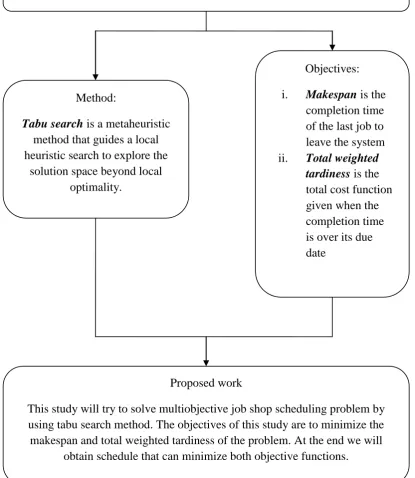
makespan and total weighted tardiness by using tabu search method. Figure 1.1 provides the framework of this study.
Figure 1.1 Scenario leading to the problem
Job shop scheduling problem is a problem with m machines and each job j has its own route to be followed and it will visit each machine at most once.
Method:
Tabu search is a metaheuristic method that guides a local heuristic search to explore the
solution space beyond local optimality.
Objectives:
i. Makespan is the
completion time of the last job to leave the system
ii. Total weighted
tardiness is the total cost function given when the completion time is over its due date
Proposed work
This study will try to solve multiobjective job shop scheduling problem by using tabu search method. The objectives of this study are to minimize the makespan and total weighted tardiness of the problem. At the end we will
5
1.3 Statement of the Problem
Job shop scheduling problem (JSSP) consists of a set of j jobs that need to undergo a process on a set m machines. The set of jobs can be denoted by J = {J1, J2, ..., Jn} and the set of machines can be written as M = {M1, M2, ..., Mm}. This problem assumes that only one job can be processed on a machine at a time. The process of a job on a machine is called an operation (Oij) and each operation has its own processing time, pij. In job shop problem each job has its own predetermined route to follow. Meaning that, the sequence of machines for each job is different. Hence the sequence of the machines is known as technological constraint.
There are two main objective functions highlighted in this study. The first objective is to minimize the makespan, . Makespan can be defined as completion time of the last job to leave the system and can be denoted as = max (C1, C2, C3, ... , Cn). The second is to minimize the total weighted tardiness,
. The weight is basically a priority factor that signifying the important of job j during the process. Meanwhile, Tj is the tardiness of job j and it can be defined as . At the end of this study, we will use equation given by
1.4 Objectives of the Study
In this study, we consider three main objectives that need to be focused. Those three objectives of this study are as follows:
a) To propose an algorithm of tabu search (TS) in solving multiobjective job shop scheduling problem (JSSP).
b) To get the optimal schedule for makespan and total weighted tardiness respectively.
c) To obtain the best schedule that minimizes the value of weighted sum for both makespan and total weighted tardiness.
1.5 Scope of the Study
7
1.6 Significance of the Study
Scheduling involves taking decision regarding the allocation of available capacity or resources to solve problems regarding on jobs, activities, tasks and production over time. The application of scheduling can be seen on scheduling of jobs in factories and companies and also scheduling employee work hours (Pedersen, 2009). Pinedo (2008) states a few more application of job shop scheduling in real life. The present research is conducted in developing the tabu search algorithm to solve JSSP. It helps in minimizing the total completion time of the whole process (makespan) and gives the best schedule that can minimize total weighted tardiness.
1.7 Layout of the Dissertation
REFERENCES
Abdelaziz, A.Y., Mohamed, F.M., Mekhamer, S.F., and Badr, M.A.L. (2010). Distribution system reconfiguration using modified tabu search algorithm. Electric Power System Research. 80, 943-953.
Adibi, M.A., Zandieh, M., and Amiri, M. (2010). Multi-objective scheduling of dynamic job shop using variable neighbourhood search. Expert Systems with Applications. 37, 282-287.
Bilge, U., Kirac, F., Kurtulan, M., and Pekgun, P. (2004). A tabu search algorithm for parallel machine total tardiness problem. Computers & Operations Research. 31, 397-414.
Bilge, U., Kurtulan, M., and Kirac, F. (2007). A tabu search algorithm for the single machine total weighted tardiness problem. Computers & Operations Research. 176, 1423-1435.
132
Baozhen, Y., Ping, H., Mingheng, Z., and Maoqing, J. (2014). A support vector machine with the tabu search algorithm for freeway incident detection. International Journal Applied Mathematic & Computer Science. Vol. 24(2), 397-404.
Carlos, A. C. C., Gary, B. L., and David, A. V. V. (2007). Evolutionary Algorithms for Solving Multi-Objective Problems. (2nd ed.). Spring Street, N. Y.: Springer.
Ching, F. L. (2013). An improved branch-and-bound algorithm for the preemptive open shop total completion time scheduling problem. Journal of Industrial and Production Engineering. Volume 30 (5), 327-335.
Fatihah, N. H. (2012). Solving job shop scheduling problem by using tabu search method. Master Thesis, Universiti Teknologi Malaysia, Skudai.
Fred, G. (1997). Tabu Search. (1st ed.). Netherland: Kluwer Academic Publishers Group.
French, S. (1982). Sequencing and Scheduling: An Introduction to the Mathematics of the Job shop. (1st ed.). England: Ellis Horwood LimitedGeyik, F., and Cedimoglu, I.H. (2004). The strategies and parameters of tabu search for job shop scheduling. Journal of Intelligent Manufacturing. 15, 439-448.
Geyik, F., and Ismail, H. C. (2004). The strategies and parameters of tabu search for job shop scheduling. Journal of Intelligent Manufacturing. 15, 439-448.
Guohua, W., and Benjamin, P. C. Y. (2002). Tabu search for single machine scheduling with distinct due windows and weighted earliness/tardiness penalties. European Journal of Operational Research. 142 (2), 271-281.
Haritha, M. (2008). Adaptive, multi-objective job shop scheduling using genetic algorithms. Master Thesis, University of Kentucky.
Jaeggi, D. M., Parks, G. T., Kipuoros, T., and Clarkson, P. J. (2008). The development of a multi-objective Tabu search algorithm for continuous optimisation problems. European Journal of Operational Research. 185, 1192-1212.
Jayaraj, V., Jegathesh, A. J., and Hemalatha, S. (2014). An Analysis of genetic algorithm and tabu search algorithm for Channel Optimization in Cognitive AdHoc Networks. International Journal of Computer Science and Mobile Computing (IJCSMC). Volume 3(7), 60-69.
Jie, G., Mitsuo, G., Linyan, S., and Xiaohui, Z. (2007). A hybrid of genetic algorithm and bottleneck shifting for multiobjective flexible job shop scheduling problems. Computer & Industrial Engineering. 53, 149-162.
134
Liping, Z., Liang, G., and Xinyu, L. (2013). A hybrid genetic algorithm and tabu search for multi-objective dynamic job shop scheduling problem. International Journal of Production Research. Volume 51(12), 3516-3531.
Liyana, N. A. A. (2014). Simulated annealing approach for solving job shop scheduling problem with makespan and total weighted tardiness. Master Thesis, Universiti Teknologi Malaysia, Skudai.
Mustufa, H.A., Ibrahim, A.H., Abdulaziz, M.E.T., Al-Ahmari, A.M., and Emad, S.A.N. (2014). Ant colony optimization for job shop scheduling to minimize the total weighted tardiness. Proceeding of the 2014 Industrial and Systems Engineering Research Conference Y. Guan and H. Liao, eds. 1-3 June. Montreal, Canada: ISERC, 25-34.
Mason, S.J., Fowler, J.W., Carlyle, W.M., and Montgomery, D.C. (2005). Heuristics for minimizing total weighted tardiness in complex job shops. International Journal of Production Research. Volume 43 (10), 1943-1963.
Meeran, S., and Morshed, M. S. (2014). Evaluation of a hybrid genetic tabu search framework on job shop scheduling benchmark problems. International Journal of Production Research. Volume 5(19), 5780-5798.
Nguyen, S., Mengjie, Z, Mark, J., and Kay, C. T. (2013). A computational study of representations in genetic programming to evolve dispatching rules for the job shop scheduling problem. IEEE Transactions on Evolutionary Computation. Vol.17 (5), 621-639.
Pawel, P. L. (2005). Metaheuristic for job shop scheduling problem, comparison of effective methods. Master Thesis, Aarhus School of Business.
Pedersen, A. B. (2009). Analysis of tabu search. Journal of Artificial Intelligence Research. 36(1), 471-511.
Pierre, L., and Francois, R. (2008). Production Scheduling. (1st ed.). Hoboken, N. J.: John Wiley & Sons, Inc.
Pinedo, M. L. (2008). Scheduling: Theory, Algorithms, and Systems. (3rd ed.). New York: Prentice Hall.
Ponnambalam, S. G., Rajesh, S. V., and Aravindan, P. (2000). A tabu search algorithm for job shop scheduling. International Journal of Advanced Manufacturing Technology. 16, 765-771.
136
Salhi, S. (1996). Heuristic search methods. George, A., M. Modern methods for business research (pp. 147-175). New Jersey: Lawrance Erlbaum Associates, Inc.
Salhi, S. (2002). Defining tabu list size and aspiration criterion within tabu search methods. Computers & Operations Research. 29, 67-86.
Sarmady, S. (2007). An investigation on tabu search parameters. School of Computer Science, Universiti Sains Malaysia.
Senthil, V.P., and Selladurai, V. (2007). A tabu search algorithm for job shop scheduling problem with industrial scheduling case study. International Journal of Soft Computing. 2(4), 531-537.
Tamilarasi, A., and Anantha, K. T. (2010). An enhanced genetic algorithm with simulated annealing for job shop scheduling. International Journal of Engineering, Science and Technology. 2(1), 144-151.
Tsubakitan, S., and James, R. E. (1998). Optimizing tabu list size for the travelling salesman problem. Computers Operations Research. 25(2), 91-97.
Xianpeng, W., and Lixin, T. (2009). A population-based variable neighborhood search for the single machine total weighted tardiness problem. Computers & Operations Research. 36, 2105-2110.
Zhang, C.Y., Li, P.G., Guan, Z.L., and Rao, Y.Q. (2007). A tabu search algorithm with a new neighborhood structure for the job shop scheduling problem. Computers & Operations Research. 34, 3229-3242.
Zhang, G., Xinyu, S., Peigen, L., and Liang, G. (2009). An effective hybrid particle swarm optimization algorithm for multi-objective flexible job-shop scheduling problem. Computers & Industrial Engineering. 56, 1309-13178.
Zhang, G., Liang, G., and Yang, S. (2011). An effective genetic algorithm for the flexible job-shop scheduling problem. Expert Systems with Application. 38, 3563-3573.