MATHEMATICAL THINKING IN MULTIVARIABLE CALCULUS
THROUGH BLENDED LEARNING
HAMIDREZA KASHEFI
MATHEMATICAL THINKING IN MULTIVARIABLE CALCULUS
THROUGH BLENDED LEARNING
HAMIDREZA KASHEFI
A thesis submitted in fulfilment of the
requirements for the award of the degree of
Doctor of Philosophy (Mathematics Education)
Faculty of Education
Universiti Teknologi Malaysia
iii
DEDICATION
To
My beloved Wife Fariba Mirzaei
And
ACKNOWLEDGEMENT
I would like to express my sincerest appreciation and thanks to my main
thesis supervisor, Associate Professer Zaleha Ismail, whose encouragement,
supervision and support from the preliminary to the concluding level enables me to
complete this research. Without her continuing support and interest, this thesis would
not have been the same as presented here. I would also like to thank, my
co-supervisor Assoociate Professer Yudariah Mohammad Yusof, for her commitment,
support, patience, and guidance throughout the process of carrying out the research
work. My sincere gratitude also goes to all academic staff of Faculty of Education
especially Prof. Dr. Noor Azlan Ahmad Zanzali, Prof. Dr. Ismail Kailani, Prof. Dr.
Mohd Salleh Abu, Assoc. Prof. Dr. Mohmad Bilal Ali, Assoc. Prof. Dr. Zainal
Abidin, Assoc. Prof. Dr. Yusof Boon, Dr. Fatin Aliah Phang and those who have
encouraged and assisted me throughout this study to make this thesis a success.
Many thanks and gratitude to the library adminestrative staff of Perpustakaan
Sultanah Zanariah, Universiti Teknologi Malaysia for their kind cooperation in
assisting me to gain access to the books, journals and materials needed for preparing
this dessertation. I am also grateful to all the students who participated in this study
and gave me the permission and privilege to analyze their work. Last but not least, I
wish to thank all the friends especially Mr. Kourosh Nemati, Mr. Farshad Khosravi,
Mrs. Maryam Salarian, Mrs. Avin Kaykhosravi, and Ms. Asma Chinigarzadeh for
their warm support and encourangement.
v
ABSTRACT
ABSTRAK
vii
TABLE OF CONTENTS
CHAPTER
TITLE
PAGE
DECLARATION
ii
DEDICATION
iii
ACKNOWLEDGEMENT
iv
ABSTRACT
v
ABSTRAK
vi
TABLE OF CONTENTS
vii
LIST OF TABLES
xi
LIST OF FIGURES
xiii
LIST OF ABBREVIATIONS
xix
LIST OF APPENDICES
xx
1
INTRODUCTION
1.1
Introduction
1.2
Background of the Problem
1.3
Statement of the Problem
1.4
Objectives of the Study
1.5
Theoretical Framework
1.6
Conceptual Framework
1.7
Research Questions
1.8
Importance of the Study
1.9
Chapter Summary
1
1
3
7
8
9
15
17
17
18
2
LITERATUR REVIEW
2.1
Introduction
2.2
Multivariable Calculus
20
2.3
Mathematical Thinking
2.3.1
Promoting Mathematical Thinking
with Computers
2.3.1.1
Dubinsky Method
2.3.1.2
Tall Method
2.3.2
Promoting Mathematical Thinking without
Computers
2.4
Creative Problem Solving
2.4.1 The Different Versions of CPS
2.4.2 Using CPS in Learning and
Teaching Mathematics
2.5
Blended Learning
2.5.1 Face-to-Face and Online Instruction
in Mathematics
2.5.2 Definition of Blended Learning
2.6 Chapter Summary
23
24
24
28
33
42
42
45
46
46
49
53
3
THE PRELIMINARY INVESTIGATION
3.1
Introduction
3.2
Purposes of the Preliminary Investigation
3.3
Design of the Study
3.4
Participants of the Preliminary Study
3.5
Methods of Data Collection
3.5.1
Qualitative Data Collection
3.5.2
Quantitative Data Collection
3.6
Data Analysis
3.7
Results
3.7.1 Classroom Observation: An Overview
3.7.2 Results of Written Assessments
3.7.2.1 Peer Assessment
3.7.2.2 Quiz
3.7.2.3 Test 1
3.7.2.4 Test 2
ix
3.7.2.5 Final Exam
3.7.3 Questionnaires Results
3.7.3.1 Students Questionnaires Results
3.7.3.2 Lecturers Questionnaires Results
3.8
Discussion
3.8.1 Qualitative Data Discussion
3.8.2 Quantitative Data Discussion
3.9
Conclusions
3.10 Chapter Summary
80
83
83
85
87
87
91
92
94
4
METHODOLOGY
4.1
Introduction
4.2
Research Method
4.3
Sample of the Study
4.4
The Blended Learning Experience
4.5
Methods of Data Collection
4.5.1
Think-Aloud Verbalization
4.5.2
Participant’ Written Solutions
4.5.3
Semi-structured Interview
4.5.4
Students Web Comments and
Semi-Structured Questionnaire
4.6
Analysis of Data
4.7
Chapter Summary
95
95
95
97
97
99
101
105
107
108
112
115
5
INTEGRATING MATHEMATICAL THINKING IN
BLENDED LEARNING
5.1
Introduction
5.2
Design of The Model
5.3
Development of Multivariable Calculus in Blended
Learning
5.3.1 Structure of the Course
5.3.2 Resources
5.4 Chapter Summary
6
RESULTS AND CONCLUSION
6.1
Introduction
6.2
The Analysis of the Data
6.2.1 Analysis of Think-aloud Problems
6.2.1.1 Analysis Based on Students
6.2.1.2 Analysis Based on Problems
6.2.1.3 Discussion of Think-Aloud Results
6.2.2 Analysis of Students’ Written Solutions
6.2.2.1 Results of Students’ Written Solutions
6.2.2.2 Discussion of Students’ Written Solutions
6.2.3 Students’ Web Comments and
Semi- structured Questionnaire
6.2.3.1 Students’ Web Comments
6.2.3.2 Semi-structured Questionnaire
6.2.3.3 Discussion of Students’ Web
Comments and Semi-
structured Questionnaire
6.3
Chapter Summary
146
146
146
146
146
156
188
193
193
210
212
212
218
220
221
7
CONCLUSION AND RECOMMENDATIONS FOR
FUTURE RESEARCH
7.1
Introduction
7.2
Overview of the Study
7.3
Conclusion
7.4
Limitations of the Research
7.5 Recommendations for Future Research
222
222
222
223
227
228
REFERENCES
230
xi
LIST OF TABLES
TABLE NO.
TITLE
PAGE
1.1
Reality construction
10
2.1
Action associated with mathematical thinking powers
(from Roselainy, 2009)
35
2.2
Questions and prompts for mathematical thinking (from
Roselainy, 2009)
36
2.3
Structures in mathematics (from Roselainy, 2009)
38
2.4
A grid linking the list of mathematical structures to the
mathematical thinking activities (from Watson and
Mason, 1998)
39
3.1
A framework for mathematical error analysis
(adopted from Mason (2002) and Peng and Luo (2009))
61
3.2
Ranking methods from students’ perspective
84
3.3
Ranking methods from lecturers’ perspective
86
4.1
The upper group students
103
4.2
The lower group students
104
4.3
The methods of supporting students’ learning
111
4.4
Coding Sheet Based on CPS Steps and Mathematical
Thinking Activities
113
4.5
Action associated with mathematical thinking powers
114
5.1
The grid linking between students’ difficulties and
mathematical thinking activities
127
5.2
Finding the domain, range and sketching the graph of a
typical example
130
Variables
5.4
Problem Worksheet: Vertical and Horizontal Shifts
134
5.5
Problem Worksheet: Graphs of Surfaces
135
5.6
The Symbolic Insight of six common types of quadric
surfaces
136
6.1
Amin’s mathematical thinking activities through CPS
steps of problems
148
6.2
The upper group students’ results in solving Problem 1
162
6.3
The lower group students’ results in solving Problem 1
166
6.4
The upper group students’ results in solving Problem 2
169
6.5
The lower group students’ results in solving Problem 2
171
6.6
The upper group students’ results in solving Problem 3
173
6.7
The lower group students’ results in solving Problem 3
177
6.8
The upper group students’ results in solving Problem 4
180
6.9
The lower group students’ results in solving Problem 4
182
6.10
The upper group students’ results in solving Problem 5
186
6.11
The lower group students’ results in solving Problem 5
188
6.12
Upper Group students’ mathematical thinking activities
through CPS steps of problems
189
6.13
Lower Group students’ mathematical thinking activities
through CPS steps of problems
190
6.14
Comparison of the upper and lower groups’ students’
abilities and their difficulties in solving the problems
192
xiii
LIST OF FIGURES
FIGURE NO.
TITLE
PAGE
1.1
The relation between three Bruner’s modes and three
worlds of mathematical thinking
10
1.2
The relation between the theories of Bruner, Tall, and
Skemp
11
1.3
A blend of learning theories
12
1.4
The relation between the theories of Tall, Skemp and
blended learning
13
1.5
The relation between three primary senses and blended
learning
13
1.6
The relation between Bruner’s modes, primary senses,
and blended learning
14
1.7
Theoretical framework of the Study
15
1.8
Conceptual framework of the study
16
2.1
Schemas and their construction (from Dubinsky, 1991)
26
2.2
The three worlds of mathematics illustrated by selected
aspects (from Tall, 2008)
30
2.3
Procedural knowledge as part of conceptual knowledge
(from Tall, 2008)
31
2.4
The didactic tetrahedron
32
2.5
Focus of mathematical learning
40
2.6
Model of active learning
42
2.7
CPS Version 1.0 (from Isaksen and Treffinger, 2004)
43
2.8
The CPS version 6.1 (from Treffinger, Selby, and
Isaksen, 2008)
3.1
A typical group’s error in finding the range of
f
66
3.2
A typical group’s response in finding the range of
f
based on the graph of domain
66
3.3
A typical student’s response in a group to a question in
the semi-structured questionnaire
67
3.4
A typical group’s response in finding the range of
f
68
3.5
A typical group’s attempt in finding the range of
f
68
3.6
A typical student’s attempt in finding and sketching the
domain of
, = 9 −
−
69
3.7
A typical student’s response in finding the domain and
range of
, = 9 −
−
70
3.8
A typical student’s response to a question in the
semi-structured questionnaire
70
3.9
A typical student’s attempt in sketching the graph of
+
−
= 1
71
3.10
A typical student’s error in solving Problem 2
72
3.11
A typical student’s attempt in finding of the domain of
, = 1 −
−
73
3.12
A typical student’s mistake in finding of the range of
, = 1 −
−
74
3.13
A typical student’s response in finding the range of
, = 1 −
−
74
3.14
A typical student’s attempt in sketching the region of
integration for Problem 7
75
3.15
A typical student’s attempt in solving Problem 7
75
3.16
A typical student’s poor algebraic manipulation in
solving Problem 1
76
3.17
A typical student’s poor algebraic manipulation in
solving Problem 3
77
xv
3.21
A typical student’s response in sketching the graphs of
surfaces in Problem 5
79
3.22
A typical student’s difficulty in solving the Problem
1(b)
80
3.23
A student’s difficulty in solving the Problem 1(b)
81
3.24
A typical student’s response in sketching the region of
integration for Problem 2(a)
81
3.25
A typical student’s attempt in finding the limits of
integration for Problem 2(a)
82
3.26
A typical student’s attempt in sketching the surfaces of
Problem 2(b)
82
3.27
A typical student’s attempt in finding the limits of
integration for Problem 2(c)
83
3.28
A student’s response to a question in the semi-structured
questionnaire
84
3.29
A student’s response to the semi-structured
questionnaire
85
3.30
A typical lecturer’s response to the semi-structured
questionnaire
85
3.31
A typical lecturer’s response to the semi-structured
questionnaire
87
4.1
A typical social forum screen on the web course
109
4.2
Journal module 1
110
5.1
Focus of mathematical learning
117
5.2
Albano’s didactic scheme in e-learning
118
5.3
Building a didactic scheme in blended learning
118
5.4
The resources of blended learning mathematics course
119
5.5
Model of blended learning
120
5.6
The page of Moodle including Engineering Mathematics
course
123
5.7
The creation of New Account page
123
5.8
The home page of the blended learning multivariable
calculus course
5.9
A typical group exploratory assignment
126
5.10
A typical laboratory part of web course
126
5.11
A typical animations to show the traces of hyperboloid
of two sheets
137
5.12
The preliminary test for Chapter 1
138
5.13
A typical concept check for Chapter 1
139
5.14
A typical web-based interactive tool in teaching the
domain and the range
140
5.15
An online tool to sketch the graph of two-variable
functions
141
5.16
A typical web-base tool to teach the concept of limit
141
5.17
An online tools to find the limit
142
5.18
A typical web-based interactive tools in the concept of
partial derivatives
143
5.19
A typical web-based interactive tool to understand the
concept of double integral
144
5.20
An online tool to evaluate double integral
144
5.21
A web-based interactive tool for showing the limits of
integration
145
6.1
Amin’s written solution for Problem 1
158
6.2
Hadis’s written solution for Problem 1
160
6.3
Sanaz’s written solution for Problem 1
161
6.4
Yazdan’s written solution for Problem 1
163
6.5
Saman’s written solution for Problem 1
164
6.6
Tahereh’s written solution for Problem 1
165
6.7
Ali H’s written solution for Problem 2
167
6.8
Salar A’s written solution for Problem 2
168
6.9
Tooraj’s written solution for Problem 2
169
6.10
Mostafa’s written solution for Problem 2
170
6.11
Sanaz’s written solution for Problem 3
173
6.12
Tahereh’s written solution for Problem 3
175
6.13
Ahmad’s written solution for Problem 3
176
xvii
6.15
Hadis’s written solution for Problem 4
180
6.16
Keyvan’s written solution for Problem 4
181
6.17
The first page of Amin’s written solution for Problem 5
184
6.18
The second page of Amin’s written solution for Problem
5
185
6.19
Yazdan’s written solution for Problem 5
187
6.20
Meysam’s
difficulty in algebraic manipulation
194
6.21
A typical process of data analysis of students’ written
solutions
195
6.22
Omid’s
attempt in finding the domain of
, = 64 − 4
−
196
6.23
Saeed’s attempt in finding and sketching the domain of
f
197
6.24
Maryam N’s
attempt in finding the domain of
, = 9 −
−
198
6.25
Maryam N’s attempt in finding the range of
, = 9 −
+
198
6.26
Saman’s attempt in finding the range of
, = 9 −
+
199
6.27
Shahriar’s attempt in sketching the graph of
, = 9 −
+
199
6.28
Amir’s attempt in finding the domain and range and in
sketching of the graph of
, = 9 −
+
200
6.29
Kaveh’s attempt in sketching the graph of
+
4
−
9
= 1
201
6.30
Mohammad’s attempt in sketching the graph of
+
−
= 1
203
6.31
Alireza M’s attempt in finding the domain of
, = 1 −
−
203
6.32
Fateme’s attempt in finding
of
, = 1 −
−
204
6.33
Rasoul’s attempt in solving
sin
6.34
Amir’s response to Problem 4
206
6.35
Ali’s response to Problem 4
206
6.36
Sajad’s response to Problem 4
207
6.37
Maryam’s response to Problem 4
208
6.38
Soheil’s response to Problem 4
209
6.39
Payam’s response to Problem 4
209
6.40
Mohsen’s response to Problem 4
210
6.41
Sayed’s response to Journal 1
214
xix
LIST OF ABBREVATIONES
APOS
-
Action-Process-Object-Schema
CMS
-
Course Management System
CPS
-
Creative Problem Solving
F2F
-
Face-to-Face
HTML
-
Hyper Text Markup Language
IAUKSH
-
Islamic Azad University of Kermanshah
Moodle
-
Modular Object-Oriented Dynamic Learning Environment
PASW
-
Predictive Analytics SoftWare
PDA
-
Personal Digital Assistant
-
Portable Document Format
RQ
-
Research Question
LIST OF APPENDICES
APPENDICS
TITLE
PAGE
CHAPTER 1
INTRODUCTION
1.1
Introduction
Calculus is one of the most important courses for engineering students that is
offered as a prerequisite course to other advanced mathematics or even engineering
courses. The importance of calculus learning for engineering students is to provide
them with ways of working with several mathematical ideas and various
representations and also use this knowledge in their engineering fields (Roselainy,
Yudariah, and Sabariah, 2007). The lack of understanding of concepts in calculus
may hinder the understanding of other concepts or even subjects. In other words,
mathematics, in particular calculus, enables engineering students in learning to apply
a wide range of mathematical techniques and skills in their engineering classes and
later in their professional work (Croft and Ward, 2001). However, for most
undergraduate students, specifically engineering students, calculus is one of the most
difficult courses in their fields of study (Schwarzenberger, 1980; Morgan, 1988;
Cornu, 1991; Eisenberg, 1991; Artigue and Ervynck, 1993; Tall, 1993a; Yudariah
and Roselainy, 2001; Willcox and Bounova, 2004; Kashefi, Zaleha, and Yudariah,
2010d, 2011a).
learning styles, poor problem solving skills and the inability to select and use
appropriate mathematical representations (see Tall and Schwarzenberger, 1978;
Smith, 1979; Orton, 1983a, b; Morgan, 1988; Artigue and Ervynck, 1993; Tall,
1993a; Tall and Razali, 1993; Norman and Pritchard, 1994; Yudariah and Tall, 1999;
Hirst, 2002; Yudariah and Roselainy, 2004; Sabariah, Yudariah, and Roselainy,
2008; Roselainy, 2009; Kashefi, Zaleha, and Yudariah, 2010d, 2011a).
Studies on students’ learning have found various methods that can support
students in the learning of calculus. Promoting mathematical thinking with or
without computer is one of the most important methods to support students in the
learning of calculus. There is quite an extensive study on promoting mathematical
thinking in calculus such as works by Dubinsky (1991), Schoenfeld (1992), Watson
and Mason (1998), Yudariah and Tall (1999), Gray and Tall (2001), Mason (2002),
Tall (1986, 1995, 2004), and Roselainy (2009).
Mathematical thinking is a dynamic process which expands students’
understanding with highly complex activities, such as abstracting, specializing,
conjecturing, generalizing, reasoning, convincing, deducting, and inducting (Mason,
Burton, and Stacey, 1982; Tall, 1991; Yudariah and Roselainy, 2004). Authors like
Tall and Dubinsky and their colleagues, endeavored to support students’
mathematical knowledge construction and mathematical thinking in calculus
especially basic calculus through the use of computers. In a study of multivariable
calculus, Roselainy and her colleagues (Roselainy, 2009; Roselainy, Yudariah, and
Mason, 2007; Roselainy, Yudariah, and Sabariah, 2007) presented a model of active
learning in face-to-face (F2F) multivariable calculus classroom. The model was
based on invoking students’ mathematical thinking powers, supporting mathematical
knowledge construction, and promoting generic skills such as communication,
teamwork, and self-directed learning.
3
learning of engineering, science, and even mathematics courses through computer
tools (Lumsdaine and Voitle, 1993a; Lumsdaine and Lumsdaine, 1995b; León de la
Barra et al., 1997; Pepkin, 2004; Cardellini, 2006; Wood , 2006; Gustafson, 2006;
Kandemir and Gür, 2009; Williamson, 2011). CPS is a multi steps method for
solving problems in various disciplines that not only use analytical, creative, and
critical thinking in the most appropriate sequence but can also use the capabilities of
computers (Lumsdaine and Lumsdaine, 1995b; Forster, 2008; Chen and Cheng,
2009; Robertson and Radcliffe, 2006, 2009; Maiden et al., 2010).
The literature as well as the preliminary investigation (see Chapter 3) showed
that many students struggle as they encounter new mathematical ideas and objects in
multivariable calculus
course. There are very few researches that investigate on how
to develop and support students’ thinking powers in the construction of mathematical
knowledge in multivariable calculus by using computers. Moreover, not many
studies were done that involve effective communication, teamwork, and problem
solving in mathematics courses specifically multivariable calculus by CPS and
computer tools. Thus, in this study, we shall explore and propose a model of teaching
and learning of multivariable calculus that enhance students’ thinking powers by
using computer which also involves generic skills via CPS steps based on
mathematical thinking activities. Blended learning that integrates the benefits of both
F2F and computer-based environment is proposed as a sufficient environment in
supporting students’ mathematical learning based on mathematical thinking.
1.2
Background of the Problem
appropriate to enable them to cope with the mathematics needed for their engineering
problems. In order to characterize engineering students’ use of mathematics, it is
crucial to recognize not only the mathematical content knowledge that engineering
students apply in engineering contexts but also other generic skills that engineering
students learn from mathematics courses (Cardella, 2006).
CPS is a framework designed to assist problem solver in invoking
communication and teamwork skills and using computer tools to support students’
thinking powers and overcome obstacles. The roots of CPS are found in Alex
Osborn’s classic book, Applied Imagination, (1953). The CPS are refined and
extended by many researchers over the past six decades (Parnes, 1967; Isaksen and
Treffinger, 1985; Isaksen and Dorval, 1993; Isaksen, Treffinger, and Dorval, 1994).
Through CPS, some researches (Lumsdaine and Voitle, 1993a; León de la Barra et
al., 1997; Cardellini, 2006; Gustafson, 2006; Wood , 2006; Williamson, 2011) tried
to support students’ learning and thinking powers in engineering, science, and even
mathematics courses. However, there is very little literature reporting on the use of
CPS to help engineering students in the learning of calculus and in using computer
tools (Lumsdaine and Lumsdaine, 1995b; Pepkin, 2004; Gustafson, 2006; Wood ,
2006; Kandemir and Gür, 2009).
Researchers, by promoting mathematical thinking with computer or without
it, try to support students in understanding mathematical concepts and solving real
problems in F2F classroom. Encouraging mathematical thinking and supporting
students’ mathematical knowledge construction can help to reduce their difficulties
in calculus. Researchers like Dubinsky and Tall and their collaborators, have been
trying to support students’ mathematical thinking powers and overcome students’
difficulties in basic calculus by using computers.
5
construction (Breidenbach et al., 1992; Dubinsky and Yiparaki, 1996). Dubinsky and
Yiparaki (1996) noted several specific pedagogical strategies for helping students to
make the mathematical knowledge constructions. The main strategies used for this
method are ACE (Activities, Class discussion, and Exercises) teaching cycle,
cooperative learning groups to engage students in problem solving activities and the
use of ISETL (Interactive SET Language) as an interactive mathematical
programming language (Dubinsky and Yiparaki, 1996; Asiala et al., 1996).
Gray and Tall (see Gray and Tall, 1994, Gray et al., 1999) had introduced a
similar cycle of mental construction as in APOS theory, called “procept” which is the
amalgam of three components namely a process which produces a mathematical
object, and a symbol which is used to represent either a process or an object.
Reflecting on the theoretical development on the construction of mathematical
knowledge in elementary and advanced mathematics, Gray and Tall (2001) then
proposed three distinct types of mathematics worlds to describe certain mental
construction for learning mathematical concepts. They suggested three different
ways of constructing mathematical concepts from
perception
of objects (as occurs in
geometry),
actions
on objects (as in arithmetic and algebra) and
properties
of objects
that lead to formal axiomatic theories.
In a further study, Tall (2004) pointed out that there are not only three distinct
types of mathematics worlds; there are in fact three significantly different worlds of
mathematical thinking:
conceptual
-
embodied, proceptual-symbolic,
and
axiomatic-formal
. This theory underlies the creation of computer software which Tall called
generic organizer
and used it in his researches (Tall, 1986, 1989, 1993b, 2000, 2003)
construction and prevent misleading factors (Tall, 1986). In fact, Tall tried to support
all modes of reality building (experience, communication, and creativity) and reality
testing (experiment, discussion, and internal consistency) of Skemp’s theory to
construct mathematical concepts.
In the study of multivariable calculus, Roselainy and her colleagues
(Roselainy, 2009; Yudariah and Roselainy, 2004; Roselainy, Yudariah, and Mason,
2005, 2007; Roselainy, Yudariah, and Sabariah, 2007) adopted the theoretical
foundation of Tall (1995) and Gray et al. (1999) and used frameworks from Mason,
Burton, and Stacey (1982) and Watson and Mason (1998) to develop the
mathematical pedagogy for classroom practice. They highlighted some strategies to
support students to empower themselves with their own mathematical thinking
powers thus help them in constructing new mathematical knowledge and generic
skills, particularly, communication, teamwork, and self-directed learning (Yudariah
and Roselainy, 2004). In the classroom activities, they used themes and mathematical
processes through specially designed prompts and questions to invoke students’ use
of their own mathematical thinking powers and to further develop these powers
according to the complexity of the mathematical concepts (Roselainy, Yudariah, and
Mason, 2005). In this way, students’ attention was focused and directed to the
prompts and questions in the beginning until the students became aware of the type
of questions faced (Sabariah, Yudariah, and Roselainy, 2008).
7
1.3
Statement of the Problem
Both Dubinsky and Tall in their research used special mathematics software
and programming language that are difficult to use in the formal calculus class.
Moreover, they have not focused much on supporting students’ thinking and
knowledge construction in multivariable calculus. The Dubinsky method was based
on some strategies like computer activities as mathematical programming language,
class discussion and team working, and problem solving activities. In this approach,
Dubinsky and his colleagues used visual tools after knowing the mathematics and
algebraic manipulation. The most challenging aspect in their method was very few
engineering students at the freshman or sophomore level that learnt a mathematical
programming language can write program and use this skill in their college study.
Furthermore, only students with career goals in programming need to study these
languages (Lumsdaine and Lumsdaine, 1995b).
In the study of multivariable calculus, Roselainy and her colleagues
(Roselainy , 2009; Roselainy, Yudariah, and Mason, 2007; Roselainy, Yudariah, and
Sabariah, 2007) focused on supporting engineering students’ thinking powers,
mathematical knowledge construction and generic skills in multivariable calculus.
Using prompts and questions as an important strategy in Roselainy method focuses
more on the symbolic world of mathematical thinking. Moreover, in their model of
active learning, they did not use computer tools to support students’ learning and
thinking powers. The findings of the preliminary investigation (see Chapter 3)
indicated that although Roselainy et al.’s method helps in making students aware of
their mathematical thinking processes, students still have difficulties when they
encounter new mathematical ideas and concepts (Kashefi, Zaleha, and Yudariah,
2010d, 2011a).
used as synchronous and asynchronous communication. Moreover, in the case of
multivariable calculus, Roselainy and her colleagues did not use any computer
facilities such as animations, web-based tools, and visual aids in lecturers to support
students’ visualization. There is few established literature on using computer tools
and generic skills such as communication, teamwork, and problem solving via CPS
steps to develop and support students’ thinking powers based on mathematical
thinking in multivariable calculus. Thus, the most important purpose of this study is
to investigate the potential of blended learning as an approach to develop and support
students’ thinking powers and knowledge construction by using computer tools. It
also tries to invoke generic skills via CPS steps, especially in the learning of
multivariable calculus.
1.4
Objectives of the Study
This study will design and develop a model that conceptualized a framework
for supporting students’ mathematical learning in multivariable calculus by using
computer tools and generic skills based on mathematical thinking through a blended
learning environment. The main goal of this study is to determine the effectiveness
of the blended learning multivariable calculus course on the students’ knowledge
construction and problem solving specifically in reducing students’ difficulties.
The three objectives of this research are:
1. To design an alternative blended learning approach in fostering students’
mathematical thinking in multivariable calculus course.
2. To construct and implement a multivariable calculus course in the blended
learning environment based on the designed model.
9
1.5
Theoretical Framework
It is widely believed that to make significant progress in an area of research,
there is a need for a structured theory of learning (Stewart, 2008). The theory should
be used to explain the specific successes and failures of students in learning
mathematics. In addition, the theory must be extensible and applicable to other
phenomena, different from the ones that it was developed from.
Previously most theories in mathematics education came from general
educators and psychologists such as Piaget (1965), Bruner (1966) and Skemp (1979),
who only had something to say that was particularly related to mathematics (Tall,
2004d). Today research in mathematics education is based on theoretical
perspectives and mathematics education owns many theories which are directly
related to aspects of mathematics (Stewart, 2008). This section will firstly attempt to
identify the theoretical reasons for selecting blended learning to promote
mathematical thinking in calculus based on the both types of theories. Secondly,
Tall’s theory of the three worlds of mathematical thinking will be highlighted as a
theory that has formed this research.
Figure 1.
1
: The relation between three Bruner’s modes
and three worlds of mathematical thinking
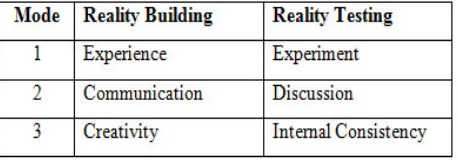
Skemp (1979) identifies three modes of building and testing conceptual
structures as shown in Table 1.1. Skemp’s theory notes that in the process of
mathematical knowledge construction, one, two, or three modes of reality building
can be used in combination with one, two, or three modes of reality testing (Skemp,
1979).
Table 1.1 Reality construction
11
modification of Skemp’s Mode 1 (Tall, 1989, 1993b). In fact, the computer provide
an environment and that give a new way for building and testing mathematical
concept by supporting all modes. Therefore, computer environment can be used in all
these modes and learners also may build mathematical concepts by considering
examples (and non-examples) of process in interaction with this environment
especially in the embodied world of mathematics (Tall, 1986).
In other words, computer environment provides not only a numeric
computation and graphical representation; it also allows manipulation of objects by
an enactive interface (Tall, 1986) that by using them we can support students’
knowledge construction and help them to overcome their difficulties in the embodied
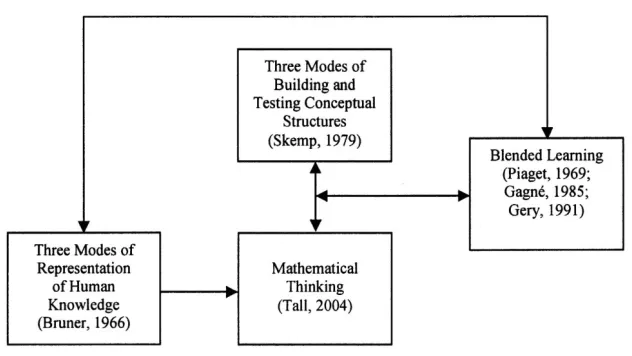
world of mathematics. Tall (1989) by combination of a human teacher as guide
(organizing agent) and using a computer environment (generic organiser) for
teaching tried to support students’ mathematical knowledge construction. In Tall’s
method, teachers as organizing agent do not have a directive role and they only
answer questions which may arise in the course of the student investigations through
a Socratic dialogue with them (Skemp’s Mode 2) which is enhanced by the presence
of computers (Tall, 1986, 2004). See Figure 1.2.
Figure 1.2: The relation between the theories of Bruner, Tall, and Skemp
underpinned educational theories. Hence, the need to explore educational theory and
its relationship with technology is essential. There is growing agreement that there is
not, and probably never will be, one great unified General Theory of Adult Learning
that will solve all our problems (Carman, 2005). Rather, blended learning offerings
should be based on an appropriate blend of learning theories, such as those put
forward by Piaget (1969), Bloom (1956), Vygosky (1978), Gagné (1985), Keller
(1987), Merrill (1994), Clark (2002), and Gery (1991) . See Figure 1.3.
Figure 1.3: A blend of learning theories
13
Figure 1.4: The relation between the theories of Tall, Skemp and blended learning
Current learning theories support the notion that learning occurs through an
individual’s interaction with others in the context of a real world event. These
theories support the teacher’s role as one of facilitator, not lecturer or director. In
other words, learning occurs as students develop knowledge, construct meanings, and
test out their theories in their community and social environments (Giddens and
Stasz, 1999). Blended learning by employing online and offline computer has the
potential as a social environment to support students’ learning by invoking generic
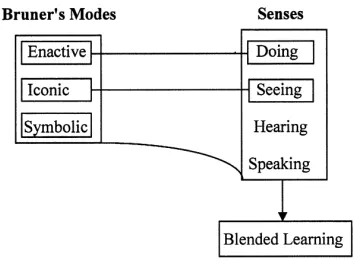
skills. Fahlberg-Stojanovska and Stojanovski (2007) noted that the best learning can
takes place when all three primary senses of seeing (visual), hearing (audio) and
doing (enactive) are involved in an interactive environment. They proposed links
between these senses and two components of blended learning as shown in the
following figure (see Figure 1.5):
Figure 1.5: The relation between three primary senses and blended learning
occurs when students learn through the combination of these senses. Blended
learning has the potential to involve all these senses better than using computer or
lecture separately. Therefore, due to the relation between Bruner’s modes and
primary senses on one hand and also the relation between primary senses and
blended learning on the other hand we can see a link between Bruner’s theory and
the components of blended learning (Kashefi, Zaleha, and Yudariah, 2010a). See
Figure 1.6.
Figure 1.6: The relation between Bruner’s modes,
primary senses, and blended learning
15
Figure 1.7: Theoretical framework of the Study
Tall’s theory of the three worlds of mathematical thinking suggested a
framework for the development of mathematics from childhood to the research
mathematicians (Stewart, 2008). As many multivariable calculus concepts have
embodied, symbolic and formal representations, based on Tall’s point of view for
university students it would be helpful to present them with the embodied aspects of
concepts, before focusing on the formal ideas. However, the preliminary
investigation revealed that the embodied ideas were often missing in lectures and
students’ course books. Thus, in this study it was decided to apply the theory of Tall,
by firstly examining students’ thinking in the preliminary investigation, and secondly
applying it in teaching multivariable calculus concepts.
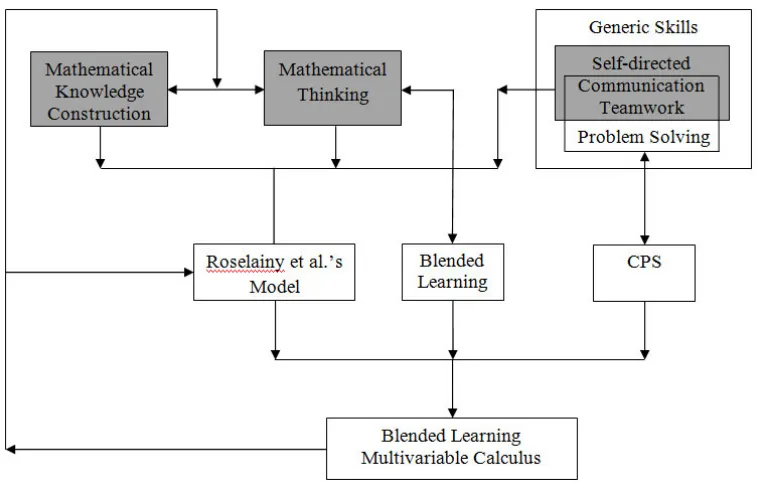
1.6
Conceptual Framework
Figure 1.8: Conceptual framework of the study
The conceptual framework shows the six variables identified in this study,
namely mathematical knowledge construction, mathematical thinking, students’
difficulties in the learning of multivariable calculus through Roselainy model,
generic skills, CPS, and blended learning and how they are interconnected.
The preliminary investigation of this research was implemented to determine
the effectiveness of Roselainy et al.’s method in supporting students’ learning based
on mathematical thinking approach. Moreover, knowing students’ difficulties in the
learning of multivariable calculus through this method and looking for ways of
improving them from the students and lecturers’ perspectives were among the aims
of the preliminary investigation.
17
alternative learning approach that considers the advantages of both e-learning and
F2F environments.
Then, how the blended learning multivariable calculus course can support
students’ mathematical thinking powers in the construction of mathematical
knowledge, doing problem solving and in reducing students’ mathematical
difficulties are investigated.
1.7 Research Questions
In particular, the research would answer questions that include:
1. How an alternative approach in fostering students’ mathematical thinking and
generic skills in multivariable calculus can be designed based on the preliminary
investigation, the existing model, integrating CPS, and blended learning?
2. How appropriate mathematical experiences for multivariable calculus course can
we adapted, modified and/or created in a blended learning environment?
3. How effective is the blended learning multivariable calculus course in developing
and supporting students’ thinking powers in the construction of mathematical
knowledge, problem solving, and in reducing their difficulties.
1.8 Importance of the Study
This study may evoke awareness among mathematics educators that CPS can
be integrated in mathematics problem solving with the potential of using computer
and invoking generic skills in its processes. Through CPS, different generic skills
such as communication, teamwork, and problem solving skills can be invoked to
develop and support students’ mathematical knowledge construction and problem
solving ability through technology tools. Moreover, applying this model in calculus
provides opportunities for students to familiarize themselves with the CPS and to be
able to use it in their engineering subjects or even later in their professional works.
1.9 Chapter Summary
Section 1.1 of this chapter gave the introduction of this study where the
importance of calculus was briefly mentioned. This is followed by the ways
researchers try to help students to overcome their difficulties in multivariable
calculus by supporting mathematical thinking with or without computer in F2F
classroom. This section ends with a discussion on the implementation of CPS to
support students’ mathematical knowledge construction in their mathematics class.
Section 1.2 briefly clarified the background of this study that was started by
three studies concerned using mathematical thinking for supporting students in
mathematical knowledge construction and also overcoming their difficulties in
calculus were quoted. The blended learning considered as environment that has tools
and potentials in supporting learning and teaching of mathematics and students’
generic skills.
19
Following from the statement of the problem was Section 1.4 where the objectives
for this study were stated.
Section 1.5 discussed the components in the theoretical framework of this
study. The discussion began with the relation between the theory of the three worlds
of mathematical thinking by Tall (2004) and Bruner’s theory (1966). This led to the
way of empowering students’ mathematical thinking by using computer based on
Skemp’s theory (1979) and introducing blended learning (Piaget, 1969; Gagné, 1985;
Gery, 1991) as a relevant environment to support students’ mathematical thinking.
Section 1.6 presented the construction of conceptual framework and the
relation between all possible variables in this study. Following this are the
formulations of the research questions of this study (Section 1.7).
Abraham, A. (2007). Student Centered Teaching of Accounting to Engineering
Students:
Comparing Blended Learning with Traditional Approache
s
,
Proceedings of ASCILITE, pp.1-9.
Albano, G. (2005). Mathematics and e-Learning: A Conceptual Framework,
DIDIA-Center of Excellence “Methods and Systems for Learning and Knowledge”,
University of Salerno, Italy.
Artigue, M., and Ervynck, G. (1993). Proceedings of Working Group 3 on Students’
Difficulties in Calculus, ICME-7, Québec, Canada
.
Asiala, M., Brown, A., DeVries, D., Dubinsky, E., Mathews, D., and
Thomas, K. (1996). A framework for research and curriculum development in
undergraduate mathematics education, Research in Collegiate Mathematics
E d u c at io n, 1 1 , 1-35.
Aycock, A., Garnam, C., and Kaleta, R. (2002). Lessons Learned from the Hybrid
Course Project, Teaching with Technology Today, 8-6.
Bailey, K. D. (2002). The Effects of Learning Strategies on Student Interaction and
Student Satisfaction. Unpublished doctoral dissertation, The Pennsylvania
State University, University Park.
Bajpai, A. C., and James, D. J. (1985). Mathematical Education for Engineers - a
Future Perspective,
European Jnl for Engineering Education,
Vo. 10, 277-83.
Barnum, C., and Paarman, W. (2002). Bringing Induction to the Teacher: A Blended
Learning Model,
T. H. E. Journal 30 no2 S 2002.
Bersin, J. (2004). Blended Learning: Finding What Works, Retrieved May 14, 2011,
from
the
Chief
Learning
Officer
website
at
http://www.clomedia.com/content/templates/clo_feature.asp?articleid=357&zo
neid=30
231
Blank, B., and Krantz, S. (2008).
Calculus Multivariable,
Wiley & Sons.
Bloom, B. S. (1956). Taxonomy of Educational Objectives: The Classification of
Educational Goals,
Handbook I: Cognitive Domain,
New York: Longmans,
Green.
Bogacki, P., and Melrose, G. (2010). Calculus Animations with Mathcad,
http://www.math.odu.edu/cbii/calcanim/
Borasi, R. (1994). Capitalizing on errors as “springboards for inquiry”: A teaching
experiment,
Journal for Research in Mathematics Education
,
25
(2), 166-208.
Branch, J. L. (2000). The Trouble with Think Alouds: Generating Data Using
Concurrent Verbal Protocols.
CAIS 2000: Dimensions of a Global
Information
Science
. Canadian Association for Information Science Proceedings of the 28th
Annual Conference.
Breidenbach, D., Dubinsky, E., Hawks, J., and Nichols, D. (1992). Development of
the process conception of function,
Educational Studies in Mathematics, 23
,
247– 285.
Briggs, W. L., and Cochran, L. (2010).
Calculus: Early Trancendentals (Ebook),
Pearson/Addison-Wesley, 2010.
Bruner, J. S. (1966).
Towards a Theory of Instruction
, New York: Norton.
Cardellini, L. (2006). Fostering creative problem solving in chemistry through group
work, Chemistry Education Research and Practice, Volume 7, Issue 2, 2006,
Pages 131-140 .
Carman, J. M. (2005). Blended Learning Design: Five Key Ingredients,
www.knowlegent.com.
Chen, Y.
F., and Cheng, K. (2009). Integrating computer-supported cooperative
learning and creative problem solving into a single teaching strategy, Social
Behavior and Personality, Volume 37, Issue 9, pp. 1283-1296.
Chew, E., Jones, N., and Turner, D. (2008). The Marriage of Rousseau and Blended
Learning: An Investigation of 3 Higher Educational Institutions’ Praxis, In:
Leung, H., Li, F., Lau, R., Li, Q. (eds.) ICWL 2007. LNCS, vol. 4823, pp.
641–652. Springer, Heidelberg.
Cohen, L., Manion, L., and Morrison, K. (2007). Research methods in education
(Sixth ed.). London: Routledge.
Cornu, B. (1991). Limits. In Tall (ed),
Advanced Mathematical Thinking
, Kluwer
Academic Publishers, Dordrecht
Croft, A., and Ward, J. A. (2001). Modern and Interactive Approach to Learning
Engineering Mathematics,
British Journal of Educational Technology,
vol.32,
no.2, pp 195-207.
Dreyfus, T. (1990). Advanced mathematical thinking. In ICM study series
,
Mathematics and
cognition: a research synthesis by the international group for
the psychology of
mathematics education
(pp.113-134), New York: Cambridge
University.
Driscoll, M. (2002). Blended Learning: Let’s get beyond the hype, Retrieved
from
http://www.elearningmag.com/elearning/ article/articleDetail.jsp?id=11755.
Dubinsky, E. (1991). Reflective Abstraction in Advanced Mathematical Thinking, In
D. O.Tall (ed.)
Advanced Mathematical Thinking
, Kluwer: Dordrecht, 95–123.
Dubinsky, E. (1994). Pedagogical Change in Undergraduate Mathematics Education
in Bettye Anne Case, Editor You're the Professor, What Next, MAA Notes, 35,
pp. 114-119.
Dubinsky,
E .
(1995).
ISETL:
A
Programming
Language
for
Learning
Mathematics, Communications i n Pure and Applied Mathematics, 48 , 1–25.
Dubinsky, E., and Yiparaki, O. (1996). Predicate Calculus and the Mathematical
Thinking of Students,
International Symposium on Teaching Logic and
Reasoning in an Illogical World,
Centre of Discrete mathematics and
Theoretical Computer Science, Rutgers University.
Duncker, K. (1945). On problem-solving, In Dashiell, J. F. (Ed.)
Psychological
Monographs
(pp.1–114),
Washington,
DC:
American
Psychological
Association.
Edwards, B. S., Dubinsky, E., and McDonald, M. A. (2005). Advanced
mathematical thinking.
Mathematical
Thinking and Learning, 7,
15–25
.
Eisenberg, T. (1991). Functions and Associated Learning Difficulties, In Tall (ed),
Advanced Mathematical Thinking
, Kluwer Academic Publishers, Dordrecht.
233
Fahlberg-Stojanovska, L., and Stojanovski, V. (2007). Elearning Materials for
Mathematics Mathcasts, Self- Testing and Interactivities, Eighth National
Conference with International Participation- ETAI.
Fonteyn, M. E., Kuipers, B., and Grobe, S. J. (1993). A description of think aloud
method and protocol analysis,
Qualitative Health Research, 3
(4), 430–441.
Forster, F. (2008). Distributed creative problem solving over the web, Proceedings
3rd International Conference on Internet and Web Applications and Services,
ICIW 2008, pp. 283-288.
Frank, M., Kurtz, G., and Levin, N. (2002). Implication of presenting pre-university
courses using the blended e-learning approach,
Educational Technology and
Society, 5
(4), 137-147, http://www.ifets.info/journals/5_4/frank.pdf
Gagné, R. (1985). The Conditions of Learning (4th ed.), New York: Holt, Rinehart &
Winston.
Garnham, C., and Kaleta, R. (2002). Introduction to hybrid courses. Teaching with
Technology
Today,
8(6),
Retrieved
Dec
8,
2009,
from
http://www.uwsa.edu/ttt/articles/garnham.htm
Gay, L. R., Mills, G. E., and Airasian, P. (2009).
Education Research Competencies
for Analysis and Applications,
Pearson Education, N.J.
Gery, G. (1991). Electronic performance support systems: how and why to remake
the workplace through the strategy application of technology, Ziff Institute, pp.
33, In: C. Leighton. <http://online.sfsu.edu/~leighton/whatisepss.htm>.
Giddens, B., and Stasz, C. (1999).
Context matters: Teaching and learning skills for
work. Why should educators worry about workplace skills?
National Center for
Research, University of California, Berkeley.
Goldin, G. A. (2000). A scientific perspective on structured, task-based interviews in
mathematics education research, In Kelly, A. E., & Lesh, R. A. (Eds.),
Handbook of Research Design in Mathematics & Science Education (pp.
517-545), USA: Lawrence Erlbaum Associates, Inc.
Gonzalez-Leon, E. (1989). Remedial Work in Mathematics for Students Entering
Engineering Courses at Universities,
Int. Jnl. Of Math. Educ. In Sc. & Tech
.,
Vol. 11, 81-89.
Gordon, S. E. (1994).
Systematic Training Program Design: Maximizing
Graham, C. R. (2006). Blended Learning Systems: Definition, Current Trends, and
Future Directions, In Bonk, C. J. & Graham, C. R. (Eds.).
Handbook of
blended learning: Global perspectives, local designs
. San Francisco, CA:
Pfeiffer Publishing.
Graham, D., and Valsamidis, A. (2006). A Framework for e-Learning: A Blended
Solution?, Proceedings of the 4th International Conference on Multimedia and
Information & Communication Technologies in Education, Seville, Spain,
22-25,November 2006, Vol. 1, pp. 233-23.
Gray, E., Pinto, M., Pitta, D., and Tall, D. O. (1999). Knowledge Construction and
Diverging Thinking in Elementary and Advanced Mathematics,
Educational
Studies in Mathematics,
38 (1-3), 111-113.
Gray, E. M., and Tall, D. O. (1994). Duality, ambiguity and flexibility: A proceptual
view of simple arithmetic,
Journal for Research in Mathematics Education
, 25,
2, 115–141.
Gray, E. M., and Tall, D. O. (2001). Duality, Ambiguity and Flexibility in Successful
Mathematical Thinking,
Proceedings of PME 15
, Assisi, 2, p72-79.
Gustafson, S.
(2006). Creative problem solving with genetic programming,
IEEE
Intelligent Systems, Volume 21, Issue 3, May 2006, Page 10.
Habre, S. (2001). Visualization Enhanced by Technology in the Learning of
Multivariable Calculus,
International Journal of Computer Algebra in
Mathematics Education
8 (2), 115 – 130.
Harding, A., Engelbrecht, J., Lazenby, K., and Le Roux, I. (2006). Blended Learning
In Undergraduate Mathematics at the University of Pretoria, In Bonk, C. J. &
Graham, C. R. (Eds.),
Handbook of blended learning: Global perspectives,
local designs
, San Francisco, CA: Pfeiffer Publishing.
Harel, G., and Sowder, L. (2005). Advanced mathematical-thinking at any age: Its
nature and its development,
Mathematical Thinking and Learning, 7,
27–50.
Haripersad, R. (2010). Deep and surface learning of elementary calculus concepts in
blended learning environment, In P.Dondon and O.Martin,
Latest Trends On
Enginering
Education : 7th WSEAS International
Conference on Engenering
Education
2010, pp 470-476.
235