Available Online at www.ijcsmc.com
International Journal of Computer Science and Mobile Computing
A Monthly Journal of Computer Science and Information Technology
ISSN 2320–088X
IJCSMC, Vol. 4, Issue. 4, April 2015, pg.670 – 683
RESEARCH ARTICLE
INTERPRETATION OF NOISE POLLUTION EFFECTS ON
HUMAN BEING USING FUZZY LOGIC TECHNIQUES
Tukan Namita Prakash
1, B.N.Veerappa
21
PG Scholar, UBDT College Of Engineering & Technology, Davanagere, Karnataka, (India)
2
Associate Professor, Dept Of CS&E, UBDT College Of Engineering & Technology,Davanagere, Karnataka, (India)
Abstract- Environmental noise at workplace always affects human health and work efficiency. The prominent adverse effects of noise pollution on human beings include noise-induced hearing loss, work efficiency, annoyance responses, interference with communication, the effects on sleep and social behavior. In assessing noise-induced effects the globalCriterion is “Human Health” and periodic checkup of health is very important. Neuro-fuzzy model (fuzzy toolbox) of Matlab using ANFIS (adaptive neuro-fuzzy inference system) techniques are found to be most effective to interpret noise pollution effects on human health. The main parameters used in model are Noise level, type of task and exposure level.
Keywords: Soft computing, Neuro –fuzzy model, noise pollution, human work efficiency
1. Introduction
rules by an expert. However, this approach is not feasible when there is no expert available or there is a need of tuning the linguistic knowledge of the expert with the available data. In fuzzy systems, the parameters are defined in a non-optimal way but for better adaptation, the design parameters must be optimized. Different optimization techniques based on mathematical programming and optimization theory have been suggested but they have slow convergence.
Neural networks, on the other hand, possess good learning capabilities. They learn from the given input/output data pairs and adjust the design parameters through minimization of error function using a suitable learning algorithm. But, unlike fuzzy systems, these neural networks lack the interpretation capability, i.e., they are unable to explain about a particular decision to the user in a human-comprehensible form. In order to have both the capabilities of learning and interpretability in a single system, hybridization of neural networks and fuzzy systems, often, called neuro-fuzzy systems, is a powerful designing approach.
Noise is a pervasive and influential source of stress. Whether through the acute effects of impulse noise or the chronic influence of prolonged exposure, the challenge of noise confronts many who must accomplish vital performance duties in its presence. Although noise has diffuse effects, which are shared in common with many other chronic forms of stress, i present a quantitative evaluation of these influences so that their harmful effects can be mitigated, their beneficial effects exploited, and any residual effects incorporated and synthesized into selection, training, and design strategies to facilitate human performance capacities. Predictions of single and joint moderator effects were made on the basis of major theories of noise and performance. These predictions were tested through moderator analyses of effects as a function of task type, noise type and exposure time. Observed outcome effects varied as a function of each of these moderators.
my present study is to predict the effects of noise pollution on human work efficiency as a function of noise level, type of task, and exposure time. Among these, only parameters like noise level and exposure time can be measured with the help of some scientific instruments, which provide the numerical values to the researchers. But the type of task and effects of noise pollution on human beings are studied through social surveys based on questionnaires. These questionnaires are generally words and propositions drawn from a natural language. For example, type of task may be represented by the words like simple, moderate, and complex. These linguistic variables (words) cannot be precisely measured and inherently contain imprecision, uncertainty, and partial truth. They can best be represented by fuzzy logic. Hence, the study of noise pollution is the unique combination of linguistic and numerical values. Therefore, neuro-fuzzy computing seems to be the natural choice for developing a model to study the effects of noise pollution on human work efficiency. The paper is organized as follows. Section 2 is devoted to the description of effects of noise pollution on human beings and Section 3 introduces the neuro-fuzzy modeling aspects. In Section 4, methodology for its development is discussed and implementation details are given in Section 5. Results are presented in Section 6 followed by the conclusion in Section 7.
2. Noise Pollution and human work efficiency
The prominent adverse effects of noise pollution on human beings include noise-induced hearing loss, work efficiency, annoyance responses, interference with communication, the effects on sleep and social behaviour. In assessing noise-induced effects the global criterion is ―human health‖. The established definition by the World Health Organization (WHO) says that health is ―a state of complete physical, mental and social well-being and not merely the absence of disease or infirmity‖ [1]. The effects on work efficiency may have serious implications for industrial workers and other occupations. In the past many studies have been conducted to determine the effects of noise on human performance involving varieties of tasks.
been proposed for 8 hours exposure in industrial environments[3]. During the last four decades, there has been an exponential growth in noise level due to reasons like increase in population, increase in traffic density (both road and air), increase in industrial establishments and increase in the use of various noise producing devices on several occasions. This has necessitated the society to think of the overall effects of noise on humans. The prominent adverse effects of noise pollution on human beings include noise-induced hearing loss, reduction in work efficiency, annoyance responses, interference with communication, the effects on sleep and social behavior. The effects on work efficiency may have serious implications for road traffic constable and other occupations. In the past, many studies have been conducted to determine the effects of noise on human performance involving varieties of tasks. Simple routine tasks usually remain unaffected at noise levels as high as 115 dB (A) or above while more complex tasks are disrupted at much lower levels [4]. Noise causes brief periods of inefficiency when sustained visual attention (e.g., visual target detection) is required without decrement in the overall levels of performance [5]. Impulsive and continuous noise impairs the human performance in signal monitoring and tracking task. The effects of noise on human performance have also been investigated by researchers based on sex [6], laterality, age [7] and extrovert-introvert characteristics. However, these factors do not affect human performance significantly. Therefore, depending on the nature of the task, worker performance gets affected differently under the impact of different levels of noise, age and duration of exposure.
3. Neuro-fuzzy computing
Over the past few decades, fuzzy logic has been used in a wide range of problem domains. Although the fuzzy logic is relatively young theory, the areas of applications are very wide: process control, management and decision making, operations research, economies and, fot this paper the most important, pattern recognition and classification. Dealing with simple ‗black‘ and ‗white‘ answers is no longer satisfactory enough; a degree of membership (suggested by Prof. Zadeh in 1965) became a new way of solving the problems. A fuzzy set is a set whose elements have degrees of membership. A element of a fuzzy set can be full member (100% membership) or a partial member (between 0% and 100% membership). That is, the membership value assigned to an element is no longer restricted to just two values, but can be 0, 1 or any value in-between. Mathematical function which defines the degree of an element's membership in a fuzzy set is called membership function. The natural description of problems, in linguistic terms, rather than in terms of relationships between precise numerical values is the major advantage of this theory.
3.1 FUZZY LOGIC CLASSIFICATION
3.1.1Matlab’s Fuzzy Logic Toolbox
In the lack of precise mathematical model which will describe behaviour of the system, Fuzzy Logic Toolbox is a good ―weapon‖ to solve the problem: it allows using logic if-then rules to describe the system‘s behaviour. This Toolbox is a compilation of functions built on the
MATLAB® numeric computing environment and provides tools for creating and editing fuzzy inference systems within the framework of MATLAB.
The toolbox provides three categories of tools: 1. command line functions,
2. graphical interactive tools and 3. simulink blocks and examples.
The Fuzzy Logic Toolbox provides a number of interactive tools that allow accessing many of the functions through a graphical user interface (GUI). Fuzzy Logic Toolbox allows building the two types of system:
1. Fuzzy Inference System (FIS) and
3.2 Fuzzy inference system
Fuzzy inference is the process of formulating the mapping from a given input to an output using fuzzy logic. The process of fuzzy inference involves: membership functions, fuzzy logic operators and if-then rules. There are two types of fuzzy inference systems that can be implemented in the Fuzzy Logic Toolbox:
1. Mamdani-type and
2. Sugeno-type.
Mamdani's fuzzy inference method is the most commonly seen fuzzy methodology and it expects the output membership functions to be fuzzy sets. After the aggregation process, there is a fuzzy set for each output variable that needs defuzzification. Sugeno-type systems can be used to model any inference system in which the output membership functions are either linear or constant. This fuzzy inference system was introduced in 1985 and also is called Takagi-Sugeno-Kang. Sugeno output membership functions (z, in the following equation) are either linear or constant. A typical rule in a Sugeno fuzzy model has the following form:
If Input 1 = x and Input 2 = y, then Output is z = ax + by + c For a zero-order Sugeno model, the output level z is a constant (a=b =0).
3.2.1 Membership function
Membership function is the mathematical function which defines the degree of an element's membership in a fuzzy set. The Fuzzy Logic Toolbox includes 11 built-in membership function types. These functions are built from several basic functions:
1. piecewise linear functions, 2. the Gaussian distribution function, 3. the sigmoid curve and
4. quadratic and cubic polynomial curve.
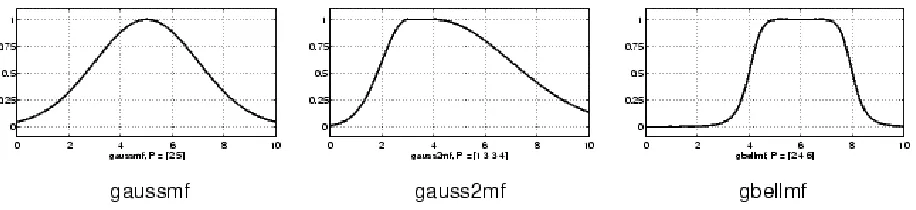
Two membership functions are built on the Gaussian distribution curve: a simple Gaussian curve and a two-sided composite of two different Gaussian curves (Figure 1.)
Figure 1. Membership functions built on the Gaussian distribution curve This type of membership function will be used later on, according to the results coming from PCI.
3.2.2 Fuzzy logic operators
The most important thing to realize about fuzzy logical reasoning is the fact that it is a superset of standard Boolean logic. In other words, if the fuzzy values are kept at their extremes of 1 (completely true) and 0 (completely false), standard logical operations will hold. That is, A AND M operator is replaced with minimum - min (A,M) operator, A OR M with maximum - max (A,M) and NOT M with 1-M.
3.2.3 If-Then rules
Fuzzy sets and fuzzy operators are the subjects and verbs of fuzzy logic. Usually the knowledge involved in fuzzy reasoning is expressed as rules in the form:
where x and y are fuzzy variables and A and B are fuzzy values. The if-part of the rule "x is A" is called the antecedent or premise, while the then-part of the rule "y is B" is called the consequent or conclusion. Statements in the antecedent (or consequent) parts of the rules may well involve fuzzy logical connectives such as ‗AND‘ and ‗OR‘. In the if-then rule, the word "is" gets used in two entirely different ways depending on whether it appears in the antecedent or the consequent part.
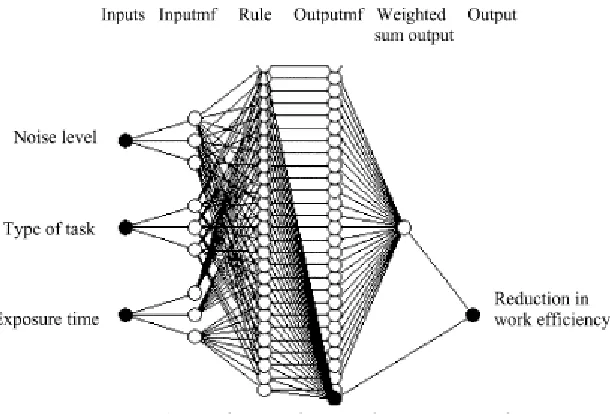
Fig. 2. Conceptual diagram of ANFIS.
4. System modeling
The modelling process based on ANFIS can broadly be classified in three steps 4.1. Step 1: system identification
The first step in system modelling is the identification of input and output variables called the system‘s variables. Then fuzzy IF–THEN rules based on Takagi–Sugeno–Kang (TSK) model [7,8] are formed, where antecedents are defined by a set of non-linear parameters and consequents are either linear combination of input variables and constant terms or may be constants, generally called, singletons.
4.2. Step 2: determining the network structure Once the input and output variables are identified, the neuro-fuzzy system is realized using a six-layered network as shown in Fig. 2. The input, output, and node functions of each layer are explained in the subsequent paragraphs.
4.2.1. Layer 1 (input layer) Each node in layer 1 represents the input variables of the model identified in step 1. This layer simply transmits these input variables to the fuzzification layer.
4.2.2. Layer 2 (fuzzification layer)
symbol mA(x) is the membership function. Its value on the unit interval [0,1] measures the degree to which element x belongs to the fuzzy set A, xi is the input to node i and Ai is the linguistic label for each input variable associated with this node. Each node in this layer is an adaptive node, that is, the output of each node depends on the parameters pertaining to these nodes. Thus the membership function for A can be any appropriate parameterized membership function. The most commonly used membership functions are triangular, trapezoidal, Gaussian, and bell shaped. Any of these choices may be used. The triangular and trapezoidal membership functions have been used extensively, especially in real-time implementations, due to their simple formulas and computational efficiency. In our original fuzzy model [8,5], we have used triangular membership functions. However, since these membership functions are composed of straight-line segments, they are not smooth at the corner points specified by the parameters. Though the parameters of these membership functions can be optimized using direct search methods but they are less efficient and more time consuming [32,33]. Also, the derivatives of these functions are not continuous so the powerful and more efficient gradient methods cannot be used for optimizing their parameters. Gaussian and bell shaped membership functions are becoming increasingly popular for specifying fuzzy sets as they are nonlinear and smooth and their derivatives are continuous. Gradient methods can be used easily for optimizing their design parameters. Thus in this model, we have replaced the triangular fuzzy memberships with bell shaped functions. The bell or generalized bell (or gbell) shaped membership function is specified by a set of three fitting parameters {a, b, c} as
(1) The desired shape of gbell membership function can be obtained by proper selection of the parameters. More specifically, we can adjust c and a to vary the center and width of the membership function, and b to control the slope at the crossover points. The parameter b gives gbell shaped membership function one more degree of freedom than the Gaussian membership function and allows adjusting the steepness at crossover points.
Fig. 3. ANFIS structure of the model.
operator which can perform fuzzy AND operation [34]. The fuzzy intersection operators are commonly referred to as T-norm (triangular norm) operators. Most frequently used T-norm operators are min or product operators. For instance
IF x1 is A1 ANDx2 is A2 ANDx3 is A3 THEN y is f ðx1; x2; x3Þ
where f (x1, x2, x3) is a linear function of input variables or may be a constant. The output of ith node is given as
(2) 4.2.4. Layer 4 (normalization layer)
The ith node of this layer is also a fixed node and calculates the ratio of the ith rule‘s firing strength in inference layer to the sum of all the rules‘ firing strengths
(3)
where i = 1, 2, . . ., R and R is total number of rules. The outputs of this layer are called normalized firing strengths. 4.2.5. Layer 5 (output layer) This layer represents the THEN part (i.e., the consequent) of the fuzzy rule. The operation performed by the nodes in this layer is to generate the qualified consequent (either fuzzy or crisp) of each rule depending on firing strength. Every node i in this layer is an adaptive node. The output of the node is computed as
(4)
where ¯wi is a normalized firing strength from layer 3 and fi is a linear function of input variables of the form ( pix1 + qix2 + ri), where { pi, qi, ri} is the parameter set of the node i, referred to as consequent parameters or f may be a constant. If fi is linear function of input variables then it is called first order Sugeno fuzzy model and if fi is a constant (as in our present model) then it is called zero order Sugeno fuzzy model. The consequent can be a linear function as long as it appropriately describes the output of the model within the fuzzy region specified by the antecedent of the rule. But in the present case, the relationship between the input variables (noise level, type of tasks, and exposure time) and output (reduction in work efficiency) is highly non-linear. In Sugeno model, consequents can be taken as singletons, i.e. real numbers without losing the performance of the system.
4.2.6. Layer 6 (defuzzification layer)
This layer aggregates the qualified consequents to produce a crisp output. The single node in this layer is a fixed node. It computes the weighted average of output signals of the output layer as
(5) 4.3. Step 3: learning algorithm and parameter tuning
functions are propagated to the output unit. The network output is compared with the desired output values. The error measure EP, for pattern P at the output node in layer 6, may be given as
(6)
single node output of defuzzification layer in the network. Further, the sum of squared errors for the entire training data set is
(7)
The error measure with respect to node output in layer 6 is given by delta (d)
(8)
This delta value gives the rate at which the output must be changed in order to minimize the error function. Since the output of adaptive nodes of the given adaptive network depends on the design parameters so the design parameters must be updated accordingly. this delta value of the output unit must be propagated backward to the inner layers in order to distribute the error of output unit to all the layers connected to it and adjust the corresponding parameters. The delta value for layer 5 is given as
(9) Similarly, for any Kth layer, the delta value may be calculated using the chain rule as
(10) Now, if a is a set of design parameters of the given adaptive network, then
(11) where P is the set of adaptive nodes whose output depends on a. Thus, update for the parameter a is
given by
(12) where h is the learning rate and may be calculated as
(13)
propagation algorithm though widely used for training neural networks may suffer from some problems. The back propagation algorithm is never assured of finding the global minimum. The error surface may have many local minima so it may get stuck during the learning process on flat or near flat regions of the error surface. This makes the progress slow and uncertain.
Another efficient learning algorithm, which can be used for training the network, is hybrid-learning rule. Hybrid learning rule is a combination of least square estimator (LSE) and gradient descent method (used in back propagation algorithm). It converges faster and gives more interpretable results. The training is done in two passes. In forward pass, when training data is supplied at the input layer, the functional signals go forward to calculate each node output. The non-linear or premise parameters in layer 2 remain fixed in this pass. Thus the overall output can be expressed as the linear combination of consequents parameters. These consequent parameters can be identified using least square estimator (LSE) method. The output of layer 6 is compared with the actual output and the error measure can be calculated as in Eqs. (6) and (7). In backward pass, error rates propagate backward from output end towards the input end and non-linear parameters in layer 2 are updated using the gradient descent method (Eqs. (8)– (13)) as discussed in back propagation algorithm. Since the consequent parameters are optimally identified using LSE under the condition that the premise parameters are fixed, the hybrid algorithm converges much faster as it reduces the search space dimensions of the original pure back propagation algorithm.
5. Implementation
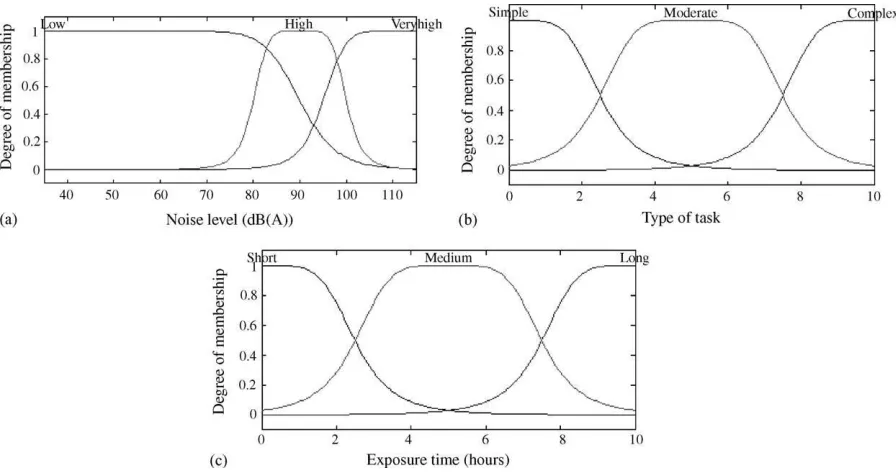
We have implemented our model using ANFIS (Fuzzy Logic Tool box) of MATLAB#[36]. The system is first designed using Sugeno Fuzzy Inference System. It is a three input–one output system. The input variables are noise level; type of task, and exposure time and the reduction in work efficiency is taken as the output variable. The input parameters are represented by fuzzy sets (or linguistic variables). We have chosen gbell shaped membership functions to characterize these fuzzy sets. The membership functions for input variables are shown in Fig. 3(a–c).
The membership functions are then aggregated using T-norm product operator to construct fuzzy IF– THEN rules that have a fuzzy antecedent part and constant consequent. The total number of rules is 27. Some of the rules are given below:
described in Section 2. Out of the total 2400 input/output data sets, 1950(80%) data pairs were used for training the model. The model was trained for 200 epochs with step size of 0.01 and error tolerance of 0%. To validate the model 450(20%) data sets were used for testing purpose.
6. Results and discussion
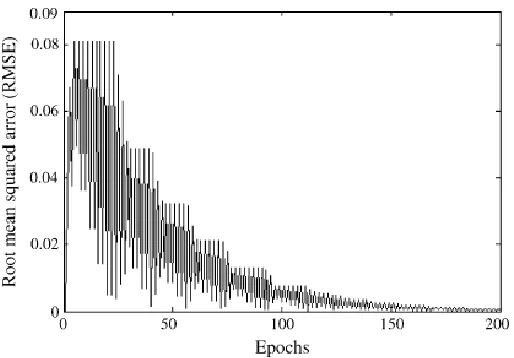
The model was trained for 200 epochs and it was observed that the most of the learning was completed in the first 150 epochs as the root mean square error (RMSE) settles down to almost 0% at 150th epoch. Fig. 4 shows the training RMSE curve for the model. After training the fuzzy inference system, it is found that the shape of membership functions is slightly modified. This is because of the close agreement between the knowledge provided by the expert and input/output data pairs.
The results can be obtained either in 3-D or 2-D forms. The surface representation in 3-D is not easily comprehensible while 2-D representation is more interpretable and understandable. Hence, the impact of noise level on human work efficiency is represented in the form of graphs in Fig. 6(a–c) with the type of tasks as parameters for different exposure times. The reduction in work efficiency up to the noise level of 85 dB(A) is almost negligible for all type of tasks irrespective of exposure times assuming effect of 25% reduction in work efficiency as negligible. Fig. 6(a) shows the reduction in work efficiency versus noise level with ‗short‘ (0–2 h) exposure time for ‗simple‘, ‗moderate‘, and ‗complex‘ tasks. The work efficiency reduces to almost 50% and 70% at 105 dB(A) and above noise levels for ‗moderate‘ and ‗complex‘ tasks but the ‗simple‘ tasks remain ‗unaffected‘. It is to be observed from Fig. 6(b) that the work efficiency is not affected (only 23%) at 100 dB(A) for ‗simple‘ task whereas for ‗moderate‘ and ‗complex‘ tasks, the reduction in work efficiency is 47% and 67% at the same noise levels for ‗medium‘ exposure times. However, the reduction in work efficiency is almost 37%, 70%, and 85% for ‗simple‘, ‗moderate‘ and ‗complex‘ tasks, respectively at 105 dB(A) and above noise levels.
Fig. 6(c) depicts the reduction in work efficiency with noise level at ‗long‘ exposure time for ‗simple‘, ‗moderate‘, and ‗complex‘ tasks. It is evident from this
Fig. 6. Training root mean squared error curve.
figure that the reduction in work efficiency is negligible up to the noise level of 90 dB(A) for ‗simple‘ and ‗moderate‘ tasks while it is about 40% for ‗complex‘ tasks. The work efficiency starts reducing after 90 dB(A) even for ‗simple‘ and ‗moderate‘ tasks. At 100 dB(A), work efficiency reduces to 36%, 58%, and 76% for ‗simple‘, ‗moderate‘, and ‗complex‘ tasks, respectively. There is significant reduction in work efficiency after 100 dB(A) for all type of tasks. When noise level is in the interval of 110–115 dB(A), it is 56% for ‗simple‘, 90% for ‗moderate‘, and 96% for ‗complex‘ tasks, respectively.
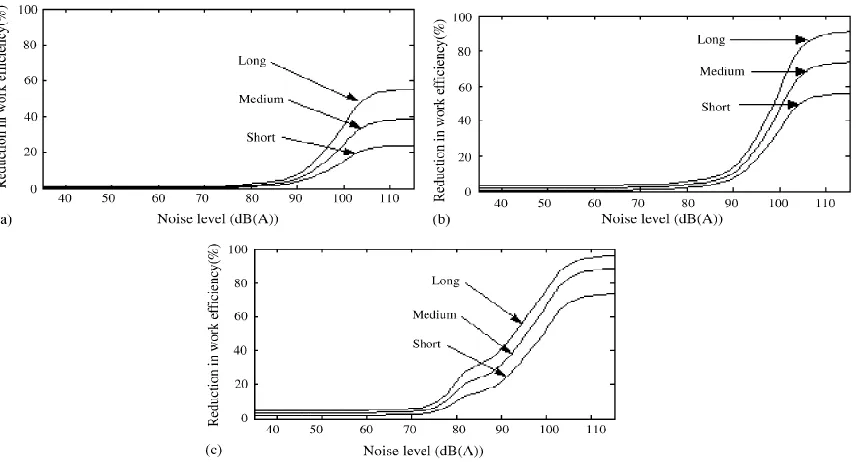
An alternative representation to Fig. 6(a–c) discussed above is shown in Fig. 6(a–c), in which the reduction in work efficiency with noise level for ‗short‘, ‗medium‘, and ‗long‘ exposure times at different type of tasks is presented. The following inferences are readily drawn:
If the task is ‗simple‘ as shown in Fig. 7(a), the work efficiency reduces to 38% for ‗medium‘ and 55% for ‗long‘ exposure times while it reduces to
23% for ‗short‘ exposure time at 110 dB(A) and above noise levels.
2. In case of ‗moderate‘ task, the work efficiency is reduced to 58%, 72%, and 89% at 110 dB(A) for ‗short‘, ‗medium‘, and ‗long‘ exposure times, respectively as is evident from Fig. 7(b).
3. For complex tasks, the reduction in work efficiency occurs even at much lower noise levels as can be observed from Fig. 7(c). It is 72%, 87%, and 95% at 110 dB(A) for ‗short‘, ‗medium‘, and ‗long‘ exposure times, respectively.
In order to validate the model, we have compared some of our model results with the deduction based on the criterion of Safe Exposure Limit recommended for industrial workers. The Recommended Exposure Li-mit (REL) for workers engaged in occupations such as engineering controls, administrative controls, and/or work practices is 85 dB(A) for 8 h duration [33]. NIOSH [32] also recommended a ceiling limit of 115
Fig. 7. (a) Reduction in work efficiency as a function of noise level for ‗simple‘ task at various exposure times, (b) reduction in work efficiency as a function of noise level for ‗moderate‘ task at various exposure times, and (c) reduction in work efficiency as a function of noise level for ‗complex‘ task at various exposure times.
7. Conclusion
The main thrust of the present work has been to develop a neuro-fuzzy model for the prediction of work efficiency as a function of noise level, type of tasks and exposure times. It is evident from the graph that the work efficiency, for the same exposure time, depends to a large extent upon the noise level and type of task. It has also been verified that simple tasks are not affected even at very high noise level while complex tasks get significantly affected at much lower noise level. It is to be appreciated that the training done using ANFIS is computationally very efficient as the desired RMSE value is obtained in very less number of epochs. Moreover, minor changes are observed in the shape of the membership functions after training the model. This is because of close agreement between the knowledge provided by expert and input/output data pairs.
References
[1]L.A. Zadeh, Soft computing and fuzzy logic, IEEE Software (1994) 48–56. [2]L.A. Zadeh, Fuzzy sets, Inform. Control 8 (1965) 338–353.
[3]L.A. Zadeh, Fuzzy algorithm, Inform. Control 12 (1968) 94– 102.
[4]L.A. Zadeh, Outline of a new approach to the analysis of complex systems and decision processes, IEEE Trans. Syst. Man Cyb., 3 (1973) 28–44.
[5]A.H. Suter, Noise and its Effects, 1991. This is available online at
http://www.nonoise.org/library/suter/suter.html.
[6]B. Berglund, T. Lindvall, Community Noise, Document pre-pared for WHO, Stockholm, Sweden, 1995. This is available online at the site http://www.nonoise.org/library/whonoise.html.
[7]H.D. Warner, N.W. Heimstra, Effects of noise intensity on visual target detection performance, Hum. Factors 14 (1972) 181–185.
[8]M. Loeb, P.D. Jones, Noise exposure, monitoring and tracking performances as a function of signal bias and task priority, Ergonomics 21 (1978) 265–272.
[9]W.D. Arnoult, J.W. Voorhees, Effects of aircraft noise on an intelligibility task, Hum. Factors 22 (1980) 183– 188.
[10] L. Hartley, M. Dunne, S. Schwartz, J. Brown, Effects of noise on cognitive strategies in a sentence verification task, Ergo-nomics 29 (1986) 607–617.
[11] Q.J. Fu, R.V. Shanno, X. Wang, Effects of noise and spectral resolution on vowel and consonant recognition: acoustic and electric hearing, J. Acoust. Soc. Am. 6 (1998) 3586–3596.
[12] S. Cohen, After-effects of stress on human performance and social behaviour: a review of research and theory, Psychol. Bull. 88 (1980) 82–108.
[13] L. Percival, M. Loeb, Influence of noise characteristics on behavioural after-effects, Hum. Factors 22 (1980) 341–352.
[14] G. Belojevic, E. Ohrstrom, R. Rylander, Effects of noise on mental performance with regard to subjective noise sensitivity, Int. Arch. Occ. Env. Health 64 (1992) 293–301.
[15] S. Hygge, G.W. Evans, M. Bullinger, The munich airport noise study: psychological, cognitive, motivational, and quality of life effects on children, in: M. Vallet (Ed.), Noise as a Public Health Problem, INRETS, France, 1993, pp. 301–308.
[16] S. Banbury, D.C. Berry, Disruption of office related tasks by speech and office noise, Brit. J. Psychol. 89 (1998) 499– 517.
[17] D.J. Herrmann, M. Crawford, M. Holdsworth, Gender-linked differences in everyday memory performance, Brit. J. Psychol. 83 (1992) 221–231.
[18] G.V. Jone, M. Martin, Handedness dependency in recall from everyday memory, Brit. J. Psychol. 88 (1997) 609–619.
[19] S.J. Westerman, D.R. Davies, A.I. Glendon, R.B. Stammers, G. Matthews, Ageing and word processing competence: compen-sation or compilation? Brit. J. Psychol. 89 (1998) 579–597.
[20] D.L. Johnson, J.S. Wiebe, S.M. Gold, N.C. Andreasen, Cere-bral blood flow and personality: a position emission tomo-graphy study, Am J. Psychiatr. 156 (1999) 252–257.
[21] S. Mitra, Y. Hayashi, Neuro-fuzzy rule generation: survey in soft computing framework, IEEE Trans. Neural Networks 11 (2000) 748–768.
[22] A. Abraham, B. Nath, A Neuro-fuzzy approach for modelling electricity demand in Victoria, Appl. Soft Comput. 1 (2001) 127–138.
(1993) 665–685.
[25] N. Kasabov, DENFIS: dynamic evolving neural-fuzzy infer-ence system and its application for time-series prediction, IEEE Trans. Fuzzy Syst. 10 (2002) 144–154.
[26] J.S. Wang, C.S.G. Lee, Self-adaptive neuro-fuzzy inference systems for classification applications, IEEE Trans. Fuzzy Syst. 10 (2002) 790–802.
[27] L. Rutkowski, K. Cpalka, Flexible neuro-fuzzy systems, IEEE Trans. Neural Networks 14 (2003) 554–574. [28] M. Sugeno, G.T. Kang, Structure identification of fuzzy mod-els, Fuzzy Sets Syst. 28 (1988) 15–33. [29] T. Takagi, M. Sugeno, Fuzzy identification of systems and its applications to modelling and control, IEEE
Trans. Syst. Man Cyb. 15 (1985) 116–132.
[30] Zaheeruddin, G.V. Singh, V.K. Jain, Fuzzy modelling of human work efficiency in noisy environment, in: Proceedings of the IEEE International Conference on Fuzzy Systems, vol. 1, 2003, pp. 120–124.
[31] Zaheeruddin, V.K. Jain, A fuzzy approach for modelling the effects of noise pollution on human performance, J. Adv. Comput. Intell. Intell. Inform. 8 (2004) 332–340.
[32] S.S. Rao, Engineering Optimization—Theory and Practice, Wiley, New Delhi, 1998.