Available Online atwww.ijcsmc.com
International Journal of Computer Science and Mobile Computing
A Monthly Journal of Computer Science and Information Technology
ISSN 2320–088X
IMPACT FACTOR: 6.199
IJCSMC, Vol. 9, Issue. 1, January 2020, pg.121 – 127
A SECURE ERASURE CODE-BASED
CLOUD STORAGE SYSTEM WITH
SECURED DATA FORWARDING
1
G.Suganya; 2S.Hariharan; 2S.Jeeva; 2J.Nandhakumar; 2M.Nirmal
1
Assistant Professor, Department of CSE, VSBCETC, Coimbatore, India
2
UG Scholar, Department of CSE, VSBCETC, Coimbatore, India
Abstract: High-speed networks and ubiquitous Internet access become available to users for access anywhere at anytime. Cloud computing is a concept that treats the resources on the Internet as a unified entity, a Cloud storage is a model of networked online storage where data is stored in virtualized pools of storage which are generally hosted by third parties. Hosting companies operate large data centers, The data center operators, in the background, virtualized the resources according to the requirements of the customer and expose them as storage pools, which the customers can themselves use to store files or data objects. Physically, the resource may span across multiple servers. Data robustness is a major requirement for storage systems. There have been many proposals of storing data over storage servers. One way to provide data robustness is to replicate a message such that each storage server stores a copy of the message. A decentralized erasure code is suitable for use in a distributed storage system.
Index Terms— Cloud computing security, Encryption, Secure storage.
I. Introduction:
resources in the back end. This is done based on the requests of the clients and given to them in the form of storage pools. The consumers can use these pools to store their documents or data objects Physically, the resources may be spanned across multiple servers. The users who store the information to the cloud do not need to know how the information is stored. This paper focuses on providing a secure cloud storage that supports functionalities also.
The cloud is measured as a large scale distributed storage system that includes many autonomous storage servers. Data robustness is the major requirement for the storage systems. There have been many schemes for keeping data over storage servers. One tactic to deliver data robustness is to duplicate a message such that each storage server provides a copy of the message. Another way is to encode the message by erasure coding. In erasure codes, the replica of the message is kept in every storage server. In both the methods, even if one of the storage server flops, the message can be recovered by any one of the remaining servers.
This method is suitable for use in a distributed environment. In order to provide strong confidentiality for messages in storage servers, a user can encrypt messages by a cryptographic method before applying an erasure code method to encode and store messages. There are three problems in the above straight forward integration of encryption and encoding. First, the users have the information stored in a single location. So, when many users access the data at the same time the traffic to the system becomes high. Second, the user has to manage his cryptographic keys. If the user’s device that is storing the cryptographic keys is lost or compromised, the security is broken. In the existing method, the owner of messages has to retrieve, decode, decrypt and then forward them to another user.
II. SYSTEM ARCHITECTURE:
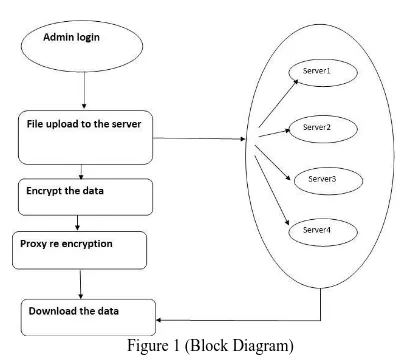
Figure 1 (Block Diagram)
III. PROPOSED WORK:
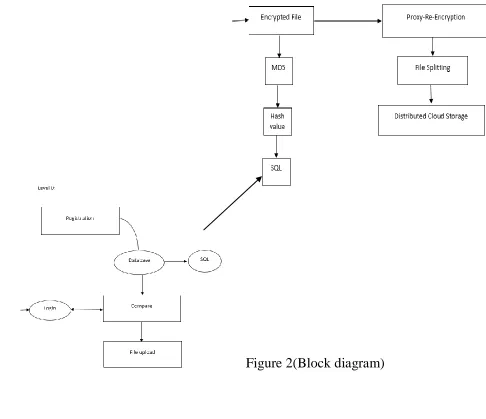
Figure 2(Block diagram)
IV.PROPOSED ADVANTAGE:
V. RELATED WORKS:
A. Proxy Re-encryption:
Proxy re-encryption schemes are crypto frameworks that allow intermediaries (proxies) to alter a cipher content which has been encoded for one client, so that it may be unscrambled by another client. By using proxy re-encryption technique the encrypted data (cipher text) in the cloud is again altered by the user. It provides highly secured information stored in the cloud. Every user will have a public key and private key. Public key of each user is well-known to everybody but private key is known only by the particular user. This is achieved using MD5 algorithm.
Keeping in mind the end goal to preserve security, the customers will encode their information when they out- source it to the cloud. In any case, the encrypted type of files significantly impede the usage due to its haphazardness. Numerous researches have been done for the goal of information usage with functionalities without compromising with the information security. Fig. 4 explains the pseudo code of proxy re- encryption.
A.Homomorphism: Given two cipher texts c and d on plaintexts m and n separately, an individual can acquire the cipher text on the original message m + n or m*n by calculating c and d without the necessity to decrypt cipher texts.
B.Proxy re-encryption: Proxy re-encryption is the process where the data that is already encrypted by a certain encrypting algorithm is again encoded using a hashing algorithm. This is done to improve security of the stored files.
D.Advanced Encryption Standard:
Advanced encryption Standard (AES) is a symmetric encryption algorithm that produces 128 bit key (in this project). This method is efficient for both hardware and software. Fig. 3 explains the algorithm used for AES encryption technique.
E.MD5 Hashing Algorithm:
The Md5 algorithm is a hash function that produces 128-bit hash value that is stored as a 32 bit hexadecimal value. The advantage of MD5 is it produces different hash values for the same plain text.
CONCLUSION:
REFERENCES:
[1].Xuechen Zhang ECE Department Wayne State Universities Trans. Kei Davison Alamos
National Laboratory Parallel and Distributed Systems, vol. 21, no. 11, pp. 1586-1594, Nov. 2010.
[2].Huayu Zhang, Hui Li, Bing Zhu, Jun Chen 2014 IEEE 33rd International Symposium on Reliable Distributed System.
[3].Weidong Sun, Yijie Wang, Yongquan Fu, Xiaoqiang Pei 2014 IEEE 8th International Symposium on Service Oriented System Engineering.
[4].Jibin Wang, Lili Yang, Hu Zhang, Zhaogang Xu, Ying Guo 2015 Third International
Conference on Advanced Cloud and Big Data.
[5].David Nunez, Isaac Agudo, Javier Lopez 2015 IEEE 28th Computer Security
Foundations Symposium.