PESTO: Proactively Secure Distributed Single Sign-On,
or How to Trust a Hacked Server
Carsten Baum1, Tore K. Frederiksen2, Julia Hesse3, Anja Lehmann4, and Avishay Yanai5
1Aarhus University, Denmark, [email protected]
2Alexandra Institute, Denmark, [email protected]
3IBM Research – Zurich, Switzerland, [email protected]
4Hasso-Plattner-Institute, University of Potsdam, Germany,[email protected]
5VMware Research, Israel, [email protected]
Abstract—Single Sign-On (SSO) is becoming an increasingly popular authentication method for users that leverages a trusted Identity Provider (IdP) to bootstrap secure authen-tication tokens from a single user password. It alleviates some of the worst security issues of passwords, as users no longer need to memorize individual passwords for all service providers, and it removes the burden of these service to properly protect huge password databases. However, SSO also introduces a single point of failure. If compromised, the IdP can impersonate all users and learn their master pass-words. To remedy this risk while preserving the advantages of SSO, Agrawal et al. (CCS’18) recently proposed a dis-tributed realization termed PASTA (password-authenticated threshold authentication) which splits the role of the IdP acrossnservers. While PASTA is a great step forward and guarantees security as long as not all servers are corrupted, it uses a rather inflexible corruption model: servers cannot be corrupted adaptively and — even worse — cannot recover from corruption. The latter is known as proactive security and allows servers to re-share their keys, thereby rendering all previously compromised information useless.
In this work, we improve upon the work of PASTA and propose a distributed SSO protocol with proactive and adaptive security (PESTO), guaranteeing security as long as not all servers are compromised at the same time. We prove our scheme secure in the UC framework which is known to provide the best security guarantees for password-based primitives. The core of our protocol are two new primitives we introduce: partially-oblivious distributed PRFs and a class of distributed signature schemes. Both allow for non-interactive refreshs of the secret key material and tolerate adaptive corruptions. We give secure instantiations based on the gap one-more BDH and RSA assumption respectively, leading to a highly efficient 2-round PESTO protocol. We also present an implementation and benchmark of our scheme in Java, realizing OAuth-compatible bearer tokens for SSO, demonstrating the viability of our approach.
1. Introduction
Until today, passwords are still the primary means of user-authentication towards online services. While stronger approaches, such as two-factor or key-based au-thentication have been considered and are partially de-ployed, passwords are still ubiquitous due to their usability advantages: users do not have to securely manage
crypto-graphic keys or hardware tokens, but only need to type-in a human-memorizable phrase.
Unfortunately, password databases are a prime target of potential attackers and even large companies seem to struggle to protect this information properly [4], [5], [7]. In fact, server compromise is currently the biggest threat to password security and has lead to a compromise of over 1 billion passwords to date [40]. In combination with user tendencies to re-use passwords at different services, such data breaches can have a devastating impact for those affected by the breach.
Using single sign-on services (SSO) alleviates some of the worst security issues with passwords, and also enhances the usability aspects for the end user. The SSO approach centralizes the authentication task via a trusted Identity Provider (IdP). The user only has to login towards the IdP which then generates a short-term cryptographic access token such as a JWT [38] or SAML assertion [3], allowing the user to authenticate herself towards other ser-vices. The main advantage of SSO is that it avoids tedious password handling with every single service provider, and does not require users to trust each of these providers to keep their passwords safe. Hence such approaches have been standardized though frameworks like OAuth [29], and more concretely through protocols like OpenID Con-nect (OIDC) [44] based on a JWT [38].
On the negative side, SSO introduces a single point of failure: an attacker that compromises an IdP can take overallof the users’ registered accounts and learns their master passwords. For the latter, even protective measures such as storing salted password hashes only have rather limited impact, as any such information is still vulnerable to offline guessing attacks due to the low entropy of human-memorizable passwords [6].
1.1. Distributed Single Sign-On
password-authenticated key exchange (TPAKE) [30], [39], [43], [47], threshold password-authenticated secret sharing (TPASS) [10], [14], [12], [31], as well as plain distributed password verification [22], [13], [21].
The newest addition to this line of research is password-based threshold authentication (PASTA) [8] which allows to split the role of the IdP for SSO. The PASTA protocol combines distributed password verifica-tion with a distributed signature scheme, and achieves many of the properties needed for distributed SSO: Iftout of n servers remain honest, the users’ master passwords are safe against offline attacks and impersonation attacks via forged signatures on access tokens are prevented too.
Proactive Security.While PASTA avoids the single point of failure of standard SSO, it does not provide significantly stronger security though due to the lack of a recovery
strategy — also known as proactive security. A crucial feature in distributed protocols is to allow servers to refresh their keys so that they can securely re-initialize after a compromise. Without such a recovery mechanism, it is only a matter of time until all servers have been hacked and their data can be combined to an offline-testable password table. For a distributed SSO, one would probably not want to deploy much more than 2 or 3 servers, i.e., in a static setting the costs and time of an attack would only double or triple.
UC Security.Another more subtle challenge is that of an appropriate security model: Agrawal et al. [8] define the desired security properties in the form of game-based no-tions. It is well-known that for password-based primitives this cannot properly capture the way users (mis)handle passwords [18]. When formulated through games, users are assumed to choose their passwords at random from known and independent distributions. The adversary also only gains access to “perfect” users which always use the correct password. In reality, however, users share, re-use, and leak information related to their passwords, and often make typos when using them which leads to running the protocol on incorrect yet related passwords. In the Universal Composability (UC) model, this is modeled naturally as the environment provides the passwords. That is, a UC security notion guarantees the desired properties without making any assumptions regarding the passwords’ distributions, dependencies, or leakages.
Key Management. When aiming for a distributed system, the key and secret state handling by the individual servers should be as simple and concise as possible, as any com-plexity increases the risks of (implementation) mistakes and the attack surface for adversaries. Translated to the task of SSO, each server should ideally have a single secret key (per time epoch) only, whereas the dynamic user-specific information should be non-sensitive. This way, the secret key can enjoy stronger protection, e.g., through hardware, which is much harder to realize for the large and dynamic user database. Unfortunately, PASTA does not satisfy this design criteria, as the servers obtain dedicated secret key material from each user which needs to be protected accordingly. In fact, this choice is also one of the reasons the PASTA protocol is not amendable to proactive security measures.
Online Attacks. Finally, one reason to move to a dis-tributed setting for password-based protocols such as SSO, is to rely on honest servers for detecting and preventing
online guessing attacks. That is, an adversary targets a dedicated account and tries to guess the users password to gain access to her account. Honest servers can block or throttle login attempts for a specific account when they notice suspicious behaviour and thereby significantly limit the adversary’s amount of guesses — roughly mimicking the hardware protection our short 4-digit PIN numbers for ATM cards enjoy. In the PASTA protocol the servers do not learn whether a password attempt was successful though, which restricts their capabilities to detect such on-line guessing attacks. For instance, an adversary can cam-ouflage its attack by spreading many password guesses across a day and gain several hundreds or thousands of undetected guesses, whereas a system in which servers learn the outcome of the password verification would have stopped the attack after a few failed attempts already.
1.2. Our Contributions
In this work we propose a distributed SSO protocol — PESTO — which achieves all the aforementioned properties, while still being compatible with existing au-thentication standards such as OAuth [29] and OIDC [44]. Similar to PASTA, we model SSO through a password-authentication distributed signature functionality. Therein, the distributed servers sign messages (uid, m), i.e., they bind a user-provided messagemto the verified user name uid. They only do so after they have verified that the user knows the password which has been setup for uid. For SSO applications, the message m will contain the unique ID of the targeted service provider and a nonce that is usually specified by the provider. We compare the overall features of PESTO with PASTA, lined up against a standard, single-server, JWT-based scheme [38] in Fig. 1.
Proactive and UC Security for Distributed SSO.We define security of PESTO in form of an ideal functionality in the UC framework, avoiding any unrealistic assumptions in-herent in game-based definitions. We admit a fine grained corruption model: first, servers can be corrupted in an
adaptivemanner, i.e., the adversary can take control of any initially honest party at any time. This improves upon [8] which allows only static corruptions. Second, we allow bothtransientandpermanentcorruptions. Transiently cor-rupted parties can recover from an attack by going through a dedicated refresh procedure, whereas permanently cor-rupted ones cannot recover. Security is guaranteed as long as not all servers are corrupt at the sametime.
Our PESTO Protocol.We propose a protocol that securely satisfies this strong notion. While our PESTO protocol uses similar building blocks as PASTA, it significantly differs inhowthey are used.
Roughly, we start with adistributed partially-oblivious PRF (dpOPRF) to let users deterministically derive a signing key pair from their username and password as
SECURITY EFFICIENCY
Threshold Serv.
Corrup-tion
Security Model
Proactive Security
Offline Attack Resist.
Online Attack Resist.
Secret Keys per
Server
Rounds Exponentiation / Pairings per
Server User
Std. JWT (1,1) - - 8 8 3 O(1) 1 1ex 0
PASTA (t,n) static Game 8 3 (3) O(#Users) 1 2ex 2ex
PESTO (n, n) adaptive UC 3 3 3 O(n) 2 4ex+ 1p 5ex
Figure 1: Comparison between PESTO (Our Work), PASTA [8], and a standard Json Web Token (JWT) used for SSO. For efficiency we count the most expensive operations, i.e., exponentiations and pairings per party.
Figure 2: High-level overview of SSO with PESTO
When creating her account, the user sends the derived upk to all servers which store (uid,upk) along with a signature on these values that is generated in a distributed way. This jointly computed signature is crucial to ensure that an adversary cannot gradually plant malicious public keys for honest user accounts, when he transiently corrupts individual servers. In contrast to PASTA, all user-specific information stored by the servers is not security sensitive. When asking for a SSO token on a message m for username uid, the user repeats the dpOPRF part for a password attempt pw0 to re-construct her key pair
(upk,usk), and usesusk to sign a fresh nonce towards all servers. The servers verify the signature against the stored upk to determine whether the user provided the correct password. If so, the servers jointly sign(uid, m) using a proactively-secure distributed signature schemeDSIG.
Proactively Secure dpOPRF and DSIG. Our protocol is built from generic building blocksdpOPRFandDSIGwe introduce and which constitute contributions of indepen-dent interest. For both we first present security models that capture the strong type of adaptive and transient corrup-tions, and then propose secure instantiations. ThedpOPRF
is based on the classical 2Hash-Diffie-Hellman OPRF construction [31] and DSIG is realized for a distributed version of RSA signatures. The challenge in making these schemes proactively and adaptively secure is to avoid a loss in security by having to guess corrupted servers upfront. While this loss can be tolerated once, it would blow exponentially when moving into a proactive setting where such a guess needs to be done at every epoch.
We avoid this by ensuring that none of the values sent by servers commits them to their secret key shares. To do this efficiently, we rely on a trusted setup that generates pairwise seeds for all servers from which they derive consistent blinding values to mask all outgoing messages. In the security proof, this allows us to choose
a server’s keys only at the moment that it is corrupted, without having to guess anything upfront. Finally, to allow servers to recover from transient corruptions we assume that each server has access to a special backup tape. Such a backup tape is necessary to allow servers to re-boot with a clean and uncorrupted state. We also leverage it to run the refresh in anon-interactive(yet synchronized) manner. The backup tape is only needed during the refresh procedure but does not have to (andshouldnot) be online during normal operations. Transiently corrupted parties leak their full state to the adversary, but not the content of their backup tape, and recover with the next refresh. Our model also supports more damaging attacks which additionally leak the backup tape to the adversary. Such parties are considered permanently corrupted and cannot become uncorrupted again.
Implementation & Efficiency. Using the aforementioned DDH-baseddpOPRFand RSA-basedDSIGinstantiations, we obtain an efficient 2-round PESTO protocol which we test in a proof-of-concept implementation in Java. We use our protocol to constructstandardRSA-signed JWTs, i.e., they can be verified by any service provider that accepts such tokens in an OAuth or OIDC authentication flow. Our implementation utilizes REST and TLS in order to give a realistic benchmark on the efficiency to be expected in a real-world deployment. Overall, our protocol requires4
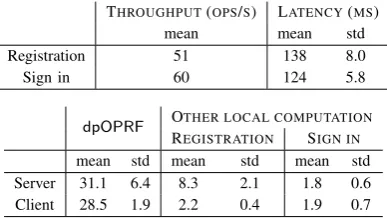
exp. and1pairing operation per server and authentication request, which adds only minimal overhead compared with PASTA yet provides significantly stronger security. Concretely, a complete sign-in operation is only 124 ms even when all entities are located in distinct countries.
Distributed vs. Threshold Setting. While our scheme provides stronger security than PASTA (proactive and adaptive vs. static security), it does pay a price in terms of robustness: PESTO is fully distributed, i.e., requires n-out-of-n servers to participate, whereas PASTA offers a threshold (t, n) solution. Thus, our solution is more vulnerable to Denial-of-Service attacks as a single offline server will result in a shutdown of the entire protocol.
The (n, n)setting is the result of our solution coping withadaptivecorruptions: to avoid that any protocol mes-sage commits to a server’s secret share, we let each server add blinding values to their messages which cancel out when shares of all servers are combined. This approach seems to inherently conflict with a threshold solution, and thus it is an interesting open problem how an adaptively secure andthreshold version can be achieved.
rest of the protocol then needs to use threshold build-ing blocks that are secure against this weaker attacker. Currently, PESTO exploits the trusted setup and (n, n)
approach to also bootstrap an efficientnon-interactivekey refresh procedure, whereas a (t, n) solution most likely needs to revert to an adaptive refresh protocol.
1.3. Related Work
Apart from PASTA [8] which we discussed already, our work takes inspiration from a number of previous works we detail here. We also refer to [8] for a compre-hensive overview of concepts related to distributed SSO.
Distributed Password Verification.The use of blinding val-ues and offline backup tapes to recover from corruptions is inspired by the distributed password verification protocol by Camenisch et al. [13], that also aimed at proactive security in the UC framework. The targeted problems are different though, as their protocol considers a single login server that protects it’s password database by relying on nback-end servers to re-compute the password “hashes”. The back-end servers in [13] are also fully oblivious: they neither learn the uid’s for which they verify a password nor the result of the verification. Both significantly limit the servers’ capabilities to prevent online attacks.
Furthermore, we make the proactive security proper-ties accessible in a more modular and re-usable way, as we already integrate them in our generic building blocks: distributed partially-oblivious OPRFs and distributed sig-natures. Both can be used in a plug-and-play fashion to enhance security of protocols where their distributed yet non-proactive versions have been used.
Partially-Oblivious PRF with Key Rotation. The Pythia protocol [21] introduced the concept ofpartially-oblivious PRFs which they used to build a password hardening service with fine-grained rate limiting. However, Pythia only uses a single backend PRF server. As a single key cannot be re-shared, proactive security is achieved through key rotation instead, i.e., the PRF server switches to a fresh key and provides a short update token that allows to update all previous PRF outputs accordingly.
Our work extends these partially-oblivious PRF to a fully distributed setting, which naturally allows for a more elegant refresh protocol without the need to update any previously computed PRF outputs. Further, Pythia’s approach requires direct access to the algebraic structure of the OPRF which prevented them of using the outer hash of the 2Hash-DDH construction and lead to weaker overall security of the OPRF. Recently, Jarecki et al. [34] pre-sented a distributed partially-oblivious PRF that achieves partial blindness in a different and more efficient way. However, they did not propose a security notion and their construction inherently does not allow to re-share the key.
Password-Authenticated Secret Sharing. Finally, the first part of our protocol essentially can be seen as a proactively-secure version of password-authenticated se-cret sharing (TPASS) [10], [31], [32], [33] and might provoke the question why we need the second protocol step and distributed SSO at all: the user could simply use the reconstructed signing key pair (usk,upk) to directly authenticate to the service providers in a secure, password-less manner. However, using TPASS for such user au-thentication would lead to a full loss of security when the
user’s device gets compromised during key reconstruction. As the adversary then learns the user’s master key it can impersonate the user towards all service providers. In our PESTO approach, a compromised device or password alone is not sufficient to gain access to the user’s accounts. All servers need to sign every single access token, which provides a second line of defense: They can refuse to complete these requests when they notice suspicious ac-cess patterns, and the user can block her account with the online servers when she suspects a breach of her device — thereby rendering the compromised information useless.
2. Preliminaries
We denote with [k] the set{1, . . . , k} and say that a non-negative functionf(n)is negligible inn, orf(n)≤ (n), if for every polynomial p(X) there exists a bound t such that ∀t0 ≥ t : f(t0) ≤ 1
|p(t0)|. We denote the computational security parameter throughout this work as τ and the statistical security parameter as s.
2.1. Bilinear Groups
Definition 1 (Asymmetric Pairing). Let G1,G2,GT be cyclic groups of order p with generators g1, g2, gT, re-spectively. Furthermore, let e : G1×G2 → GT be an efficiently computable non-degenerate function such that ∀a, b ∈ Zp : e(g1a, gb2) = gTab. Then e is called an
asymmetric pairing. G= (p, g1, g2, gT,G1,G2,GT, e) is called an asymmetric bilinear group setting, or bilinear groupfor short.
We formulate two assumptions on G. The first as-sumption is the standard DDH-generalization groups with asymmetric pairings and has been used e.g. in [19].
Definition 2(Bilinear DDH Assumption). Letτ∈Nbe a
security parameter andG= (p, g1, g2, gT,G1,G2,GT, e) be a bilinear group wherelog(p) =poly(τ). We say that the Bilinear Decisional Diffie-Hellman (BDDH) assump-tion holds forGif for any PPT (inτ) algorithm A
Pr[A(G, gar, g b s, g
c
t, R) = 1]− Pr[A(G, ga
r, gbs, gct, e(g1, g2)abc) = 1]
≤(τ)
wherea, b, c are uniformly random inZp, r, s, t∈ {1,2}
andRis uniformly random in GT.
For the second assumption we first define the follow-ing experiment with an algorithmA:
ExperimentExpG
A,Gapom-BDH(τ):
k←RZp,qC←0,X1← ∅,X2← ∅.
{(xi, yi, zi)}i∈[`]← AOG-1,OG-2,OD-help,OC-help(G, gk2)
return0 if
0≤`−1< qCor
∃i∈[`] : (xi6∈X1∨yi6∈X2)or
∃i, j∈[`], i < j: (xi=xj∧yi=yj)
return1 if∀i∈[`] :e(xi, yi)k=ziand 0 otherwise.
where the experiment uses the following oracles:
OG-r()
return⊥ifr6∈ {1,2} x←RGr
Xr←Xr∪ {x}
returnx
OC-help(m)
return⊥ifm6∈GT
qC←qC+ 1
OD-help(m, w, m0, w0)
return⊥if eitherm, w, m0, w0not in GT
return1iflogm(w) = logm0(w0)and else0
To win,Aneeds to find pairs(x, y, e(x, y)k)without
querying e(x, y) to OC-help and where A could not
re-randomize previous such pairs as it does not know the discrete logarithm of anyx, y(enforced by sampling them at random usingOG-r).Ais equipped with a DDH oracle OD-help in the groupGT. The gameGapom-BDHfollows
the definition in [21].
Definition 3 (Gap One-More BDH Assumption). Let
τ ∈ N be a security parameter and G =
(p, g1, g2, gT,G1,G2,GT, e) be a bilinear group with log(p) = poly(τ), then we then say that the Gap One-More Bilinear Diffie-Hellman (Gapom-BDH) assumption holds for G if for all PPT adversaries A there is a
negligible function(·)such thatPr[ExpG
A,Gapom-BDH(τ) = 1]≤(τ).
2.2. Digital Signatures
We use a signature scheme SIG, consisting of al-gorithms SIG.Setup(1τ) →
R pp,SIG.KGen(pp;r) →R
(sk,pk),SIG.Sign(sk, m)→R σandSIG.Vf(pk, m, σ)→ {0,1}. Note that we sometimes make the randomness r used in key generation explicit. When used on the same in-put and randomness,SIG.KGenbehaves deterministically. It is required that except with negligible probability over τ, for a key pair (pk, sk), where sk output by
SIG.SKGgen(pp) andpk output by SIG.PKGgen(pp, sk), it holds that SIG.Vf(pk, m,SIG.Sign(sk, m)) = 1 for every message m ∈ {0,1}∗ (for implicit pp generated
bySIG.Setup).
Security of a signature scheme is defined through the standard unforgeability experiment ExpSIGA,forge(τ).
ExperimentExpSIGA,forge(τ):
pp←RSIG.Setup(1τ),(sk, pk)←RSIG.KGen(pp)
(m∗, σ∗)←RA
OSign(pk)
whereOSign(m):
addmtoQ, returnSIG.Sign(sk, m)
return1 ifSIG.Vf(pk, m∗, σ∗) = 1andm∗∈ Q/
Definition 4. A signature scheme SIG is existentially unforgeable under adaptive chosen-message attacks, if for all PPT adversariesA, there is a negligible function(·) such thatPr[ExpSIGA,forge(τ) = 1]≤(τ).
3. Proactively Secure Distributed Signatures
In this section we formalize the notion of a proactively secure distributed signature and present an instantiation of it based on RSA signatures. A distributed signature scheme DSIG is a tuple of polynomial-time algorithms
(Setup,KGen,Sign,Comb,Vf,Refresh)such that:
DSIG.Setup(1τ,1s)→
R pp: Given a computational
secu-rity parameter1τand a statistical security parameter1s,
outputs public parameterspp.
DSIG.KGen(pp, n)→R(pk,(ski)i∈[n],(bki)i∈[n]): Given
public parameters pp and the number of parties n, output a public key pk, secret signing key shares sk1, . . . , skn and backup key shares bk1, . . . ,bkn.
DSIG.Sign(ski, m, `)→σi: Given a key share ski,
mes-sagem, and query label`, output a signature share σi. DSIG.Comb(σ1, . . . , σn)→σ: Given signature shares
σ1, . . . , σn, output signatureσor ⊥.
DSIG.Vf(pk, m, σ)→b: Given a public key pk, a mes-sagemand a signatureσ, output a bitbsuch thatb= 1
meansvalid andb= 0 meansinvalid.
DSIG.Refresh(bki)→R (sk
0 i,bk
0
i): Given a backup key
bki, output new keyssk0i andbk 0 i.
We assume that the server’s indexi can be efficiently recovered fromskiandbki, and that the public parameters
ppare available to all algorithms.
The Sign algorithm generates a signature share on a message m and an additional parameter `, while verifi-cation only requires m. The parameter ` is used to bind signature shares to a query label`. The label ensures that signature share σ1, . . . , σn can only be combined if all
where received for the same `, i.e., even shares for the same message cannot be combined if they were derived for ` 6=`0. This will prevent so-called “mix-and-match” attacks.
Correctness. We define correctness of DSIG in
terms of providing the required functionality of a signature when used as intended. Let
(skepi , bkepi )←DSIG.Refreshep(bki)result from applying
DSIG.Refresh(. . .(DSIG.Refresh(bki))foreptimes where bk0
i = bki. DSIG is correct if for every ` ∈ {0,1}∗,
ep ∈ N+ and n > 1, it follows that Vf(pk, m, σ) = 1
with overwhelming probability over the randomness of
Setup,KGen,Refresh; where σ = Comb(σ1, . . . , σn),
pp ← Setup(1τ), σi ← Sign(skepi , m, `) and (pk,(ski)i∈[n],(bki)i∈[n])←KGen(pp, n).
3.1. Proactive Security Model for DSIG
We now present the desired security definitions for
DSIG capturing proactive security against adaptive cor-ruptions, and allowing the adversary to corrupt servers in both a transient and permanent way.
We formalize three security properties: proactive un-forgeability, which can be seen as the strengthening of standard unforgeability to the proactive setting, share simulatabilityandsignature indistinguishability. The latter two are needed to give us the strong simulation-based security needed prove UC security for PESTO. The se-curity games in the remainder of this section require us to explicitly keep track of the different epochs using an extra variableep. This is done to express the adversaries knowledge: for each epoch, the adversary may obtain a different subset of keys skepi and different sets of signa-tures shares. Our security properties must hold as long as the adversary does not corrupt all servers at the same epoch. The security experiment thus has to keep track of which information the adversary gets at which time.
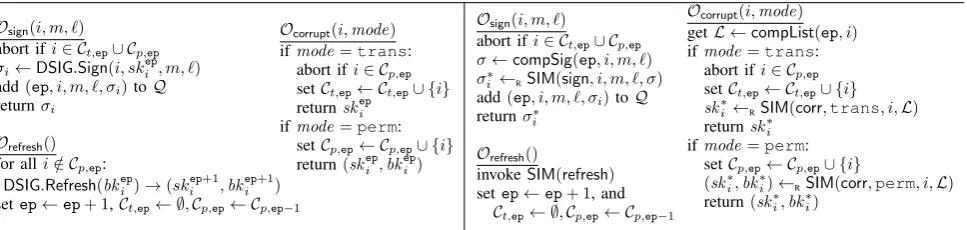
Proactive Unforgeability.This notion generalizes standard (strong) unforgeability to the proactive, distributed setting. It is defined with oracles given in Fig 3 which allow the adversary A to obtain signature and key shares (either ski or (ski,bki) depending on the corruption mode) at
into honest ones. He wins if he successfully forges a valid signature without either corrupting all parties or requesting signature shares for the same messagemand query label `for all uncorrupted parties in one epoch.
Definition 5(Proactive Unforgeability). A distributed sig-nature schemeDSIGisproactively unforgeableif for all PPT adversariesA, there is a negligible function(·)such that Pr[ExpDSIGA,forge,n(τ, s) = 1]≤(τ, s).
ExperimentExpDSIG,nA,forge(τ, s): pp←RDSIG.Setup(1
τ,1s), setep←0,C
t,ep,Cp,ep← ∅
(pk,(ski)i∈[n],(bki)i∈[n])←RDSIG.KGen(pp, n) (m∗, σ∗)←
RAOsign
,Ocorrupt,Orefresh(pk)
return0 ifDSIG.Vf(pk, m∗, σ∗) = 0or ∃epwhere|Ct,ep∪ Cp,ep|=nor
∃ep, `s.t.DSIG.Comb(σ1, , . . . , σn) =σ∗
where∀i /∈ Ct,ep∪ Cp,ep (ep, i, m∗, `, σi)∈ Q
and ∀i∈ Ct,ep∪ Cp,ep σi←DSIG.Sign(i, skiep, m∗, `)
elsereturn1
Share Simulatability.The second property is needed to use
DSIGas a building block in a UC-secure protocol (aiming at proactive security and allowing adaptive corruptions), as therein security is proven by constructing a simulator that mimics the ideal functionality in a way that is not notice-able to the environment. The notion of share simulatability expresses exactly that and ensures that we can simulate signature and key shares of honest parties in a security game without knowledge of the actual signing key. The definition follows the simulation paradigm and either gives the adversary access to real signature and key oracles (the same ones we used in our unforgeability definition above) or simulated ones. Share simulatability is satisfied when the adversary cannot distinguish between both worlds.
Definition 6 (Share Simulatability). A distributed signature scheme DSIG is share simulatable if for all PPT adversariesA, there exists a stateful PPT algorithm SIMwith inputpkand a negligible function(·)such that
Pr[Exp
DSIG,n
A,sim,1(τ, s) = 1]−Pr[Exp
DSIG,n
A,sim,0(τ, s) = 1]
≤(τ, s).
ExperimentExpDSIG,nA,sim,b(τ, s): pp←RDSIG.Setup(1
τ,1s)
(pk,(ski)i∈[n],(bki)i∈[n])←RDSIG.KGen(pp, n) setep←0,Ct,ep← ∅,Cp,ep← ∅
b∗← RAO
sign,Ocorrupt,Orefresh(pk)
ifb= 0: left oracles as in Fig 3
ifb= 1: right oracles as in Fig 3 (forSIM(init,pk))
return1 ifb∗=band ∀ep:|Ct,ep∪ Cp,ep|< n
Roughly,Ainteracts withDSIGwhenb= 0, while for b= 1the signature and key shares are simulated bySIM. The simulator thereby has no information about the under-lying secret key shares. We have to be careful to be prevent trivial wins though: Eventually, signature shares can be completed into a full signature by Aand verified against the public key. Thus, we have to keep track whenSIMis about to reveal enough information (either via signatures or key shares) that allow A to complete a signature. If so, we generate the full signature A is about to learn via σ←Comb(Sign(sk1, m, `), . . . ,Sign(skn, m, `))and
giveσ as advice toSIM.
There are two scenarios where this can occur: in a signature or in a corruption query. For the former, we use a functioncompSigQ,C
t,Cp(ep, i, m, `)→ {σ,⊥}that tests
whether answering a signing query for (i, m, `) would,
together with the information already revealed toA (con-tained inQ,Ct,Cp,), allow him to complete the signature.
If so, it returns the fullsignatureσfor m.
For corruption queries, we use a similar function
compListQ,Ct,Cp(e, i) → L which checks which
previ-ously answered sign queries(ep, j, m, `)the adversary can complete after corrupting party i in epoch ep. For each such query, the function computes the corresponding full signature and returns a setLof tuples(ep, j, m, `, σ).
For sake of brevity, we also sometimes omit the subindex Q,Ct,Cp from the name of these
func-tions. The functions compSigQ,Ct,Cp(ep, i, m, `) and
compListQ,Ct,Cp(ep, i)are defined as follows:
compSigQ,Ct,Cp(ep, i, m, `):
if∀j /∈ Ct,ep∪ Cp,ep∪ {i} ∃(ep, j, m, `)∈ Q get σi←(DSIG.Sign(skiep, m, `)fori∈[n] returnσ←DSIG.Comb(σ1, . . . , σn)
elsereturn⊥
compListQ,Ct,Cp(ep, i):
setL ← ∅
for all(ep, j, m, `)∈ Q:
if∀j∗∈ C/ t,ep∪ Cp,ep∪ {i} ∃(ep, j∗, m, `)∈ Q getσi←(DSIG.Sign(skiep, m, `)fori∈[n]
setσ←DSIG.Comb(σ1, . . . , σn)
and setL ← L ∪(ep, j, m, `, σ) returnL
Signature Indistinguishability. Our last definition also covers some simulation-based aspects and guarantees that signatures generated in a distributed way can-not be distinguished from directly computed ones. The notion guarantees that algorithms Sign∗,Comb∗
exist, such that Sign∗(Comb∗(sk1, . . . ,skn), m) ≈ Comb(Sign(sk1, m, `), . . .Sign(skn, m, `)).
Signature indistinguishability can again be seen as an artifact of usingDSIGin a UC-protocol: therein the func-tionality produces signatures generated bySign∗, while the simulator has to mimic our distributed signature scheme where each party runsSignlocally.
Definition 7 (Signature Indistinguishability). A distributed signature scheme DSIG is signature indistinguishable if for all PPT adversaries A, there is a negligible function (·) such that
Pr[Exp
DSIG,n
A,ind,1(τ, s) = 1]−Pr[Exp
DSIG,n
A,ind,0(τ, s) = 1]
≤(τ, s).
ExperimentExpDSIG,nA,ind,b(τ, s): pp←RDSIG.Setup(1
τ,1s)
(pk,(ski)i∈[n],(bki)i∈[n])←RDSIG.KGen(pp, n)
sk←DSIG.Comb∗(pk,sk1, . . . ,skn)
b∗←RA
Ochallb(pk,(sk1, . . . , skn),(bk1, . . . ,bkn)) whereOchallb(σ1, . . . , σn, m):
σ∗
0 ←DSIG.Comb(σ1, . . . , σn)
σ∗
1 ←DSIG.Sign∗(sk, m) abort ifDSIG.Vf(pk, m, σ∗
0) = 0 else returnσ∗b
return1 ifb∗=b
3.2. Our RSA-DSIG Instantiation
Osign(i, m, `)
abort ifi∈ Ct,ep∪ Cp,ep
σi←DSIG.Sign(i, skepi , m, `) add(ep, i, m, `, σi)toQ returnσi
Orefresh()
for alli /∈ Cp,ep:
DSIG.Refresh(bkepi )→(skiep+1,bkepi+1) setep←ep+ 1,Ct,ep← ∅,Cp,ep← Cp,ep−1
Ocorrupt(i,mode)
ifmode=trans: abort ifi∈ Cp,ep
setCt,ep← Ct,ep∪ {i}
returnskepi ifmode=perm:
setCp,ep← Cp,ep∪ {i}
return(skepi ,bkepi )
Osign(i, m, `)
abort ifi∈ Ct,ep∪ Cp,ep
σ←compSig(ep, i, m, `)
σ∗
i ←RSIM(sign, i, m, `, σ) add(ep, i, m, `, σi)toQ returnσ∗i
Orefresh()
invokeSIM(refresh) setep←ep+ 1, and
Ct,ep← ∅,Cp,ep← Cp,ep−1
Ocorrupt(i,mode)
getL ←compList(ep, i) ifmode=trans:
abort ifi∈ Cp,ep
setCt,ep← Ct,ep∪ {i}
sk∗i ←RSIM(corr,trans, i,L) returnsk∗i
ifmode=perm: setCp,ep← Cp,ep∪ {i}
(sk∗i,bk∗i)←RSIM(corr,perm, i,L) return(sk∗i,bk∗i)
Figure 3: Left: Oracles for our unforgeability and share-simulatability experiment (forb= 0).Right: simulated oracles for share-simulatability andb= 1. Note thatcompSigused in the simulated sign-oracle will only returnσ6=⊥when the adversary is about to complete the signature. Also, we omit the epoch or any previously computed output ofSIMas explicit input to the simulator, as
SIMcan simply keep track of that information itself.
reason we chose RSA and not ECDSA is that even without proactive security, signing requires interaction between the servers [20]. Thus the latency of executing this over WAN would overshadow the local computation time of generating an RSA signature.
Generation and Refresh of Key Shares. The signature scheme during KGen generates both the RSA modulus N and the keysd, eas in regular RSA signatures. Next, it generatesnshares ofdover the integers. This is necessary as the multiplicative orderϕ(N)of the underlying group must be unknown. The algorithm generates two different levels of shares of key for each party, namely “offline” key sharesdi and “online” shares fi.
First, it choosesdifrom an exponentially larger
inter-val than what the inter-value dcan have, which hides deven when the adversary has shares di of n−1 parties by a
standard argument. This “master” share di is stored per
party inside its backup keybki, which is only used during
refresh and the adversary gets it only when he permanently corrupts a certain party i. The actual signing share per party and epoch isfi which each party derives by adding
an epoch-specific share of 0 to their di share. We again
choosefito be from an exponentially larger interval than
di, thus hiding the “master” share from bki for any A
only accessing ski.
The adding of additive (pseudorandom) shares of 0
is done in a non-interactive way by relying on pairwise exchanged seeds mki,j which the servers can apply
lo-cally. These seeds, generated during key generation in a consistent manner, are stored as part of the backup key and used to obtain a freshfi at every epoch.
Blinding of Signature Shares. To achieve proactive and adaptive security servers should not commit to their key shares. We achieve this by applying fresh sharesβi of 1
to each signing share. We use a similar trick for the fi
values to do this in non-interactive manner: All servers share pairwise seeds si,j that are generated during key
generation and every refresh. The blinding βi is derived
through a random oracle call on these seeds and a fresh label `. The random oracle gives the flexibility we need in the security proof, and the uniqueness of`ensures that we use every blinding value at most once. These blinding values also prevent mix-and-match attacks, i.e., combining shares for different labels`, as required by the proactive unforgeability notion, as the βi values only cancel out
when the user combines signature shares for the same `.
Detailed RSA-DSIG Description. The algorithms for our distributed and proactively secure signature scheme
RSA-DSIG are defined as follows. To ease presen-tation, we define the function a : Zn → Z as a(i,{xj}j∈[n]r{i}) =Pj∈[i−1]xj−Pj∈[i+1,n]xj.
We also stress that we assume that all servers use each label` only once, this can be ensured, e.g., by letting all servers contribute to`before using it. In fact, when using
DSIG in our PESTO protocol, the label will simply be the ssid which is assumed to be unique for every call.
RSA-DSIG.Setup(1τ,1s): Output pp ← (H,H˜) where
H :{0,1}∗→ {0,1}τ andH˜
N :{0,1}∗→[N].
RSA-DSIG.KGen(pp, n):
1) Pick random primesp, qof lengthτ /2, setN ←p·q. 2) Letebe a prime≥3 and set d←e−1 modϕ(N).
3) Choose randomγi,j, δi,j fori, j∈[n], i6=j:
• γi,j←R[−nN2
s, nN2s]for i < j
• δi,j←[−n2N22s,+n2N22s]for i < j • γj,i←γi,j,δj,i←δi,j for i > j
4) For i ∈ [n−1] set di ← a(i, γi,1, . . . , γi,n) while
dn ← a(n, γn,1, . . . , γn,n−1) +d . Furthermore, set fi←a(i, δi,1, . . . , δi,n) +di for alli∈[n].
5) Pick random blinding seeds si,j and master keys
mki,j for alli, j∈[n], i6=j:
• si,j ←R{0,1}
τ,mk
i,j←R{0,1}
τ fori < j
• sj,i←si,j,mkj,i←mki,j i > j
6) Outputpk = (N, e) andski = (fi,{si,j}j∈[n]r{i}), bki= (di,{mki,j}j∈[n]r{i})for everyi∈[n].
RSA-DSIG.Sign(ski, m, `):
1) Parse(fi,{si,j}j∈[n]r{i})←ski.
2) Let∆i,j= 1if i > j and else −1.
3) Computeβi=Qj∈[n]r{i}H˜N(`, si,j)∆i,j modN.
4) Outputσi =H(m)fi·βi modN.
RSA-DSIG.Comb(σ1, . . . , σn):
Outputσ=Qn
i=1σi modN.
RSA-DSIG.Vf(pk, m, σ): Parse (N, e) ← pk. Output b= 1ifσe=H(m) modN andb= 0otherwise.
RSA-DSIG.Refresh(bki):
1) Parse(di,{mki,j}j∈[n]r{i})←bki.
2) Compute(mk0i,j, s0i,j, δi,j)←PRG(mki,j)for every
j∈[n]r{i}such thatmk0i,j∈ {0,1}τ, s0
i,j∈ {0,1}τ
andδi,j∈[−n2N22s,+n2N22s].
(fi,{s0i,j}j∈[n]r{i})andbk0i= (di,{m0i,j}j∈[n]r{i}).
Theorem 1. Assuming hardness of RSA and modelingH˜
as a random oracle, the distributed signature RSA-DSIG satisfies proactive unforgeability, share simulatability and signature indistinguishability.
Towards correctness, note that Pn
i=1a(i, γi,1, . . . ,
γi,n) =Pn
i=1a(i, δi,1, . . . , δi,n) = 0, and thus
Pn
i=1di=
Pn
i=1fi=d. Signature indistinguishability follows as the
fi form an additive sharing ofdand from the uniqueness
of the (combined) signatures for eachm.
For share simulatability we can generate allbki
with-out knowledge of d as a secret-sharing of0, which also sets thefi to be a0-sharing. This is ok because in order
to win, an adversary can obtain at most n−1 of these shares for which the secret-sharing is statistically hiding. All but one of the signatures σi for a certain epoch ep
and input(m, `)can then be generated from the dummyfi
shares, whereas the last signature has to be made fit such thatσ=Q
iσi. To make this consistent with transient or
permanent corruptions we exploit the programmability of
˜
H — and the fact that all labels`will only be used once per server — in the construction ofβi.
Proactive unforgeability follows from the unforgeabil-ity of the basic RSA signature scheme for one party together with the share simulatability and signature in-distinguishability argument.
The full proof can be found in Appendix A.
Comparison to other Threshold RSA Signatures.Early works on threshold RSA were only proven secure against static corruptions [23], [45], [26], [28]. Later, after the introduction of the proactive security model [41] this was extended to ‘static-proactive’ security, where the adversary may corrupt parties only in the onset of each operational phase [25], [24], [42], [37]. These works were strength-ened towards security for adaptive-proactive corruptions in [17], [27], [36], [9]. However, note that all those works use a different definition for proactive security than ours: they do not assume an inaccessible storage for temporarily corrupted parties whereas our approach, following [13], does (in the form of backup tapes). This allows us to technically distinguish between corruptions inside and outside the refresh phase, leading to different treatment of permanent and transient corruptions. Our use of a backup tape also means that the refresh is completely local, which is not just highly efficient but also means that the overall corruption bound is always optimal. Previous works had to allow for a “cooling-down” after refresh of corrupted parties, leading to non-optimal corruption threshold right after parties got “uncorrupted”.
4. Proactively Secure Distributed
Partially-Oblivious PRF
In this section we provide both the ideal functionality as well as a construction of a distributed partially-blind oblivious PRF(dpOPRF). Both functionality and protocol run in the presence of an arbitrary number of users as well as n servers S1, . . . , Sn. For each dpOPRF evaluation
there will only be one user present and we denote this user as U. The dpOPRF is partially blind in the sense that in addition to the user input xpriv (which remains
hidden towards thedpOPRFservers) the evaluation is also parameterized by a public valuexpub.
4.1. Functionality FdpOPRF
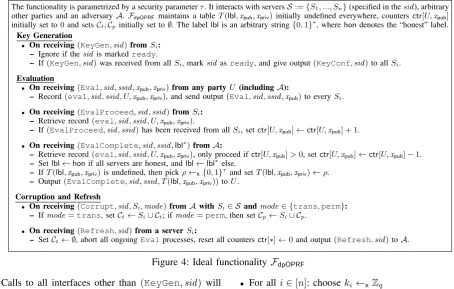
We follow the previous line of work [32], [33], [35] and model security for ourdpOPRFvia an ideal function-ality FdpOPRF in the UC framework [15]. The function-ality allows evaluation of a random function on chosen inputs (xpriv,xpub), given all servers S1, . . . , Sn agree to
participate. Implementing a partially-oblivious function,
FdpOPRF tells the serversxpub before they have to make
their decision. The adversary may also evaluate the func-tion on arbitrary inputs, but crucially requires participafunc-tion of all servers. Note that ourFdpOPRF does not contain an adversarial interface for offline evaluations, i.e., without all servers participating, as is the case for other OPRF functionalities [32], [33], [35]. We do not need such an interface since we are only interested in security when less thannservers are corrupted concurrently.
To model servers deviating from the protocol,FdpOPRF
allows A to modify the PRF key if not all servers are honest. This is implemented by lettingAinput a labellbl
andFdpOPRF maintaining a different random function for
each lbl. Lastly, our FdpOPRF provides strong guarantees by preventing "mix-and-match" attacks, where participa-tion agreement of servers can be collected among differ-ent evaluation requests (as possible in, e.g., [32], [33]).
FdpOPRF prevents such attacks by maintaining evaluation
ticket counters ctr[U,xpub] that are increased only when
all servers agree to participate in an evaluation initiated byU usingxpub as public input. Neither can other parties
"steal" those evaluation tokens, nor canU later decide to instead evaluate on a different public input value.
Corruption and Proactive Security.FdpOPRFis designed to work with adversaries performing adaptive permanent (of-ten calledstandardorByzantine) andtransientcorruptions of servers Si. Transient corruptions are a special type of
corruption that we use to model proactive security. Upon a transient corruption, a party’s internal state is given to the adversary and he gains control over the party’s actions. However, the adversary can decide to "uncorrupt" all transiently corrupted parties. FdpOPRF is informed about such corruption recovery via an input Refresh from one of the servers. The detailed functionality is given in Figure 4. For brevity, we use the following conventions:
Writing Conventions forFdpOPRF (andFPESTO).
1) The functionality considers a specific session sid = (S1, . . . , Sn,sid0)and only accepts inputs from servers
Si that are contained in thesid.
2) We assume sub-session identifiers ssid to be unique. All interfaces that take as input an ssid will only accept one input per party and such ssid.
3) When the functionality is supposed to retrieve an internal record, but no such record can be found, then the query is ignored.
The functionality is parametrized by a security parameterτ. It interacts with serversS:={S1, ..., Sn}(specified in thesid), arbitrary
other parties and an adversaryA.FdpOPRFmaintains a tableT(lbl,xpub,xpriv)initially undefined everywhere, countersctr[U,xpub]
initially set to0and setsCt,Cpinitially set to∅. The labellblis an arbitrary string{0,1}∗, wherehondenotes the “honest” label.
Key Generation
• On receiving(KeyGen,sid)fromSi: – Ignore if thesid is markedready.
– If(KeyGen,sid)was received from allSi, marksidasready, and give output(KeyConf,sid)to allSi.
Evaluation
• On receiving(Eval,sid,ssid,xpub,xpriv)from any partyU (includingA):
– Record(eval,sid,ssid, U,xpub,xpriv), and send output(Eval,sid,ssid,xpub)to everySi.
• On receiving(EvalProceed,sid,ssid)fromSi: – Retrieve record(eval,sid,ssid, U,xpub,xpriv).
– If(EvalProceed,sid,ssid)has been received from allSi, setctr[U,xpub]←ctr[U,xpub] + 1.
• On receiving(EvalComplete,sid,ssid,lbl∗)fromA:
– Retrieve record(eval,sid,ssid, U,xpub,xpriv), only proceed ifctr[U,xpub]>0, setctr[U,xpub]←ctr[U,xpub]−1.
– Setlbl←honif all servers are honest, andlbl←lbl∗else. – IfT(lbl,xpub,xpriv)is undefined, then pickρ←R{0,1}
τ
and setT(lbl,xpub,xpriv)←ρ.
– Output(EvalComplete,sid,ssid, T(lbl,xpub,xpriv))toU.
Corruption and Refresh
• On receiving(Corrupt,sid, Si,mode)fromAwithSi∈ Sandmode∈ {trans,perm}: – Ifmode=trans, setCt←Si∪ Ct; ifmode=perm, then setCp←Si∪ Cp.
• On receiving(Refresh,sid)from a serverSi:
– SetCt← ∅, abort all ongoingEvalprocesses, reset all countersctr[∗]←0and output(Refresh,sid)toA.
Figure 4: Ideal functionalityFdpOPRF
5) Calls to all interfaces other than (KeyGen,sid) will only be processed after KeyGenis completed.
4.2. Our DH-dpOPRF Construction
We now describe our protocol DH-dpOPRF, which has at its core the distributed 2HashDH protocol for com-puting H0(xpriv, H(xpriv)K)[31], but combines additional
features inspired by other works: partial obliviousness using pairings [21], and proactive security [13].
In the 2HashDH protocol, the user blinds his inputxpriv
with randomnessrand sendsx¯←H1(xpriv)rto the server,
which she can remove again after receivingx¯K from the
server. The protocol can be made distributed by simply settingK←P
i∈[n]ki whereki are the individual server
keys and letting the user multiply the individual PRF shares she receives. To achieve partialblindness, servers contributee(¯x, H2(xpub))ki with an asymmetric pairinge
and a public inputxpubobtained from the user in the clear.
Overall, our protocol computes y ← PRFK(xpriv,xpub)
with: y=H4
xpriv,xpub, e(H1(xpriv), H2(xpub)) P
i∈[n]ki
Setup. For our construction, we assume a bilinear group
(p, g1, g2, gT,G1,G2,GT, e) and hash functions H1 : {0,1}∗→
G1,H2:{0,1}∗ →G2, H3 :{0,1}∗ →GT,
andH4:{0,1}∗×GT → {0,1}τ.
Key Generation.For simplicity we assume the existence of a trusted dealer that generates master keys for the servers. Each server disposes of an offline backup tape that can be plugged in for performing read and write operations on it. A server Si, upon input (KeyGen,sid), sends (KeyGen,sid) to the trusted dealer. The trusted dealer, upon the first message(KeyGen,sid)for a particularsid from a server Si, generates the signing keys for all n
servers in sid = (S1, . . . , Sn,sid0). More precisely, the
dealer generates the secret key shares ki of an implicit
joint PRF key K ←R Zq, seeds si,j for blinding factors
as well as master keysmki,j as follows:
• For alli∈[n]: chooseki←RZq • For alli, j∈[n], i6=j:
– si,j←R{0,1}τ,mki,j←R{0,1}τ for i < j – sj,i←si,j,mkj,i←mki,j for j > i
It sends (ki,{si,j}j∈[n]\{i},{mki,j}j∈[n]\{i}) to Si over
a secure channel. Note that the seeds si,j = sj,i and
master keys mki,j = mkj,i will be known only to
the servers Si and Sj, i.e., each pair of servers will
share a common master key and blinding seed that is unknown to all other servers. For all further mes-sages (KeyGen,sid) from the other servers Sj
con-tained in sid, the dealer simply responds with the al-ready generated key shares for that server. Upon re-ceiving (ki,{si,j}j∈[n]\{i},{mki,j}j∈[n]\{i}), Si stores (ki,{si,j}j∈[n]\{i}) as the current epoch key, stores (ki,{mki,j}j∈[n]\{i})on the backup tape and erases any mki,j from the memory.
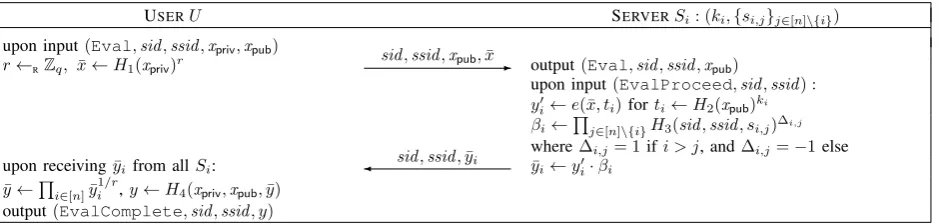
Evaluation.The detailed protocol is given in Figure 5 and lets the user U and all n servers jointly and (partially) blind compute the functionPRFK(xpriv,xpub)stated above
for private inputxprivand public inputxpub. For achieving
proactive and adaptive security it is again important to avoid any commitment to secret key shares. We use the same approach as in our RSA-DSIG construction and let servers mask all messages with a blinding value βi
which is a pseudorandom multiplicative share of1 that is constructed from the pairwise shared si,j-values and the
(unique)ssid. Similar as inRSA-DSIGthe purpose of the servers’ blinding valuesβiis two-fold as they also prevent
mix-and-match attacks, i.e., combining shares from differ-ent sub-sessionsssid, as required by our functionality.
Refresh. The refresh is triggered when a server Si
re-ceives the input (Refresh,sid), upon which it sends
(Refresh,sid) over a secure broadcast channel to all other serversSj∈ S\Siwhich now perform their updates
in a synchronized manner. They first retrieve their values
USERU SERVERSi: (ki,{si,j}j∈[n]\{i})
upon input(Eval,sid,ssid,xpriv,xpub)
r←RZq, ¯x←H1(xpriv)r
-sid,ssid,xpub,x¯
output(Eval,sid,ssid,xpub)
upon input(EvalProceed,sid,ssid) :
y0i←e(¯x, ti)forti←H2(xpub)ki
βi←Qj∈[n]\{i}H3(sid,ssid, si,j)∆i,j where∆i,j= 1ifi > j, and∆i,j=−1else upon receivingy¯ifrom allSi:
sid,ssid,y¯i y¯
i←yi0·βi ¯
y←Q i∈[n]y¯
1/r
i ,y←H4(xpriv,xpub,y¯)
output(EvalComplete,sid,ssid, y)
Figure 5: Evaluation protocol of ourDH-dpOPRFconstruction.
a PRG to derive a new master key, fresh seeds s0i,j for the blinding values, and seedsδi,j for their update share.
The latter is used to refresh the PRF key share, which is simply done by updating the old sharekiwith a share of0.
Relying on δi,j which are deterministically derived from
their pairwise exchanged master keys mki,j, the servers
can compute these shares of 0 in a non-interactive fash-ion. More precisely, each server Si (either triggered via (Refresh,sid)or by receiving (Refresh,sid)from a server Sj∈ S) runs the following update procedure:
• Retrieve(ki,{mki,j}j∈[n]\{i}) from the backup tape. • For allj∈[n]\ {i}:(mk0i,j, s0i,j, δi,j)←PRG(mki,j).
• Setki0←ki+P n
j=1,j6=i∆i,jδi,j modq, where∆i,j is ∆i,j = 1if i > j, and∆i,j=−1else.
• Store(k0
i,{s0i,j}j∈[n]\{i})as the current epoch key and (k0i,{mk0i,j}j∈[n]\{i})on the backup tape.
• Securely delete ki,mki,j,mk0i,j, si,j, δi,j for all j ∈ [n]\ {i} from the memory, and (ki,{mki,j}nj=1,j6=i)
from the backup tape.
Note that retrieving an uncorrupted ki from the
backup tape is necessary to recover from transient cor-ruptions, as the adversary may have alteredki.
4.2.1. Security of DH-dpOPRF. For our analysis, we require that transiently corrupted parties are always "un-corrupted" before plugging in their backup tape, such that transient corruptions never reveal the backup tape to the adversary. Formally, this is handled by defining a corruption model for UC where, upon sendingRefresh, the adversary neither controls nor observes the state of any formerly transient corrupted party anymore, and all these parties are considered honest again. As a result, they give inputs and receive outputs directly to/fromFdpOPRF
instead of sending them via the adversary. For this cor-ruption modeling to be meaningful, we assume that the adversary can corrupt servers at any time, but if he does so duringKeyGenorRefresh, then he must perform a permanent corruption.
We assume private and server-sided authenticated channels between each user and each server. Such a channels can be implemented, e.g., using TLS.
Theorem 2. The protocolDH-dpOPRFsecurely realizes FdpOPRFin the random oracle model ifPRGis secure and the Gapom-BDH assumption holds in G, w.r.t
environ-ments corrupting at mostn−1servers concurrentlyusing adaptive permanent and transient corruptions.
The Gapom-BDH assumption (Def 3), stated in Sec-tion 2, is a generalizaSec-tion of the assumpSec-tion introduced by [21] which in turn is the bilinear variant of the one-more
DDH assumption that underlies the standard 2HashDH construction. The overall proof idea is similar to the one by [33], extended to our partially-blind and proactive setting. An informal proof is given in Appendix B.
5. Proactively-Secure Distributed SSO
We now present our approach for proactively-secure distributed SSO (PESTO). We start by describing the high-level functionality and desired security properties. In Section 5.1 we then present our formal security forPESTOand give our protocol in Section 5.2.
High-Level Idea.From a user perspective,PESTOshould work just as standard SSO, but simply interacting withn servers instead of only one. The servers hereby possess a joint public verification keyvk.
First, the user can create a user account for a certain user name uid and a chosen password pw. Note that he only uses one password to register with all n servers. Upon successful registration, the user can request joint signatures of all servers on messages m of his choice. To do so, the user must authenticate under uid and a password attemptpw0. If the provided password matches the one used at account creation foruid, the user receives a signatureσ, that was created by all servers for(uid, m), i.e., they bind the message to the verified user name. For SSO applications, the message will contain the unique ID of the targeted service provider and a nonce that is usually specified by the provider. Finally, the signatureσcan be verified by everyone against the public keyvk. We want
PESTOto satisfy the following security properties:
Offline-Attack Resistance: An adversary corrupting at mostn−1servers must not be able to run offline attacks against the users’ account passwords.
Unforgeability of Tokens: An adversary corrupting at most n−1 servers cannot forge signatures that verify under the joint public keyvk. The only way to receive a valid signature for an honestly createduid and adversar-ially chosen messagem∗ is by guessing the associated passwordandgetting the remaining honest server(s) to explicitly approve the signature request.
can base their further actions on this information, e.g., blocking accounts after 10 failed attempts.
Adaptive and Proactive Security: For modelling realis-tic attacks, we allow the adversary to corrupt servers in anadaptivefashion, i.e., he can take control of any ini-tially honest party at any time. We further allowtransient corruptions as detailed in Section 4.2.1, ensuring that our protocol features proactive security and the above properties hold even when all servers get corrupted, as long as not all of them are corrupted at the same time.
5.1. Security Model
In this section we present our formal security for
PESTO in form of an ideal functionality FPESTO in the UC framework. The main entities in our system are a set of servers S := {S1, ..., Sn} which are specified in the
sid = (S1, . . . , Sn,sid0), where sid0 is a unique string.
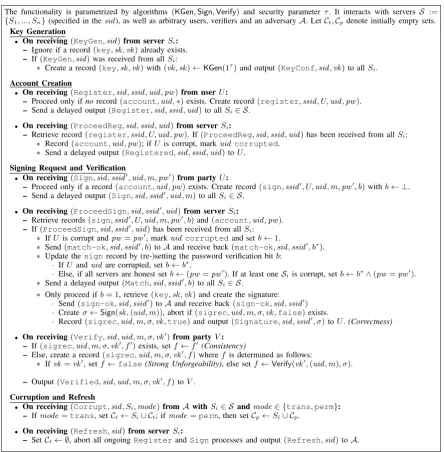
We now briefly discuss the interfaces our functionality provides and how they enforce the desired security prop-erties sketched above. The detailed definition is given in Figure 6. For the sake of brevity, our FPESTO definition
assumes the writing conventions from Section 4.
Key Generation. The functionality is parametrized by algorithms (KGen,Sign,Verify), and internally generates a key pair (vk,sk) ← KGen(1τ) when all servers
have explicitly triggered key generation by sending
(KeyGen,sid). From then on, FPESTO accepts calls to the other interfaces and will guarantee unforgeability of signatures w.r.t.vk. We stress that we will not rely on any security properties of these algorithms but only use them to letFPESTO output well-formed cryptographic values.
Account Creation.The creation of a new account for user-nameuid and passwordpw is initiated by a user on input
(Register,sid,ssid,uid,pw). To distinguish between several account creation (and signing) sessions, we use unique sub-session identifiers ssid. If uid has not been registered yet, all servers S1, . . . , Sn are notified about
the request (but without learning the password) and must approve it by sending(ProceedReg,sid,ssid,uid). The functionality internally stores (uid,pw) and from then on allows signing requests for uid. We flag accounts created by malicious users, as the adversary will have more control over these when signing.
Password-Authenticated Distributed Signing.After an ac-count foruid was created, a user can request password-authenticated signatures for a message m by sending
(Sign,sid,ssid0,uid, m,pw0) where pw0 denotes the password attempt the user is logging in with. The servers are notified — again without learning the password pw0 — and the functionality only proceeds with the pass-word verification when all servers have responded with
(ProceedSign,sid,ssid0,uid).
Awaiting explicit approval of all servers gives each the opportunity to block a session if they detect some suspicious behaviour, or they have been asked by the user to suspend her account. This is crucial to prevent offline attacks against the password, as well as to detect and stop online guessing attacks. Note that this implicitly implements our rate limiting requirement: servers will not send the ProceedSign command when they suspect malicious activities, e.g., a certain number of failed lo-gin attempts. By not specifying the exact method how
servers come to the decision on whether to proceed or not, our model remains flexible, i.e., it can support any rate limiting policy.
When given approval, the functionality now checks whether pw0 matches the original password pw the user has created her account with. If all servers and the user are honest, the decision bit is simply set tob←(pw=pw0). If malicious parties are involved, the adversary has a bit of wiggle room: If at least one server is corrupt, the adversary can always make a correct login fail and enforce b←0
but not vice versa, i.e., he cannot make a mismatch of the passwords look like a match. If the user account foruid has been corrupted, either because it was created by the adversary or the adversary correctly guessed the password of an initially honest account, A now can freely set the decision bit, modeling the fact that he has full control over the account anyway. These capabilities of the attacker are modeled by first telling A whether login was successful via output match-ok, and then asking A for a bit b∗. The functionality enforces its influence according to the corruption setting. All servers receive the decision bit via an output(Match,sid,ssid0, b).
Finally, when the password was determined to be correct, the signature is created. FPESTO gener-ates σ ← Sign(sk,(uid, m)) and stores a record
(sigrec,uid, m, σ,vk,true)that will allow successful verification of σ. Note that the record also contains uid which enforces that the signature is only valid for that particular user. The user receives the computed signature via the output (Signature,sid,ssid0, σ).
Verification. Everyone can check the validity of signa-tures by sending(Verify,sid,uid, m, σ,vk0). Ifvk0 =
vk, i.e,. verification is requested for the verification key associated with sid, then FPESTO uses its internal records to determine whether σ is valid for (uid, m). The output is set to f ← true only if a record
(sigrec,uid, m, σ,vk,true) exist. As such records only get created through successful signing requests, the desired unforgeability is enforced. For other verification keys, the functionality uses theVerify algorithm to deter-minef. Allowing such verification for “incorrect” public keys is necessary to avoid that FPESTO must realize a trusted certification authority too.
Corruptions and Refresh.We use the same transient cor-ruption model in UC as in Section 4.2.1, and thusFPESTO
provides the same corruption interfaces Corrupt and
Refreshfor corrupting servers as FdpOPRF.
We note that the functionality does not prevent the adversary from callingRefreshwhen he has corrupted a server. Since a refresh models "cleaning" of all tran-siently corrupted servers, it does not seem desireable for a corrupted server to callRefresh: if the calling server is transiently corrupted, such a request will only result in the adversary being booted from that server.
The functionality is parametrized by algorithms (KGen,Sign,Verify) and security parameterτ. It interacts with servers S :=
{S1, ..., Sn}(specified in thesid), as well as arbitrary users, verifiers and an adversaryA. LetCt,Cpdenote initially empty sets.
Key Generation
• On receiving(KeyGen,sid)from serverSi: – Ignore if a record(key,sk,vk)already exists. – If(KeyGen,sid)was received from allSi:
∗ Create a record(key,sk,vk)with(vk,sk)←KGen(1τ)and output(KeyConf,sid,vk)to allSi.
Account Creation
• On receiving(Register,sid,ssid,uid,pw)from userU:
– Proceed only ifnorecord(account,uid,∗)exists. Create record(register,ssid, U,uid,pw). – Send a delayed output(Register,sid,ssid,uid)to allSi∈ S.
• On receiving(ProceedReg,sid,ssid,uid)from serverSi:
– Retrieve record(register,ssid, U,uid,pw). If(ProceedReg,sid,ssid,uid)has been received from allSi:
∗ Record(account,uid,pw); ifU is corrupt, markuidcorrupted.
∗ Send a delayed output(Registered,sid,ssid,uid)toU.
Signing Request and Verification
• On receiving(Sign,sid,ssid0,uid, m,pw0)from partyU:
– Proceed only if a record(account,uid,pw)exists. Create record(sign,ssid0, U,uid, m,pw0, b)withb← ⊥. – Send a delayed output(Sign,sid,ssid0,uid, m)to allSi∈ S.
• On receiving(ProceedSign,sid,ssid0,uid)from serverSi:
– Retrieve records(sign,ssid0, U,uid, m,pw0, b)and(account,uid,pw). – If(ProceedSign,sid,ssid0,uid)has been received from allSi:
∗ IfU is corrupt andpw=pw0, markuidcorruptedand setb←1.
∗ Send(match-ok,sid,ssid0, b)toAand receive back(match-ok,sid,ssid0, b∗).
∗ Update thesignrecord by (re-)setting the password verification bitb:
· IfU anduidare corrupted, setb←b∗.
· Else, if all servers are honest setb←(pw=pw0). If at least oneSiis corrupt, setb←b∗∧(pw=pw0).
∗ Send a delayed output(Match,sid,ssid0, b)to allSi∈ S.
∗ Only proceed ifb= 1, retrieve(key,sk,vk)and create the signature:
· Send(sign-ok,sid,ssid0)toAand receive back(sign-ok,sid,ssid0)
· Createσ←Sign(sk,(uid, m)), abort if(sigrec,uid, m, σ,vk,false)exists.
· Record(sigrec,uid, m, σ,vk,true)and output(Signature,sid,ssid0, σ)toU.(Correctness)
• On receiving(Verify,sid,uid, m, σ,vk0)from partyV: – If(sigrec,uid, m, σ,vk0, f0)exists, setf←f0(Consistency)
– Else, create a record(sigrec,uid, m, σ,vk0, f)wherefis determined as follows:
∗ Ifvk=vk0, setf←false(Strong Unforgeability), else setf←Verify(vk0,(uid, m), σ).
– Output(Verified,sid,uid, m, σ,vk0, f)toV.
Corruption and Refresh
• On receiving(Corrupt,sid, Si,mode)fromAwithSi∈ S andmode∈ {trans,perm}: – Ifmode=trans, setCt←Si∪ Ct; ifmode=perm, then setCp←Si∪ Cp.
• On receiving(Refresh,sid)from serverSi:
– SetCt← ∅, abort all ongoingRegisterandSignprocesses and output(Refresh,sid)toA.
Figure 6: Ideal functionalityFPESTO for proactively-secure distributed SSO
captured by the UC model, as the environment can leak passwords of honest users to the adversary.
5.1.1. SSO-specific Modeling Choices.Apart from bind-ing the username uid to signed messages, there is an-other subtle SSO-related aspect to our model. Essentially,
FPESTOcan be seen as a complexsignature functionality. The common approach for UC signature definitions [16] is to let the adversary provide the signature valuesσ(either directly or by imputing algorithms with hardcoded signing keys). FPESTO instead generates signatures within the functionality for a key that is unknown to the adversary. While this might seem like a benign modeling choice — unforgeability does not depend on σ but the records
FPESTO maintains — it makes a big difference for our SSO application: Allowing the adversary to determine and learn signatures of honest users would render the SSO aspect useless where signatures serve as authentication tokens! The internal approach taken by FPESTO ensures that only the affected user learns her signature, but also makes proving security much more challenging.
5.2. Our PESTO Construction
On a high level, our protocol ΠPESTO combines a
distributed partially-oblivious PRFdpOPRF, a distributed signature scheme DSIG and standard signature SIG. The
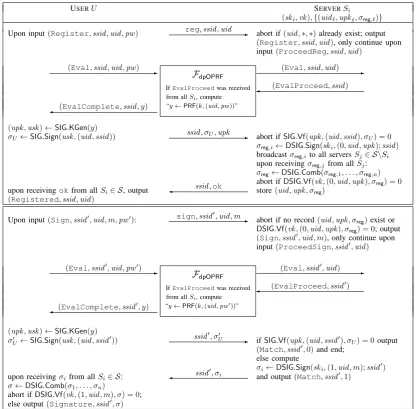
dpOPRF is evaluated on the username uid (public) and password (private), and the PRF value is interpreted as long-term secret signing keyusk ofSIG. Servers store the corresponding verification keyupk in the user’s account. When the user later requests a signature for message m and uid, she re-derives usk and signs a session-specific nonce to convince the servers of her possessing the right password. Servers then jointly sign the message(uid, m)
using the distributed signature schemeDSIG.
The distributed building blocks are as defined in Sec-tions 3 and 4, andSIGis a conventional signature scheme consisting of algorithms(SIG.KGen,SIG.Sign,SIG.Vf). In our construction we will make the randomness r used in SIG.KGen explicit, and assume that key generation behaves deterministically when using the samer.
pro-USERU SERVERSi
(ski,vk),{(uid`,upk`, σreg,`)}
Upon input(Register,ssid,uid,pw)
-reg,ssid,uid
abort if(uid,∗,∗)already exist; output (Register,ssid,uid), only continue upon input(ProceedReg,ssid,uid)
-(Eval,ssid,uid,pw)
-(Eval,ssid,uid) FdpOPRF
(
EvalProceed,ssid) IfEvalProceedwas received
from allSi, compute “y←PRF(k,(uid,pw))”
(
EvalComplete,ssid, y)
(upk,usk)←SIG.KGen(y)
σU←SIG.Sign(usk,(uid,ssid)) ssid, σU,upk - abort ifSIG.Vf(upk,(uid,ssid), σU) = 0 σreg,i←DSIG.Sign(ski,(0,uid,upk);ssid) broadcastσreg,ito all serversSj∈ S\Si upon receivingσreg,jfrom allSj: σreg←DSIG.Comb(σreg,1, . . . , σreg,n) abort ifDSIG.Vf(vk,(0,uid,upk), σreg) = 0
upon receivingokfrom allSi∈ S, output (Registered,ssid,uid)
ssid,ok
store(uid,upk, σreg)
Upon input(Sign,ssid0,uid, m,pw0):
-sign,ssid0,uid, m abort if no record(uid,upk, σ
reg)exist or
DSIG.Vf(vk,(0,uid,upk), σreg) = 0; output
(Sign,ssid0,uid, m), only continue upon input(ProceedSign,ssid0,uid)
-(Eval,ssid0,uid,pw0)
-(Eval,ssid0,uid) FdpOPRF
(
EvalProceed,ssid0) IfEvalProceedwas received
from allSi, compute “y←PRF(k,(uid,pw0))” (
EvalComplete,ssid0, y)
(upk,usk)←SIG.KGen(y)
σ0
U←SIG.Sign(usk,(uid,ssid
0))
-ssid0, σ0
U ifSIG.Vf(upk,(uid,ssid0), σU) = 0output
(Match,ssid0,0)and end; else compute
σi←DSIG.Sign(ski,(1,uid, m);ssid0) upon receivingσi from allSi∈ S: ssid
0
, σi and output(Match,ssid0,1)
σ←DSIG.Comb(σ1, . . . , σn)
abort ifDSIG.Vf(vk,(1,uid, m), σ) = 0; else output(Signature,ssid0, σ)
Figure 7: Registration and sign procedures ofΠPESTO. For concise notation, we omit thesid from all in- and outputs.
vides all servers with their initial key shares and backup keys. That is, when a server Si receives input (KeyGen,sid)it checks that sid = (S1, . . . , Sn,sid0). It
sends (KeyGen,sid) to FdpOPRF and (keygen,sid) to
the trusted dealer of theDSIGscheme.
The trusted dealer, upon first message(keygen,sid)
for a particularsid from a serverSi generates the signing
keys for all n servers as (pk,{ski}i∈[n],{bki}i∈[n])←R DSIG.KGen(pp, n). It sets vk ← pk and returns
(vk, ski,bki)over a secure channel toSi. For all further
messages (keygen,sid) from the other servers in sid, the dealer responds with the already generated key shares. Each server stores(sid,ski,vk)as the online signing key,
and keepsbki on a secure and offline backup tape.
Account Creation.A user can create an account for user-nameuid and passwordpw with allnservers, by running the protocol depicted in Figure 7. Roughly, the servers perform a partially blind FdpOPRF evaluation where the uid is the public and pw the blinded input. From the receivedFdpOPRF outputy, the user deterministically de-rives a key pairusk,upk of a standard signature scheme, and sendsupk and a signature computed fromusk back to the servers. The servers now check the validity of the upk and user signature, and then use their distributed
sig-nature scheme to sign(0,uid,upk). The jointly computed signature σreg on these values ensures that an adversary
cannot gradually plant malicious public keys for honest user accounts, when he transiently corrupts individual servers. Prepending the 0-bit to the signed message is done to enforce domain separation from the messages the servers are signing for the users later on (using the same distributed signature scheme). The account information stored by each server is(uid,upk, σreg).