Indistinguishability Obfuscation from
Functional Encryption
∗Nir Bitansky† Vinod Vaikuntanathan‡
Abstract
Indistinguishability obfuscation (IO) is a tremendous notion, powerful enough to give rise to almost any known cryptographic object. Prior candidate IO constructions were based on specific assumptions on algebraic objects called multi-linear graded encodings.
We present a generic construction of indistinguishability obfuscation from public-key functional encryption with succinct encryption circuits and subexponential security. This shows the equivalence of indistinguishability obfuscation and public-key functional en-cryption, a primitive that has previously seemed to be much weaker, lacking the power and the staggering range of applications of indistinguishability obfuscation.
Our main construction can be based on functional encryption schemes that support a single functional key, and where the encryption circuit grows sub-linearly in the circuit-size of the function. We further show that sublinear succinctness in circuit-size for single-key schemes can be traded with sublinear succinctness in the number of keys (also known as thecollusion-size) for multi-key schemes. We also show that, under the Learning with Errors assumption, our techniques imply that any indistinguishability obfuscator can be converted into one where the size of obfuscated circuits is twice that of the original circuit plus an additive overhead that is polynomial in its depth, input length, and the security parameter.
∗
An extended abstract of this paper appears in the proceedings of FOCS 2015.
†Tel Aviv University.
E-mail:[email protected]. Member of the Check Point Institute of Information Security. Supported by the Alon Young Faculty Fellowship and by Len Blavatnik and the Blavatnik Family foun-dation. Part of this research was done while at MIT and supported in part by NSF Grants CNS-1350619 and CNS-1414119, and by the NEC Corporation.
‡
Contents
1 Introduction 1
1.1 This Work . . . 1
1.2 Main Ideas . . . 3
1.3 Concurrent Work . . . 7
1.4 Followup Work . . . 8
2 Definitions 9 2.1 Standard Computational Concepts . . . 9
2.2 Single-Key FE with Succinct Encryption . . . 10
2.3 Indistinguishability Obfuscation . . . 11
2.4 Puncturable Pseudorandom Functions . . . 12
2.5 One-Time Symmetric Encryption with Local Decryption . . . 12
2.6 Decomposable Randomized Encodings . . . 13
3 The Transformation 14 3.1 Puncturable Functional Encryption . . . 14
3.2 From Puncturable Functional Encryption to Indistinguishability Obfuscation . . 19
3.3 IO with Linear Overhead . . . 26
4 A Bootstrapping Theorem 29 4.1 Multi-Key FE with Succinct Encryption . . . 29
1
Introduction
Program obfuscation, aiming to turn programs into “unintelligible” ones while preserving functionality, has been a holy grail in cryptography for over a decade. While heuristic meth-ods of obfuscation are widely used in practice, our theoretical understanding of obfuscation is still in its early stages. Rather unfortunately, the most natural and intuitively appealing no-tion of obfuscano-tion, namelyvirtual-black-box(VBB) obfuscation [Had00,BGI+12], was shown to have strong limitations [Had00,BGI+12,GK05,BCC+14]. Furthermore, except for very
re-stricted function classes (see, for example, [Can97,LPS04,Wee05,HMS07,HRSV11,CRV10]), no candidate construction with any form of meaningful security was known for a long time.
This changed dramatically when Garg, Gentry, Halevi, Raykova, Sahai and Waters [GGH+13b]
demonstrated a candidate obfuscation algorithm for all circuits, and conjectured that it satis-fies an apparently weak notion of indistinguishability obfuscation(IO) [BGI+12, GR07], requir-ing only that the obfuscations of any two circuits of the same size and the same functionality (namely, the same truth table) are computationally indistinguishable. Since then, a sequence of works, pioneered by Sahai and Waters [SW14], have demonstrated that IO is not such a weak notion after all, leading to a plethora of applications and even resolving long-standing open problems. The number of cryptographic primitives that we do not know how to construct from IO is small and dwindling fast.1
The tremendous power of IO also begets its reliance on strong and untested computational assumptions. Despite significant progress [PST14, GLSW15], known IO constructions prior to this work [GGH+13b, PST14, BR14, BGK+14, GLSW15, AB15, Zim15] were based on the hardness of little-studied problems on multi-linear maps [GGH13a]. Thus, an outstanding foundational question in cryptography is:
Can we base indistinguishability obfuscation on solid cryptographic foundations?
1.1 This Work
In this work, aiming to make progress in the above direction, we show how to construct in-distinguishability obfuscation from an apparently weaker primitive: public-key functional en-cryption. In a functional encryption scheme [BCOP04,SW05,BSW12,O’N10], it is possible to produce functional keysFSKf for functionsf (represented as circuits throughout this paper).
Given an encryption of an inputx, computed using a public keyPK and the functional key FSKf, anyone can computef(x), but nothing more aboutxitself.
In the past few years, functional encryption (FE) schemes with different efficiency and se-curity features were constructed from various computational assumptions. A central measure of interest (in general and in the specific context of this work) is the size of ciphertexts, or more generally the encryption time. Here the ideal requirement is that the time to encrypt depends only on the underlying plaintextx, but this requirement may be relaxed in several meaningful ways, such as allowing dependence on the size of the circuits computing the corresponding functions, just the size of their output, or the number of generated functional keys.
Functional encryption, on the face of it, seems much less powerful than IO and sure enough, it has not had nearly as many applications. Seemingly, IO derives its power from the fact that it allowsanyoneto compute meaningfully with a hidden object (say, a circuit) with no additional help. In contrast, FE does allow us to encrypt circuits2but to evaluate the circuit on an input,
1Strictly speaking, we need the assumption that IO exists, plus a very mild (and minimal) complexity-theoretic
assumption that NP6⊆ioBPP [KMN+14].
2Given FE for a sufficiently expressive class, we can switch the roles of circuits and inputs, going through a
one needs a functional key associated with the input! Not surprisingly, the power of FE seems to be limited to achieving a notion of “obfuscation on a leash” or “token-based obfuscation”, as defined by Goldwasser, Kalai, Popa, Vaikuntanathan and Zeldovich [GKP+13].
Perhaps surprisingly, we show:
Theorem 1.1(informal). Assuming the existence of a sub-exponentially-secure public-key functional encryption scheme for all circuits, where encryption time is polynomial in the input-size and sub-linear in the circuit-size, there exists indistinguishability obfuscation for all circuits.
Furthermore, in the above theorem, it suffices to start from a scheme that supports only a single functional key and satisfies a mild selective-security indistinguishability-based guaran-tee. We can further relax the above to allow the encryption to also depend polynomially on circuit-depth (or even exponentially, assuming pseudo-random functions in NC1).
We also show that the requirement for sub-linear dependence on circuit size can be traded, when moving tomulti-keyfunctional encryption schemes with a sub-linear dependence on the number of derived keys. Informally, in such multi-key schemes, it is guaranteed that an ad-versary in the possession of a set of functional keys, learns nothing on the encrypted message beyond the combination of function outputs corresponding to the set of keys.
In fact, we show a generic bootstrapping theorem that captures both the transformation from the multi-key setting to the single-key setting, and the removal of depth dependence in single-key schemes.
Theorem 1.2(informal). Assuming the existence of multi-key functional encryption schemes for all circuits, where encryption time is polynomial in the input-size and circuit-size, but sub-linear in the number of released keys, or single-key functional encryption schemes with sub-linear dependence on circuit-size and polynomial dependence on circuit-depth, there exist single-key functional encryption schemes with sub-linear dependence on circuit-size (and no further dependence on circuit-depth).
This transformation, in particular, allows obtaining new IO candidates from exsiting multi-key functional encryption schemes such as the one by Garg et al. [GGHZ16] (in its subepxonentially-hard version).
Another corollary that follows from our techniques and previous results on FE with suc-cinct keys [BGG+14] is that obfuscation size can always be reduced to linear in the function’s
circuit-size plus some overhead in circuit-depth.
Corollary 1.3(informal). Assuming sub-exponential hardness of the Learning with Errors problem and IO, there exists IO such that an obfuscation of any circuitCof depthdand input lengthnis of size
2|C|+ poly(n, d, λ).
Interpretation.Functional encryption schemes satisfying the succinctness properties required in Theorem1.2were previously known based on indistinguishability obfuscation [GGH+13b] or the stronger notion of differing-inputs obfuscation [BCP14]. Thus, our result establishes the equivalence of functional encryption and IO, up to some sub-exponential security loss. The question of basing IO on more standard assumptions still stands, but is now reduced to improving the state of the art in functional encryption.
It is rather tempting to be pessimistic and to interpret our result as a lower-bound show-ing that improvshow-ing functional encryption based on standard assumptions may be very hard, or perhaps straight out impossible. Our take on the result is quite optimistic. We hope that the construction would eventually lead to IO from more standard assumptions, or improved assumptions on multilinear graded encodings.3 Indeed, in the past few years, we have seen
a remarkable progress in constructions of functional encryption based on standard assump-tions [SS10, GVW12,GVW13]. The state of the art scheme based on a standard assumption is that of Goldwasser, Kalai, Popa, Vaikuntanathan and Zeldovich [GKP+13] relying on the
sub-exponential learning with errors assumption. The construction achieves ciphertext size that only grows polynomially with the circuit output size and depth; thus, for circuits with say a single output bit, ciphertexts may indeed be sub-linear in circuit size, but this will not be the case for circuits with long outputs. Interestingly, the latter construction achieves a strong simulation-based security guarantee, under which sub-linear growth in the output size (let alone circuit-size) is actually impossible [AGVW13, AIKW13, GKP+13]. Reducing the
de-pendence on the output (under an indistinguishability-based notion) has been a tantalizing problem. Now, this question becomes of central importance in the quest to achieve indistin-guishability obfuscation.
Gorbunov, Vaikuntanathan and Wee [GVW15] showed how to construct predicate encryp-tion schemes for all circuits (with a-priori bounded depth) from sub-exponential hardness of the Learning with Errors problem (LWE). In their scheme, the ciphertext size is polynomial in the input length and the depth of the circuit, and otherwise independent of the circuit size and output size. A predicate encryption scheme can be interpreted as a functional encryption scheme with a “weak attribute-hiding” property (see [KSW13,AFV11,GVW15] for more de-tails). Strengthening this to “full attribute hiding” will give us a functional encryption scheme that satisfies the requirements of Theorem1.2, and is yet another frontier in achieving indistin-guishability obfuscation from LWE.
We next explain the main ideas standing behind our construction.
1.2 Main Ideas
Our starting point is a naturalinput extensionapproach: given an obfuscatorOn−1for circuits
with input lengthn−1, design an obfuscatorOnfor circuits with input lengthn. Intuitively, this way we can get obfuscation for circuits with arbitrary polynomial input length — recursively apply the input extension step polynomially many times. The base case is trivial — for circuits C with a single input bit, simply define the obfuscationO1(C) to be the corresponding truth table(C(0), C(1)).
A crucial feature of any such input extension procedure is the blowup it incurs in complex-ity. Indeed, a trivial input extension procedure:
On(C(x1, . . . , xn)) :=On−1(C(x1, . . . , xn−1,0)◦C(x1, . . . , xn−1,1))
that first creates an(n−1)-bit input circuit with a doubly-long output (by taking two copies of the original circuit and fixing the last bitxnto either0or1) blows up the obfuscation size, at
each step, by at least a multiplicative factor of two. Accordingly, such a procedure can only be applied logarithmically-many times (indeed, it is equivalent to simply writing the truth table of the circuit). To avoid such blowup, we must ensure that the total size of circuits obfuscated in each recursive step does not outgrow the size of previous circuits (except perhaps by an additive amount).
At high-level, this work is dedicated to developing such an input-extension procedure, based on functional encryption.
inputxto learnC(x), here evaluation requires a tokenxecorresponding tox. The tokenxecan be generated by an encoding algorithmTok.Enc(SK, x)using the secret keySK(for simplicity of exposition, we shall assume thatTok.Encis deterministic). Security is guaranteed against any adversary that does not possess the secret key and only gets the obfuscationCe, as well as a polynomial number of encoded inputsexof its choice. For the notion to be non-trivial, the complexity ofTok.Encis required to only depend on the inputx, and not on the circuitC.
Intuitively (and for now thinking about an obfuscation as an opaque black-box), token-based obfuscation suggests a simple input-extension procedure:
On(C(x1, . . . , xn)) :=Tok.Obf(C(x1, . . . , xn)),
On−1(Tok.Enc(SK, x1, . . . , xn−1,0)◦Tok.Enc(SK, x1, . . . , xn−1,1)) ;
namely, to obfuscate a circuit C with n-bit inputs (x1, . . . , xn), obfuscate C using the token
based obfuscation, and then use the obfuscatorOn−1, to obfuscate a bit-fixing variant of the
token generator
Tok.Enc(SK, x1, . . . , xn−1,0)◦Tok.Enc(SK, x1, . . . , xn−1,1)
that given(x1, . . . , xn−1)generates two encodings corresponding to fixingxnto either0or1.
Crucially, since the complexity ofTok.Enc(SK, x)only grows with the encoded inputx ∈ {0,1}n, the circuit recursively obfuscated byO
n−1(and thenOn−2and so on) is now bounded,
through all steps, by a fixed polynomialpoly(n)in the input lengthn. Unwinding the recur-sion, the complexity ofOnwill now be bounded bypoly(|C|) +n·poly(n).
From functional encryption to token-based obfuscation. As observed in [GKP+13, BS15],
token-based obfuscation can be constructed from anysymmetric-keyfunctional encryption scheme that has a succinct encryption circuit. Concretely, they show that it is possible to harness the existing message-hiding of functional encryption to also guarantee function hiding. Here a functional keyFSKC is guaranteed to hide the circuitC and can be viewed as a token-based
obfuscation ofC. The encryption algorithmEnc(SK,·), with the corresponding private encryp-tion keySK, is then viewed as the token generator.
Combined with the token-based input extension procedure, this suggests a strategy for constructing obfuscation based on (symmetric-key) functional encryption with a succinct en-cryption circuit. Materializing this high-level strategy requires of course a more careful exami-nation of the security guaranteed at each and every step. Assuming all the involved primitives satisfy anideal(simulation-based) security guarantee would indeed allow implementing this strategy and eventually lead to an ideal obfuscation guarantee (known as virtual black-box security). However, ideal security is known to be impossible for either (succinct) functional encryption or obfuscation [AGVW13,BGI+12].
The hope is that starting with a weaker indistinguishability-based guarantee for functional encryption would still allow to carry through the above strategy, leading to indistinguishabil-ity obfuscation. This turns out to encounter certain difficulties, which eventually lead to our requirement of public-key functional encryption (rather than symmetric-key), as well as our sub-exponential security requirement. We next overview these challenges and the way they are dealt with.
Under the hood. A natural first attempt to achieve our goal is to mimic the ideal solution. Namely, starting from a (symmetric-key) function-hiding functional encryption scheme, to ob-fuscate any circuitC with inputx = x1. . . xn, generate the functional key FSKC and add an
obfuscation
of the corresponding (bit fixing) encryption circuit. This clearly satisfies the required function-ality, but it is not clear how to prove security based on IO. While the function-hiding guarantee of symmetric-key FE holds in the presence of an encryptionoracle, it may not hold when the adversary is presented with an actual circuit implementing this oracle. In particular, an indis-tinguishability obfuscation of the encryption circuit, which includes the secret encryption key, may potentially leak the secret key. (As a matter of fact, it may even be that the encryption function isunobfuscatable[BGI+12] in the sense that any circuit implementation thereof would leak the secret key).
To overcome the above difficulty, we would like to obtain FE with a more robust func-tion hiding guarantee that holds even in the presence of an indistinguishability obfuscafunc-tion of the encryption algorithm. Perhaps the first thought that comes to mind is to usepublic-key
function-hiding FE, in which case the encryption circuit can be published without compromis-ing security. However, it is easy to see that public-key function-hidcompromis-ing FE is too strong in the sense that it directly implies IO, which is the very thing we are trying to construct.4
Instead, we define a new notion ofpuncturable functional encryptionthat lies somewhere be-tween the notions of symmetric-key and public-key for function-hiding FE. In particular, this notion may not provide full-fledged function hiding in the presence of the encryption key, but does satisfy certain weaker properties. Once we define this notion, we show how to obtain it from plain (non-function-hiding) public-key FE, and show that the guaranteed security prop-erties are already enough to prove the security of the IO input-extension procedure described above.
Puncturable FE.Roughly speaking, the notion of puncturable FE (PFE) satisfies two proper-ties:key indistinguishabilityandpuncturing. The first property asserts that for any two functions f0 andf1, of the same size and functionality, it is possible to generate a fake functional key
FSK? = FSK?f0,f1 together with two fake encryption keys EK?0,EK?1 so that a real encryption key EK and a functional key FSKfb corresponding to fb are indistinguishable from the fake
functional keyFSK?together with the corresponding fake encryption keyEK?b:
EK,FSKf0 ≈cEK ?
0,FSK?, EK?1,FSK? ≈cEK,FSKf1 .
The gap between such an FE and a function hiding FE is that given the fake functional keyFSK? it may still be possible to distinguishEK?0fromEK?1(indeed this is the case in our scheme).
The second property, called puncturing, is meant to bridge this gap. Our notion of punc-turing is inspired by that of puncturable pseudorandom functions[BW13, KPTZ13, BGI14] and roughly says the following. First, for any messagex, encryptions under the two fake keys are indistinguishable
Enc(EK?0, x),FSK? ≈cEnc(EK?1, x),FSK? .
Moreover, there is an efficient way to generate a so called punctured versionEK?0{x},EK?1{x}
of the keysEK?0,EK?1, so that the above indistinguishability holds even in the presence ofboth
punctured keys. In terms of functionality, the punctured keys still allow to compute encryp-tions for all messagesx0 6=x.
Why is puncturable FE enough? While the above puncturing requirement still does not say that the fake keys EK?0 andEK?1 are indistinguishable, it is sufficient for showing that indis-tinguishability obfuscationsiO(Enc(EK?0,·))andiO(Enc(EK?1,·))of the corresponding encryp-tion algorithms are in fact indistinguishable (even in the presence of the fake funcencryp-tional key FSK?), provided that the underlying puncturable FE and IO are subexponentially-secure. This
4Roughly speaking, an obfuscation of a circuitCconsists of a functional key forCand the public-encryption
is shown using a hybrid technique commonly used in the context of IO [BGL+15, CHJV15,
KLW15,CLTV15].
Roughly speaking, we can move from an obfuscation of one circuit to an obfuscation of the other through a sequence of hybrids{Hx}x∈{0,1}n ranging over all messagesxof lengthn. In
Hx, the obfuscated circuit uses the keyEK?1to encrypt all messagesx0that are lexicographically
smaller thanx, and uses the keyEK?0to encrypt all other messages. Going from one hybrid to the next, we consider a circuit where both keys are punctured at the pointx, and the encryption ofxis hardwired. The new circuit computes the exact same function as the original one, and thus this change cannot be detected when the circuit is (indistinguishability) obfuscated. Now, we can switch an encryption under one key to an encryption under the other relying on the security of the puncturable PFE.
The distinguishing gap between the hybrids additively grows as we move between one hybrid to the next, and overall degrades by a factor of2n. This is indeed the reason we need to start from subexponentially secure IO and puncturable FE (where the security parameter will be an appropriate polynomial inn).
The final construction. Overall, our input-extension step has the following form. To generate an obfuscationiOn(C)of a circuitCwithn-bit inputx=x1. . . xn, generate a (real) functional
keyFSKC together with a (real) encryption keyEKand add an obfuscation
iOn−1(Enc(EK, x1, . . . , xn−1,0)◦Enc(EK, x1, . . . , xn−1,1))
of the corresponding (bit fixing) encryption circuit, defined on n−1 bits. To evaluate the circuit on inputx, the evaluator runs the obfuscation on the(n−1)-bit prefix ofxand chooses the encryptionEnc(EK,x)according to the last bit of x. Then it simply performs functional decryption.
Indistinguishability between obfuscations of two functionally-equivalent circuits C0 and
C1is shown by first using the key-indistinguishability property to switch real keysEK,FSKC0,
corresponding to an obfuscation ofC0, into fake keysEK0,FSK?. Then, we switch to the fake
keysEK1,FSK?using the puncturing property following the hybrid argument outlined above.
Finally, we can switch back to real keysEK,FSKC1 corresponding to an encryption ofC1, using
key indistinguishability again.
In terms of security, each invocation of the input extension step incurs a multiplicative loss of2nin the distinguishing gap, and overall when extending a trivial one-bit-input IO to n-bit-input IO, the overall degradation is roughly2Pi∈[n]i≈2n2.
Constructing puncturable FE and the need for public-key encryption. Finally, we describe how to convert any public-key FE schemeFEinto a new schemePFEthat is puncturable. The construction relies on similar techniques to those used for function hiding in the symmetric-key setting [BS15].
Concretely, to generate a key for a functionf, we use the underlying schemeFEto generate a functional keyFSKg, for an augmented functiong. The circuitg=g[CT0,CT1]has two (plain)
symmetric-key encryptionsCT0,CT1, under two independently chosen secret keysSK0,SK1,
hardwired into its code. In the actual scheme, both ciphertexts encrypt the circuit f. The function g expects as input, not only an input x for f, but also a keySKb. Given those, it
decrypts the corresponding ciphertextCTb, and applies the decrypted circuit to the inputx.
The (real) encryption keyEKthen consists of the encryption keyEKFEof the underlying FE
along with a secret keySKb for a randomly chosenb, as well as a keyKfor a pseudorandom
function. Encryption is done using the encryption of the underlying FE, encrypting not only the message x, but also the secret key SKb; any randomness r required for the encryption
A fake encryption keyEK?0is distributed identically to a real keyEK, consisting ofEKFE,SKb0,K,
for a random bitb0. The second key EK?1 only differs in the symmetric key, which is chosen
to be the second keySKb1, whereb1 = 1−b0. As expected, the fake functional keyFSK ?
cor-responds now tog[CT0,CT1]whereCTb0 encryptsf0 andCTb1 encrypts f1 (rather than both
encrypting the same function).
Proving key indistinguishability and puncturing naturally extends the ideas used to prove function-hiding in [BS15]. (There, the adversary, never actually sees the encryption key, and is only given an oracle that computes encryptions.) Key indistinguishability, follows directly from the security of the symmetric encryption scheme; indeed, the only difference between the real keysEK,FSKf0 and fake keysEK
?
0,FSK? is that in the latter the ciphertext CTb1
em-bedded inFSK? encryptsf1 instead off0. SinceEK?0 only includes the secret keySKb0 and is
independent ofSKb1, semantic security applies. A symmetric argument holds for the real keys
EK,FSKf1 and fake keysEK ? 1,FSK?.
We then need to prove that encryptions of any messagexunder the fake keyEK?0are indis-tinguishable from ones underEK?1, even in the presence of a punctured version of the keys. Let us first understand why such indistinguishability holds when the adversary does not obtain any encryption keys. In this case, which is analogous to [BS15], we can rely on the security of the underlying FE. Specifically, recall that the only difference between encryptions under the two keys is that when encrypting withEK?0, we use the underlying encryption to encrypt
(x,SKb0), whereas when encrypting under EK ?
0, we encrypt (x,SKb1). Note, however, that
sincef0 andf1compute the same function, the functiong[CT0,CT1]does distinguish between
two such inputs. Indeed, in the first case it outputs f0(x) and in the second f1(x). This, in
particular, means that two such encryptions are indistinguishable.
It is left to show that we can produce a punctured version of the encryption keysEK?0{x}, EK?1{x} such that the above would hold even in their presence. This basically implies that we have to: (1) generate a punctured version of the encryption keyEKFE in the underlying
(non-function-hiding) functional encryption scheme, and (2) generate a punctured version of the pseudorandom functional keyK. The second requirement can be dealt with easily relying on puncturable pseudorandom functions [BW13,KPTZ13,BGI14] — these are exactly pseudo-random functions where it is possible to puncture the secret key at any pointx, so that given the punctured keyK{x}the valuer =PRFK(x)is pseudorandom.
The question is how to satisfy the first requirement, namely, ensure puncturing for the functional encryption keyEKFE. This is exactly where we rely on public-key functional
en-cryption. Indeed, with public-key functional encryption the encryption key EKFE = PK is
trivially puncturable. That is, given the keyPKitself (unchanged) indistinguishability is still guaranteed. This is in contrast to symmetric-key FE where in the presence of the encryption key, indistinguishability may no longer hold.5
1.3 Concurrent Work
We mention several concurrent and independent works:
• Ananth and Jain [AJ15] also show how to construct indistinguishability obfuscation from sub-exponentially secure public-key functional encryption, under a similar assumption on the running-time of the encryption algorithm (which they termcompactness). The two works take a somewhat different perspective to the problem. At high-level, Ananth and Jain show that functional encryption schemes as above can be converted into a multi-input functional encryption, a notion defined by Goldwasser et al. [GGG+14] that is
5The subsequent work [KNT17] shows how to construct a puncturable symmetric-key FE directly from plain
known to imply indistinguishability obfuscation. The core step of their construction is a transformation fromn-input FE to(n+ 1)-input FE, which is analogous to our recursive step of basing (n+ 1)-bit-input IO on n-bit-input IO. Our proof of security is perhaps more simple and concise, which we attribute to the fact that in each recursive step we fully exploit the expressive power of the IO guarantee, compared to the less expressive (multi-input) FE guarantee. In particular, we are able directly invoke previous proof techniques developed for IO.
• Brakerski, Komargodski, and Segev [BKS16] show how to convert any (single-input) symmetric-key functional encryption scheme into anO(1)-input symmetric-key scheme (or doubly-logarithmic-input assuming sub-exponential security), which is not known to be sufficient to go all the way to IO polynomially large inputs.
• Ananth, Jain, and Sahai [AJS17] show how IO can be bootstrapped to always have linear-size overhead. By developing new techniques, they improve on the above Corollary1.3
in two aspects. First, they avoid the LWE assumption. Second, they avoid the polynomial dependence of the obfuscated circuit-size on the depth of the original circuit.
• Ananth, Jain, and Sahai [AJS15] also show how to transform any collusion-resistant FE into a single-key FE scheme with succinct encryption circuits.
1.4 Followup Work
We mention several subsequent works that have relied on our result, or have extended it:
• Lin, Pass, Seth and Telang [LPST16b] show a different transformation from (public-key) functional encryption to IO. While their transformation shares much of the structure of our transformation, it has different features such as better (but still sub-exponential) se-curity loss, and admits a very elegant description in the language of succinct random-ized encodings [BGL+15, CHJV15, KLW15]. Their description of the transformation from public-key FE to IO shares much of the same high-level structure as the classi-cal Goldreich-Goldwasser-Miclassi-cali transformation from a pseudorandom generator to a pseudorandom function.
• Lin, Pass, Seth and Telang [LPST16a], in another work, introduce a relaxation of IO called Exponential Indistinguishability Obfuscation (XIO) that only requires that the size of an obfuscated circuit is sub-linear in the size of its truth table. Based on our result and the learning with errors (LWE) assumption, they show that this relaxation suffices for obtaining full-fledged IO.
• A progression of works [Lin16,LV16,AS17,Lin17,LT17] has shown how to reduce the degree of multi-linear maps required for constructing IO (assuming also the existence of appropriate local pseudorandom generators). The core of these works is a construction of FE, which is then bootstrapped to IO using our transformation.
• Garg, Pandey, Srinivasan and Zhandry [GPS16,GPSZ17] show how many of the appli-cations of IO (such as the hardness of PPAD and multiparty key exchange) can be based instead directly on polynomially-secure functional encryption. Their reduction invokes a variant of our input-extension technique, but avoids the sub-exponential security loss. An general framework that captures these works was subsequently introduced by Liu and Zhandry [LZ17].
• Li and Micciancio [LM16] and Garg and Srinivasan [GS16] independently show a
con-struction of a multi-key (collusion-resistant) functional encryption starting from any polynomially-secure single-key functional encryption scheme with succinct encryption circuits. Such
a transformation follows from our results as IO implies a collusion-resistant functional encryption scheme by the results of [GGH+13b], except that we lose a sub-exponential
security factor that comes from invoking our transformation. The results of [LM16, GS16] avoid this loss. This, together with our result that transforms a polynomially se-cure collusion-resistant FE into a single-key FE scheme with succinct encryption circuits, shows that both variants of FE are in fact equivalent.
2
Definitions
We review basic concepts and present the basic definitions used throughout the paper.
2.1 Standard Computational Concepts
We rely on the standard notions of Turing machines and Boolean circuits.
• We say that a Turing machine is PPT if it is probabilistic and runs in polynomial time.
• For (a deterministic and time-bounded) algorithmA, we denote byA(·)the correspond-ing boolean circuit (computcorrespond-ing the same function). We denote byA(x,·)the circuit where a prefix of the input is fixed tox.
• A polynomial-size circuit familyCis a sequence of circuitsC ={Cλ}λ∈N, such that each circuitCλis of polynomial sizeλO(1)and hasλO(1) input and output bits.
• We follow the standard habit of modeling any efficient adversary as a family of polynomial-size circuits. For an adversaryA corresponding to a family of polynomial-size circuits
{Aλ}λ∈
N, we often omit the subscriptλ, when it is clear from the context. When we write
A(x)for a circuitA, without specifying the length ofx, we assume thatAonly reads an `-bit prefix ofx, where`is the input-size of the circuitA.
• A functionf :N→Ris negligible iff(λ) =λ−ω(1).
• For random variablesXandY, distinguisherD, and0< µ <1, we writeX ≈D,µY if
|Pr[D(X) = 1]−Pr[D(Y) = 1]| ≤µ.
• Two ensembles of random variables X = {Xλ}λ∈N and Y = {Yλ}λ∈N are said to be computationally indistinguishable, denoted byX ≈cY, if for all polynomial-size
distin-guishersD={Dλ}λ∈
N, there exists a negligible functionµsuch that for allλ,
For a concrete functionδ, we denote byX ≈δ Y the case that the above distinguishing gap is bounded byδΩ(1). That is, for every polynomial-size distinguisherDthere exists a
constantα≤1such thatXλ ≈D,δ(λ)α Yλ.
• Our constructions rely on primitives that are subexponentially-secure, or more generally δ-secure for some negligibleδ. Typically, in the literature, this addresses adversaries of subexponential size that break the underlying system with subexponentially small prob-ability. Like many other works in the context of indistinguishability obfuscation, for our purpose, it will be sufficient to require that polynomial-size (rather than subexponential-size) adversaries break the system with subexponentially-small probability.
2.2 Single-Key FE with Succinct Encryption
In this work, we consider a restricted notion of single-key functional encryption schemes where the function is known in setup time. This is in contrast to the typical stronger definition in the literature where the function is not known in setup time and the encryption key and a master decryption key are generated independently of the function. (Note that since we aim to construct IO from functional encryption, considering such a weaker notion only strengthens the result.) Furthermore, we will require certain succinctness of the encryption circuit, which will play an essential role in our constructions.
Such a schemeFE, for a function classF(represented by boolean circuits) and message space
{0,1}∗, consists of three PPT algorithms(FE.Setup,FE.Enc,FE.Dec)with the following syntax:
• FE.Setup(1λ, f): takes as input a security parameterλin unary and functionf ∈ F and outputs a public keyPKand a functional keyFSKf.
• FE.Enc(PK, m): takes as input a public keyPKand a messagem ∈ {0,1}∗ and outputs an encryption ofm. We shall sometimes address the randomnessr used in encryption explicitly, which we denote byFE.Enc(PK, m;r).
• FE.Dec(FSKf,CT): takes as input a functional keyFSKf and a ciphertextCTand outputs
b m.
We next define the required correctness, security, and efficiency properties.
Definition 2.1(Single-key, selectively-secure, public-key FE with succinct encryption). A tuple of PPT algorithms FE = (FE.Setup,FE.Enc, FE.Dec) is a single-key, selectively-secure, public-key functional encryption scheme with succinct encryption, for function classF, and message space{0,1}∗,
if it satisfies:
1. Correctness: for every λ, n ∈ N, message m ∈ {0,1}n, and function f ∈ F, with domain
{0,1}n,
Pr
f(m)←FE.Dec(FSKf,CT)
(PK,FSKf)←FE.Setup(1λ, f)
CT←FE.Enc(PK, m)
= 1 .
2. Selective security: for any polynomial-size adversaryA = {Aλ}λ∈
N, there exists a negligible
functionµ(λ)such that for anyλ, n∈N, anym0, m1 ∈ {0,1}n, and functionf ∈ F such that
f(m0) =f(m1),
where(PK,FSKf)←FE.Setup(1λ, f).
We further say thatFEisδ-secure, for some concrete negligible functionδ(λ), if for all polynomial-size adversaries the above distinguishing gapµ(λ)is smaller thanδ(λ)Ω(1).
3. Succinct encryption circuit:there exists a polynomialΦand a constant0< ε≤1, such that for any input-sizen, circuit-sizes, ands-size functionf :{0,1}n→ {0,1}∗,
|FE.Enc(PK,·)| ≤s1−ε·Φ(n, λ) ,
where(PK,FSKf)←FE.Setup(1λ, f).
• Encryption isfully succinctifε= 1.
• Encryption isweakly depth-succinctif
|MFE.Enc(PK,·)| ≤s1−ε·Φ(n, d, λ) .
• Encryption isvery weakly depth-succinctif
|MFE.Enc(PK,·)| ≤s1−ε·Φ(n,2d, λ) .
In Section 4, we show that any weakly-depth-succinct scheme implies a succinct scheme. Furthermore, assuming the existence of pseudorandom functions in NC1this extends to very-weakly-depth-succinct schemes. Accordingly, throughout most of the paper, we restrict atten-tion to succinct schemes (and do not address depth).
2.3 Indistinguishability Obfuscation
We define indistinguishability obfuscation (IO) with respect to a given class of circuits. The definition is formulated as in [BGI+12].
Definition 2.2(Indistinguishability obfuscation). A PPT algorithmiO is said to be an indistin-guishability obfuscatorfor a class of circuitsC, if it satisfies:
1. Functionality:for anyC∈ Cand security parameterλ,
Pr
iO h
∀x:iO(C,1λ)(x) =C(x)
i
= 1 .
2. Indistinguishability: for any polynomial-size distinguisherD={Dλ}λ∈
Nthere exists a
neg-ligible functionµ(λ), such that for any two circuitsC0, C1 ∈ Cthat compute the same function
and are of the same size:
iO(C0,1λ)≈D,µ iO(C1,1λ) ,
where the probability is over the coins ofiO.
2.4 Puncturable Pseudorandom Functions
We consider a simple case of puncturable pseudorandom functions (PRFs) where anyPRFmay be punctured at a single point. The definition is formulated as in [SW14] and is satisfied by the GGM [GGM86] pseudorandom function [BW13,KPTZ13,BGI14].
Definition 2.3(Puncturable PRFs). Letk(λ) be a polynomially-bounded length function. An effi-ciently computable family of functions
PRF =
n
PRFK:{0,1}∗ → {0,1}λ
K∈ {0,1}
k(λ), λ∈
N
o ,
associated with an efficient (probabilistic) key samplerGenPRF, is a puncturable PRFif there exists a polynomial-time puncturing algorithmPuncthat takes as input a keyK, and a pointx∗, and outputs a punctured keyK{x∗}of the same size, so that the following conditions are satisfied:
1. Punctured-key correctness:for everyx∗ ∈ {0,1}∗,
Pr
K←GenPRF(1λ)
∀x6=x∗:PRFK(x) =PRFK{x∗}(x)
K{x∗}=Punc(K, x∗)
= 1 .
2. Indistinguishability at punctured points:for any polynomial-size distinguisherD={Dλ}λ∈
N
there exists a negligible functionµ(λ), such that for allλ∈N, and anyx∗ ∈ {0,1}∗,
K{x∗},PRFK(x∗)≈D,µK{x∗}, r ,
whereK←GenPRF(1λ),K{x∗}=Punc(K, x∗), andr← {0,1}λ.
We further say that PRF is δ-secure, for some concrete negligible function δ(λ), if for all polynomial-size adversaries the above distinguishing gapµ(λ)is smaller thanδ(λ)Ω(1).
Remark2.4. The definition requires that punctured keys are of the same size as plain keys and that the same evaluation algorithmPRFworks for both. We note that this requirement is w.l.o.g by appropriate padding.
Remark2.5. The original [GGM86] construction of pseudorandom functions is described for a fixed input length. Here we define and use pseudorandom functions over arbitrary strings. A slight variant of the [GGM86] construction is known to achieve this [Gol01] and admits exactly the same puncturing properties (and proof of security).
2.5 One-Time Symmetric Encryption with Local Decryption
A one-time symmetric encryption schemeSymwith local decryption consists of a tuple of two PPT algorithms(Sym.Enc,Sym.Dec)with the following syntax:
• Sym.Enc(SK, m) takes as input a symmetric key SK ∈ {0,1}λ, whereλ is the security
parameter, and a messagem∈ {0,1}n, and outputs a size-nciphertextCT.
• Sym.Dec(SK,CTi, i)takes as input the keySKa ciphertext bit CTi and the indexi∈ [n],
and outputs the decrypted message bitmi.
Throughout, we interpretSym.Dec(SK,CT), where no set of bits is specified as decrypting the entire ciphertextSym.Dec(SK,CT) =Sym.Dec(SK,CT1,1), . . . ,Sym.Dec(SK,CTn, n).
1. Correctness: for every security parameterλ∈N, message lengthn∈N, messagem∈ {0,1}n, and indexi∈[n],
Pr
Sym.Dec(SK,CTi, i) =mi
SK← {0,1}λ
CT=Sym.Enc(SK, m)
= 1 .
We say thatSymisshallowif it has a decryption circuit of depthlogλ.
2. One-time indistinguishability: for any polynomial-size distinguisherD = {Dλ}λ∈
N there
exists a negligible functionµ(λ), such that for allλ∈N, and any equal size messagesm0, m1,
Sym.Enc(SK,m0)≈D,µ Sym.Enc(SK,m1) ,
whereSK← {0,1}λ.
We say thatSymisδ-secure, for some concrete negligible functionδ(λ), if for all polynomial-size adversaries the above distinguishing gapµ(λ)is smaller thanδ(λ)Ω(1).
Such encryption schemes follow from any pseudorandom function (or local pseudorandom generator). Given pseudorandom functions in NC1(which are known under various standard assumptions [BR17]), there exist such schemes that are also shallow.
Fact 2.7([GGM86,HILL99]). Assuming (δ-secure) one-way functions, there exists a (δ-secure) one-time symmetric encryption with local decryption. Assuming pseudorandom functions in NC1, the scheme is shallow.
2.6 Decomposable Randomized Encodings
We rely on the notion of decomposable randomized encodings (REs) from [Yao86,IK00,AIK04, AIK06]. There are different variants of REs in the literature differing in their security and de-composition (or locality) properties. Here we define the properties that will be used in our constructions, which are satisfied by Yao’s garbled circuit [Yao86] in conjunction with appro-priate pseudorandom functions.
Such a schemeREconsists of two polynomial-time algorithms(RE.Enc,RE.Dec) with the fol-lowing syntax:
• RE.Enc(f,1λ): takes as input a circuitf : {0,1}n → {0,1}∗ and a security parameter1λ
and outputs a new encoder circuitfˆ:{0,1}n× {0,1}λ→ {0,1}∗.
• RE.Dec(ˆy)takes as input an encodingyˆand outputsy.
We next the define the required correctness, security, and decomposability properties.
Definition 2.8(Decomopsable randomized encoding). A pair of polynomial-time algorithmsRE= (RE.Enc,RE.Dec)is a decomposable randomized encoding if it satisfies:
1. Correctness:for everyλ, n∈N, circuitf :{0,1}n→ {0,1}∗, and inputx∈ {0,1}n,
Pr
RE.Dec( ˆf(x;r)) =f(x)
ˆ
f ←RE.Enc(f,1λ)
r← {0,1}λ
2. Privacy:there exists a PPT simulatorRE.Simsuch that for any polynomial-size adversaryA=
{Aλ}λ∈
N, there exists a negligible functionµ(λ)such that for anyλ, n∈N, anyf :{0,1}
n →
{0,1}m, andx∈ {0,1}n,
ˆ
f(x;r)≈A,µRE.Sim(f, f(x)) ,
wherefˆ←RE.Enc(f,1λ)andr ← {0,1}λ.
We further say thatREisδ-secure, for some concrete negligible functionδ(λ), if for all polynomial-size adversaries the above distinguishing gapµ(λ)is smaller thanδ(λ)Ω(1).
3. Decomopsability: there exists a polynomialΦsuch that for any input sizen ∈ Nand size-s circuitf : {0,1}n → {0,1}∗, the encoder circuitfˆ← RE.Enc(f,1λ)can be decomposed into
`=s·Φ(n, λ)circuits
ˆ
f(x;r) = ( ˆf1(x;r), . . . ,fˆ`(x;r)) ,
each of sizeΦ(n, λ)and with single output bit.
We say thatREisshallowif the depth of eachfˆiislogλ.
Such randomized encodings can be constructed from one-time symmetric encryption (Def-inition 2.6) and pseudorandom functions (which can in turn be constructed from one-way functions) based on Yao’s garbled circuit. Assuming pseudorandom functions in NC1, the randomized encodings are shallow.
Fact 2.9([Yao86,AIK06]). Assuming (δ-secure) one-way functions there exists a (δ-secure) decom-posable randomized encoding. Assuming also pseudorandom functions in NC1, it is shallow.
3
The Transformation
In this section, we describe the transformation from FE to IO and analyze it. The transforma-tion consists of two steps. First, in Sectransforma-tion3.1, we define and construct a notion of puncturable functional encryption with a succinct encryption circuit that satisfies a weak form of function hiding. Then, in Section3.2, we construct IO from such FE schemes.
3.1 Puncturable Functional Encryption
We now define the abstraction of Puncturable Functional Encryption (PFE) that will be used in our transformation.
Such a schemePFE, for a function classF(represented by boolean circuits) and message space
{0,1}∗, consists of three polynomial-time algorithms(PFE.Setup,PFE.Enc,PFE.Dec), the first probabilistic and the other two deterministic, with the following syntax:
• PFE.Setup(1λ, f): takes as input a security parameterλin unary and functionf ∈ F with domain{0,1}n, and outputs an encryption keyEKand a functional keyFSK
f.
• PFE.Enc(EK, m): takes as input an encryption keyEK and a message m ∈ {0,1}n and
outputs a ciphertextCTencryptingm.
• PFE.Dec(FSKf,CT): takes as input a functional keyFSKf and a ciphertextCTand
out-putsmb.
• PFE.Setup?(1λ, f0, f1): a PPT algorithm that takes as input the security parameterλ, and
two functionsf0, f1 ∈ F with domain{0,1}nand outputs a pair of keys(EK?0,EK?1)and
a fake functional keyFSK?.
• PFE.Punc(EK?0,EK?1, m): a deterministic polynomial-time algorithm that takes as input keys(EK?0,EK?1)and a messagem∈ {0,1}nand outputs a punctured keys(EK?
0{m},EK?1{m}).
Definition 3.1(Puncturable functional encryption). PFE= (PFE.Setup,PFE.Enc,PFE.Dec)is a puncturable functional encryption scheme with succinct encryption, for function classF and message space{0,1}∗, if it satisfies:
1. Correctness: for every λ, n ∈ N, message m ∈ {0,1}n, and function f ∈ F with domain
{0,1}n,
Pr
f(m) =PFE.Dec(FSKf,CT)
(EK,FSKf)←PFE.Setup(1λ, f)
CT=PFE.Enc(EK, m)
= 1 .
2. Punctured-key Correctness:for everyλ, n∈N, messagem∈ {0,1}n, and functionsf 0, f1 ∈
F, andb∈ {0,1},
Pr∀m0 ∈ {0,1}n\ {m}:PFE.Enc(EK?b{m}, m0) =PFE.Enc(EK?b, m0)= 1 ,
where(EK?0,EK?1,FSK?)←PFE.Setup?(1λ, f0, f1)and(EK?0{m},EK?1{m}) =PFE.Punc(EK?0,EK?1, m).
3. Key indistinguishability: for any polynomial-size adversary A = {Aλ}λ∈N, there exists a
negligible functionµ(λ), such that for any λ ∈ N, equal-size functions f0, f1 ∈ F, andb ∈
{0,1}:
EKb,FSKfb ≈A,µ EK
?
b,FSK? ,
where(EKb,FSKfb)←PFE.Setup(1
λ, f
b)and(EK?0,EK?1,FSK?)←PFE.Setup?(1λ, f0, f1).
4. Indistinguishability at punctured points:for any polynomial-size adversaryA={Aλ}λ∈
N,
there exists a negligible functionµ(λ), such that for anyλ, n∈N,m ∈ {0,1}n, and equal-size functionsf0, f1∈ F such thatf0(m) =f1(m),
EK?0{m},EK?1{m},FSK?,PFE.Enc(EK?0, m)≈A,µ
EK?0{m},EK?1{m},FSK?,PFE.Enc(EK?1, m) ,
where(EK?0,EK?1,FSK?)←PFE.Setup?(1λ, f0, f1)and(EK?0{m},EK?1{m}) =PFE.Punc(EK?0,EK?1, m).
We further say thatPFEisδ-secure, for some concrete negligible functionδ(λ), if for all polynomial-size adversaries the above distinguishing gapsµ(λ)are smaller thanδ(λ)Ω(1).
5. Succinct encryption circuit: there exists a polynomialΦand a constant0< ε≤1, such that for any input-sizen, circuit-sizes,s-size functionsf, f0 :{0,1}n → {0,1}∗
,m∈ {0,1}n, and
b∈ {0,1},
|PFE.Enc(EK?b,·)|=|PFE.Enc(EK?b{m},·)|=|PFE.Enc(EK,·)| ≤s1−ε·Φ(n, λ) ,
where(EK,FSK)←PFE.Setup(1λ, f),(EK?0,EK?0,FSK?)←PFE.Setup?(1λ, f, f0),
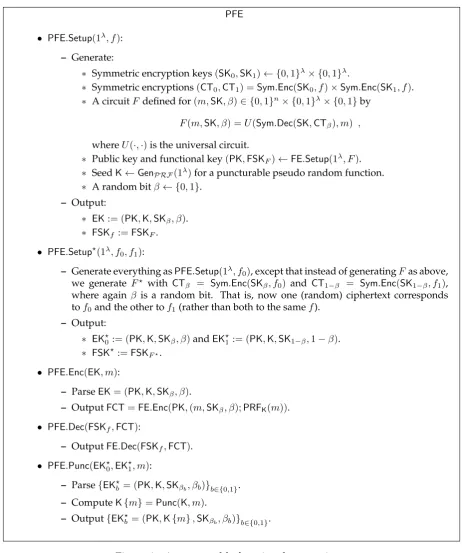
Puncturable FE from single-key FE. We now show that any single-key, selectively-secure public-key FE scheme (Definition 2.1) implies a puncturable FE scheme that has essentially the same succinctness properties as the original scheme.
Ingredients. We rely on the following primitives:
• A single-key, selectively-secure, public-key functional encryption schemeFE for all cir-cuits.
• A one-time symmetric encryption schemeSym.
• A puncturable pseudo-random function familyPRF.
The constructed schemePFEconsists of the algorithms
(PFE.Setup,PFE.Enc,PFE.Dec,PFE.Setup?,PFE.Punc)
described in Figure1.
Theorem 3.2. PFEis a puncturable functional encryption for all circuits. IfFEis succinct so isPFE. IfFE,Sym,PRF are allδ-secure so isPFE.
Proof. We prove that the constructed scheme satisfies the properties of a PFE (Definition3.1).
Correctness: Fix a security parameterλ ∈ N, messagem ∈ {0,1}n, andf ∈ F with domain
{0,1}n. By the functionality ofFEand correctness ofSym,
PFE.Dec(FSKf,FCT) = FE.Dec(FSKF,FCT) =
F(m,SKβ, β) =
U(Sym.Dec(SKβ,CTβ), m) =
U(f, m) =f(m) ,
where(EK,FSKf) ←PFE.Setup(1λ, f),FCT =PFE.Enc(EK, m),EK= (PK,K,SKβ, β),F is the
function underlyingFSKf, andCT0,CT1are the ciphertexts corresponding toF.
Punctured-key correctness:Fix a security parameterλ∈N, messagem∈ {0,1}n, andf 0, f1 ∈
F with domain{0,1}n. By the punctured-key correctness ofPRF, for anym0 ∈ {0,1}n\ {m}
andb∈ {0,1},
PFE.Enc(EK?b{m}, m0) = FE.Enc(PK,(m0,SKβb, βb);PRFK{m}(m 0
)) =
FE.Enc(PK,(m0,SKβb, βb);PRFK(m 0)) =
PFE.Enc(EK?b, m0) ,
where(EK?0,EK?1,FSK?)←PFE.Setup?(1λ, f0, f1),EK?b = (PK,K,SKβb, βb),(EK
?
0{m},EK?1{m}) =
PFE.Punc(EK?0,EK?1, m), andK{m}=Punc(K, m).
Key indistinguishability: Fix any polynomial-sizeA ={Aλ}λ∈
N. By the indistinguishability of Sym, there exists a negligible µSym(λ), such that for any λ, n ∈ N, m ∈ {0,1}n, equal-size
f0, f1 ∈ F with domain{0,1}n, andb∈ {0,1},
EK,FSKfb ≈A,µSym EK
?
b,FSK? ,
where(EK,FSKfb)←PFE.Setup(1
λ, f
b)and(EK?0,EK?1,FSK?)←PFE.Setup?(1λ, f0, f1).
Indeed,EKandEKbare identically distributed, whereas the only difference betweenFSKfb
PFE
• PFE.Setup(1λ, f):
– Generate:
∗ Symmetric encryption keys(SK0,SK1)← {0,1}λ× {0,1}λ.
∗ Symmetric encryptions(CT0,CT1) =Sym.Enc(SK0, f)×Sym.Enc(SK1, f).
∗ A circuitF defined for(m,SK, β)∈ {0,1}n× {0,1}λ× {0,1}by
F(m,SK, β) =U(Sym.Dec(SK,CTβ), m) ,
whereU(·,·)is the universal circuit.
∗ Public key and functional key(PK,FSKF)←FE.Setup(1λ, F). ∗ SeedK←GenPRF(1λ)for a puncturable pseudo random function.
∗ A random bitβ ← {0,1}. – Output:
∗ EK:= (PK,K,SKβ, β).
∗ FSKf :=FSKF. • PFE.Setup?(1λ, f
0, f1):
– Generate everything asPFE.Setup(1λ, f
0), except that instead of generatingFas above,
we generate F? with CT
β = Sym.Enc(SKβ, f0) and CT1−β = Sym.Enc(SK1−β, f1),
where again β is a random bit. That is, now one (random) ciphertext corresponds tof0and the other tof1(rather than both to the samef).
– Output:
∗ EK?0:= (PK,K,SKβ, β)andEK1?:= (PK,K,SK1−β,1−β).
∗ FSK?:=FSKF?. • PFE.Enc(EK, m):
– ParseEK= (PK,K,SKβ, β).
– OutputFCT=FE.Enc(PK,(m,SKβ, β);PRFK(m)).
• PFE.Dec(FSKf,FCT):
– OutputFE.Dec(FSKf,FCT).
• PFE.Punc(EK?0,EK
?
1, m):
– Parse{EK?b = (PK,K,SKβb, βb)}b∈{0,1}.
– ComputeK{m}=Punc(K, m).
– Output{EK?b = (PK,K{m},SKβb, βb)}b∈{0,1}.
Figure 1: A puncturable functional encryption
both ciphertexts{CTα=Sym.Enc(SKα, fb)}α∈{0,1}encrypt the same functionfb. In the second,
CT1−βb =Sym.Enc(SK1−βb, f1−b)encryptsf1−b. The keyEK, respectivelyEK
?
b, only include the
keySKβband not the keySK1−βb. Thus the indistinguishability ofSymapplies. Indistinguishability at punctured points:Fix any polynomial-sizeA={Aλ}λ∈
andb∈ {0,1},
{EK?α{m}}α∈{0,1},FSK?,PFE.Enc(EK?b, m)) =
{PK,K{m},SKβα, βα}α∈{0,1},FSK
?,FE.Enc(PK,(m,SK
βb, βb);PRFK(m))≈A,µPRF
{PK,K{m},SKβα, βα}α∈{0,1},FSK
?,FE.Enc(PK,(m,SK
βb, βb);r)≈A,µFE
{PK,K{m},SKβα, βα}α∈{0,1},FSK?,FE.Enc(PK,(m,SK0,0);r) ,
where(EK?0,EK?1,FSK?)←PFE.Setup?(1λ, f0, f1),(EK?0{m},EK?1{m}) =PFE.Punc(EK?0,EK?1, m),
K{m}=Punc(K, m), andr← {0,1}λ.
The first indistinguishability follows from pseudorandomness at punctured points. The second indistinguishability follows from the selective security ofFEand the fact that the func-tionF? underlyingFSK? satisfies
F?(m,SKβb, βb) = U(Sym.Dec(SKβb,CTβb), m) =U(fb, m) =fb(m) =f0(m) =F
?(m,SK 0,0) .
Overall, the distributionEK?0{m},EK?1{m},FSK?,PFE.Enc(EK?b, m))is indistinguishable from a distribution that is independent of b, and thus the two distributions corresponding to b ∈ {0,1}are indistinguishable.
For the last two properties, it follows readily that ifSym,PRF,FEareδ-secure for some con-crete negligibleδthenPFEisδ-secure.
Succinct encryption: Assume thatFE is succinct. That is, there exist a polynomialΦFE and
constant0< ε≤1such that the size of its encryption circuit is bounded by s1−ε·ΦFE(n, λ) ,
wheren, sare the input-size and circuit-size of the function chosen during the setup phase. We show thatPFEis also succinct with parameters(ε,ΦPFE)for a fixed polynomialΦPFE.
First, observe that fake keys EK? and fake punctured keys EK?{m}, for any message m ∈ {0,1}n, are of the same size as real keysEK?, and the corresponding encryption circuit is of the
same size:
|PFE.Enc(EK,·)|=|PFE.Enc(EK?,·)|=|PFE.Enc(EK?{m},·)|
We now bound the size ofPFE.Enc(EK,·), which is of the formFE.Enc(PK,(·,SK, β);PRFK(·)).
Observe that
• PRFK(·), for messages of sizen, can be computed by a circuit of sizeΦPRF(n, λ)for a fixed
polynomialΦPRF.
• Givenr =PRFK(m)as input, FE.Enc(PK,(m,SK, β);r)can be computed by a circuit of
sizes01−εΦFE(n0, λ), where inPFE, messagesmof sizentranslate to messages(m,SK, β)
of sizen0and circuitsf(m)of sizestranslate to circuitsF(m,SK, β)of sizes0inFE. Observe thatn0 =n+λ+ 1. It is left to bounds0. F choosesCTβ according toβand applies
U(Sym.Dec(SKβ,CTβ), m). By Fact2.7, eachCTβencryptingfis of sizesand applyingSym.Dec
requires sizes·ΦSym(λ)for a fixed polynomialΦSym. Applying a universal circuit for an input
circuit of sizesrequires sizes·ΦU(logs) ≤s·ΦU(λ)for a fixed polynomialΦU [Val76]. Thus
overall,
s0≤s·ΦSym,U(λ) ,
for a fixed polynomialΦSym,U(λ)that aggregates the above.
In conclusion, we can bound the size of the encryption circuitPFE.Enc(EK,·)by
ΦPRF(n, λ) +s01−εΦFE(n0, λ)≤s1−ε(ΦPRF(n, λ) + ΦSym,U(λ)·ΦFE(n+λ+ 1, λ)) ,
3.2 From Puncturable Functional Encryption to Indistinguishability Obfuscation
In this section, we show how to transform any puncturable functional encryption with succinct encryption, such as the one constructed in the previous section, into an indistinguishability obfuscator.
Ingredient.We rely on a puncturable functional encryption scheme
PFE= (PFE.Setup,PFE.Enc,PFE.Dec,PFE.Setup?,PFE.Punc) .
Notation: Throughout, bit-strings will be boldfaced, whereas bits will not. In particular, for a stringx∈ {0,1}n, we denote byx
j itsj-long prefix and byxj thejth bit in the string.
The obfuscator. The obfuscator, formally given in Figure 2, is parameterized by a function
˜
λ(n, λ) ≥ λ (of the circuit input-length and the security parameter), which will define the security parameter with whichPFEwill be invoked. The security and the complexity of the obfuscator will depend on the choice of the function.
A high-level description. Given a circuit C : {0,1}n → {0,1}m and security parameterλ,
the obfuscatoriO˜λ(C,1λ), first computes a new security parameter ˜λ= ˜λ(n, λ), and invokes
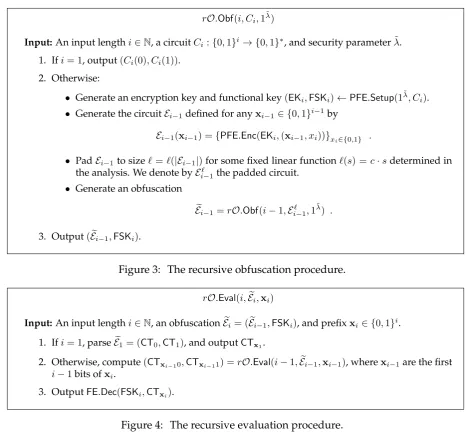
a recursive obfuscation procedurerO.Obf(n, C,1λ˜), formally described in Figure3. A corre-sponding recursive evaluation procedurerO.Evalis described right after in Figure4.
The recursive obfuscation procedurerO.Obf(i, Ci,1 ˜
λ)extends obfuscation for circuits with
i−1 input-bits to obfuscation for circuits withiinput-bits. To this end, it generates an ob-fuscation of an encryption circuit Ei−1 and a corresponding functional key FSKi, under the
puncturable functional encryption scheme PFE. The encryption circuit Ei−1 takes a prefix
xi−1 ∈ {0,1}i−1 and generates two encryptions — one for of each possible continuationxi−10
and xi−11. The corresponding functional key FSKi allows to evaluate the circuit Ci on the
encrypted input .
Unrolling this recursive process, we obtain “a tree of encryptions”, where for each node corresponding to some input-prefixxi, there is a corresponding encryptionCTxiof that prefix,
and the node’s children can be computed using the corresponding functional keyFSKi. The
leaves, correspond to encryptions of the full input x = xn, and the last functional keyFSKn
corresponds to the original circuitC. Overall, to evaluate the obfuscation at an inputx, one expands the tree along the path corresponding tox, until obtainingC(x)at the final level.
iOλ˜(C,1λ)
Input:A circuitC:{0,1}n→ {0,1}mand security parameterλ.
1. Compute a new security parameterλ˜= ˜λ(n, λ). 2. OutputrO.Obf(n, C,1˜λ).
Figure 2: The obfuscator.
Theorem 3.3. Letλbe a security parameter, letndenote circuit-input size, and let˜λ(n, λ)be a func-tion. Then if PFE is δ(˜λ)-secure, for security parameter λ˜, iOλ˜, using security parameter λ, is a
2n2δ(˜λ)-secure indistinguishability obfuscator for all circuits .
rO.Obf(i, Ci,1
˜
λ)
Input:An input lengthi∈N, a circuitCi:{0,1}i→ {0,1}∗, and security parameterλ˜.
1. Ifi= 1, output(Ci(0), Ci(1)).
2. Otherwise:
• Generate an encryption key and functional key(EKi,FSKi)←PFE.Setup(1λ˜, Ci).
• Generate the circuitEi−1defined for anyxi−1∈ {0,1}i−1by
Ei−1(xi−1) ={PFE.Enc(EKi,(xi−1, xi))}xi∈{0,1} .
• PadEi−1to size`=`(|Ei−1|)for some fixed linear function`(s) =c·sdetermined in
the analysis. We denote byE`
i−1the padded circuit.
• Generate an obfuscation
e
Ei−1=rO.Obf(i−1,Ei−` 1,1 ˜
λ) .
3. Output(Eei−1,FSKi).
Figure 3: The recursive obfuscation procedure.
rO.Eval(i,Eei,xi)
Input:An input lengthi∈N, an obfuscationEei= (Eei−1,FSKi), and prefixxi∈ {0,1}i.
1. Ifi= 1, parseEe1= (CT0,CT1), and outputCTx1.
2. Otherwise, compute(CTxi−10,CTxi−11) =rO.Eval(i−1,Eei−1,xi−1), wherexi−1are the first
i−1bits ofxi.
3. OutputFE.Dec(FSKi,CTxi).
Figure 4: The recursive evaluation procedure.
Corollary 3.4. IfPFEis2−˜λα-secure, for security parameterλ˜, theniO˜λisλ−ω(1)-secure, for security
parameterλ, and any functionλ˜(n, λ) =ω((n2+ logλ)α−1).
Remark 3.5 (Technical remark on the proof). One may think of our obfuscator as iteratively applying an input-extension procedure that takes an obfuscator for i−1 bits and produces an obfuscator for ibits. Each such step incurs a certain security loss in the distinguishing gap, which may of course depend on the size of the specific analyzed adversary. We formally analyze the obfuscator as a whole, rather than analyzing a single input-extension step. This allows us to capture the overall loss of ann-step extension process for any specific adversary (or rather any specific adversary size).
Proof of Theorem3.3. We prove that the constructed scheme is an indistinguishability obfusca-tor.
Functionality. Correctness follows the intuition outlined above — an evaluation corresponds to gradually constructing an encryption of the inputx=xn, by using the corresponding
We formally prove correctness by induction on the input length1≤i≤n. Specifically, we prove that for any circuitCi :{0,1}i → {0,1}∗, lettingEei =rO.Obf(i, Ci,1
˜
λ), it holds that for
any inputxi ∈ {0,1}i,rO.Eval(i,Eei,xi) =Ci(xi). Correctness then follows by considering the full inputx=xnand the obfuscated circuitCn=C.
For the base casei= 1, it holds by definition thatEe1 =C1(0), C1(1)and for anyx1∈ {0,1}, rO.Eval(1,Ee1,x1) = C1(x1). We now assume that the required correctness holds fori−1and show that it holds fori.
By definition
e
Ei =rO.Obf(i, Ci,1 ˜ λ) = (
e
Ei−1,FSKi) ,
where Eei−1 = rO.Obf(i−1,Ei`−1,1 ˜ λ), (EK
i,FSKi) ← PFE.Setup(1 ˜ λ, C
i), and Ei`−1(xi−1) is a
circuit that computes two encryptions
CTxi−1b =PFE.Enc(EKi,xi−1b) b∈{0,1}(padded to size `(|Ei−1|)).
By the induction hypothesis, we know thatrO.Eval(i−1,Eei−1,xi−1) = (CTxi−10,CTxi−11); namely, the obfuscationEei−1 preserves the functionality of the obfuscated circuitEei. It then, follows by definition that
rO.Eval(i,Eei,xi) =PFE.Dec(FSKi,CTxi) ,
which by the functionality ofPFEis equal toCi(xi)as required.
Security. Lets(λ), n(λ)be any two polynomially-bounded functions and letD={Dλ}λ∈Nbe any polynomial-size distinguisher that works on obfuscationsiO(C,1λ)for circuitsC of size s(λ), defined on{0,1}n(λ).
We aim to bound
δiO(λ) := max
C0,C1
Pr
h
D(iOλ˜(C0,1λ)) = 1
i
−Pr
h
D(iO˜λ(C1,1λ)) = 1
i =
max
C0,C1
Pr
h
D(rO.Obf(n, C0,1 ˜
λ)) = 1i−PrhD(rO.Obf(n, C 1,1
˜
λ)) = 1i ,
whereC0,C1are any two circuits defined on{0,1}n(λ)of the same functionality and sizes(λ).
For everyλ∈N,1≤i≤n(λ), and size-scircuitC, we may view
rO.Obf(n, C,1λ˜) =rO.Obf(i, Ci,1 ˜ λ), z
as consisting of an obfuscationrO.Obf(i, Ci,1 ˜
λ) for inputs of sizeialong with additional
in-formationz (capturing the functional keysFSKi+1, . . . ,FSKn). We shall denote byζi = ζi(˜λ)
the length of such az.
We now defineδn(λ) :=δiO(λ)and fori < n(λ),
δi(λ) := max C0,C1,z
Pr
h
D(rO.Obf(i, C0,1 ˜
λ), z) = 1i−PrhD(rO.Obf(i, C 1,1
˜
λ), z) = 1i ,
whereC0andC1are any two circuits defined on{0,1}iof the same size and functionality and
z∈ {0,1}ζi.
Proposition 3.1. If PFEis γ-secure, there exists a functionδPFE(˜λ) = γ(˜λ)Ω(1) such that for any
λ∈N,n=n(λ),λ˜ = ˜λ(n, λ),i∈ {2, . . . , n}:
• δi(λ)≤2i+1·(δi−1(λ) +δPFE(˜λ)).
Before proving the proposition, we show that it concludes the security analysis:
Claim 3.6. δn≤O(2n 2
·δPFE).
Proof. To prove the claim, we show by induction onithat
δi ≤δPFE i−1
X
j=1 j−1
Y
k=0
2i+1−k .
By Proposition 3.1, δ1 = 0 and thus satisfies the above. Assuming the above holds for
i−1≥1, and using the proposition again:
δi ≤2i+1(δi−1+δPFE)≤
2i+1δPFE+ 2i+1δPFE i−2
X
j=1 j−1
Y
k=0
2i−k=
2i+1δPFE+δPFE i−2
X
j=1 j
Y
k=0
2i+1−k=
2i+1δPFE+δPFE i−1
X
j=2 j−1
Y
k=0
2i+1−k=
δPFE i−1
X
j=1 j−1
Y
k=0
2i+1−k .
We deduce accordingly
δn≤δPFE n−1
X
j=1 j−1
Y
k=0
2n+1−k≤δPFE(n−1)2
Pn+1
j=3j ≤O(δ
PFE2n
2
) .
We now turn to prove the proposition.
Proof of Proposition3.1. First, to see thatδ1= 0, note that for anyCdefined on{0,1},
rO.Obf(1, C,1λ˜) = (C(0), C(1))
by definition, and thus for any twoC0, C1with the same functionality
rO.Obf(1, C0,1 ˜
λ)≡rO.Obf(1, C 1,1
˜ λ) .
We now prove the main part of the proposition. Fixi∈ {2, . . . , n(λ)}, and letC0, C1be any two
circuits defined on{0,1}iof eqaul size and fix any auxiliary inputz∈ {0,1}ζi. We will bound
Pr
h
D(rO.Obf(i, C0,1 ˜
λ), z) = 1i−PrhD(rO.Obf(i, C 1,1
˜
λ), z) = 1i .
For this purpose, we consider the following sequence hybrid experiments.
Hbforb∈ {0,1}: This hybrid corresponds to the (real) distribution where:
rO.Obf(i, Cb,1 ˜ λ) =
e