53 |
P a g e
A SECURE ARCHITECTURE FOR ENHANCED KEY
AGGREGATION CRYPTO SYSTEM
B. Shilpa
1, Bhaludra Raveendranadh Singh
2, Moligi Sangeetha
31
Pursuing M.Tech (CSE),
2Principal,
3Associate Professor & HOD (CSE)
3
Visvesvaraya College of Engineering and Technology (VCET), M.P Patelguda, Ibrahimpatnam (M),
Ranga
Reddy, (India)
ABSTRACT
Now a Days Data sharing plays an energetic role in the cloud computing. In this system we define that how the
data is transferred or shared securely and efficiently data sharing from one cloud storage to other cloud
storage. In this chapter we introduce a present public-key cryptosystems which produces the constant-size
cryptograph texts such that dependable allocation of decryption for any set of cryptograph texts is possible. The
Actual subject is that one can collective any number of secret keys and makes them as a compact as a single key,
but to include something new the power of all the keys being used. Apart from this , the secret key container can
realise that a constant-size aggregate or happen troubled key for cable of being changing the choices of the
cryptograph text set in to the cloud storage, but the additional encoded file which is maintained outside will
remain secure. This original aggregate key can be freely and conveniently sent to the other storage device or
being stored in a smart card with very limited safe storing. In this system we presented certain protected
analysis of our schemes in the standard model. In particular, our schemes give the public-key patient that is
controlled encryption for flexible hierarchy, which was to be known.
I. INTRODUCTION
Distributed storage is picking up importance as of late. In big business settings, we see the ascent popular for
information outsourcing, which helps with the dynamic administration of corporate information. It is
additionally utilized as a centre innovation behind numerous online administrations for individual applications.
These days, it is anything but difficult to apply with the expectation of complimentary records for email,
photograph collection, document sharing and/or remote access, with capacity estimate more than 25GB (or a
couple of dollars for additional than 1TB). Together with the present remote innovation, clients can get to the
greater part of their documents and messages by a cell telephone in any edge of the world. Considering
information security, a conventional approach to guarantee it is to depend on the server to authorize the entrance
control after confirmation, which implies any startling benefit heightening will uncover all information. In a
mutual occupancy distributed computing environment, things turn out to be surprisingly more terrible.
Information from distinctive customers can be facilitated on partitioned virtual machines (VMs) yet live on a
solitary physical machine. Information in an objective VM could be stolen by instantiating another VM
co-occupant with the objective one With respect to of documents, there are progressions of cryptographic plans
54 |
P a g e
information proprietor without spilling anything about the information, or without bargaining the information
proprietors obscurity. Similarly, cloud clients most likely won't hold the solid conviction that the cloud server is
making a decent showing as far as secrecy. A cryptographic arrangement, with demonstrated security depended
on number-theoretic suspicions is more attractive, at whatever point the client is not perfectly content with
trusting the security of the VM or the genuineness of the specialized staff. These clients are converted to encode
their information with their own keys before transferring them to the server. Information sharing is an essential
usefulness in cloud capacity. Case in point, bloggers can let their companions view a subset of their private
pictures; an undertaking may gift her workers access to a bit of delicate information. The testing issue is the
means by which to viably offer encoded information. Obviously clients can download the scrambled
information from the capacity, unscramble them, then send them to others for sharing, yet it loses the estimation
of distributed storage. Clients ought to have the capacity to appoint the entrance privileges of the sharing
information to others with the goal that they can get to this information from the server specifically. In any case,
discovering an effective and secure approach to share halfway information in cloud capacity is not unimportant.
Beneath we will take Drop box as a case for delineation. Accept that Alice puts all her private photographs on
Drop box, and she wouldn't like to open her photographs to everybody. Because of different information
spillage plausibility Alice can't feel eased by simply depending on the security assurance components provided
by Drop box, so she encodes every one of the photographs utilizing her own keys before transferring. One day,
Alice's companion, Bob, requests that her share the photographs assumed control over every one of these years
which Bob showed up in. Alice can utilize the offer capacity of Drop however the issue now is the manner by
which to designate the unscrambling rights for these photographs to Bob. A conceivable choice Alice can pick is
to safely send Bob the mystery keys included.
1.1 Architecture
Fig: Alice Shares Files with Identifiers 2, 3, 6 and 8 with Bob by Sending Him a Single
Aggregate Key.
We take care of this issue by presenting an extraordinary sort of open key encryption which we call
key-aggregate cryptosystem (KAC). In KAC, clients scramble a message under an open key, as well as under an
55 |
P a g e
key proprietor holds an expert mystery called expert mystery key, which can be utilized to concentrate mystery
keys for distinctive classes. More critically, the separated key have can be a total key which is as reduced as a
mystery key for a solitary class, in any case, totals the force of numerous such keys, i.e., the unscrambling force
for any subset of cipher text classes. With our answer, Alice can basically send Bob a solitary total key through
a protected email. Sway can download the scrambled photographs from Alice's Drop box space and at that point
utilize this total key to unscramble these scrambled photographs. The situation is portrayed in Figure. The sizes
of cipher text, open key, expert mystery key also, total key in our KAC plans are all of consistent size. General
society framework parameter has size direct in the number of cipher text classes, however just a little piece of it
is required every time and it can be gotten on interest from extensive (yet non-classified) distributed storage.
Past results may accomplish a comparable property highlighting a consistent size unscrambling key, yet the
classes need to adjust to some pre-characterized various leveled relationship. Our work is adaptable as in this
limitation is wiped out, that is, no exceptional connection is needed between the classes.
II. RELATED WORK
This section we compare our basic KAC scheme with other possible solutions on sharing in secure cloud
storage.
2.1 Cryptographic Keys for a Predefined Hierarchy
The main theme of the cryptographic key or security of the data in this phase is to provide the security of a user
data. In cryptographic system is to reduce the cost of a storing the key and managing the security. Secrete key
for the purpose of cryptographic. In basic structure of tree hierarchy containing nodes and sub nodes. Granted
permissions of a main node then share files in descent nodes.
2.2 Compact Key in Symmetric-Key Encryption
Compact key symmetric key encryption problem is supporting hierarchy flexible delegation power of
decryption. Benaloh was proposed an encryption scheme it mainly apply for trans mitting large number of keys
in broadcast of telecommunication. In compact key encryption is tried to minimize the size of symmetric
encryption in authentication.
2.3 Compact Key in Identity-Based Encryption
It is the one type of public key encryption is identity based encryption. In this a user can send identity string
through secure mail. In middle adjust a trusted party is called private key generator. In identity based
encryption user holds a secure master secrete key, secrete key issue based on the trustee authentication, user
encrypt the public key with message and receiver decrypt the cipher text with help of secrete key.
2.4 Attribute Based Encryption:
In attribute based encryption user encrypt the code cipher text and along with one attribute, master secret key
user separate a secret key based on a policy of this attributes, so cipher text decryption can be based on the
56 |
P a g e
2.5 Key-Aggregate Encryption
Here in this encryption technique first we give the framework and definition for key-aggregate encryption. After
that we discuss about how to use KAC i.e., key-Aggregate Encryption in a scenario of its application in its cloud
storage.
2.6 Framework
In this framework a key aggregate encryption scheme consists of five polynomial-time algorithms. The data
owner creates the public key via setup and generates a master-secret key pair via Key Gen. Messages can be
encrypted what cipher text class is associated with the plain text message to be encrypted. Here the file is shared
using KAC and the key aggregation is useful when we expect the delegation to be efficient and flexible and is
finally shared another user secure.
In this paper, we know that how to make decrypt key is more secure in the sense that allows the decryption of
multiple cipher texts, without changing its size. In order to solve the issue we have introduced a special type of
key i.e., Public-Key cryptosystem or key aggregate cryptosystem It will send or shares the data securely because
we are using KAC and the user encrypt a message not only under public-key, but also under an identifier of
cipher text which is called as class.
Here in this existing system we are having the encryption and decryption key in order to share the data securely
but the size of the file is increased that has been improved by this paper.
We are going to increase the security and privacy level of the data and meanwhile the size of the file will also
maintain constant securely providing access to the users.
1. Setup Phase
Here in this phase the data owner will execute this phase for an registered account which is not trusted whether
the user is genuine or not. The setup phase will have the algorithm that takes only the implicit parameters.
2. KeyGen Phase
Here in this phase the KeyGen will be executed by the above data owner and enters the Public Key(pk) or the
Master Key(msk).
3. Encrypt Phase
Here in this phase the Encryption will be executed by everyone who got registered and who wants to send the
data from sender to receiver. Encrypt i.e, (pk,m,i) , the encryption algorithm takes the input parameters as public
key(pk),message (m) and the output will be cipher text(C). This algorithm willencrypt the message m and the
cipher text C and along with this the public key which should assign by sender will also be send to the receiver.
4. Decrypt Phase
Here in this phase the decryption will be executed firstly we will enter the public key and the cipher text and the
public key combine and gets the output of the original file. This decrypt phase will take the input as public
parameters pk, as a cipher text C, i and the output will be the message m and the final output or file can be
received for the receiver after the Decryption process.
2.7 Data Sharing
KAC which means for Data sharing. Here the data owner can share the data very securely and confidently
57 |
P a g e
the server first the setup phase will be execute and a public key is generated using KeyGen. The master key is
kept secret and while decryption the receiver will enter the secret key and combing this two i.e., public key and
the cipher text the original file is displayed. When the aggregate key he enters then the user can view the file and
download the file with the same file size in a secure manner.
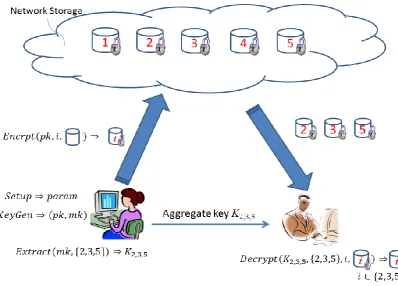
Fig. Using KAC for Data Sharing in Cloud Storage
Here from the above architecture the sender is sharing the each individual file with its own key every file has its
own file name and key by using the Key Aggregate Generator and this all the files are stored in the cloud
storage by using the concept of the cloud computing. This all the files are securely stored in the cloud storage in
network storage and meanwhile the file size will not be increased it will maintain constant at the time of the
encryption. Messages can be encrypted what cipher text class is associated with the plain text message to be
encrypted. Here the file is shared using KAC and the key aggregation is useful when we expect the delegation to
be efficient and flexible and is finally shared another user securely. Here we use the Key Aggregate
cryptosystem algorithm to generate a key and meanwhile to share the data securely and the size of the data will
not be increased while encrypting or decrypting. The sender will send only the wanted files to the receiver and
stop the unwanted files .From the receiver side the receiver will receive the files that are sent by the sender The
receiver while viewing the file or images the receiver should enter the key while decryption once the receiver
enter the key if the key matches the receiver can view the file and meanwhile download the file.
III. CONCLUSION AND FUTURE WORK
Step by step instructions to secure clients' information protection is a focal inquiry of distributed storage. With
more numerical instruments, cryptographic plans are getting more adaptable and regularly include various keys
58 |
P a g e
which bolster appointment of mystery keys for diverse cipher text classes in cloud capacity. Regardless of which
one among the force set of classes, the delegate can simply get a total key of steady size. Our methodology is
more adaptable than progressive key task which can just spare spaces in the event that every key-holder shares a
comparable arrangement of benefits.
A constraint in our work is the predefined bound of the quantity of most extreme cipher text classes. In cloud
capacity, the quantity of cipher texts typically becomes quickly. So we need to save enough cipher text classes
for the future expansion. Else, we have to extend the open key as we portrayed. In spite of the fact that the
parameter can be downloaded with cipher texts, it would be better in the event that its size is autonomous of the
most extreme number of cipher text classes. On the other hand, when one bears the appointed keys in a cell
phone without utilizing unique trusted equipment, the key is brief to spillage, planning a leakage resilient
cryptosystem yet permits effective and adaptable key assignment is likewise an intriguing course.
REFERENCES
[1] S. S. M. Chow, Y. J. He, L. C. K. Hui, and S.-M.Yiu, “SPICE -Simple Privacy-Preserving
Identity-Management for Cloud Environment, ”in Applied Cryptography and Network Security – ACNS 2012, ser.
LNCS, vol. 7341. Springer, 2012, pp. 526–543.
[2] C. Wang, S. S. M. Chow, Q. Wang, K. Ren, and W. Lou, “Privacy-Preserving Public Auditing for Secure
Cloud Storage,” IEEE Trans.Computers, vol. 62, no. 2, pp. 362–375, 2013.
[3] B. Wang, S. S. M. Chow, M. Li, and H. Li, “Storing Shared Data on the Cloud via Security-Mediator,” in
International Conference on Distributed Computing Systems - ICDCS 2013. IEEE, 2013.
[4] M. J. Atallah, M. Blanton, N. Fazio, and K. B. Frikken, “Dynamic and Efficient Key Management for
Access Hierarchies,” ACM Transactions on Information and System Security (TISSEC), vol. 12, no. 3,
2009.
[5] F. Guo, Y. Mu, Z. Chen, and L. Xu, “Multi-Identity Single-Key Decryption without Random Oracles,” in
Proceedings of Information Security and Cryptology (Inscrypt ’07), ser. LNCS, vol. 4990. Springer, 2007,
pp. 384–398.
[6] S. G. Akl and P. D. Taylor, “Cryptographic Solution to a Problem of Access Control in a Hierarchy,”
ACM Transactions on Computer Systems (TOCS), vol. 1, no. 3, pp. 239–248, 1983.
[7] W.-G. Tzeng, “A Time-Bound Cryptographic Key Assignment Scheme for Access Control in a
Hierarchy,” IEEE Transactions on Knowledge and Data Engineering (TKDE), vol. 14, no. 1, pp. 182–188,
2002.
[8] R. S. Sandhu, “Cryptographic Implementation of a Tree Hierarchy for Access Control,” Information
Processing Letters, vol. 27, no. 2, pp. 95–98, 1988.
[9] L. B. Oliveira, D. Aranha, E. Morais, F. Daguano, J. Lopez, and R. Dahab, “Tiny Tate: Computing the
Tate Pairing in Resource-Constrained Sensor Nodes,” in Proceedings of 6th IEEE International
Symposium on Network Computing and Applications (NCA ’07). IEEE, 2007, pp. 318–323.
[10] D. Boneh, X. Boyen, and E.-J. Goh, “Hierarchical Identity Based Encryption with Constant Size Cipher
text,” in Proceedings of Advances in Cryptology - EUROCRYPT ’05, ser. LNCS, vol. 3494. Springer,
59 |
P a g e
[11] C.-K. Chu, J. Weng, S. S. M. Chow, J. Zhou, and R. H. Deng, “Conditional Proxy Broadcast
Re-Encryption,” in Australasian Conference on Information Security and Privacy (ACISP ’09), ser. LNCS,
vol. 5594. Springer, 2009, pp. 327–342.
[12] J. Benaloh, “Key Compression and Its Application to Digital Fingerprinting,” Microsoft Research, Tech.
Rep., 2009.
AUTHORDETAILS
B. Shilpa Pursuing M-Tech in Visvesvaraya College of Engineering and Technology (VCET), M.P Patelguda, Ibrahimpatnam (M), Ranga Reddy (D)-501510, India.
Sri Dr. Bhaludra Raveendranadh Singh working as Associate Professor & Principal in Visvesvaraya College of Engineering and Technology obtained M.Tech, Ph.D(CSE)., is a
young, decent, dynamic Renowned Educationist and Eminent Academician, has overall 20
years of teaching experience in different capacities. He is a life member of CSI, ISTE and
also a member of IEEE (USA)
Ms’s. Sangeetha M working as Assoc. Professor & HOD (CSE). She has completed bachelor of technology from Swamy Ramananda Theertha Institute of Science &
Technology and Post-graduation from Jawaharlal Nehru Technological