Electronic Thesis and Dissertation Repository
9-27-2011 12:00 AM
Workplace Commitment and Employee Well-Being: A
Workplace Commitment and Employee Well-Being: A
Meta-analysis and Study of Commitment Profiles
analysis and Study of Commitment Profiles
Elyse R. Maltin
University of Western Ontario
Supervisor Dr. John P. Meyer
The University of Western Ontario Graduate Program in Psychology
A thesis submitted in partial fulfillment of the requirements for the degree in Doctor of Philosophy
© Elyse R. Maltin 2011
Follow this and additional works at: https://ir.lib.uwo.ca/etd Part of the Industrial and Organizational Psychology Commons
Recommended Citation Recommended Citation
Maltin, Elyse R., "Workplace Commitment and Employee Well-Being: A Meta-analysis and Study of Commitment Profiles" (2011). Electronic Thesis and Dissertation Repository. 273.
https://ir.lib.uwo.ca/etd/273
This Dissertation/Thesis is brought to you for free and open access by Scholarship@Western. It has been accepted for inclusion in Electronic Thesis and Dissertation Repository by an authorized administrator of
WORKPLACE COMMITMENT AND EMPLOYEE WELL-BEING:
A META-ANALYSIS AND STUDY OF COMMITMENT PROFILES
Spine Title: Workplace Commitment and Employee Well-Being
Thesis format: Monograph
by
Elyse R. Maltin
Graduate Program in Psychology
A thesis submitted in partial fulfillment of the requirements for the degree of
Doctor of Philosophy
The School of Graduate and Postdoctoral Studies The University of Western Ontario
London, Ontario, Canada
ii
THE UNIVERSITY OF WESTERN ONTARIO School of Graduate and Postdoctoral Studies
CERTIFICATE OF EXAMINATION
Supervisor
______________________________ Dr. John P. Meyer
Supervisory Committee
______________________________ Dr. Richard Goffin
______________________________ Dr. Natalie Allen
Examiners
______________________________ Dr. Natalie Allen
______________________________ Dr. Joan Finegan
______________________________ Dr. Heather Laschinger
______________________________ Dr. E. Kevin Kelloway
The thesis by
Elyse Rebecca Maltin
entitled:
Workplace Commitment and Employee Well-Being: A Meta-Analysis and Study of Commitment Profiles
is accepted in partial fulfillment of the requirements for the degree of
Doctor of Philosophy
______________________ _______________________________
iii Abstract
Employee commitments have been connected to a multitude of
organizationally-relevant variables, including turnover, absenteeism, job performance, and organizational
citizenship behaviours (e.g., Meyer, Stanley, Herscovtich, & Topolnytsky, 2002).
Research has repeatedly demonstrated that the form these commitments take matters; that
is, research has shown that commitment based on a mindset of affective attachment has
the strongest positive relations with desired outcomes, while commitment based on
mindsets of social or economic costs has much weaker and sometimes even negative
relations with these same outcomes.
Far less research exists on the connection between workplace commitments and
their implications for employees themselves, although research is beginning to
accumulate (see Meyer & Maltin, 2010, for a review). Some meta-analyses of the links
between commitment and individual well-being variables (e.g. stress, Mathieu & Zajac,
1990; Dowden & Tellier, 2004; and engagement, Halbesleben, 2010) exist, but these, and
the bulk of primary research in this area, focused almost exclusively on affectively-based
commitment.
The research presented here aimed to provide a clear picture of what we know
about the connection between commitment and well-being operationalized
multidimensionally, and provide new information about their relation. Wellness research
has often focused not on well-being but on the absence of illness; the studies presented
here, in addition to ill-health, include both hedonic well-being (i.e., happiness, pleasure)
and eudaimonic well-being (i.e., meaning, energy; Ryan & Deci, 2001). Study 1 provides
well- iv
being. Study 2 aims to go beyond what is known about commitment and well-being by
taking a person-centered, multidimensional approach. Specifically, Study 2 is a primary
study exploring the occupational and organizational commitment of 326 teachers. These
teachers were classified into naturally-occurring commitment profile groups through
latent profile analysis (Muthén & Muthén, 2000), and the groups were compared with
regard to need support, need satisfaction, ill health, hedonic well-being, and eudaimonic
well-being. Findings of both studies confirmed that the nature of the commitment does
indeed count, and that employees whose commitment is characterized by strong affective
attachment report higher levels of well-being. Directions for future research in this area
and implications for practice are discussed.
Keywords: Organizational commitment, occupational commitment, employee well-being,
v
Acknowledgments
I am overwhelmed with gratitude for all of the incredible people and teachers who
made it possible for me to make it to this moment.
First, I offer my gratitude to all my colleagues and teachers at Western who made
me the scholar I am today. To my supervisory and examination committee members,
Rick, Natalie, Joan, Heather, and Kevin: thank you for your guidance and insightful
questions that made this research the best it could be. To Tim, Chester, and Stephanie,
without whom this research would not have been possible: thank you for your invaluable
advice and hours of help. To Leah, for your emotional support, friendship, and every
single pep talk: I love you and thank you. And finally, to John, thank you for so many
things: for your immeasurable patience, guidance, support, and incredible editing skills;
for going above and beyond the call of duty to help me get where I needed to go (even
editing theses on planes!); for your scholarly insight and reflection that made this
research excellent. It has been a pleasure and an honour to work with you.
For all of my leaders, coaches, and friends at Landmark Education, especially but
not limited to my coach Michelle: your support and coaching throughout this process has
made it possible not just to get to this point, but to get here powerfully and enjoy (almost)
every moment. Thank you for pointing me towards who I always was.
And finally, to my family and friends, especially my parents, Les, Celeste, and
Jen: I am who I am because I have you in my life. I offer you my heart in gratitude and
love for putting up with me, supporting me, listening to me, cheerleading me, pointing
vi Table of Contents
CERTIFICATE OF EXAMINATION ... ii
Abstract ... iii
Acknowledgments... v
Table of Contents... vi
List of Tables ... viii
List of Figures ... ix
List of Appendices ... x
CHAPTER 1: GENERAL INTRODUCTION ... 1
Commitment from the Perspective of the Three Component Model... 7
The Meaning of Health and Well-Being from Multiple Perspectives ... 11
CHAPTER 2: A META-ANALYTIC EXAMINATION OF RELATIONS BETWEEN COMMITMENT AND EMPLOYEE WELL-BEING ... 15
Introduction... 15
Commitment-Well-Being Links ... 16
Narrative Reviews and Meta-analyses... 19
Study Hypotheses... 21
Method ... 25
Literature Search... 25
Data Analysis ... 27
Results... 37
Relations between Commitment and Well-Being... 37
Moderator Analyses ... 49
Conclusions and Implications ... 56
Summary and Interpretation of Findings ... 56
Implications for Theory and Research... 59
CHAPTER 3: COMMITMENT PROFILES, NEED SUPPORT AND SATISFACTION, AND EMPLOYEE WELL-BEING... 63
Introduction... 63
The Person-Centered Approach... 64
vii
Commitment Profiles and Well-Being Outcomes: Hypotheses... 76
Commitment Profiles and Other Outcomes: Hypotheses ... 78
Need Support, Need Satisfaction, and Commitment: Hypotheses ... 78
Method ... 82
Participants... 82
Procedure ... 84
Measures ... 85
Analyses... 93
Results... 97
Psychometric Evaluation of Scales... 97
Correlations... 99
Profile Analyses ... 109
Tests of Hypotheses ... 116
Discussion ... 126
Summary and Interpretation of Findings ... 127
Implications for Theory and Research... 129
CHAPTER 4: GENERAL DISCUSSION ... 134
Summary of Findings... 135
Meta-Analytic Findings ... 135
Commitment Profile Findings ... 136
Limitations of the Current Studies and Directions for Future Research... 136
Study 1: Meta-Analysis of Commitment and Well-Being... 136
Study 2: Commitment Profiles, Need Support and Satisfaction, and Employee Well-Being ... 139
Implications for Practice ... 142
Conclusions... 145
References... 147
Appendices... 189
Ethics Approval ... 194
viii List of Tables
Table Description Page
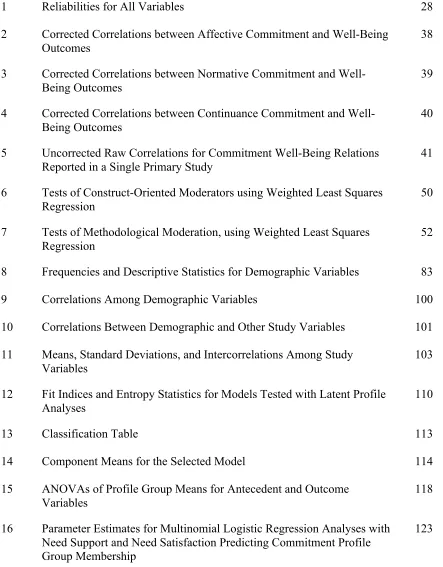
1 Reliabilities for All Variables 28
2 Corrected Correlations between Affective Commitment and Well-Being Outcomes
38
3 Corrected Correlations between Normative Commitment and Well-Being Outcomes
39
4 Corrected Correlations between Continuance Commitment and Well-Being Outcomes
40
5 Uncorrected Raw Correlations for Commitment Well-Being Relations Reported in a Single Primary Study
41
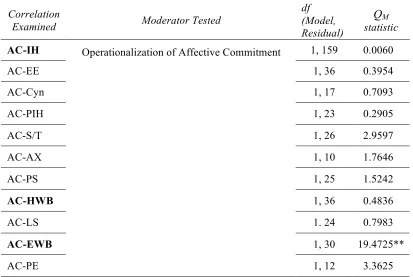
6 Tests of Construct-Oriented Moderators using Weighted Least Squares Regression
50
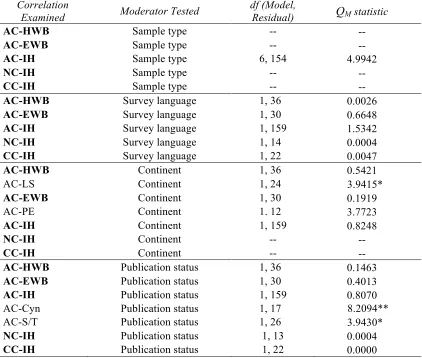
7 Tests of Methodological Moderation, using Weighted Least Squares Regression
52
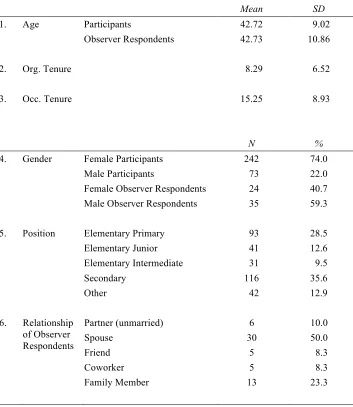
8 Frequencies and Descriptive Statistics for Demographic Variables 83
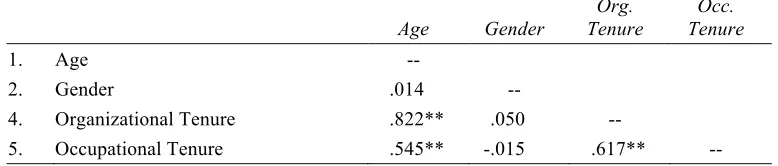
9 Correlations Among Demographic Variables 100
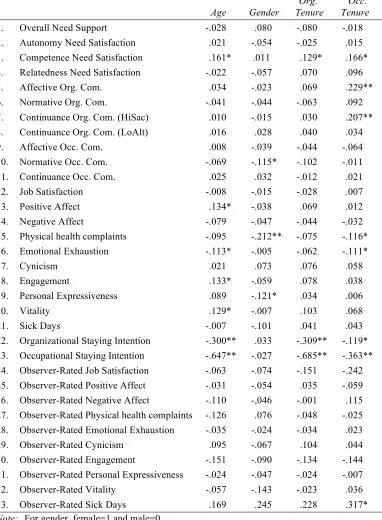
10 Correlations Between Demographic and Other Study Variables 101
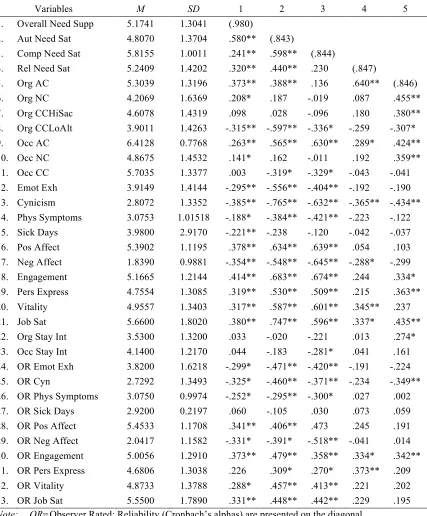
11 Means, Standard Deviations, and Intercorrelations Among Study Variables
103
12 Fit Indices and Entropy Statistics for Models Tested with Latent Profile Analyses
110
13 Classification Table 113
14 Component Means for the Selected Model 114
15 ANOVAs of Profile Group Means for Antecedent and Outcome Variables
118
16 Parameter Estimates for Multinomial Logistic Regression Analyses with Need Support and Need Satisfaction Predicting Commitment Profile Group Membership
ix List of Figures
Figure Description Page
1 Breakdown of levels of all included well-being and ill-health variables 31
x
List of Appendices
Appendix Description Page
A Acronyms used throughout the document 189
B Study Eligibility Criteria 190
CHAPTER 1: GENERAL INTRODUCTION
Scientists and practitioners alike have come to recognize employee commitment
as one of the most important and influential attitudinal variables to be studied. Certainly,
the available evidence demonstrating the numerous benefits of a committed workforce is
substantial. Meta-analytic reviews of the commitment literature have demonstrated that
employees who are committed to the organization for which they work are less likely to
leave (e.g., Mathieu & Zajac, 1990; Tett & Meyer, 1993), and more likely to attend work
regularly (e.g., Meyer, Stanley, Herscovtich, & Topolnytsky, 2002), perform effectively
(e.g., Cooper-Hakim & Viswesvaran, 2005; Riketta, 2002), and be good organizational
citizens (e.g., Meyer et al., 2002; Riketta, 2002). Not all commitments are equal,
however; the nature of the commitment makes a considerable difference. Commitments
reflecting an affective attachment and involvement with the organization have been
shown to be more strongly associated with desired outcomes than those reflecting
concerns based on social or economic costs (Meyer, et al., 2002).
Does strong organizational commitment benefit employees, as it does their
employing organizations? While researchers have given far less attention to the
implications of commitment for employees themselves, research on the links between
commitment and employee well-being is becoming more common (Meyer & Maltin,
2010). For the most part, this research is cross-sectional in nature. Thus, although causal
language is sometimes used in the following pages to describe the expected and observed
relations between commitment and well-being, this discussion of causality should be read
Accumulating evidence points to strong relations between organizational
commitment and employee well-being. Just as with other hypothesized outcomes of
commitment, however, the strength and direction of the commitment-well-being link
depend on the nature of the commitment. The available research is overwhelmingly
focused on attachment-based commitment, and this research points to relations that
mirror those with organizational outcomes. That is, attachment-based commitment tends
to be more beneficial for employees’ well-being than does cost-based commitment. The
strength and direction of the commitment-well-being link also depend on what is meant
by well-being.
Although evidence of the connection between commitment and well-being is
mounting, that evidence is somewhat scattered. This is, in part, because of the vast array
of well-being outcomes that have been examined. Every study seems to operationalize
the concept in a different way; indeed, the meaning of well-being is as complex, or more,
than the meaning of commitment. The lack of a universal or agreed-upon definition of
well-being and of an overarching theory of what it encompasses has made it challenging
to conduct and review systematic research on the links between commitment and
well-being (cf. Meyer & Maltin, 2010). Ryan & Deci (2001) offered an extensive review of
two general perspectives on well-being, the hedonic and eudaimonic perspectives, which
will be used as the general framework for the current research. The hedonic perspective
focuses on happiness, whereas the eudaimonic perspective is more concerned with
“living well” in all respects. I discuss these two perspectives in more detail below, and
The first main objective of the current research is, in short, to gather and present
what is already known about the connection between workplace commitment and
employee well-being. A meta-analytic review of the accumulated research examining
relations between organizational commitment and widely-studied employee well-being
variables serves this purpose, and is presented in Chapter 2.
After having addressed what we already know regarding workplace
commitment-well-being links, the second study in this dissertation ventures into relatively uncharted
territories. In other words, having gathered “what we know” about commitment and
well-being, the second study will turn to “where we need to go.” Specifically, this second
study addresses several limitations in the extant literature on commitment and employee
well-being. It also examines two potentially important antecedents of commitment and
well-being, managerial need support and need satisfaction.
The first limitation of the current literature addressed herein is that the vast
majority of the commitment literature examines the construct unidimensionally, focusing
almost exclusively on commitment characterized by affective attachment to the
organization. Those studies that do examine commitment from a multidimensional
perspective rarely examine the interactions among the components of commitment and
their relations with hypothesized outcomes (for exceptions, see Sinclair, Tucker, Cullen,
& Wright, 2005; Somers, 2009; Somers, 2010; Stanley, Vandenberg, Vandenberghe, and
Bentein 2009; Tsoumbris & Xenikou, 2010; and Wasti, 2005). Meyer and Allen (1997)
and Meyer and Herscovitch (2001), in their overviews of the three component model
(TCM; see Appendix A for a list of acronyms) of commitment, strongly advised that
study included in this research is a primary study that examines commitment from this
multidimensional perspective.
Most commitment research employs a variable-centered, or dimensional,
approach (e.g., multiple regression or structural equation modeling). That is, this research
focuses on examining how variables relate to each other, and uses these relations to infer
psychological processes or causality (Vandenberg & Stanley, 2009; Wang & Hanges,
2011). Studies using the variable-centered approach, however, do not consider that these
relations among variables may differ meaningfully among different subgroups of the
sample (Morin, Morizot, Boudrias, & Madore, 2011). An equally valid approach is to
classify individuals into relatively homogeneous subgroups, often called profile groups,
that are believed to differ in the level of and/or relations among the variables under study.
Because employees can feel differing levels of each component of commitment
simultaneously, Meyer and Herscovitch (2001) recommended using this profile approach
to detect groups of employees grouped together according to all three components of
commitment. This person-centered or profile approach offers several methodological
advantages for studying interactions among commitment constructs, and is gaining
popularity in commitment research (e.g., Morin, et al., 2011; Sinclair & Sears, 2011;
Vandenberg & Stanley, 2009). This approach is used in the second study.
A second limitation of the existing commitment-well-being literature is that
researchers have, for the most part, examined commitment to the organization, with little
attention to commitments to other foci. Those studies that have considered affective
commitment to other foci such as occupations, careers, teams, supervisors, and
to organizations and employees. These outcomes include, but are not limited to, turnover
intention (e.g., Stinglhamber, Bentein, & Vandenberghe, 2002), performance (e.g.,
Becker, Billings, Eveleth, & Gilbert, 1996; Vandenberghe, Bentein, & Stinglhamber,
2004), organizational citizenship behaviours (OCBs; e.g., Becker & Kernan, 2003;
Cohen, 2007), job stress (Yeh, Ko, Chang, & Chen, 2007), and burnout (e.g., Miller,
Ellis, Zook, & Lyles, 1990; Reilly, 1994).
Occupational or professional commitment is the most studied of commitments to
foci other than organizations, and researchers have debated its compatibility with
organizational commitment. Two perspectives have been put forth, one arguing that
professional commitment might conflict with organizational commitment (e.g., Gouldner,
1957; Kalleberg & Berg, 1987), the other that they can be mutually reinforcing (Steers,
1977). Moderate positive meta-analytic relations between organizational and
occupational commitment (Cooper-Hakim & Viswesvaran, 2005; Meyer, et al., 2002;
Wallace, 1993) support the perspective that they can be mutually reinforcing. However,
because these relations are moderate, the possibility remains that these two commitments
might conflict for some individuals but not for others. One of the advantages of the
person-centered approach is that one can detect compatibility for some groups and
conflict for others. Very little research has been done that examines organizational and
occupational commitment in combination (for exceptions, see Maltin, Stanley, & Meyer,
2011; Tsoumbris & Xenikou, 2010). The second study presented here examines both
organizational and occupational commitment, using the person-centered approach.
The second study, in addition to addressing all of the issues noted above, also
need support. Research has indicated that one of the most important antecedents of
commitment is positive work experiences, particularly those reflecting support on the part
of the target (Meyer and Allen, 1991, 1997). It is therefore logical to assert that support
for employees’ basic psychological needs, and satisfaction of these needs in turn, would
be associated with commitment. Self-determination theory (SDT; e.g., Deci & Ryan,
1985; Ryan & Deci, 2000a) is a broad theory of human motivation and well-being that is
supported by decades of research in contexts such as parenting, education, sport and
exercise, health care, psychotherapy, religion, and politics. It has recently been gaining
ground as a theory of work motivation, and calls have been made to apply it to more
organizational behaviour research (Gagné & Deci, 2005; Meyer & Gagné, 2008; Meyer,
Gagné, & Parfyonova, 2010). SDT’s emphasis on the extent to which the social context
fulfills our basic psychological needs, thereby fostering performance and well-being,
makes it an ideal theory to guide the second study of the present research. Research has
related both commitment and need satisfaction (as defined in SDT) to well-being (e.g.,
Deci & Ryan, 2000; Ryan & Deci, 2000a; Meyer & Maltin, 2010; Meyer et al., 2002).
However, only one study to date (Meyer, Stanley, & Parfyonova, in press) has examined
commitment, need satisfaction, and well-being together in one study, and it focused
exclusively on organizational commitment.
Thus, the main objectives of the second study presented herein are to examine
both a major, employee-relevant consequence of commitment (well-being), and the
related antecedents of need support and satisfaction, all while utilizing a person-centered
multidimensionally, and will explore commitment toward two different foci (the
organization and the occupation).
In the remainder of this introduction, I examine relevant theories and research
findings. First, I review commitment theory and its known connections to well-being will
be reviewed. Following this, I provide a brief review of the conceptualization of
well-being in organizational research.
Commitment from the Perspective of the Three Component Model
As discussed above, the benefits of a committed workforce are numerous,
including better retention (e.g., Mathieu & Zajac, 1990; Tett & Meyer, 1993), attendance
(Meyer et al., 2002), performance (e.g., Cooper-Hakim & Viswesvaran, 2005; Riketta,
2002), and OCBs (Meyer et al., 2002; Riketta, 2002). The caveat to these benefits,
however, is that it is not simply the amount of commitment that employees display, but the form, that is important. Commitments reflecting an affective attachment and
involvement with the target (e.g., the organization) have been shown to have greater
benefit to the recipient of the commitment than those based on concerns over social or
economic costs (Meyer et al., 2002).
Commitment has been conceptualized in varying ways over the years (for
reviews, see Klein, Molloy, & Cooper, 2009; Meyer & Allen, 1997; Mowday, Porter, &
Steers, 1982). The present research adopts the approach taken by the well-established
TCM and views commitment as a “force that binds an individual to a course of action of
relevance to a particular target (Meyer & Herscovitch, 2001, p. 301). This binding force
can be experienced in different ways; that is, it can be accompanied by different
involvement with a target; in other words, AC is said to be reflected in “wanting to” be
involved with the target of commitment (e.g., wanting to stay in an organization).
Normative commitment (NC) is characterized by a mindset of obligation, and is therefore
said to imply a feeling that one “ought to” remain connected to the target. Continuance commitment (CC) involves a mindset of awareness of the costs associated with
discontinuing the course of action of relevance to the target. CC is therefore associated
with a feeling of “having to” remain connected to a target.
While popular, the TCM of commitment has not been without controversy. Two
major issues that have arisen are the discriminability of AC and NC, and the
dimensionality of CC. AC and NC are quite strongly correlated (e.g., ρ=.63 in Meyer et
al.’s 2002 meta-analysis); as a result, several researchers have argued that they are, in
fact, redundant concepts (e.g., Jaros, 1997; Ko, Price, & Mueller, 1997). Evidence from
other sources, however, has attested to their distinction. For example, Meyer et al.’s
(2002) meta-analysis demonstrated that AC and NC relate differently to theoretical
antecedents and consequences. Furthermore, confirmatory factor analyses in numerous
studies have yielded better fit when AC and NC are modeled as two factors, as opposed
to a single factor (e.g., Dunham, Grubé, & Castenada, 1994; Hackett, Bycio, & Hausdorf,
1994; Meyer, Allen, & Gellatly, 1990). Recent research on NC, reviewed briefly below,
points to its differing implications for other variables depending on levels of AC and CC
by which it is accompanied.
The second issue that theoretical analyses of the TCM have brought forward is the
dimensionality of CC. Specifically, these analyses have provided evidence that CC
sacrifice CC (CCHiSac), reflects one’s perception that severing the commitment (e.g., to
one’s organization) would require making considerable sacrifices. The second
subcomponent, called low alternatives CC (CCLoAlt), involves a mindset that one has to
maintain the commitment because there are so few available alternatives. A great deal of
research has accumulated that corroborates the two-dimensional structure of CC,
including factor analytic studies (e.g., Hackett et al., 1994; Meyer, Allen, & Gellatly,
1990; Somers, 1993). Furthermore, while CCHiSac relates positively to AC and NC,
CCLoAlt is actually negatively related to these components (McGee & Ford, 1987;
Meyer et al., 2002). In addition, CCHiSac is more strongly related to withdrawal and
turnover intentions than is CCLoAlt (Meyer et al., 2002). Given this evidence, and given
that CCHiSac is more closely aligned with Meyer and Allen’s original definition of CC
(based on Becker’s 1960 definition), Powell and Meyer (2004) revised the CC scale to
include only items tapping the CCHiSac conceptualization. Researchers continue to use
both the original scales (sometimes separating the CCHiSac and CCLoAlt items) and the
revised scale.
In terms of variables theoretically postulated as outcomes, research has generally
shown that AC is has the strongest positive relation with desired outcomes, followed by
NC (Meyer et al., 2002). These desired outcomes include both focal behaviours (i.e.,
those that are included within the terms of the commitment, such as staying and
performing the job adequately) and discretionary behaviours (i.e., those that are not
necessarily included within the terms of the commitment, such as OCBs and going
“above and beyond” in terms of performance) (Meyer & Herscovitch, 2001). The effects
specified within the terms of a commitment, but is unrelated or negatively related to more
discretionary acts of relevance to the target and to well-being (Meyer & Herscovitch,
2001; Meyer & Maltin, 2010).
Very little commitment research involves a person-centered approach, but a few
studies have examined commitment profiles and their connections to relevant outcomes.
Recent research using the profile approach to commitment (Gellatly, Meyer, & Luchak,
2006; Meyer & Parfyonova, 2010; Meyer et al., 2011), as well as recent theoretical work
(Meyer & Parfyonova, 2010) has shed light on the somewhat inconsistent relations NC
has had with hypothesized outcomes in past research. These scholars described the “two
faces” of NC. That is, NC relates differently with other variables depending on the
accompanying levels of AC and NC. Specifically, Gellatly et al. (2006) described the
combination of strong AC and NC with weak CC as a moral imperative profile,
connoting commitment to a course of action based not simply on desire but also out of a
sense of that it is the “right” thing to do. In contrast, they referred to the combination of
strong NC and CC with weak AC as an indebted obligation profile, implying a feeling of
being trapped in a relationship or course of action for fear of the economic or social costs
associated with discontinuation. I review other commitment profiles and studies
incorporating the profile approach in Chapter 3.
While much of the extant research on the TCM focuses on organizational
commitment, commitments to other workplace foci have also received some research
attention. Researchers have applied the TCM to commitment to the occupation (e.g.,
Chang, Chi, & Miao, 2007; Meyer, Allen, & Smith, 1993); supervisor (e.g., Snape, Chan
Kernan, 2003; Den Hartog & Belschak, 2007), unions (e.g., Stinglhamber et al., 2002;
Chan, Snape, & Redman, 2004), and customers (Stinglhamber et al., 2002;
Vandenberghe, Bentein, Michon, Chebat, Tremblay, & Fils, 2007). These commitments
have all been found to have outcomes of benefit to the target, and, in many cases, to the
organization as a whole. Regardless of focus, however, it is the nature of the commitment
(i.e., the mindset accompanying it) that has implications for the way it is enacted. I
review specific research pertaining to “dual commitments” (e.g., to the organization and
occupation), and their effects on outcomes, in Chapter 3.
Having reviewed the major concepts and controversies in the commitment
literature, I now turn to a discussion of the meaning of health and well-being, particularly
in the current studies.
The Meaning of Health and Well-Being from Multiple Perspectives
Although the concepts health and well-being seem to be clear, and most people
have an understanding of what they mean, they are nevertheless very difficult to actually
define (Larson, 1999). Indeed, because of their complex nature, our societal perceptions
of health have been likened to a “receding mirage” whose substance disappears as we
advance toward a definition (Dubos, 1961). Recent times have seen nothing less than a
paradigm shift in our thinking about health, from a medical model emphasizing disease,
to a new model emphasizing health, optimal functioning, and well-being (Larson, 1999;
Tetrick, 2002). The emergence of positive psychology (Seligman & Csikszentmihalyi,
2000), which focuses on human strengths and optimal functioning, has been a large part
Various models of health have been proposed and outlined (e.g., Larson, 1999;
Tetrick, 2002). The predominant model, the medical model, essentially defines health as
the absence of illness or disease. Research guided by the medical model generally
operationalizes well-being in terms of the absence of ill-health. Ill-health is the term used
by Tetrick (2002) to encompass negative indicators of both physical and psychological
health. The medical model has been criticized by proponents of positive psychology for
not telling the whole story of human health, and for weighting psychological research
toward an almost exclusive focus on ill-health (Seligman & Csikszentmihalyi, 2000;
Tetrick, 2002). Other, more positively-oriented models take a more holistic view of
health, including physical, mental, and social well-being over and above the simple
absence of illness or disease (Larson, 1999; Tetrick, 2002).
Ryan and Deci (2001) defined well-being as “optimal psychological functioning
and experience” (p. 142). Opinion differs widely, however, on how to operationalize the
concept of well-being. Ryan and Deci (2001) detailed two perspectives on well-being
that, while relatively distinct, overlap somewhat. These two perspectives stem from
traditions with long histories dating back many centuries. The tradition of hedonism
holds that well-being consists of pleasure or happiness and the absence of pain
(Kahneman, Diener, & Schwartz, 1999). This philosophy refers not only to physical
hedonism, but includes a broad sense of pleasure versus displeasure in mind and body,
and in all areas of life (Diener, Sapyta, & Suh,1998; Kubovy, 1999).
The philosophy of eudaimonism, in contrast, asserts that well-being is more than
mere happiness. Instead, philosophers in this tradition define well-being as the
“daimon” or true nature (Waterman, 1993). From this perspective, some outcomes that
may be pleasurable would not necessarily lead to well-being; only when these activities
are in accordance with one’s true self would they truly promote wellness (Ryan & Deci,
2001). For example, while accomplishing a goal such as graduating from medical school
might lead to happiness or pleasure for the graduate, if they were pursuing this line of
work in order to please others (e.g., their parents), it would not necessarily lead to
wellness. In contrast, accomplishing this same goal would likely lead to wellness for
someone who felt that medicine was their true calling. This conceptualization of
well-being as moving beyond the boundaries of lack of ill-health and hedonic pleasure is
consistent with the positive psychology movement (Seligman & Csikszentmihalyi, 2000).
Research guided by the hedonic perspective of well-being, such as the large body
of research on subjective well-being (e.g., Diener & Lucas, 1999), generally takes the
view that well-being is comprised primarily of the presence of positive affect, the absence
of negative affect, and the presence of life satisfaction; in other words, a positive state of
mind. Researchers in the eudaimonic tradition have variously defined psychological
well-being as having one’s life activities be fully congruent with one’s deeply held values
(Waterman, 1993); experiencing a set of well-being indicators including autonomy,
personal growth, self-acceptance, life purpose, mastery and positive relatedness (Ryff &
Keyes, 1995); and experiencing other feelings such as self-actualization, meaning, and
vitality (Ryan & Deci, 2000a). Each of these operationalizations points to a lifestyle
associated with outcomes above and beyond happiness.
Research measuring well-being from both perspectives has found that hedonic
Qualls, 1996) but still conceptually distinct (McGregor & Little, 1998). Moreover, their
relationship is not considered to be perfectly reciprocal: eudaimonia is believed to be a
sufficient but not necessary condition for hedonic being, whereas hedonic
well-being is neither sufficient nor necessary in order to experience eudaimonia (cf.
Waterman, Schwartz, & Conti, 2008). Indeed, some conditions that foster hedonic
well-being, such as succeeding at an activity while under pressure, do not result in eudaimonic
well-being (Nix, Ryan, Manly, & Deci, 1999). However, SDT maintains that satisfaction
of the basic psychological needs will typically foster both hedonic and eudaimonic
well-being. Given this assertion, SDT research tends to focus on eudaimonic well-being, as
operationalized by self-actualization and vitality, supplementing this focus with the
measurement of subjective or hedonic well-being. Consistent with this practice, the
present research will operationalize well-being as both eudaimonic well-being and
hedonic well-being.
Having now provided an overview of the major concepts of interest, commitment
and well-being, in the following chapters I will delve deeper into the connection between
them. Chapter 2 presents a meta-analysis of relations between commitment and key
well-being variables. Chapter 3 presents a study exploring relations between occupational and
organizational commitment and need support, need satisfaction, and several well-being
outcomes, using a person-centered (profile) approach. Chapter 4 constitutes a general
discussion addressing the findings and limitations of both studies, and offering
conclusions, implications for science and practice, and recommendations for future
CHAPTER 2: A META-ANALYTIC EXAMINATION
OF RELATIONS BETWEEN COMMITMENT AND EMPLOYEE WELL-BEING
Introduction
As discussed above, commitment is a key variable in organizational research, and
volumes of studies attest to its connection to important organizational outcomes. This
research has consistently shown that AC relates negatively to turnover and turnover
intention (e.g, Mathieu & Zajac, 1990; Tett & Meyer, 1993), and positively to both focal
job performance (e.g., Cooper-Hakim & Viswesvaran, 2005; Riketta, 2002) and
organizational citizenship behaviours (OCBs; e.g., Meyer et al., 2002; Riketta, 2002),
with the strongest relations occurring between AC and the latter. In contrast to AC,
meta-analytic evidence suggests that while CC is negatively related to turnover and turnover
intention, it is also negatively related to job performance and a near-zero relation with
OCBs (Meyer, et al., 2002). Finally, NC tends to display relations in the same direction
as AC, but weaker (Meyer, et al., 2002).
What, then, of employee-relevant outcomes? Much less of the research on the
outcomes of workplace commitment has concentrated on relations between commitment
and employee well-being. Nevertheless, evidence is beginning to accumulate showing
that relations between commitment and well-being mirror relations between commitment
and organizationally-relevant variables (Meyer & Maltin, 2010).
The remainder of this introduction is divided into three sections. In the first, I
review the literature on the links between commitment and well-being and ill-health.
above narrative reviews. Finally, I offer hypotheses for the current meta-analytic study.
The reader is reminded that causal language is sometimes used in the following
discussion of relations between commitment and well-being. This use of causal language
is based on theoretical assumptions that commitment acts as an antecedent to employee
well-being (see Meyer & Maltin, 2010, for a theoretical model postulating such
relations). Because the findings reviewed here are bivariate correlations, the discussion of
causality should be read as assumed but not confirmed.
Commitment-Well-Being Links
There is a distinct absence of theory to guide the explanation of the link between
commitment and well-being. Attempts to develop theory (cf. Meyer et al., 2010; Meyer
& Maltin, 2010; Meyer, Maltin, & Thai, in press) have used the framework of
self-determination theory (SDT), positing that commitment’s links with well-being can be
explained, at least in part, by its status as an indicator that employees’ basic needs are
being filled in the work context. The focus in Study 1 was to establish the empirical links
between commitment and well-being; however, SDT and the basic needs it postulates
will be explained more thoroughly in Chapter 3.
Research has shown that AC is positively related to mental health (e.g., Grawitch
et al., 2007; Probst, 2003), positive affect (e.g., Thoresen, Kaplan, Barsky, Warren, & de
Chermont, 2003), engagement (Hallberg & Schaufeli, 2006; Jackson, Rothmann, & van
de Vijver, 2006), meaning at work (Clausen & Borg, 2010; Clausen, Christensen, &
Borg, 2010), subjective relational experiences (composed of positive regard, mutuality,
and relational vitality; Vinarski-Peretz, Binyamin, & Carmeli, 2011); zest, enthusiasm,
of burnout (e.g., Leiter & Maslach, 1988; Otto & Schmidt, 2007). Researchers have also
found negative relations between AC and measures of strain, such as psychosomatic
symptoms and physical health complaints (e.g., Richardson et al., 2006; Wegge et al.,
2006), negative affect (Thoresen, et al., 2003), and burnout (e.g., Grawitch, et al., 2007;
Hakanen, Bakker, & Schaufeli, 2006).
Fewer studies have examined relations between CC and employee well-being, and
the results of these have been somewhat inconsistent (see Meyer & Maltin, 2010, for a
review). Studies have reported negative relations between CC and life satisfaction
(Zickar, Gibby, & Jenny, 2004) as well as professional efficacy (Chuo, 2003). Others
have found positive relations between CC and job-related tension (Irving & Coleman,
2003) and emotional exhaustion (Donovan, 2003; King & Sethi, 1997; Maltin, 2006).
Other studies have found non-significant relations between CC and negative outcomes
such as negative emotions and health complaints (Wegge et al., 2006) and job stress and
carry-over stress (i.e., stress that persists outside of work; Somers, 2009). One study
(Wasti, 2005) even found a small but significant negative correlation between CC and job
stress (although this correlation was positive in a second sample in this study). It is not
difficult to imagine that an employee reporting strong CC, with its connotation of being
trapped, would not experience feelings of wellness, and might, in fact, experience strain.
The little evidence that exists does appear to support this notion; however, because of the
inconsistent findings, further research is clearly needed for clarification.
Recall from Chapter 1 that theoretical distinctions have been made between two
aspects of CC (McGee & Ford, 1987; Powell & Meyer, 2004): CCHiSac, connoting a
target; and CCLoAlt, characterized by a mindset of having few alternatives should one
choose to sever that bond. While most research exploring the links between CC and
employee well-being has used the original three-component model (TCM) scales without
differentiating between the two aspects of CC, two studies did make the distinction
(Herrbach, 2006; Panaccio & Vandenberghe, 2009). Both of these studies found that
while CCHiSac had a weak positive correlation with positive affect and a near-zero
correlation with negative affect, the relations between CCLoAlt and these variables were
in the opposite direction.
Fewer studies still have examined the connection between NC and employee
well-being. Just as with organizationally-focused outcomes, the few studies that have
been conducted generally find that relations between NC and well-being variables are in
the same direction as but weaker than the relations between AC and the same variables.
For instance, NC has been found to be positively related to life satisfaction (e.g., Huff,
2001; Redman & Snape, 2006), engagement (Wefald, 2008), and professional efficacy
(Chuo, 2003). Like AC, NC has also been found to be negatively related to burnout (e.g.,
Bakker, Demerouti, de Boer, & Schaufeli, 2003; Chuo, 2003), job tension (e.g., Arbour,
2008; Johnson, Groff, & Tang, 2009), psychological ill-health (Arbour, 2008), and
depression (Minzenmayer, 2007). Interestingly, the one study examining relations
between NC and affect found that NC was positively related to both positive and negative
affect (Panaccio & Vandenberghe, 2009).
A few meta-analytic studies have been conducted that include examinations of
commitment and well-being links. The bulk of these have measured commitment
other unidimensional conceptualizations (e.g., the Organizational Commitment
Questionnaire, OCQ; Porter, Steers, Mowday, & Boulian, 1974; Mowday, Steers, &
Porter, 1979) that are typically very similar to AC. For example, Mathieu and Zajac
(1990) found that organizational commitment (largely affective-based) was negatively
related to stress, as did Dowden and Tellier (2004). Both of these meta-analyses
operationalized stress as an outcome. A meta-analysis of positive and negative affect
(Thoresen, Kaplan, Barsky, Warren, & de Chermont, 2003) yielded a positive correlation
between AC and positive affect, and a negative correlation between AC and negative
affect. Halbesleben (2010) found moderate positive relations between commitment and
both overall/composite measures of engagement and its individual components (vigour,
dedication, and absorption). In the latter meta-analysis, commitment was measured
unidimensionally, but Halbesleben did not make clear whether that included only
affective-based measures, any measures of any components, or measures collapsing two
or more of the components of commitment. The only meta-analysis that employed the
TCM (Meyer, et al., 2002) found that AC was negatively related to stress. As expected,
the Meyer et al. (2002) meta-analysis found that NC was negatively related to stress, but
with a weaker correlation than AC, and that CC was positively related to stress.
Narrative Reviews and Meta-analyses
As is evident from the preceding discussion, no meta-analysis to date has
examined the relations between all three components of commitment and well-being.
Furthermore, no meta-analysis of commitment and well-being has examined the concept
of well-being beyond a single, somewhat vague variable—stress. Meyer and Maltin
three components of commitment and being defined broadly. However, it is
well-known that, while they are useful and important, narrative reviews have many potential
limitations (e.g. over- or under-weighting of specific studies, failure to account for study
artifacts and/or measurement error; Hunter & Schmidt, 1990). Because the subjective
accounting of study results in narrative reviews can lead to errors (e.g., Judge, Piccolo, &
Ilies, 2004), an analysis of the “actual size” of the relation between variables, taking into
account sampling and measurement error, and correcting for unreliability, is valuable
(Judge, Piccolo, Podsakoff, Shaw, & Rich, 2010). Particularly given the scattered and
somewhat inconsistent findings in previous research connecting commitment and
well-being, a meta-analysis would allow for much more precise estimates of the magnitude of
relations between commitment and well-being at both broad (e.g., ill-health) and more
narrow (e.g., emotional exhaustion) levels of operationalization. Finally, a meta-analysis
provides the opportunity to identify the impact of potential moderators.
AC has commonly been measured in previous research with two different scales:
the OCQ (Porter, Steers, Mowday, & Boulian, 1974; Mowday, Steers, & Porter, 1979)
and the TCM organizational commitment scales (Allen & Meyer, 1990; Meyer, Allen, &
Smith, 1993). While both of these scales measure commitment based on an affective
attachment to the organization, they are nevertheless different and might therefore relate
differently to well-being and ill-health measures. Thus, operationalization of AC was the
first moderator I examined here. I also explored several other variables that are
commonly targeted as potential moderators. These were all methodological in nature.
The present research therefore aimed to provide a systematic review of what we
as operationalized in accord with the categories discussed in Chapter 1: ill-health,
hedonic well-being, and eudaimonic well-being.
Study Hypotheses
Ill-health
In addition to well-being, the present study also examined relations between
commitment and the more traditional conceptualization of well-being (or rather, lack
thereof), ill-health. In this meta-analysis, the following specific ill-health variables were
examined in connection with commitment: omnibus measures of burnout, emotional
exhaustion, cynicism, stress/tension, psychological ill-health, anxiety, depression, and
psychosomatic symptoms. Analyses were conducted at three levels. First, I calculated
relations between commitment and overall ill-health, including all of the specific
variables listed above. Next, I examined links between commitment and overall
psychological health (a combination of all psychologically-oriented indicators of
ill-health). Finally, I analyzed the correlations between commitment and each of the specific
indicators of ill-health.
As described above, the bulk of the extant research concerning the links between
commitment and well-being concerns its antipode, ill-health, and provides evidence for
moderate negative relations between AC and ill-health and weak negative relations
between NC and CCHiSac and ill-health. The existing research also indicates weak
positive correlations between omnibus CC measures and CCLoAlt and ill-health. Based
on this existing research, and on the existing theoretical frameworks modelling relations
between commitment and well-being, I expected that relations found in the current
hypotheses, the magnitude of the expected correlations are labeled in keeping with
Cohen’s (1992) distinction between small (ρ=.10), medium/moderate (ρ=.30), and
large/strong (ρ=.50) effect sizes.
Hypothesis 1: AC will have moderate negative correlations with ill-health.
Hypothesis 2: NC will have weak negative correlations with ill-health.
Hypothesis 3: CC (omnibus and LoAlt) will have weak positive correlations with
ill-health. CCHiSac will have weak negative correlations with ill-health.
Hedonic Well-Being
As discussed in Chapter 1, the hedonic perspective on well-being has defined it
broadly as pleasure or happiness. The dominant model in this perspective, that of
subjective well-being, asserts that well-being is comprised of the presence of positive
affect, the absence of negative affect, and a general satisfaction with life. Accordingly, all
three of these variables were examined in the present study. Meta-analytic correlations
were calculated both for the overall category of hedonic well-being, and for the
individual variables of positive affect, negative affect, and life satisfaction. AC, NC, and
CCHiSac are expected to have positive relations with hedonic well-being (moderate for
AC, weak for NC and CCHiSac). CCLoAlt, in contrast, is expected to have a weak
negative correlation with hedonic well-being.
Hypothesis 4: AC will have moderate positive correlations with hedonic well-being.
Hypothesis 6: CC (omnibus and LoAlt) will have weak negative correlations with hedonic well-being. CCHiSac will have weak positive correlations with hedonic
well-being.
Eudaimonic Well-Being
From the eudaimonic perspective, well-being is more than pleasure or happiness;
it is “optimal psychological functioning” (Ryan & Deci, 2001, p. 142), or in other words,
the actualization of human potential. It has variously been operationalized as a
combination of autonomy, personal growth, self-acceptance, life purpose, mastery, and
positive relatedness (Ryff & Keyes, 1995); self-actualization and mastery (Ryan & Deci,
2000a); personal expressiveness (Waterman, 1993); and vitality (Ryan & Frederick,
1997). SDT researchers have generally supplemented subjective well-being scales with
measures of eudaimonic indicators such as self-actualization, vitality, and mental health
(Ryan & Deci, 2001). This conceptualization of well-being is in line with the positive
psychology movement that asserts that well-being exists beyond lack of ill-health and
beyond pleasure.
Very little research exists connecting workplace commitment and any specific
indicators of eudaimonic well-being discussed by Ryan and Deci (2001; e.g., vitality,
personal expressiveness, personal growth). However, if we move beyond those specific
measures and look at eudaimonic well-being as encompassing well-being beyond
happiness or affect, a few studies do exist. For example, as mentioned above, research
has found that AC directed at the organization is positively related to meaning at work
(Clausen & Borg, 2010; Clausen, Christensen, & Borg, 2010); subjective relational
Vinarski-Peretz, Binyamin, & Carmeli, 2011); and zest, enthusiasm, and vitality (Lester, Parnell,
& Carraher, 2010). Furthermore, the professional efficacy dimension of burnout could be
argued to represent an indicator of eudaimonic well-being, given that it represents a
feeling of well-being beyond mere happiness. Professional efficacy has been shown to be
positively related to AC in the past (e.g., Leiter & Maslach, 1988; Otto & Schmidt,
2007). Only one study has related the other two components of commitment to
professional efficacy (Chuo, 2003); in that study, NC was found to be positively related
and CC negatively related.
In addition to these variables, it has been argued that both engagement (e.g.,
absorption, dedication, and vigour in the Schaufeli et al. 2002 model) and positive
psychological capital (PsyCap; hope, resilience, optimism, and self-efficacy; e.g.,
Luthans, Youssef, & Avolio, 2007) could be used as indicators of eudaimonic well-being
(Meyer & Maltin, 2010). Very little research exists connecting commitment to PsyCap.
However, Youssef and Luthans (2007) found that employees who reported more
organizational commitment were also more resilient (one of the components of PsyCap).
Although they collapsed the three components of commitment to form a single indicator
of employee commitment, McMurray, Pirola-Merlo, Sarros, and Islam (2010)
nevertheless found a positive relation between commitment and a composite PsyCap
scale. In terms of engagement, research has found that all three components of
commitment correlate with the three components of engagement: AC positively (e.g.,
Demerouti, Mostert, & Bakker, 2010; Parzefall & Hakanen, 2010), NC positively
(Louison, 2007; Wefald, 2008), and CC positively in one study (Wefald, 2008) and
In the present analysis, eudaimonic well-being was represented by professional
efficacy, omnibus measures of engagement, and the three components of engagement.
Analyses were conducted both for the omnibus category of eudaimonic well-being and
for these individual variables. Although substantially less research exists connecting
commitment and measures of eudaimonic well-being, the existing evidence suggests that
AC and NC are positively related to these variables. Because there has been very little
research connecting CC and well-being, and because that research is somewhat
inconsistent, I expected weak negative or near-zero relations between CC and eudaimonic
well-being here. As above, the magnitude of the expected correlations are labeled in
keeping with Cohen’s (1992) distinction between small (ρ=.10), moderate (ρ=.30), and
strong (ρ=.50) effect sizes.
Hypothesis 7: AC will have moderate positive correlations with eudaimonic well-being.
Hypothesis 8: NC will have weak positive correlations with eudaimonic well-being.
Hypothesis 9: CC will have weak negative or near-zero correlations with
eudaimonic well-being.
Method
Literature Search
I conducted electronic searches in PsycINFO, Business Source Complete, and
emotional exhaustion, engagement, vigour, absorption, hedonic well-being, subjective being, life satisfaction, positive affect, negative affect, PANAS, eudaimonic well-being, stress, strain, tension, anxiety, depression, health, psychosomatic, symptoms, and
ill-being. In SSCI, I conducted a search for key commitment papers, and then cross-referenced this search with the outcome (i.e., non-commitment) keywords from the list
above. The key commitment papers were Allen and Meyer (1990; 1996); Meyer, Allen,
and Smith (1993); and Meyer and Allen (1997). I conducted all searches from the earliest
available date to January 2011. All database searches included published articles as well
as unpublished doctoral dissertations.
The initial search included all three components of burnout. This search revealed
that while many studies used the words cynicism and professional efficacy in contexts
other than research on burnout, any study that did measure these components of burnout
also included the words “burnout” and/or “emotional exhaustion”. The same issue arose
for the third component of engagement (dedication); the word is used extensively in
research on a wide variety of topics, but is never used as a component of engagement in
absence of the word “engagement”. Thus, I did not include these extraneous words in
further searches.
Because they are the two languages I comprehend, only articles and dissertations
written in English or French were included in this review. Furthermore, I only included
studies using the most well-established and commonly used measures of commitment,
i.e., the OCQ (Porter, et al. (1974); Mowday, et al., 1979) and the TCM organizational
commitment scales (Allen & Meyer, 1990; Meyer, et al., 1993). This criterion was
commitment scales across studies. Because the current study focused on well-being
outcomes, and not the working conditions that may influence them, I did not include
stressors such as role ambiguity and role conflict. Very specific stress or strain variables
such as traumatic stress, promotion stress, and technostress, were also not included, as it
could not be unequivocally determined that these variables measured outcomes (i.e., as
conditions experienced by individuals as opposed to conditions of the work
environment). Thus, I included only studies that measured stress as an outcome (i.e.,
strain, tension, etc.). The full list of criteria used for selecting studies for this review is
given in Appendix B.
Data Analysis
If data were missing from a study, I contacted the primary authors to ask for
clarification on the missing information. In cases where the contact information listed for
the primary author in the article was incorrect or out of use, I searched electronically for
more recent contact information. If the Cronbach alpha was still missing for a variable
after contacting the primary author, then I imputed the missing alpha using the
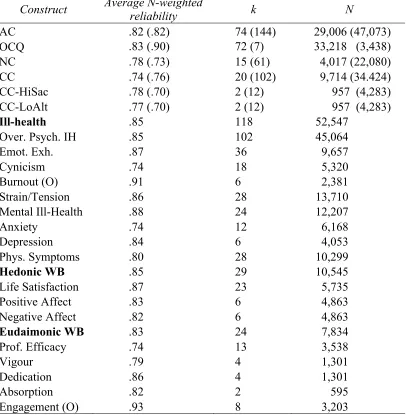
N-weighted average alpha for a given construct. I derived this N-weighted average alpha using the data in the present study (these values are listed in Table 1). I followed this
procedure for all variables except the commitment variables (AC, NC, CC, CCHiSac, and
CCLoAlt); for these variables, I took meta-analytic alphas from Meyer et al. (2002)
(these appear in parentheses in Table 1). I took this approach for the commitment
variables because the Meyer et al. (2002) meta-analysis calculated average alphas based
Table 1
Reliabilities for All Variables
Construct Average N-weighted reliability k N
AC .82 (.82) 74 (144) 29,006 (47,073) OCQ .83 (.90) 72 (7) 33,218 (3,438) NC .78 (.73) 15 (61) 4,017 (22,080) CC .74 (.76) 20 (102) 9,714 (34.424) CC-HiSac .78 (.70) 2 (12) 957 (4,283) CC-LoAlt .77 (.70) 2 (12) 957 (4,283)
Ill-health .85 118 52,547
Over. Psych. IH .85 102 45,064
Emot. Exh. .87 36 9,657
Cynicism .74 18 5,320
Burnout (O) .91 6 2,381
Strain/Tension .86 28 13,710 Mental Ill-Health .88 24 12,207
Anxiety .74 12 6,168
Depression .84 6 4,053
Phys. Symptoms .80 28 10,299
Hedonic WB .85 29 10,545
Life Satisfaction .87 23 5,735 Positive Affect .83 6 4,863 Negative Affect .82 6 4,863
Eudaimonic WB .83 24 7,834
Prof. Efficacy .74 13 3,538
Vigour .79 4 1,301
Dedication .86 4 1,301
Absorption .82 2 595
Engagement (O) .93 8 3,203
Note: AC=Affective Commitment; OCQ=Organizational Commitment Questionnaire; NC=Normative Commitment; CC=Continuance Commitment; HiSac=High Sacrifices Continunace Commitment; CC-LoAlt=Low Alternatives Continuance Commitment; WB=Well-Being; Prof. Efficacy = Professional Efficacy; (O)=Omnibus Measure; Over. Psych. IH=Overall psychological ill-health; Emot.
Exh.=Emotional Exhaustion; Phys. Symptoms=Physical Symptoms; N=total number of respondents;
the N-weighted average of the primary studies included here that employed the OCQ, rather than the alpha for the overall AC construct from this study.
I estimated the meta-analytic relations examined in this study using psychometric
meta-analysis (Hunter & Schmidt, 2004). All variables were corrected for both sampling
and measurement error. I used Piers Steel’s Microsoft Excel-based meta-analysis
program (http://webapps2.ucalgary.ca/~steel/Procrastinus/metanalysis.php) to calculate
the meta-analytic statistics presented here. Several other published meta-analyses have
made use of this program (e.g., Gelade, Dobson, & Gilbert, 2006; Steel, 2007).
Coding Commitment Variables
As previously mentioned, the TCM scales (Allen & Meyer, 1990; Meyer, Allen,
& Smith, 1993) and the OCQ (Porter, et al., 1974; Mowday, et al., 1979) were included
in this meta-analysis. I considered including primary studies employing several other
commitment scales (e.g., the Healthy Organization Barometer; Lindström, Hottinen, &
Bredenberg, 2000; Cook & Wall, 1980), but made the decision to retain only studies that
used the established, well-validated, and commonly used scales cited above.
In previous meta-analyses (e.g., Jackson, 2010; Meyer, et al., 2002) of the TCM,
researchers differentiated between the eight-item (Allen & Meyer, 1990) and six-item
(Meyer et al., 1993) versions of the NC scale. The former focuses on antecedents of NC
(e.g., socialization), while the latter highlights a sense of obligation to the organization
and does not include any mention of antecedents (see Meyer & Parfyonova, 2010).
However, making a distinction between the two versions would require between-study
included NC at all, there simply wouldn’t be enough studies to make such a distinction
meaningful.
Similarly, previous studies and meta-analyses (e.g., Jackson, 2010, Meyer, et al.,
2002) have differentiated between the two forms of CC, CCHiSac and CCLoAlt. These
two subscales have been found to be distinct in factor analyses of Meyer and Allen’s six-
and eight-item CC scales (Hackett, et al., 1994; McGee & Ford, 1987; Meyer, Allen, &
Gellatly, 1990; Somers, 1993), and have been found to correlate differently with
antecedents and consequences. Only two studies identified in the present literature search
differentiated between the two subscales (Herrbach, 2002; Panaccio & Vandenberghe,
2009). Because comparisons involving these two subscales are actually within-study,
meta-analyses involving these two studies are reported here despite the low number of
primary studies.
Coding Ill-health and Well-Being Variables
Ill-health. A visual representation of the breakdown of levels of analysis (i.e., overall ill-health, overall psychological ill-health, and individual ill-health variables) is
presented in Figure 1. Based on a cursory review of the included studies, I identified the
variables listed in Figure 1 a priori as the construct categories into which studies would
be classified. In order to be included in a category (e.g., depression), the study did not
have to have used the same measure as the other studies in that category. It simply
needed to have shown clearly that it belonged in that category, either through inspection
of the actual measures, or by definitions provided in the study. I discuss classification of
Ill-health Hedonic Well-Being
Eudaimonic Well-Being
Overall psychological
ill-health
Physical health complaints
Life Satisfaction Positive Affect
Lack of Negative Affect
Professional Efficacy
Engagement (Omnibus) Vigour
Dedication
Absorption
Burnout (Omnibus) Emotional Exhaustion
Cynicism Strain/Tension
Psychological ill-health
Anxiety
Depression
Physical health complaints
The first ill-health indicator category was burnout. While burnout is generally
measured and reported in terms of its separate subscales, a few studies in this analysis
either combined subscales or used other measures of burnout that tap several dimensions
(e.g., Gillespie & Numerof, 1984; Pines & Aronson, 1988). Thus, I included studies here
that correlated commitment with the emotional exhaustion and cynicism subscales, as
well as “omnibus” (i.e., combined Maslach Burnout Inventory [MBI] or other scales)
measures of burnout. In the case of studies that combined the MBI subscales,
professional efficacy was scored such that higher values reflected lower efficacy.
When categorizing the other ill-health variables, which included stress/tension,
psychological ill-health, anxiety, depression, and physical health complaints, some
subjective judgment was needed. Many of the primary studies included in this analysis
reported measuring general variables such as “well-being”, “health”, or “strain”. In any
case where the well-being outcome variable was not perfectly clear (e.g., depression), I
examined the description of the variable, the example items, and (where available) the
original scale. I categorized any outcome variable that described feelings of tension,
stress (as an outcome, not as an antecedent), feelings of being strained, etc., as
stress/tension. If a variable was simply described as “stress”, no other description was given, and the original scale was not available, I did not include the study (so as to
exclude studies that measured stressors, or sources of strain/tension/lack of well-being
residing in the environment). I categorized any outcome variable that described
non-specific mental/psychological health, ill-health, or distress (e.g., coping with difficulties,
self-worth), or that combined indicators of mental health (e.g., anxiety and depression),
(i.e., reflecting lack of ill-health), statistics and correlations were appropriately reversed
to reflect ill-health as measured. I coded variables as anxiety or depression if they very clearly indicated that they measured these outcomes, and did not combine these outcomes
with any others. Finally, I labeled any physically-oriented outcome measure as physical health complaints. I chose to combine variables labeled as “physical” health, well-being,
or symptoms, and those labeled as “psychosomatic” symptoms, because all of these
studies, regardless of label, tapped into the same type of symptoms; namely, those that
have been used as psychosomatic indicators in the past (e.g., colds, flus, trouble sleeping,
indigestion). Appendix C indicates all of the “other” outcome scales included in the study
(i.e., other than burnout, engagement, life satisfaction, and positive/negative affect), and
their categorization under the study variables.
Hedonic Well-Being. I analyzed hedonic well-being at two levels: overall hedonic well-being (including life satisfaction, positive affect, and lack of negative affect), and
the “lower level” variables individually. Life satisfaction was very straightforward to
code. Positive and negative affect measures included only state-type (not trait) measures
of positive or negative emotions and/or affect, job-specific or not, and were all
adjective-based measures (e.g., interested, inspired, distressed, upset). Negative affect was
reverse-scored when combined with positive affect and life satisfaction to form analyses
concerning overall hedonic well-being.
Eudaimonic Well-Being. Like hedonic being, I analyzed eudaimonic
well-being both at the higher level of overall eudaimonic well-well-being (including studies
measuring professional efficacy, engagement (omnibus), vigour, dedication, and