Available Online atwww.ijcsmc.com
International Journal of Computer Science and Mobile Computing
A Monthly Journal of Computer Science and Information Technology
ISSN 2320–088X
IMPACT FACTOR: 6.017
IJCSMC, Vol. 6, Issue. 9, September 2017, pg.28 – 32
The Virtual Machine Migration in
Cloud Computing Using Firefly
and Gravitational Algorithm
Sumanpreet Kaur, Amritpal Kaur
Computer Science and Engineering, Sri Guru Granth Sahib World University Fatehgarh Sahib, India Computer Science and Engineering, Sri Guru Granth Sahib World University Fatehgarh Sahib, India
[email protected], [email protected]
Abstract— The cloud computing is the architecture in which cloudlets are executed by the virtual machines. The most applicable virtual machines are selected on the basis of execution time and failure rate. Due to virtual machine overloading execution time and energy consumption is increased at steady rate. In this paper, Gravitational technique is applied in which weight of each virtual machine is calculated and virtual machine which has maximum weight is selected on which cloudlet will be migrated. The performance of proposed algorithm is tested by implemented in matlab in terms of execution time, energy consumption.
Keywords— Vm migration, Cloudlet, virtual machines, Matlab.
I. INTRODUCTION
security and offer greater control, which is typically lacking in a public cloud. Hybrid Clouds join both public and private cloud models. With a Hybrid Cloud, service providers can use outsider Cloud Providers in a full or partial manner which helps in expanding the flexibility of computing. The Hybrid cloud environment is capable of giving on-demand externally provisioned scale [5]. The ability to augment a private cloud with the resources of a public cloud can be utilized to manage any unexpected surges in workload.
The cloud resources are to be allocated is a proper manner and this is a prior objective of this system. It is to be made sure that the financial profit is the highest in the selected architecture. One of the major function of cloud computing is the allocation of resources in which the resources are distributed in a proper manner [6]. For the purpose of satisfying the requirements of users, resource allocation is relates to provide commodities are services. It is done keeping is mind the perspective of the consumer. The economy of the industries is increased by the proficient resource allocation results provided. The clients enter the resources at very less chances for a small job when the skill is to be deployed as a service [7]. In the certain systems, the resource allocation as well as the scheduling for providing proper coordination for the job resources is done by including a key. There should be no violation of the set of constraints while this resource allocation process. There is no prediction of which resources are perfect for the allocation in a particular job provided by the cloud users [8]. The perfect resource allocation procedure involves the proficient allocation along with the least number of resources to be used. This will help in providing maximum profit for the users. The main aim of resource allocation strategy is to provide resources from team for the purpose of concurrent allocation in the cloud computing environment.
II. LITERATUREREVIEW
The authors introduced in this paper [9], an interval number theory to portray the uncertainty of the computing environment and a scheduling engineering to mitigate the impact of uncertainty on the task scheduling quality for a cloud data center. Based on this design, a novel scheduling algorithm (PRS1) is presented. The experimental results demonstrate that PRS performs superior to those algorithms, and can effectively improve the performance of a cloud data center.
The authors proposed in this paper [10], an algorithm for allocating tasks to resources that minimizes the infringement of the tasks' time requirements. The exact time scheduling of the tasks on the resources is then decided by considering the time constraints. Experimental results demonstrate that the proposed algorithm outperforms other scheduling algorithms for various values of the granularity and the load of the task requests. The authors discussed in this paper [11], open challenges connected with energy efficient resource allocation. Accessible techniques presented are summarized based on the energy-efficient research dimension taxonomy. The focal points and inconveniences of the existing techniques are comprehensively analyzed against the proposed research dimension taxonomy. On the basis of this study various techniques are enlisted which can be utilized as per their benefits.
The authors proposed in this paper [12], two energy-cognizant task consolidation heuristics are presented, which aim to maximize resource utilization and explicitly consider both dynamic and sit without moving energy consumption. The heuristics assign every task to the resource on which the energy consumption for executing the task is explicitly or implicitly minimized without the performance degradation of that task. Based on the experimental results, the heuristics demonstrate their efficient energy-saving capability.
The authors proposed in this paper [13], a dynamically hierarchical, resource-allocation algorithm for multiple cloud nodes collaborating in big data environment. Both theoretical and experimental results represent that the proposed algorithm outperforms the MinMin algorithm in terms of communication traffic and makespan. The results demonstrate that DHRA can reduce message number and communication traffic significantly, with the equal or even less tasks finish time compared with MinMin.
The authors proposed in this paper [14], a pragmatic approximated solution with the accompanying two steps. Every participant solves its optimal problem independently, without consideration of the multiplexing of resource assignments. It is demonstrated that Nash equilibrium dependably exists if the resource allocation game has feasible solutions. The advancement problem considered in this paper relates to a large proportion of cloud-based computing services.
III.RESEARCHMETHODOLOGY
node will start perform their tasks. We will also enter number of task in this scenario. Suppose during execution of task one move moves from its location than failure occurs at that point. To overcome this problem a novel technique has been proposed which overcome the problem of failure due to mobility of the node. In the proposed algorithm, we have added a new parameter in the present algorithm that is master node time. Master node time is the result time to join the end users. It is for node collaboration. For this we have formulae which are as follow:
1. E-cost= maximum execution time + Time taken by the master node (master node time) After that we will calculate profit of each node.
2. Profit of each node = E-cost+ Failure node of each node
3. Weight of each node= No. of tasks + maximum execution time/Profit
The node which has the highest weight. Weight will be calculated according to the above mention formulae.
Pseudo Code
Begin
Step 1: Get list of all VMs working on all hosts. Step 2: Initialize no migration is done.
Step 3: Get resource utilization, failure rate, and execution time of all machines. Step 4: Built transition matrix for hosts and VMs.
Step 5: Loop will execute until all machines on over utilized hosts are migrated.
Step 5.1: Calculate the current utilization of each host for that particular VM that needs migration. Step 5.2: Check creation history of the VM.
Step 5.3: Compare increase in utilization of selected hosts with other hosts. Step 5.4: Select host for which increase in utilization is minimum End loop Step 5.6: If maximum utilization exceeds upper utilization threshold go to step 5.1. Step 6: Else choose that particular host for migration.
Step 7: return migration List END
Results and Discussion
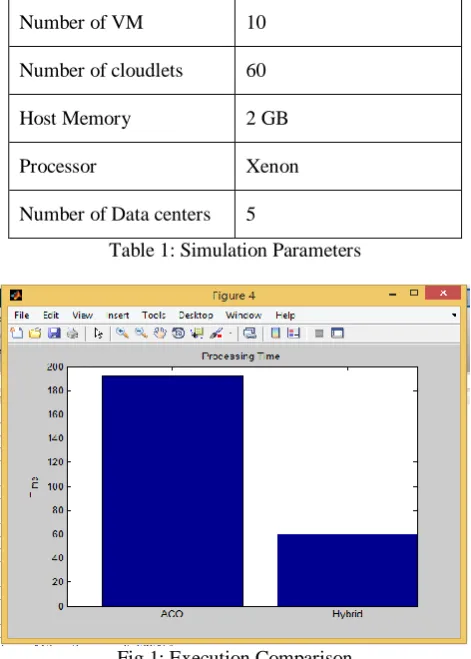
The proposed algorithm can be implemented in MATLAB as it is very difficult to make real time simulation as large scale. In the performance of existing technique and proposed algorithm is compared in terms of execution time, energy consumption. The simulation parameters are given in the table 1
Number of VM 10
Number of cloudlets 60
Host Memory 2 GB
Processor Xenon
Number of Data centers 5
Table 1: Simulation Parameters
As shown in the figure 1, the execution time of the proposed and existing algorithm is compared and it is been analyzed that due to fault recovery in the network , the execution time is reduced in the proposed technique. Execution time= Time at the end of the algorithm- Time at the start of the algorithm – (1)
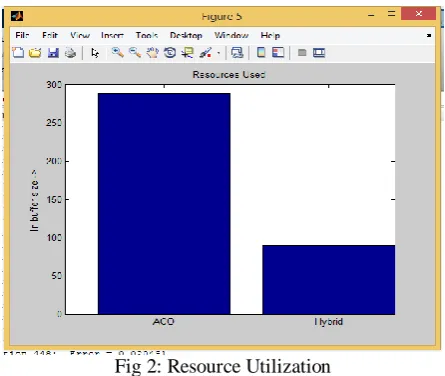
Fig 2: Resource Utilization
As shown in the figure 2, the proposed and existing algorithms are compared in terms of space utilization and it is been analyzed that when the fault is recovery in the network, space utilization reduced and network efficiency is increased
Space Utilization = Resource consumed per unit seconds * total number of seconds --(2)
The space utilization is calculated with the formula given in the equation 1, in which per unit bandwidth consumption is multiplied with the time.
IV.CONCLUSION
In this paper, it is been concluded that due to dynamic architecture of cloud uncertainties may happen in the network. The most applicable virtual machines are selected on the basis of execution time and failure rate. The gravitation algorithm is applied which will migrate the task of virtual machine which gets overloaded. The performance of proposed algorithm is tested in MATLAB and it is been analyzed that execution time is reduced with the energy consumption.
R
EFERENCES
[1] M. D. Dikaiakos, D. Katsaros, P. Mehra, G. Pallis and A. Vakali, “Cloud computing: Distributed Internet computing for IT and scientific research”, 2009, Internet Computing, IEEE, 13(5), 10-13,
[2] T. Surcel and F. Alecu, “Applications of Cloud Computing”, 2008, International Conference of Science and Technology in the Context of the Sustainable Development, pp. 177-180
[3] Sumit Goyal, “Public vs Private vs Hybrid vs Community - Cloud Computing: A Critical Review”, 2014, I.J. Computer Network and Information Security, 3, 20-29
[4] G. Lewis, “Basics about cloud computing”, 2010, Software Engineering Institute Carniege Mellon University, Pittsburgh
[5] M.A. Vouk, “Cloud computing–issues, research and implementations”, 2004, Journal of Computing and Information Technology, 16(4), 235-246
[6] Christian V, Rodrigo NC, Dileban K, Rajkumar B,” Deadline-driven provisioning of resources for scientific applications in hybrid clouds with Aneka”, 2012, Future Gener Comput Syst 28:58–65
[7] Guiyi W, Athanasios V, Vasilakos YZ, Naixue X,” A game-theoretic method of fair resource allocation for cloud computing services”, 2012, J Supercomput 54:252–269
[8] Anton B, Jemal A, Rajkumar B,” Energy-aware resource allocation heuristics for efficient management of data centers for cloud computing”, 2012, Future Gener Comput Syst 28:755–768
[9] Huangke Chen, Xiaomin Zhu, Hui Guo, Jianghan Zhu, Xiao Qin, Jianhong Wu,” Towards Energy-Efficient Scheduling for Real-Time Tasks under Uncertain Cloud Computing Environment”, 2015, J Syst Softw 99:20–35 [10] Doulamis ND, Kokkinos P, Varvarigos E,” Resource selection for tasks with time requirements using spectral clustering”, 2014, IEEE Trans Comput 63(2):461–474 Vol. 63, No. 2
Zomaya,” A survey and taxonomy on energy efficient resource allocation techniques for cloud computing systems”, 2014, Computing 1–24
[12] Young Choon Lee, Albert Y. Zomaya,” Energy efficient utilization of resources in cloud computing systems”, 2012, J Supercomput60:268–280
[13] Zhanjie Wang, Xianxian Su,” Dynamically hierarchical resource-allocation algorithm in cloud computing environment”, 2015, J Supercomput