VOLUME 5
September 1952
Number 5
In this Issue
Editorials
Our 1952 Student Issue ... ...R.S. Campbell
301
Mr. Scientist : Watch Your Language!
John J. Sturm
301
Is Science Enough?.. ... Raymond M. Housley, Jr. 302
What Should the Goal of Range Education Be?
Arthur D. Smith
304
Nutritive Value of Browse on Montana Winter Ranges
Donald A. Jameson
306
Range Education for the Texas Rancher
A. H. Walker
311
Must Conservation Be a Government Monopoly?
H. Byron Mock
315
Washington Cattleman of the Tear Program Promotes
Good Range Management... Dale Ausman
322
Managing Beef Cattle on East Texas Timberland
Richard M. Townsend
328
Nutritive Value of Cheatgrass and Crested Wheatgrass
On Spring Ranges of Utah
C. Wayne Cook and Lorin E. Harris
331
Competition Between Grasses Reseeded on Burned
Brushlands in California
A.M. Schultz and H.H. Biswell
338
Variations on Chemical Composition of Bluebush
Wheatgrass, Arrowleaf Balsamroot, and Associated
Range Plants... ... James P. Blaisdell et al.
346
Miner's Lettuce on California Burned Brushlands (abs.)
Walter R. Spivey
354
Book Reviews:
Improving the World's Grasslands (Simple, ed.)
H.W. Springfield
355
Las Leguminosas Argentinas-Silvestres y Cultivadas
(Burkart) ... ... ... Alan Beetle
356
Current Literature... ... Robert R. Humphrey
358
Range Students Roundup 1951-1952 ... ... 363
News and Notes . ... ... ... ... 370
With the Sections... ... ... ... 386
Society Business ... ... ... ... 393
Published Quarterly by
2,4-D WEED KILLERS l a l
. . . Esters and Amine salts.
Selected weed killers proved effective against annual and perennial weeds, many types of thistle and cress -and nettle.
2,4,5-T BRUSH KILLERS.. . . . . isopropyl and Butyl esters.
Low volatile, high kill esters of 2, 4, 5-T recom- mended and approved for mesquite and other brush control on range and grassland, along railroads, pipelines and other right-of-ways.
To meet increasing demands, Kolker-one of the nation’s major producers of weed and brush control chemicals-has expanded production facilities at its Newark plant. Expert technical assistance supplied. Call on Kolker-and be sure of delivery at the right time, at the right price.
DIAMOND ALKALI COMPANY
upwB+
Other products of Kolker Chemical Works, Dia- mond Alkali’s subsidiary, specializing in organic chemicals for agriculture and industry, include: DDT. ... .TcchnicaI BHC ...
LINDANE
.Tcchnical Grade (36% and go’% gamma)
...
U-D
99% gamma Isomer 2,4,5-T :‘.: ‘_’ . . :‘.’ : ‘.:
... ....
... Brush Weed Killers Killers K-101 ... .Miticidc
Order from
KOLKER CHEMICAL WORKS, INC.
80 LISTER AVENUE, NEWARK 5, NEW JERSEY
Plants; Newark, New Jersey and Houston, Texas
NATIVE RANGE
GRASS SEEDS
Blue Grama-Side Oats Grama-Blue Stem -Buffalo-Crested Wheat-Love Grasses-
Sand Drop, etc.
We purchase-Harvest-and Sell.
PEPPARD SEED CO.
1131
West 8th StreetKANSAS CITY 7, MO.
PRACTICAL
GRASSLAND MANAGEMENT
By B. W. ALLRED
Regional Range Conservationist, U. S. Soil Conservation Service, Fort Worth, Texas
Most Practical Grass Book Published! Written for students and ranchmen, this book has 15 well-illustrated, readable chapters on growth, care, and management of the country’s most valuable crop- grass.
FEATURES.. . latest facts about economic and conser- vation vahies of important range plants.. . guide for seeding 64 native and domestic grasses.. . glossary of range terms.. . check list of nearly 1000 important range plants, with common and scientific names.
The first printing was sold out within six months. Im- mediately adopted as text by the Veterans’ Vocational Training program, many colleges and schools in west and southwest.
COMMENTS.. . “Of all the trained men in range man- agement, I know of no one individual better qualified through professional training and applied experience to write a book on the subject of Practical Grassland Management.. .” VERNON A. YOUNG, Head, Dept. of Range and Forestry. A & M College of Texas.
$5.00 PP. Second Printing
Publisher:
SHEEP AND GOAT RAISER San Angelo, Texas
MOVING? CHANGING ADDRESS?
Don’t miss a copy 01 the JOUR&AL
IF YOU FAIL TO NOTIFY the Secretary when you change your address, here’s what happens: The Jour- nal is returned to the publisher by the Post Office. Your Society pays 3# return postage. Publisher noti- fies Secretary. Cost 3#. When 2 numbers are returned, Secretary notifies publisher to suspend-14#. You send us new address, we advise publisher to again place your name on list-14#. Postage on 2 returned Jour- nals-@. Total cost to the Society-++.
ON THE OTHER HAND, if you advise the Ex- ecutive Secretary of change of address in advance, cost to the Society is only-6$. Executive-Secretary, 209 S. W 5th Avenue, Portland 4, Oregon.
PERSONALIZED
STATIONERY
For Society Mem hers
Your name and address on good quality paper and envelopes.
Each sheet and envelope will, at no extra cost to you, show you as a member of the American Society of Range Management, with an attrac- tive cut of the Charlie Russel painting “The Trail Boss.”
Printings and shipments, post paid, will be made about September 20th for orders received prior to September 15th.
Introdzlctory Ojer
200 sheets, 6” x 7” and 1.50 envelopes $2.00 300 sheets, 6” x 7” and 150 envelopes $2.75 200 sheets, 83” x 11” and 150 envelopes $2.50 300 sheets, S+” x 11” and 150 envelopes $3.50 Orders shipped, post paid, direct from printer in plain cardboard container.
PRINT YOUR NAME AND ADDRESS PLAINLY.
Order Now-check or money order.
Orchards, Washington
RANCH J, Management Service * Consulting & Appraisals or Reseeding Contractors or Investment Agents Throughout the Western States & Canada Call or Wire:
R. B. (Dick) Peck, WESTERN RANCHING SERVICES
Journal of
Volume 5, Number 5, . September, 1952
RANGE
MANAGEMENT
Editorials
Our
1952
Student Issue
T
0 THE range men of the future this Annual Student Issue of the Journal is dedicated.This year, Professor Arthur D. Smith, Range Management Department, Utah State Agricultural College, worked dili- gently from January to June on the task of soliciting, assembling, and editing the material from the range schools. As a result, this issue has two student edi- torials, two student research articles, an article on Range Education, and numer- ous items in the Range Student Roundup
and the News and Notes. In addition, Professor Smith’s thoughtful statement on the goal of range education is printed as the concluding editorial.
It is encouraging to note that nine schools furnished material for this issue, two more than in 1951. With each suc- ceeding year we hope that more range schools and more students will be repre- sented by editorials, articles, reports on range school courses and field trips, and Student Chapter activities.--R. S. Camp- bell, Editor.
Mr. Scientist: Watch Your Language!
N
OTHING is more disconcerting to aspeaker than to suddenly realize that he has lost the attention of his lis- teners; that their minds are otherwise occupied by some subject far removed from the one he is discussing. Equally disheartening is the discovery that a com- prehensive report on a research project, after publication, is gathering dust on some forgotten shelf, unopened and un- perused, because it is “too hard to read.” In either case the cause can usually be traced to the wrong choice of language.
Every research worker has an interest- ing story to tell. How well he recounts ‘it is as important as the facts he has learned. To tell about his work fully, he must em- ploy two variants of a single language. First, he must discuss his results in the
exact terminology of his profession, in a language fully understood only by his co-workers. Second, he should recount his findings in the everyday language which is universally understood in his commu- nity, state, or nation. It is at this point that the research worker runs into diffi- culties.
The fact that “in the genus Canis the posterior appendage oscillates rapidly from certain stimulii” is not particularly intelligible to the average listener or reader. However, everyone understands the more simple statement that “a dog wags its tail when excited, angry, or pleased.” Many fine pieces of research written in technical form still await a more “popular” translation.
our inability to transpose our thoughts from technical to common language with romplete facility. In Range Management, for example, browse, shrub, brush, and coppice refer to woody plants with edible leaves, twigs, and shoots. To the British, the word coppice will moat likely be understood to refer to a thicket of small trees which is used periodically as fuel. The American lix&ockman scans to pre- fer the all-inclusive term, “brush.” Simi- larly in range management, literature
litter, mulch, residue, and debris all refer to dead plant material on the soil surface l&h the manuer of deposition being quali- fied as natural or artificial. Cereals in- vestigators use both residue and mulch t,o describe stubble left on the surface after a crop is harvested. Debris is gen- erally thought of as rubbish. Hence, the
manner of presentation of subject matter depends upon the group we wish to reach. To fellow xierrtists it is important to ex- press ours&es exactly in the language which conveys OUT ideas and research re- suits accurately. To an infinitely larger group, uamrly the public, it is mandatory that our findings be presented in a com- mon language, in an interesting form and in an enthusiastic manner.
We Americans live in a favored nation, in a country filled t,o overflowing x&h the results of applied basic research. We touch a switch and we have available an abun- dance of electric power,manufactured from the energy of some distant river. We mow and stark improved alfalfa and grass from irrigated meadows, graze our animals on fix pastures and fatten them on hybrid cereals. The bread we eat comes from high quality wheat developed in the lab- oratories of the plant breeders. Although these scientific wonders are relatively new, they have become commonplace because of their abundance and wide use.
Advances in the agricultural sciences have come mainly from basic research carried on at our educational institutions and governmental agencies. Such research agencies are supported largely by taxes. The American public is interested not only in enjoying the fruits of research, but also in hearing the story of how the results came about.
The man or woman who did the work is the one who can best tell about it. So, Mr. Scientist, please tell us about your research in everyday words, in our own language.-John J. Sturm, Student, Uni- versity of Wyoming, Laramie. (Supt. North Montana Branch Station, Havre.)
Is Science Enough?
EDITORIALS 303
important phase of the field has been neglected to the extent that it detracts from the worth of our scientific informa- tion. Too often, we have not recognized the need for selling range management. If the technical side of the field is to con- tribute to the objective of wise range land use on a nation-wide basis, new dis- coveries must be brought home to the people who use and manage the range resource.
Ranchers, land use planners, and public land administrators need working infor- mation that can be applied to the prob- lems at hand. Learned dissertations on t#he ecology of a cemetery are doubtless worthwhile and fine in their place, but they have little appeal to the man who is faced with the problems of supporting a family or planning a range management program that will result in full use, but not damage to the resource. Many of our ablest researchers have recognized this need, and have slanted their research pro- grams and reporting toward it, with the encouragement and assistance of the American Society of Range Management and the Journal. This trend must be con- tinued if we are to derive full benefit from range management research.
Techniques for selling range manage- ment, like techniques of any other kind of salesmanship, are limited only by the imagination of the salesman. Qualified technicians and experienced ranchmen need not limit their writing to technical and semi-technical journals, or to govern- ment bulletins. Their contributions to popular style periodicals have already im- proved the accuracy and usefulness of the range information in that area. Other popular selling methods in recent years have included show-me trips and a wide variety of contests.
Extension work by the states in coop- eration with the Federal government is an important and effective means of get- ting information into the hands of those
who can use it. The extension program now under way in Texas is an example of what can be done, using the tools de- veloped over the years in other fields of agricultural extension. Each of the range state agricultural colleges could materially increase the value of their extension work by adding a range management section to their extension service.
Range land administrators have not always seen the need for selling as well as administering. The value of selling in this sphere of range work i? twofold: first,, it can make the administrative job easier by showing the scientific reasons for administrative actions, and convincing stockmen of the need for these actions; and second, it can result in the passing along of information which will be of value to the ranch operator in handling his own land to the best advantage.
Most of our selling efforts to date have naturally centered around the easiest commodity to sell: range improvement. A successfully reseeded pasture, or a range cleared of noxious shrubs is an effective sales talk in itself. The area in which most of our problems lie, and the one which is hardest to face in developing an educational program is that of manage- ment planning. Often, changes in a range management plan are slow to show tan- gible results, a fact which makes selling difficult. Nevertheless, that one field seems as important today as any in range management education.
304 EDITORIALS
better job for themselves and their land. -Raymond M. Housely, Jr., Student, Anyone who earnestly wants to further School of Forestry and Range Manage- the practice of sound range management ment, Colorado Agricultural and Me- has a receptive audience waiting for him. chanical College, Fort Collins.
What Should the Goal of Range Education
Be?
R
ANGE management is a youngster among college curricula. Data se- cured from schools offering degrees in range management indicate that but two schools offered a bachelor’s degree in range management prior to 1930. Al- though instruction in this field was begun earlier than this, it is perhaps safe to say that the development of range education has occurred in the last forty years, with the major expansion having occurred within the last twenty-five years.The major problems surrounding the development of a curriculum are asso- ciated with the many related fields of science which concern the range manager. It is difficult to see how one can be an effective range administrator without some reasonable knowledge .of animal hus- bandry, agronomy, both soils and field crops, agricultural economics, public ad- ministration, and forestry, to name but a few of the more obvious. Some knowledge of few of these could properly be omitted from a course of training for a rancher. Yet, each of these has a sufficiently large body of information to occupy a full cur- riculum. How then can we hope to supply sufficient training in the field of range management and at the same time include the essential training from these related fields to make the range graduate an ef- fective land administrator or ranch man- ager?
A further complication arises from the fact that the needs of the student for knowledge in these related fields vary considerably with the employment posi- tion of the individual. What will be essen- tial information to one individual may be
but helpful subsidiary information to an- other. Stated briefly, those responsible for developing a course of range instruction have little time, an almost unlimited amount of information, and no precise knowledge of the individual needs after graduation of the students for whom the range curriculum is being devised.
One solution is to elaborate the number of courses required so that an individual receives training in all the possibly useful areas of knowledge. This obviously can extend the required number of courses beyond that which can possibly be covered in the time available to the college student. Moreover, it is likely to develop into the elaboration of trivia and the em- phasis upon operational details rather than upon fundamental and basic infor- mation.
EDITORIALS 305
problems dealing with land tenure and landlord-tenant relations? The first course presumes that the present procedures are finally correct and that we are simply training individuals. The second more cor- rectly assumes that improvements will come about so fast as those concerned are aware in a broad way of the fundamental problems involved. This applies equally well should the graduate be the rancher rather than the administrator.
It is not contended that technical skill and operational “know how” need not be expected of the college graduate. It is true that all the technical skills and oper- ational details which may possibly be use- ful to the graduate cannot be taught in t)he time available, and that these alone do not insure satisfactory accomplishment on the job. Moreover, it is easier to im- prove ones skill and become familiar with t)he “tricks of the trade” on the job than
it is to acquire a sound philosophy, and a basic understanding of fundamental problems. If range management as a pro- fession is to make the most rapid advance- ment, we must instill understanding in the student even if it be at the expense of familiarization with the less important though relevant facts.
This is not to suggest that facts are not important, but to argue that “ideas about facts” are more so. When time demands that a choice must be made between al- ternatives let us be certain that the basic idea has been imparted. If the student has been stimulated to thinking in the particular field concerned, he can later acquire knowledge of the details and, moreover, he may uncover sotie new facts or provide some important new tools in the process.-Arthur D. Smith, Associate Professor, Range Management, Utah State Agricultural College, Logan.
THE SPIRIT OF SCHOLARSHIP
Nutritive Value of Browse on Montana Winter
Ranges
DONALD A. JAMESON
Graduate Assistant, Montana State Agricultural Experiment Station, Boxeman
A
LTHOUGH there has been much speculation on the value of browse as a winter feed for cattle in the Northern Great Plains region, there has been very little done in the way of a careful study of the problem.The study reported here was to explore the possibility of a correlation between the blood nutrient levels of cattle on winter ranges in southeastern Montana and the utilization and chemical composition of some of the major browse species of the area.
In 1932, the U. S. Forest Service started a study at the U. S. Range Livestock Experiment Station to determine the effect of light, moderate, and heavy grazing on breeding cows and range vegetation. Summer and winter grazing unit,s were established, the winter pastures being in rough, broken country to provide prote&ion from storms. The pastures were arranged in a more or less circular pattern and watered by a central well. Weights of the breeding cows on these pastures were taken at twenty-eight day intervals (U.S.D.A. Forest Service, 1950).
In 1947, the Montana State Agricultural Experiment Station began a project on the area. The objective of this project was to determine the nutritive value of range plants and their influence in cattle nutrition. It was found that the range grasses were deficient in some nutrients, especially protein and phosphorus, during the fall and winter months. At the same time cattle did not show external symp- toms of deficiencies other than energy deficiencies.
THE SWDY AREA
Average annual precipitation of the area is 13.2 inches. In all but the more severe winters the snowfall is light and that which falls remains on the ground for only a short time.
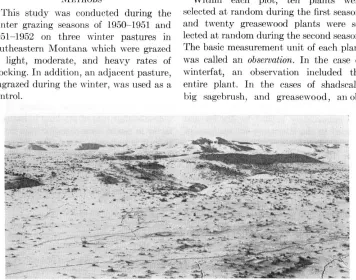
The area is considered to be within the mixed prairie association of the grassland formation. The vegetation is dominated by grass species. On the rough, broken winter pastures, various browse species are also abundant (Fig. 1).
REVIEW OF LITERATURE
Clarke an,d Tisdale (1945) found that many of the shrubs are higher in nutritive value when in the cured stage than are the cured grasses, and that many of these species are utilized to a considerable extent in the winter. No other studies on the use of browse on cattle ranges in the Northern Great Plains area have come to the at- tention of the author. Other workers have determined, however, that browse plants generally are potentially valuable forage species (Table 1).
METHODS
This study was conducted during the winter grazing seasons of 1950-1951 and 1951-1952 on three winter pastures in southeastern Montana which were grazed at light, moderate, and heavy rates of stocking. In addition, an adjacent pasture, ungraaed during the winter, WILS used as a control.
Within each plot, ten plants were selected at random during the first season, and twenty greasewood plants were se- lected at random during the second season. The basic measurement unit of each plant was called an observation. In the case of winterfat, an observation included the entire plant. In the cases of shadscale, big sagebrush, and greasewood, an ob-
throupb the snow.
Sampling areas were located within each of the four pastures. Each of these areas w&s as nearly alike as possible in regard to site potential. Each sampling area, except for the control area, was about 600 yards from water, with a second are’e5 established about 1200 yards from water during the second year.
At each sampling area, including the pasture used as a control, shadscale (AtripZa confert$&z), big sagebrush (Ar-
tcmisia trident&a), winterfat (Eurotia
km&), and greasewood (Sarwbatus vermic- ulatus) were measured for utilization during the first season. These species mere selected as being the most abundant and as being of possible forage value. Grease- nx~I alone was studied during the second season. Plots were established for each species, these plots containing at least forty plants of the species to be measured.
TABLE 1
Shndscale.. 7.64
Big sagebrush
~~~~~~~~~rl .,.,::. / ‘ME
.QSQ ,300
::~3
*The above figures BT~ averages of analyses
published by the following: Bidwell and
Wooton (1925), Clarke and Tisdnle (1945),
Cook nnd Hnrris (19501, Esplin, et al. (1937),
Idaho EqmGnent Station (1937), McCreary
(1927 and 1939), and Wasser (1945).
servation was a group of at least five
308 DONALD A. JAMESON
of the grazing season and at twenty-eight being no more than 1 percent in any of day intervals thereafter until spring. the pastures.
From the plants chosen for measurement of utilization, a twelve gram composite sample for each study area, except the control, was clipped at each twenty-eight day interval. In the case of winterfat, since the entire plant was measured for utilization, nearby plants were used for collection of the samples. The material
was immediately packed in dry ice and shipped to the laboratory for analyses of protein, phosphorus, and carotene.
At the same dates that the browse samples and measurements were taken, blood samples were collected from five animals in each pasture. The same five animals were bled each time. These samples were analyzed for phosphorus, carotene, and vitamin A.
Utilization of Greasewood, 1951-l 952
Table 3 shows a considerable difference in utilization at 600 yards from water, the greatest use occurring under heavy stocking. At 1200 yards from water, how- ever, utilization of greasewood was not greatly different between pastures. This indicates that rate of stocking is less of a factor in use at some distance from water than it is nearer to water. The difference between locations was probably due to a combination of distance, cold, and snow. These last two factors encouraged stock to remain near hay and shelter.
TABLE 3
TABLE 2
Percentage twig lengths removed from greasewood by cattle during the winter grazing season,
1951-1952 Percentage twig length removed by cattle during
the winter grazing season, 1950-1951 YARDS FROM WATER RATE OF STOCKING LOCA- TION
Heavy Light Mode- MEANS
rate
SPECIES
Heavy ... 63 52 0 Light ... 13 16 3 Moderate ... 15 17 22
Big sage- brush
0 1 1
RESULTS AND DISCUSSION
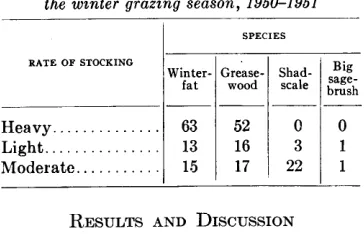
Table 2 shows the season-long utiliza- tion by cattle of the four species measured. Winterfat and greasewood show heavier use under heavy stocking. Appreciable use of shadscale occurred only under moderate stocking. By observation cattle were seen utilizing shadscale twigs which still held their fruits, but avoided those which had shed their fruits. It is felt that the r.eason for heavier use of shadscale under moderate stocking is that the particular plants measured had retained more fruit than the plants measured in the other pastures.
Big sagebrush utilization was negligible,
~~___
600 56 19 33 36
1200 10 16 8 11
--- --
Pasture means:. . . 33
I 18 I 21 ;
Chemical Composition of Browse Plants, 1950-1951
Protein
Greasewood had an average crude protein content of 8.4 percent. This is considerably above the minimum recom- mended for adequate cattle nutrition by the National Research Council (Guilbert
et al., 1950). Winterfat and shadscale had about 1 percent less protein than greasewood, and big sagebrush was the lowest with 6.4 percent protein.
Phosphorus
NUTRITIVE VALUE OF BROWSE 309
species having about .075 percent phos- phorus. The phosphorus content of big sagebrush is considerably lower than the average winter phosphorus content of this species found by other workers (Table I). The relationship of big sagebrush phos- phorus content to phosphorus of the other browse species is similar to that reported in other experiments. The phosphorus content of all species was too low for ade- quate nutrition of cattle (Guilbert e2 al., 1950).
Carotene
Average carotene content of the four species was 9 mcg./gm. on November 30, rising to 20 mcg./gm. by January 3, and dropping to 5 mcg./gm. by February 22. It is of particular interest to note that no significant correlation was observed be- tween temperature changes and carotene content of the browse to account for the higher values of the January samples. The November and January values were well above the 6.7 mcg./gm. minimum recommended for adequate cattle nutrition by the National Research Council (Guil- bert et al., 1950).
Chemical Composition of Greasewood,
1951-1952
Protein and Phosphorus
Greasewood protein was higher than the previous year, being 9.0 percent as com- pared to 8.4 percent. Phosphorus was con- siderably higher than during the previous year, being .087 percent as compared to .075 percent. The reason for these differ- ences between years is not known.
Carotene
The trend of carotene through the seasbn was very similar to that observed the previous season, rising from an early winter value of 12 mcg./gm. to 21 mcg./gm. by January 24, and dropping tjo 2.5 mcg./gm. by February 21. Repeti-
tion of this rise in carotene is of special interest. The original thought that tem- perature change was a factor seems un- likely since weather records show no appreciable rise in temperature during the month of January. There has been no other plausible explanation of this phenom- enon suggested from the data available.
Blood Nutrient Analyses Phosphorus
Average blood phosphorus levels for the two winter seasons was 3.02 mg./lOO ml. This is considered to be low enough to produce external signs of phosphorus deficiency. However, none of the usual symptoms of a phosphorus deficiency were observed. The hay which was fed during severe weather had a much higher phosphorus content than did either the range grasses or browse, and blood phos- phorus levels were higher during the time hay was fed than during most of the rest of the winter season.
Carotene
Carotene began a rapid decline early in each season, but declined less rapidly in mid-winter. Averages of the two years showed blood carotene to be 46 mcg./lOO ml. on December 28, 36 on January 24, and 35 on February 22.
Vitamin A
Vitamin A continued to decline through- out the winter, but did not become dangerously low (Thomas, 1951). No external symptoms of vitamin A deficiency were observed. The vitamin A decline is probably due to the dwindling body reserve (Thomas, 1951).
310 DONALD A. JAMESON
CONCLUSIONS nutritive content of the grazing sheep’s
Winterfat, greasewood, and shadscale were important as winter feed sources on the study pastures, whereas big sage- brush had very little use.
Abundant, palatable browse plants on winter ranges should provide some nu- trients which are deficient in range grasses during the winter months. On this experi- mental area, the palatable shrubs had some value as sources of protein and carotene, but were not valuable as a phosphorus source.
ACKNOWLEDGEMENTS
diet on summer and winter ranges of Utah. Utah Agr. Expt. Sta. Bul. 342. 66 pp. ESPLIN, A. C., J. E. GREAVES, AND L. A.
STODDART. 1937. A study of Utah’s win- ter range, composition of forage plants, and use of supplements. Utah Agr. Expt. St,a. Bul. 277. 47 pp.
GUILBERT, H. R., P. GERLAUGH, AND L. L. MADSEN. 1950. Recommended nutrient allowances for domestic animals. Number IV. Recommended nutrient allowances for beef cattle. National Research Council, Washington, D. C. 37 pp.
Idaho Agricultural Experiment Station. 1937. Preliminary report on the composition of range forage plants as related to animal nutrition. Idaho Agr. Expt. Sta. mimeo
The material included in this paper is leaflet 13.23 pp.
a contribution of the Montana State MCCREARY, 0. C. 1927. Wyoming forage College, Agricultural Experiment Station, plants and their chemical composition- Studies no. 8. Wvo. Exot. Sta. Bul. 157. Paper No. 276 Journal Series. The original pp. 91-106. ” -
material uDon which it was based is con- -. 1939. Phosphorus in Wyoming pas-
tained in i Master’s Thesis. Loan copies ture, hay, and other foods. Wyo. Agr.
may be obtained from the Library, Mon- Expt. Sta. Bul. 233. 20 pp.
tana State College, Boseman, Montana. THOMAS, 0. 0. 1951. I. Relation of nutrition
LITERATURE CITED
ALDOUS, C. M. 1945. A wint’er study of mule deer in Nevada. Jour. Wildlife Mangt. 9: 145-151.
and age at first calving to lifetime per- formance of beef cows. II. The effect of low phosphorus rations upon carotene metab- olism in ruminants. Thesis submitted to the Graduate Faculty of the Oklahoma Agricultural and Mechanical Coliege. 122 pp.
S. Department of Agriculture, Forest Serv- ice. 1950. The Northern Great Plains Research Center, its work and aims. North- ern Rocky Mountain Forest and Range Expt. Sta. Misc. Pub. 1. 10 pp.
BIDWELL, G. L. AND E. 0. WOOTON. 1925. Salt bushes and their allies in the United U States. U. S. D. A. Bul. 1345. 40 pp.
CLARKE, S. E. AND E. W. TISDALE. 1945. The chemical composition of native forage plants of southern Alberta and Saskatche-
Range Education for the Texas Rancher
A. H. WALKER
Extension Range Specialist, Texas A. and M. College, College Station
USE
AU
KEYS FOR SUCCESSFUL
RANGE MANAGEMENT
T
EXAS ranchmen not only have the will, but the want to carry out range management practices.The layman might ask why range management? There are a number of reasons, but essentially to increase pro- duction of meat per acre for better living. Numerous range management specialists lose sight of this main purpose. For posterity, yes, and for soil conservation, yes, but increased returns here and now are what intrigue the ranchman. And a good return must be realized while the range improvements are being made. Good range management is basically education with five main factors involved.
Know Range Plants
In range management, knowing range plants is the basic fundamental. It has the same importance as the alphabet to the first grader. The crop that a ranch- man is growing for his livestock is forage- the cheapest and most neglected com- modity in the nation-and yet he probably knows the least about it. This is a day of billion figures and few understand what
a billion is so let’s just say this crop of nature’s forage is worth tuice the value of all the feed grown each year. Whether an operator has a little or a lot of good forage present on his pasture depends largely on the management, which he has given it. It may be that he is producing only 200 to 300 pounds of poor grass per acre, or he may be growing a mixture of tall and mid-grasses at 5,000 to 6,000 pounds per acre. A cow needs about 3.5 tons of dry forage per year. Taking half and leaving half, 2.5 acres will supply a cow on a good range, while it requires as much as 70 acres on a very poor range. Management is in most cases able to bring back the better plants. But first, we have got to know what they are in any given area. Normally, t,here are only ten to fifteen plants of fundamental importance on any given ranch. Are the “key” species increasing? Are there new seedlings? Are they hiding in the brush, dying in the center or almost gone entirely? Knowing forage plants, like recognizing the qualities of a good beef animal, is fundamental in the range livestock business.
312 A. H. WALKER
Proper Stocking
What is proper stocking? Essentially, it is balancing the livestock numbers with the forage produced. Experience has shown that taking half of the current year’s forage production through grazing and leaving half for plant maintenance, reproduction, and litter is proper. Many operators run a certain number of head of livestock on a given pasture through force of habit. To some of them it is be- coming evident that present stocking is too great and gradual range deterioration is taking place. This is so gradual as not to be noticed. Stocking records of 70-80 years ago show rates of 2 to 4 acres per grown cow. Through the years with con- tinued overgrazing, drought, and brush invasion the acres per animal unit is going up and up. Taxes, operating expenses, land and feed costs are rising. Livestock prices have been favorable or we would have reached the point of no return. We’ve got to increase our production capacity of range lands or be forced out of the business. How can we do this? Deferred or rotation grazing will help. These practices give range plants an op- portunity to gain in vigor and make seed for reproduction. In many cases, it is the cheapest and most efficient and effective way. Securing better livestock distribution through more waterings, cross- fences, and salting away from water are definite aids.
More and more ranchmen are grazing only about three-fourths of the breeding stock they think their ranges will carry. This gives them more leeway during drought periods, which are certain to come. Then in good years they can carry over calves or lambs through the ‘winter and in bad years all can be marketed during summer or fall. Such an operation shows less risk, less investment, less feeding with higher and heavier calf or lamb crops, more pounds of livestock production
.
per acre, range improvement and more profit in the long run.
Brush Control
To some brush control apparently is the only problem. That it is huge is well known because over half of Texas range lands are infested with brush of one kind or another. Overgrazing and drought have increased infestations through the years, making even the handling of livestock very difficult in some areas. Rainfall is the limiting factor on most Texas range lands. For most species of brush it requires three to four times as much water to produce a pound of leaves as it does to produce a pound of good grass. Bare ground invites brush invasion as well as poor moisture penetration and absorption. On many ranges we are losing a high percentage of our moisture through runoff. There is not sufficient litter, organic matter, and plant roots to make this water penetrate the soil where it is needed. This means in many cases ranchmen are only using 4-6 inches of their top soil for grass production. Close grazing retards plant roots from going much deeper. Consequently, oper- ators say, “It is drier than it used to be.” The facts are we are not conserving our moisture, and established brush with deep and wide root systems have top moisture priority.
RANGE EDUCATION 313
recommended. Brush control as a means to continue to overgraze is folly.
Range Reseeding
In Texas, for the most part, range re- seeding is a last resort and a major opera- tion. Generally, there are three classes of reseeding-on old fields, on barren range land, and following brush control.
Most old fields need organic matter and soil fertility before any attempt at reseed- ing should be made. A soil test will deter- mine the plant nutrients which are lacking. These should be added in the form of fertilizer. Annual grasses and legumes usually will make more growth and produc- tion than perennial plants. Grow them, build up the soil and secure some returns from grazing, hay, or seed in the process. After conditioning the soil and building it up, then we can plant these good peren- nial grasses and legumes-these 100 per- cent plants-on at least 80 to 90 percent soil, where they can be expected to grow. In many cases, if the fertility were there, these climax plants would be present. Nature in her own ecological way will build up the soil in time, but from a financial standpoint we cannot afford to wait that long.
Seedlings on barren range land have given fair to poor success. Some land preparation is desirable if terrain permits. Native species adapted to the soil and climate have given the best results under Texas range conditions. Severe drought and cold damage have recently made questionable the place of a number of introduced plants. Native plants are adapted to these conditions and generally should be recommended. Seedling plants should not be grazed until they are well established. This may mean six months to one year deferment depending on rainfall, species, and growth.
Reseeding following brush control is a good practice and especially will it pay
if the operator defers the area treated during the growing season following seed- ing. What actually happens is that the native species are given a chance to re- produce themselves and most of the im- provement is due to this rest rather than the artificial reseeding. But, the ranch- man thinks t,hese new grasses are those he planted and believes in reseeding. When good native plants can be found almost every step on a range area, deferment and controlled grazing should be followed rather than reseeding. Of course, some areas do need to be reseeded when less than 15 percent of the “key” plants remain. Scattering adapted grass seed on brush controlled areas has been fairly successful. A mulch of dead brush and twigs on the ground aids in providing organic matter and gives protection to the seedling plants. There is nothing magical about reseeding. Even more than other practices reseeding needs “know how” management and luck to be suc- cessful.
Range Fire Protection
314 A. H. WALKER
timber areas, but all the “ifs” should be ramifications to be successful. Basically, adhered to. the goal is increasing meat production per
It will require several years of good range acre and providing for range improvement management to undo the damage done bY in the process. Recognition of range
an uncontrolled range fire in a few minutes. plants, proper stocking, brush control,
SUMMARY range reseeding, and range fire protection
Range management involves the com- are the five key points being stressed under bination of five main factors and their Texas range education programs.
PERSEVERANCE
The journey of a thousand miles begins with one step.--Lao-‘l’sxe.
To climb steep hills requires slow pace at first.-Shakespeare.
Industry, perseverance, and frugality make fortune yield.-Benjamin Franklin.
There is nothing difficult in the world; the only fear is that men will lack perseverance.-
All human power is a compound of time and patience.-Balzac.
Must Conservation, Be a Government
Monopoly?
H. BYRON MOCK
Regional Administrator (Colorado-Utah), Bureau of Land Management, Salt Lalc’e City, Utah
(This paper was given at the Annual Banquet of the Forestry Club, Utah State Agricultural College, Logan, April 5, 1951.)
Y have enlisted in the army for con- OU men, by your choice of careers,
servation of the natural resources, and it is a proud and honorable career before you. But times do not stay the same, new problems rise, new demands, new methods, new public attitudes. You are challenged by these changes in a way that not even the best of your teachers in the classrooms and in the field can completely prepare you to meet unless you know the stakes for which we play.
These are changing times on all fronts. The world is in turmoil. The United States is harassed by pressing issues. Pressures have built up from compression of our rising population and gigantically ex- panded economy, and from the rise of divergent philosophies in the world. Be- cause of that turmoil and because of the tremendous momentum of the American industrial might, the need for natural resources now and in the future has be- come a great issue and their preservation has become an even greater crusade. Unfortunately, the issues that look so clear in theory often are insoluble in practice.
We are today forced to take stock and decide whether we must give precedence to present use or to maintenance of re- serves for the future; or whether the two can be reconciled. Even more important, the nation must decide what method or methods shall be used-private enter- prise, government control, or government regulation of private enterprise? The
trends of the past are beginning to collide. Reconciliation is required.
EARLY POLICT
In the early days, because the frontiers stretched on and on, and population was small, and the industrial developments were still but a hint of the tremendous activities of today, preservation of land resources was not much of a private problem. Land resources were plentiful, preservation was an unknown problem- wasn’t there plenty for all, forever? But there was a basic trend of using the public lands to incite permanent development rather than to encourage temporary ex- ploitation alone. Soon the trend was toward settlement. We had great new areas within the national boundaries; they had to be settled and developed to be held. The general Preemption Act of 1841 allowed actual settlers to “squat” on 160 acres and later get title. But the settlement era really began with the Homestead Law signed by President Lincoln in 1862. In the year that followed, other settlement and development laws found their way into the books; the Desert- Land Act of 1877 and the mining laws of 1866 and 1872.
But a new era was fast approaching. Preservation of certain areas was recog- nized as a need, and so the “conservation era” arrived with the setting aside of the Yellowstone National Park in 1872. The incentive-to-develop trend was not altered, but parallel to it, and applied to different lands, the new line of thinking was de- veloping-preservation. The word “con- servation”, synonymous by dictionary definition with “preservation”, had not
316 H. BYRON MOCK
yet acquired its overtones to imply managed use.
CONSERVATION TRENDS
The possibility that timber supplies might some day be exhausted caused forest reserve withdrawals of 1891-but the management of timber as a renewable resource is really marked by the establish- ment of the Forest Service in 1905. Gifford Pinchot in his book, Breaking New Ground, outlines how first private interests, then government agencies pio- neered sustained-yield practices in this country. One development must not be missed. The original Forest Reserve Act (1891) provides for reserves of timber lands only. By June 4, 1897, not only timber but “favorable conditions of water flows” were the objectives. By March 1, 1911, and June 7, 1934, acts of those dates placed “stream flow protec- tion” ahead of timber.
In 1906 the Congress empowered the President to reserve as national monu- ments public lands containing objects of historic and scientific- interest. The National Park Service was established in 1916 to administer the system of parks already coming into existence. Other preservation withdrawals included those for dam and power sites and for water. These withdrawals were made to preserve the sites for future use against interfering conflicting claims, rather than to provide current management.
Even with the rising tide of the pres- ervation trend, the incentive to develop land remained strong. Mineral lands continued to be sold (1847 to 1920). The Timber and Stone Acts of 1878 allowed sale of public lands valuable for such purposes but unfit for cultivation. There were other settlement, or “in- centive to develop”, acts-the reclama- tion homesteads of 1906, the forest homesteads (1906 and 1911) when lands in national forests were suitable for
agriculture, the enlarged homestead (1909).
We cannot talk about the developments of the early twentieth century without paying our respects to the Reclamation Law of 1902. Often called one of our great conservation laws-and with justi- fication-it is not only a preservation law but also a great development law. The Newlands project of Nevada pio- neered; others followed-Roosevelt and Coolidge dams in Arizona-and new mammoth structures in ever-increasing number throughout the entire arid West. The “conservation” label on the Reclama- tion Act describes but a part of that law- it is an “incentive to develop” law in its finest sense. By its passage, Congress acknowledged that some developments are too big for private individuals to handle. The act recognized that develop- ment of our nation requires federal aid to help citizens pioneer an area that without water is doomed to long delay in develop- ment.
By 1933 the pressures for land and its proper use had begun to make them- selves felt in a new direction. No longer could a farmer mine his fields and move on to new lands. There were no new lands available and adequate.
CONSERVATION A GOVERNMENT MONOPOLY? 317
the Forest Service were squeezing stock from the high watershed country. Either stockmen were faced with number re- ductions or they had to overload their private lands or go onto the public do- main. Stockmen must be conservationists of their private lands (and they are if they are to stay in business), so the choice
was obvious. They went on the public domain rather than reduce their herds or overgraze their own lands. But there was no security-a man who tried to graze public domain moderately found a neighbor or a transient sheepman har- vesting the crop down to the roots. What incentive was there for conserva- tion measures? The effects of overgrazing on vacant public lands began to be ap- parent. There was no safety valve. The conservation measures on some public and private land helped those lands but created a greater problem on the unregu- lated public domain. Conservation itself was breeding misuse of part of our na- tion’s natural resources.
The nation moved to me& the two problems. First in 1933 it acted to help tlhe farmer help himself. The Soil Con- servation Act was passed which, by making it economic for a farmer to practice sound conservation measures, allowed him to conserve his land and still earn a living. The act harnessed the profit motive of individuals to save the soil.
Congress also recognized the second problem. In 1934 the Taylor Grazing Act was passed, putting the vacant, unappropriated, and unreserved public lands under administration and providing for grazing use until the land had been classified for entry for some higher use. All of the public land now was placed under some administration. The act was one for conservation-it gave protection through management and other methods to lands that until then were uncon- trolled. But the Taylor Grazing Act
was also an “incentive to develop” act. The current users of the land were recog- nized and the dependent livestock in- dustry was stabilized. Here, as in the Soil Conservation Act, stabilization of private use was employed as one of the greatest forces for conservation. He who used the land wisely would reap the benefits. How well such an approach can work is shown by the stockmen who, from funds available to them, have paid for over half of the costs of range im- provements and their maintenance on public lands in grazing districts in the past 16 years. This shows the innate desire of stockmen to use sound range management practices and conserve our land resources if they can get their share of the returns. What greater policing force can there be than self interest?
There was another great conservation act passed in 1920-the Mineral Leasing Act. This act withdrew certain lands from entry under mining laws, and pro- vided for leasing of the public lands for extraction of oil and gas, coal, and cer- tain other minerals. Even as this law was being passed to prevent wasteful pro- duction of oil, oil men were developing for themselves methods of extracting oil and gas with minimuti waste-call it conservation, it was also profitable. The leasing act allowed unitizing of an oil structure so that joint effort could extract the oil at the optimum rate. No conser- vation measure has stronger support from private citizens than the unit system of developing an oil field has from the oil producers themselves.
318 H. BYRON MOCK
general given first right and the highest priority on the public lands. Even so, where a mining use is found to conflict with a higher value to the public, special provisions have been made to meet the situation. For example, national parks are closed to mineral development, but they can be opened if necessity dictates. Another special law is that of May 29, 1950, which authorizes the Secretary of Agriculture, with the agreement of the municipality, to close Forest Service lands within a municipal watershed to all forms of entry, including mineral.
And so, we have seen three great eras in the public-land program of the United States: (1) revenue producing, (2) settle- ment and development with the “in- centive to develop” emphasis, and (3) prevention of waste and maintenance of reserves with the “conservation” em- phasis. None of these has ended, they all still exist today; only the emphasis in the public mind has changed-changed as conditions and needs changed.
A FOURTH GREAT ERA? Today, the pressures for proper handling of our natural resources are on us with even greater vigor. The limitless lands ’ are running out-except
possibly in Alaska. The two trends of “incentive to develop” and “conser- vation” can no longer operate independ- ently of one another. An example is the recent head-on clash between two great forces-the park and reclamation forces- over the Echo Park damsite and the Dinosaur National Monument of Utah and Colorado.
We are today in a fourth great period of our natural resource problem-the era of reconciliation of our need for development and our need to avoid waste and maintain reserves. The problem is not: shall we have conservation; but instead is : by what method are we to
accomplish it?
Arguments on conservation seldom touch the fundamental question. We do not discuss how we can reconcile present use and establishment of a sound economy with the avoidance of waste and main- tenance of reserves. Usually, at the first mention of conservation, the talk turns to denouncement of so-called predatory interests-the stockmen are exhibit A, but once it was timber interests, and tomorrow it may be the mining industry. Read almost any national magazine of the last four years--Harpers, Collier’s, and others; read the voices of doom- Fairfield Osborne’s Our Plundered Planet, and William Vogt’s The Road to Survival. You will find denunciatory articles that almost lead you to believe that anyone who wants to control some natural resource for his business is un-American. Who is against conservation of our natural resources? I cannot believe any thinking American can be. But this agreement is obscured by the uproar over methods to be used. You in this army for proper use of our natural resources will not have simple questions to answer. You will find , fights within fights; reclamation
conservationists versus park conserva- tionists; timber conservationists favoring regular harvesting versus conservationists who want untouched wilderness areas; sheepmen versus cattlemen ; wildlife ver-
sus livestock; farmer versus ranchers; miner versus soil-savers ; timber versus
CONSERVATION A GOVERNMENT MONOPOLY? 319
Multiple use is the obvious answer- where uses can be reconciled-but with which use must other uses be reconciled? On the municipal watershed of major cities other uses must be subordinated to water supply. Do you believe that uranium deposits will be left unde- veloped even if development disturbs a wild bird refuge for whooping cranes or con- dors? But must Colorado slopes be closed to development because activities on them, including uranium development, might affect the water supply of Los Angeles? If producing 1 ,OOO,OOO barrels of oil a day from oil shale puts an in- dustry and a population of 500,000 in western Colorado, how much water will there be left for farming and other uses? Would that perhaps force California to perfect a method of getting water from the sea? When you need water no price is too great to pay. The questions for resolution are ones of degree and of specifics not of generalities and blind service of one cause.
How PRIVATE EFFORTS HAVE WORKED Before coming to any conclusion on the question “Must Conservation be a Government Monopoly?” look at a few problems and what was done. First, in Little Cottonwood Canyon of the Wa- satch Range, just outside of Salt Lake City, is a fine ski resort-Alta. But the site is a long-time mining area and was privately owned. Today that resort, located in the watershed of Salt Lake City, is run by the Forest Service and is one of the finest in the country. How did it happen ? It happened because mining men, recognizing the need for recreation, and for protection of water- sheds, turned over the surface to the federal government .
Another example is found near Silver- ton, Colorado. The area is as ruggedly beautiful as any in a state of beautiful mountains. Mines are everywhere. There
are beautiful clear streams, crying for a fisherman’s attention, but there are no fish. Today, Colorado has legislation requiring avoidance of stream pollution. Fishing is coming back; the mines are still working.
Near Bisbee and Douglas, Arizona, the sulphur fumes from the smelters killed vegetation for miles around. Damage suits were brought. Today, the smelting companies capture the fumes, remove the sulphur and other minerals, and their profits from this reclamation and pro- tection far exceed the cost. Farming continues.
In Wyoming and other states 2 years ago, seismograph crews were ruining water holes and roads as they explored the area. The land looked worthless to them, but not to stockmen. A federal land manager got the oil companies together; they adopted a voluntary code of ethics, and today they police their own people against the abuse of lands. It works throughout the entire Rocky Mountain area.
320 H. BYRON MOCK
that all punitive action later could not repair.
In the State of Washington the state law requires proper forestry practices on privately owned lands used for com- mercial timber operations. The United States Supreme Court upheld that law as constitutional, recognizing public in- terests. ’
One other case is found in California’s San Fernando Valley, just outside of Los Angeles. The land is privately owned, but almost every tree has a sign placed by county officials that says “No smoking except in private dwellings”; and no one disobeys. The country is too dry, the fire danger too great. Put a sign like that up in Logan, and all you non-smokers would take up the habit just to strike matches on the sign! That’s the American way.
With these examples in mind, let us again look at the methods available for reconciling use without waste, reserves for the future, and incentives to create new wealth from our natural resources. The conditions of today are not those of 20 years ago, nor even 5 years ago. The pressures on the Nation are great; the demand for our natural resources is great, but the conditions that have raised new problems have produced an awareness of the problem that now is enlisting the entire public in the cause of wise use of our natural resources. That awareness alone seems to give an answer to our question: “Must conservation be a gov- ernment monopoly?” It need not be, it has not been.
Can we harness the self interest of individuals to do the conservation job? The advisory boards of the Taylor Grazing Act administration indicate that we can; the soil conservation districts so indicate; the oil industry’s actions so indicate.
To my mind there are two strong reasons why we should achieve conserva-
tion ends through private means when possible to do so without detriment to the public interest. First, unless this country can develop new resources, new uses for presently known resources, and better techniques of using resources, we face national stagnation. I feel that any unnecessary failure to utilize private interests and energies to meet these problems would be a criminal waste of great national assets?American resource- fulness and willingness to pioneer. With the current attitude toward conservation and the recognition given by courts, I feel that we can today harness a force for conservation that was not available 50 years ago, a force that in the aggregate is greater than any government can ever bring to bear through efforts of govern- ment agencies alone. With all respect for the efforts and abilities of govern- ment and large business leaders, I feel we must keep the door open for contribu- tions from efforts by those who do not know what is impossible or impractical. The April 1951 issue of Readers’ Digest
tells of a man who struck gas in Pennsyl- vania, contrary to the profound forecasts of eminent geologists. I know of wealthy farmers in southeastern Utah who raised pinto beans on land declared unfit for cultivation. I know of men in California who were told their land was worthless, but today they have fine vineyards on that land. No one had thought of grapes as the crop. I also know of many failures. Would it have been better to eliminate the failures if it meant eliminating the winners too?