Scholarship@Western
Scholarship@Western
Electronic Thesis and Dissertation Repository
9-1-2011 12:00 AM
The Power of Dialogue: Understanding Developmental Origins and
The Power of Dialogue: Understanding Developmental Origins and
Processes Underlying Mother-Child Conversations About Past
Processes Underlying Mother-Child Conversations About Past
Emotional Events
Emotional Events
Celia Hsiao
University of Western Ontario
Supervisor Dr. Greg Moran
The University of Western Ontario
Graduate Program in Psychology
A thesis submitted in partial fulfillment of the requirements for the degree in Doctor of Philosophy
© Celia Hsiao 2011
Follow this and additional works at: https://ir.lib.uwo.ca/etd
Part of the Developmental Psychology Commons
Recommended Citation Recommended Citation
Hsiao, Celia, "The Power of Dialogue: Understanding Developmental Origins and Processes Underlying Mother-Child Conversations About Past Emotional Events" (2011). Electronic Thesis and Dissertation Repository. 260.
https://ir.lib.uwo.ca/etd/260
This Dissertation/Thesis is brought to you for free and open access by Scholarship@Western. It has been accepted for inclusion in Electronic Thesis and Dissertation Repository by an authorized administrator of
UNDERSTANDING DEVELOPMENTAL ORIGINS AND PROCESSES UNDERLYING MOTHER-CHILD CONVERSATIONS
ABOUT EMOTIONAL EVENTS
(Spine title: Mother-Child Emotion Dialogues)
(Thesis format: Monograph)
by
Celia Hsiao
Graduate Program in Psychology
A thesis submitted in partial fulfillment of the requirements for the degree of
Doctor of Philosophy
The School of Graduate and Postdoctoral Studies The University of Western Ontario
London, Ontario, Canada
ii
THE UNIVERSITY OF WESTERN ONTARIO
SCHOOL OF GRADUATE AND POSTDOCTORAL STUDIES
CERTIFICATE OF EXAMINATION
Supervisor
______________________________ Dr. Greg Moran
Supervisory Committee
______________________________ Dr. Heidi Bailey
______________________________ Dr. David Pederson
Examiners
______________________________ Dr. David Pederson
______________________________ Dr. Koren-Karie ______________________________ Dr. Quan-Haase ______________________________ Dr. Peppler
The thesis by
Celia Hsiao
entitled:
The Power of Dialogue:
Understanding Developmental Origins and Processes Underlying
Mother-Child Conversations About Emotional Events
is accepted in partial fulfillment of the requirements for the degree of
Doctor of Philosophy
iii Abstract
Mother-child emotion dialogues represent an integral medium through which
children’s autobiography develops. This study sought to understand the developmental
origins and processes underlying this co-construction process by examining the
inter-relations between: mother-infant attachment inter-relationships, maternal attachment
representations, maternal sensitivity during interactions in infancy, maternal affective
mindset during toddlerhood, and mother-child emotion dialogues.
Our findings are consistent with past research on the links between the three
organized categories of mother-infant attachment relationships and later mother-child
emotion dialogues. Children in disorganized attachment relationships were found to
display a lack of consistent and coherent strategy during emotion communication with
their mothers. Our results also emphasize the important role of maternal state of mind
with regards to attachment in shaping emotion dialogues. Autonomous mothers
co-constructed emotionally integrated and coherent narratives with their children, while
non-autonomous mothers created stories that were less emotionally attuned and narratively
organized; furthermore, the unresolved/ disoriented classification was found to be
unrelated to mother-child emotion discourse. Finally, a mismatch in infant attachment
and maternal attachment representation was associated with a mismatch in
communication style during dyads’ shared conversations.
While we failed to find support for the suggestion of maternal sensitivity and
affective mindset as mediating the link between maternal attachment representation and
iv
autonomous mothers exhibiting unexpectedly low levels of sensitivity during infancy
tended to engage in dialogues that were less emotionally integrated and coherent.
This study highlights the importance of maternal attachment representation in
how emotion-laden memories are recalled, interpreted, and verbalized. Results are
v
Acknowledgements
This dissertation was a result of a wonderful collaboration between an amazing
group of people, each of whom I give my most sincere gratitude. First, I would like to
thank my supervisor, Greg Moran. It has truly been a privilege working with you, I thank
you from the bottom of my heart for taking a chance on me and for believing in me. You
have been an inspiration – both within and outside the field of research. Next, I would
like to thank Sandi Bento. Words cannot begin to describe how much you have
contributed to my experience and growth here at Western. I will always remember the
kindness and generosity you have shown me. I would also like to thank Dave Pederson
for his contagious sense of excitement for research, what an honour to have been around
such enthusiasm these past few years! Thank you to Heidi Bailey for her helpful
comments and her unique way of looking at data and research. Thank you also to Deanne
Pederson for her incredible energy and strength. Thank you to the rest of our research
group and to Nina Koren-Karie for the wonderful dialogues we have had over email and
Skype!
My graduate training here at Western has also been greatly enriched by a group of
incredible friends – thank you for 6 wonderful years! I would not have survived these
years without the unconditional love and support of my amazing parents, two of the most
remarkable people in my life. Last, but certainly not least, thank you to my sweetie
Evasen for your patience, understanding, and for being there every step of the way. I
could not have completed this without you!
vi
Table of Contents
Page
CERTIFICATE OF EXAMINATION ii
ABSTRACT iii
ACKNOWLEDGMENTS v
TABLE OF CONTENTS vi
LIST OF TABLES xi
LIST OF FIGURES xiv
LIST OF APPENDICES xv
INTRODUCTION 1
Mother-Child Conversations About Past Emotional Events 2
Contributions to Children’s Development 2
Maternal Reminiscing Styles 4
Attachment Theory as a Framework for Understanding Developmental
Origins of Quality of Mother-Child Emotion Dialogues 8
Emotion Dialogues as a Reflection of Quality of Attachment
Relationships 8
Empirical Evidence for Quality of Attachment Relationship as
Precursor to Emotion Dialogues 12
Role of Disorganization 14
The Impact of Maternal Attachment on Mother-Child Emotion Discourse:
vii
Maternal Attachment Representations and Quality of Mother-Child
Emotion Discussions: A Missing Link in the Empirical Literature 16
The Utility of the Adult Attachment Interview in the Current Study 19
Attachment Pairs: Understanding Quality of Emotion Dialogues in
Both Continuities and Discontinuities of Attachment 23
The Impact of Maternal Attachment on Mother-Child Emotion Discourse:
Understanding Developmental Processes 25
Mediation Models 25
Quality of Early Mother-Child Interactions: The Role of
Maternal Sensitivity 25
Mothers’ Thoughts and Feelings About Emotions: The
Role of Maternal Affective Mindset 29
Moderation Models 34
Summary of Study Goals and Hypotheses 36
METHOD 40
Participants 40
Measures 43
Maternal Attachment Representation 43
Quality of Mother-Child Interactions 44
Child Attachment 45
Maternal Affective Mindset 46
Mother-Child Emotion Dialogue 48
viii
Overview of Procedures 53
RESULTS 56
Overview of Analyses 56
Meta-Emotion Interview: Variable Reduction 57
Mother-Child Emotion Dialogues: Variable Reduction 58
Preliminary Analyses 59
Child Gender and Age: Associations with SSP and AEED 59
Maternal Characteristics: Associations with AAI, AEED,
Maternal Sensitivity and Maternal Affective Mindset 59
Vocabulary: Associations with AEED Variables 65
Descriptive Summary of Key Variables 65
Developmental Origins of Mother-Child Emotion Dialogues:
Associations With Child Attachment Maternal Attachment Representation 69
Associations Between Dialogues and Infant Attachment 69
Associations Between Dialogues and Maternal Attachment
Representation 74
Associations Between Dialogues and Attachment Pairs 79
The Impact of Maternal Attachment Representation on Mother-Child
Emotion Dialogues: The Mediating and Moderating Roles of Maternal
Sensitivity and Maternal Affective Mindset 84
Mediation Models 84
ix
Maternal Affective Mindset: Awareness of Emotions 87
Maternal Affective Mindset: Coaching of Emotions 87
Moderation Models 88
Logistic Regression 88
Analysis of Concordant and Discordant Pairs 92
Maternal Sensitivity 93
Maternal Affective Mindset 96
DISCUSSION 98
Overview of Main Study Findings 98
The Role of Disorganization in Mother-Child Emotion Dialogues 102
The Importance of Maternal Attachment Representation for
Co-Constructing Organized Narratives Surrounding Children’s
Emotional Past 104
The Unresolved/disoriented Classification 107
The Autonomous-NonEM Link: An Unanticipated Pattern 108
Co-Construction as a Function of Both Partners’ Attachment:
Independent Processes? 109
The Contributing Roles of Maternal Sensitivity and Maternal Affective
Mindset 111
Early Maternal Sensitivity is Unrelated to Later Maternal
Sensitive Guidance During Emotion Dialogues 111
Maternal Attachment Representation and Maternal Awareness of
x
Lack of Support for a Mediation Model 113
Early Sensitivity Moderates the Impact of Maternal Attachment
Representation on Later Mother-Child Emotion Dialogues 114
Examining Emotion Dialogues of Three and a Half to Four Year Olds 116
Implications and Future Directions 117
REFERENCES 120
APPENDICES 136
xi
LIST OF TABLES
Table Description Page
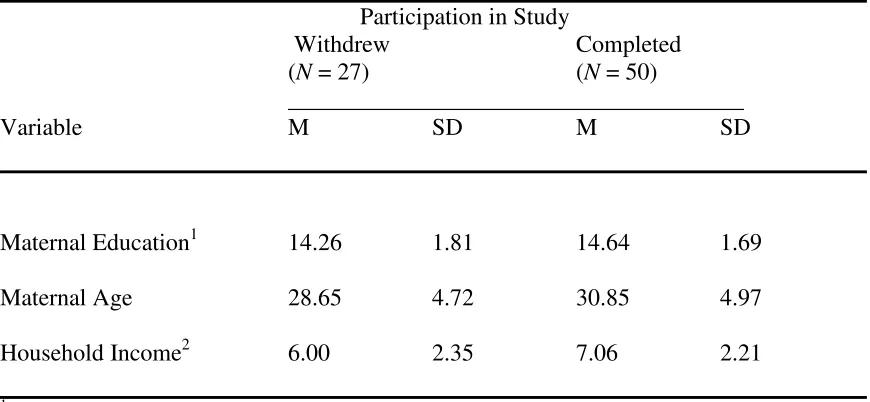
1 Descriptive Statistics of Demographic Information by Mothers who 42
Completed the Study and Mothers who Withdrew From the Study
2 Outline of Procedure and Measures 55
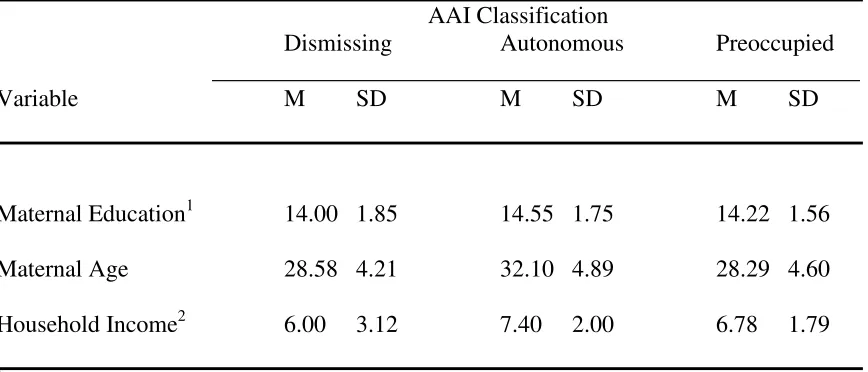
3 Descriptive Statistics of Demographic Information at 3 Months by AAI
Classifications 61
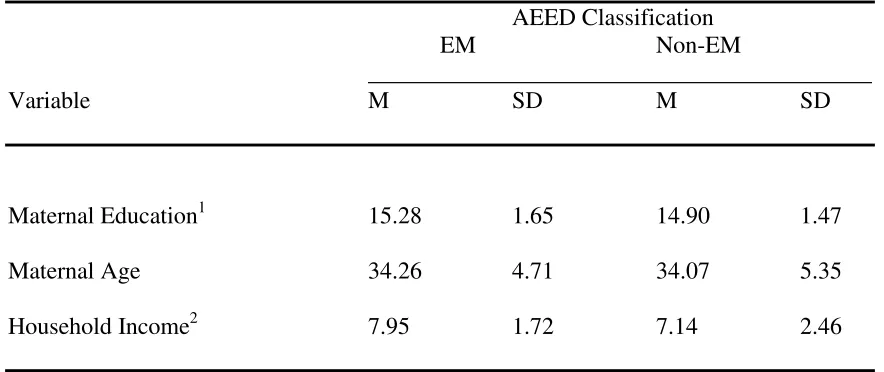
4 Descriptive Statistics of Demographic Information at 3.5 Years by AEED
Classifications 62
5a Pearson Correlations of Maternal Sensitive Guidance Aggregate Dialogue
Score and Demographic Information at 3.5 Years 63
5b Pearson Correlations of Maternal Sensitivity and Demographic Information
at 10 Months 63
5c Pearson Correlations of Maternal Affective Mindset Aggregate Variables
and Demographic Information at 21 Months 64
6 Distributions of AAI, SSP, and AEED classifications 66
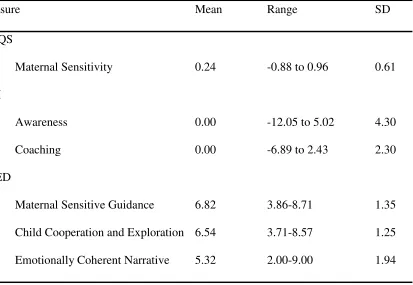
7 Descriptive Statistics of Maternal Sensitivity, MEI Aggregate Scores, and
AEED Aggregate Scales 67
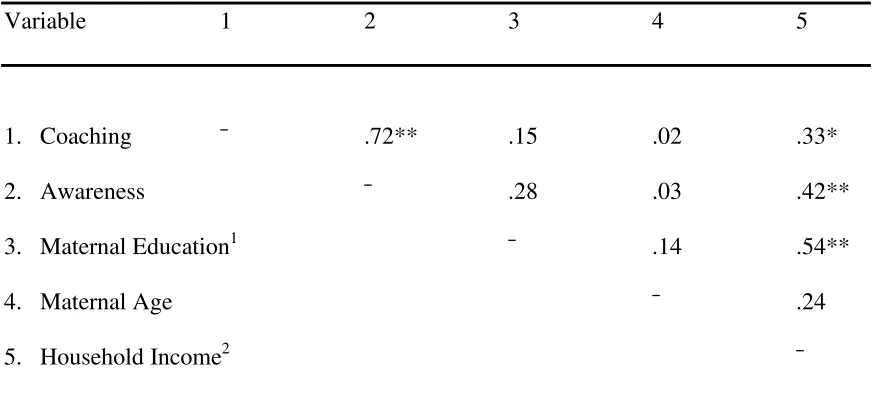
8 Pearson Correlations Among All Variables 68
9a Associations Between 3-Way Infant Attachment and Dichotomous
xii
9b Associations Between 4-way Infant Attachment and Dichotomous
Dialogue Classifications at 3.5 Years 71
10a Comparison of Children’s Cooperation and Exploration During
Emotion Dialogues Across 3-Way Infant Attachment Classifications 73
10b Comparison of Children’s Cooperation and Exploration During Emotion
Dialogues Across 4-Way Infant Attachment Classifications 73
11a Associations Between 3-Way Maternal Attachment and Dichotomous
Dialogue Classifications at 3.5 Years 76
11b Associations Between 4-way Maternal Attachment and Dichotomous
Dialogue Classifications at 3.5 Years 76
12a Comparison of Maternal Sensitive Guidance During Emotion Dialogues
Across 3-Way Maternal Attachment Classifications 78
12b Comparison of Maternal Sensitive Guidance During Emotion Dialogues
Across 4-Way Maternal Attachment Classifications 78
13a Associations Between Concordant and Discordant Attachment Pairs and
Emotion Dialogue Classifications at 3.5 Years 82
13b Comparison of the Emotion Dialogue Aggregate Scales Across
Attachment Pairs 83
14 Results of Logistic Regressions Predicting Mother-Child Emotion
Dialogue Classification 91
15 Descriptive Statistics for Maternal Sensitivity Across AAI-AEED
xiii
16 Descriptive Statistics for Maternal Affective Mindset Across AAI-AEED
xiv
LIST OF FIGURES
Figure Description Page
1 Mediating Roles of Maternal Sensitivity and Maternal Affective
xv
LIST OF APPENDICES
Appendix Description Page
A Ethics Approval 136
B Letter of Information and Consent Form 137
C Meta Emotion Interview Coding Sheet 144
D Description of AEED Scales 146
Introduction
Talking about emotional aspects of past experiences is a quintessentially human
activity. As we recount past events to others the emotional meaning of that event emerges,
allowing us to represent and understand our personal history. This process of reminiscing
about the past begins early in development and unfolds within a Vygotzkian framework
(Vygotsky, 1978) with younger children depending on the assistance and insight of a
more experienced adult in shaping the dialogue and guiding them through the discussion.
Although much research has focused on identifying the different ways in which mothers
structure the conversation and scaffold their children when talking about a past event and
on the influence of discourse styles on children’s development, there is a paucity of
research examining the developmental origins and processes through which mothers and
children establish a pattern of communicating about past emotional events. The
overarching goal of this dissertation is twofold: first, to examine the origins of
mother-child emotion dialogues, with a specific focus on mothers’ attachment representations, as
assessed by the manner in which she reflects upon her own childhood experiences; and
second, to elucidate the developmental mechanisms by which maternal attachment
influences mothers and children’s co-creation of narratives surrounding children’s
emotional past.
This introduction will be divided into four major sections. I will begin with an
overview of the significance of recounting past experiences to children’s development;
the different styles that mothers adopt when engaged in conversations with their children
about past events, and how maternal discourse styles have been found to be linked to
discuss the importance of attachment theory as a framework for understanding the
antecedents of mother-child emotion conversations. This will be bolstered by empirical
findings that have focused on the quality of early mother-child attachment as a precursor
to the way mothers and children communicate about emotions and emotional experiences.
The third section will introduce the current research project. First, I will address the need
to examine the influential role of the mother’s attachment representation, in addition to
the quality of mother-infant attachment relationship, in shaping the way she assists her
child to verbally organize past emotional experiences. I will then discuss possible
developmental mechanisms by which maternal attachment representations might impact
mother-child conversations with particular emphasis on maternal sensitivity during
interactions in infancy and maternal affective mindset in toddlerhood. In the final section,
I will review the various study hypotheses.
Mother-Child Conversations About Past Emotional Events
Contributions to children’s development. Talking about an ongoing emotion is
fundamentally different from talking about a pastemotional state. For very young
children, the discussion of an ongoing emotion mostly involves expressing an emotion
that the child is currently experiencing (Harris, 1999). On the other hand, talking about a
past emotional experience requires that the child not only recallthe past event and his
emotional reactions but also reflect on and interpret that past experience (Dunn, Brown,
& Beardsall, 1991).
This difference between these two situations has particular significance for
children’s cognitive, emotional, and self-concept development. Cognitively reflecting on
(Nelson, 1996) by enabling it to become more narratively organized (Fivush, 1991; 1993;
1994). In their conversations about past events, the parent assists the child to create a
coherent structure for recounting the past by guiding the child toward the necessary
information for setting the event in context (Fivush, 1991). For example, the child learns
to include information regarding not only what happened, but when and where the event
occurred, and who was involved. Furthermore, the child is taught that actions within an
experience must follow a temporal sequence. Through this process, the child learns that
earlier events in a sequence lead to and often are the cause of events occurring later. As a
result, the child begins to learn how to organize his personal memories in a structured and
coherent manner (Fivush, 1993).
Another important aspect of creating a coherent structure for representing one’s
personal memories is the evaluative framework within which this process occurs (Fivush,
1991). While recalling contextual information about a past event (i.e., what happened)
enables the child to organize and structure his1 memories in a coherent manner, the
evaluative framework takes into account the subjective and emotional tone of the event,
thereby assisting the child to interpret and understand the emotional significance of the
event being discussed (Haden, Haine, & Fivush, 1997). In order to help the child
understand the experienced emotions, parents often discuss the cause of the emotional
reaction to the event, what the child felt and experienced during a specific scenario, and
what the child can do to resolve or cope with the negative emotion experienced. Through
this process of reminiscing and discussing openly about past experiences, the child is able
to attribute meaning and emotional significance to the events (Fivush, 1994).
1
Many researchers argue that as personal memories accumulate, they contribute to
one’s evolving self-concept (e.g., Neisser & Fivush, 1994). The argument is that
memories of past experiences are the foundation of each person’s notion of the kind of
person that they are and these memories provide individuals with a continuous sense of
self over time. They also provide us with information about the kinds of events that are
important to the self. By evaluating past emotions, children learn what kind of emotional
being they are, whether they are someone who tends to be happy, or someone whose
anger is easily provoked; it also allows them to establish what meaning the event has for
the self (Fivush, 1994).
In sum, by participating in adult-guided conversations about past emotional
events, mothers re-present the experience to their children in a way that allows them to
integrate the event into their sense of self. The child not only acquires the ability to create
a coherent structure for representing his personal memories, but also learns to evaluate,
interpret, and understand his emotions and experiences. Over time, these lessons are
internalized by the child and contribute toward his emerging self-concept.
Researchers interested in the contributions of talking about past emotional events
to children’s development have found that the ways mothers scaffold understanding and
re-construction of past events through conversation vary dramatically. In the next section,
I will discuss in detail the different styles mothers adopt when reminiscing about past
events with their children.
Maternal reminiscing styles. Over the past two decades, a substantial body of
research has amassed on the different ways mothers structure past event conversations
2002; Reese & Fivush, 1993; Reese, Haden, & Fivush, 1993). Mothers adopt one of two
reminiscing styles in such discussions. Some mothers are highly elaborative as they
encourage their children to provide more details and support their children’s
contributions during their discussions. These mothers achieve this goal by enlisting their
children’s participation and asking them many open-ended questions (e.g., “What did we
see at the zoo?”), and frequently providing evaluative feedback to their children’s
responses by praising or confirming their answers (e.g., “Yeah, that’s right, we saw a
monkey!”) Furthermore, if their children are unable to respond to their probing, highly
elaborative mothers are likely to adjust their questions by elaborating further and
providing additional information so that the child is better able to respond (Fivush, Haden,
& Reese, 2006).
In contrast, mothers with a low elaborative reminiscing style are less likely to
probe their children for new information during their discussions of past events. These
mothers are more likely to ask their children questions that involve a yes/no response
(e.g., “Did we see a monkey at the zoo?”), thus resulting in shorter conversations and less
opportunity for the child to participate in the discussion. In response to their children’s
“empty” conversational turn (e.g., “I don’t know”), less elaborative mothers are more
likely to repeat the question without giving the child additional information, thus limiting
the child’s contributions to the dialogue (Reese et al., 1993).
Overall, by being more supportive and accepting of their children’s point of view
in their conversations about past events, highly elaborative mothers both encourage their
children’s participation and convey to them that this involvement is valued. Through their
children are able to co-construct narratives that are lengthy and rich in detail. Low
elaborative mothers, on the other hand, provide less structure and scaffolding during
conversations with their children about past events. This results in shorter and more
impoverished conversations with children participating less in the dialogue (Reese &
Fivush, 2002).
Over the past two decades, empirical research has focused on establishing mother
child past event conversation as an integral medium through which children’s
autobiographical memory develops. A host of studies have demonstrated that mothers
who are highly elaborative when discussing past events with their preschoolers have
children who develop more sophisticated autobiographical memory skills (Cleveland &
Reese, 2006; Nelson & Fivush, 2004; Reese et al., 1993; Reese & Newcombe, 2007) in
that they later provide more details and elaborated personal memories, and develop more
comprehensive understanding and coherent recollections of their experiences (see Fivush
et al., 2006, for a review).
Over the years, the significance of maternal reminiscing styles has evolved from
its initial theoretical base in autobiographical memory to expand into other facets of the
child’s cognitive development; endorsing the theoretical positions of Vygotsky (1978)
and Rogoff (1990) that cognitive skills have their origins in joint social interactions. For
instance, maternal elaborative discourse has been found to be related to preschoolers’
understanding of mind as assessed in various perspective taking and false-belief tasks
(Ontai & Thompson, 2008; Reese & Cleveland, 2006; Welch-Ross, 1997); suggesting
avenue by which young children gain an understanding of mental states and their
influence on behaviour.
In addition, several studies have demonstrated that maternal elaborative style
contributes to conscience development in early childhood (e.g., Laible, 2004; Thompson,
Laible, & Ontai, 2003). For example, it was shown that elaborative mothers, who tend to
display richer portrayal of the needs and feelings of other people during an emotion-laden
discourse (e.g., “He’s angry like when you were angry at sissy for hitting you this
morning.”), and who tend to make moral statements framed in the form of evaluatives
(e.g., “That was a nice thing to do!”), had children who exhibited higher resistance in a
temptation task. This suggests that within the context of a rich and supportive discourse
environment, children learn to connect the challenges of behavioural compliance with the
needs and emotions of others, thus contributing to their early conscience development
(Thompson et al., 2003).
On a similar note, it has been shown that maternal elaboration in parent-child
conversations is also associated with children’s enhanced understanding of emotions (see
Thompson, 2006, for a review). This suggests that mothers who encourage rich
background details and elicit children’s participation and memory with supportive and
varied questions have children who form strong and accessible memories of their
emotional experiences, which in turn, are likely to facilitate children’s reflective thinking
about emotions and emotional events (Laible, 2004; Laible & Song, 2006). Moreover, it
has been argued conceptually (e.g., Harris, 1999) and demonstrated empirically (e.g.,
Ontai & Thompson, 2002; Thompson, 2009a; Thompson et al., 2003) that secure
narrative style fosters more advanced emotion understanding in young children. This
perspective is consistent with attachment theorists and researchers, who propose that
secure mother-child attachment relationships promote emotion communication that is
more open, elaborative and fluid, thus enabling children to understand emotional events
more coherently (Bowlby, 1969, 1988; Bretherton, 1990).
Taken together, the different ways in which mothers and children converse about
prior experiences and how participation in these linguistically scaffolded interactions is
internalized by the child and become part of his repertoire, have been well established in
the literature. Building from this body of work, there is now growing interest in
explaining the origins of the individual differences observed in these memory discussions.
To address this issue, many have turned to attachment theory as a framework for
exploring the possibility that differences in the quality of early parent-child attachment
relationships are related to differences in the way in which mothers and children recount
previous emotional experiences. (e.g., Alexander, Quas, & Goodman, 2002; Fivush &
Vasudeva, 2002; Koren-Karie, Oppenheim, Haimovich, & Etzion-Carasso, 2003;
Newcombe & Reese, 2004).
Attachment Theory as a Framework for Understanding Developmental Origins of
Quality of Mother-Child Emotion Dialogues
Emotion dialogues as a reflection of quality of attachment relationship. In
recent years, researchers have integrated ideas from attachment theory to yield new
perspectives on parent-child emotion communication as stemming from the quality of the
early parent-child attachment relationship (e.g., Bretherton & Munholland, 1999; Fivush
attachment theory is that experiences with the emotional availability of caregivers shape
children’s feelings of felt security and trust in others (Bowlby, 1973, 1980, 1988). As a
result of the quality of these early experiences, children construct “internal working
models” of themselves, others, and ultimately relationships. These representational
structures consolidate over development and enable children to anticipate, interpret, and
guide interactions with caregivers and others. Secure children, who are recipients of
consistent and sensitive caregiving, develop coherent working models of the self as loved
and valued, and the world as a safe place in which others can be trusted. Insecure children,
on the other hand, who repeatedly experience insensitive or inconsistently responsive
caregiving develop a less coherent and consistent view of themselves as incompetent and
unloved, the world as unsafe, and others as unloving and untrustworthy. Elaborating on
these formulations, Bretherton (1990, 1991) proposed that the development of working
models is shaped by the quality of a young child’s shared communication with the
caregiver, and that patterns of communication begin early in the child’s development.
During infancy, before the advent of language, communication is manifest
through non-verbal emotional signaling; at this stage, Ainsworth’s concept of sensitivity
is intricately tied to mother-infant communication (Bretherton, 1990). Mothers who are
sensitive and emotionally available are attuned to their infant’s emotional signals, they
interpret the signals accurately, and respond to them promptly and appropriately
(Ainsworth, 1969). As a result of their experience, children of sensitive mothers
anticipate that their mothers will be available and are expected to feel comfortable in
expressing their emotional needs openly because they anticipate that their mothers will be
unavailable, on the other hand, are less aware of their children’s emotional signals; they
selectively ignore certain signals and may interpret them inaccurately. As a result of this
quite distinct experience, children of insensitive mothers are hypothesized to mask or
restrict their range of emotional expressiveness (Cassidy, 1994).
As portrayed by Oppenheim & Koren-Karie (2009), the developmental
implications of these communication patterns can be illustrated within the context of the
secure base concept, a notion that is at the core of attachment theory (Waters &
Cummings, 2000). This concept refers to a dynamic system in which the child uses his
parent as a secure base from which to explore the external environment, and to which the
child returns as a haven of safety during times of emotional needs and distress. In order
for this system to operate optimally, it requires a level of well-coordinated
communication between mother and child (Oppenheim & Koren-Karie, 2009). As the
child engages in exploratory behaviour, the mother is expected to match the child’s
emotional signals and attachment behaviour by supporting and encouraging his
exploration. The child thus feels confident to explore his environment because he knows
that his mother is physically and emotionally available. When the child encounters
distress and his sense of security is threatened, he displays a range of emotional signals
and attachment behaviour that communicate to the mother his need for closeness, comfort,
and protection. The mother picks up on these signals and responds accordingly in order to
help her child regain a feeling of security.
The dynamic system of the secure base is considered to extend beyond infancy,
although its manifestations change with development (Ainsworth, 1989). The mother’s
well as the non-verbal primitive exploration of emotions, evolves during the years to
support her role in promoting the child’s more advanced exploration of the internal
emotional world through language. That is to say, open communication within a secure
dyad during infancy, primarily involving non-verbal signals, provides the basis for a
more open and fluid communication style in the toddler and preschool years. The secure
child thus feels confident in exploring and sharing his thoughts and feelings with his
mother because he knows that she will be emotionally available. The mother expresses
support to her child by encouraging him to elaborate on his emotions, by facilitating an
open and free discussion, and by validating and accepting his contributions. When the
child encounters difficulty in recalling certain events or in understanding his emotions,
the mother is able to interpret his signals accurately and respond in a sensitive manner.
She achieves this by imputing labels to her child’s emotional state, by helping him to
structure and organize his experiences in a manner that he can comprehend, and by
assisting him to understand and resolve his negative experiences, thereby helping him
regain a sense of security (Oppenheim & Koren-Karie, 2009; Oppenheim & Waters,
1995).
Insecure dyads, on the other hand, develop a different pattern of communicating
about emotions. For instance, children in insecure-avoidant relationships whose bids for
care during infancy may have been rejected or belittled may learn to eschew
emotion-related elaborations as a way of keeping the attachment system from being strongly
activated. Such “defensive exclusion” (Bowlby, 1980) results from children’s experience
of rejection and distress from their mothers in response to their emotional signals during
emotional or attachment-related themes in order to reduce psychological pain or
discomfort. Thus, conversations of insecure-avoidant dyads about past emotional events
may be more restricted and lacking in substance because these children are
uncomfortable in expressing their emotions to their mothers. In contrast, children in
insecure-anxious attachment relationships represent their mothers as inconsistently
available or inconsistently supportive which lead them to be hypervigilant to
attachment-related stressors (Ainsworth, Blehar, Waters, & Wall, 1978). As a result, when talking
about previously experienced emotional or stressful events with their mothers, these
children may excessively focus on negative themes because they may have more
difficulty in coping with negative emotions.
Empirical evidence for quality of attachment relationship as precursor to
emotion dialogues. Results from numerous studies provide support for these theoretical
suggestions. For instance, Laible and Thompson (2000) examined the concurrent link
between attachment security, as assessed by the Attachment Behavior Q-Sort (AQS;
Waters, 1987), and conversations of mothers and their four-year-old children surrounding
one past event when the child was well-behaved and another in which the child
misbehaved. Results indicated that the discourse between dyads in secure attachment
relationships was more emotionally open. Compared to dyads in insecure attachment
relationships, these dyads were more likely to make references to feelings as well as
evaluatives (e.g., “good boy”, “that was a nice thing to do”). These findings suggest that
securely attached children and their mothers are able to discuss potentially negative
topics (i.e., past misbehaviours) with more emotional openness because the negative
another study, Fivush and Vasudeva (2002) found that maternal reminiscing style was a
function of the concurrent mother-child emotional relationship. Mothers who rated their
four-year-old preschoolers as more secure using the AQS, also tended to be highly
elaborative when reminiscing with their children about a shared past experience.
In recent longitudinal studies, Koren-Karie and her colleagues examined the
association between 12 month attachment security, as measured by the Strange Situation
Procedure (SSP; Ainsworth, Bell, & Stayton, 1971), and mother-child emotion
discussions when children were 4.5 and 7.5 years of age (e.g., Koren-Karie, Oppenheim,
Haimovich, & Etzion-Carasso, 2003; Oppenheim, Koren-Karie, & Sagi-Schwartz, 2007).
Results indicated that dyads who were securely attached during infancy were later better
able to work together in co-constructing coherent and emotionally attuned accounts of
past emotional experiences than insecurely attached dyads. To examine the details of how
mothers and children interacted with each other in constructing a coherent narrative about
past arousing experiences, the authors developed a coding scheme called the
Autobiographical Emotional Events Dialogue (AEED; Koren-Karie, Oppenheim,
Haimovich, & Etzion-Carasso, 2000). Using this coding tool, the authors were able to
demonstrate that children who were classified as being in secure attachment relationships
at 12 months of age had mothers who were more emotionally attuned to their children
when discussing a wide range of emotions. During their conversations, these mothers
maintained their children’s involvement and scaffolded their exploration of emotions by
providing appropriate levels of probing and structuring, and by accepting their children’s
expressions of thoughts and feelings. These mothers also tended to be more emotionally
feelings, provide comfort to their children and help them bring the memory of a negative
experience to a positive resolution. In turn, the children were more cooperative and
tolerant of their mothers’ suggestions, and were more willing to elaborate on their
thoughts and feelings. This resulted in narratives that were jointly constructed and that
were characterized by coherence and emotional openness. On the other hand, children
that were classified as insecure at 12 months had mothers who were less emotionally
attuned to their children’s expressions. During their conversations, mothers may have
displayed some level of hostility towards their children; they may have criticized and not
been as supportive and accepting of their children’s contributions. When discussing past
events in which the child experienced a negative emotion, mothers of insecure children
were less likely to assist the child in resolving the negative emotion. Instead, mothers
either ended the discussion abruptly by changing the topic, or they enhanced the negative
emotion by focusing and elaborating on negative aspects of the experience. In turn,
children tended to be less cooperative and were either less willing to explore and express
their thoughts and feelings or did so in an overly dramatic and exaggerated manner. As
such, insecure children and their mothers tended to create narratives that were less
coherent and less emotionally organized.
Role of disorganization. With only a few exceptions, most studies to date have
largely focused on the links between the three organized categories of the attachment
relationship and mother-child emotion dialogues; as a result, much less is known about
the role of the disorganized classification in parent-guided reminiscing. During the
Strange Situation, Disorganized infants display odd or disoriented behaviours, such as
attachment strategy in the face of distress is believed to reflect the infant’s dysregulation
or disintegration of emotions under such stressful scenarios (Solomon, George, & De
Jong, 1995).
In a study examining the links between early infant-mother attachment at 1 year
and mother child communication at 4.5 years during a reunion episode, Etzion-Carasso &
Oppenheim (2000) found that children classified as insecure/disorganized tended to have
non-open communication with their mothers later on. Their conversations were lacking in
coherence and fluency, mothers were not attuned to their children but rather displayed
poor timing in communication, boredom, and provided poor structure to the dialogues;
while children did not co-operate with mothers, ignoring mothers’ requests, rejecting
them, or showing signs of anger toward them.
Using the AEED described earlier, Oppenheim et al. (2007) further explored this
link and found that, like those in other insecure attachment relationships, dyads classified
as disorganized were likely to engage in emotion dialogues that were less coherent and
emotionally organized. The authors examined sub-classifications of the emotion
dialogues to determine whether the disorganized group differed from the other insecure
groups. Specifically, the authors examined the link between disorganization and the
“Inconsistent” (IN) sub-classification. During this type of dialogue, dyads display a lack
of a consistent strategy in communication either across the emotions being discussed or
between the two speakers. The authors expected that the lack of a consistent strategy
evinced in disorganized behaviour during the Strange Situation Procedure would lead to a
lack of a consistent strategy in emotion dialogues, but despite this strong conceptual
The first goal of the current study will be to replicate previous findings by
establishing a link between 12 month attachment security, assessed using the Strange
Situation Procedure, and later mother child emotion dialogues using Koren-Karie et al.’s
(2003) AEED coding scheme. In addition to examining the organized attachment
classifications, we will also be investigating the role of disorganization in later
mother-child emotion dialogues.
The Impact of Maternal Attachment on Mother-Child Emotion Discourse:
Understanding Developmental Origins
Although the body of work just reviewed has established infant attachment as an
important precursor to emotion dialogues, the developmental origins of this association
have yet to be determined. That is, we still know very little about why some mothers talk
more openly and coherently about emotion laden experiences with their children than
others. The next section of this paper highlights the influential role of mothers’
representations of attachment in determining why some are more equipped than others to
foster a more open, collaborative, and organized discussion with their children about their
previous emotional experiences.
Maternal attachment representations and quality of mother-child emotion
discussions: A missing link in the empirical literature. Past research has demonstrated
that mothers are remarkably consistent in their reminiscing style over time (Newcombe &
Reese, 2004; Reese, Haden, & Fivush, 1993), across siblings (Haden, 1998), and across
children with contrasting levels of difficulty (Koren-Karie, 2011). For instance, using a
foster care sample, Koren-Karie (2011) found that mothers engaged in the same type of
considered to be challenging or not. Similarly, in an early study, Smolak & Winraub
(1983) observed that some aspects of mothers’ style remained stable regardless of
whether she was talking with her own 2 year old child or with an unfamiliar target child.
These findings prompt the question of which maternal characteristics might
influence mothers’ conversational styles with their children? Recently, maternal
attachment style has been identified by many in the field as an important avenue to help
explain how mothers may differ in their scaffolding ability during the reconstruction of
their children’s emotionally-laden memories (Fivush et al., 2006; Fivush & McDermott
Sales, 2006; Laible & Panfile, 2009; Thompson, 2009a; Thompson et al., 2003). The
argument here is that children learn to create more emotionally expressive and integrated
narratives in the context of appropriate and sensitive parent-guided reminiscing, and that
the structure and content of these dialogues are, in part, a function of the parent’s own
representation of past experiences (Fivush & Sales, 2006). According to this perspective,
the mother’s own representation with regards to attachment not only plays a significant
role for the immediate emotional support she provides to her child during the discussion,
but also impinges on how emotional memories are recalled, evaluated, and interpreted
(Harris, 1999; Thompson, 2009a; Thompson et al., 2003).
Despite the growing interest in examining the role of maternal attachment status
in shaping the climate of mother-child conversations about past emotional memories,
relatively few researchers have tested this connection empirically; those studies that have
addressed the issue have yielded mixed results. In a study exploring the relations of
maternal attachment status, maternal general coping skills, and the quality of the
mothers and their 9- to 12- year old children while they discussed stressful events
resulting from the child’s asthmatic condition. To assess mothers’ attachment style,
mothers completed the Experiences in Close Relationships Inventory (ECRI: Brennan,
Clark, & Shaver, 1998). Items on this questionnaire identify anxiety and avoidance as
two dimensions that are important for determining adult attachment style within close
romantic relationships. Individuals who score high on either dimension are considered to
be less secure in close relationships with others. The authors found that maternal avoidant
attachment status was negatively correlated with quality of narrative interactions.
Specifically, avoidant mothers engaged in conversations with their children that were less
attuned, less communicatively fluent, and less collaborative (see also Sales, 2009). The
authors also found an unexpected association between maternal anxious attachment status
and mother-child co-constructed narratives. Mothers who were more anxiously attached
tended to be more elaborative when reminiscing about a stressful asthma-related event
with their child, and tended to provide more explanations for the causes and/or
consequences of the illness or attack. Upon closer examination, it was shown that
children of anxiously attached mothers had higher levels of internalizing and
externalizing behaviour problems. Thus, the authors speculate that maternal elaboration
may be qualitatively different in the context of highly stressful emotional events. By
trying to elaborate on and explain a highly stressful and uncontrollable event, such as an
asthma attack, anxious mothers may not actually be effectively helping their child to
understand and cope with the situation; instead they may be increasing their child’s level
In another study examining the links between maternal attachment representations,
child attachment security, and reminiscences about everyday shared experiences between
mothers and their 3 year old children, Bost and her colleagues (2006) used secure base
scripts as an index of maternal attachment representation. Secure base scripts refer to an
individual’s history of secure base support which is represented in memory as cognitive
structures referred to as scripts. To complete the attachment script task, mothers were
given lists of words and asked to construct a story for each using the words that appeared
in the list. These word-prompted lists are intended to prime the mother’s secure base
script. Mothers who have a good knowledge of and easy access to the secure base script
are expected to produce narratives organized around this script, and mothers who do not
have an organized and consolidated secure base script will not have easy access to this
cognitive structure, and thus will use the prompt words in an idiosyncratic way with no
secure base content (Waters & Waters, 2006). Results from Bost et al’s (2006) study did
not provide support for a link between maternal secure base scripts and maternal
reminiscing style but did reveal an association between the scripts and number of
references to emotions in the mother-child narratives. The authors concluded that, while
mothers’ attachment representation may not be related to the way in which they help their
children to organize and talk about shared events, they do seem to have an influence on a
mother’s tendency to integrate emotional content into these relational narratives.
The utility of the Adult Attachment Interview in the current study.
Measurement issues may provide an explanation of these mixed findings. While both the
ECRI and secure base script are valid assessments of adult attachment, they may not be
previous emotional experiences. The ECRI is a self-report measure of attachment focused
on mothers’ appraisals of themselves in romantic relationships, and the secure base script
is a word-prompt story generation task that indirectly assesses the mothers’
representation of attachment relationships. A more appropriate and direct approach to
measuring maternal attachment in this context would be one that considers how mothers
themselves reflect on and discuss episodic memories of their own early experiences with
their parents, and how they create narratives surrounding these events. The Adult
Attachment Interview (AAI; Main, Goldwyn, & Hesse, 2002) is a widely used and
validated instrument that asks participants to report on their own attachment-related
experiences during childhood and would appear to provide the best assessment of those
aspects of adult attachment that are most relevant for mother-child emotion dialogues.
Trained coders assign adults to an attachment category by analyzing how they talk about
their childhood experiences, and not the content of their speech. In this sense,
individuals’ AAI classification is indexed by the degree of emotional openness and
coherence in which they can discuss their early attachment experiences (Hesse, 2008),
constructs which are at the heart of mothers’ ability to scaffold their children while
reminiscing about their children’s emotional experiences.
Adults classified as secure-autonomous on the AAI tend to talk about their own
childhood experiences in a reflective, coherent, and consistent manner (Main, 2000).
They are able to recount these early memories with ease, and do so in an emotionally
open and fresh manner such that it is free from distortions and emotional defenses.
During the interview, these individuals explore their thoughts and feelings freely as they
of the effects of their early childhood experiences upon their present state of mind as they
are able to accept and describe the effects of past experiences on the self. Dismissing
individuals tend to detach themselves from experiences that may trigger negative feelings.
This way of restricting negative emotions or experiences is often displayed during their
interview through an insufficiency of details, an inability to support assertions with
memories of specific attachment-related events, and a tendency to minimize or downplay
descriptions of negative experiences. As a result, the narratives of dismissing adults
during the AAI tend to be incoherent, overly succinct and brief; reflecting a need to avoid
and ignore childhood experiences and thus to protect themselves from negative emotions.
In contrast, individuals classified as preoccupied on the AAI tend to become overly
involved and enmeshed in their own attachment experiences (Main et al., 2002). During
the interview, preoccupied speakers may amplify negative affect and discuss childhood
experiences in an angry manner, indicating that they may still be overwhelmed by early
negative experiences. The narratives of preoccupied adults tend to be incoherent insofar
as they often stray from the topic, tell lengthy and rambling stories and lose track of the
interview process. Finally, mothers who are considered to be unresolved are those who
tend to be disoriented during discussions of loss or trauma (Hesse & Main, 2000; Main et
al., 2002). For example, they tend to display lapses in monitoring of reasoning or
irrational thinking when discussing loss or trauma (e.g., making statements indicating that
a parent who passed away 20 years ago is still alive in a real, not metaphysical, sense);
their speech may also be marked by a lapse in monitoring of discourse or losing track of
unresolved group are also assigned a best fitting alternate major classification of secure,
dismissing, or preoccupied.
The way in which mothers represent their own personal memories during the AAI,
thus, may serve as a particularly useful measure of maternal attachment for exploring
links to how they assist their children in constructing narratives about their children’s
past experiences, and thus represent their own autobiographical memories. To date, only
one study has examined the link between maternal state of mind as assessed with the AAI
and maternal reminiscing style. Working with 31 mothers and their 5.5 year old children
as they reminisced about everyday past events, Reese (2008) found that mothers who
were more coherent on the AAI were also more elaborative and confirming when
reminiscing with their children, even after controlling for mothers’ general language
skills. In other words, mothers who were more coherent in discussing their own
childhood experiences were better able to talk openly and elaboratively with their
children about their children’s past experiences.
Reese’s (2008) study, however, had several limitations. First, its small sample
size reduced power in detecting overall differences between maternal attachment
classifications in reminiscing styles. Second, as the author pointed, maternal state of mind
and mother-child reminiscing were assessed only months apart and the AAI was
administered following the assessment of reminiscing, thus limiting conclusions about
causal links. Finally, because no links were found between AAI classifications and
mother-child conversations, it does not provide any insight on the unresolved/disoriented
examining the association between maternal attachment representation and mother-child
co-construction with a larger sample and within a longitudinal design.
A second and major goal of the current study is therefore to investigate the link
between maternal state of mind with regards to attachment, using the AAI, and
mother-child emotion dialogues, using the AEED. The current study will use longitudinal data
and a larger sample and will be the first to examine the association between an
unresolved/disorientated state of mind with regards to attachment and later emotion
dialogues.
Attachment pairs: understanding quality of emotion dialogues in both
continuities and discontinuities of attachment. The preceding sections have considered
the associations of mother-infant attachment and maternal attachment representations
with emotion dialogues separately. A more complete approach to examining the process
through which differences in emotion communication evolves from socio-emotional
relationships would be one that takes into account both quality of mother-infant
attachment and maternal attachment. Although empirical investigations of this issue are
currently lacking, theory suggests that concordantly secure dyads, that is, dyads featuring
secure patterns of maternal state of mind and infant attachment, would be particularly
inclined to co-construct emotionally attuned and coherent dialogues; while the shared
conversations of concordantly insecure dyads would likely be less fluent and organized.
Of particular interest, however, is how mothers and children might work together in
constructing shared narratives when there is discordance in their attachment
classifications. Studying such discontinuities in attachment patterns has been highlighted
power of adult attachment representation (e.g., van IJzendoorn, 1995; Atkinson et al.,
2005). In these mismatched pairs, where one partner is secure and the other is non-secure,
it is much more difficult to predict the quality of the co-construction process.
The third goal of the current study will be to assess the link between
attachment and emotion dialogues when both mother and infant attachment
classifications are taken into account. The argument is that these shared emotion
conversations represent a dyadic interaction, and so the quality of the co-construction
process ought to reflect the contributions of both partners. Concordantly secure dyads
will likely develop an open and collaborative milieu in which the mother will support and
welcome the discussion of her child’s emotional past, and the child will cooperate
because he feels safe and trusts that his mother will guide this discussion in a warm and
sensitive manner. Conversely, a more restricted or overly dramatized dialogue is
expected to emerge when dyads are concordantly insecure. In these dyads, mothers are
expected to be less supportive by either maintaining a detached emotional stance or by
having difficulty sustaining a contained emotional atmosphere; and the child is expected
to be less cooperative and willing to discuss their thoughts and feelings in an organized
manner. The end product will likely be a dialogue that is less coherent and less
narratively organized. In the case of discordant dyads, where one partner is secure and the
other insecure, communication is expected to be less harmonious and emotionally attuned.
In these dyads, it is expected that there will be a noticeable gap, and a mismatch in
communication patterns with one partner expressing interest and cooperation, while the
other either blocking the opportunity for dialogue or filling the conversation with
Once the links between maternal attachment and later mother-child emotion
dialogues have been thoroughly examined, the next major goal of this study is to uncover
the developmental mechanisms by which the former shapes the latter. In the following
section, I will address the issue of how mothers’ state of mind with regards to attachment
manifests itself into her scaffolding ability of her child’s personal narratives, and the
factors that could impact this link.
The Impact of Maternal Attachment on Mother-Child Emotion Discourse:
Understanding Developmental Processes
As discussed earlier, it has been argued that mothers’ sensitivity and
responsiveness to their children’s affective signals and emotional state during infancy
play a fundamentally important role in shaping the structure and emotional climate of the
dyads’ emotion dialogues later on. Based on this premise, I first discuss the quality of the
mother’s interactions with her infant as reflected in her level of sensitivity during these
dyadic exchanges, and then consider the mother’s thoughts and feelings about emotions,
or her affective mindset. Both stand as possible avenues through which a mother’s
attachment representation might influence her ability to serve as a communicative partner
who promotes and encourages her child to explore and reflect on his emotional past. In
addition to the mediating roles of maternal sensitivity and maternal affective mindset, I
will also examine the possibility that the strength of associations between adult
attachment and quality of emotion dialogues is altered, or moderated, by individual
differences in early maternal sensitivity and maternal affective mindset.
Quality of early mother-child interactions: The role of maternal sensitivity.
Attachment theory posits that mothers’ attachment representation shapes the manner in
which she responds to her infant’s emotional signals, needs, and behaviours during daily
interactions (Grossmann, Fremmer-Bombik, Rudolph, & Grossmann, 1988; Tarabulsy et
al., 2005; van IJzendoorn, 1995). In turn, mothers’ sensitivity or responsiveness creates
the experiential basis through which the infant develops his working model of others and
himself (van IJzendoorn, 1995). In this regard, a mother’s representations of attachment
guides her affective exchange with her infant and the moment-to-moment quality of this
exchange forms the basis of the child’s internalized knowledge of social interactions and
his own feelings (Stern, 1985). The quality of these early interactions, thus, likely plays
an important role in shaping the dyad’s later conversational quality about emotional
experiences. Sensitive and responsive caregiving expressed during the pre-verbal phase,
primarily involving attunement and responses to infants’ non-verbal emotional cues,
serve as important catalysts to developing sensitive and responsive verbal emotion
communication as the child becomes more linguistically proficient (Bretherton, 1993;
Etzion-Carasso & Oppenheim, 2000; Fivush & Sales, 2006; Oppenheim & Koren-Karie,
2009).
Mothers with different states of mind with regards to attachment can be expected
to exhibit different interactive behaviours toward their infants that will have differential
effects on later conversational quality. Autonomous mothers will not restrict or distort
perceptions of their baby’s emotional signals (van IJzendoorn, 1995) as they will
accurately interpret their baby’s emotional signals, and respond to them in an appropriate
emerge during later verbal interactions as their ability to serve as a sensitive
communicative partner during emotional reminiscing with their children.
Dismissing mothers, who tend to downplay or minimize their own negative
childhood experiences as a way of restricting their emotional experiences, may have
difficulty interpreting and dealing with a range of emotions in her infant. As a way of
keeping strong negative emotions at a distance, she may thus reject or be unresponsive to
certain emotional signals from her infant such as distress and need for comfort or
reassurance (e.g., Haft & Slade, 1989; Zeanah, Benoit, Barton, Regan, Hirschberg &
Lipsett, 1993). Children’s experiences of such consistent rejection from their mother may
result in “defensive exclusion” (Bowlby, 1980) leading them to express their emotional
needs in a more restricted manner. This may be interpreted as the infant’s way of
cooperating in order to help maintain her mother’s state of mind with regards to
attachment (Bretherton, 1990; Cassidy, 1994). As a result of suppressing and avoiding
communication around certain emotions throughout infancy, the conversations of these
dyads, particularly around negative or aversive emotional experiences, are likely to be
emotionally flat, dysfluent, and lacking in detail.
Preoccupied mothers tend to be overly entangled in their own attachment
experiences and are unable to provide a coherent account of their early childhood
experiences, and are therefore likely to attend to their child’s emotional signals in an
unpredictable manner (Haft & Slade, 1989; van IJzendoorn, 1995). In response to the
inconsistently available parent, children of preoccupied mothers may learn to heighten or
exaggerate their negative emotions as a way of increasing their bids for attention and
these dyads may co-construct narratives, particularly around the child’s negative
experiences, in an exaggerated or overly dramatic manner without appropriate resolution.
Numerous studies have examined the association between maternal attachment
and maternal sensitivity and responsiveness during interactions with their infants (e.g.,
Biringen, Brown, Donaldson, Green, Krcmarik, & Lovas, 2000; Haft & Slade, 1989;
Pederson, Gleason, Moran, & Bento, 1998). Consistent with the theoretical suggestions
outlined above, autonomous mothers are likely to be more emotionally attuned to their
infants during social interactions. These mothers interact with their infants during play in
a more harmonious, mutual, and empathic fashion. They consistently respond to a broad
range of their infants’ affect and intervene appropriately. Dismissing mothers, on the
other hand, tend to consistently misread their babies’ negative affect. While they are
comfortable attuning to their infants’ positive expressions, dismissing mothers may reject
of expressions of negative emotions, such as distress or bids for reassurance. Preoccupied
mothers appear to respond to their babies in a pervasively unpredictable manner, within
the context of both positive and negative infant affect. They may completely ignore their
infants’ expressions, or become overly attentive to their babies. The converging data
provide convincing evidence that mothers’ attunement or misattunement to their babies’
emotional needs convey important information about her own internal world to her baby.
Through these social interactions, the infant learns which emotions he is able to share
with his mother and which must be regulated in another manner.
No studies to date have examined the link between early maternal sensitivity and
their ability to co-construct narratives around affective memories. However, many
conversations is a function of maternal sensitivity and attunement to children’s emotional
state (e.g., Fivush, 2009; Koren-Karie et al., 2003; Oppenheim & Koren-Karie, 2009). A
mother’s dialogic sensitivity may be expressed in the way in which she structures the
dialogue. A highly sensitive mother is adept at adjusting her responses according to her
child’s cognitive and linguistic functioning (Fivush et al., 2006). In other words, the
mother allows her child’s voice to be heard in the dialogue by sensitively probing her
child when he may be at a loss. She may also appropriately re-direct him when he shifts
his attention away or drifts to irrelevant details. At the same time, she is able to recede
and listen to her child express his thoughts and feelings when he is able to recall certain
memories and contribute to the narrative. I argue that such sensitivity during emotion
dialogues are a reflection of the dyad’s earlier interactions. Mothers who were more
sensitive to their children’s emotional signals during infancy will also display increased
insight into their children’s mental world. This will be evident in the harmonious and
emotionally integrated narrative that they co-construct.
In summary, the theoretical and empirical literature supports the argument that
maternal attachment status translates into an ability to provide a scaffold for her child
during narratives about past events by way of her state of mind’s impact on the dyad’s
earlier non-verbal interactions and their subsequent embodiment in later dialogues. The
mother’s own mental representations of attachment guides her sensitivity and
responsiveness to her infant’s emotional signals, and over time these experiences provide
a basis for emotional expressiveness and connectedness between the dyad.
Mothers’ thoughts and feelings about emotions: The role of maternal affective