374 | P a g e
MATLAB SIMULATION OF PV MODEL TO STUDY
THE EFFECT OF IDEALITY FACTOR AND SERIES
RESISTANCE
Uma Sharma
Department of ECE, Ajay Kumar Garg Engineering College Ghaziabad, (India)
ABSTRACT
This paper present a MATLAB based characterization of Solar Cell which relates solar cell parameters to the
output current and voltage. In this work mainly the effect of ideality factor and the series resistance on the I-V
and P-V characteristics has been shown. These are the parameters that affect the performance of the solar cell.
Photovoltaic can generate electricity for a wide range of applications, and in very environmental friendly way. It
is a cost-effective way to provide power to remote areas and for space applications. It can be integrated into new
or existing building structures. Simulation results provide the knowledge how the I-V and P-V characteristics
vary due to the variation in the ideality factor and series resistance.
Keywords: Solar Cell, Ideality Factor, Series Resistance, MATLAB
I INTRODUCTION
Solar cell constitutes a critical technology for overcoming global environment and energy problems [3]. A solar
cell is a semiconductor PN junction diode, normally without external bias, that provides electrical power to a
load when illuminated. Converting the sun’s radiation directly into electricity is done by solar cell. These cells
are made up of semiconducting materials similar to those used in computer chips. When sunlight is absorbed by
these materials, the solar energy knocks electrons loose from their atom, allowing the electrons to flow through
the material to produce electricity. This process of converting light to electricity is called the photovoltaic effect.
The incident photons induce the transition of electron from lower energy states, and thus separate electron and
hole quasi-fermi levels. In practical design of solar cell the electric field in the depletion region of p-n junction
diode is utilized to separate excited electron-hole pair, which are then collected by ohmic contacts[5].
The Figure.1 shows the simplest equivalent circuit of a solar cell which is a current source in parallel with a
diode. The output of the current source is directly proportional to the light falling on the cell.
II.CHARACTERISATION OF SOLAR CELL:
The characteristics equation of a solar cell, which relates solar cell parameters tothe output current and voltage:
I = IL – IO {exp[q(V + IRS)/ AkT] -1} – [(V + IRS)/ RSH]
Where,
IO = reverse saturation current
A = Ideality factor q = elementary charge k = Boltzmann’s constant
T= absolute temperature
RS = series resistance
RSH = shunt resistance
Fig.1 The circuit diagram of the PV -model [2]
2.1
Ideality Factor
The ideality factor (also called the emissivity factor) is a fitting parameter that describes how closely the diode's
behavior matches that predicted by theory, which assumes the p-n junction of the diode is an infinite plane and
no recombination occurs within the space-charge region. A perfect match to theory is indicated
when A=1.When recombination in the space-charge region dominate other recombination, however, A=2.Most
solar cells, which are quite large compared to conventional diodes, well approximate an infinite plane and will
usually exhibit near-ideal behavior under Standard Test Condition (A ≈ 1). Under certain operating conditions,
however, device operation may be dominated by recombination in the space-charge region. This is characterized
by a significant increase in I0 as well as an increase in ideality factor to A≈ 2. The latter tends to increase solar
cell output voltage while the former acts to erode it. The net effect, therefore, is a combination of the increase in
voltage shown for increasing A in the figure to the right and the decrease in voltage shown for increasing I0 in
the figure above. Typically, I0 is the more significant factor and the result is a reduction in voltage.
2.2
Series Resistance
As series resistance increases, the voltage drop between the junction voltage and the terminal voltage becomes
376 | P a g e
short-circuit current. Very high values of RS will also produce a significant reduction in ISC; in these regimes,series resistance dominates and the behavior of the solar cell resembles that of a resistor. Even for the value of
series resistance in few ohms the short circuit current becomes nearly equal to zero. These effects are shown in
I-V and P-V characteristics in the simulation results.
Losses caused by series resistance are in a first approximation given by Ploss=VRsI=I2RS and increase
quadratically with (photo)current. Series resistance losses are therefore most important at high illumination
intensities.
III.DEPENDENCE OF PV CELL PERFORMANCE ON EXTERNAL FACTORS
The two important external parameters that affect solar cell performance most are temperature and radiation
effects. As we have L= √Dτ, with increase of temperature, D remains fairly constant or increase slightly and τ
increases . Therefore diffusion length L increases with temperature causing an increase in Iph ,since the
saturation current increase exponentially with temperature ,Voc will decrease rapidly as a result I-V curve
becomes more rounded, degrading the fill factor . The overall effect is a reduction of cell efficiency with
increasing temperature.
IV. SIMULATION RESULTS
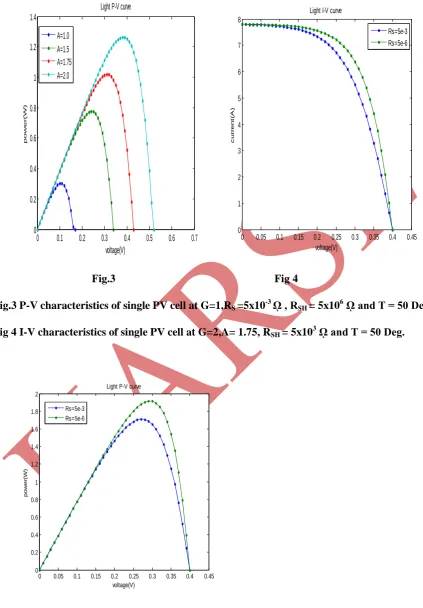
In this paper the characterization of I-V and P-V characteristics in MATLAB is given. The effect of ideality factor and series resistance on these characteristics has seen. The simulation results can be seen from fig.2 to fig.5
0 0.1 0.2 0.3 0.4 0.5 0.6 0.7
0 0.5 1 1.5 2 2.5 3 3.5 4
Light I-V curve
voltage(V)
c
u
rr
e
n
t(
A
)
A=1.0 A=1.5 A=1.75 A=2.0
Fig.2 I-V characteristics of single PV cell at G=1,R
S=5x10
-3ῼ , R
SH
= 5x10
60 0.1 0.2 0.3 0.4 0.5 0.6 0.7 0 0.2 0.4 0.6 0.8 1 1.2 1.4
Light P-V curve
voltage(V) p o w e r ( W ) A=1.0 A=1.5 A=1.75 A=2.0
0 0.05 0.1 0.15 0.2 0.25 0.3 0.35 0.4 0.45 0 1 2 3 4 5 6 7 8
Light I-V curve
voltage(V) c u r r e n t ( A ) Rs=5e-3 Rs=5e-6
Fig.3 Fig 4
Fig.3 P-V characteristics of single PV cell at G=1,R
S=5x10
-3ῼ , R
SH
= 5x10
6ῼ and T = 50 Deg.
Fig 4 I-V characteristics of single PV cell at G=2,A= 1.75, R
SH= 5x10
3ῼ and T = 50 Deg.
0 0.05 0.1 0.15 0.2 0.25 0.3 0.35 0.4 0.45 0 0.2 0.4 0.6 0.8 1 1.2 1.4 1.6 1.8 2
Light P-V curve
voltage(V) p o w e r( W ) Rs=5e-3 Rs=5e-6
Fig.5 P-V characteristics of single PV cell at G=2,A= 1.75 , R
SH= 5x10
3378 | P a g e
V. CONCLUSION
In this paper we presented the MATLAB based simulation of single PV cell. In the resulted I-V and P-V
characteristics the variation of ideality factor and series resistance has seen. From the characteristics it is seen
that as the value of ideality factor increases the voltage is also increase and the net effect is the shifting of the
curve in the right. And the same effect is seen in the P-V characteristics. From the characteristics equation of
solar cell it can be seen that the output current depends on series and shunt resistance. The incremental effect on
output current can be seen by decreasing series resistance and increasing shunt resistance. The same effect can
be seen from the simulation results. To get maximum output from the single PV cell or from the array of PV cell
,value of series resistance should be very less and value of shunt resistance should be high.
REFERENCES
[1] G. Walker, Evaluating MPPT converter topologies using a Matlab PV model, Journal of Electrical &
Electronics Engineering, Australia, Vol.21, No. 1. (2001), pp. 49-56
[2] H.G.Bhatt , R.A.Thakker “MATLAB-based Simulation of Photovoltaic Solar Cell and its Array at Different Temperature values” National Conference on Recent Trends in Engineering & Technology,2011,pp.1-4.
[3]Pallab Bhatacharya,semiconductor optoelectronic devices,(Prentice-Hall of India private
Limitted,1995,pp.422-427)
[4] J. A. Gow and C. D. Manning,Development of a photovoltaic array model for use in power-electronics
simulation studies,IEEE Proceedings- Electric Power Applications, vol. 146, no. 2, 1999, pp. 193-199.
[5] Schokley and Queisser,Detailed balance limit of efficiency of p-n junction solar cell, J. Appl. Phys., vol. 32,
pp. 510-519, 1961.